Bayesian Optimization on the Equilibrium Manifold
Pith reviewed 2026-06-30 02:31 UTC · model grok-4.3
The pith
When the equilibrium manifold has a low-dimensional Negishi-weight parameterization, Bayesian optimization reliably finds approximate solutions and certifies them with high probability.
A machine-rendered reading of the paper's core claim, the machinery that carries it, and where it could break.
Core claim
The central claim is that Bayesian optimization applied to the low-dimensional Negishi-weight parameterization of the equilibrium manifold reliably locates approximate equilibria and provides probabilistic certification of their quality, as demonstrated by computing optimal carbon taxes in a heterogeneous-agent climate economy where equilibria are most likely unique under realistic damage calibration.
What carries the argument
Bayesian optimization performed over the low-dimensional Negishi-weight parameterization of the equilibrium manifold, which reduces the search for equilibria to a tractable space.
If this is right
- Optimal carbon taxes can be computed in dynamic economies with heterogeneous agents and climate change.
- Competitive equilibria are most likely unique in the example economy with realistic calibration of damages.
- Candidate solutions can be certified with high probability using the Bayesian optimization procedure.
- Recent machine learning advances can be applied to core problems of multiple equilibria in macroeconomics.
Where Pith is reading between the lines
- The dimensionality reduction via Negishi weights is what makes the high-dimensional equilibrium search tractable for the optimizer.
- The same reduction could support policy calculations in other macroeconomic settings that feature potential equilibrium multiplicity.
- Models without the low-dimensional property would mark the boundary where the certification guarantees cease to hold.
Load-bearing premise
The equilibrium manifold must admit a low-dimensional parameterization by Negishi weights, or else the reliability and certification guarantees of the optimization procedure do not apply.
What would settle it
An economy whose equilibrium manifold requires a high-dimensional parameterization, in which Bayesian optimization fails to locate approximate solutions or to certify them at the claimed probability level.
Figures
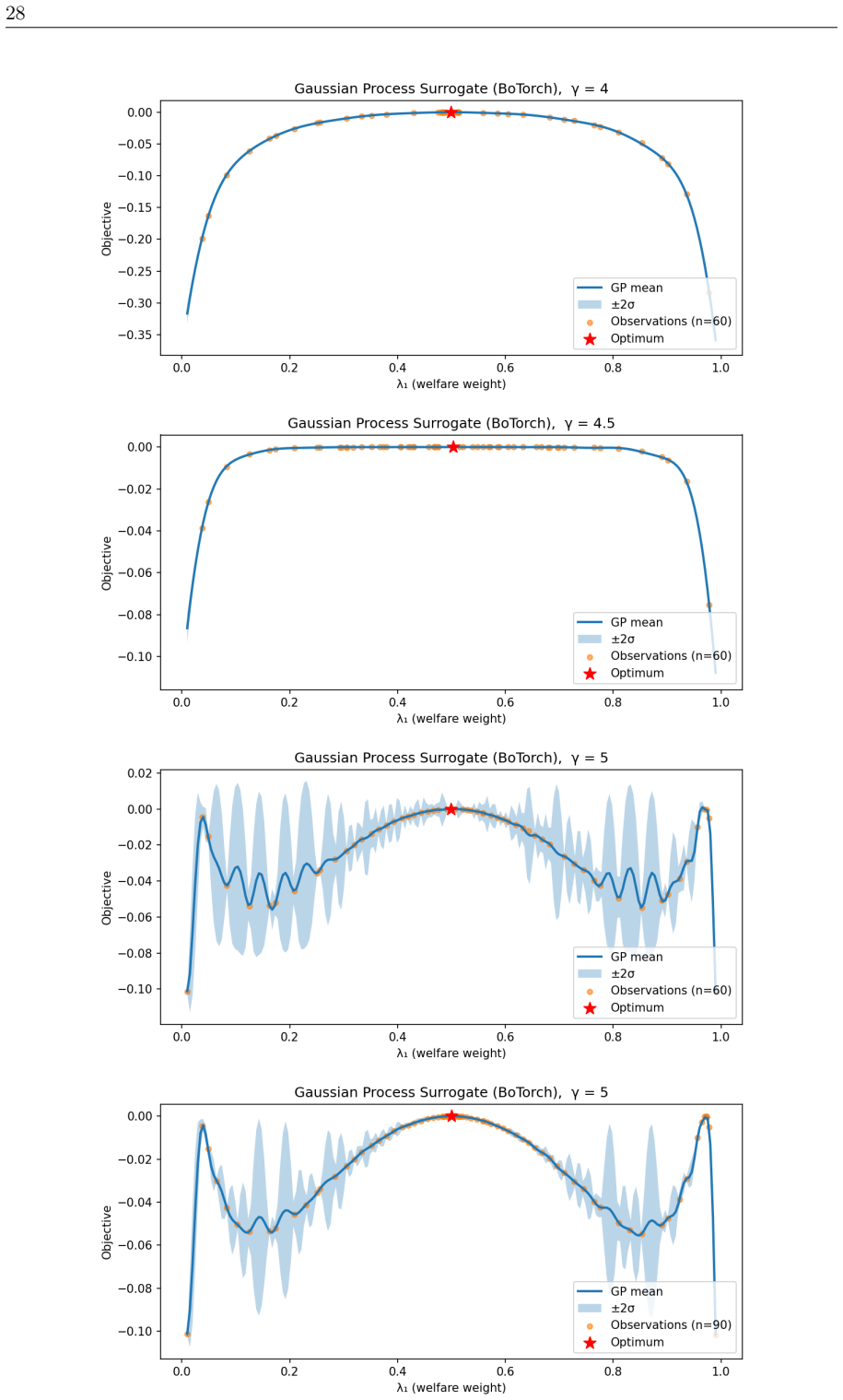
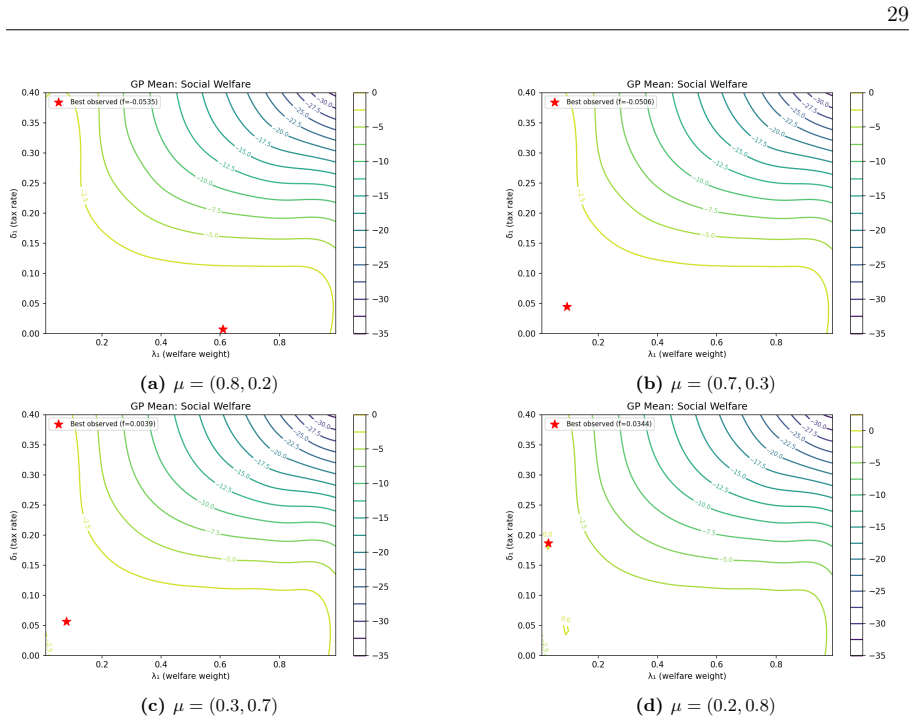
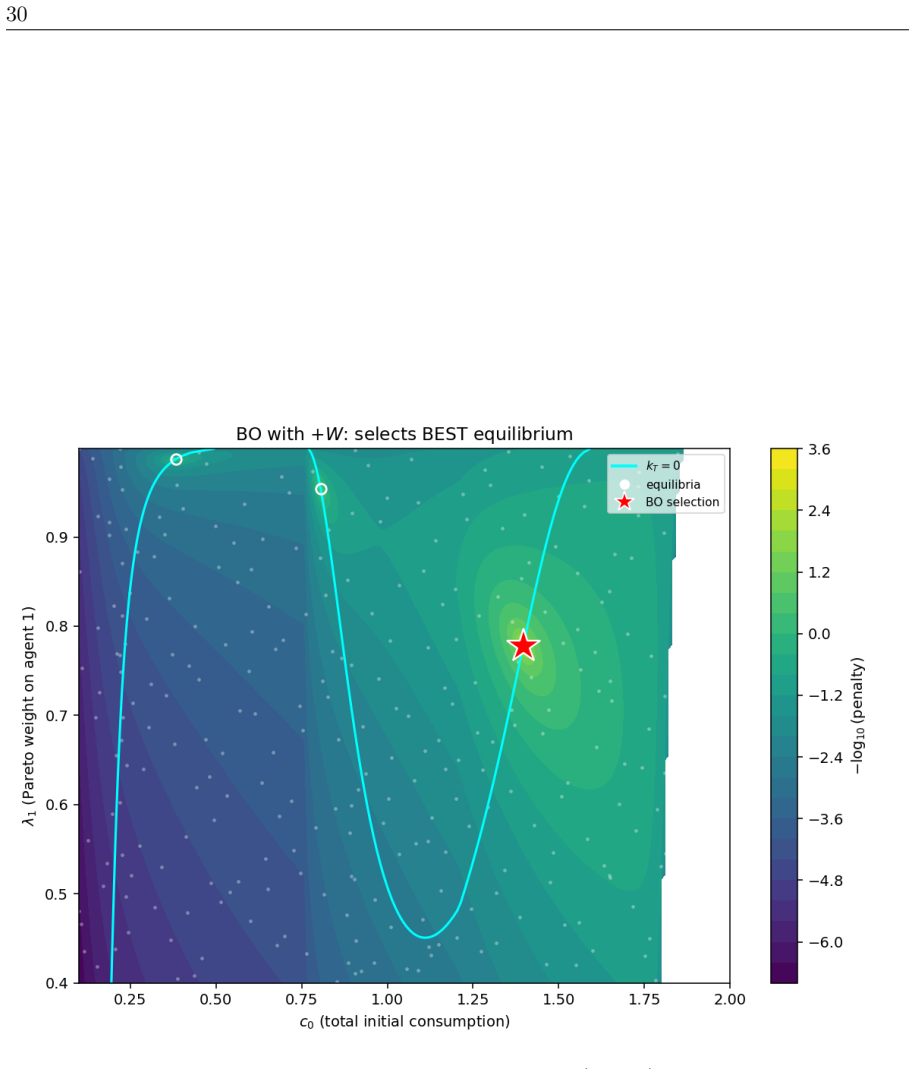
read the original abstract
Computing optimal policy in heterogeneous-agent economies is complicated by the possibility of multiple equilibria. We overcome this difficulty by showing that when the equilibrium manifold has a low-dimensional Negishi-weight parameterization, Bayesian optimization reliably finds approximate solutions and can be used to certify candidate solutions with high probability. This insight brings recent machine learning advances to bear on a core problem in macroeconomics. We apply Bayesian optimization to a dynamic economy with heterogeneous agents and climate change and compute optimal carbon taxes in this setting. Although in principle the presence of the carbon externality creates scope for multiple equilibria, we show that in an example with realistic calibration of damages competitive equilibra are most likely unique.
Editorial analysis
A structured set of objections, weighed in public.
Referee Report
Summary. The manuscript claims that when the equilibrium manifold in heterogeneous-agent economies admits a low-dimensional parameterization by Negishi weights, Bayesian optimization reliably locates approximate competitive equilibria and can certify candidate solutions with high probability. The method is applied to a dynamic heterogeneous-agent economy with climate change to compute optimal carbon taxes; under realistic damage calibration the paper concludes that competitive equilibria are most likely unique.
Significance. If the central claims hold, the work is significant because it imports recent Bayesian optimization techniques from machine learning to address the longstanding difficulty of multiple equilibria when computing optimal policy in heterogeneous-agent macroeconomic models. The climate-economy application illustrates a concrete use case for carbon-tax design. The paper explicitly credits the transfer of ML advances to a core problem in macroeconomics.
major comments (1)
- [climate-model application] The reliability and high-probability certification guarantees of the Bayesian optimization procedure rest on the equilibrium manifold having a low-dimensional Negishi-weight parameterization. In the climate-model application the manuscript asserts this property and concludes that equilibria are most likely unique, yet it supplies no explicit verification of the effective dimension (numerical rank of the equilibrium map with respect to the Negishi weights). Uniqueness alone does not establish that the dimension remains low enough for the stated guarantees to apply.
minor comments (1)
- [Abstract] The abstract refers to 'high-probability certification' without a one-sentence pointer to the underlying probabilistic argument or error analysis; adding such a pointer would improve readability.
Simulated Author's Rebuttal
We thank the referee for the careful reading and constructive feedback. The positive assessment of the paper's significance is appreciated. We respond to the single major comment below.
read point-by-point responses
-
Referee: The reliability and high-probability certification guarantees of the Bayesian optimization procedure rest on the equilibrium manifold having a low-dimensional Negishi-weight parameterization. In the climate-model application the manuscript asserts this property and concludes that equilibria are most likely unique, yet it supplies no explicit verification of the effective dimension (numerical rank of the equilibrium map with respect to the Negishi weights). Uniqueness alone does not establish that the dimension remains low enough for the stated guarantees to apply.
Authors: We agree that an explicit verification of the effective dimension strengthens the application of the certification guarantees. The manuscript demonstrates that, under the realistic damage calibration, competitive equilibria are most likely unique by showing that the Bayesian optimization procedure consistently converges to the same point across multiple random initializations and that the posterior probability of additional equilibria is low. However, as the referee notes, this does not automatically confirm that the numerical rank of the equilibrium map with respect to the Negishi weights is sufficiently low. In the revised manuscript we will add a direct computation of this rank (via the numerical rank of the relevant Jacobian or equilibrium map) for the calibrated climate-economy example and report the resulting effective dimension. revision: yes
Circularity Check
No circularity; claims conditional on independent structural premise with external numerical method
full rationale
The derivation conditions all reliability and certification claims on the equilibrium manifold admitting a low-dimensional Negishi-weight parameterization, which is asserted as a model property rather than derived from the Bayesian optimization procedure or any fitted quantity. The application to the climate model then uses this premise to conclude likely uniqueness under realistic damages, without any self-definitional reduction, fitted-input-as-prediction, or load-bearing self-citation chain visible in the abstract or described structure. Bayesian optimization is treated as an imported external tool whose guarantees are not redefined by the paper's own equations.
Axiom & Free-Parameter Ledger
Reference graph
Works this paper leans on
-
[1]
The Annals of mathematical statistics , volume=
Experimental determination of the maximum of a function , author=. The Annals of mathematical statistics , volume=. 1941 , publisher=
1941
-
[2]
Techniques of Statistical Analysis , volume=
Planning Experiments Seeking Maximia , author=. Techniques of Statistical Analysis , volume=. 1947 , publisher=
1947
-
[3]
Kushner, H. J. , title =. Journal of Basic Engineering , volume =
-
[4]
The American Economic Review , pages=
A regional dynamic general-equilibrium model of alternative climate-change strategies , author=. The American Economic Review , pages=. 1996 , publisher=
1996
-
[5]
2017 , month = feb, journal =
Revisiting the Social Cost of Carbon , author =. 2017 , month = feb, journal =
2017
-
[6]
International Economic Review , volume=
Making carbon taxation a generational win win , author=. International Economic Review , volume=. 2021 , publisher=
2021
-
[7]
Journal of Political Economy , volume=
Optimal taxation without state-contingent debt , author=. Journal of Political Economy , volume=. 2002 , publisher=
2002
-
[8]
The Review of Economic Studies , volume=
Optimal fiscal policy in a model with uninsurable idiosyncratic income risk , author=. The Review of Economic Studies , volume=. 2023 , publisher=
2023
-
[9]
The Review of Economic Studies , volume=
Pecuniary externalities in economies with financial frictions , author=. The Review of Economic Studies , volume=. 2018 , publisher=
2018
-
[10]
Journal of Monetary Economics , volume=
Managing credit booms and busts: A Pigouvian taxation approach , author=. Journal of Monetary Economics , volume=. 2019 , publisher=
2019
-
[11]
2023 , publisher=
Bayesian optimization , author=. 2023 , publisher=
2023
-
[12]
2006 , publisher=
Gaussian processes for machine learning , author=. 2006 , publisher=
2006
-
[13]
2022 , publisher=
Probabilistic Numerics: Computation as Machine Learning , author=. 2022 , publisher=
2022
-
[14]
Proceedings of the National Academy of Sciences , volume=
Policies, projections, and the social cost of carbon: Results from the DICE-2023 model , author=. Proceedings of the National Academy of Sciences , volume=. 2024 , publisher=
2023
-
[15]
Journal of Computational Science , volume=
Machine learning for high-dimensional dynamic stochastic economies , author=. Journal of Computational Science , volume=. 2019 , publisher=
2019
-
[16]
Journal of Financial Economics , volume=
Deep surrogates for finance: With an application to option pricing , author=. Journal of Financial Economics , volume=. 2026 , publisher=
2026
-
[17]
arXiv preprint arXiv:2507.01704 , year=
Using machine learning to compute constrained optimal carbon tax rules , author=. arXiv preprint arXiv:2507.01704 , year=
-
[18]
Economic Theory , volume=
On characterizing equilibria of economies with externalities and taxes as solutions to optimization problems , author=. Economic Theory , volume=. 1992 , publisher=
1992
-
[19]
Econometrica: Journal of the Econometric Society , pages=
Price distortion and economic welfare , author=. Econometrica: Journal of the Econometric Society , pages=. 1970 , publisher=
1970
-
[20]
Nature , volume=
The proportionality of global warming to cumulative carbon emissions , author=. Nature , volume=. 2009 , publisher=
2009
-
[21]
The Climate in Climate Economics , journal =
Folini, Doris and Friedl, Aleksandra and K. The Climate in Climate Economics , journal =. 2025 , url =
2025
-
[22]
Energy economics , volume=
Multiple equilibria in a stochastic implementation of DICE with abrupt climate change , author=. Energy economics , volume=. 2006 , publisher=
2006
-
[23]
Annual Review of Economics , volume=
The consequences of uncertainty: climate sensitivity and economic sensitivity to the climate , author=. Annual Review of Economics , volume=. 2018 , publisher=
2018
-
[24]
2013 , publisher=
Spatial variation , author=. 2013 , publisher=
2013
-
[25]
arXiv preprint arXiv:2506.17366 , year=
Gaussian processes and reproducing kernels: Connections and equivalences , author=. arXiv preprint arXiv:2506.17366 , year=
-
[26]
Journal of Machine Learning Research , volume=
Information Rates of Nonparametric Gaussian Process Methods , author=. Journal of Machine Learning Research , volume=
-
[27]
IMS Collections , volume=
Reproducing kernel Hilbert spaces of Gaussian priors , author=. IMS Collections , volume=
-
[28]
Constructive Approximation , volume=
Which Spaces can be Embedded in Reproducing Kernel Hilbert Spaces? , author=. Constructive Approximation , volume=. 2026 , publisher=
2026
-
[29]
arXiv preprint arXiv:2407.11898 , year=
When does a Gaussian process have its paths in a reproducing kernel Hilbert space? , author=. arXiv preprint arXiv:2407.11898 , year=
-
[30]
Advances in Neural Information Processing Systems , volume=
Uniform error bounds for Gaussian process regression with application to safe control , author=. Advances in Neural Information Processing Systems , volume=
-
[31]
International conference on machine learning , pages=
Global optimization of Lipschitz functions , author=. International conference on machine learning , pages=. 2017 , organization=
2017
-
[32]
arXiv preprint arXiv:2410.13737 , year=
Global Optimization Algorithm through High-Resolution Sampling , author=. arXiv preprint arXiv:2410.13737 , year=
-
[33]
Mathematical Programming Computation , volume=
Deterministic global optimization with Gaussian processes embedded , author=. Mathematical Programming Computation , volume=. 2021 , publisher=
2021
-
[34]
Journal of Environmental Economics and Management , volume=
Cumulative carbon emissions and economic policy: in search of general principles , author=. Journal of Environmental Economics and Management , volume=. 2019 , publisher=
2019
-
[35]
Climate change policy under polar amplification , journal =. 2017 , issn =. doi:https://doi.org/10.1016/j.euroecorev.2017.03.003 , url =
-
[36]
and Daulton, Samuel and Letham, Benjamin and Wilson, Andrew Gordon and Bakshy, Eytan , booktitle =
Balandat, Maximilian and Karrer, Brian and Jiang, Daniel R. and Daulton, Samuel and Letham, Benjamin and Wilson, Andrew Gordon and Bakshy, Eytan , booktitle =. 2020 , url =
2020
-
[37]
Advances in Neural Information Processing Systems 32 , editor =
PyTorch: An Imperative Style, High-Performance Deep Learning Library , author =. Advances in Neural Information Processing Systems 32 , editor =. 2019 , publisher =
2019
discussion (0)
Sign in with ORCID, Apple, or X to comment. Anyone can read and Pith papers without signing in.