Semi-Empirical Pulsation Reconstruction of Delta Cephei with Photometry, Radial Velocities, and Temperature Constraints
Pith reviewed 2026-06-30 01:47 UTC · model grok-4.3
The pith
Delta Cephei's observed light curve, radial displacement, and temperature variations align consistently on a common phase, with the absolute radius scale as the dominant systematic.
A machine-rendered reading of the paper's core claim, the machinery that carries it, and where it could break.
Core claim
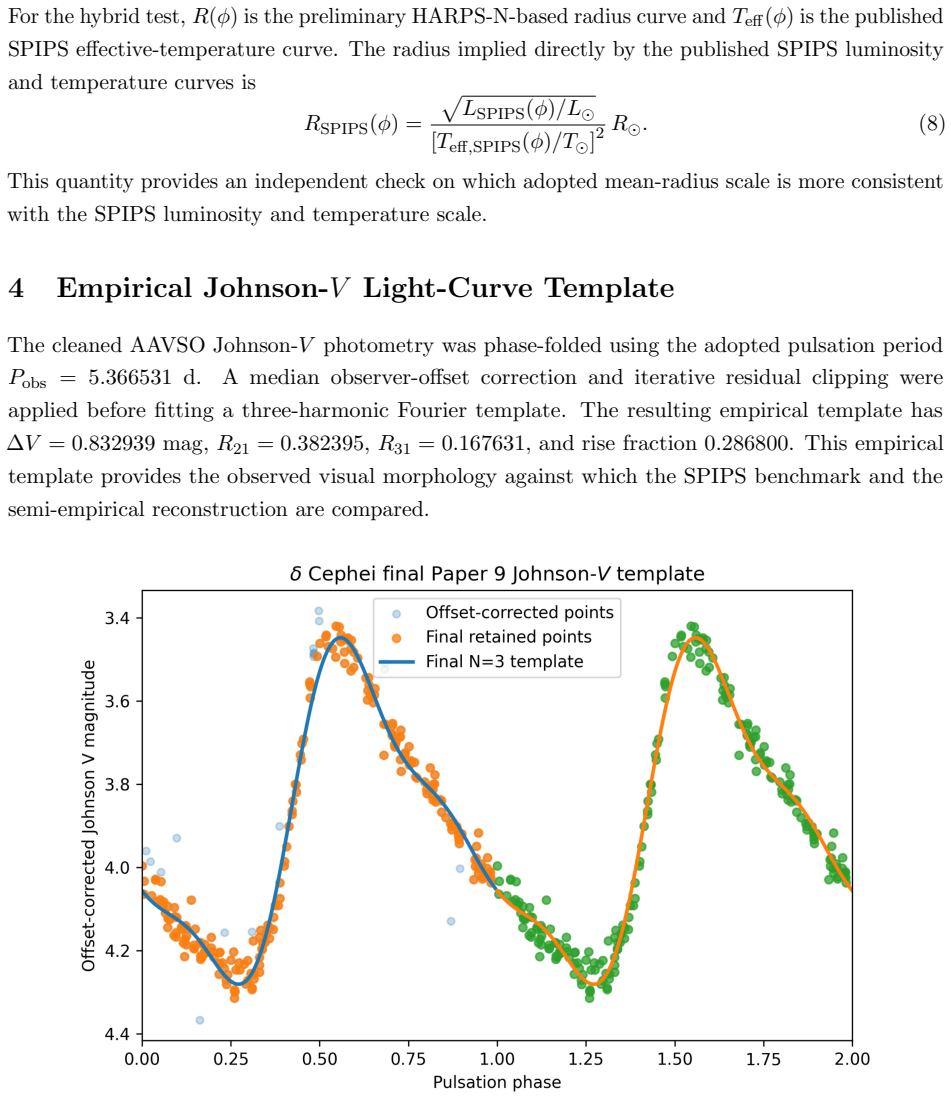
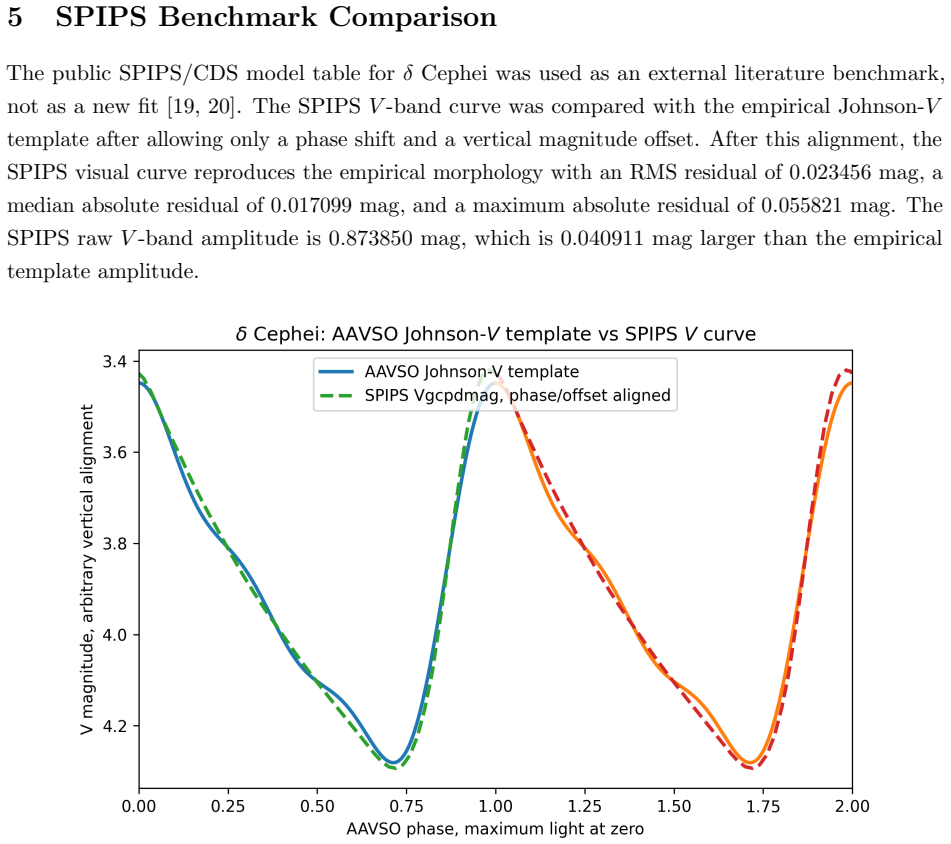
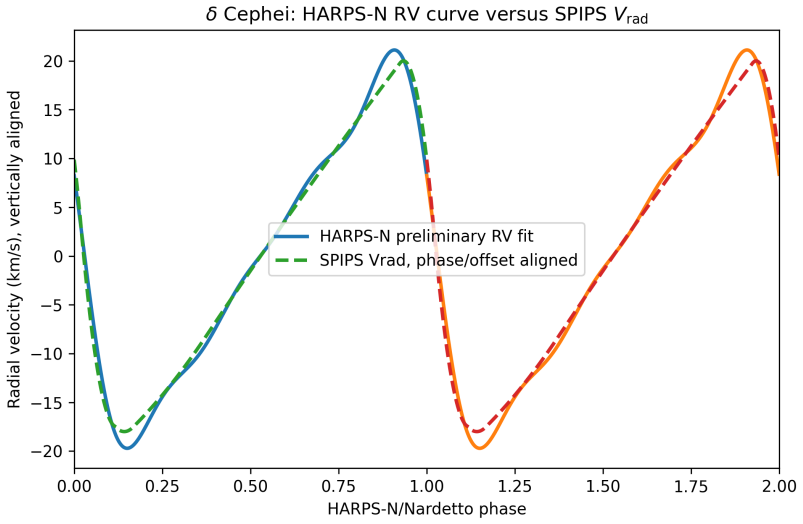
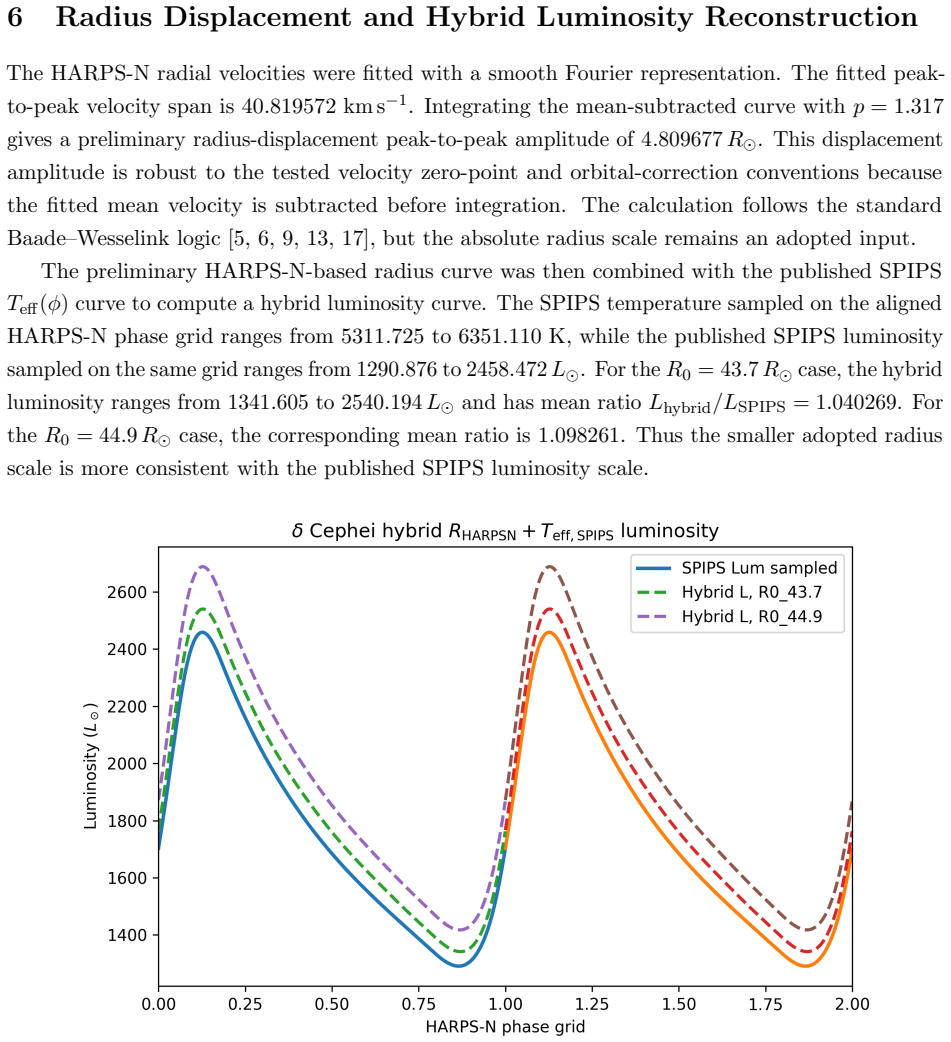
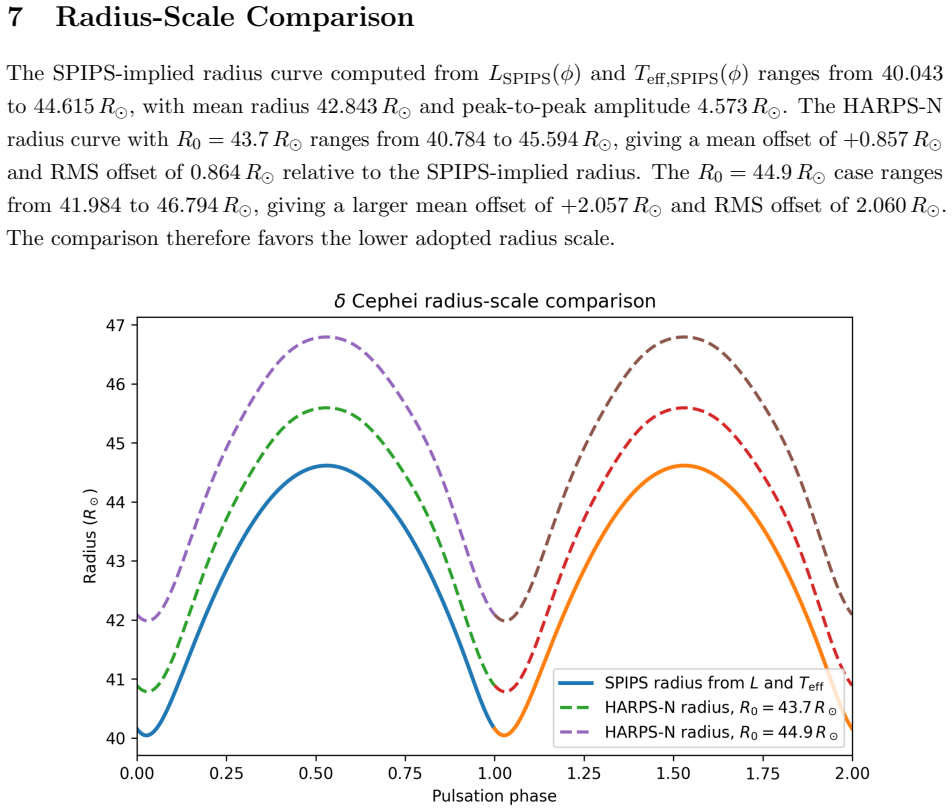
After phase-folding the photometry at P = 5.366531 d and fitting a three-harmonic Fourier template that yields Delta V = 0.833 mag, the published SPIPS V-band curve reproduces the empirical morphology to 0.023 mag RMS. A Fourier representation of the HARPS-N velocities gives a 40.82 km/s peak-to-peak span that converts to a 4.81 solar radii radius-displacement amplitude for p = 1.317. The hybrid luminosity formed from this empirical radius curve and the SPIPS Teff(phi) curve lies close to the published SPIPS luminosity curve, with mean ratio 1.04 when R0 = 43.7 solar radii and 1.10 when R0 = 44.9 solar radii; the lower radius scale also produces the smaller RMS offset of 0.864 solar radii in
What carries the argument
The hybrid luminosity curve obtained by combining the empirically derived radius-displacement curve from radial velocities with the SPIPS temperature curve as a function of phase.
If this is right
- The empirical Johnson-V morphology aligns with the SPIPS V-band curve once both are placed on the same phase convention.
- The radius-displacement amplitude derived from radial velocities can be combined with the model temperature curve to construct a hybrid luminosity that closely tracks the SPIPS luminosity for an appropriate mean-radius choice.
- Adopting the lower mean radius of 43.7 solar radii produces both a smaller luminosity ratio offset and a smaller RMS difference in the direct radius-curve comparison.
- The p-factor of 1.317 converts the observed velocity span into the stated radius-displacement amplitude used throughout the reconstruction.
Where Pith is reading between the lines
- The same combination of empirical photometry, velocities, and model temperature curves could be applied to additional classical Cepheids to test whether phase consistency holds beyond this single star.
- Reducing the uncertainty in the absolute radius scale would tighten the agreement between hybrid and model luminosities and thereby improve the precision of Cepheid-based distance estimates that rely on these quantities.
- The separation of radius and temperature contributions demonstrated here suggests that similar hybrid constructions might isolate the temperature-driven component of luminosity variation in other pulsating stars.
Load-bearing premise
The published SPIPS pulsation-model curves supply an accurate reference for both V-band morphology and Teff(phi) that can be combined directly with the empirical radius curve without introducing unaccounted model systematics.
What would settle it
An independent interferometric measurement of the angular-diameter variation of delta Cephei that produces a radius amplitude differing from 4.81 solar radii by more than the reported 0.864 solar radii offset would falsify the claimed consistency between the velocity-derived radius curve and the SPIPS reference.
Figures
read the original abstract
We present a semi-empirical reconstruction of the pulsation behavior of the classical Cepheid delta Cephei using observed Johnson-V photometry, HARPS-N radial velocities, and published SPIPS pulsation-model curves. A cleaned AAVSO Johnson-V data set was phase folded with P = 5.366531 d, corrected for observer zero-point offsets, clipped for residual outliers, and fitted with a three-harmonic Fourier template. The resulting empirical template has Delta V about 0.833 mag, R21 about 0.382, R31 about 0.168, and a rise fraction about 0.287. After phase and vertical alignment, the published SPIPS V-band curve reproduces the empirical Johnson-V morphology with an RMS residual about 0.023 mag. A Fourier representation of the HARPS-N radial velocities gives a peak-to-peak velocity span about 40.82 km s^-1, corresponding to a preliminary radius-displacement amplitude about 4.81 solar radii for p = 1.317. Combining this radius curve with the SPIPS Teff(phi) curve yields a hybrid luminosity curve close to the published SPIPS luminosity curve. The adopted R0 = 43.7 solar radii scale gives a mean luminosity ratio L_hybrid/L_SPIPS about 1.04, while R0 = 44.9 solar radii gives about 1.10. A direct radius-scale comparison also favors the lower adopted radius scale, with an RMS offset of 0.864 solar radii relative to the SPIPS-implied radius, compared with 2.060 solar radii for the larger-radius case. These results show that the observed visual morphology, radial displacement, and temperature-driven luminosity variation are mutually consistent when placed on a common phase convention, while the absolute radius scale remains the dominant systematic.
Editorial analysis
A structured set of objections, weighed in public.
Referee Report
Summary. The manuscript presents a semi-empirical reconstruction of Delta Cephei pulsation by phase-folding and Fourier-fitting cleaned AAVSO Johnson-V photometry (Delta V ~0.833 mag, three-harmonic template), deriving a radius-displacement curve from HARPS-N RVs (peak-to-peak 40.82 km/s, amplitude ~4.81 Rsun at fixed p=1.317), and combining the empirical radius with published SPIPS Teff(phi) to form a hybrid luminosity. After alignment, the SPIPS V-band matches the empirical template to 0.023 mag RMS; the hybrid L is close to SPIPS L (ratio 1.04 at R0=43.7 Rsun, 1.10 at 44.9 Rsun), with smaller RMS radius offset (0.864 Rsun) for the lower R0. The central claim is that observed visual morphology, radial displacement, and temperature-driven luminosity variation are mutually consistent on a common phase convention, with absolute radius scale as the dominant systematic.
Significance. If the consistency holds after addressing model-dependence issues, the work would supply a concrete cross-check (0.023 mag RMS V-match, sub-Rsun radius offsets) between empirical photometry/RVs and SPIPS models for a well-observed Cepheid, helping quantify how radius-scale choice propagates into luminosity reconstruction. The explicit reporting of RMS residuals and the identification of radius as the leading uncertainty are positive features that could inform similar hybrid analyses.
major comments (3)
- [Abstract] Abstract: the hybrid luminosity is formed by feeding the SPIPS Teff(phi) curve directly into the luminosity derived from the empirical (RV-based) radius curve, then compared to the published SPIPS luminosity; because SPIPS luminosity itself incorporates its own radius and temperature solutions, the reported L_hybrid/L_SPIPS ratios (~1.04 or 1.10) and the mutual-consistency statement contain built-in dependence on the reference model.
- [Abstract] Abstract: the statements that SPIPS V-band reproduces the empirical morphology to 0.023 mag RMS and that the radius-scale comparison favors R0=43.7 Rsun rest on data cleaning steps (observer zero-point corrections, outlier clipping) and error propagation whose concrete criteria and impact on the final residuals/offsets are described only at high level; these details are load-bearing for the claimed consistency.
- [Abstract] Abstract: the assumption that the published SPIPS Teff(phi) curve is free of systematics relative to the empirical radius phasing is invoked for both the hybrid construction and the comparison metric, yet no independent validation or sensitivity test against that phasing is reported; this assumption directly supports the central claim of mutual consistency on a common phase convention.
minor comments (2)
- The abstract reports Fourier coefficients R21~0.382, R31~0.168 and rise fraction~0.287 without defining the exact normalization or phase reference used for these quantities.
- No mention is made of the number of AAVSO points retained after cleaning or the precise time span of the photometry used for the template.
Simulated Author's Rebuttal
We thank the referee for their constructive comments. We address each major comment point by point below. We agree that revisions to the abstract and main text will improve clarity on model dependence, data processing, and assumptions.
read point-by-point responses
-
Referee: [Abstract] Abstract: the hybrid luminosity is formed by feeding the SPIPS Teff(phi) curve directly into the luminosity derived from the empirical (RV-based) radius curve, then compared to the published SPIPS luminosity; because SPIPS luminosity itself incorporates its own radius and temperature solutions, the reported L_hybrid/L_SPIPS ratios (~1.04 or 1.10) and the mutual-consistency statement contain built-in dependence on the reference model.
Authors: We agree that the luminosity ratio comparison incorporates dependence on the SPIPS model, as the hybrid uses SPIPS Teff with empirical radius while SPIPS L uses both from the model. The intent is to show that the empirical radius curve, when paired with the SPIPS Teff, produces a luminosity close to the SPIPS one, supporting consistency on phase. We will revise the abstract to clarify this model dependence and the scope of the consistency claim. revision: yes
-
Referee: [Abstract] Abstract: the statements that SPIPS V-band reproduces the empirical morphology to 0.023 mag RMS and that the radius-scale comparison favors R0=43.7 Rsun rest on data cleaning steps (observer zero-point corrections, outlier clipping) and error propagation whose concrete criteria and impact on the final residuals/offsets are described only at high level; these details are load-bearing for the claimed consistency.
Authors: The manuscript's Methods section describes the data cleaning, including zero-point corrections and outlier clipping criteria. We acknowledge that the abstract is high-level. In the revision, we will include additional quantitative details on the effects of these steps in the main text and, if space allows, reference them in the abstract to better substantiate the RMS values and radius offsets. revision: partial
-
Referee: [Abstract] Abstract: the assumption that the published SPIPS Teff(phi) curve is free of systematics relative to the empirical radius phasing is invoked for both the hybrid construction and the comparison metric, yet no independent validation or sensitivity test against that phasing is reported; this assumption directly supports the central claim of mutual consistency on a common phase convention.
Authors: The common phase is set by aligning the empirical V photometry and RV curves to the SPIPS curves. The Teff curve is used as published from SPIPS. While the V-band RMS match of 0.023 mag provides supporting evidence for the alignment, we agree that a dedicated sensitivity test to phase offsets is not reported. We will add a short sensitivity discussion in the revised version to address this. revision: yes
Circularity Check
No significant circularity; comparisons reduce to independent radius and photometry checks
full rationale
The paper fits Fourier templates to AAVSO V photometry and HARPS-N RVs (with fixed p=1.317) to obtain empirical radius curve, then combines it with published external SPIPS Teff(phi) to form hybrid L(phi) for comparison against published SPIPS L(phi). Because L ~ R^2 T^4 and the same T_SPIPS is used in both, the reported L_hybrid/L_SPIPS ratio equals (R_emp/R_SPIPS)^2 exactly and is therefore redundant with the separate direct radius-curve RMS comparison (0.864 Rsun offset). The V-band morphology match (0.023 mag RMS) is an independent datum. No self-citation chains, self-definitional steps, or fitted inputs renamed as predictions appear; SPIPS curves are treated as external references throughout.
Axiom & Free-Parameter Ledger
free parameters (2)
- p-factor =
1.317
- R0 =
43.7 or 44.9 solar radii
axioms (2)
- domain assumption The pulsation period is 5.366531 days
- domain assumption SPIPS model curves accurately represent the star's V-band and Teff variations
Reference graph
Works this paper leans on
-
[1]
W. L. Freedman, B. F. Madore, B. K. Gibson, L. Ferrarese, D. D. Kelson, S. Sakai, J. R. Mould, R. C. Kennicutt, H. C. Ford, J. A. Graham, J. P. Huchra, S. M. G. Hughes, G. D. Illingworth, L. M. Macri, and P. B. Stetson. Final results from the hubble space telescope key project to measure the hubble constant.The Astrophysical Journal, 553:47–72, 2001. doi:...
-
[2]
W. L. Freedman and B. F. Madore. The hubble constant.Annual Review of Astronomy and Astrophysics, 48:673–710, 2010. doi: 10.1146/annurev-astro-082708-101829. 10
-
[3]
A. G. Riess, L. M. Macri, S. L. Hoffmann, D. Scolnic, S. Casertano, A. V. Filippenko, B. E. Tucker, M. J. Reid, D. O. Jones, J. M. Silverman, R. Chornock, P. Challis, W. Yuan, P. J. Brown, and R. J. Foley. A 2.4% determination of the local value of the hubble constant.The Astrophysical Journal, 826:56, 2016. doi: 10.3847/0004-637X/826/1/56
-
[4]
A. G. Riess, W. Yuan, L. M. Macri, D. Scolnic, D. Brout, S. Casertano, D. O. Jones, Y. Mu- rakami, G. S. Anand, L. Breuval, T. G. Brink, A. V. Filippenko, S. Hoffmann, S. W. Jha, W. D’Arcy Kenworthy, J. Mackenty, B. E. Stahl, and W. Zheng. A comprehensive measurement of the local value of the hubble constant with 1 km s −1 mpc−1 uncertainty from the hubbl...
-
[5]
W. Baade. Zur bestimmung der entfernung von ver¨ anderlichen sternen.Astronomische Nachrichten, 228:359, 1926
1926
-
[6]
A. J. Wesselink. The method of determining the distances of cepheids.Bulletin of the Astronomical Institutes of the Netherlands, 10:91, 1946
1946
-
[7]
T. G. Barnes and D. S. Evans. Stellar angular diameters and visual surface brightness. i. late spectral types.Monthly Notices of the Royal Astronomical Society, 174:489–502, 1976
1976
-
[8]
Fouqu´ e and W
P. Fouqu´ e and W. P. Gieren. A calibration of the infrared surface brightness technique for cepheid distance determination.Astronomy & Astrophysics, 320:799–810, 1997
1997
-
[9]
J. Storm, W. Gieren, P. Fouqu´ e, T. G. Barnes, I. Soszy´ nski, G. Pietrzy´ nski, N. Nardetto, and D. Queloz. Calibrating the cepheid period-luminosity relation from the infrared surface brightness technique. i. the p-factor, the milky way relations, and comparison with parallaxes. Astronomy & Astrophysics, 534:A94, 2011. doi: 10.1051/0004-6361/201117154
-
[10]
J. Storm, W. Gieren, P. Fouqu´ e, T. G. Barnes, G. Pietrzy´ nski, N. Nardetto, M. Weber, T. Granzer, and K. G. Strassmeier. Calibrating the cepheid period-luminosity relation from the infrared surface brightness technique. ii. the effect of metallicity and the distance to the lmc.Astronomy & Astrophysics, 534:A95, 2011. doi: 10.1051/0004-6361/201117155
-
[11]
J. T. Armstrong, T. E. Nordgren, M. E. Germain, A. R. Hajian, D. Mozurkewich, R. B. Hindsley, C. A. Hummel, H. R. Schmitt, J. A. Benson, T. A. Pauls, and C. Tycner. Diameters of delta cephei and eta aquilae measured with the navy prototype optical interferometer.The Astronomical Journal, 121:476–484, 2001. doi: 10.1086/318037
-
[12]
P. Kervella, N. Nardetto, D. Bersier, D. Mourard, and V. Coud´ e du Foresto. Cepheid distances from infrared long-baseline interferometry. i. vinci/vlti observations of seven galactic cepheids. Astronomy & Astrophysics, 416:941–953, 2004. doi: 10.1051/0004-6361:20031743. 11
-
[13]
A. M´ erand, P. Kervella, V. Coud´ e du Foresto, G. Perrin, S. T. Ridgway, J. P. Aufdenberg, T. A. ten Brummelaar, D. H. Berger, J. Sturmann, L. Sturmann, N. H. Turner, and H. A. McAlister. A calibration of the baade-wesselink method using the chara array: The cepheid delta cephei. Astronomy & Astrophysics, 438:L9–L12, 2005. doi: 10.1051/0004-6361:200500139
-
[14]
G. F. Benedict, B. E. McArthur, L. W. Fredrick, T. E. Harrison, C. L. Slesnick, J. Rhee, R. J. Patterson, M. F. Skrutskie, O. G. Franz, L. H. Wasserman, W. H. Jefferys, E. Nelan, W. van Altena, P. J. Shelus, P. D. Hemenway, R. L. Duncombe, D. Story, A. L. Whipple, and A. J. Bradley. Astrometry with the hubble space telescope: A parallax of the fundamental...
-
[15]
G. F. Benedict, B. E. McArthur, M. W. Feast, T. G. Barnes, T. E. Harrison, R. J. Patterson, J. W. Menzies, J. L. Bean, and W. L. Freedman. Hubble space telescope fine guidance sensor parallaxes of galactic cepheid variable stars: Period-luminosity relations.The Astronomical Journal, 133:1810–1827, 2007. doi: 10.1086/511980
-
[16]
Nardetto, D
N. Nardetto, D. Mourard, P. Mathias, A. Fokin, and D. Gillet. High-resolution spectroscopy for cepheids distance determination. i. line asymmetry.Astronomy & Astrophysics, 471:661–669,
-
[17]
doi: 10.1051/0004-6361:20066853
-
[18]
Nardetto, W
N. Nardetto, W. Gieren, P. Kervella, P. Fouqu´ e, J. Storm, G. Pietrzy´ nski, D. Mourard, and D. Queloz. High-resolution spectroscopy for cepheids distance determination. ii. a period- projection factor relation.Astronomy & Astrophysics, 502:951–963, 2009. doi: 10.1051/ 0004-6361/200912034
2009
-
[19]
B. Trahin, L. Breuval, P. Kervella, A. Gallenne, V. Hocd´ e, N. Nardetto, W. Gieren, J. Storm, G. Pietrzy´ nski, B. Pilecki, D. Graczyk, and R. I. Anderson. Inspecting the cepheid parallax of pulsation using gaia edr3 parallaxes: Projection factor and period-luminosity and period-radius relations.Astronomy & Astrophysics, 656:A102, 2021. doi: 10.1051/0004...
-
[21]
M´ erand, P
A. M´ erand, P. Kervella, J. Breitfelder, A. Gallenne, V. Coud´ e du Foresto, T. A. ten Brummelaar, H. A. McAlister, S. Ridgway, L. Sturmann, J. Sturmann, and N. H. Turner. Pulsation model data for delta cep and eta aql. CDS/VizieR catalog J/A+A/584/A80, 2015. Data associated with A&A 584, A80
2015
-
[22]
Gaia Collaboration, A. G. A. Brown, A. Vallenari, T. Prusti, J. H. J. de Bruijne, C. Babusiaux, M. Biermann, et al. Gaia early data release 3: Summary of the contents and survey properties. Astronomy & Astrophysics, 649:A1, 2021. doi: 10.1051/0004-6361/202039657. 12
-
[23]
P. Kervella, A. Gallenne, N. R. Evans, C. R. Proffitt, N. Nardetto, R. I. Anderson, W. Gieren, S. Borgniet, L. Eyer, V. Hocd´ e, A. M´ erand, J. Breitfelder, G. Pietrzy´ nski, and B. Pilecki. Multiplicity of galactic cepheids from gaia dr2.Astronomy & Astrophysics, 623:A117, 2019. doi: 10.1051/0004-6361/201834210
-
[24]
V.Bosch-Ramon,M.V.Barkov,D.Khangulyan,andM.Perucho.A&A,544:A59,Aug.2012
N. Nardetto, V. Hocd´ e, P. Kervella, A. Gallenne, W. Gieren, D. Graczyk, A. M´ erand, M. Rainer, J. Storm, G. Pietrzy´ nski, B. Pilecki, E. Poretti, M. Bailleul, G. Bras, and A. Afanasiev. The orbital parameters of the delta cep inner binary system determined using 2019 harps- n spectroscopic data.Astronomy & Astrophysics, 684:L9, 2024. doi: 10.1051/0004...
discussion (0)
Sign in with ORCID, Apple, or X to comment. Anyone can read and Pith papers without signing in.