Hypocoercivity-preserving space-time Galerkin methods for kinetic Fokker-Planck equations
Pith reviewed 2026-06-30 01:48 UTC · model grok-4.3
The pith
Galerkin methods for kinetic Fokker-Planck equations preserve total mass and converge exponentially to equilibrium in weighted norms.
A machine-rendered reading of the paper's core claim, the machinery that carries it, and where it could break.
Core claim
The proposed space-time Galerkin methods mimic Villani's framework of enhanced quadratic forms to obtain a coercive bilinear form in an exponentially weighted norm that admits a spectral gap despite the degeneracy of the diffusion; coercivity then implies exponential convergence to equilibrium via a weighted Poincaré inequality, while the schemes exactly preserve total mass.
What carries the argument
The hypocoercivity-preserving Galerkin bilinear form constructed in exponentially weighted norms that produces a spectral gap for the degenerate kinetic Fokker-Planck operator.
If this is right
- The discrete solutions remain nonnegative and conserve mass for all time steps.
- The error to equilibrium decays exponentially in the weighted norm at a rate independent of the mesh size once the time step is small enough.
- The same exponential decay holds for the fully discrete scheme that combines the spatial Galerkin method with hp discontinuous Galerkin time stepping of any order.
- The new inverse trace inequalities apply to a broad class of exponential weights and may be reused for other weighted finite-element analyses.
Where Pith is reading between the lines
- The same construction could be tested on related degenerate kinetic equations such as the Boltzmann equation with simplified collision operators.
- Extending the infinite-element treatment to curved or moving domains would allow simulation of kinetic problems on non-rectangular phase-space regions.
- Because the weighted Poincaré constant is explicit in the weight parameter, one could optimize the weight to obtain the fastest provable decay rate for a given problem.
Load-bearing premise
New polynomial inverse trace inequalities hold in exponentially weighted norms for the chosen simplicial, box, and semi-infinite prismatic elements.
What would settle it
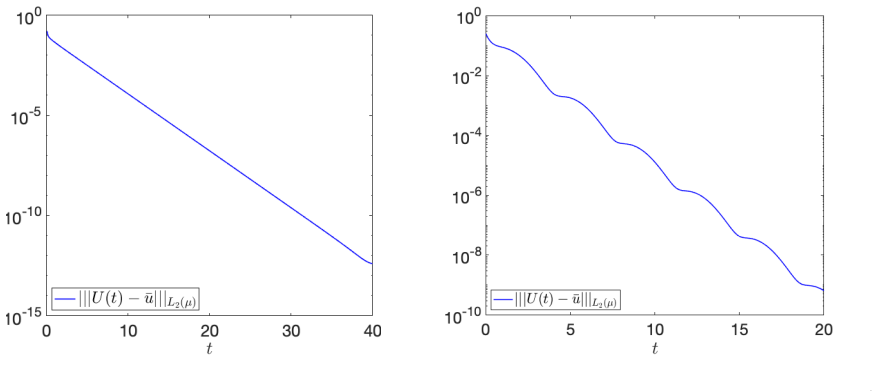
A numerical run on a simple one-dimensional kinetic Fokker-Planck problem in which the discrete solution either loses more than machine epsilon of total mass or fails to decay at an exponential rate in the weighted norm would falsify the claims.
Figures
read the original abstract
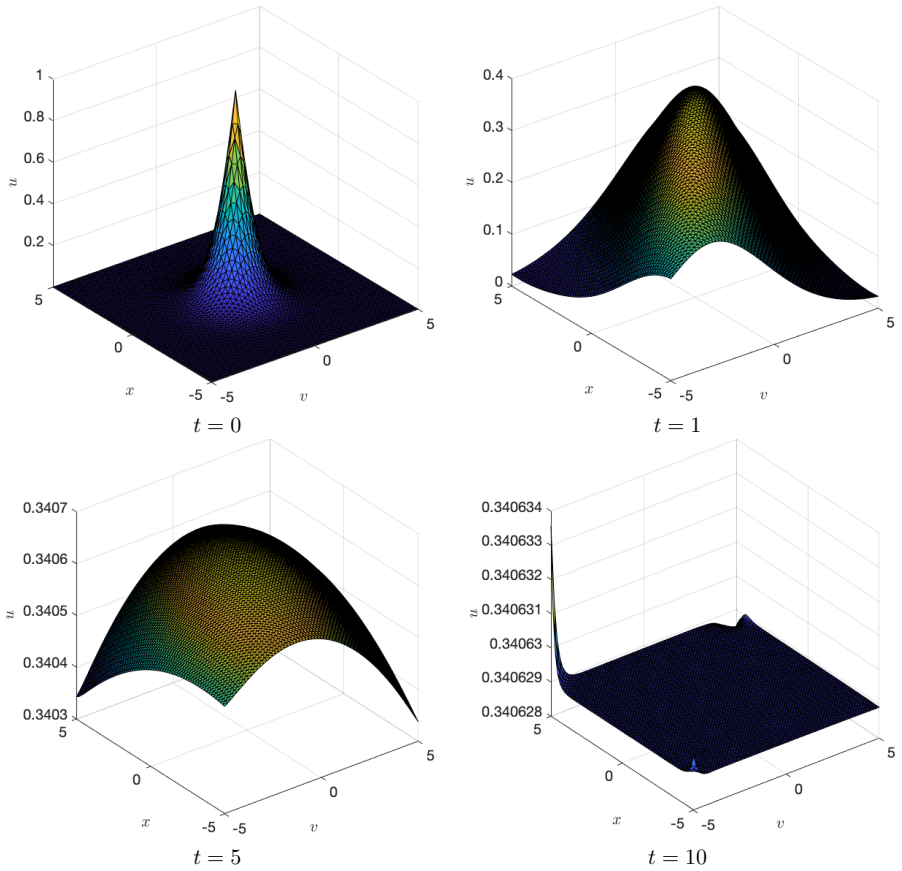
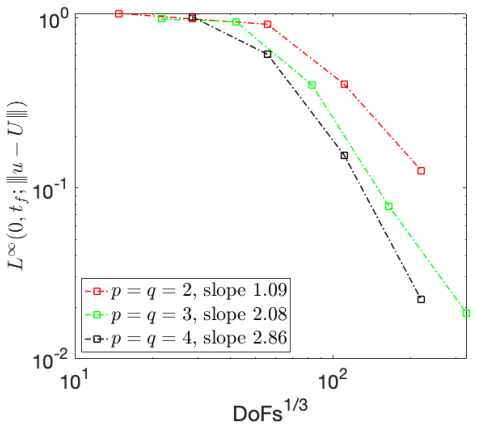
We design and analyse a family of hypocoercivity-preserving fully discrete Galerkin methods for the (inhomogeneous) kinetic Fokker--Planck (kFP) equations, a class of evolution PDEs with degenerate diffusion. The proposed methods mimic Villani's framework of enhanced quadratic forms [23], yielding a coercive bilinear form in an exponentially weighted norm that admits a spectral gap/Poincar\'{e} inequality despite the degeneracy. The problem is formulated as a fourth-order-in-space evolution PDE on the whole space $\mathbb{R}^{d}\times\mathbb{R}^d$. The spatial discretisation employs continuous piecewise polynomial finite element spaces on simplicial and/or box-type meshes comprising both finite and ``infinite'' elements, while nonconformity is handled by numerical fluxes in the spirit of $C^0$ interior penalty ($C^0$-IP) methods. The analysis requires new polynomial inverse trace inequalities in exponentially weighted norms for simplicial, box-type, and semi-infinite prismatic elements, which are proved for a broad class of exponential weights and are of independent interest. Coercivity of the Galerkin method then leads to exponential convergence to equilibrium via an exponentially weighted Poincar\'{e} inequality. We further develop a fully discrete scheme by coupling the spatial discretisation with an $hp$-version discontinuous Galerkin time-stepping method of arbitrary order and establish the same exponential convergence. The proposed methods preserve the total mass and exhibit \emph{provably} exponential convergence to equilibrium, making them well suited for long-time kFP simulations. Numerical experiments validate the theoretical results and demonstrate the convergence behaviour of the proposed methods.
Editorial analysis
A structured set of objections, weighed in public.
Referee Report
Summary. The manuscript designs and analyzes a family of hypocoercivity-preserving fully discrete Galerkin methods for kinetic Fokker-Planck equations. Spatial discretization uses C0-IP continuous piecewise polynomials on simplicial/box meshes with semi-infinite prismatic elements; time discretization uses hp-version DG. New polynomial inverse trace inequalities in exponentially weighted norms are proved for a broad class of weights. These yield coercivity of the discrete bilinear form in an enhanced quadratic norm, a weighted Poincaré inequality, and thus exponential convergence to equilibrium while preserving mass. Numerical experiments validate the rates.
Significance. If the new inverse trace inequalities hold with constants independent of h and p for the specific exponential weights of kFP equilibria, the work supplies the first rigorous hypocoercivity-preserving space-time discretization for degenerate kinetic equations, enabling reliable long-time simulations with provable exponential decay. The trace inequalities are of independent interest for weighted finite-element analysis.
major comments (2)
- [Proof of inverse trace inequalities] The coercivity and exponential convergence claims rest entirely on the new inverse trace inequalities (abstract, spatial discretisation paragraph). The proof must explicitly establish that the constants remain uniform in h and p for the precise exponential weights appearing in the kFP equilibrium measure; any degeneration would invalidate the discrete spectral gap.
- [Coercivity analysis and spectral gap] It is unclear whether the discrete coercivity constant (and resulting decay rate) is shown to be comparable to the continuous Villani constant or whether a mesh- or degree-dependent degradation factor appears; this must be quantified to support the claim of 'provably exponential convergence' without hidden parameter dependence.
minor comments (2)
- The abstract states that the inequalities are proved 'for a broad class of exponential weights'; the introduction should explicitly identify which weights are used for the kFP problem and confirm they lie inside the proved class.
- Numerical experiments should report observed decay rates alongside the theoretical constant to allow direct comparison.
Simulated Author's Rebuttal
We thank the referee for the careful reading and constructive comments on our manuscript. We address the major comments point by point below. We will revise the manuscript to incorporate the requested clarifications on uniformity and quantification.
read point-by-point responses
-
Referee: [Proof of inverse trace inequalities] The coercivity and exponential convergence claims rest entirely on the new inverse trace inequalities (abstract, spatial discretisation paragraph). The proof must explicitly establish that the constants remain uniform in h and p for the precise exponential weights appearing in the kFP equilibrium measure; any degeneration would invalidate the discrete spectral gap.
Authors: The inverse trace inequalities are established in Section 4 (Theorems 4.1--4.3) for a broad class of exponential weights satisfying Assumption 2.1, which explicitly includes the weights of the kFP equilibrium measure given in (2.3). The proofs rely on the specific structure of these weights (Gaussian decay in velocity combined with a slowly varying spatial factor) and yield constants independent of both h and p. We will revise the manuscript by adding an explicit remark immediately following Theorem 4.3 confirming that the kFP weights fall within the assumed class with no degeneration of the constants. revision: yes
-
Referee: [Coercivity analysis and spectral gap] It is unclear whether the discrete coercivity constant (and resulting decay rate) is shown to be comparable to the continuous Villani constant or whether a mesh- or degree-dependent degradation factor appears; this must be quantified to support the claim of 'provably exponential convergence' without hidden parameter dependence.
Authors: Section 5 derives discrete coercivity of the bilinear form in the enhanced norm by combining the continuous Villani-type estimate with the inverse trace inequalities. Because the trace constants are independent of h and p, the resulting discrete spectral gap is comparable to the continuous one up to a multiplicative factor that depends only on the continuous Villani constant and the weight parameters, with no hidden mesh- or degree-dependent degradation. We will revise the manuscript by adding a new remark (or short subsection) in Section 5 that explicitly quantifies this relation and states the discrete decay rate in terms of the continuous constant. revision: yes
Circularity Check
No significant circularity; derivation rests on newly proved inequalities and external Villani framework
full rationale
The paper's central claims of hypocoercivity preservation and exponential convergence are obtained by establishing coercivity of a discrete bilinear form in an exponentially weighted norm (mimicking Villani [23]), followed by a weighted Poincaré inequality. This chain depends on newly derived polynomial inverse trace inequalities for the relevant elements and weights, which the paper states are proved independently in the manuscript and are of independent interest. No step reduces a claimed result to a fitted parameter, self-citation chain, or input by definition; the analysis is self-contained against the stated assumptions and external reference.
Axiom & Free-Parameter Ledger
axioms (2)
- domain assumption The continuous kinetic Fokker-Planck operator satisfies Villani's enhanced quadratic-form hypocoercivity framework yielding a spectral gap in an exponentially weighted norm.
- standard math Standard polynomial approximation and inverse properties hold in the chosen finite-element spaces on simplicial and box meshes.
Reference graph
Works this paper leans on
-
[1]
Hypoelliptic second order differential equations , JOURNAL =
H\". Hypoelliptic second order differential equations , JOURNAL =. 1967 , PAGES =. doi:10.1007/BF02392081 , URL =
-
[2]
Dong, Zhaonan and Georgoulis, Emmanuil H. and Herbert, Philip J. , TITLE =. SIAM J. Numer. Anal. , FJOURNAL =. 2025 , NUMBER =. doi:10.1137/24M163373X , URL =
-
[3]
Kolmogoroff, A. , TITLE =. Ann. of Math. (2) , FJOURNAL =. 1934 , NUMBER =. doi:10.2307/1968123 , URL =
-
[4]
Villani, C\'. Hypocoercivity , JOURNAL =. 2009 , NUMBER =. doi:10.1090/S0065-9266-09-00567-5 , URL =
-
[5]
Isotropic hypoellipticity and trend to equilibrium for the
H\'. Isotropic hypoellipticity and trend to equilibrium for the. Arch. Ration. Mech. Anal. , FJOURNAL =. 2004 , NUMBER =. doi:10.1007/s00205-003-0276-3 , URL =
-
[6]
Eckmann, J.-P. and Hairer, M. , TITLE =. Comm. Math. Phys. , FJOURNAL =. 2003 , NUMBER =. doi:10.1007/s00220-003-0805-9 , URL =
-
[7]
Porretta, Alessio and Zuazua, Enrique , TITLE =. Math. Comp. , FJOURNAL =. 2017 , NUMBER =. doi:10.1090/mcom/3157 , URL =
-
[8]
Dujardin, Guillaume and H\'erau, Fr\'ed\'eric and Lafitte, Pauline , TITLE =. Numer. Math. , FJOURNAL =. 2020 , NUMBER =. doi:10.1007/s00211-019-01094-y , URL =
-
[9]
Foster, Erich L. and Loh\'. A structure preserving scheme for the. J. Comput. Phys. , FJOURNAL =. 2017 , PAGES =. doi:10.1016/j.jcp.2016.11.009 , URL =
-
[10]
Atti Accad
Fichera, Gaetano , TITLE =. Atti Accad. Naz. Lincei. Mem. Cl. Sci. Fis. Mat. Nat. Sez. I. (8) , FJOURNAL =. 1956 , PAGES =
1956
-
[11]
Second order equations with nonnegative characteristic form , NOTE =
Ole. Second order equations with nonnegative characteristic form , NOTE =. 1973 , PAGES =
1973
-
[12]
Short and long time behavior of the
H\'. Short and long time behavior of the. J. Funct. Anal. , FJOURNAL =. 2007 , NUMBER =. doi:10.1016/j.jfa.2006.11.013 , URL =
-
[13]
Risken, H. , TITLE =. 1989 , PAGES =. doi:10.1007/978-3-642-61544-3 , URL =
-
[14]
, TITLE =
Schwab, Ch. , TITLE =. 1998 , PAGES =
1998
-
[15]
Sch\"otzau, Dominik and Schwab, Christoph , TITLE =. SIAM J. Numer. Anal. , FJOURNAL =. 2000 , NUMBER =. doi:10.1137/S0036142999352394 , URL =
-
[16]
Georgoulis, Emmanuil H. , TITLE =. SIAM J. Numer. Anal. , FJOURNAL =. 2021 , NUMBER =. doi:10.1137/19M1296914 , URL =
-
[17]
Dong, Zhaonan and Georgoulis, Emmanuil H and Herbert, Philip J. , URL =. Math. Comp. , FJOURNAL =
-
[18]
Erd\'elyi, T. , TITLE =. J. Approx. Theory , FJOURNAL =. 1989 , NUMBER =. doi:10.1016/0021-9045(89)90021-X , URL =
-
[19]
On the constants in hp -finite element trace inverse inequalities , author=. Comput. Methods Appl. Mech. Engrg. , volume=. 2003 , publisher=
2003
-
[20]
Hypocoercivity for linear kinetic equations conserving mass , JOURNAL =
Dolbeault, Jean and Mouhot, Cl\'. Hypocoercivity for linear kinetic equations conserving mass , JOURNAL =. 2015 , NUMBER =. doi:10.1090/S0002-9947-2015-06012-7 , URL =
-
[21]
Houston, Paul and Schwab, Christoph and S\"uli, Endre , TITLE =. SIAM J. Numer. Anal. , FJOURNAL =. 2002 , NUMBER =. doi:10.1137/S0036142900374111 , URL =
-
[22]
and Houston, Paul , TITLE =
Cangiani, Andrea and Dong, Zhaonan and Georgoulis, Emmanuil H. and Houston, Paul , TITLE =. 2017 , PAGES =
2017
-
[23]
Li, Huiyuan and Shen, Jie , TITLE =. Math. Comp. , FJOURNAL =. 2010 , NUMBER =. doi:10.1090/S0025-5718-09-02308-4 , URL =
-
[24]
Chernov, Alexey , TITLE =. Math. Comp. , FJOURNAL =. 2012 , NUMBER =. doi:10.1090/S0025-5718-2011-02513-5 , URL =
-
[25]
and Hall, Edward and Melenk, Jens Markus , TITLE =
Georgoulis, Emmanuil H. and Hall, Edward and Melenk, Jens Markus , TITLE =. J. Sci. Comput. , FJOURNAL =. 2010 , NUMBER =. doi:10.1007/s10915-009-9315-z , URL =
-
[26]
Akrivis, G. and Crouzeix, M. and Thom\'. Numerical methods for ultraparabolic equations , JOURNAL =. 1994 , NUMBER =. doi:10.1007/BF02575877 , URL =
-
[27]
Ern, Alexandre and Guermond, Jean-Luc , TITLE =. SIAM J. Numer. Anal. , FJOURNAL =. 2006 , NUMBER =. doi:10.1137/05063831X , URL =
-
[28]
, TITLE =
Dong, Zhaonan and Georgoulis, Emmanuil H. , TITLE =
-
[29]
Mouhot, Cl\'. Quantitative perturbative study of convergence to equilibrium for collisional kinetic models in the torus , JOURNAL =. 2006 , NUMBER =. doi:10.1088/0951-7715/19/4/011 , URL =
-
[30]
Bessemoulin-Chatard, Marianne and Filbet, Francis , TITLE =. SIAM J. Sci. Comput. , FJOURNAL =. 2012 , NUMBER =. doi:10.1137/110853807 , URL =
-
[31]
Helffer, Bernard and Nier, Francis , TITLE =. 2005 , PAGES =. doi:10.1007/b104762 , URL =
-
[32]
Makridakis, Charalambos and Nochetto, Ricardo H. , TITLE =. Numer. Math. , FJOURNAL =. 2006 , NUMBER =. doi:10.1007/s00211-006-0013-6 , URL =
-
[33]
A posteriori error estimation for hp -version time-stepping methods for parabolic partial differential equations , author=. Numer. Math. , volume=. 2010 , publisher=
2010
-
[34]
2014 , publisher =
Pareschi, Lorenzo and Toscani, Giuseppe , title =. 2014 , publisher =
2014
-
[35]
Dimarco, G. and Pareschi, L. , title =. Acta Numerica , issn =. 2014 , language =. doi:10.1017/S0962492914000063 , keywords =
-
[36]
Bungartz, Hans-Joachim and Griebel, Michael , title =. Acta Numerica , issn =. 2004 , language =. doi:10.1017/S0962492904000182 , keywords =
-
[37]
Bessemoulin-Chatard, Marianne and Laidin, Tino and Rey, Thomas , TITLE =. IMA J. Numer. Anal. , FJOURNAL =. 2025 , NUMBER =. doi:10.1093/imanum/drae058 , URL =
-
[38]
Bessemoulin-Chatard, Marianne and Herda, Maxime and Rey, Thomas , TITLE =. Math. Comp. , FJOURNAL =. 2020 , NUMBER =. doi:10.1090/mcom/3490 , URL =
-
[39]
Blaustein, Alain and Filbet, Francis , TITLE =. Math. Comp. , FJOURNAL =. 2024 , NUMBER =. doi:10.1090/mcom/3862 , URL =
discussion (0)
Sign in with ORCID, Apple, or X to comment. Anyone can read and Pith papers without signing in.