VLBI Astrometry of Magnetars
Pith reviewed 2026-06-30 05:43 UTC · model grok-4.3
The pith
VLBI astrometry measures magnetar proper motions to test whether they form via enhanced dynamos in irregular supernovae.
A machine-rendered reading of the paper's core claim, the machinery that carries it, and where it could break.
Core claim
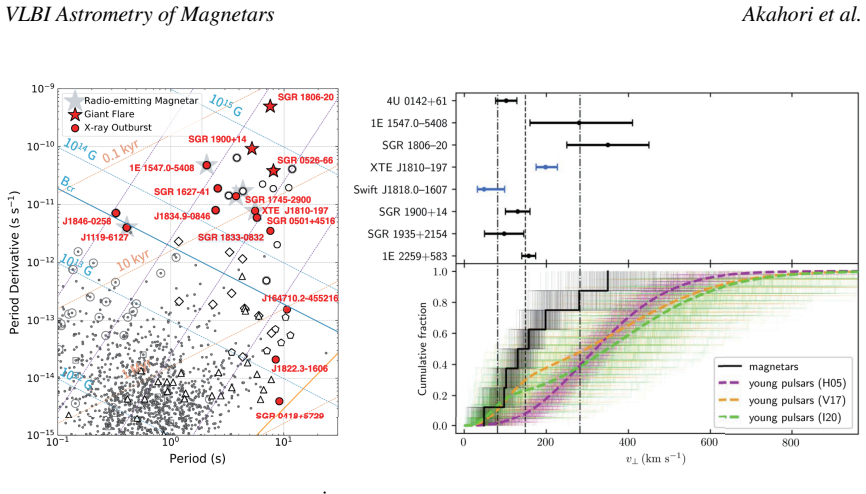
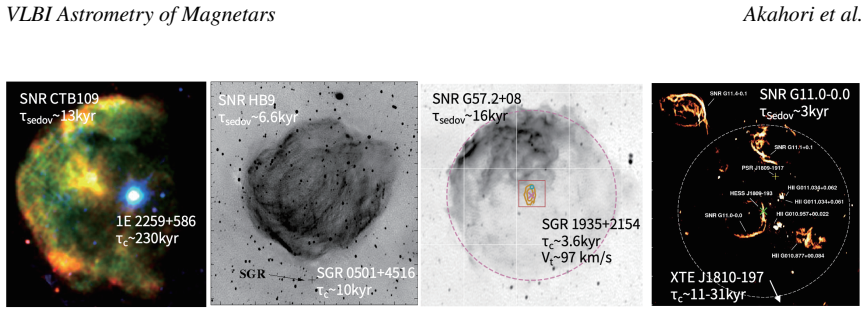
An enhanced dynamo effect in an irregular supernova explosion implies a stronger kick velocity and a higher proper motion of the magnetar compared to those of ordinary pulsars as well as an irregular morphology of the host supernova remnant. VLBI astrometry of magnetars is a unique tool to examine the hypothesis. The MONSTER project will use this technique, and SKA-VLBI's unprecedented sensitivity and angular resolution will dramatically expand the survey volume in which proper motions can be measured within radio outburst periods of a few months.
What carries the argument
VLBI astrometry (precise radio-interferometric tracking of position changes) applied to magnetars during their radio outbursts, enabling direct comparison of kick velocities with those of ordinary pulsars.
If this is right
- Magnetars formed in irregular supernovae should exhibit higher proper motions than ordinary pulsars.
- Host supernova remnants of magnetars should show irregular morphology consistent with asymmetric explosions.
- SKA-VLBI observations will allow proper-motion measurements for many more magnetars within the short duration of their radio outbursts.
- Precise astrometry will help identify which magnetars have measurable kicks and link them to specific supernova remnants.
Where Pith is reading between the lines
- If the hypothesis holds, the same VLBI campaigns could also constrain the distribution of birth velocities across the neutron-star population.
- Combining proper-motion data with SNR morphology studies would provide an independent test of explosion asymmetry models.
- The technique might later be applied to other high-magnetic-field neutron stars to see whether they share the same formation channel.
Load-bearing premise
An enhanced dynamo in an irregular supernova explosion produces a stronger kick velocity for the resulting magnetar than for ordinary pulsars.
What would settle it
A sample of measured magnetar proper motions that are statistically indistinguishable from those of ordinary pulsars would undermine the predicted link between the dynamo mechanism and kick velocity.
Figures
read the original abstract
The origin of the strongest magnetic fields in the Universe, i.e., the origin of magnetars, is a longstanding question. An enhanced dynamo effect in an irregular supernova explosion is a possible origin, which implies a stronger kick velocity and a higher proper motion of the magnetar compared to those of ordinary pulsars as well as an irregular morphology of the host supernova remnant (SNR). However, this hypothesis is not well studied yet, because there is a lack of precise measurement of the proper motion of magnetar and of identification of the host SNR. VLBI astrometry of magnetars is a unique tool to examine the hypothesis. In this chapter, we introduce the MONSTER (Monitoring Observations of the Neutron Stars That Evolve Rapidly) Project. SKA-VLBI's unprecedented sensitivity and the highest angular resolution will allow us to dramatically expand the survey volume in which we can measure the proper motion of magnetars within a radio outburst period of a few months.
Editorial analysis
A structured set of objections, weighed in public.
Referee Report
Summary. The manuscript introduces the MONSTER project, a VLBI astrometry program targeting magnetars during radio outbursts. It argues that an enhanced dynamo in irregular supernovae implies higher kick velocities (and thus higher proper motions) for magnetars than for ordinary pulsars, and that SKA-VLBI's sensitivity and resolution will dramatically expand the volume in which such proper motions can be measured within a few-month outburst window, thereby testing the formation hypothesis.
Significance. If realized, the project would supply the first statistically useful sample of magnetar proper motions and SNR associations, directly addressing the origin of the strongest neutron-star magnetic fields. The proposal correctly identifies VLBI as the only technique capable of sub-milliarcsecond astrometry on these faint, transient sources.
major comments (2)
- [Abstract] Abstract and introductory paragraph: the central claim that SKA-VLBI 'will allow us to dramatically expand the survey volume' is presented without any supporting calculation of expected source counts, astrometric precision, outburst duty cycle, or comparison to existing VLBI limits. Because the manuscript supplies neither a target list nor an error budget, the feasibility of the MONSTER project cannot be assessed from the text.
- [Abstract, first paragraph] The hypothesis that an irregular supernova implies both stronger dynamo action and a larger kick velocity is stated as motivation but is not accompanied by any quantitative prediction (e.g., expected proper-motion distribution or SNR morphology statistics) that the proposed observations would test. Without such predictions the scientific return of the program remains undefined.
minor comments (1)
- The manuscript refers to itself as 'this chapter' but provides no section headings, equations, tables, or figures; adding a structured outline would improve readability.
Simulated Author's Rebuttal
We thank the referee for the constructive comments on the MONSTER project proposal. We address each major point below and will revise the manuscript to strengthen the presentation of feasibility and scientific predictions.
read point-by-point responses
-
Referee: [Abstract] Abstract and introductory paragraph: the central claim that SKA-VLBI 'will allow us to dramatically expand the survey volume' is presented without any supporting calculation of expected source counts, astrometric precision, outburst duty cycle, or comparison to existing VLBI limits. Because the manuscript supplies neither a target list nor an error budget, the feasibility of the MONSTER project cannot be assessed from the text.
Authors: We agree that the abstract and introduction would benefit from quantitative support. In the revised version we will add a dedicated subsection (or appendix) that includes: (i) an error budget for SKA-VLBI astrometric precision at the relevant frequencies and integration times, (ii) estimates of the number of magnetars expected to be detectable within a few-month outburst window based on known radio-outburst statistics, (iii) a direct comparison with the volume and precision limits of existing VLBI campaigns, and (iv) a preliminary target list drawn from the current catalog of radio-loud magnetars. These additions will allow readers to evaluate project feasibility directly from the text. revision: yes
-
Referee: [Abstract, first paragraph] The hypothesis that an irregular supernova implies both stronger dynamo action and a larger kick velocity is stated as motivation but is not accompanied by any quantitative prediction (e.g., expected proper-motion distribution or SNR morphology statistics) that the proposed observations would test. Without such predictions the scientific return of the program remains undefined.
Authors: The manuscript currently presents the irregular-supernova dynamo hypothesis as motivation drawn from the literature, without explicit model predictions. We accept that the scientific return would be clearer with quantitative benchmarks. In revision we will insert a short section that (a) summarizes existing theoretical expectations for the proper-motion distribution of magnetars formed via enhanced dynamo action versus ordinary pulsars, and (b) outlines how the anticipated SKA-VLBI sample size and precision would allow statistical tests of both the kick-velocity distribution and the correlation with irregular SNR morphologies. These predictions will be referenced to the specific observables the MONSTER program will deliver. revision: yes
Circularity Check
No significant circularity
full rationale
The manuscript is a forward-looking project proposal for the MONSTER project rather than a completed analysis containing derivations, equations, or quantitative predictions. The hypothesis (enhanced dynamo implying higher kick velocity) is presented as the target of future VLBI measurements, not as a premise required for the proposal's internal logic. No fitted parameters, self-citations that are load-bearing, or renamings of known results appear. The central claim about SKA-VLBI expanding measurable proper-motion samples is a descriptive statement of capability with no internal reduction to its own inputs.
Axiom & Free-Parameter Ledger
axioms (1)
- domain assumption Enhanced dynamo in irregular supernova explosion produces stronger magnetar kick velocity than ordinary pulsars
Reference graph
Works this paper leans on
-
[1]
doi: 10.1103/PhysRevD.102.072004. M. G. Baring. In D. M. Dubois, editor, Computing Anticipatory Systems: CASYS’07 - Eighth International Conference, volume 1051 ofAmerican Institute of Physics Conference Series, pages 53–64. AIP, Oct
-
[2]
doi: 10.1063/1.3020681. E. Bear and N. Soker. ApJ, 855(2):82, Mar
-
[3]
doi: 10.3847/1538-4357/aaad07. J. M. Blondin, A. Mezzacappa, and C. DeMarino. ApJ, 584(2):971–980, Feb
-
[4]
doi: 10.1038/s41586-020-2872-x. S. Burke-Spolaor et al. MNRAS, 423(2):1351–1367, June
-
[5]
doi: 10.1111/j.1365-2966.2012. 20998.x. A. Burrows et al. The Astrophysical Journal , 664(1):416, jul
-
[6]
URL https://doi.org/10.1086/519161
doi: 10.1086/519161. URL https://doi.org/10.1086/519161. I. H. Cairns, S. Johnston, and P . Das. ApJL, 563(1):L65–L68, Dec
-
[7]
doi: 10.1086/338359. F. Camilo et al. Nature, 442(7105):892 r895, Aug
-
[8]
ISSN 1476-4687. doi: 10.1038/ nature04986. URL http://dx.doi.org/10.1038/nature04986. A. Caputo et al. Phys. Rev. D, 100(6):063515, Sept
-
[9]
doi: 10.1103/PhysRevD.100.063515. G. Castelletti, E. Giacani, and A. Petriella. A&A, 587:A71, Mar
-
[11]
doi: 10.1093/mnras/staa2764. CHIME/FRB Collaboration et al. Nature, 587(7832):54–58, Nov
-
[12]
doi: 10.1051/0004-6361/202453479. G. Desvignes et al. The Astronomer’s Telegram, 12285:1, Dec
-
[13]
doi: 10.1093/mnras/staa2531. H. Ding et al. The Astrophysical Journal Letters, 971(1):L13, aug
-
[14]
URL https://doi.org/10.3847/2041-8213/ad5550
doi: 10.3847/2041-8213/ ad5550. URL https://doi.org/10.3847/2041-8213/ad5550. R. C. Duncan and C. Thompson. ApJL, 392:L9, June
-
[15]
doi: 10.1086/186413. S. Eie et al. PASJ, 73(6):1563–1574, Dec
-
[16]
doi: 10.1093/pasj/psab098. T. Enoto, S. Kisaka, and S. Shibata. Reports on Progress in Physics , 82(10):106901, Oct
-
[17]
doi: 10.1088/1361-6633/ab3def. J. R. Eskilt and E. Komatsu. Phys. Rev. D, 106(6):063503, Sept
-
[18]
doi: 10.1103/PhysRevD. 106.063503. T. Foglizzo, L. Scheck, and H.-T. Janka. The Astrophysical Journal , 652(2):1436, dec
-
[19]
URL https://doi.org/10.1086/508443
doi: 10.1086/508443. URL https://doi.org/10.1086/508443. B. M. Gaensler and S. Chatterjee. GRB Coordinates Network, 8149:1, Jan
-
[20]
URL https://doi.org/10.3847/2041-8213/ab101a
doi: 10.3847/ 2041-8213/ab101a. URL https://doi.org/10.3847/2041-8213/ab101a. E. I. Guendelman and D. Chelouche. International Journal of Modern Physics E , 20:100–108, Jan
-
[21]
doi: 10.1142/S0218301311040669. J. P . Halpern et al. ApJL, 632(1):L29–L32, Oct
-
[22]
doi: 10.1086/497537. J. L. Han et al. Research in Astronomy and Astrophysics , 25(1):014001, jan
-
[23]
URL https://doi.org/10.1088/1674-4527/ada3b7
doi: 10.1088/ 1674-4527/ada3b7. URL https://doi.org/10.1088/1674-4527/ada3b7. D. J. Helfand et al. ApJ, 662(2):1198–1203, June
-
[24]
doi: 10.1086/518028. J. W. T. Hessels et al. ApJL, 876(2):L23, May
-
[25]
doi: 10.3847/2041-8213/ab13ae. A. Hewish et al. Nature, 217(5130):709–713, Feb
-
[26]
doi: 10.1038/217709a0. G. Hobbs, D. R. Lorimer, A. G. Lyne, and M. Kramer. MNRAS, 360(3):974–992, July
-
[27]
doi: 10.1111/j.1365-2966.2005.09087.x. N. Hurley-Walker et al.Nature, 619(7970):487–490, July
-
[28]
doi: 10.1038/s41586-023-06202-5. V . M. Kaspi and A. M. Beloborodov. ARA&A, 55(1):261–301, Aug
-
[29]
doi: 10.3847/2041-8213/ab9898. S. C. Lundgren et al. ApJ, 453:433, Nov
-
[30]
doi: 10.1086/176404. J. D. Lyman et al. ApJ, 926(2):121, Feb
-
[31]
doi: 10.3847/1538-4357/ac432f. A. Lyne et al. The Astronomer’s Telegram, 12284:1, Dec
-
[32]
R. N. Manchester, G. B. Hobbs, A. Teoh, and M. Hobbs. AJ, 129(4):1993–2006, Apr
1993
-
[33]
doi: 10.1086/428488. Y . Minami and E. Komatsu. Progress of Theoretical and Experimental Physics, 2020(10):103E02, Oct
work page internal anchor Pith review doi:10.1086/428488 2020
-
[34]
doi: 10.1093/ptep/ptaa130. Y .-L. Mong and C.- Y . Ng.ApJ, 852(2):86, Jan
-
[35]
doi: 10.3847/1538-4357/aa9e90. F. Naokawa. arXiv e-prints, art. arXiv:2504.06709, Apr
-
[36]
doi: 10.48550/arXiv.2504.06709. F. Pintore et al. MNRAS, 483(3):3832–3838, Mar
-
[37]
doi: 10.1093/mnras/sty3378. N. Rea et al. The Astrophysical Journal , 940(1):72, nov
-
[38]
13 VLBI Astrometry of Magnetars Akahori et al
doi: 10.3847/1538-4357/ac97ea. 13 VLBI Astrometry of Magnetars Akahori et al. URL https://doi.org/10.3847/1538-4357/ac97ea. S. P . Reynolds. ARA&A, 46:89–126, Sept
-
[39]
doi: 10.1146/annurev.astro.46.060407.145237. M. Rioja et al. In Advancing Astrophysics with the SKA – II (AASKAII)
-
[40]
doi: 10.1086/425353. M. Serylak et al. Monthly Notices of the Royal Astronomical Society , 394(1):295–308, 03
-
[41]
ISSN 0035-8711. doi: 10.1111/j.1365-2966.2008.14260.x. URL https://doi.org/10.1111/j. 1365-2966.2008.14260.x. L. G. Spitler et al. Nature, 531(7593):202–205, Mar
-
[42]
doi: 10.1038/nature17168. C. Thompson and R. C. Duncan. ApJ, 408:194, May
-
[43]
doi: 10.1086/172580. P . Torne et al. MNRAS, 451:L50–L54, July
-
[44]
doi: 10.1093/mnrasl/slv063. F. Verbunt, A. Igoshev, and E. Cator. A&A, 608:A57, Dec
-
[45]
doi: 10.1051/0004-6361/ 201731518. S. Wyckoff and C. A. Murray. MNRAS, 180:717–729, Sept
-
[46]
doi: 10.1093/mnras/180.4.717. M. Xue et al. Research in Astronomy and Astrophysics , 23(9):095005, jul
-
[47]
URL https://doi.org/10.1088/1674-4527/acdbbd
doi: 10.1088/ 1674-4527/acdbbd. URL https://doi.org/10.1088/1674-4527/acdbbd. 14
discussion (0)
Sign in with ORCID, Apple, or X to comment. Anyone can read and Pith papers without signing in.