Effective Depth in Joint Source-Channel Coding: An Implicit Equilibrium Analysis
Pith reviewed 2026-07-01 07:01 UTC · model grok-4.3
The pith
Implicit equilibrium analysis yields a calibrated model that predicts the receiver refinement depth required at each SNR for joint source-channel coding.
A machine-rendered reading of the paper's core claim, the machinery that carries it, and where it could break.
Core claim
Semantic encoding and decoding are cast as fixed-point equilibrium processes whose effective depths are set by solver convergence rather than fixed layers. Channel noise perturbations are propagated through a Gaussian-process kernel model across receiver iterations, producing a closed-form relation between SNR and required depth after offline calibration of system parameters.
What carries the argument
The Gaussian-process-inspired kernel evolution framework, which models equilibrium iterations as an effective-depth propagation process tracking channel-induced representation perturbations.
If this is right
- Residual-based solver convergence determines adaptive effective encoder and decoder depths without manual layer selection.
- Parameter sharing across equilibrium iterations keeps total parameter count independent of chosen depth.
- The derived depth-SNR model directly supplies the number of receiver iterations needed to meet any prescribed perturbation tolerance.
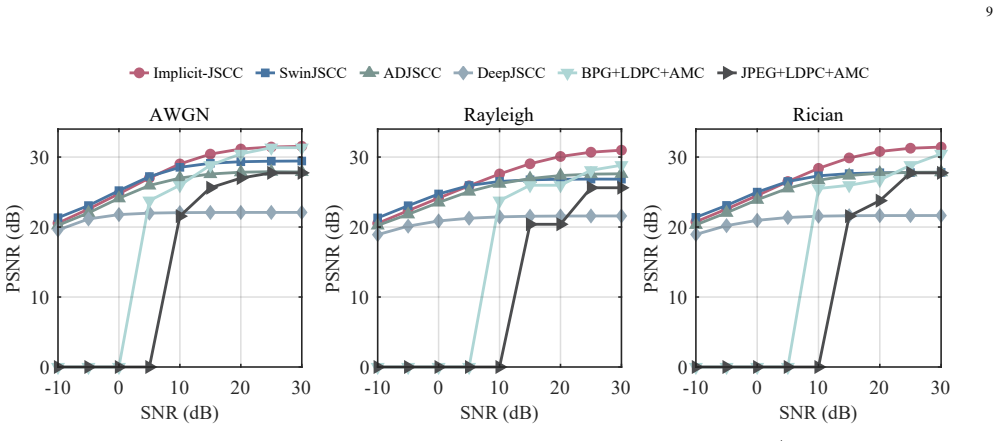
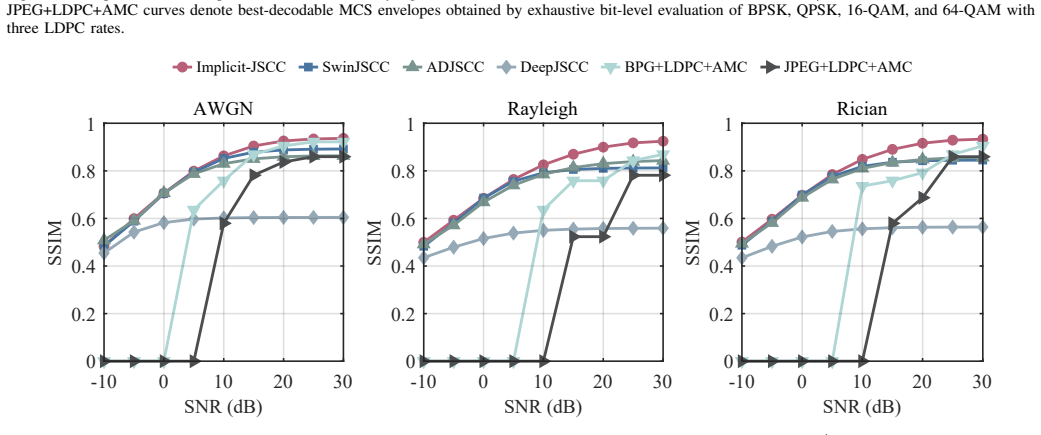
- Experiments confirm that the resulting system matches the reconstruction quality of fixed-depth baselines while allowing explicit computation-quality tradeoffs.
Where Pith is reading between the lines
- The same equilibrium-plus-kernel construction could be reused in other iterative receiver tasks where noise level changes over time.
- A pre-calibrated curve would let a deployed system choose its iteration count on the fly from an SNR estimate without any retraining step.
- If the kernel model continues to hold, hyperparameter searches over network depth become unnecessary for new channel conditions.
Load-bearing premise
The Gaussian-process kernel evolution accurately captures how channel noise perturbs representations across successive equilibrium iterations at the receiver.
What would settle it
Run the calibrated depth-SNR formula on a held-out set of SNRs, measure the actual residual-based iterations needed to reach the target reconstruction quality in each case, and check whether the predicted and observed depths agree within the reported tolerance.
Figures
read the original abstract
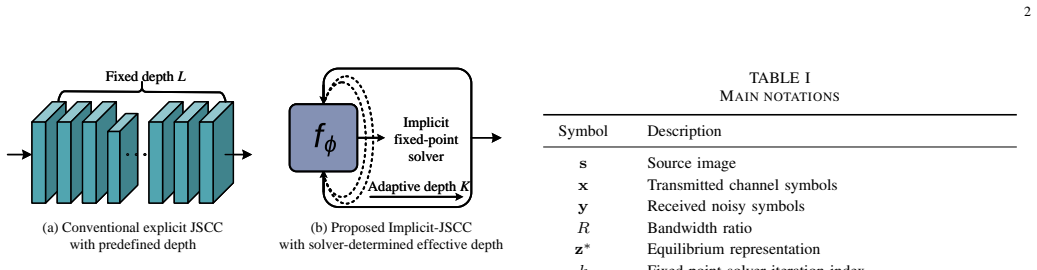
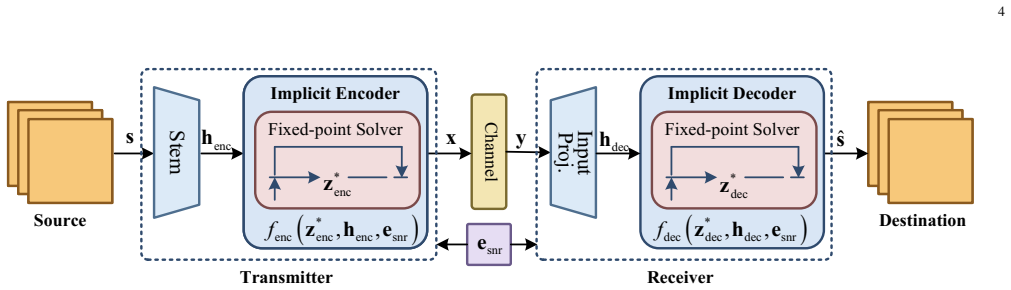
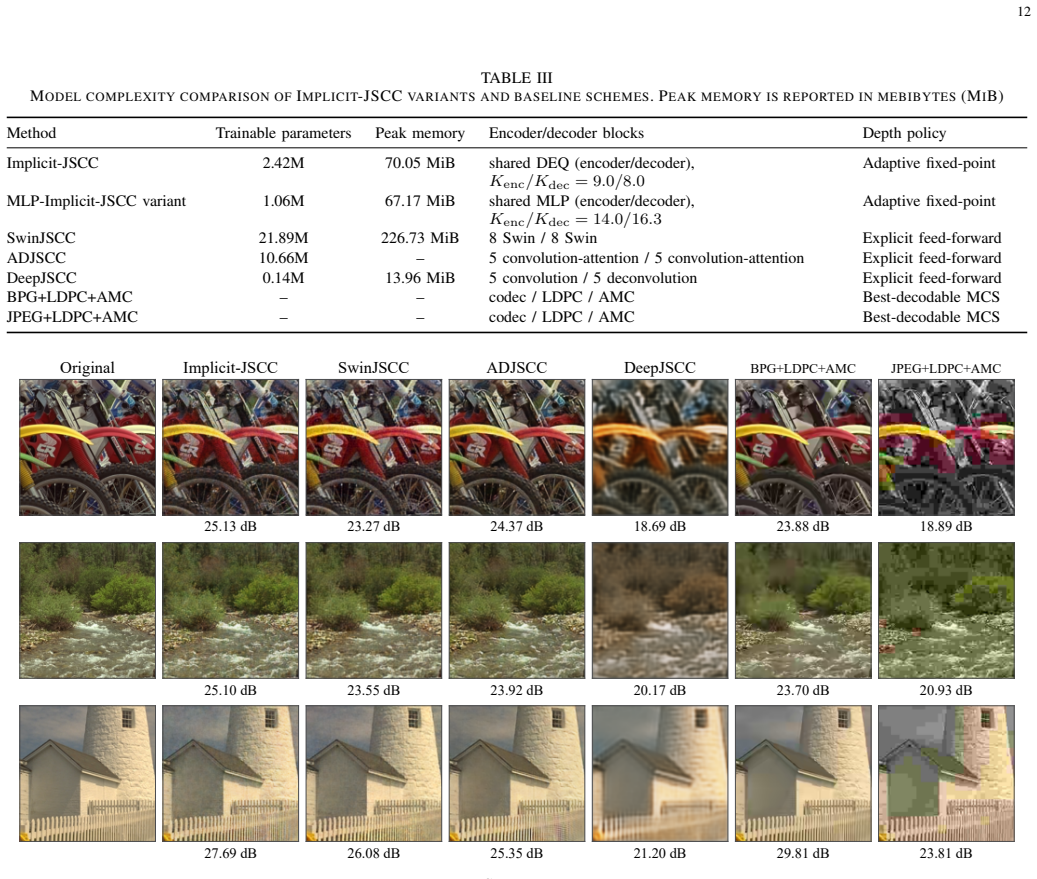
A fundamental design question in deep joint source-channel coding (Deep JSCC) remains insufficiently explored: given a channel signal-to-noise ratio (SNR), what effective computation depth is required for semantic reconstruction? Existing Deep JSCC systems typically employ fixed-depth neural architectures selected through empirical hyperparameter tuning, which may lead to unnecessary computation under favorable channel conditions and insufficient refinement under severe channel noise. This paper proposes \emph{Implicit-JSCC}, an implicit equilibrium framework in which semantic encoding and decoding are formulated as fixed-point equilibrium processes. The effective encoder and decoder depths are determined by residual-based solver convergence rather than manually predefined layer numbers, while parameter sharing across equilibrium iterations enables depth-independent parameter complexity. To analyze the resulting effective-depth behavior, we develop a Gaussian-process-inspired kernel evolution framework that models equilibrium iterations as an effective-depth propagation process. Since channel noise is injected between the encoder and decoder, the analysis tracks channel-induced representation perturbations across receiver-side equilibrium iterations and derives a theory-guided depth--SNR relationship. After offline calibration of the system-specific parameters, the resulting model characterizes the required receiver-side refinement depth under different SNRs. Extensive experiments show that Implicit-JSCC achieves competitive reconstruction performance while enabling residual-based adaptive inference and controllable computation--quality tradeoffs. The depth--SNR model further provides a characterization of the SNR-dependent refinement depth required to reach a prescribed perturbation tolerance.
Editorial analysis
A structured set of objections, weighed in public.
Referee Report
Summary. The paper proposes Implicit-JSCC, an implicit equilibrium framework for deep joint source-channel coding in which semantic encoding and decoding are cast as fixed-point processes whose effective depths are set by residual-based solver convergence rather than fixed layer counts, with parameter sharing across iterations. A Gaussian-process-inspired kernel evolution framework is developed to track channel-induced representation perturbations across receiver-side iterations and derive a theory-guided depth-SNR relationship; this relationship is obtained after offline calibration of system-specific parameters. Experiments report competitive reconstruction performance together with residual-based adaptive inference and controllable computation-quality trade-offs.
Significance. If the calibrated depth-SNR characterization holds, the work supplies a practical tool for predicting required receiver refinement depth as a function of channel SNR in JSCC systems, thereby supporting adaptive computation. The implicit formulation and parameter sharing yield depth-independent parameter counts, which is a clear implementation advantage. The explicit acknowledgment of calibration avoids over-claiming universality. The approach is internally consistent with the fixed-point construction; the main limitation on broader significance is the system-specific calibration step and the absence of quantitative error metrics linking the kernel model to the reported experiments.
major comments (1)
- [Gaussian-process-inspired kernel evolution framework] The central depth-SNR claim rests on the GP-inspired kernel evolution accurately tracking channel-induced perturbations. The manuscript should supply, in the analysis section, a direct quantitative comparison (e.g., perturbation decay curves or MSE between predicted and observed residuals) between the kernel model and the actual equilibrium iterations realized by the Implicit-JSCC solver; without this, the theory-guided relationship cannot be verified against the paper's own data.
minor comments (2)
- [Experiments] The abstract states that experiments show 'competitive reconstruction performance' but provides no numerical tables or baseline PSNR/SSIM deltas; a results section should include quantitative comparisons with fixed-depth JSCC baselines at multiple SNRs.
- [Analysis] Notation for the calibrated system-specific parameters and the precise form of the depth-SNR equation should be introduced explicitly with equation numbers rather than described only in prose.
Simulated Author's Rebuttal
We thank the referee for the detailed review and the constructive suggestion regarding validation of the kernel evolution framework. We address the major comment below.
read point-by-point responses
-
Referee: [Gaussian-process-inspired kernel evolution framework] The central depth-SNR claim rests on the GP-inspired kernel evolution accurately tracking channel-induced perturbations. The manuscript should supply, in the analysis section, a direct quantitative comparison (e.g., perturbation decay curves or MSE between predicted and observed residuals) between the kernel model and the actual equilibrium iterations realized by the Implicit-JSCC solver; without this, the theory-guided relationship cannot be verified against the paper's own data.
Authors: We agree that a direct quantitative comparison between the GP-inspired kernel predictions and the observed residuals from the solver would strengthen verification of the depth-SNR model. In the revised manuscript we will add, in the analysis section, perturbation decay curves together with MSE values computed between the kernel-evolution predictions and the actual residual norms recorded during Implicit-JSCC equilibrium iterations. These plots and metrics will be generated from the same experimental configurations already reported, thereby linking the calibrated model directly to the solver behavior. revision: yes
Circularity Check
No significant circularity identified
full rationale
The paper explicitly derives a theory-guided depth-SNR relationship via a Gaussian-process-inspired kernel evolution framework that tracks channel-induced perturbations in equilibrium iterations. It then states that after offline calibration of system-specific parameters the resulting model characterizes required receiver-side refinement depth. Calibration is openly acknowledged rather than hidden, the framework is presented as an analysis tool rather than a parameter-free claim, and no self-citation, self-definitional step, or fitted-input-renamed-as-prediction is quoted in the provided material. Experiments are described as independent validation of reconstruction performance. The derivation chain therefore remains self-contained against external benchmarks.
Axiom & Free-Parameter Ledger
free parameters (1)
- system-specific parameters
axioms (1)
- domain assumption Gaussian-process-inspired kernel evolution framework models equilibrium iterations as an effective-depth propagation process
Reference graph
Works this paper leans on
-
[1]
Recent contributions to the mathematical theory of com- munication,
W. Weaver, “Recent contributions to the mathematical theory of com- munication,”ETC: a review of general semantics, pp. 261–281, 1953
1953
-
[2]
Deep joint source- channel coding for wireless image transmission,
E. Bourtsoulatze, D. B. Kurka, and D. G ¨und¨uz, “Deep joint source- channel coding for wireless image transmission,”IEEE Trans. Cogn. Commun. Netw., vol. 5, no. 3, pp. 567–579, 2019
2019
-
[3]
Wireless image transmission using deep source channel coding with attention modules,
J. Xu, B. Ai, W. Chenet al., “Wireless image transmission using deep source channel coding with attention modules,”IEEE Trans. Circuits Syst. Video Technol., vol. 32, no. 4, pp. 2315–2328, 2022
2022
-
[4]
SwinJSCC: taming Swin Transformer for deep joint source-channel coding,
K. Yang, S. Wang, J. Daiet al., “SwinJSCC: taming Swin Transformer for deep joint source-channel coding,”IEEE Trans. Cogn. Commun. Netw., vol. 11, no. 1, pp. 90–104, 2025
2025
-
[5]
Two-way semantic communications without feedback,
K. Yu, Q. He, and G. Wu, “Two-way semantic communications without feedback,”IEEE Trans. Veh. Technol., vol. 73, no. 6, pp. 9077–9082, 2024
2024
-
[6]
Partial sampling-based semantic com- munications,
K. Yu, Q. He, G. Wuet al., “Partial sampling-based semantic com- munications,”IEEE Trans. Commun., vol. 73, no. 10, pp. 9059–9070, 2025
2025
-
[7]
Deep equilibrium models,
S. Bai, J. Z. Kolter, and V . Koltun, “Deep equilibrium models,” inAdvances in Neural Information Processing Systems, vol. 32, 2019. [Online]. Available: https://papers.neurips.cc/paper/ 8358-deep-equilibrium-models
2019
-
[8]
Deep neural networks as Gaussian processes,
J. Lee, Y . Bahri, R. Novaket al., “Deep neural networks as Gaussian processes,” inInternational Conference on Learning Representations, 2018. [Online]. Available: https://openreview.net/ forum?id=B1EA-M-0Z
2018
-
[9]
A contemporary survey on semantic communications: theory of mind, generative AI, and deep joint source-channel coding,
L. X. Nguyen, A. D. Raha, P. S. Aunget al., “A contemporary survey on semantic communications: theory of mind, generative AI, and deep joint source-channel coding,”IEEE Commun. Surveys Tuts., vol. 28, pp. 2377–2417, 2026
2026
-
[10]
ComAI: the convergence of communication and artificial intelligence,
P. Zhang, K. Niu, X. Wanget al., “ComAI: the convergence of communication and artificial intelligence,”IEEE Commun. Surveys Tuts., vol. 28, pp. 2163–2197, 2026
2026
-
[11]
A robust image semantic communi- cation system with multi-scale vision transformer,
X. Peng, Z. Qin, X. Taoet al., “A robust image semantic communi- cation system with multi-scale vision transformer,”IEEE J. Sel. Areas Commun., vol. 43, no. 4, pp. 1278–1291, 2025
2025
-
[12]
MambaJSCC: adaptive deep joint source–channel coding with generalized state space model,
T. Wu, Z. Chen, M. Taoet al., “MambaJSCC: adaptive deep joint source–channel coding with generalized state space model,”IEEE Trans. Wireless Commun., vol. 25, pp. 9264–9279, 2026
2026
-
[13]
Generative diffusion models for wireless networks: Fundamental, architecture, and state-of-the-art,
D. Fan, R. Meng, X. Xuet al., “Generative diffusion models for wireless networks: Fundamental, architecture, and state-of-the-art,”IEEE Commun. Surveys Tuts., vol. 28, pp. 5632–5677, 2026
2026
-
[14]
V AE-GAN-based semantic com- munication for high-quality image transmission,
N. Omi, S. Kojima, and C.-J. Ahn, “V AE-GAN-based semantic com- munication for high-quality image transmission,”IEEE Trans. Wireless Commun., vol. 25, pp. 9799–9813, 2026
2026
-
[15]
Residual diffusion models for variable-rate joint source–channel coding of MIMO CSI,
S. K. Ankireddy, H. Kim, J. Choet al., “Residual diffusion models for variable-rate joint source–channel coding of MIMO CSI,”IEEE J. Sel. Areas Commun., vol. 44, pp. 3620–3633, 2026
2026
-
[16]
Scene graph-aided probabilistic semantic communication for image transmission,
C. Zhu, S. Liang, Z. Zhaoet al., “Scene graph-aided probabilistic semantic communication for image transmission,”IEEE Trans. Mobile Comput., vol. 25, no. 4, pp. 5905–5919, 2026
2026
-
[17]
Towards universal semantic commu- nication via matchable semantic subspace transmission,
B. Li, X. Yang, S. Duanet al., “Towards universal semantic commu- nication via matchable semantic subspace transmission,”IEEE Trans. Image Process., vol. 35, pp. 5003–5016, 2026
2026
-
[18]
Cross-modal generative semantic communications powered by semantic knowledge base,
Z. Fang, M. Sun, S. Wanget al., “Cross-modal generative semantic communications powered by semantic knowledge base,”IEEE Trans. Netw. Sci. Eng., vol. 13, pp. 5568–5585, 2026
2026
-
[19]
Generative semantic communications for robust speech-to-text translation,
Z. Weng, Z. Wang, Z. Qinet al., “Generative semantic communications for robust speech-to-text translation,”IEEE Trans. Wireless Commun., vol. 25, pp. 1380–1393, 2026
2026
-
[20]
Live high-fidelity semantic communi- cation via cross-modal fusion for volumetric video,
T. Gong, Z. Cao, Z. Lianget al., “Live high-fidelity semantic communi- cation via cross-modal fusion for volumetric video,”IEEE J. Sel. Areas Commun., vol. 44, pp. 2750–2764, 2026
2026
-
[21]
GAI-enabled task-driven semantic communication for surveillance video,
M. Chen, W. Ma, L. Wanget al., “GAI-enabled task-driven semantic communication for surveillance video,”IEEE Trans. Commun., vol. 74, pp. 3162–3173, 2026
2026
-
[22]
SPHARQ-based semantic communi- cation,
W. An, C. Dong, H. Lianget al., “SPHARQ-based semantic communi- cation,”IEEE Trans. Wireless Commun., vol. 25, pp. 9548–9564, 2026
2026
-
[23]
Coverage-enhanced semantic commu- nication systems for cellular networks,
Y . Wang, C. Dong, W. Anet al., “Coverage-enhanced semantic commu- nication systems for cellular networks,”IEEE Trans. Commun., vol. 74, pp. 3720–3735, 2026
2026
-
[24]
A secure and efficient distributed semantic communication system for heterogeneous internet of things,
W. Zeng, X. Xu, Q. Zhanget al., “A secure and efficient distributed semantic communication system for heterogeneous internet of things,” IEEE Trans. Mobile Comput., pp. 1–16, 2026
2026
-
[25]
A semantic-empowered free-space optical communication system with turbulence-resilient vector beams,
Y . Wei, C. Chen, L. Yaoet al., “A semantic-empowered free-space optical communication system with turbulence-resilient vector beams,” IEEE Trans. Wireless Commun., vol. 25, pp. 11 530–11 545, 2026
2026
-
[26]
Distributed hierarchical deep reinforcement learning for semantic-aware resource allocation,
K. Yu, Q. He, C. Yuet al., “Distributed hierarchical deep reinforcement learning for semantic-aware resource allocation,”IEEE Trans. Veh. Technol., vol. 74, no. 10, pp. 16 322–16 334, 2025
2025
-
[27]
Beyond Shannon: semantic informa- tion theory and methodology,
P. Zhang, K. Niu, Z. Lianget al., “Beyond Shannon: semantic informa- tion theory and methodology,”IEEE Trans. Netw. Sci. Eng., vol. 13, pp. 8062–8079, 2026
2026
-
[28]
Resilient image semantic commu- nication based on rate-optimized information bottleneck theory,
W. Wang, C. Wang, Z. Zhanget al., “Resilient image semantic commu- nication based on rate-optimized information bottleneck theory,”IEEE Trans. Netw. Sci. Eng., vol. 13, pp. 3127–3143, 2026
2026
-
[29]
Robust information bottleneck guided non-autoregressive semantic communication with synonymous mapping,
M. Zhang, H. Zhang, D. Yuanet al., “Robust information bottleneck guided non-autoregressive semantic communication with synonymous mapping,”IEEE Trans. Wireless Commun., vol. 25, pp. 14 859–14 874, 2026
2026
-
[30]
Task-agnostic semantic communications relying on information bottleneck and federated meta-learning,
H. Wei, W. Wang, W. Niet al., “Task-agnostic semantic communications relying on information bottleneck and federated meta-learning,”IEEE Trans. Wireless Commun., vol. 25, pp. 7600–7616, 2026
2026
-
[31]
Task-adaptive semantic communication with feedback: a conditional rate-distortion approach,
J. He, Y . Deng, S. Wuet al., “Task-adaptive semantic communication with feedback: a conditional rate-distortion approach,”IEEE Trans. Cogn. Commun. Netw., vol. 12, pp. 7157–7171, 2026
2026
-
[32]
Joint source-channel coding for task- oriented broadcast communications: an information bottleneck approach with rate splitting,
Y . Wu, J. Huang, Y . Shiet al., “Joint source-channel coding for task- oriented broadcast communications: an information bottleneck approach with rate splitting,”IEEE Trans. Wireless Commun., vol. 25, pp. 14 023– 14 036, 2026
2026
-
[33]
DeepGuard: defending deep joint source- channel coding against eavesdropping at physical-layer,
K. Chi, Y . He, Q. Yanget al., “DeepGuard: defending deep joint source- channel coding against eavesdropping at physical-layer,”IEEE J. Sel. Areas Commun., vol. 44, pp. 4128–4143, 2026
2026
-
[34]
Cooperative semantic knowledge base update for semantic communication networks,
J. Zhang, S. Li, Y . Sunet al., “Cooperative semantic knowledge base update for semantic communication networks,”IEEE Trans. Commun., vol. 74, pp. 1391–1405, 2026
2026
-
[35]
Feature-foundation model evolution for low-latency semantic communication,
H. Zhang, B. Di, H. Zhanget al., “Feature-foundation model evolution for low-latency semantic communication,”IEEE Trans. Wireless Com- mun., vol. 25, pp. 11 915–11 931, 2026
2026
-
[36]
NTIRE 2017 challenge on single image super-resolution: dataset and study,
E. Agustsson and R. Timofte, “NTIRE 2017 challenge on single image super-resolution: dataset and study,” in2017 IEEE Conference on Computer Vision and Pattern Recognition Workshops (CVPRW), 2017, pp. 1122–1131
2017
-
[37]
Kodak lossless true color image suite (PhotoCD PCD0992),
Eastman Kodak Company, “Kodak lossless true color image suite (PhotoCD PCD0992),” 1993
1993
discussion (0)
Sign in with ORCID, Apple, or X to comment. Anyone can read and Pith papers without signing in.