3-packings in Triangulations: Algorithms, bounds, and Complexity
Pith reviewed 2026-06-30 04:01 UTC · model grok-4.3
The pith
Every triangulation on n vertices has a P3-packing of size at least floor(n/5), and this bound is asymptotically tight.
A machine-rendered reading of the paper's core claim, the machinery that carries it, and where it could break.
Core claim
For P3-packings in triangulations, λ_P3(G) is at least floor(n/5) for any triangulation G on n vertices, and the bound is asymptotically tight. For induced packings of P2 ∪ P1 in plane triangulations T, λ_{P2∪P1}(T) is at least floor(n/3)-2 and such packings can be computed in polynomial time. Lower bounds for K3-packings are given in terms of maximum degree and degree sequence, and a face-path characterization is provided for triangle factors in 4-connected plane triangulations.
What carries the argument
The function λ_H(G) measuring the maximum number of vertex-disjoint copies of H in G, with the induced requirement for H = P2 ∪ P1.
If this is right
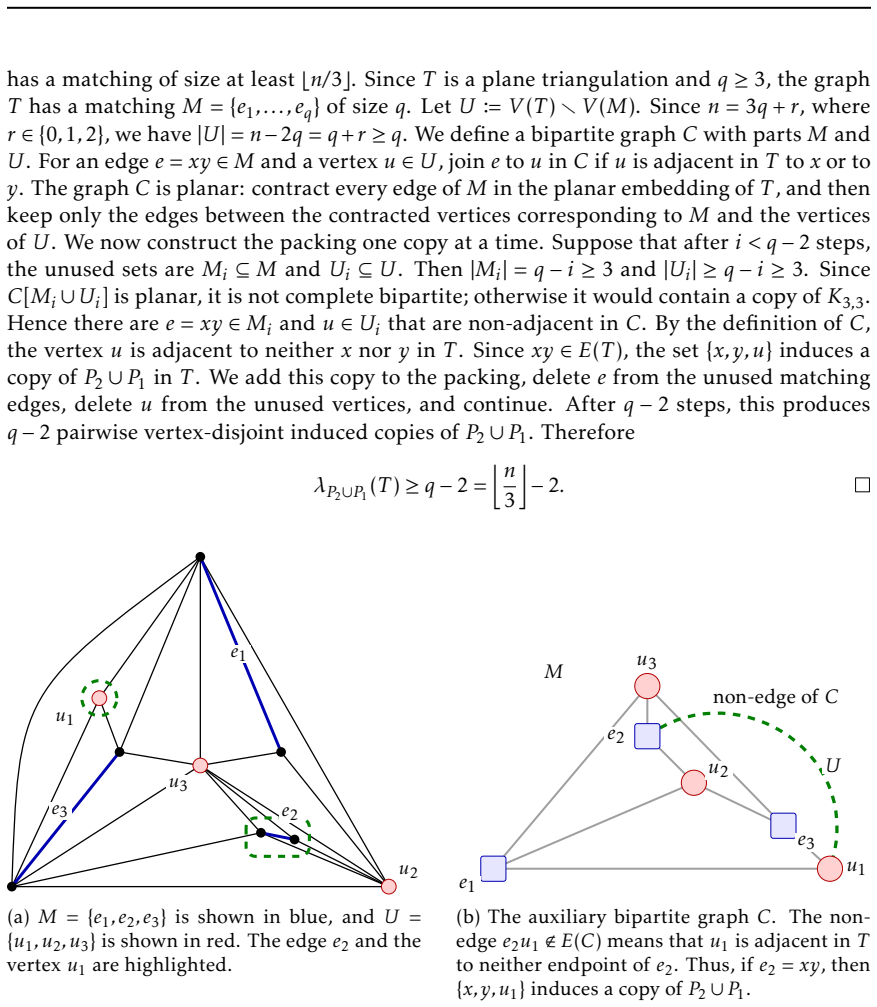
- A polynomial-time algorithm exists to find the induced P2∪P1 packing.
- Triangle packings can be bounded using the maximum degree.
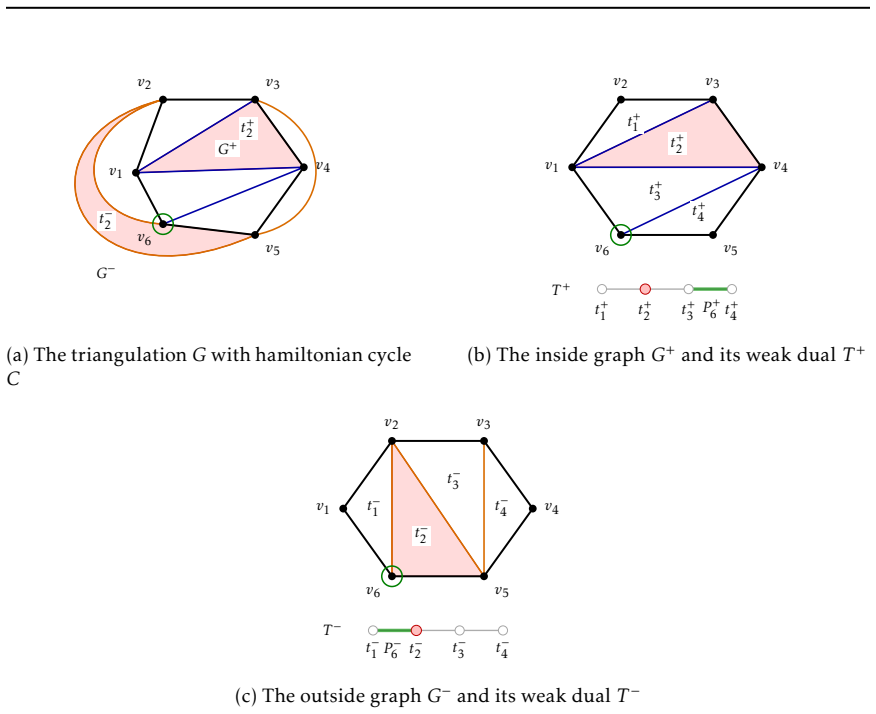
- Triangle factors in 4-connected triangulations are characterized by a hamiltonian cycle and weak duals of maximal outerplanar graphs.
Where Pith is reading between the lines
- The asymptotic tightness implies there exist infinite families of triangulations achieving roughly n/5.
- Similar packing results might hold for other classes of planar graphs.
- The polynomial algorithm suggests practical applications in graph decomposition problems.
Load-bearing premise
The graphs under consideration are exactly the plane triangulations, meaning maximal planar graphs, and the definition of packing for P2 ∪ P1 requires induced copies.
What would settle it
Finding a triangulation on a large number of vertices where the largest P3-packing has size less than n/5 would falsify the main lower bound.
Figures
read the original abstract
We study $H$-packings in plane triangulations for the three-vertex graphs $H\in\{P_3,K_3,P_2\cup P_1\}$. For a graph $H$, let $\lambda_H(G)$ denote the maximum size of an $H$-packing in $G$, with the convention that for $H=P_2\cup P_1$ the copies are required to be induced. For $P_3$-packings, we prove that every triangulation $G$ on $n$ vertices satisfies $\lambda_{P_3}(G)\ge \left\lfloor \frac n5\right\rfloor$, and show that this lower bound is asymptotically tight. We also study triangle packings in triangulations and provide lower bounds for $\lambda_{K_3}(G)$ in terms of the maximum degree and the degree sequence. We give a face-path characterization of triangle factors in $4$-connected plane triangulations using a hamiltonian cycle and the weak duals of the two associated maximal outerplanar graphs. Finally, for induced packings by $P_2\cup P_1$, we prove that every plane triangulation $T$ on $n$ vertices satisfies $\lambda_{P_2\cup P_1}(T)\ge \left\lfloor \frac n3\right\rfloor-2$, and show that such a packing can be found in polynomial time.
Editorial analysis
A structured set of objections, weighed in public.
Referee Report
Summary. The manuscript studies H-packings in plane triangulations for the three-vertex graphs H in {P3, K3, P2 ∪ P1}. It proves that every triangulation G on n vertices satisfies λ_P3(G) ≥ ⌊n/5⌋ and that this lower bound is asymptotically tight. Lower bounds are given for λ_K3(G) in terms of maximum degree and the degree sequence. A face-path characterization of triangle factors is provided for 4-connected plane triangulations using a Hamiltonian cycle and the weak duals of the two associated maximal outerplanar graphs. For induced packings by P2 ∪ P1, it proves that every plane triangulation T on n vertices satisfies λ_{P2∪P1}(T) ≥ ⌊n/3⌋-2 and that such a packing can be found in polynomial time.
Significance. If the proofs and algorithm are correct, the results would constitute a useful contribution to packing problems in maximal planar graphs. The asymptotic tightness of the P3 bound and the polynomial-time algorithm for the induced P2 ∪ P1 packing are notable strengths, as they combine a sharp theoretical guarantee with an efficient constructive method. The degree-based bounds on triangle packings and the structural characterization for triangle factors add further value for understanding the extremal and algorithmic properties of triangulations.
minor comments (2)
- [Abstract] Abstract: the definition of λ_H(G) and the induced-copy convention for H = P2 ∪ P1 are stated, but the main text should cross-reference these definitions explicitly when presenting the algorithm and the lower-bound proof to avoid any ambiguity for readers.
- [Abstract] The title includes 'Complexity' yet the abstract only reports a polynomial-time algorithm; if the manuscript contains additional complexity results (e.g., NP-hardness for related problems), they should be summarized in the abstract for completeness.
Simulated Author's Rebuttal
We thank the referee for the positive summary, significance assessment, and recommendation of minor revision. The report lists no specific major comments under the MAJOR COMMENTS section.
Circularity Check
No significant circularity detected
full rationale
The paper presents direct mathematical proofs establishing lower bounds such as λ_P3(G) ≥ ⌊n/5⌋ for any triangulation G on n vertices (asymptotically tight) and λ_{P2∪P1}(T) ≥ ⌊n/3⌋-2 for plane triangulations T, along with a polynomial-time algorithm. These results rely on graph-theoretic arguments, face-path characterizations, and constructive methods applied to the stated definitions of H-packings in maximal planar graphs. No equations, parameters, or claims reduce by construction to fitted inputs, self-definitions, or load-bearing self-citations; the derivation chain is self-contained with independent content.
Axiom & Free-Parameter Ledger
Reference graph
Works this paper leans on
-
[1]
Noga Alon and Raphael Yuster.H-factors in dense graphs.J. Combin. Theory Ser. B, 66(2):269–282, 1996.doi:10.1006/jctb.1996.0020. 23
-
[2]
Brenda S. Baker. Approximation algorithms for NP-complete problems on planar graphs.Journal of the ACM, 41(1):153–180, 1994
1994
-
[3]
David W. Barnette. Trees in polyhedral graphs.Canadian Journal of Mathematics, 18:731–736, 1966.doi:10.4153/CJM-1966-073-4
-
[4]
Therese Biedl. Trees and co-trees with constant maximum degree in planar 3- connected graphs.ArXiv, abs/1312.4101, 2013.1312.4101
Pith/arXiv arXiv 2013
-
[5]
Packing triangles in bounded degree graphs.In- form
Alberto Caprara and Romeo Rizzi. Packing triangles in bounded degree graphs.In- form. Process. Lett., 84(4):175–180, 2002.doi:10.1016/S0020-0190(02)00274-0
-
[6]
New results on the independence number
Yair Caro. New results on the independence number. Technical report, Tel-Aviv University, 1979
1979
-
[7]
K. Corradi and A. Hajnal. On the maximal number of independent circuits in a graph. Acta Math. Acad. Sci. Hungar., 14:423–439, 1963.doi:10.1007/BF01895727
-
[8]
Wayne Goddard and Michael A. Henning. Thoroughly distributed colorings.ArXiv, 2016.1609.09684
arXiv 2016
-
[9]
Pandu Rangan, Maw-Shang Chang, Gerard J
Venkatesan Guruswami, C. Pandu Rangan, Maw-Shang Chang, Gerard J. Chang, and C. K. Wong. The vertex-disjoint triangles problem. In Juraj Hromkovičand Ondrej Sýkora, editors,Graph-Theoretic Concepts in Computer Science, volume 1517 ofLecture Notes in Computer Science, pages 26–37. Springer, Berlin, Heidelberg, 1998.doi: 10.1007/10692760_3
-
[10]
P . Hell and D. G. Kirkpatrick. On generalized matching problems.Inform. Process. Lett., 12(1):33–35, 1981.doi:10.1016/0020-0190(81)90073-9
-
[11]
On packing 3- vertex paths in a graph.J
Atsushi Kaneko, Alexander Kelmans, and Tsuyoshi Nishimura. On packing 3- vertex paths in a graph.J. Graph Theory, 36(4):175–197, 2001.doi:10.1002/ 1097-0118(200104)36:4<175::AID-JGT1005>3.0.CO;2-T
2001
-
[12]
Packing 3-vertex paths in claw-free graphs and related topics
Alexander Kelmans. Packing 3-vertex paths in claw-free graphs and related topics. Discrete Appl. Math., 159(2-3):112–127, 2011.doi:10.1016/j.dam.2010.05.001
-
[13]
D. G. Kirkpatrick and P . Hell. On the complexity of general graph factor problems. SIAM J. Comput., 12(3):601–609, 1983.doi:10.1137/0212040
-
[14]
Daniela Kühn and Deryk Osthus. The minimum degree threshold for perfect graph packings.Combinatorica, 29(1):65–107, 2009.doi:10.1007/s00493-009-2254-3
-
[15]
Vazirani
Silvio Micali and Vijay V. Vazirani. AnO( √ |V| |E|) algorithm for finding maximum matching in general graphs. In21st Annual Symposium on Foundations of Computer Science, pages 17–27. 1980
1980
-
[16]
Lower bounds on the cardinality of the maximum matchings of planar graphs.Discrete Mathematics, 28(3):255–267, 1979.doi:10
Takao Nishizeki and Ilker Baybars. Lower bounds on the cardinality of the maximum matchings of planar graphs.Discrete Mathematics, 28(3):255–267, 1979.doi:10. 1016/0012-365X(79)90133-X. 24
1979
-
[17]
Daniel P . Sanders. On hamilton cycles in certain planar graphs.Journal of Graph Theory, 21(1):43–50, 1996.doi:10.1002/(SICI)1097-0118(199601)21:1<43:: AID-JGT6>3.0.CO;2-M
-
[18]
The complexity of pinning sim- ple multiloops.arXiv preprint arXiv:2602.07344, 2026
Eric Seo, Christopher-Lloyd Simon, and Ben Stucky. The complexity of pinning sim- ple multiloops.arXiv preprint arXiv:2602.07344, 2026
arXiv 2026
-
[19]
An improved kernel for planar vertex-disjoint triangle packing.Theoret
Zimo Sheng and Mingyu Xiao. An improved kernel for planar vertex-disjoint triangle packing.Theoret. Comput. Sci., 922:122–130, 2022.doi:10.1016/j.tcs.2022.04. 017
-
[20]
W. T. Tutte. A theorem on planar graphs.Trans. Amer. Math. Soc., 82:99–116, 1956. doi:10.2307/1992980
-
[21]
NP-complete problems on a 3-connected cubic planar graph and their applications
Ryuhei Uehara. NP-complete problems on a 3-connected cubic planar graph and their applications. Technical Report TWCU-M-0004, Tokyo Woman’s Christian Uni- versity, 1996
1996
-
[22]
V. K. Wei. A lower bound on the stability number of a simple graph. Technical Report 81-11217-9, Bell Laboratories, Murray Hill, NJ, 1981
1981
-
[23]
Non-separable and planar graphs.Trans
Hassler Whitney. Non-separable and planar graphs.Trans. Amer. Math. Soc., 34(2):339–362, 1932.doi:10.2307/1989545. 25
discussion (0)
Sign in with ORCID, Apple, or X to comment. Anyone can read and Pith papers without signing in.