Beyond Equidistant Assumptions: An Autoregressive Ordered Stereotype Model for Ordinal Time Series
Reviewed by Pith T0 review T1 audit T2 compute T3 formal T4 kernel 2026-06-30 05:29 UTCgrok-4.3pith:6LEU2YFZrecord.jsonopen to challenge →
The pith
An autoregressive ordered stereotype model for ordinal time series estimates category spacings from data rather than assuming they are equal.
A machine-rendered reading of the paper's core claim, the machinery that carries it, and where it could break.
Core claim
The AR-OSM extends the ordered stereotype model by incorporating lagged ordinal responses as covariates, which induces serial dependence while the model simultaneously estimates the scores that determine the spacing between categories from the observed data.
What carries the argument
The autoregressive ordered stereotype model, which places lagged response values into the systematic component of the stereotype model to capture serial dependence while estimating category scores directly from the data.
If this is right
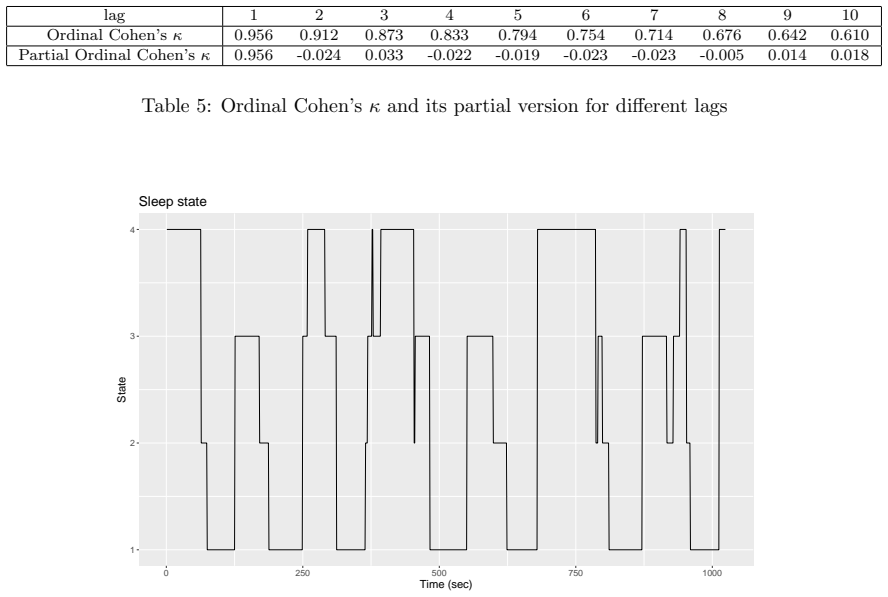
- The model applies directly to ordinal series such as sleep states where equidistance between categories is implausible.
- The strength and form of serial dependence are controlled by the values of the autoregressive parameters.
- Larger sample sizes improve recovery of both the dependence parameters and the category spacings in simulation.
- The model provides an alternative to existing ordinal time-series regressions that impose equidistance.
Where Pith is reading between the lines
- Joint estimation of spacing and autoregressive terms may allow the model to adapt to slowly changing category interpretations over long series.
- The same structure could be extended to multiple lagged terms or to include exogenous covariates without altering the core spacing estimation.
- If the estimated spacings prove stable, the model could serve as a diagnostic tool to test whether an equidistant assumption is reasonable for a given series.
Load-bearing premise
Category spacings can be estimated from the same data that is used to estimate the autoregressive coefficients without creating identifiability problems that distort the dependence estimates.
What would settle it
A dataset or simulation in which the AR-OSM produces materially different serial-dependence estimates from an otherwise identical model that forces equidistant categories, or in which the estimated category scores change substantially when the sample is split.
Figures




read the original abstract
We propose an extension of the ordered stereotype model (OSM) for ordinal time series data, referred to as the Autoregressive OSM (AR-OSM). The model captures serial dependence by incorporating lagged values of the response as covariates in the systematic component. In contrast to existing regression models for ordinal time series, the AR-OSM does not assume equidistant categories, but instead allows the data to determine their relative spacing. This property makes the model particularly suitable for applications where the equidistance assumption is unrealistic. Such a case is illustrated through the analysis of infant sleep state data. Additionally, a comprehensive simulation study is conducted to assess the performance of the model under varying sample sizes and to investigate how parameter values influence the induced serial dependence structure.
Editorial analysis
A structured set of objections, weighed in public.
Referee Report
Summary. The paper proposes the Autoregressive Ordered Stereotype Model (AR-OSM) for ordinal time series. It extends the ordered stereotype model by incorporating lagged values of the ordinal response as covariates in the systematic component to capture serial dependence, while allowing the data to estimate the relative spacing of categories (via parameters φ_j) rather than assuming equidistance. The model is illustrated on infant sleep state data and evaluated in a simulation study that varies sample sizes and examines the induced serial dependence structure.
Significance. If the joint estimation of φ_j and the autoregressive coefficients proves identifiable and stable, the AR-OSM would provide a useful extension for ordinal time series where equidistance is unrealistic, with the simulation study offering evidence on finite-sample performance.
major comments (2)
- [Model definition and estimation (likely §2–3)] Model definition and estimation (likely §2–3): because the lagged response enters the linear predictor as categorical indicators that are scaled by the same φ vector used for the stereotype spacings, a scaling ambiguity exists between φ and the AR coefficients. The manuscript must state the exact normalization (e.g., φ_1 = 0, φ_K = 1) and any additional constraints on the AR terms, then verify that these constraints eliminate the indeterminacy.
- [Simulation study (likely §5)] Simulation study (likely §5): data are generated under the model, yet no condition numbers of the observed information matrix, no parameter-recovery errors for φ when estimated jointly with the AR coefficients, and no checks for label-switching or instability are reported. Without these diagnostics the claim that “the data determine the relative spacing” without compromising the serial-dependence estimates remains untested.
minor comments (1)
- The abstract should briefly indicate the identification constraints adopted for the joint estimation.
Simulated Author's Rebuttal
We thank the referee for the careful reading and constructive suggestions. We address the two major comments point by point below and will incorporate the requested clarifications and diagnostics in a revised manuscript.
read point-by-point responses
-
Referee: Model definition and estimation (likely §2–3): because the lagged response enters the linear predictor as categorical indicators that are scaled by the same φ vector used for the stereotype spacings, a scaling ambiguity exists between φ and the AR coefficients. The manuscript must state the exact normalization (e.g., φ_1 = 0, φ_K = 1) and any additional constraints on the AR terms, then verify that these constraints eliminate the indeterminacy.
Authors: We agree that an explicit statement of the normalization is required. The model is identified by fixing φ_1 = 0 and φ_K = 1 (with the remaining φ_j estimated freely in (0,1)), which removes the scale indeterminacy between the stereotype parameters and the autoregressive coefficients. In the revised manuscript we will add this normalization explicitly in Section 2, state the resulting constraints on the AR coefficients, and include a short algebraic verification that the indeterminacy is eliminated under these restrictions. revision: yes
-
Referee: Simulation study (likely §5): data are generated under the model, yet no condition numbers of the observed information matrix, no parameter-recovery errors for φ when estimated jointly with the AR coefficients, and no checks for label-switching or instability are reported. Without these diagnostics the claim that “the data determine the relative spacing” without compromising the serial-dependence estimates remains untested.
Authors: The simulation study currently reports bias, coverage, and dependence structure but omits the requested numerical-stability and recovery diagnostics. We will augment the simulation section with (i) condition numbers of the observed information matrix across replications, (ii) root-mean-square errors for the φ_j parameters when estimated jointly with the AR coefficients, and (iii) explicit checks confirming absence of label-switching or convergence instability. These additions will directly test the joint identifiability claim. revision: yes
Circularity Check
No circularity: extension is defined independently of its fitted outputs
full rationale
The provided abstract and description define the AR-OSM as an extension that adds lagged response terms to the systematic component of the existing OSM while letting category spacings be estimated from data. No quoted equations, self-citations, or claims reduce the serial-dependence structure to a fitted parameter by construction, import uniqueness from prior author work, or rename a known result. The simulation study is presented as external performance assessment rather than a tautology. The derivation therefore remains self-contained against external benchmarks.
Axiom & Free-Parameter Ledger
Reference graph
Works this paper leans on
-
[1]
Computational Statistics & Data Analysis , volume=
Mixture-based clustering for the ordered stereotype model , author=. Computational Statistics & Data Analysis , volume=. 2016 , publisher=
2016
-
[2]
Journal of the Royal Statistical Society: Series B (Methodological) , volume=
Regression and ordered categorical variables , author=. Journal of the Royal Statistical Society: Series B (Methodological) , volume=. 1984 , publisher=
1984
-
[3]
Advances in GLIM and Statistical Modelling: Proceedings of the GLIM92 Conference and the 7th International Workshop on Statistical Modelling, Munich, 13--17 July 1992 , pages=
Ordinal time series models with application to forest damage data , author=. Advances in GLIM and Statistical Modelling: Proceedings of the GLIM92 Conference and the 7th International Workshop on Statistical Modelling, Munich, 13--17 July 1992 , pages=. 1992 , organization=
1992
-
[4]
Stochastic Environmental Research and Risk Assessment , volume=
Modeling air quality level with a flexible categorical autoregression , author=. Stochastic Environmental Research and Risk Assessment , volume=. 2022 , publisher=
2022
-
[5]
Journal of Time Series Analysis , volume=
Modeling normalcy-dominant ordinal time series: an application to air quality level , author=. Journal of Time Series Analysis , volume=. 2022 , publisher=
2022
-
[6]
Statistical Science , volume=
Regression theory for categorical time series , author=. Statistical Science , volume=. 2003 , publisher=
2003
-
[7]
Nonlinear
Jahn, Malte and Wei. Nonlinear. Stochastic Environmental Research and Risk Assessment , volume=. 2024 , publisher=
2024
-
[8]
Journal of the American Statistical Association , year=
Distance-based analysis of ordinal data and ordinal time series , author=. Journal of the American Statistical Association , year=
-
[9]
A model for high-order
Raftery, Adrian E , journal=. A model for high-order. 1985 , publisher=
1985
-
[10]
Variable length
B. Variable length. The Annals of Statistics , volume=. 1999 , publisher=
1999
-
[11]
Statistics , volume=
Categorical time semes with a recursive scheme and with covariates , author=. Statistics , volume=. 1993 , publisher=
1993
-
[12]
Statistical Modelling , volume=
Ordinal compositional data and time series , author=. Statistical Modelling , volume=. 2024 , publisher=
2024
-
[13]
Computational statistics & Data analysis , volume=
Pairwise likelihood inference for ordinal categorical time series , author=. Computational statistics & Data analysis , volume=. 2006 , publisher=
2006
-
[14]
I: Correlational and runs properties , author=
Discrete time series generated by mixtures. I: Correlational and runs properties , author=. Journal of the Royal Statistical Society: Series B (Methodological) , volume=. 1978 , publisher=
1978
-
[15]
Journal of the Royal Statistical Society: Series B (Methodological) , volume=
Discrete time series generated by mixtures II: Asymptotic properties , author=. Journal of the Royal Statistical Society: Series B (Methodological) , volume=. 1978 , publisher=
1978
-
[16]
1978 , publisher=
Discrete time series generated by mixtures III: Autoregressive processes (DAR (p)) , author=. 1978 , publisher=
1978
-
[17]
Weighted discrete
Wei. Weighted discrete. Journal of Time Series Analysis , volume=. 2025 , publisher=
2025
-
[18]
International Journal of Methods in Psychiatric Research , volume=
A method for ordinal outcomes: The ordered stereotype model , author=. International Journal of Methods in Psychiatric Research , volume=. 2019 , publisher=
2019
-
[19]
2010 , publisher=
Analysis of ordinal categorical data , author=. 2010 , publisher=
2010
-
[20]
Statistics in Medicine , volume=
A goodness-of-fit test for the ordered stereotype model , author=. Statistics in Medicine , volume=. 2016 , publisher=
2016
-
[21]
Information Sciences , volume=
Archetypal analysis for ordinal data , author=. Information Sciences , volume=. 2021 , publisher=
2021
-
[22]
Journal of the Royal Statistical Society: Series C (Applied Statistics) , volume=
Partial proportional odds models for ordinal response variables , author=. Journal of the Royal Statistical Society: Series C (Applied Statistics) , volume=. 1990 , publisher=
1990
-
[23]
Journal of the Royal Statistical Society: Series B (Methodological) , volume=
Regression models for ordinal data , author=. Journal of the Royal Statistical Society: Series B (Methodological) , volume=. 1980 , publisher=
1980
-
[24]
2026 , note =
clustord: Cluster Ordinal Data via Proportional Odds or Ordered Stereotype , author =. 2026 , note =
2026
-
[25]
Advances in Data Analysis and Classification , publisher =
Finite mixture biclustering of discrete type multivariate data , author =. Advances in Data Analysis and Classification , publisher =. 2019 , volume =
2019
-
[26]
, title=
Greenland, S. , title=. Statistics in Medicine , year=
-
[27]
Statistical Methods in Medical Research , volume=
Model-based goodness-of-fit tests for the ordered stereotype model , author=. Statistical Methods in Medical Research , volume=. 2020 , publisher=
2020
-
[28]
2025 , school=
Partial Ordered Stereotype Model: Development of a New Model for Ordinal Data , author=. 2025 , school=
2025
-
[29]
2018 , publisher=
An introduction to discrete-valued time series , author=. 2018 , publisher=
2018
discussion (0)
Sign in with ORCID, Apple, or X to comment. Anyone can read and Pith papers without signing in.