Multi-height Identification of Sausage and Fluting Eigenmodes in a Solar Pore
Pith reviewed 2026-06-30 04:20 UTC · model grok-4.3
The pith
Multi-height observations identify sausage modes as standing and fluting modes as upward propagating in a solar pore.
A machine-rendered reading of the paper's core claim, the machinery that carries it, and where it could break.
Core claim
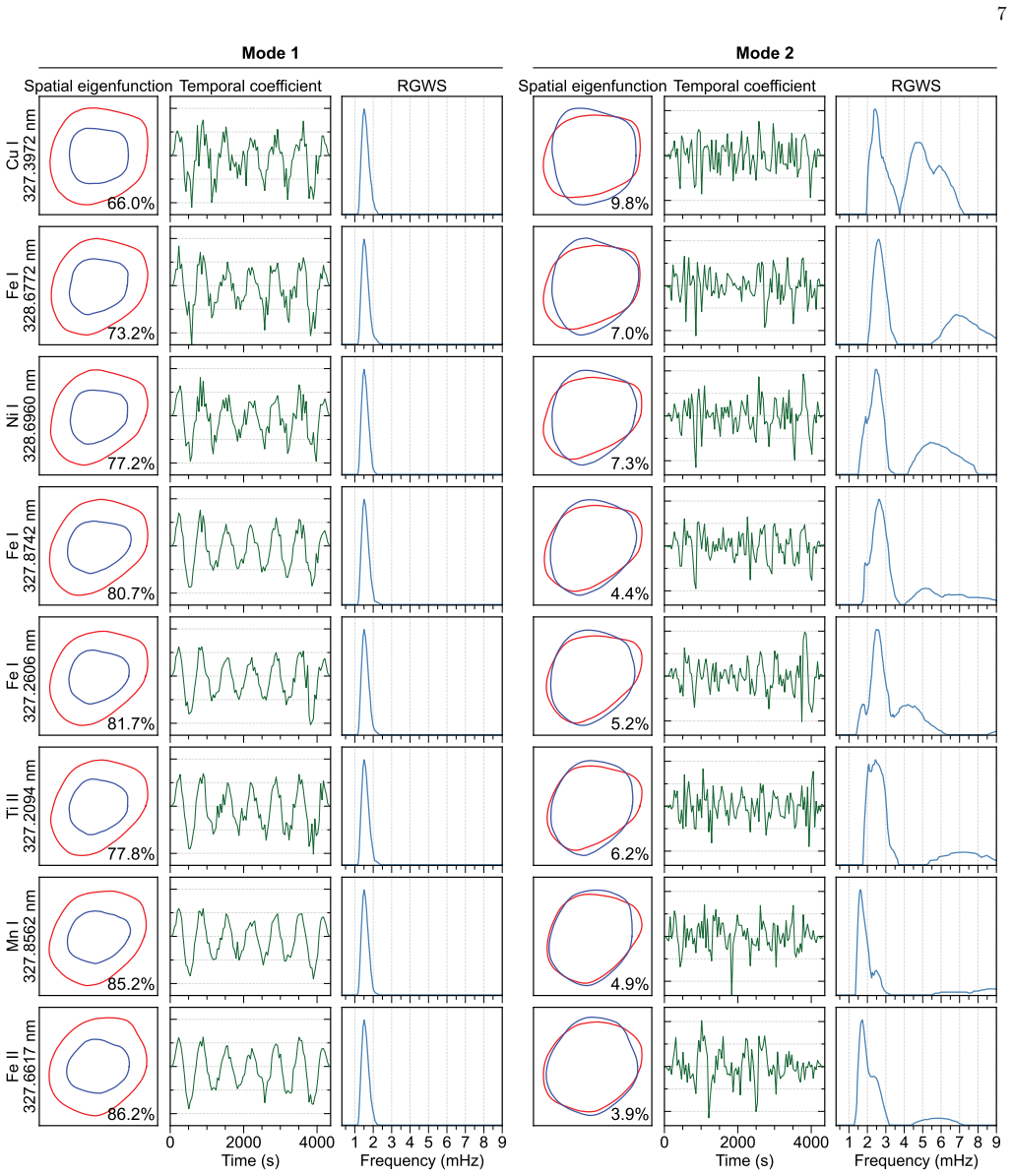
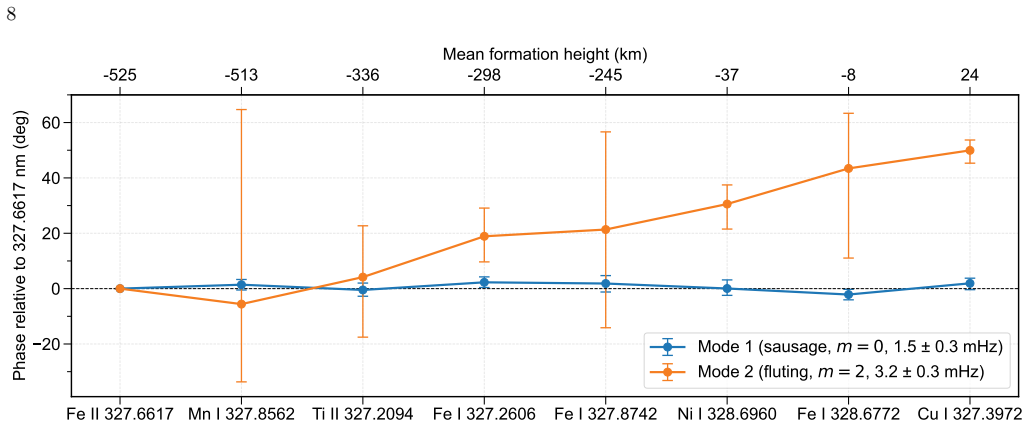
In all eight lines the first POD mode is consistently an axisymmetric sausage mode with dominant power at approximately 1-2 mHz that carries 66-86 percent of the normalised eigenvalue fraction, while the second mode is a fluting mode with m=2 dominant at 2-3.5 mHz that contributes 4-10 percent. Cross-line wavelet phase analysis shows the sausage mode remains close to zero phase difference across the sampled heights, consistent with standing or near-standing behaviour, whereas the fluting mode displays a modest but systematic increase in phase with height reaching about 50 degrees, indicative of an upward-propagating component.
What carries the argument
Proper orthogonal decomposition applied to the time series of pore-boundary positions identified in each of eight spectral lines.
If this is right
- The sausage mode dominates oscillation power and behaves as a standing wave across the photosphere to low chromosphere.
- The fluting mode carries a propagating component capable of transporting energy upward.
- Mode identification remains consistent regardless of the exact height sampled within the 500 km range.
- Lower-frequency power concentrates in the sausage mode while higher frequencies appear in the fluting mode.
Where Pith is reading between the lines
- The same boundary-tracking and decomposition approach could be used on other compact magnetic structures to separate standing from propagating wave energy.
- The clear frequency separation between the two modes suggests they may be excited by different photospheric drivers.
- Because the sausage mode shows little net phase progression, it is unlikely to carry significant time-averaged energy flux through the pore.
Load-bearing premise
The eight spectral lines correspond to distinct formation heights that increase systematically across roughly 500 km.
What would settle it
If POD applied to boundary oscillations in a new pore or with a different set of lines yields a different ordering of modes or if the fluting-mode phase difference shows no systematic increase with height.
Figures
read the original abstract
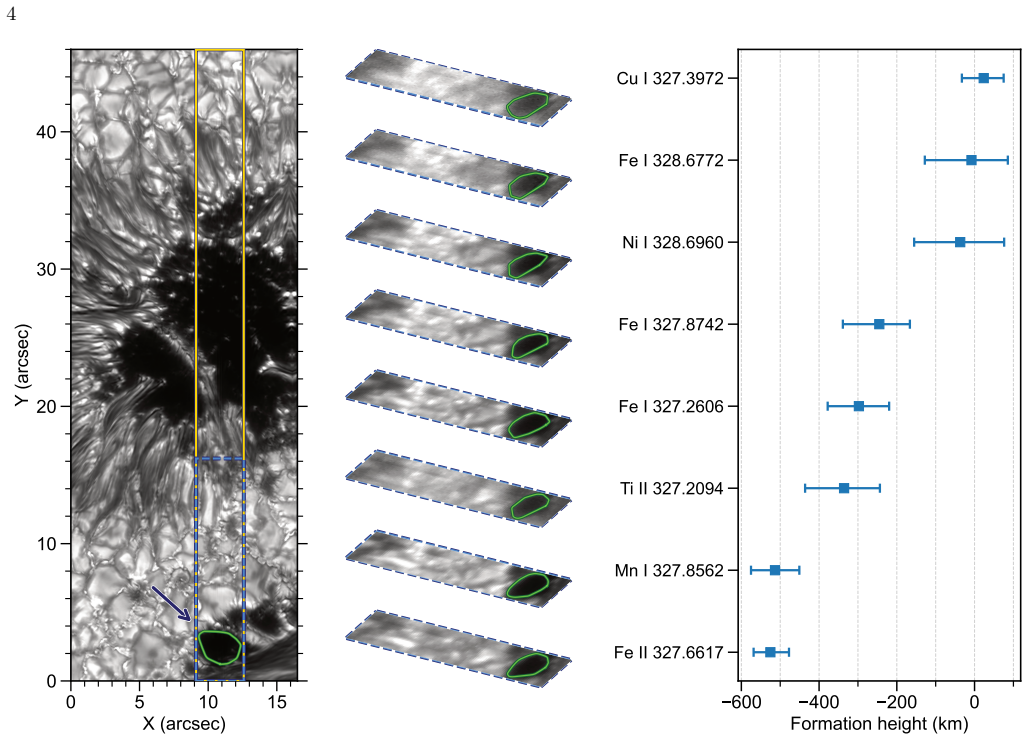
Magnetic pores are compact, strongly magnetised waveguides in the lower solar atmosphere and therefore provide favourable conditions for identifying magnetohydrodynamic (MHD) wave modes. Earlier seeing-free observations revealed concurrent sausage, kink, and fluting modes in photospheric pores, but only at a single sampled layer. In this Letter, we exploit the dense spectral sampling of the near-ultraviolet 327-329 nm window observed by the Sunrise-III UV Spectropolarimeter and Imager (SUSI) to investigate how pore wave modes behave across multiple photospheric and low-chromospheric heights spanning roughly 500 km. We analyse ~75 min of a Sunrise-III/SUSI time series containing a small solar pore. From eight selected spectral lines sampling different estimated formation heights, we identify the pore boundary at each line and time step and apply proper orthogonal decomposition (POD) to the boundary oscillations. In all eight lines, the first POD mode is consistently identified as an axisymmetric sausage mode, with dominant power at ~1-2 mHz, and carries the dominant normalised eigenvalue fraction, typically about 66-86%, while the second mode is a fluting mode with azimuthal wave number m = 2, dominant at ~2-3.5 mHz, and contributes about 4-10%. Cross-line wavelet phase analysis of the temporal coefficients shows that the sausage mode remains close to zero phase difference across the sampled heights, consistent with standing or near-standing behaviour, whereas the fluting mode displays a modest but systematic increase in phase with height, reaching about 50 degrees, indicative of an upward-propagating component. These observations provide the first multi-height identification and phase characterisation of sausage and fluting modes inferred from pore-boundary oscillations.
Editorial analysis
A structured set of objections, weighed in public.
Referee Report
Summary. The paper reports the first multi-height identification of sausage (m=0) and fluting (m=2) MHD eigenmodes in a solar pore using proper orthogonal decomposition (POD) applied to pore-boundary oscillations extracted from eight spectral lines in the 327-329 nm window observed by Sunrise-III/SUSI. Across all lines, the dominant POD mode is identified as sausage with power at 1-2 mHz (66-86% eigenvalue fraction) and the second as fluting at 2-3.5 mHz (4-10%); wavelet phase analysis of temporal coefficients shows near-zero phase difference (standing behavior) for sausage and a systematic ~50° increase with height (upward propagation) for fluting over an estimated ~500 km height range.
Significance. If the formation-height ordering holds, the work supplies the first observational constraints on the vertical structure and propagation character of these modes across the photosphere-low chromosphere transition in a pore waveguide. The consistency of mode identification across eight independent lines and the direct extraction of frequencies and phase differences from the data (no fitted parameters) are strengths that would advance wave-mode diagnostics in solar magnetic structures.
major comments (1)
- [Section describing spectral-line selection and height assignment (near the multi-height analysis)] The central interpretation of the fluting-mode phase gradient as evidence of upward propagation rests on the eight lines providing distinct, correctly ordered formation heights spanning ~500 km. The manuscript states these heights are 'estimated' from the 327-329 nm window but provides no contribution-function calculations, model-atmosphere comparisons, or other independent validation of the ordering and separation; any overlap or misordering would render the cross-line wavelet phase vs. height trend uninterpretable.
minor comments (2)
- [POD mode identification subsection] Clarify the precise criterion used to assign azimuthal wavenumber m=2 to the second POD mode (e.g., spatial structure of the eigenfunction or additional diagnostics).
- [Results section] The normalized eigenvalue fractions (66-86% and 4-10%) are reported per line; a table summarizing these values across all eight lines would improve readability.
Simulated Author's Rebuttal
We thank the referee for the thorough review and for highlighting the importance of validating the formation-height ordering. We address the single major comment below and will revise the manuscript accordingly to strengthen the multi-height interpretation.
read point-by-point responses
-
Referee: The central interpretation of the fluting-mode phase gradient as evidence of upward propagation rests on the eight lines providing distinct, correctly ordered formation heights spanning ~500 km. The manuscript states these heights are 'estimated' from the 327-329 nm window but provides no contribution-function calculations, model-atmosphere comparisons, or other independent validation of the ordering and separation; any overlap or misordering would render the cross-line wavelet phase vs. height trend uninterpretable.
Authors: We agree that the current manuscript describes the heights as estimated without supplying explicit contribution-function calculations or new model-atmosphere comparisons. The line selection and approximate ordering draw on established formation-height ranges for the 327-329 nm window reported in prior SUSI and UV spectroscopy studies, but these references are not detailed in the text. To address the concern directly, we will revise the manuscript by adding a concise subsection (or expanded methods paragraph) that cites the relevant literature on line-formation heights in this spectral region and notes the expected photospheric-to-low-chromospheric progression. This addition will supply the independent validation requested and allow readers to evaluate the robustness of the ordering. We do not claim the revision eliminates all uncertainty in absolute heights, but it will make the basis for the relative ordering explicit. revision: yes
Circularity Check
No circularity: pure observational extraction from time series
full rationale
The paper performs direct data analysis on observed time series from eight spectral lines: boundary identification, POD decomposition of oscillations, frequency power spectra, eigenvalue fractions, and cross-line wavelet phase differences. All reported quantities (1-2 mHz sausage dominance at 66-86%, 2-3.5 mHz fluting at 4-10%, ~50° phase gradient) are computed outputs from the input data and standard methods (POD, wavelets). No step reduces a claimed prediction or eigenmode identification to a fitted parameter defined from the same data, nor relies on self-citation chains for uniqueness or ansatz. Formation-height estimates are external inputs from literature/models, not internally derived quantities renamed as results. The derivation chain is therefore self-contained and non-circular.
Axiom & Free-Parameter Ledger
axioms (2)
- domain assumption Proper orthogonal decomposition applied to pore-boundary time series separates axisymmetric sausage and m=2 fluting eigenmodes.
- domain assumption The eight spectral lines form at sufficiently separated heights to permit meaningful cross-line phase comparison.
Reference graph
Works this paper leans on
-
[1]
B., Brevis, W., Fedun, V., et al
Albidah, A. B., Brevis, W., Fedun, V., et al. 2021, Phil. Trans. R. Soc. London Ser. A, 379, 20200181, doi: 10.1098/rsta.2020.0181
-
[2]
Albidah, A. B., Fedun, V., Aldhafeeri, A. A., et al. 2022, ApJ, 927, 201, doi: 10.3847/1538-4357/ac51d9
-
[3]
Albidah, A. B., Fedun, V., Aldhafeeri, A. A., et al. 2023, ApJ, 954, 30, doi: 10.3847/1538-4357/acd7eb
-
[4]
Barthol, P., Gandorfer, A., Solanki, S. K., et al. 2011, SoPh, 268, 1, doi: 10.1007/s11207-010-9662-9
-
[5]
Sunrise III: The Wavefront Correction System
Berkefeld, T., Bell, A., Volkmer, R., et al. 2026, arXiv e-prints, arXiv:2602.07448, doi: 10.48550/arXiv.2602.07448
work page internal anchor Pith review Pith/arXiv arXiv doi:10.48550/arxiv.2602.07448 2026
-
[6]
2025, SoPh, 300, 112, doi: 10.1007/s11207-025-02524-x
Bernasconi, P., Carpenter, M., Eaton, H., et al. 2025, SoPh, 300, 112, doi: 10.1007/s11207-025-02524-x
-
[7]
Cho, K.-S., Bong, S.-C., Nakariakov, V. M., et al. 2015, ApJ, 802, 45, doi: 10.1088/0004-637X/802/1/45
-
[8]
Bakunina, I. A. 2010, A&A, 513, A27, doi: 10.1051/0004-6361/200913683 del Toro Iniesta, J. C., Orozco Su´ arez, D.,´Alvarez-Herrero, A., et al. 2025, SoPh, 300, 148, doi: 10.1007/s11207-025-02562-5 Dorotoviˇ c, I., Erd´ elyi, R., Freij, N., Karlovsk´ y, V., & M´ arquez, I. 2014, A&A, 563, A12, doi: 10.1051/0004-6361/201220542
-
[9]
Edwin, P. M., & Roberts, B. 1983, SoPh, 88, 179, doi: 10.1007/BF00196186
-
[10]
2025, SoPh, 300, 65, doi: 10.1007/s11207-025-02471-7
Feller, A., Gandorfer, A., Grauf, B., et al. 2025, SoPh, 300, 65, doi: 10.1007/s11207-025-02471-7
-
[11]
Freij, N., Dorotoviˇ c, I., Morton, R. J., et al. 2016, ApJ, 817, 44, doi: 10.3847/0004-637X/817/1/44
-
[12]
2018, in Society of Photo-Optical Instrumentation Engineers (SPIE) Conference Series, Vol
Gandorfer, A., Grauf, B., Staub, J., et al. 2018, in Society of Photo-Optical Instrumentation Engineers (SPIE) Conference Series, Vol. 10698, Space Telescopes and Instrumentation 2018: Optical, Infrared, and Millimeter Wave, ed. M. Lystrup, H. A. MacEwen, G. G. Fazio, N. Batalha, N. Siegler, & E. C. Tong, 106984N, doi: 10.1117/12.2311816
-
[13]
Grant, S. D. T., Jess, D. B., Moreels, M. G., et al. 2015, ApJ, 806, 132, doi: 10.1088/0004-637X/806/1/132
-
[14]
Grant, S. D. T., Jess, D. B., Stangalini, M., et al. 2022, ApJ, 938, 143, doi: 10.3847/1538-4357/ac91ca
-
[15]
A., Feller, A., Gandorfer, A., et al
Iglesias, F. A., Feller, A., Gandorfer, A., et al. 2025, SoPh, 300, 58, doi: 10.1007/s11207-025-02470-8
-
[16]
Jafarzadeh, S., Jess, D. B., Stangalini, M., et al. 2026a, Frontiers in Astronomy and Space Sciences, 13, 1843842, doi: 10.3389/fspas.2026.1843842
-
[17]
Jafarzadeh, S., Schiavo, L. A. C. A., Fedun, V., et al. 2024, A&A, 688, A2, doi: 10.1051/0004-6361/202449685 12
-
[18]
Jafarzadeh, S., Jess, D. B., Stangalini, M., et al. 2025a, Nature Reviews Methods Primers, 5, 21, doi: 10.1038/s43586-025-00392-0
-
[19]
Jafarzadeh, S., Jess, D. B., Stangalini, M., et al. 2025b, WaLSAtools - Wave Analysis Tools, v1.0.0.post5 Zenodo, doi: 10.5281/zenodo.17569951
-
[20]
Jafarzadeh, S., Jess, D. B., Stangalini, M., et al. 2026b, ApJL, in press (Focus Issue on Early Science Results fromSunrise iii), doi: 10.3847/2041-8213/ae63d0
-
[21]
Jafarzadeh, S., Jess, D. B., Stangalini, M., et al. 2026c, ApJL, in press (Focus Issue on Early Science Results fromSunrise iii), doi: 10.3847/2041-8213/ae7072
-
[22]
Jess, D. B., Jafarzadeh, S., Keys, P. H., et al. 2023, Living Reviews in Solar Physics, 20, 1, doi: 10.1007/s41116-022-00035-6
-
[23]
Jess, D. B., Keys, P. H., Stangalini, M., & Jafarzadeh, S. 2021, Phil. Trans. R. Soc. London Ser. A, 379, 20200169, doi: 10.1098/rsta.2020.0169
-
[24]
Jess, D. B., Morton, R. J., Verth, G., et al. 2015, SSRv, 190, 103, doi: 10.1007/s11214-015-0141-3
-
[25]
B., Van Doorsselaere, T., Verth, G., et al
Jess, D. B., Van Doorsselaere, T., Verth, G., et al. 2017, ApJ, 842, 59, doi: 10.3847/1538-4357/aa73d6
-
[26]
Kang, J., Chae, J., Nakariakov, V. M., et al. 2019, ApJL, 877, L9, doi: 10.3847/2041-8213/ab1f6c
-
[27]
Katsukawa, Y., del Toro Iniesta, J. C., Solanki, S. K., et al. 2020, in Society of Photo-Optical Instrumentation Engineers (SPIE) Conference Series, Vol. 11447, Ground-based and Airborne Instrumentation for Astronomy VIII, ed. C. J. Evans, J. J. Bryant, & K. Motohara, 114470Y, doi: 10.1117/12.2561223
-
[28]
Keys, P. H., Morton, R. J., Jess, D. B., et al. 2018, ApJ, 857, 28, doi: 10.3847/1538-4357/aab432
-
[29]
2015, Living Reviews in Solar Physics, 12, 6, doi: 10.1007/lrsp-2015-6
Khomenko, E., & Collados, M. 2015, Living Reviews in Solar Physics, 12, 6, doi: 10.1007/lrsp-2015-6
-
[30]
Kobanov, N. I., Chelpanov, A. A., & Kolobov, D. Y. 2013, A&A, 554, A146, doi: 10.1051/0004-6361/201220548
-
[31]
Korpi-Lagg, A., Gandorfer, A., Solanki, S. K., et al. 2025, SoPh, 300, 75, doi: 10.1007/s11207-025-02485-1
-
[32]
L., & Bell, B
Kurucz, R. L., & Bell, B. 1995, Atomic line list
1995
-
[33]
N., Solanki, S
Lagg, A., Smitha, H. N., Solanki, S. K., et al. 2026, ApJL, in prep. (Focus Issue on Early Science Results from Sunrise iii)
2026
-
[34]
Lumley, J. L. 1967, in Atmospheric Turbulence and Wave Propagation (Moscow: Nauka), 166
1967
-
[35]
G., Freij, N., Erd´ elyi, R., Van Doorsselaere, T., & Verth, G
Moreels, M. G., Freij, N., Erd´ elyi, R., Van Doorsselaere, T., & Verth, G. 2015, A&A, 579, A73, doi: 10.1051/0004-6361/201425096
-
[36]
Morton, R. J., Erd´ elyi, R., Jess, D. B., & Mathioudakis, M. 2011, ApJL, 729, L18, doi: 10.1088/2041-8205/729/2/L18 M¨ uller, D., St. Cyr, O. C., Zouganelis, I., et al. 2020, A&A, 642, A1, doi: 10.1051/0004-6361/202038467
-
[37]
Vortex Influence on Slow Magnetoacoustic Waves Rast, M
Nakariakov, V. M., & Verwichte, E. 2005, Living Reviews in Solar Physics, 2, 3, doi: 10.12942/lrsp-2005-3
-
[38]
Pereira, T. M. D., & Uitenbroek, H. 2015, A&A, 574, A3, doi: 10.1051/0004-6361/201424785
-
[39]
2012, ApJ, 750, 62, doi: 10.1088/0004-637X/750/1/62
Rempel, M. 2012, ApJ, 750, 62, doi: 10.1088/0004-637X/750/1/62
-
[40]
2019, MHD waves in the solar atmosphere (Cambridge, United Kingdom: Cambridge University Press)
Roberts, B. 2019, MHD waves in the solar atmosphere (Cambridge, United Kingdom: Cambridge University Press)
2019
-
[41]
Smitha, H. N., van Noort, M., Solanki, S. K., & Castellanos Dur´ an, J. S. 2023, A&A, 669, A144, doi: 10.1051/0004-6361/202245130
-
[42]
Solanki, S. K. 2003, A&A Rv, 11, 153, doi: 10.1007/s00159-003-0018-4
-
[43]
K., Smitha, H
Solanki, S. K., Smitha, H. N., Lagg, A., & et al. 2026,
2026
-
[44]
K., Barthol, P., Danilovic, S., et al
Solanki, S. K., Barthol, P., Danilovic, S., et al. 2010, ApJL, 723, L127, doi: 10.1088/2041-8205/723/2/L127
-
[45]
Solanki, S. K., Riethm¨ uller, T. L., Barthol, P., et al. 2017, ApJS, 229, 2, doi: 10.3847/1538-4365/229/1/2
-
[46]
Solanki, S. K., del Toro Iniesta, J. C., Woch, J., et al. 2020, A&A, 642, A11, doi: 10.1051/0004-6361/201935325
-
[47]
2018, ApJ, 869, 110, doi: 10.3847/1538-4357/aaec7b
Stangalini, M., Jafarzadeh, S., Ermolli, I., et al. 2018, ApJ, 869, 110, doi: 10.3847/1538-4357/aaec7b
-
[48]
2022, Nature Communications, 13, 479, doi: 10.1038/s41467-022-28136-8
Stangalini, M., Verth, G., Fedun, V., et al. 2022, Nature Communications, 13, 479, doi: 10.1038/s41467-022-28136-8
-
[49]
Sych, R. A., & Nakariakov, V. M. 2008, SoPh, 248, 395, doi: 10.1007/s11207-007-9005-7
-
[50]
2001, ApJ, 557, 389, doi: 10.1086/321659 V¨ ogler, A., Shelyag, S., Sch¨ ussler, M., et al
Uitenbroek, H. 2001, ApJ, 557, 389, doi: 10.1086/321659 V¨ ogler, A., Shelyag, S., Sch¨ ussler, M., et al. 2005, A&A, 429, 335, doi: 10.1051/0004-6361:20041507
discussion (0)
Sign in with ORCID, Apple, or X to comment. Anyone can read and Pith papers without signing in.