From Frames to Features: Scalable Zigzag Persistence for Binary Video
Pith reviewed 2026-06-30 02:50 UTC · model grok-4.3
The pith
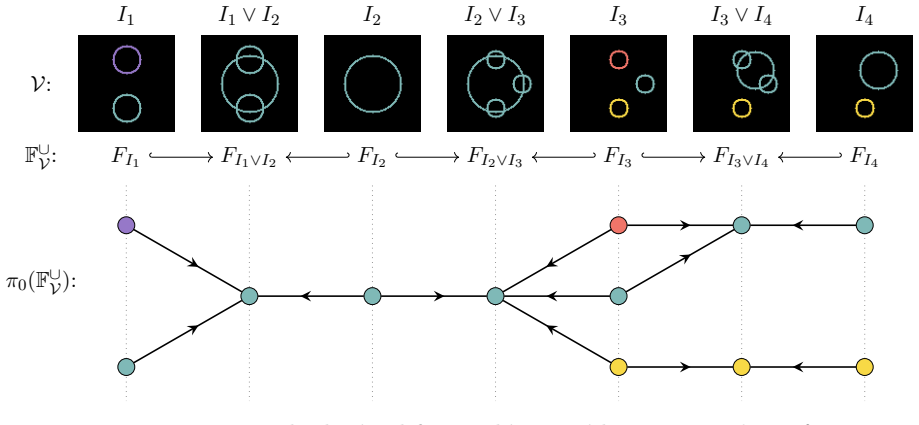
H0 and H1 barcodes for binary video zigzag persistence are extracted directly from connected-component dynamics encoded in a graph.
A machine-rendered reading of the paper's core claim, the machinery that carries it, and where it could break.
Core claim
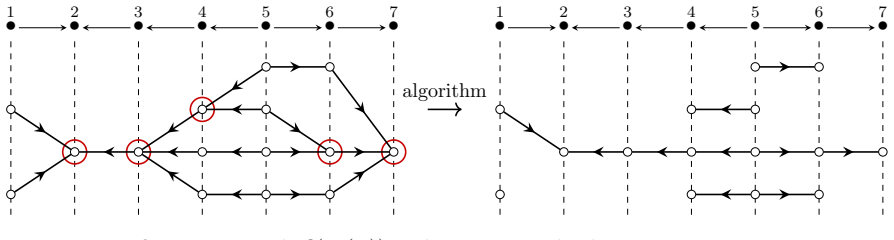
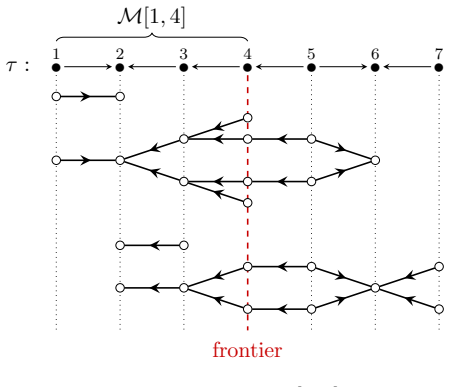
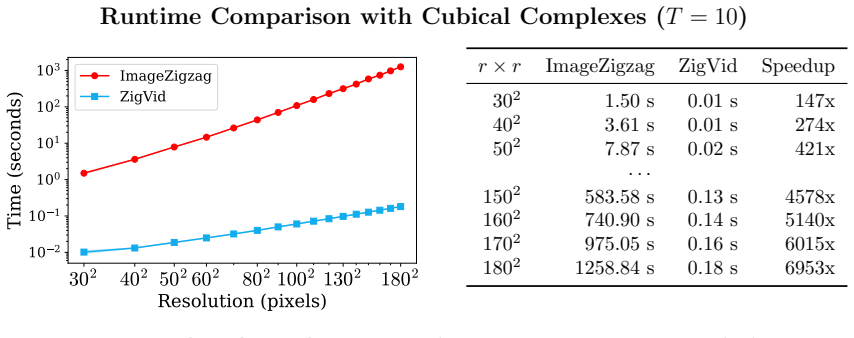
The H0 and H1 barcodes can be extracted directly from connected-component dynamics. By encoding these dynamics in a graph, cubical complexes are bypassed entirely, and the near-linear time barcode decomposition algorithm by Dey and Hou can be leveraged, leading to significant speedups and real-time performance on 4K video.
What carries the argument
Graph encoding of connected-component dynamics, which carries the zigzag persistence information for H0 and H1.
If this is right
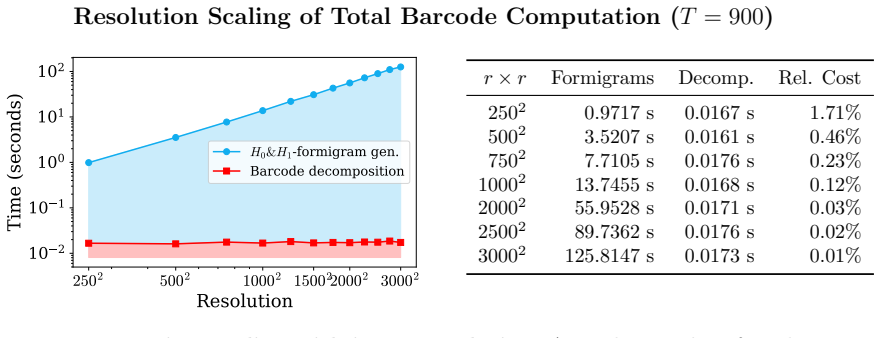
- Runtime is dominated by graph construction which scales linearly with pixel count.
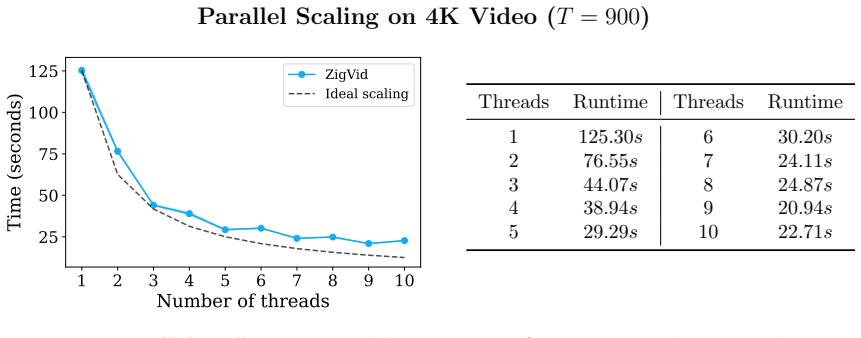
- Processing is embarrassingly parallel across frames.
- Real-time zigzag persistence becomes possible on 4K video on consumer hardware.
- Significant speedups are achieved compared to methods using cubical complexes and Gaussian elimination.
Where Pith is reading between the lines
- This graph encoding might extend to higher-dimensional or non-binary spatio-temporal data if the information preservation holds.
- The linear scaling opens the door to processing longer sequences or higher frame rates without proportional cost increases.
- Integration with existing video pipelines could make topological invariants a standard feature in real-time analysis tools.
Load-bearing premise
That the connected-component dynamics encoded as a graph preserve exactly the same H0 and H1 zigzag persistence information as the full cubical filtration.
What would settle it
Running both the graph method and a standard cubical complex method on the same small binary video sequence and finding differing barcodes would falsify the claim.
Figures

read the original abstract
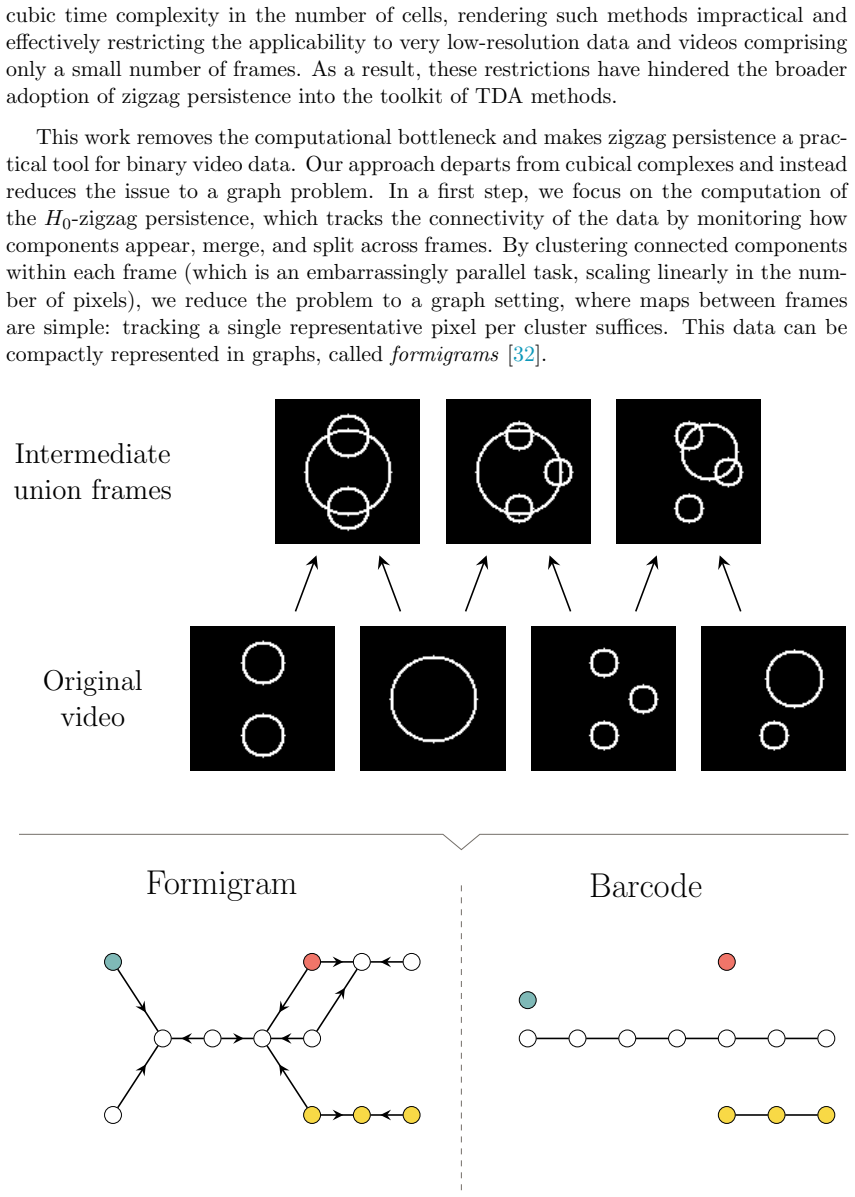
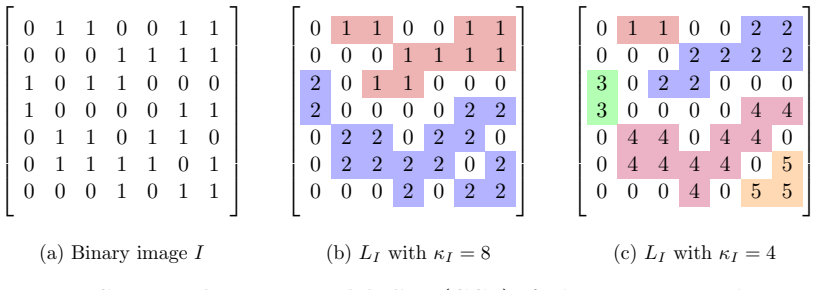
Zigzag persistence tracks topological features in spatio-temporal data through combinatorial invariants called barcodes. For binary videos, existing methods are bottlenecked by the construction of prohibitively large cubical complexes and performing Gaussian elimination on large boundary matrices, rendering high-resolution videos out of reach. We show that the $H_0$ and $H_1$ barcodes can be extracted directly from connected-component dynamics. By encoding these dynamics in a graph, we bypass cubical complexes entirely and are able to leverage the near-linear time barcode decomposition algorithm by Dey and Hou, leading to significant speedups. The total runtime of our pipeline is dominated by the construction of the underlying graph structures, which scales linearly with pixel count and is embarrassingly parallel across frames, ensuring excellent scalability. We demonstrate how this approach enables zigzag persistence on 4k video at real-time rates on consumer hardware.
Editorial analysis
A structured set of objections, weighed in public.
Referee Report
Summary. The manuscript claims that H0 and H1 zigzag persistence barcodes for binary video can be extracted directly from connected-component dynamics encoded as a graph. This bypasses construction of large cubical complexes on the space-time grid, allows use of the near-linear Dey-Hou barcode algorithm, and yields linear scaling in pixel count with frame-wise parallelism, enabling real-time 4K video processing.
Significance. If the graph encoding is shown to induce identical H0/H1 zigzag modules, the result would be a substantial practical advance in computational algebraic topology, removing the main bottleneck for spatio-temporal data and opening real-time topological video analysis. The explicit linear-time and parallel claims, together with the avoidance of Gaussian elimination on large boundary matrices, would be the primary strengths.
major comments (2)
- [Abstract] Abstract: the central claim that the component-dynamics graph preserves exactly the same H1 zigzag module as the cubical filtration is load-bearing yet unsupported by any proof sketch, boundary-map verification, or numerical check; H1 arises from 2-cycles in the cubical boundary operator, and adjacency recording of components alone does not automatically guarantee preservation of the relevant 1-cycles and their relations across frames.
- [Graph construction] Graph-construction section (inferred from abstract): no explicit statement or lemma shows that the inclusion maps or dual cycle information between consecutive frames are faithfully encoded, so it remains possible for the induced persistence diagrams to differ on H1 even when H0 matches.
minor comments (1)
- [Abstract] Abstract should cite the Dey-Hou reference explicitly rather than naming the authors only.
Simulated Author's Rebuttal
We thank the referee for the careful reading and for identifying the need for explicit justification of the H1 equivalence. We address the points below and will revise the manuscript to strengthen the presentation.
read point-by-point responses
-
Referee: [Abstract] Abstract: the central claim that the component-dynamics graph preserves exactly the same H1 zigzag module as the cubical filtration is load-bearing yet unsupported by any proof sketch, boundary-map verification, or numerical check; H1 arises from 2-cycles in the cubical boundary operator, and adjacency recording of components alone does not automatically guarantee preservation of the relevant 1-cycles and their relations across frames.
Authors: We agree that the abstract states the central claim without a supporting lemma or verification. The graph construction records component adjacencies and their evolution in a manner intended to encode the cycle relations that appear as 1-cycles in the cubical setting. To address the concern directly, the revised manuscript will contain an explicit lemma establishing that the induced H1 zigzag module is identical, together with a short numerical check on a controlled example confirming that the barcodes match. revision: yes
-
Referee: [Graph construction] Graph-construction section (inferred from abstract): no explicit statement or lemma shows that the inclusion maps or dual cycle information between consecutive frames are faithfully encoded, so it remains possible for the induced persistence diagrams to differ on H1 even when H0 matches.
Authors: The current text does not contain a formal lemma on the preservation of inclusion maps or cycle information. The graph is built so that edges between component nodes across frames capture the spatial overlaps that determine when 1-cycles form or break; this is why H1 is claimed to be recovered. We will add a precise statement and short proof of this equivalence in the revision, making the encoding of the relevant maps explicit. revision: yes
Circularity Check
No circularity; extraction method presented as independent computational reduction
full rationale
The abstract and description present a direct extraction of H0/H1 barcodes from connected-component dynamics encoded as a graph, bypassing cubical complexes and using an external algorithm (Dey and Hou). No equations, fitted parameters, self-citations, or ansatzes appear that would make any claimed result equivalent to its inputs by construction. The equivalence to cubical zigzag is asserted as a derived property of the encoding rather than defined circularly; the derivation chain remains self-contained with no load-bearing self-referential steps.
Axiom & Free-Parameter Ledger
Reference graph
Works this paper leans on
-
[1]
Computing Zigzag Persistence on Graphs in Near- Linear Time
Tamal K. Dey and Tao Hou. “Computing Zigzag Persistence on Graphs in Near- Linear Time”. In:37th International Symposium on Computational Geometry. Vol. 189. LIPIcs. Leibniz Int. Proc. Inform. Schloss Dagstuhl. Leibniz-Zent. Inform., Wadern, 2021, Art. No. 30, 15.isbn: 978-3-95977-184-9
2021
-
[2]
Persistent Homological Cell Tracking Technology
Haruhisa Oda, Kazuo Tonami, Yoichi Nakata, Naoko Takubo, and Hiroki Kurihara. “Persistent Homological Cell Tracking Technology”. In:Scientific Reports13.1 (July 2023), p. 10882.issn: 2045-2322.doi:10.1038/s41598-023-37760-3. (Visited on 12/02/2025)
-
[3]
Fast Topological Signal Identification and Persistent Cohomological Cycle Matching
In´ es Garc´ ıa-Redondo, Anthea Monod, and Anna Song. “Fast Topological Signal Identification and Persistent Cohomological Cycle Matching”. In:Journal of Ap- plied and Computational Topology8.3 (Sept. 2024), pp. 695–726.issn: 2367-1734. doi:10.1007/s41468-024-00179-4
-
[4]
Simplicial and Topological Descriptions of Human Brain Dynamics
Jacob Billings, Manish Saggar, Jaroslav Hlinka, Shella Keilholz, and Giovanni Petri. “Simplicial and Topological Descriptions of Human Brain Dynamics”. In:Network Neuroscience5.2 (June 2021), pp. 549–568.issn: 2472-1751.doi:10.1162/netn_ a_00190
-
[5]
Generalized Morse Theory of Dis- tance Functions to Surfaces for Persistent Homology
Anna Song, Ka Man Yim, and Anthea Monod. “Generalized Morse Theory of Dis- tance Functions to Surfaces for Persistent Homology”. In:Advances in Applied Mathematics166 (May 2025), p. 102857.issn: 0196-8858.doi:10.1016/j.aam. 2025.102857. (Visited on 12/02/2025)
-
[6]
Anton Fran¸ cois and Rapha¨ el Tinarrage.Train-Free Segmentation in MRI with Cu- bical Persistent Homology. Oct. 2025.doi:10.48550/arXiv.2401.01160. arXiv: 2401.01160 [eess]. (Visited on 12/02/2025)
work page internal anchor Pith review Pith/arXiv arXiv doi:10.48550/arxiv.2401.01160 2025
-
[7]
Naoya Tanabe, Shizuo Kaji, Susumu Sato, Tomoo Yokoyama, Tsuyoshi Oguma, Kiminobu Tanizawa, Tomohiro Handa, Takashi Sakajo, and Toyohiro Hirai. “A Homological Approach to a Mathematical Definition of Pulmonary Fibrosis and Emphysema on Computed Tomography”. In:Journal of Applied Physiology131.2 (2021), pp. 601–612.doi:10.1152/japplphysiol.00150.2021
-
[8]
Chenhao Wang, Leif Østergaard, Stine Hasselholt, and Jon Sporring. “A Semi- Automatic Method for Extracting Mitochondrial Cristae Characteristics from 3D Focused Ion Beam Scanning Electron Microscopy Data”. In:Communications Biol- ogy7.1 (Mar. 2024), p. 377.issn: 2399-3642.doi:10.1038/s42003-024-06045-4
-
[9]
Sunia Tanweer, Firas A. Khasawneh, Elizabeth Munch, and Joshua R. Tempel- man. “A Topological Framework for Identifying Phenomenological Bifurcations in Stochastic Dynamical Systems”. In:Nonlinear Dynamics112.6 (Mar. 2024), pp. 4687–4703.issn: 1573-269X.doi:10.1007/s11071-024-09289-1. (Visited on 11/26/2025)
-
[10]
Applications of Persistent Homology to Time Varying Systems
Elizabeth Munch. “Applications of Persistent Homology to Time Varying Systems”. PhD thesis. 2013. HDL:10161/7180. (Visited on 11/26/2025)
2013
-
[11]
Computing and Visualizing Time-Varying Merge Trees for High-Dimensional Data
Patrick Oesterling, Christian Heine, Gunther H. Weber, Dmitriy Morozov, and Gerik Scheuermann. “Computing and Visualizing Time-Varying Merge Trees for High-Dimensional Data”. In:Topological Methods in Data Analysis and Visual- ization IV. Ed. by Hamish Carr, Christoph Garth, and Tino Weinkauf. Cham: Springer International Publishing, 2017, pp. 87–101.isbn...
-
[12]
Sliding Windows and Persistence: An Application of Topological Methods to Signal Analysis
Jose A. Perea and John Harer. “Sliding Windows and Persistence: An Application of Topological Methods to Signal Analysis”. In:Foundations of Computational Math- ematics15.3 (June 2015), pp. 799–838.issn: 1615-3383.doi:10.1007/s10208- 014-9206-z. (Visited on 11/26/2025)
-
[14]
Time-Varying Reeb Graphs for Continuous Space–Time Data
Herbert Edelsbrunner, John Harer, Ajith Mascarenhas, Valerio Pascucci, and Jack Snoeyink. “Time-Varying Reeb Graphs for Continuous Space–Time Data”. In: Computational Geometry41.3 (Nov. 2008), pp. 149–166.issn: 0925-7721.doi: 10.1016/j.comgeo.2007.11.001. (Visited on 11/26/2025)
-
[15]
Vines and Vineyards by Updating Persistence in Linear Time
David Cohen-Steiner, Herbert Edelsbrunner, and Dmitriy Morozov. “Vines and Vineyards by Updating Persistence in Linear Time”. In:Proceedings of the Twenty- Second Annual Symposium on Computational Geometry. SCG ’06. New York, NY, USA: Association for Computing Machinery, June 2006, pp. 119–126.isbn: 978-1- 59593-340-9.doi:10.1145/1137856.1137877. (Visited...
-
[16]
Visual Detection of Structural Changes in Time-Varying Graphs Using Persistent Homology
Mustafa Hajij, Bei Wang, Carlos Scheidegger, and Paul Rosen. “Visual Detection of Structural Changes in Time-Varying Graphs Using Persistent Homology”. In:2018 IEEE Pacific Visualization Symposium (PacificVis)(Apr. 2018), pp. 125–134.doi: 10.1109/PacificVis.2018.00024. (Visited on 11/26/2025)
-
[17]
Topological Persistence and Simplifica- tion
Edelsbrunner, Letscher, and Zomorodian. “Topological Persistence and Simplifica- tion”. In:Discrete & Computational Geometry28.4 (Nov. 2002), pp. 511–533.issn: 1432-0444.doi:10.1007/s00454-002-2885-2. (Visited on 11/28/2025)
-
[18]
A Roadmap for the Computation of Persistent Homology
Nina Otter, Mason A. Porter, Ulrike Tillmann, Peter Grindrod, and Heather A. Harrington. “A Roadmap for the Computation of Persistent Homology”. In:EPJ Data Science6.1 (Aug. 2017), p. 17.issn: 2193-1127.doi:10.1140/epjds/s13688- 017-0109-5. (Visited on 11/28/2025)
-
[19]
Afra Zomorodian and Gunnar Carlsson. “Computing Persistent Homology”. In: Discrete & Computational Geometry33.2 (Feb. 2005), pp. 249–274.issn: 1432- 0444.doi:10.1007/s00454-004-1146-y. (Visited on 11/28/2025)
-
[20]
Zigzag Persistence
Gunnar Carlsson and Vin de Silva. “Zigzag Persistence”. In:Foundations of Com- putational Mathematics10.4 (Aug. 2010), pp. 367–405.issn: 1615-3383.doi:10. 1007/s10208-010-9066-0. (Visited on 11/26/2025)
2010
-
[21]
Zigzag Persistence for Coral Reef Resilience Using a Stochastic Spatial Model
R. A. McDonald, R. Neuhausler, M. Robinson, L. G. Larsen, H. A. Harrington, and M. Bruna. “Zigzag Persistence for Coral Reef Resilience Using a Stochastic Spatial Model”. In:Journal of The Royal Society Interface20.205 (Aug. 2023), p. 20230280.doi:10.1098/rsif.2023.0280. (Visited on 11/27/2025)
-
[22]
Analysis of Dynamic Graphs and Dynamic Metric Spaces via Zigzag Persistence
Woojin Kim, Facundo M´ emoli, and Zane Smith. “Analysis of Dynamic Graphs and Dynamic Metric Spaces via Zigzag Persistence”. In:Topological Data Analysis. Ed. by Nils A. Baas, Gunnar E. Carlsson, Gereon Quick, Markus Szymik, and Marius Thaule. Cham: Springer International Publishing, 2020, pp. 371–389.isbn: 978-3- 030-43408-3.doi:10.1007/978-3-030-43408-3_14
-
[23]
Tempo- ral Network Analysis Using Zigzag Persistence
Audun Myers, David Mu˜ noz, Firas A. Khasawneh, and Elizabeth Munch. “Tempo- ral Network Analysis Using Zigzag Persistence”. In:EPJ Data Science12.1 (Mar. 2023), p. 6.issn: 2193-1127.doi:10.1140/epjds/s13688-023-00379-5. (Visited on 11/28/2025). 49
-
[24]
Topological Analysis of Temporal Hypergraphs
Audun Myers, Cliff Joslyn, Bill Kay, Emilie Purvine, Gregory Roek, and Made- lyn Shapiro. “Topological Analysis of Temporal Hypergraphs”. In:Algorithms and Models for the Web Graph: 18th International Workshop, WAW 2023, Toronto, ON, Canada, May 23–26, 2023, Proceedings. Berlin, Heidelberg: Springer-Verlag, May 2023, pp. 127–146.isbn: 978-3-031-32295-2.do...
-
[25]
Tracking Dy- namical Features via Continuation and Persistence
Tamal K. Dey, Micha l Lipi´ nski, Marian Mrozek, and Ryan Slechta. “Tracking Dy- namical Features via Continuation and Persistence”. In:38th International Sympo- sium on Computational Geometry (SoCG 2022). Ed. by Xavier Goaoc and Michael Kerber. Vol. 224. Leibniz International Proceedings in Informatics (LIPIcs). Dagstuhl, Germany: Schloss Dagstuhl – Leib...
-
[26]
Bement.Tracking Temporal Evolution of Topological Features in Image Data
Susan Glenn, Jessi Cisewski-Kehe, Jun Zhu, and William M. Bement.Tracking Temporal Evolution of Topological Features in Image Data. Aug. 2025.doi:10 . 48550/arXiv.2508.17530. arXiv:2508.17530 [stat]. (Visited on 11/27/2025)
-
[27]
Topological Classification of Tumour-Immune Interactions and Dynamics
Jingjie Yang, Heidi Fang, Jagdeep Dhesi, Iris H. R. Yoon, Joshua A. Bull, Helen M. Byrne, Heather A. Harrington, and Gillian Grindstaff. “Topological Classification of Tumour-Immune Interactions and Dynamics”. In:Journal of Mathematical Biology 91.3 (Aug. 2025), p. 25.issn: 1432-1416.doi:10 . 1007 / s00285 - 025 - 02253 - 6. (Visited on 11/26/2025)
2025
-
[29]
Zigzag Persistent Ho- mology in Matrix Multiplication Time
Nikola Milosavljevi´ c, Dmitriy Morozov, and Primoz Skraba. “Zigzag Persistent Ho- mology in Matrix Multiplication Time”. In:Proceedings of the Twenty-Seventh An- nual Symposium on Computational Geometry. SoCG ’11. New York, NY, USA: Association for Computing Machinery, June 2011, pp. 216–225.isbn: 978-1-4503- 0682-9.doi:10.1145/1998196.1998229. (Visited ...
-
[30]
Ehrhart Polynomials of Matroid Polytopes and Poly- matroids
Cl´ ement Maria and Hannah Schreiber. “Discrete Morse Theory for Computing Zigzag Persistence”. In:Discrete & Computational Geometry71.2 (Mar. 2024), pp. 708–737.issn: 1432-0444.doi:10.1007/s00454- 023- 00594- x. (Visited on 11/27/2025)
-
[31]
Fast Computation of Zigzag Persistence
Tamal K. Dey and Tao Hou. “Fast Computation of Zigzag Persistence”. In:30th Annual European Symposium on Algorithms (ESA 2022). Ed. by Shiri Chechik, Gonzalo Navarro, Eva Rotenberg, and Grzegorz Herman. Vol. 244. Leibniz Interna- tional Proceedings in Informatics (LIPIcs). Dagstuhl, Germany: Schloss Dagstuhl – Leibniz-Zentrum f¨ ur Informatik, 2022, 43:1–...
- [32]
-
[33]
Discovering block-structured process models from event logs – A constructive approach,
Bea Bleile, Ad´ elie Garin, Teresa Heiss, Kelly Maggs, and Vanessa Robins. “The Persistent Homology of Dual Digital Image Constructions”. In:Research in Com- putational Topology 2. Vol. 30. Assoc. Women Math. Ser. Springer, Cham, [2022] ©2022, pp. 1–26.isbn: 978-3-030-95518-2 978-3-030-95519-9.doi:10.1007/978- 3-030-95519-9\_1. 50
-
[34]
Cotorsion Torsion Triples and the Representation Theory of Filtered Hierarchical Clustering
Ulrich Bauer, Magnus B. Botnan, Steffen Oppermann, and Johan Steen. “Cotorsion Torsion Triples and the Representation Theory of Filtered Hierarchical Clustering”. In:Advances in Mathematics369 (2020), p. 107171.issn: 0001-8708.doi:10.1016/ j.aim.2020.107171
-
[35]
https://arxiv.org/abs/2501.09132v3
Ulrich Bauer, Magnus Bakke Botnan, Steffen Oppermann, and Johan Steen.On the Additive Image of 0th Persistent Homology. https://arxiv.org/abs/2501.09132v3. Jan. 2025. (Visited on 02/09/2026)
-
[36]
https://arxiv.org/abs/2411.19319v1
Riju Bindua, Thomas Br¨ ustle, and Luis Scoccola.Decomposing Zero-Dimensional Persistent Homology over Rooted Tree Quivers. https://arxiv.org/abs/2411.19319v1. Nov. 2024. (Visited on 02/09/2026)
-
[37]
https://arxiv.org/abs/2008.11532v1
Jacek Brodzki, Matthew Burfitt, and Mariam Pirashvili.On the Complexity of Zero- Dimensional Multiparameter Persistence. https://arxiv.org/abs/2008.11532v1. Aug
-
[38]
(Visited on 02/09/2026)
2026
-
[39]
2026.url:https://github.com/Landa233/zigvid(vis- ited on 06/29/2026)
David Lanners.ZigVid. 2026.url:https://github.com/Landa233/zigvid(vis- ited on 06/29/2026)
2026
-
[40]
Finite Topology as Applied to Image Analysis
V.A Kovalevsky. “Finite Topology as Applied to Image Analysis”. In:Computer Vision, Graphics, and Image Processing46.2 (1989), pp. 141–161.issn: 0734-189X. doi:10.1016/0734-189X(89)90165-5
-
[41]
Digital Topology: Introduction and Survey
T.Y Kong and A Rosenfeld. “Digital Topology: Introduction and Survey”. In:Com- puter Vision, Graphics, and Image Processing48.3 (1989), pp. 357–393.issn: 0734- 189X.doi:10.1016/0734-189X(89)90147-3
-
[42]
Theory and Algo- rithms for Constructing Discrete Morse Complexes from Grayscale Digital Images
Vanessa Robins, Peter John Wood, and Adrian P. Sheppard. “Theory and Algo- rithms for Constructing Discrete Morse Complexes from Grayscale Digital Images”. In:IEEE Transactions on Pattern Analysis and Machine Intelligence33.8 (2011), pp. 1646–1658.doi:10.1109/TPAMI.2011.95
-
[43]
May 2020.doi:10.48550/arXiv.2005.04597
Ad´ elie Garin, Teresa Heiss, Kelly Maggs, Bea Bleile, and Vanessa Robins.Duality in Persistent Homology of Images. May 2020.doi:10.48550/arXiv.2005.04597. arXiv:2005.04597 [math]. (Visited on 03/10/2026)
-
[44]
Peter Gabriel. “Unzerlegbare Darstellungen I”. In:manuscripta mathematica6.1 (Mar. 1972), pp. 71–103.issn: 1432-1785.doi:10.1007/BF01298413
-
[45]
Oudot.Persistence Theory: From Quiver Representations to Data Analy- sis
Steve Y. Oudot.Persistence Theory: From Quiver Representations to Data Analy- sis. Mathematical Surveys and Monographs 209. American Mathematical Society, 2015
2015
-
[46]
Parametrized Homology via Zigzag Persistence
Gunnar Carlsson, Vin de Silva, Sara Kaliˇ snik, and Dmitriy Morozov. “Parametrized Homology via Zigzag Persistence”. In:Algebraic and Geometric Topology19.2 (2019), pp. 657–700.issn: 1472-2747,1472-2739.doi:10.2140/agt.2019.19.657
-
[47]
The structure and stability of persistence modules
Fr´ ed´ eric Chazal, Vin de Silva, Marc Glisse, and Steve Oudot. “The Structure and Stability of Persistence Modules”. In:ArXivabs/1207.3674 (2012)
work page internal anchor Pith review Pith/arXiv arXiv 2012
-
[48]
Zigzag Persistent Ho- mology and Real-Valued Functions
Gunnar E. Carlsson, Vin de Silva, and Dmitriy Morozov. “Zigzag Persistent Ho- mology and Real-Valued Functions”. In:Scg ’09. 2009
2009
-
[49]
Cubical Ripser: Software for Com- puting Persistent Homology of Image and Volume Data
Shizuo Kaji, Takeki Sudo, and Kazushi Ahara. “Cubical Ripser: Software for Com- puting Persistent Homology of Image and Volume Data”. In:ArXivabs/2005.12692 (2020)
-
[50]
Ripser: Efficient Computation of Vietoris-Rips Persistence Bar- codes
Ulrich Bauer. “Ripser: Efficient Computation of Vietoris-Rips Persistence Bar- codes”. In:Journal of Applied and Computational Topology5.3 (2021), pp. 391– 423.issn: 2367-1726.doi:10.1007/s41468-021-00071-5. 51
-
[52]
Generalized Persistence Diagrams for Persis- tence Modules over Posets
Woojin Kim and Facundo M´ emoli. “Generalized Persistence Diagrams for Persis- tence Modules over Posets”. In:Journal of Applied and Computational Topology5.4 (Dec. 2021), pp. 533–581.issn: 2367-1734.doi:10.1007/s41468-021-00075-1
-
[53]
Field Choice Problem in Persistent Homol- ogy
Ippei Obayashi and Michio Yoshiwaki. “Field Choice Problem in Persistent Homol- ogy”. In:Discrete & Computational Geometry70.3 (Oct. 2023), pp. 645–670.issn: 1432-0444.doi:10.1007/s00454-023-00544-7. (Visited on 04/24/2026)
-
[54]
Sequential Operations in Digital Picture Processing
Azriel Rosenfeld and John L. Pfaltz. “Sequential Operations in Digital Picture Processing”. In:Journal of The Acm13.4 (Oct. 1966), pp. 471–494.issn: 0004- 5411.doi:10.1145/321356.321357
-
[55]
Lifeng He, Xiwei Ren, Qihang Gao, Xiao Zhao, Bin Yao, and Yuyan Chao. “The Connected-Component Labeling Problem: A Review of State-of-the-Art Algorithms”. In:Pattern Recognition70 (2017), pp. 25–43.issn: 0031-3203.doi:10.1016/j. patcog.2017.04.018
work page doi:10.1016/j 2017
-
[56]
Data Structures for Mergeable Trees
Loukas Georgiadis, Haim Kaplan, Nira Shafrir, Robert Tarjan, and Renato Wer- neck. “Data Structures for Mergeable Trees”. In:ACM Transactions on Algorithms 7 (Mar. 2011), p. 14.doi:10.1145/1921659.1921660
-
[57]
Zigzag Zoology: Rips Zigzags for Homol- ogy Inference
Steve Y. Oudot and Donald R. Sheehy. “Zigzag Zoology: Rips Zigzags for Homol- ogy Inference”. In:Proceedings of the Twenty-Ninth Annual Symposium on Com- putational Geometry. SoCG ’13. New York, NY, USA: Association for Computing Machinery, 2013, pp. 387–396.isbn: 978-1-4503-2031-3.doi:10.1145/2462356. 2462371
-
[58]
Munkres.Elements of Algebraic Topology
James R. Munkres.Elements of Algebraic Topology. Addison-Wesley Publishing Company, Menlo Park, CA, 1984, pp. ix+454.isbn: 0-201-04586-9
1984
-
[59]
Computing Height Persistence and Homology Generators in\mathbb{R}ˆ3\ Efficiently
Tamal K. Dey. “Computing Height Persistence and Homology Generators in\mathbb{R}ˆ3\ Efficiently”. In:arXiv: Computational Geometry(2018)
2018
-
[60]
Herbert Edelsbrunner and John Harer.Computational Topology: An Introduction. Jan. 2010.isbn: 978-0-8218-4925-5.doi:10.1007/978-3-540-33259-6_7
-
[61]
The All-Pairs Min Cut Problem and the Minimum Cycle Basis Problem on Planar Graphs
David Hartvigsen and Russell Mardon. “The All-Pairs Min Cut Problem and the Minimum Cycle Basis Problem on Planar Graphs”. In:Siam Journal On Discrete Mathematics7 (May 1994), pp. 403–418.doi:10.1137/S0895480190177042
- [62]
-
[63]
Nico Stucki, Vincent B¨ urgin, Johannes C. Paetzold, and Ulrich Bauer.Efficient Betti Matching Enables Topology-Aware 3D Segmentation via Persistent Homology. July 2024.doi:10.48550/arXiv.2407.04683. arXiv:2407.04683 [math]. (Visited on 12/02/2025)
-
[64]
2024.url:https://github.com/mrzv/dionysus (visited on 06/29/2026)
Dmitriy Morozov.Dionysus 2. 2024.url:https://github.com/mrzv/dionysus (visited on 06/29/2026). 52
2024
discussion (0)
Sign in with ORCID, Apple, or X to comment. Anyone can read and Pith papers without signing in.