TinyML for On-Device and Edge Analytics in Wireless Networks: A Survey of Deployments, Opportunities, and Concept-Drift Mitigation
Pith reviewed 2026-07-01 01:43 UTC · model grok-4.3
The pith
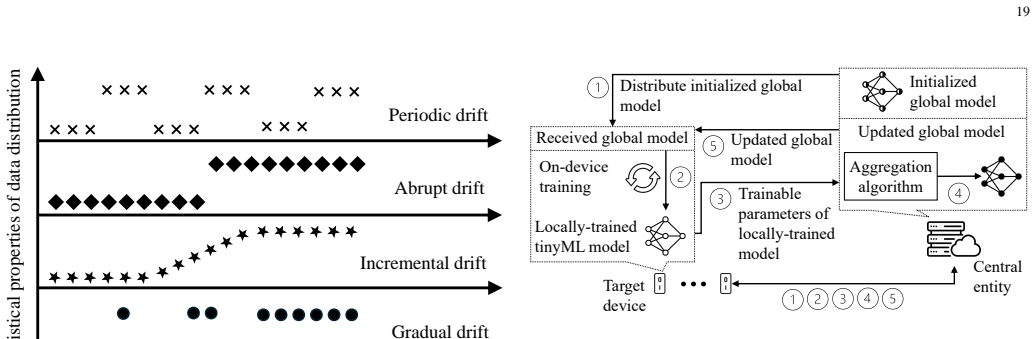
Federated learning-based updates with checkpointing and fault-tolerant mechanisms resolve concept drift for tinyML models on wireless end-devices.
A machine-rendered reading of the paper's core claim, the machinery that carries it, and where it could break.
Core claim
A federated learning-based tinyML model update procedure, supported by update-aware checkpointing, fault-tolerant bootloader, and intermittent-aware modify operation, can resolve the concept drift problem for tinyML models on both battery-powered and batteryless end-devices in wireless networks.
What carries the argument
Federated learning-based tinyML model update procedure, which enables periodic model refreshes on resource-limited devices to maintain accuracy under shifting data distributions.
If this is right
- tinyML can provide data-driven optimization directly at the end-device and edge for real-time, adaptive wireless network operations.
- The federated update procedure applies equally to battery-powered and batteryless devices.
- Update-aware checkpointing, fault-tolerant bootloader, and intermittent-aware modify operation enable reliable model updates under power intermittency.
- Multiple untapped areas exist for applying end-device intelligence across next-generation wireless systems.
Where Pith is reading between the lines
- Widespread adoption could reduce the volume of raw data sent to central servers in wireless networks.
- The same update mechanisms might extend to other energy-harvesting IoT settings outside wireless communications.
- Quantifying actual runtime overhead in realistic deployments would be a direct next measurement to validate practicality.
Load-bearing premise
That federated learning and the listed intermittent computing techniques can be practically adapted to the severe resource and energy constraints of tinyML devices without introducing prohibitive overhead or reliability issues.
What would settle it
A field test deploying the proposed update procedure on a batteryless end-device in a wireless network with measurable concept drift, recording whether model accuracy holds while tracking energy cost and successful update rates.
Figures
read the original abstract
Ubiquitous intelligence is essential for enabling real-time, adaptive, autonomous, and scalable operations in the next generation of wireless networks. However, this poses significant challenges in data management and energy consumption on the end-device/edge side, specially under dynamic environmental conditions. This has driven the adoption of tiny machine learning (tinyML), which offers data-driven optimization at the end-device/edge side. In this work, we survey and thoroughly discuss various tapped/untapped deployment possibilities of tinyML in wireless networks. We identify existing frameworks, accustomed to design tinyML algorithms, that could be utilized to solve a range of wireless network problems. We present a federated learning-based tinyML model update procedure, for both battery-powered and batteryless end-devices, to resolve the concept drift problem faced by tinyML models. Furthermore, we discuss the update-aware checkpointing, fault-tolerant bootloader, and intermittent-aware modify operation, which could support federated learning-based tinyML model update in the case of batteryless end-devices. Overall, this paper spells out several areas where end-device/edge intelligence can be utilized in the next generation of wireless systems, as well as ways to mitigate the concept drift problem faced in the case of end-device intelligence.
Editorial analysis
A structured set of objections, weighed in public.
Referee Report
Summary. The paper surveys deployments and opportunities for tinyML in wireless networks, identifies relevant design frameworks, and presents a conceptual federated learning-based tinyML model update procedure (with update-aware checkpointing, fault-tolerant bootloader, and intermittent-aware modify operation) intended to resolve concept drift for both battery-powered and batteryless end-devices.
Significance. If substantiated, the survey could consolidate knowledge on tinyML applications in wireless systems and the high-level proposal could serve as an architectural outline for adaptive edge intelligence; however, the absence of algorithms, overhead analysis, or validation limits its contribution to guiding concrete implementations.
major comments (1)
- [Abstract (description of the model update procedure)] Abstract (description of the model update procedure): the central claim that the federated learning-based procedure 'can resolve the concept drift problem' is advanced only conceptually, without algorithms, pseudocode, resource-overhead estimates, or any validation data; this directly undermines evaluation of whether the approach is feasible under the severe constraints of tinyML devices.
minor comments (1)
- The term 'intermittent-aware modify operation' is introduced without a precise definition or reference to prior work on intermittent computing, reducing clarity for readers outside that subfield.
Simulated Author's Rebuttal
We thank the referee for their review and constructive feedback on our survey manuscript. We address the major comment point-by-point below.
read point-by-point responses
-
Referee: [Abstract (description of the model update procedure)] Abstract (description of the model update procedure): the central claim that the federated learning-based procedure 'can resolve the concept drift problem' is advanced only conceptually, without algorithms, pseudocode, resource-overhead estimates, or any validation data; this directly undermines evaluation of whether the approach is feasible under the severe constraints of tinyML devices.
Authors: We acknowledge that the federated learning-based tinyML model update procedure, including the supporting mechanisms for batteryless devices, is presented at a conceptual level. The manuscript is a survey whose primary contributions are the consolidation of existing tinyML deployments in wireless networks and the identification of design frameworks and untapped opportunities. The update procedure is offered as a high-level architectural outline to address concept drift rather than as a fully specified algorithm with implementation details or empirical validation. We will revise the abstract (and relevant sections) to explicitly characterize the proposal as conceptual and to clarify that its purpose is to stimulate and guide future concrete implementations under tinyML constraints. revision: yes
Circularity Check
No significant circularity
full rationale
This is a survey paper that outlines deployment possibilities for tinyML in wireless networks and presents a high-level conceptual proposal for a federated learning-based model update procedure (with checkpointing, bootloader, and intermittent-aware operations) to mitigate concept drift. No mathematical derivations, equations, fitted parameters, or self-referential definitions are present. The proposal is framed as an architectural outline of what 'could support' updates rather than a derived result or prediction that reduces to its own inputs by construction. No self-citation chains or uniqueness theorems are invoked as load-bearing elements. The paper is self-contained as a survey and proposal without circular steps.
Axiom & Free-Parameter Ledger
axioms (1)
- domain assumption Dynamic environmental conditions in wireless networks cause concept drift in deployed ML models.
Reference graph
Works this paper leans on
-
[1]
Is TinyML sustainable?
S. Prakash, M. Stewart, C. Banbury, M. Mazumder, P. Warden, B. Plancher, and V . J. Reddi, “Is TinyML sustainable?” Communica- tions of the ACM , vol. 66, no. 11, p. 68–77, Oct. 2023
2023
-
[2]
Energy-sustainable IoT connec- tivity: Vision, technological enablers, challenges, and future directions,
O. L. A. L ´opez, O. M. Rosabal, D. E. Ruiz-Guirola, P. Raghuwanshi, K. Mikhaylov, L. Lov ´en, and S. Iyer, “Energy-sustainable IoT connec- tivity: Vision, technological enablers, challenges, and future directions,” IEEE Open Journal of the Communications Society , vol. 4, pp. 2609– 2666, 2023
2023
-
[3]
Tiny machine learning (Tiny-ML) for efficient channel estimation and signal detection,
H. Liu, Z. Wei, H. Zhang, B. Li, and C. Zhao, “Tiny machine learning (Tiny-ML) for efficient channel estimation and signal detection,” IEEE Transactions on Vehicular Technology, vol. 71, no. 6, pp. 6795–6800, 2022
2022
-
[4]
Implementation of tiny machine learning (TinyML) as pre-distorter for high power amplifier (HPA) linearization of SDR- based MIMO-OFDM,
M. M. Gulo, I. G. P. Astawa, A. Sudarsono, N. A. Priambodo, and M. W. Gunawan, “Implementation of tiny machine learning (TinyML) as pre-distorter for high power amplifier (HPA) linearization of SDR- based MIMO-OFDM,” in Proceedings of the International Electronics Symposium (IES), 2023, pp. 204–210
2023
-
[5]
A TinyML deep learning approach for indoor tracking of assets,
D. Avellaneda, D. Mendez, and G. Fortino, “A TinyML deep learning approach for indoor tracking of assets,” Sensors, vol. 23, no. 3, p. 1542, 2023
2023
-
[6]
Tiny but mighty: Embedded machine learning for indoor wireless localization,
B. Jones, U. Raza, and A. Khan, “Tiny but mighty: Embedded machine learning for indoor wireless localization,” in Proceedings of the IEEE Consumer Communications & Networking Conference (CCNC) , 2023, pp. 176–181
2023
-
[7]
Low-cost air, noise, and light pollution measuring station with wireless communication and TinyML,
J. Botero-Valencia, C. Barrantes-Toro, D. Marquez-Viloria, and J. M. Pearce, “Low-cost air, noise, and light pollution measuring station with wireless communication and TinyML,” HardwareX, vol. 16, p. e00477, 2023
2023
-
[8]
Embedded AI and computation offloading for 6G green communication,
N. Chollet, N. Bouchemal, and R.-C. Amar, “Embedded AI and computation offloading for 6G green communication,” in International Conference on 6G Networking (6GNet) , 2023, pp. 1–4
2023
-
[9]
TinyAirNet: TinyML model transmission for energy-efficient image retrieval from IoT devices,
J. Shiraishi, M. Thorsager, S. R. Pandey, and P. Popovski, “TinyAirNet: TinyML model transmission for energy-efficient image retrieval from IoT devices,” IEEE Communications Letters , vol. 28, no. 9, pp. 2101– 2105, 2024
2024
-
[10]
Tiny machine learning: Progress and futures [feature],
J. Lin, L. Zhu, W.-M. Chen, W.-C. Wang, and S. Han, “Tiny machine learning: Progress and futures [feature],” IEEE Circuits and Systems Magazine, vol. 23, no. 3, pp. 8–34, 2023. 25 TABLE IX PROTOCOL ASPECTS FOR INTEGRATION OF TINY ML TO 6G W IRELESS NETWORKS : KEY CHALLENGES AND RESEARCH DIRECTIONS Realm Challenges Research Direction TinyML- largeML integr...
2023
-
[11]
Addressing limitations of TinyML approaches for AI-enabled ambient intelligence,
A. Bonneau, F. Le Mou ¨el, and F. Mieyeville, “Addressing limitations of TinyML approaches for AI-enabled ambient intelligence,” in Pro- ceedings of the Workshop on Simplification, Compression, Efficiency and Frugality for Artificial intelligence (SCEFA), in conjunction with the European Conference on Machine Learning and Principles and Practice of Knowle...
2023
-
[12]
A comprehensive survey on TinyML,
Y . Abadade, A. Temouden, H. Bamoumen, N. Benamar, Y . Chtouki, and A. S. Hafid, “A comprehensive survey on TinyML,” IEEE Access, vol. 11, pp. 96 892–96 922, 2023
2023
-
[13]
A review on the emerging technology of TinyML,
V . Tsoukas, A. Gkogkidis, E. Boumpa, and A. Kakarountas, “A review on the emerging technology of TinyML,” ACM Computing Surveys , vol. 56, no. 10, Jun. 2024
2024
-
[14]
Lightweight deep learning for resource-constrained environments: A survey,
H.-I. Liu, M. Galindo, H. Xie, L.-K. Wong, H.-H. Shuai, Y .-H. Li, and W.-H. Cheng, “Lightweight deep learning for resource-constrained environments: A survey,”ACM Computing Surveys, vol. 56, no. 10, Jun. 2024
2024
-
[15]
A machine learning-oriented survey on tiny machine learning,
L. Capogrosso, F. Cunico, D. S. Cheng, F. Fummi, and M. Cristani, “A machine learning-oriented survey on tiny machine learning,” IEEE Access, vol. 12, pp. 23 406–23 426, 2024
2024
-
[16]
Efficient neural networks for tiny machine learning: A comprehensive review,
M. Tri L ˆe, P. Wolinski, and J. Arbel, “Efficient neural networks for tiny machine learning: A comprehensive review,” ACM Transactions on Intelligent Systems and Technology , vol. 17, no. 4, 2026
2026
-
[17]
A review on TinyML: State-of-the-art and prospects,
P. P. Ray, “A review on TinyML: State-of-the-art and prospects,” Journal of King Saud University - Computer and Information Sciences , vol. 34, no. 4, pp. 1595–1623, 2022
2022
-
[18]
Machine learning for microcontroller-class hardware: A review,
S. S. Saha, S. S. Sandha, and M. Srivastava, “Machine learning for microcontroller-class hardware: A review,” IEEE Sensors Journal , vol. 22, no. 22, pp. 21 362–21 390, 2022
2022
-
[19]
Advancements in on-device deep neural networks,
K. Saravanan and A. Z. Kouzani, “Advancements in on-device deep neural networks,” Information, vol. 14, no. 8, 2023
2023
-
[20]
TinyML for ultra- low power AI and large scale IoT deployments: A systematic review,
N. Schizas, A. Karras, C. Karras, and S. Sioutas, “TinyML for ultra- low power AI and large scale IoT deployments: A systematic review,” Future Internet, vol. 14, no. 12, 2022
2022
-
[21]
Advancements in TinyML: Applications, limitations, and impact on IoT devices,
A. Elhanashi, P. Dini, S. Saponara, and Q. Zheng, “Advancements in TinyML: Applications, limitations, and impact on IoT devices,” Electronics, vol. 13, no. 17, 2024
2024
-
[22]
TinyML: Tools, applications, challenges, and future research direc- tions,
R. Kallimani, K. Pai, P. Raghuwanshi, S. Iyer, and O. L. L ´opez, “TinyML: Tools, applications, challenges, and future research direc- tions,” Multimedia Tools and Applications, vol. 83, no. 10, pp. 29 015– 29 045, 2024
2024
-
[23]
TinyML for transporta- tion systems: Enabling smart mobility,
S. Sai, K. Shah, G. Jain, and V . Chamola, “TinyML for transporta- tion systems: Enabling smart mobility,” IEEE Consumer Electronics Magazine, pp. 1–10, 2026
2026
-
[24]
A review on resource- constrained embedded vision systems-based tiny machine learning for robotic applications,
M. Beltr ´an-Escobar, T. E. Alarc ´on, J. Y . Rumbo-Morales, S. L ´opez, G. Ortiz-Torres, and F. D. J. Sorcia-V ´azquez, “A review on resource- constrained embedded vision systems-based tiny machine learning for robotic applications,” Algorithms, vol. 17, no. 11, 2024
2024
-
[25]
Lightweight AI for drones: A survey,
M. Krichen, M. S. Abdalzaher, M. Shaaban, and R. Aburukba, “Lightweight AI for drones: A survey,” in Proceedings of the Inter- national Youth Conference on Radio Electronics, Electrical and Power Engineering (REEPE), 2025, pp. 1–6
2025
-
[26]
Tiny machine learning and on-device inference: A survey of applications, challenges, and future directions,
S. Heydari and Q. H. Mahmoud, “Tiny machine learning and on-device inference: A survey of applications, challenges, and future directions,” Sensors, vol. 25, no. 10, 2025
2025
-
[27]
TinyML and edge intelligence applications in cardiovascular disease: A survey,
A. R. Keivanimehr and M. Akbari, “TinyML and edge intelligence applications in cardiovascular disease: A survey,”Computers in Biology and Medicine, vol. 186, p. 109653, 2025
2025
-
[28]
A comprehensive survey on tiny machine learning for human behavior analysis,
I. Lamaakal, S. Essahraui, Y . Maleh, K. E. Makkaoui, I. Ouahbi, M. F. Bouami, A. A. A. El-Latif, M. Almousa, J. Peng, and D. Niyato, “A comprehensive survey on tiny machine learning for human behavior analysis,” IEEE Internet of Things Journal , pp. 1–1, 2025
2025
-
[29]
A holistic review of the TinyML stack for predictive maintenance,
E. Njor, M. A. Hasanpour, J. Madsen, and X. Fafoutis, “A holistic review of the TinyML stack for predictive maintenance,” IEEE Access, vol. 12, pp. 184 861–184 882, 2024
2024
-
[30]
Zero-energy devices for 6G: Technical enablers at a glance,
O. L ´opez, R. K. Singh, D.-T. Phan-Huy, E. Katranaras, N. Mazloum, R. J ¨antti, H. Khan, O. Rosabal, P. Alexias, P. Raghuwanshi et al. , “Zero-energy devices for 6G: Technical enablers at a glance,” IEEE Internet of Things Magazine , vol. 8, no. 3, pp. 14–22, 2025
2025
-
[31]
On-device anomaly detection in conveyor belt operations,
L. S. Martinez-Rau, Y . Zhang, B. Oelmann, and S. Bader, “On-device anomaly detection in conveyor belt operations,” IEEE Open Journal of Instrumentation and Measurement , vol. 4, pp. 1–9, 2025
2025
-
[32]
TinyML for eddy current testing: A review of advances, challenges, and applications,
S. Qin, Y . Chen, M. Masuduzzaman, C. Xu, R. Li, T. Wu, D. Fu, W. Jiang, and T. R. Gadekallu, “TinyML for eddy current testing: A review of advances, challenges, and applications,” IEEE Internet of Things Journal, pp. 1–1, 2026
2026
-
[33]
A comprehensive survey of TinyML- 26 based biometric recognition for IoT edge devices,
S. Essahraui and I. Lamaakal, “A comprehensive survey of TinyML- 26 based biometric recognition for IoT edge devices,” IEEE Internet of Things Journal, vol. 13, no. 6, pp. 10 564–10 588, 2026
2026
-
[34]
AutoML for on-sensor tiny machine learning,
M. Chowdhary, D. Lilienthal, S. S. Saha, and K. C. Palle, “AutoML for on-sensor tiny machine learning,” IEEE Sensors Letters, vol. 7, no. 11, pp. 1–4, 2023
2023
-
[35]
Reliability assessment of tiny machine learning algorithms in the presence of control flow errors,
B. Eubanks, A. Patooghy, and O. Kursun, “Reliability assessment of tiny machine learning algorithms in the presence of control flow errors,” in Proceedings of the IEEE International Midwest Symposium on Circuits and Systems (MWSCAS) , 2021, pp. 50–54
2021
-
[36]
Memory- aware efficient deep learning mechanism for IoT devices,
J. Banerjee, S. Islam, W. Wei, C. Pan, D. Zhu, and M. Xie, “Memory- aware efficient deep learning mechanism for IoT devices,” in Pro- ceedings of the IEEE International Conference on Application-specific Systems, Architectures and Processors (ASAP) , 2021, pp. 187–194
2021
-
[37]
TinyML for UWB-radar based presence detection,
M. Pavan, A. Caltabiano, and M. Roveri, “TinyML for UWB-radar based presence detection,” in Proceedings of the International Joint Conference on Neural Networks (IJCNN) , 2022, pp. 1–8
2022
-
[38]
MicroNets: Neural network architectures for deploying TinyML applications on commod- ity microcontrollers,
C. Banbury, C. Zhou, I. Fedorov, R. Matas, U. Thakker, D. Gope, V . Janapa Reddi, M. Mattina, and P. Whatmough, “MicroNets: Neural network architectures for deploying TinyML applications on commod- ity microcontrollers,” inProceedings of Machine Learning and Systems, vol. 3, 2021, pp. 517–532
2021
-
[39]
Randomized approximate channel estimator in massive-MIMO communication,
B. Li, S. Wang, J. Zhang, X. Cao, J. Zhang, and C. Zhao, “Randomized approximate channel estimator in massive-MIMO communication,” IEEE Communications Letters , vol. 24, no. 10, pp. 2314–2318, 2020
2020
-
[40]
Improving CUR matrix decomposition and the Nystrom approximation via adaptive sampling,
S. Wang and Z. Zhang, “Improving CUR matrix decomposition and the Nystrom approximation via adaptive sampling,” Journal of Machine Learning Research, vol. 14, no. 47, pp. 2729–2769, 2013
2013
-
[41]
Online anomaly detection based on reservoir sampling and lof for IoT devices,
T. Szydlo, “Online anomaly detection based on reservoir sampling and lof for IoT devices,” arXiv preprint arXiv:2206.14265 , 2022
-
[42]
On-device tiny machine learning for anomaly detection based on the extreme values theory,
E. S. Pereira, L. S. Marcondes, and J. M. Silva, “On-device tiny machine learning for anomaly detection based on the extreme values theory,” IEEE Micro, vol. 43, no. 6, pp. 58–65, 2023
2023
-
[43]
An adaptive TinyML unsupervised online learning algorithm for driver behavior analysis,
M. Silva, T. Medeiros, M. Azevedo, M. Medeiros, M. Themoteo, T. Gois, I. Silva, and D. G. Costa, “An adaptive TinyML unsupervised online learning algorithm for driver behavior analysis,” in Proceedings of the IEEE International Workshop on Metrology for Automotive (MetroAutomotive), 2023, pp. 199–204
2023
-
[44]
TinyML algorithms for big data management in large-scale IoT systems,
A. Karras, A. Giannaros, C. Karras, L. Theodorakopoulos, C. S. Mammassis, G. A. Krimpas, and S. Sioutas, “TinyML algorithms for big data management in large-scale IoT systems,” Future Internet , vol. 16, no. 2, 2024
2024
-
[45]
OnceNAS: Discovering efficient on-device inference neural networks for edge devices,
Y . Zhang, Y . Qin, Y . Zhang, X. Zhou, S. Jian, Y . Tan, and K. Li, “OnceNAS: Discovering efficient on-device inference neural networks for edge devices,” Information Sciences, vol. 669, p. 120567, 2024
2024
-
[46]
Designing and training of lightweight neural networks on edge devices using early halting in knowledge distillation,
R. Mishra and H. P. Gupta, “Designing and training of lightweight neural networks on edge devices using early halting in knowledge distillation,” IEEE Transactions on Mobile Computing , vol. 23, no. 5, pp. 4665–4677, 2024
2024
-
[47]
Automated pest detection with DNN on the edge for precision agriculture,
A. Albanese, M. Nardello, and D. Brunelli, “Automated pest detection with DNN on the edge for precision agriculture,” IEEE Journal on Emerging and Selected Topics in Circuits and Systems , vol. 11, no. 3, pp. 458–467, Sept. 2021
2021
-
[48]
PoPS: Policy pruning and shrinking for deep reinforcement learning,
D. Livne and K. Cohen, “PoPS: Policy pruning and shrinking for deep reinforcement learning,” IEEE Journal of Selected Topics in Signal Processing, vol. 14, no. 4, pp. 789–801, 2020
2020
-
[49]
TinyNS: Platform-aware neurosymbolic auto tiny machine learning,
S. S. Saha, S. S. Sandha, M. Aggarwal, B. Wang, L. Han, J. D. G. Briseno, and M. Srivastava, “TinyNS: Platform-aware neurosymbolic auto tiny machine learning,” ACM Transactions on Embedded Com- puting Systems, vol. 23, no. 3, pp. 1–48, May 2024
2024
-
[50]
Resource efficient deep reinforcement learning for acutely constrained TinyML devices,
F. Svoboda, D. Nunes, M. Alizadeh, R. Daries, R. Luo, A. Mathur, S. Bhattacharya, J. S. Silva, and N. D. Lane, “Resource efficient deep reinforcement learning for acutely constrained TinyML devices,” in Proceedings of the Research Symposium on Tiny Machine Learning , 2020
2020
-
[51]
tinyMAN: Lightweight energy manager using reinforcement learning for energy harvesting wearable IoT devices,
T. Basaklar, Y . Tuncel, and U. Y . Ogras, “tinyMAN: Lightweight energy manager using reinforcement learning for energy harvesting wearable IoT devices,” TinyML Symposium, pp. 1–7, 2022
2022
-
[52]
Intelligence beyond the edge: Inference on intermittent embedded systems,
G. Gobieski, B. Lucia, and N. Beckmann, “Intelligence beyond the edge: Inference on intermittent embedded systems,” in Proceedings of the International Conference on Architectural Support for Program- ming Languages and Operating Systems (ASPLOS) , 2019, pp. 199– 213
2019
-
[53]
Local binary pattern networks,
J.-H. Lin, J. Lazarow, Y . Yang, D. Hong, R. K. Gupta, and Z. Tu, “Local binary pattern networks,” in Proceedings of the IEEE Winter Conference on Applications of Computer Vision (WACV) , 2020, pp. 814–823
2020
-
[54]
Enabling fast deep learning on tiny energy-harvesting IoT devices,
S. Islam, J. Deng, S. Zhou, C. Pan, C. Ding, and M. Xie, “Enabling fast deep learning on tiny energy-harvesting IoT devices,” in Proceedings of the Design, Automation & Test in Europe Conference & Exhibition (DATE), 2022, pp. 921–926
2022
-
[55]
Edge-efficient deep learn- ing models for automatic modulation classification: A performance analysis,
N. M. Baishya, B. R. Manoj, and P. K. Bora, “Edge-efficient deep learn- ing models for automatic modulation classification: A performance analysis,” in Proceedings of the IEEE Wireless Communications and Networking Conference (WCNC) , 2024, pp. 1–6
2024
-
[56]
Tiny machine learning for high accuracy product quality inspection,
A. Albanese, M. Nardello, G. Fiacco, and D. Brunelli, “Tiny machine learning for high accuracy product quality inspection,” IEEE Sensors Journal, vol. 23, no. 2, pp. 1575–1583, Jan. 2023
2023
-
[57]
TinyM 2Net-V3: Memory-aware compressed multimodal deep neural networks for sustainable edge deployment,
H.-A. Rashid and T. Mohsenin, “TinyM 2Net-V3: Memory-aware compressed multimodal deep neural networks for sustainable edge deployment,” in Proceedings of the Workshop on Sustainable AI - AAAI Conference on Artificial Intelligence (SAI-AAAI) , 2024, pp. 1–7
2024
-
[58]
SquishedNets: Squishing squeezenet further for edge device scenarios via deep evolutionary synthesis,
M. J. Shafiee, F. Li, B. Chwyl, and A. Wong, “SquishedNets: Squishing squeezenet further for edge device scenarios via deep evolutionary synthesis,” in Proceedings of the Conference on Neural Information Processing Systems (NIPS) , 2017, p. 4985–4988
2017
-
[59]
MCUNet: Tiny deep learning on IoT devices,
J. Lin, W.-M. Chen, Y . Lin, j. cohn, C. Gan, and S. Han, “MCUNet: Tiny deep learning on IoT devices,” in Proceedings of the Advances in Neural Information Processing Systems (NeurIPS) , vol. 33, 2020, pp. 11 711–11 722
2020
-
[60]
EtinyNet: Extremely tiny network for TinyML,
K. Xu, Y . Li, H. Zhang, R. Lai, and L. Gu, “EtinyNet: Extremely tiny network for TinyML,” in Proceedings of the AAAI Conference on Artificial Intelligence, vol. 36, no. 4, Jun. 2022, pp. 4628–4636
2022
-
[61]
Driving the future with edge computing: a review of data offloading, enabling technologies and trends for autonomous vehicles,
S. Kulandaivel and U. C. Akuthota, “Driving the future with edge computing: a review of data offloading, enabling technologies and trends for autonomous vehicles,” Internet of Things, vol. 38, p. 101963, 2026
2026
-
[62]
MIGS: A modular edge gateway with instance-based isolation for heterogeneous industrial IoT interoperability,
Y . Ai, Y . Zhu, Y . Jiang, and Y . Deng, “MIGS: A modular edge gateway with instance-based isolation for heterogeneous industrial IoT interoperability,” Sensors, vol. 26, no. 1, 2026
2026
-
[63]
Fog/edge computing-based iot (FECIoT): Architecture, applications, and research issues,
B. Omoniwa, R. Hussain, M. A. Javed, S. H. Bouk, and S. A. Malik, “Fog/edge computing-based iot (FECIoT): Architecture, applications, and research issues,” IEEE Internet of Things Journal , vol. 6, no. 3, pp. 4118–4149, 2019
2019
-
[64]
TinyOL: TinyML with online- learning on microcontrollers,
H. Ren, D. Anicic, and T. A. Runkler, “TinyOL: TinyML with online- learning on microcontrollers,” in Proceedings of the International Joint Conference on Neural Networks (IJCNN) , 2021, pp. 1–8
2021
-
[65]
Tin-Tin: Towards tiny learning on tiny devices with integer-based neural network training,
Y . Hu, J. Zuo, E. Zhang, B. Iannucci, and C. Joe-Wong, “Tin-Tin: Towards tiny learning on tiny devices with integer-based neural network training,” arXiv preprint arXiv:2504.09405 , 2025
-
[66]
Sensors, excitation, and linearization,
P. H. Garrett, “Sensors, excitation, and linearization,” in Advanced Instrumentation and Computer I/O Design: Real-Time Computer In- teractive Engineering. IEEE, 1994, pp. 1–29
1994
-
[67]
Tiny neural deep clustering: An unsupervised approach for continual machine learning on the edge,
G. Poletti, A. Albanese, M. Nardello, and D. Brunelli, “Tiny neural deep clustering: An unsupervised approach for continual machine learning on the edge,” in Proceedings of the International Conference on Applications in Electronics Pervading Industry, Environment and Society (APPLEPIES), 2024, pp. 117–123
2024
-
[68]
Towards energy-aware TinyML on battery-less IoT devices,
A. Sabovic, M. Aernouts, D. Subotic, J. Fontaine, E. De Poorter, and J. Famaey, “Towards energy-aware TinyML on battery-less IoT devices,” Internet of Things , vol. 22, p. 100736, 2023
2023
-
[69]
A battery-free long-range wireless smart camera for face detection,
M. Giordano, P. Mayer, and M. Magno, “A battery-free long-range wireless smart camera for face detection,” in Proceedings of the International Workshop on Energy Harvesting and Energy-Neutral Sensing Systems (ENSsys) , 2020, p. 29–35
2020
-
[70]
Controlling action space of reinforcement-learning-based energy management in batteryless appli- cations,
J. Ahn, D. Kim, R. Ha, and H. Cha, “Controlling action space of reinforcement-learning-based energy management in batteryless appli- cations,” IEEE Internet of Things Journal , vol. 10, no. 11, pp. 9928– 9941, 2023
2023
-
[71]
Reinforcement learning-based adaptive stateless routing for ambient backscatter wireless sensor networks,
H. Guo, D. Yang, and H. Gao, “Reinforcement learning-based adaptive stateless routing for ambient backscatter wireless sensor networks,” IEEE Transactions on Communications , pp. 1–1, 2024
2024
-
[72]
Proximal Policy Optimization Algorithms
J. Schulman, F. Wolski, P. Dhariwal, A. Radford, and O. Klimov, “Prox- imal policy optimization algorithms,”arXiv preprint arXiv:1707.06347, 2017
work page internal anchor Pith review Pith/arXiv arXiv 2017
-
[73]
A survey of actor-critic reinforcement learning: Standard and natural policy gradients,
I. Grondman, L. Busoniu, G. A. D. Lopes, and R. Babuska, “A survey of actor-critic reinforcement learning: Standard and natural policy gradients,” IEEE Transactions on Systems, Man, and Cybernetics, Part C (Applications and Reviews) , vol. 42, no. 6, pp. 1291–1307, 2012
2012
-
[74]
Marble: collaborative scheduling of batteryless sensors with meta reinforcement learning,
F. Fraternali, B. Balaji, D. Hong, Y . Agarwal, and R. K. Gupta, “Marble: collaborative scheduling of batteryless sensors with meta reinforcement learning,” inProceedings of the International Conference on Systems for Energy-Efficient Buildings, Cities, and Transportation (BuildSys), 2021, p. 140–149. 27
2021
-
[75]
Shoeibi, A
M. Shoeibi, A. E. Oskouei, and M. Kaveh, “A novel six-dimensional chimp optimization algorithm—deep reinforcement learning-based op- timization scheme for reconfigurable intelligent surface-assisted energy harvesting in batteryless IoT networks,”Future Internet, vol. 16, no. 12, 2024
2024
-
[76]
On the layer selection in small-scale deep networks,
A. Muravev, J. Raitoharju, and M. Gabbouj, “On the layer selection in small-scale deep networks,” in Proceedings of the European Workshop on Visual Information Processing (EUVIP) , 2018, pp. 1–6
2018
-
[77]
Linearization of the sensors characteristics: a review,
T. Islam and S. C. Mukhopadhyay, “Linearization of the sensors characteristics: a review,” International Journal on Smart Sensing and Intelligent Systems, vol. 12, no. 1, pp. 1–21, 2019
2019
-
[78]
Object detection and heading estimation from radar raw data,
R. Kothari, A. Kariminezhad, C. Mayr, and H. Zhang, “Object detection and heading estimation from radar raw data,” in Proceedings of the IEEE Intelligent Vehicles Symposium (IV) , 2023, pp. 1–7
2023
-
[79]
RadarTCN: Lightweight online classification network for automotive radar targets based on TCN,
Y . Li, M. Zhang, H. Jing, and Z. Liu, “RadarTCN: Lightweight online classification network for automotive radar targets based on TCN,” Sensors, vol. 24, no. 9, 2024
2024
-
[80]
Cramnet: Camera-radar fusion with ray-constrained cross-attention for robust 3D object detection,
J.-J. Hwang, H. Kretzschmar, J. Manela, S. Rafferty, N. Armstrong- Crews, T. Chen, and D. Anguelov, “Cramnet: Camera-radar fusion with ray-constrained cross-attention for robust 3D object detection,” in Computer Vision – ECCV 2022, S. Avidan, G. Brostow, M. Ciss´e, G. M. Farinella, and T. Hassner, Eds. Cham: Springer Nature Switzerland, 2022, pp. 388–405
2022
discussion (0)
Sign in with ORCID, Apple, or X to comment. Anyone can read and Pith papers without signing in.