Editable Physically-based Reflections in Raytraced Gaussian Radiance Fields
Pith reviewed 2026-07-01 01:21 UTC · model grok-4.3
The pith
Optimizing a diffuse Gaussian scene and applying path tracing reconstructs true reflectors and reflected objects for real-time editable specular reflections.
A machine-rendered reading of the paper's core claim, the machinery that carries it, and where it could break.
Core claim
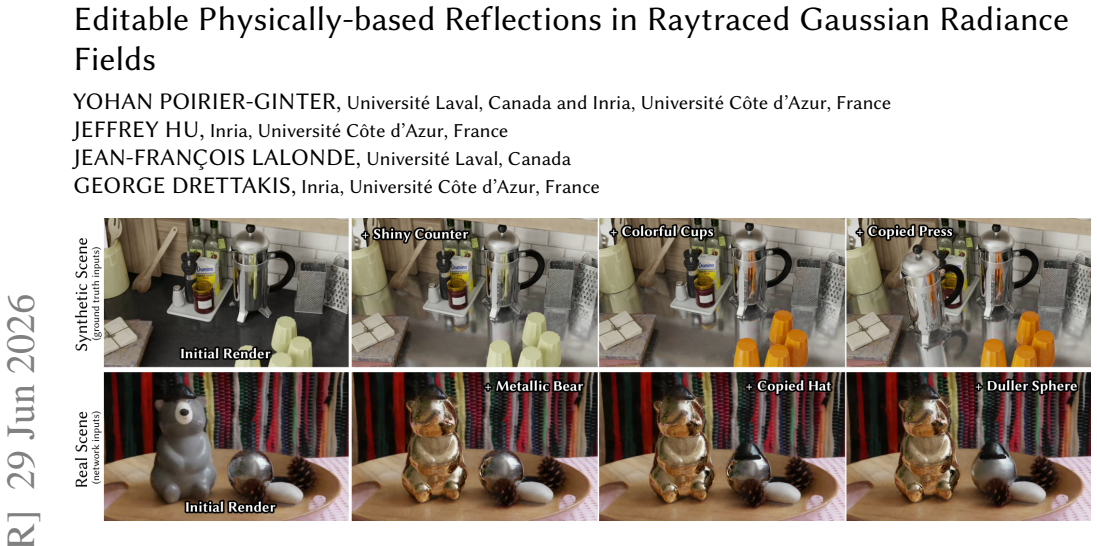
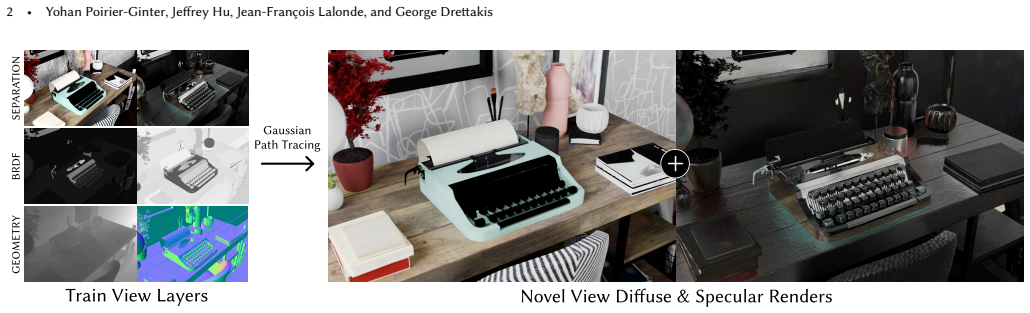
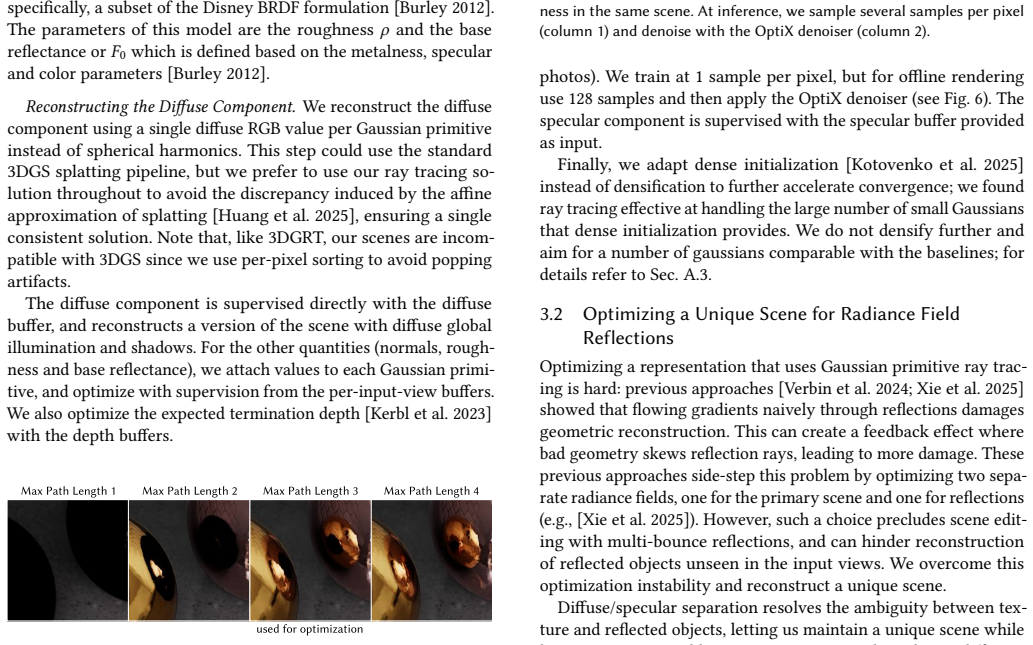
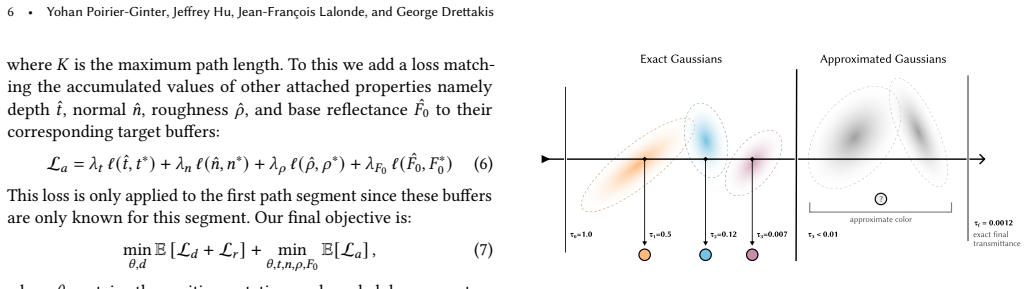
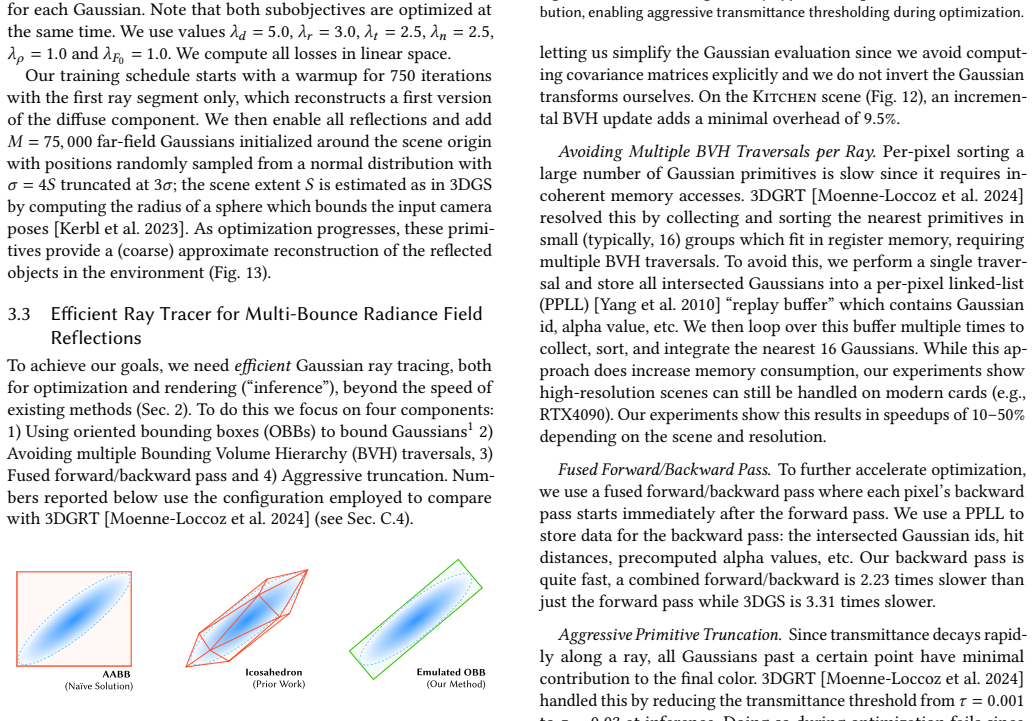
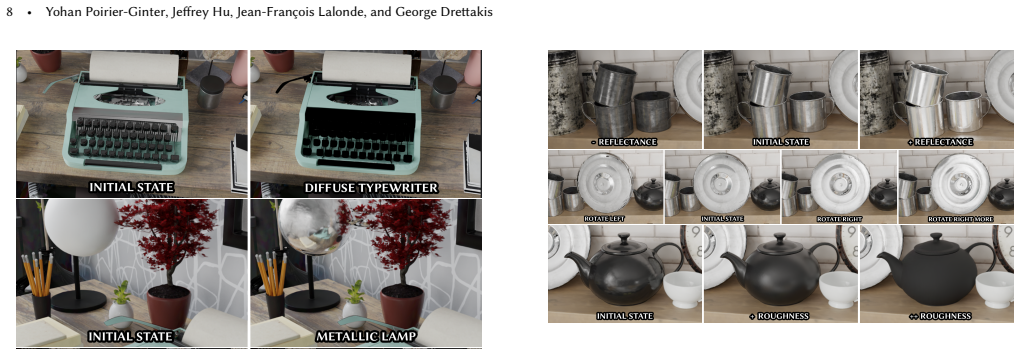
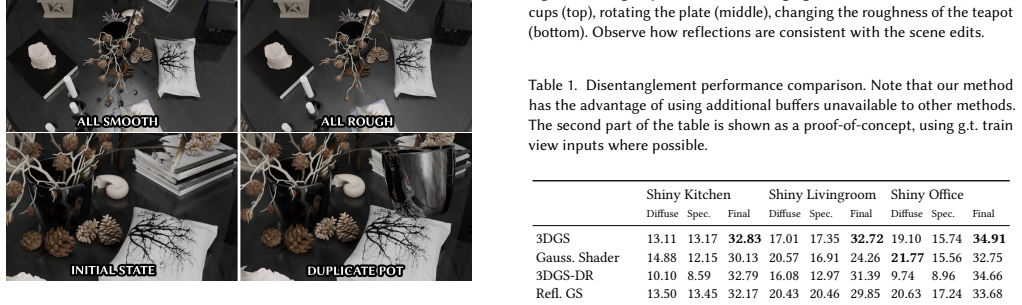
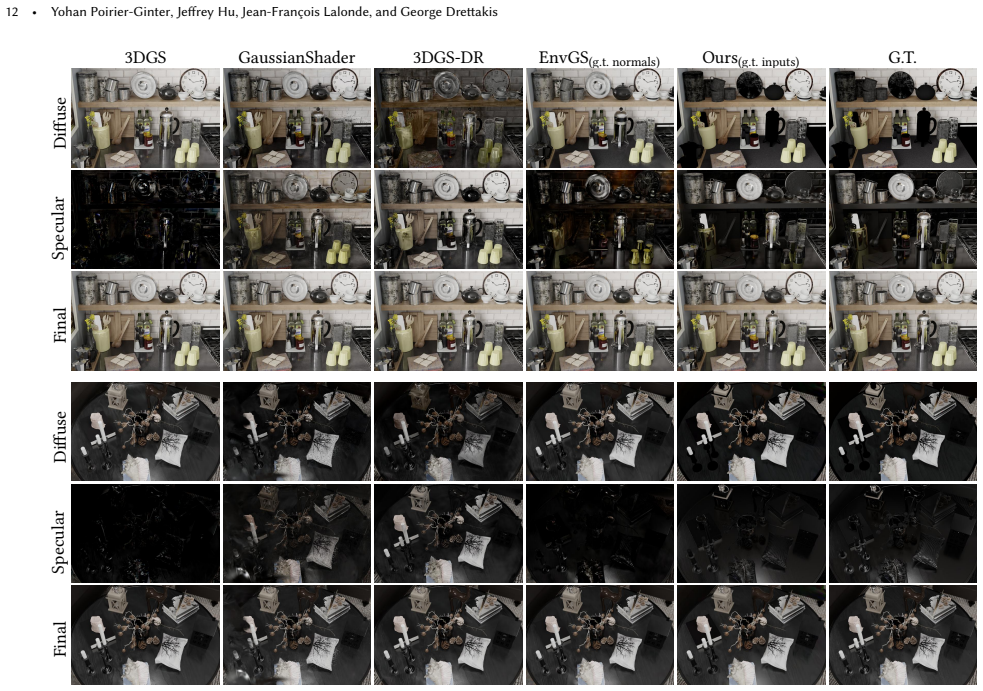
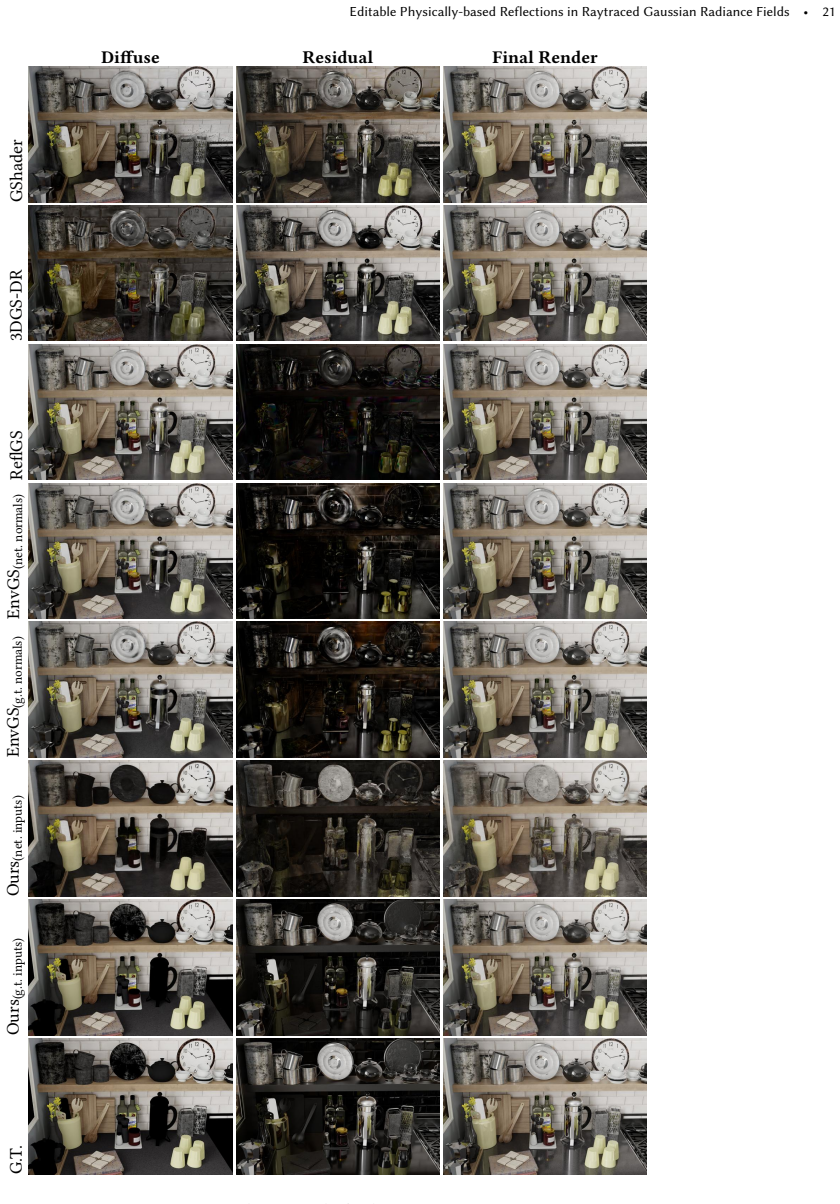
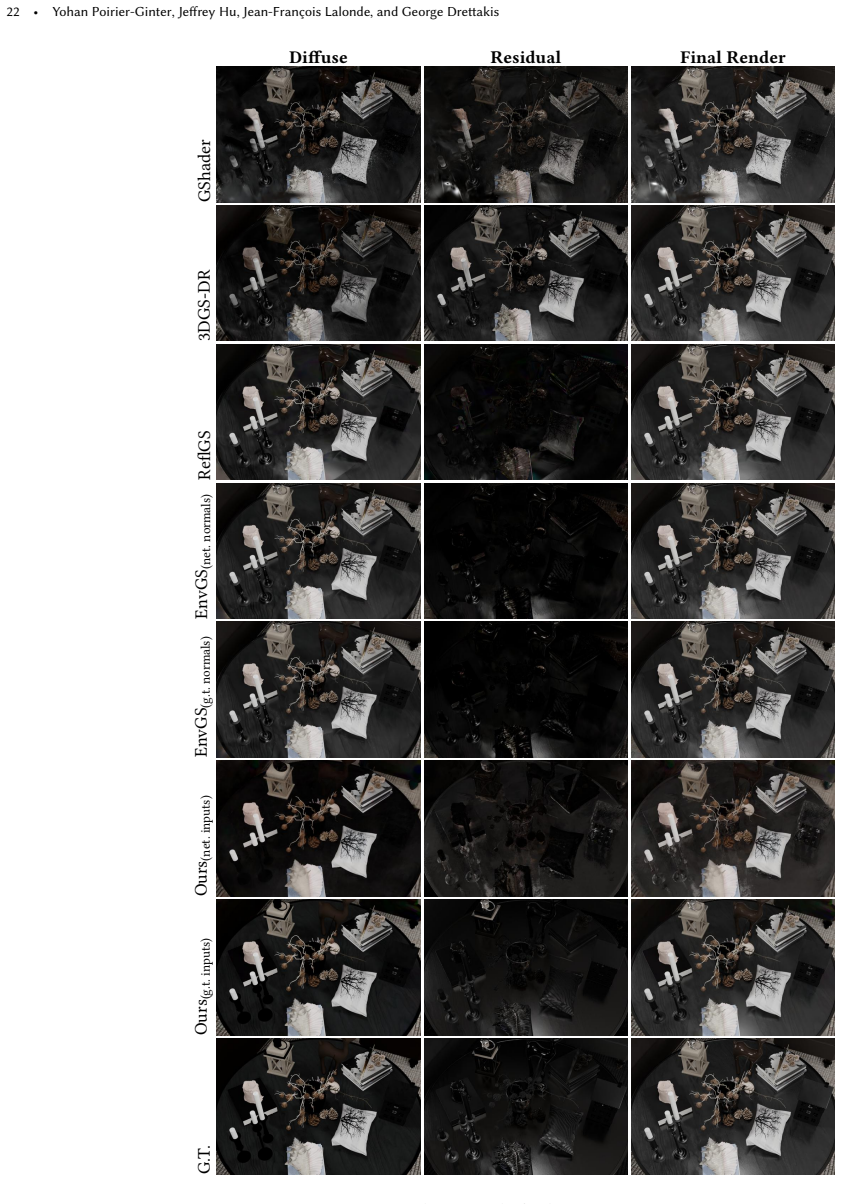
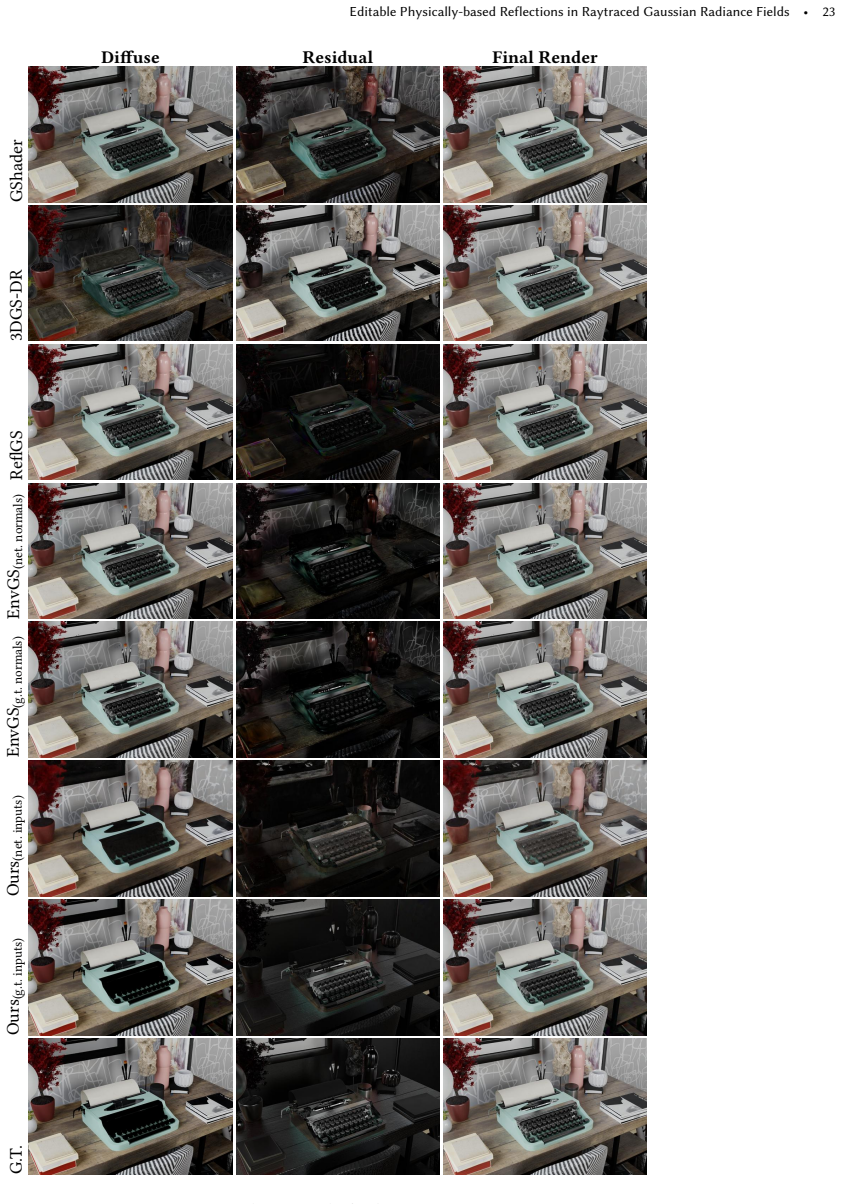
By using diffuse and specular buffers of input training views, we optimize a diffuse version of the scene and use path tracing to efficiently generate physically based specular reflections. A specialized training method allows this process to converge. A fast ray tracing algorithm for 3D Gaussian primitives enables efficient multi-bounce reflections. Our method reconstructs reflectors and reflected objects, including those not seen in the input images, in a unique scene representation. Our solution allows real-time, consistent editing of captured scenes with specular reflections, including multi-bounce effects, changing roughness, and more.
What carries the argument
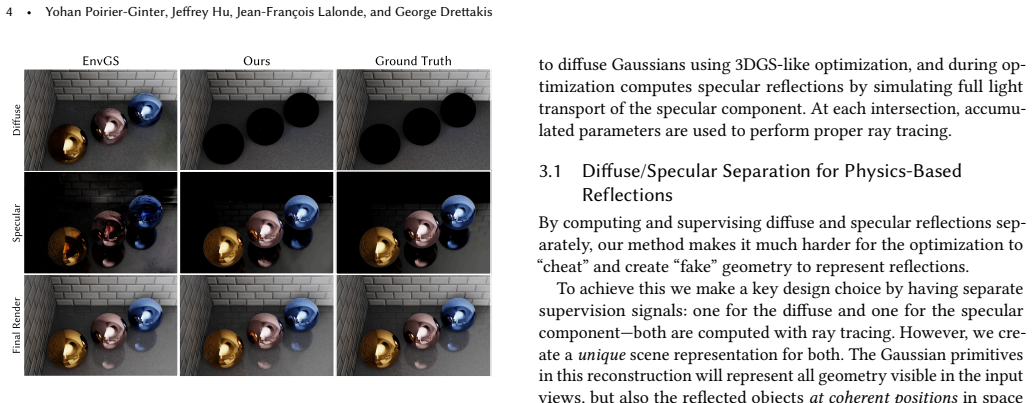
A diffuse-only 3D Gaussian scene representation optimized from specular-free buffers, augmented at render time by path tracing and a specialized ray tracer for Gaussian primitives.
If this is right
- Multi-bounce specular reflections become available without storing fake geometry behind reflectors.
- Surface properties such as roughness can be changed after capture while reflections update consistently across all views.
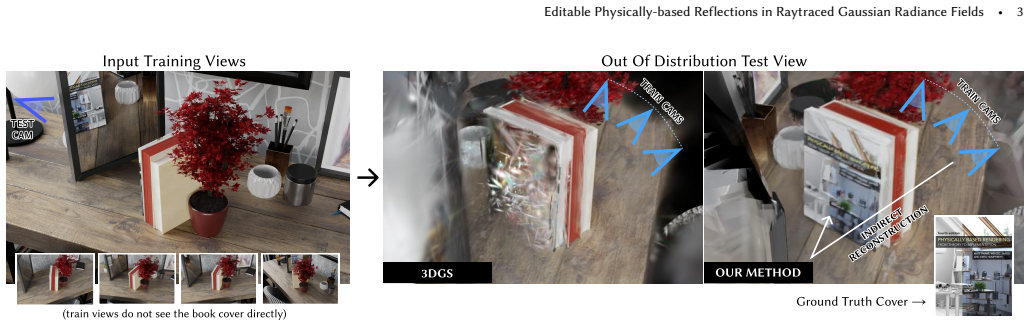
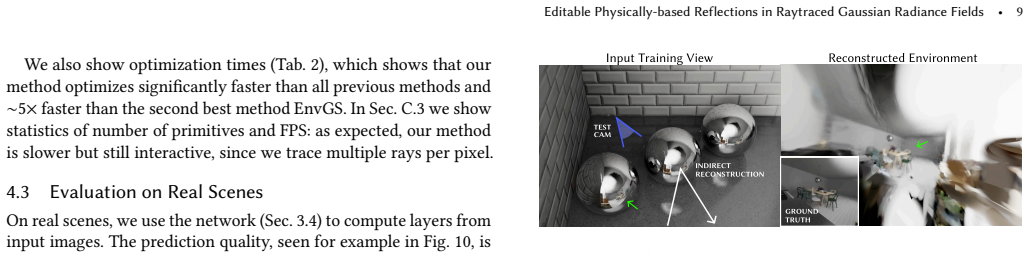
- Objects visible only through reflections can be reconstructed and edited even if they never appear directly in the input photographs.
- Editing operations remain real-time because the diffuse base and the path-traced overlay are decoupled.
Where Pith is reading between the lines
- If buffer extraction improves, the same separation could support editing of other view-dependent effects such as refraction.
- The current reliance on ground-truth buffers for the main results suggests that real-scene performance will track advances in learning-based decomposition methods.
- Because the diffuse model is trained separately, the approach may be combinable with existing diffuse-only editing tools without retraining the entire radiance field.
Load-bearing premise
The method assumes that sufficiently accurate diffuse and specular buffers can be obtained from the input views via learning-based extraction and that the specialized training procedure converges to a usable diffuse scene representation.
What would settle it
A controlled test on synthetic data where the generated reflections after material edits fail to match ground-truth path-traced images or become inconsistent when the viewpoint changes.
Figures

read the original abstract
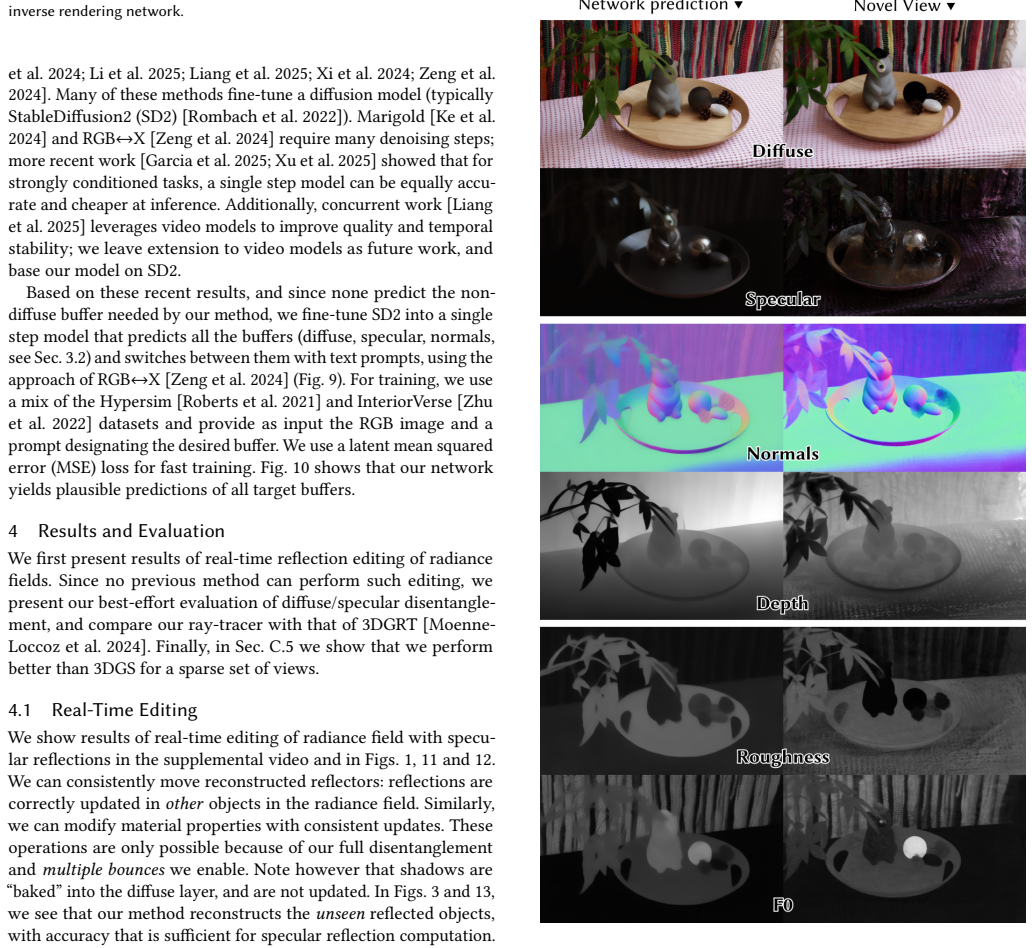
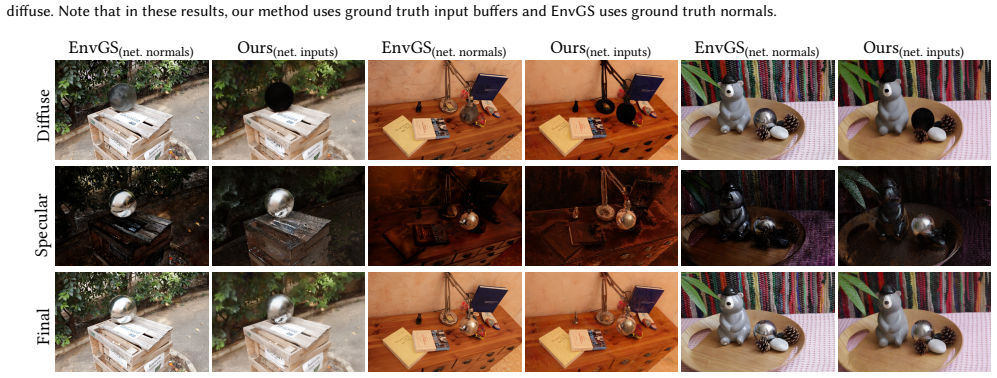
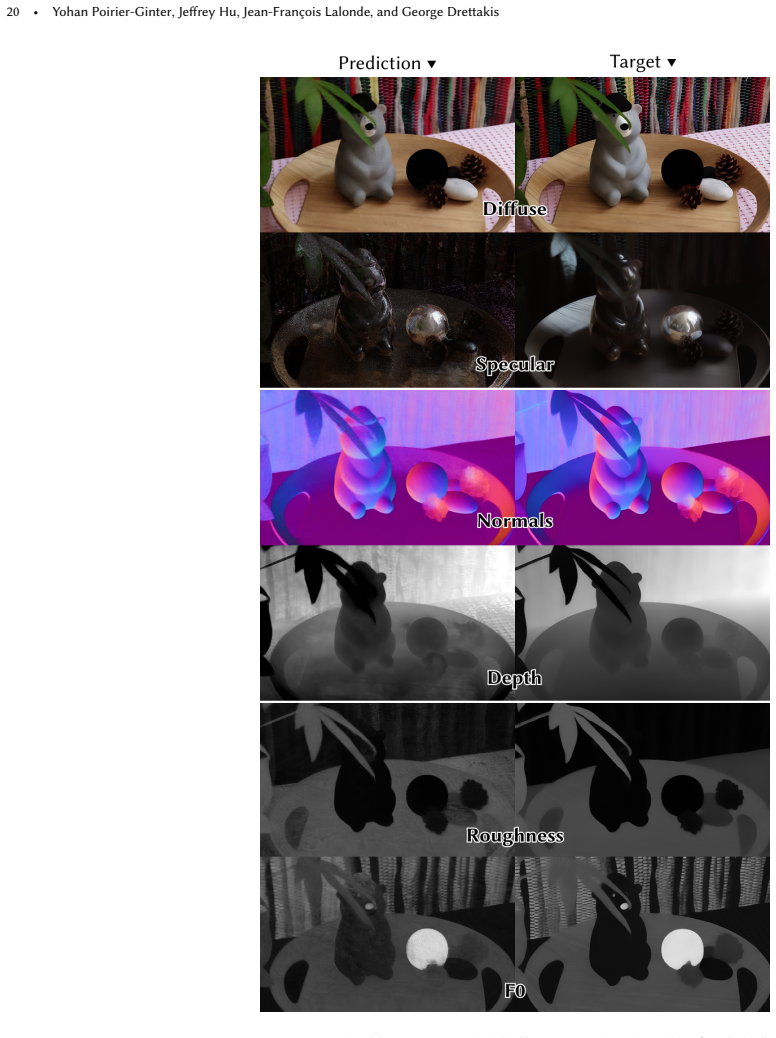
Radiance fields such as 3D Gaussian Splatting allow real-time rendering of scenes captured from photos. They also reconstruct most specular reflections with high visual quality, but typically model them with "fake" reflected geometry, using primitives behind the reflector. Our goal is to correctly reconstruct the reflector and the reflected objects such as to make specular reflections editable. We present a proof of concept which exploits promising learning-based methods to extract diffuse and specular buffers from photos, as well as geometry and BRDF buffers. Our method builds on three key components. First, by using diffuse and specular buffers of input training views, we optimize a diffuse version of the scene and use path tracing to efficiently generate physically based specular reflections. Second, we present a specialized training method that allows this process to converge. Finally, we present a fast ray tracing algorithm for 3D Gaussian primitives that enables efficient multi-bounce reflections. Our method reconstructs reflectors and reflected objects, including those not seen in the input images, in a unique scene representation. Our solution allows real-time, consistent editing of captured scenes with specular reflections, including multi-bounce effects, changing roughness, and more. We mainly show results using ground truth buffers from synthetic scenes, and also preliminary results in real scenes with currently imperfect learning-based buffers. Code and data are available at: https://repo-sam.inria.fr/nerphys/editable-gaussian-reflections/
Editorial analysis
A structured set of objections, weighed in public.
Referee Report
Summary. The paper presents a proof-of-concept method for editable, physically-based specular reflections in 3D Gaussian radiance fields. It extracts diffuse and specular (plus geometry/BRDF) buffers from input views via learning-based methods, optimizes a diffuse Gaussian scene representation, uses path tracing to generate the specular component, applies a specialized training procedure to ensure convergence, and introduces a fast ray-tracing algorithm over Gaussian primitives to support efficient multi-bounce reflections. The central claim is that this yields a unique scene representation that correctly reconstructs both reflectors and reflected objects (including those unseen in the input images) and enables real-time, consistent editing operations such as changing roughness or multi-bounce effects. Main results use ground-truth buffers on synthetic scenes; real-scene results are described as preliminary with imperfect learned buffers. Code and data are released.
Significance. If the claims hold, the work would be significant for radiance-field research in computer graphics: it replaces the common practice of modeling reflections via “fake” geometry behind the reflector with a physically-based, editable representation that supports path-traced multi-bounce effects. The combination of buffer separation, specialized optimization, and custom Gaussian ray tracing is a novel integration. Public release of code and data is a clear strength that aids reproducibility and follow-up work.
major comments (2)
- [Method overview and results sections] The central claim that reflected objects not visible in the input images can be reconstructed relies on the path-tracing component and the assumption that diffuse/specular buffers are sufficiently accurate. The manuscript provides no quantitative error analysis or ablation on buffer quality (synthetic GT vs. learned real buffers), which is load-bearing for the reconstruction and editing claims; without such analysis the extent to which unseen geometry is truly recovered versus hallucinated remains unclear.
- [Training procedure description] The specialized training procedure is presented as essential for convergence, yet no derivation, loss formulation, or comparison against standard 3DGS optimization is supplied in the high-level description. This omission makes it impossible to verify why the procedure succeeds where conventional training fails, undermining assessment of the method’s novelty and robustness.
minor comments (2)
- [Real-scene results] The abstract states that results on real scenes are “preliminary”; the corresponding section should explicitly list the current failure modes and buffer-error sensitivity to guide readers on the practical scope of the approach.
- [Ray-tracing algorithm] Notation for the diffuse versus specular Gaussian primitives and the ray-tracing acceleration structure should be introduced with a small diagram or pseudocode for clarity.
Simulated Author's Rebuttal
We thank the referee for the positive assessment of the work's significance and for highlighting the value of the public code and data release. We address each major comment below and will revise the manuscript accordingly to improve clarity and support for the claims.
read point-by-point responses
-
Referee: [Method overview and results sections] The central claim that reflected objects not visible in the input images can be reconstructed relies on the path-tracing component and the assumption that diffuse/specular buffers are sufficiently accurate. The manuscript provides no quantitative error analysis or ablation on buffer quality (synthetic GT vs. learned real buffers), which is load-bearing for the reconstruction and editing claims; without such analysis the extent to which unseen geometry is truly recovered versus hallucinated remains unclear.
Authors: We agree that quantitative analysis of buffer quality is important for substantiating the reconstruction claims. The manuscript explicitly states that main results use ground-truth buffers on synthetic scenes to demonstrate the core method in isolation, while real-scene results are presented as preliminary due to limitations in current learning-based buffers. To strengthen the paper, we will add a dedicated ablation subsection with quantitative metrics (e.g., PSNR/SSIM on reconstructed unseen geometry and reflection accuracy) comparing ground-truth versus learned buffers, including error propagation analysis from buffer inaccuracies. revision: yes
-
Referee: [Training procedure description] The specialized training procedure is presented as essential for convergence, yet no derivation, loss formulation, or comparison against standard 3DGS optimization is supplied in the high-level description. This omission makes it impossible to verify why the procedure succeeds where conventional training fails, undermining assessment of the method’s novelty and robustness.
Authors: The manuscript describes the specialized training at a high level in the method overview because the full derivation, loss terms (including the custom regularization for diffuse/specular separation and path-traced supervision), and direct comparisons to vanilla 3DGS optimization are provided in the supplementary material and implementation details section. However, we acknowledge that the main text could better highlight these elements for readers. We will expand the main-text description with a concise derivation outline, explicit loss formulation, and a short comparison table or paragraph against standard 3DGS to improve accessibility without altering the core contribution. revision: partial
Circularity Check
No significant circularity in derivation chain
full rationale
The paper describes a proof-of-concept pipeline that takes diffuse/specular buffers (extracted via external learning-based methods or ground truth) as input, optimizes a diffuse Gaussian scene representation, and applies path tracing plus a custom ray-tracing algorithm for Gaussians to produce editable specular reflections. No equations, fitted parameters, or self-citations are presented that reduce the claimed reconstruction of reflectors and unseen reflected objects to a definitional identity or a statistically forced prediction. The method explicitly qualifies results as dependent on buffer quality and training convergence, treating these as external prerequisites rather than deriving them internally. The central claims therefore remain self-contained against the stated inputs and do not exhibit any of the enumerated circularity patterns.
Axiom & Free-Parameter Ledger
Reference graph
Works this paper leans on
-
[1]
Srinivasan and Matthew Tancik and Jonathan T
Ben Mildenhall and Pratul P. Srinivasan and Matthew Tancik and Jonathan T. Barron and Ravi Ramamoorthi and Ren Ng , year=
-
[2]
Advances in neural rendering , author=
-
[3]
Structure-from-motion revisited , author=
-
[4]
Dust3r: Geometric
Wang, Shuzhe and Leroy, Vincent and Cabon, Yohann and Chidlovskii, Boris and Revaud, Jerome , booktitle=CVPR, year=. Dust3r: Geometric
-
[5]
Grounding image matching in 3d with
Leroy, Vincent and Cabon, Yohann and Revaud, J. Grounding image matching in 3d with
-
[6]
Wang, Jianyuan and Chen, Minghao and Karaev, Nikita and Vedaldi, Andrea and Rupprecht, Christian and Novotny, David , booktitle=CVPR, year=
-
[7]
Barron, Jonathan T and Mildenhall, Ben and Verbin, Dor and Srinivasan, Pratul P and Hedman, Peter , booktitle=CVPR, year=
-
[8]
Barron, Jonathan T and Mildenhall, Ben and Tancik, Matthew and Hedman, Peter and Martin-Brualla, Ricardo and Srinivasan, Pratul P , booktitle=ICCV, year=
-
[9]
Barron, Jonathan T and Mildenhall, Ben and Verbin, Dor and Srinivasan, Pratul P and Hedman, Peter , booktitle=ICCV, year=
-
[10]
Instant neural graphics primitives with a multiresolution hash encoding , author=
-
[11]
Plenoxels: Radiance fields without neural networks , author=
-
[12]
Verbin, Dor and Hedman, Peter and Mildenhall, Ben and Zickler, Todd and Barron, Jonathan T and Srinivasan, Pratul P , booktitle=CVPR, year=
-
[13]
Ma, Li and Agrawal, Vasu and Turki, Haithem and Kim, Changil and Gao, Chen and Sander, Pedro and Zollh
-
[14]
Liang, Ruofan and Chen, Huiting and Li, Chunlin and Chen, Fan and Panneer, Selvakumar and Vijaykumar, Nandita , booktitle=CVPR, year=
-
[15]
Nero: Neural geometry and brdf reconstruction of reflective objects from multiview images , author=
-
[16]
UniSDF: Unifying neural representations for high-fidelity 3d reconstruction of complex scenes with reflections , author=
-
[17]
Verbin, Dor and Srinivasan, Pratul P and Hedman, Peter and Mildenhall, Ben and Attal, Benjamin and Szeliski, Richard and Barron, Jonathan T , booktitle=SIGGRAPHAsia, year=
-
[18]
Guo, Yuan-Chen and Kang, Di and Bao, Linchao and He, Yu and Zhang, Song-Hai , booktitle=CVPR, year=
-
[19]
Zeng, Junyi and Bao, Chong and Chen, Rui and Dong, Zilong and Zhang, Guofeng and Bao, Hujun and Cui, Zhaopeng , booktitle=ACMMM, year=
-
[20]
Yin, Ze-Xin and Jiao, Peng-Yi and Qiu, Jiaxiong and Cheng, Ming-Ming and Ren, Bo , journal=PAMI, year=
-
[21]
Liu, Jiayue and Tang, Xiao and Cheng, Freeman and Yang, Roy and Li, Zhihao and Liu, Jianzhuang and Huang, Yi and Lin, Jiaqi and Liu, Shiyong and Wu, Xiaofei and others , booktitle=ECCV, year=
-
[22]
Meng, Jiarui and Li, Haijie and Wu, Yanmin and Gao, Qiankun and Yang, Shuzhou and Zhang, Jian and Ma, Siwei , booktitle=
-
[23]
Kerbl, Bernhard and Kopanas, Georgios and Leimk
-
[24]
Huang, Binbin and Yu, Zehao and Chen, Anpei and Geiger, Andreas and Gao, Shenghua , booktitle=SIGGRAPH, year=
-
[25]
Relightable
Gao, Jian and Gu, Chun and Lin, Youtian and Li, Zhihao and Zhu, Hao and Cao, Xun and Zhang, Li and Yao, Yao , booktitle=ECCV, year=. Relightable
-
[26]
Xie, Tao and Chen, Xi and Xu, Zhen and Xie, Yiman and Jin, Yudong and Shen, Yujun and Peng, Sida and Bao, Hujun and Zhou, Xiaowei , booktitle=CVPR, year=
-
[27]
arXiv preprint arXiv:2412.19282 , year=
Reflective Gaussian Splatting , author=. arXiv preprint arXiv:2412.19282 , year=
-
[28]
3D Gaussian Ray Tracing: Fast Tracing of Particle Scenes , author=
-
[29]
Bi, Zoubin and Zeng, Yixin and Zeng, Chong and Pei, Fan and Feng, Xiang and Zhou, Kun and Wu, Hongzhi , booktitle=SIGGRAPHAsia, year=
-
[30]
Jiang, Yingwenqi and Tu, Jiadong and Liu, Yuan and Gao, Xifeng and Long, Xiaoxiao and Wang, Wenping and Ma, Yuexin , booktitle=CVPR, year=
-
[31]
Ye, Keyang and Hou, Qiming and Zhou, Kun , booktitle=SIGGRAPH, year=
-
[32]
Zhang, Youjia and Chen, Anpei and Wan, Yumin and Song, Zikai and Yu, Junqing and Luo, Yawei and Yang, Wei , booktitle=CVPR, year=
-
[33]
Interactive indirect illumination using voxel cone tracing , author=
-
[34]
Zeng, Zheng and Deschaintre, Valentin and Georgiev, Iliyan and Hold-Geoffroy, Yannick and Hu, Yiwei and Luan, Fujun and Yan, Ling-Qi and Ha
-
[35]
arXiv preprint arXiv:2502.19318 , year=
Does 3D Gaussian Splatting Need Accurate Volumetric Rendering? , author=. arXiv preprint arXiv:2502.19318 , year=
-
[36]
Mallick, Saswat Subhajyoti and Goel, Rahul and Kerbl, Bernhard and Steinberger, Markus and Carrasco, Francisco Vicente and De La Torre, Fernando , booktitle=SIGGRAPH, year=. Taming
-
[37]
ACM Transactions on Graphics (ToG) , volume=
Mitsuba 2: A retargetable forward and inverse renderer , author=. ACM Transactions on Graphics (ToG) , volume=. 2019 , publisher=
2019
-
[38]
ACM Transactions on Graphics (TOG) , volume=
Differentiable monte carlo ray tracing through edge sampling , author=. ACM Transactions on Graphics (TOG) , volume=. 2018 , publisher=
2018
-
[39]
ACM Transactions on Graphics , volume=
Neural Point Catacaustics for Novel-View Synthesis of Reflections , author=. ACM Transactions on Graphics , volume=
-
[40]
2025 , organization=
Efficient Perspective-Correct 3D Gaussian Splatting Using Hybrid Transparency , author=. 2025 , organization=
2025
-
[41]
Proceedings of the Royal Society of London
The interpretation of structure from motion , author=. Proceedings of the Royal Society of London. Series B. Biological Sciences , volume=. 1979 , publisher=
1979
-
[42]
Hypersim: A photorealistic synthetic dataset for holistic indoor scene understanding , author=
-
[43]
High-resolution image synthesis with latent diffusion models , author=
-
[44]
2013 , url =
Brian Karis , title =. 2013 , url =
2013
-
[45]
Adaptive radiosity textures for bidirectional ray tracing , author=. Proc. 17th Ann. Conf. Comp. Graph. Interac. Tech. , pages=
-
[46]
Neural rays for occlusion-aware image-based rendering , author=
-
[47]
Proceedings of the 25th annual conference on Computer graphics and interactive techniques , pages=
Rendering synthetic objects into real scenes: Bridging traditional and image-based graphics with global illumination and high dynamic range photography , author=. Proceedings of the 25th annual conference on Computer graphics and interactive techniques , pages=. 1998 , organization=
1998
-
[48]
2023 , doi =
Choi, Changwoon and Kim, Juhyeon and Kim, Young Min , journal = CGF, volume =. 2023 , doi =
2023
-
[49]
Extracting triangular
Munkberg, Jacob and Hasselgren, Jon and Shen, Tianchang and Gao, Jun and Chen, Wenzheng and Evans, Alex and M. Extracting triangular
-
[50]
Wang, Peng and Liu, Lingjie and Liu, Yuan and Theobalt, Christian and Komura, Taku and Wang, Wenping , booktitle=NeurIPS, year=
-
[51]
Neuralangelo: High-fidelity neural surface reconstruction , author=
-
[52]
Neural directional encoding for efficient and accurate view-dependent appearance modeling , author=
-
[53]
Zhuang, Yiyu and Zhang, Qi and Wang, Xuan and Zhu, Hao and Feng, Ying and Li, Xiaoyu and Shan, Ying and Cao, Xun , journal=
-
[54]
1982 , publisher =
A Reflectance Model for Computer Graphics , author =. 1982 , publisher =
1982
-
[55]
arXiv preprint arXiv:1412.6980 , year=
Adam: A Method for Stochastic Optimization , author=. arXiv preprint arXiv:1412.6980 , year=
-
[56]
Mip-splatting: Alias-free
Yu, Zehao and Chen, Anpei and Huang, Binbin and Sattler, Torsten and Geiger, Andreas , booktitle=CVPR, year=. Mip-splatting: Alias-free
-
[57]
2024 , url =
Kerbl, Bernhard and Meuleman, Andreas and Kopanas, Georgios and Wimmer, Michael and Lanvin, Alexandre and Drettakis, George , title =. 2024 , url =
2024
-
[58]
A Diffusion Approach to Radiance Field Relighting using Multi-Illumination Synthesis , author=
-
[59]
Tang, Zhe Jun and Cham, Tat-Jen , booktitle=ECCV, year=
-
[60]
Chen, Anpei and Xu, Zexiang and Geiger, Andreas and Yu, Jingyi and Su, Hao , booktitle=ECCV, year=
-
[61]
Jin, Haian and Liu, Isabella and Xu, Peijia and Zhang, Xiaoshuai and Han, Songfang and Bi, Sai and Zhou, Xiaowei and Xu, Zexiang and Su, Hao , booktitle=CVPR, year=
-
[62]
2025 , publisher=
Don't Splat your Gaussians: Volumetric Ray-Traced Primitives for Modeling and Rendering Scattering and Emissive Media , author=. 2025 , publisher=
2025
-
[63]
Raygauss: Volumetric gaussian-based ray casting for photorealistic novel view synthesis , author=
-
[64]
Steven G. Parker and James Bigler and Andreas Dietrich and Heiko Friedrich and Jared Hoberock and David Luebke and David McAllister and Morgan McGuire and Keith Morley and Austin Robison and Martin Stich , title =. 2010 , month =
2010
-
[65]
Real-time concurrent linked list construction on the
Yang, Jason C and Hensley, Justin and Gr. Real-time concurrent linked list construction on the
-
[66]
Wald, Ingo and Morrical, Nate and Zellmann, Stefan and Ma, Lei and Usher, Will and Huang, Tiejun and Pascucci, Valerio , title =. Proc. ACM Comput. Graph. Interact. Tech. , month = aug, articleno =. 2020 , issue_date =. doi:10.1145/3406179 , abstract =
-
[67]
arXiv preprint arXiv:2501.19196 , year=
RaySplats: Ray Tracing based Gaussian Splatting , author=. arXiv preprint arXiv:2501.19196 , year=
-
[68]
arXiv preprint arXiv:2503.12284 , year=
Byrski, Krzysztof and Wilczy. arXiv preprint arXiv:2503.12284 , year=
-
[69]
The Visual Computer , volume=
Fast sorting for exact OIT of complex scenes , author=. The Visual Computer , volume=. 2014 , publisher=
2014
-
[70]
Stopthepop: Sorted gaussian splatting for view-consistent real-time rendering , author=
-
[71]
Marigold: Repurposing diffusion-based image generators for monocular depth estimation , author=
-
[72]
Fine-tuning image-conditional diffusion models is easier than you think , author=
-
[73]
What Matters When Repurposing Diffusion Models for General Dense Perception Tasks? , author=
-
[74]
Learning-based inverse rendering of complex indoor scenes with differentiable
Zhu, Jingsen and Luan, Fujun and Huo, Yuchi and Lin, Zihao and Zhong, Zhihua and Xi, Dianbing and Wang, Rui and Bao, Hujun and Zheng, Jiaxiang and Tang, Rui , booktitle=SIGGRAPHAsia, year=. Learning-based inverse rendering of complex indoor scenes with differentiable
-
[75]
2012 , url=
Physically-Based Shading at Disney , author=. 2012 , url=
2012
-
[76]
2025 , url =
Blender - a. 2025 , url =
2025
-
[77]
EDGS: Eliminating Densification for Efficient Convergence of
Kotovenko, Dmytro and Grebenkova, Olga and Ommer, Bj. EDGS: Eliminating Densification for Efficient Convergence of. arXiv preprint arXiv:2504.13204 , year=
-
[78]
1998 , publisher=
Inverse rendering for computer graphics , author=. 1998 , publisher=
1998
-
[79]
Srinivasan, Pratul P and Deng, Boyang and Zhang, Xiuming and Tancik, Matthew and Mildenhall, Ben and Barron, Jonathan T , booktitle=CVPR, year=
-
[80]
2021 , publisher=
Zhang, Xiuming and Srinivasan, Pratul P and Deng, Boyang and Debevec, Paul and Freeman, William T and Barron, Jonathan T , journal=TOG, volume=. 2021 , publisher=
2021
discussion (0)
Sign in with ORCID, Apple, or X to comment. Anyone can read and Pith papers without signing in.