REVIEW 3 major objections 2 minor 34 references
Rate-Splitting Multiple Access Enabled Probabilistic Semantic Communication in UAV Networks
T0 review · 3 major / 2 minor · reviewed 2026-07-01 · grok-4.3
Pith's one-line read A UAV semantic communication system using rate-splitting multiple access and probabilistic knowledge graphs minimizes energy while preserving more semantics than NOMA or SDMA.
desk verdict The paper combines PKGs with RSMA in a UAV joint-optimization loop and adds a new importance-weighted KG metric, but the performance edge rests on that unvalidated metric. read the letter →
The pith
A machine-rendered reading of the paper's core claim, the machinery that carries it, and where it could break.
The reading
What carries the argument
The PKG-assisted RSMA transmission scheme together with the SWEO algorithm that applies Lagrangian dual decomposition and successive convex approximation to jointly optimize UAV trajectory, power, beamforming, and compression ratio.
What would settle it
An experiment or simulation in which the proposed scheme uses more total energy or achieves lower semantic accuracy than conventional RSMA under identical network parameters, channel realizations, and energy weights would falsify the performance claims.
Extended reading notes
Core claim
Integrating probabilistic knowledge graphs with rate-splitting multiple access enables efficient decomposition and transmission of semantic information in UAV networks; the resulting weighted energy minimization problem is solved by the semantic-aware weighted energy optimization algorithm, yielding better energy efficiency and semantic preservation than conventional multiple-access schemes under the modeled conditions.
Load-bearing premise
Probabilistic knowledge graphs accurately represent user equipment semantics and the importance-weighted KG-triple metric correctly quantifies reconstruction reliability under the assumed channel and energy models.
Editorial extensions
If this is right
- The joint optimization reduces the combined energy cost of flight, transmission, and computation while meeting semantic accuracy targets.
- The semantic accuracy metric assigns higher weight to important KG triples, providing a finer measure of reconstruction reliability than unweighted error rates.
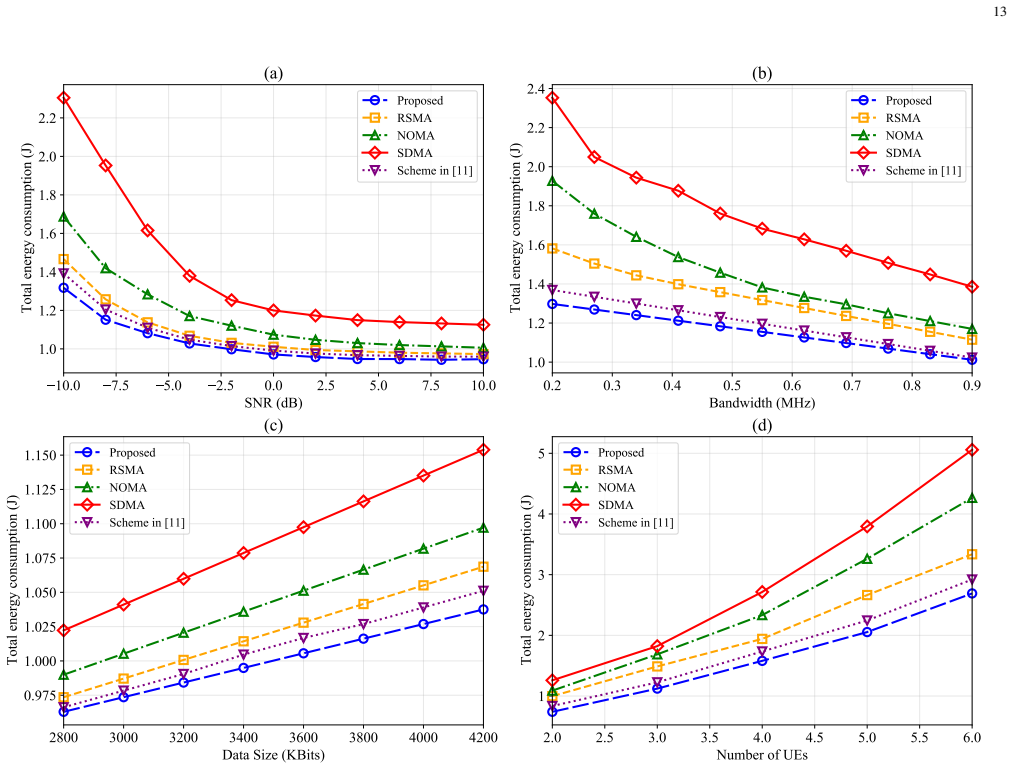
- The framework outperforms benchmark RSMA, NOMA, and SDMA schemes across varied UAV altitudes, user densities, and energy budgets.
- Decomposing semantics into shared and private components via PKGs allows RSMA to allocate common and private rates more efficiently than treating all data as private.
Reading between the lines
- The same decomposition and optimization approach could be tested on terrestrial base stations where flight energy is absent but computation and transmission costs remain coupled.
- If the PKG model is replaced by other semantic representations such as embeddings, the RSMA layer and SWEO solver might still apply with only the accuracy metric changed.
- Extending the formulation to include user mobility on the ground would require adding a new term to the weighted energy objective while keeping the RSMA and PKG structure intact.
Signed reviews
Editorial analysis
A structured set of objections, weighed in public.
Referee Report
Summary. The manuscript proposes a UAV downlink semantic communication framework that employs probabilistic knowledge graphs (PKGs) to model UE semantics and decompose them into shared/private components. It develops a PKG-assisted RSMA transmission scheme, formulates a weighted energy minimization problem jointly optimizing UAV trajectory, power allocation, beamforming, and semantic compression ratio, and solves it via the iterative SWEO algorithm (Lagrangian dual decomposition + successive convex approximation). A semantic accuracy metric based on importance-weighted KG triples is introduced to quantify reconstruction reliability. Extensive simulations are claimed to demonstrate superior energy efficiency, semantic preservation, and performance versus conventional RSMA, NOMA, and SDMA baselines across network parameters.
Significance. If the semantic accuracy metric is shown to correlate with actual reconstruction fidelity and the simulation results are made reproducible with proper statistical controls, the framework could advance practical designs for energy-constrained semantic UAV networks by leveraging RSMA's handling of semantic structure. The integration of PKGs for semantic decomposition and the joint optimization of communication/computation/flight energy are potentially useful contributions, though their impact depends on validation of the core metric.
major comments (3)
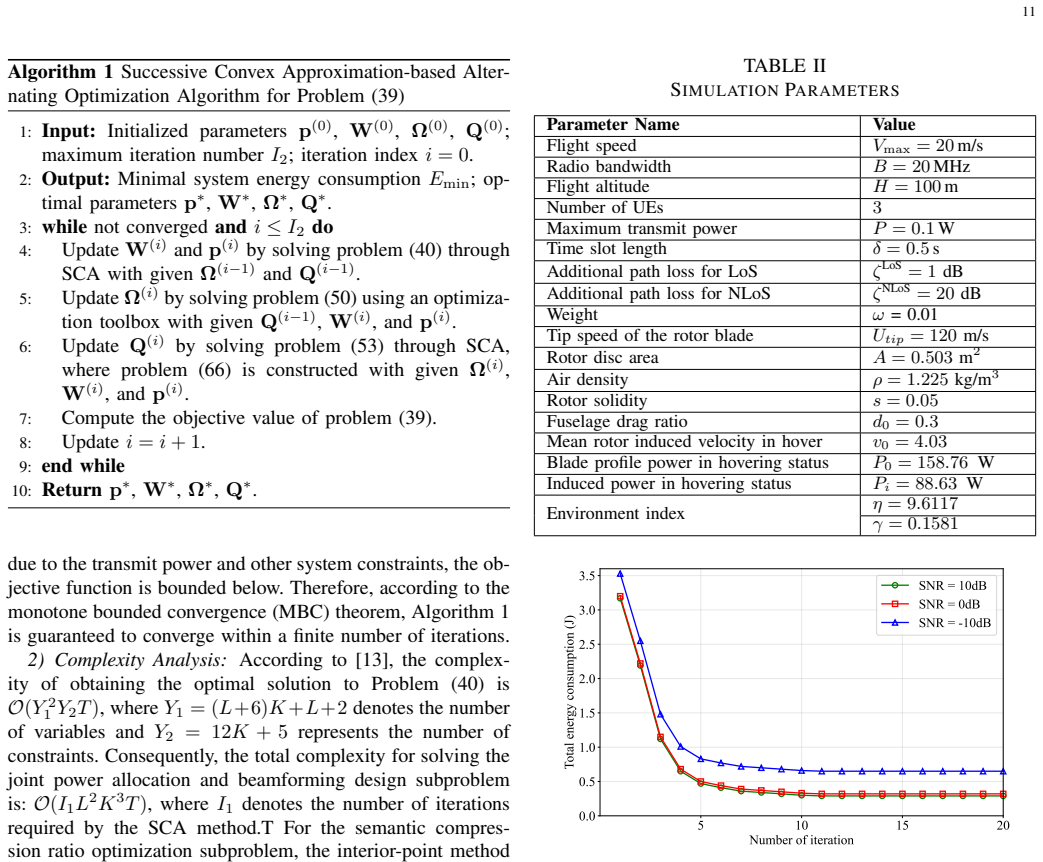
- [Abstract / Simulation Results] Abstract and Simulation Results section: The central claim that the framework achieves 'superior energy efficiency' and 'enhanced semantic preservation' rests on simulations, yet no details are provided on error bars, baseline implementations (e.g., how NOMA/SDMA are realized with the same PKG decomposition), data exclusion rules, or convergence guarantees of the SWEO algorithm. This renders the performance comparisons uninspectable and load-bearing for the superiority claim.
- [Semantic Accuracy Metric] Section introducing the semantic accuracy metric: The metric assigns importance-based weights to informative KG triples to quantify reconstruction reliability, but no validation is given against human judgments, standard semantic similarity scores (e.g., BERTScore or KG embedding distances), or ablation under modeled UAV channel impairments and compression. This directly undermines the 'enhanced semantic preservation' claim, as gains may be artifacts of the untested weighting scheme.
- [System Model / Problem Formulation] Problem formulation and assumptions: The framework assumes PKGs accurately capture UE semantics and enable reliable shared/private decomposition for RSMA; however, no sensitivity analysis or comparison to alternative semantic models (e.g., deterministic KGs or embedding-based approaches) is reported to test this under fast-varying UAV channels.
minor comments (2)
- [Problem Formulation] Notation for the semantic compression ratio and energy-component weights should be clarified with explicit definitions and ranges in the optimization problem statement.
- [Simulation Results] Figure captions for simulation results should include the exact parameter settings (e.g., number of Monte Carlo runs, specific values of free parameters) to aid reproducibility.
Simulated Author's Rebuttal
We thank the referee for the constructive comments on our manuscript. We address each major comment point by point below and will incorporate revisions to improve reproducibility, validation, and robustness as indicated.
read point-by-point responses
-
Referee: [Abstract / Simulation Results] Abstract and Simulation Results section: The central claim that the framework achieves 'superior energy efficiency' and 'enhanced semantic preservation' rests on simulations, yet no details are provided on error bars, baseline implementations (e.g., how NOMA/SDMA are realized with the same PKG decomposition), data exclusion rules, or convergence guarantees of the SWEO algorithm. This renders the performance comparisons uninspectable and load-bearing for the superiority claim.
Authors: We agree that the simulation results require additional details for reproducibility and transparency. In the revised manuscript, we will expand the Simulation Results section to include error bars (mean ± standard deviation over 100 Monte Carlo runs), explicit descriptions of baseline implementations using identical PKG decomposition for NOMA and SDMA, confirmation that no data were excluded, and a dedicated convergence analysis with plots for the SWEO algorithm. These changes will make the performance comparisons fully inspectable while preserving the original simulation outcomes. revision: yes
-
Referee: [Semantic Accuracy Metric] Section introducing the semantic accuracy metric: The metric assigns importance-based weights to informative KG triples to quantify reconstruction reliability, but no validation is given against human judgments, standard semantic similarity scores (e.g., BERTScore or KG embedding distances), or ablation under modeled UAV channel impairments and compression. This directly undermines the 'enhanced semantic preservation' claim, as gains may be artifacts of the untested weighting scheme.
Authors: The importance-weighted KG triple metric is introduced as a structure-aware measure tailored to PKGs. We recognize that external validation would strengthen the claims. In the revision, we will add a subsection providing comparisons of the proposed metric to BERTScore and KG embedding distances on representative reconstructions, along with an ablation study evaluating its sensitivity to UAV channel impairments and varying compression ratios. This will demonstrate correlation with semantic fidelity. revision: yes
-
Referee: [System Model / Problem Formulation] Problem formulation and assumptions: The framework assumes PKGs accurately capture UE semantics and enable reliable shared/private decomposition for RSMA; however, no sensitivity analysis or comparison to alternative semantic models (e.g., deterministic KGs or embedding-based approaches) is reported to test this under fast-varying UAV channels.
Authors: PKGs are foundational to the probabilistic shared/private decomposition that RSMA leverages. To address robustness under fast-varying channels, the revised version will include a sensitivity analysis on PKG parameter variations and a new comparison subsection benchmarking against deterministic KG and embedding-based alternatives. These additions will test the assumptions explicitly in the UAV setting. revision: yes
Circularity Check
No significant circularity in derivation chain
full rationale
The paper formulates a weighted energy minimization problem from first principles (energy costs of communication, computation, and flight), solves it via an iterative SWEO algorithm combining Lagrangian dual decomposition and successive convex approximation, and evaluates performance using a newly proposed importance-weighted KG-triple semantic accuracy metric against standard RSMA/NOMA/SDMA baselines. No equation or result is shown to reduce by construction to a fitted parameter, self-citation, or renamed input; the central claims rest on independent simulation outputs rather than definitional equivalence.
Assumptions & free parameters
free parameters (2)
- energy-component weights
- semantic compression ratio
assumptions (2)
- domain assumption Probabilistic knowledge graphs can be constructed that faithfully decompose semantic information into shared and private components for the modeled UEs.
- domain assumption The iterative SWEO algorithm converges to a high-quality solution of the original non-convex problem.
invented entities (1)
-
semantic accuracy metric (importance-weighted KG triples)
Cite this review
Pith. "Pith review of Rate-Splitting Multiple Access Enabled Probabilistic Semantic Communication in UAV Networks." pith.science (2026). https://pith.science/paper/47GOQAYH
@misc{pith2026260630993,
  author       = {Pith},
  title        = {Pith review of: Rate-Splitting Multiple Access Enabled Probabilistic Semantic Communication in UAV Networks},
  year         = {2026},
  howpublished = {\url{https://pith.science/paper/47GOQAYH}},
  note         = {Machine review of arXiv:2606.30993}
}
read the original abstract
This article proposes an uncrewed aerial vehicle (UAV) downlink semantic communication framework, where probabilistic knowledge graphs (PKGs) are employed to model user equipment (UE) semantics and decompose semantic information into shared and private components. Leveraging the capability of rate-splitting multiple access (RSMA) in addressing such semantic structures, a PKG-assisted RSMA transmission scheme is developed to efficiently deliver multi-user semantic information under severe energy constraints and fast-varying UAV channels. To characterize the strongly coupled energy costs of communication, computation, and flight, a weighted energy minimization problem is formulated to jointly optimize the UAV trajectory, power allocation, beamforming design, and semantic compression ratio. The resulting non-convex problem is efficiently solved using an iterative semantic-aware weighted energy optimization (SWEO) algorithm that integrates Lagrangian dual decomposition and successive convex approximation. Furthermore, a semantic accuracy metric is proposed to quantify the reliability of reconstruction by assigning importance-based weights to informative KG triples. Extensive simulation results verify that the proposed framework achieves superior energy efficiency, enhanced semantic preservation, and consistently better performance than conventional RSMA, non-orthogonal multiple access (NOMA), and space division multiple access (SDMA) schemes in benchmarks across various network parameters.
Figures


Figures from the paper (5 more)



Reference graph
Works this paper leans on
-
[1]
6G networks and the AI revolution: Exploring technologies, applications, and emerging challenges,
R. Chataut, M. Nankya, and R. Akl, “6G networks and the AI revolution: Exploring technologies, applications, and emerging challenges,”Sensors, vol. 24, no. 6, p. 1888, Mar. 2024
work page 2024
-
[2]
On the road to 6G: Visions, requirements, key technologies, and testbeds,
C.-X. Wang, X. You, X. Gao, X. Zhu, Z. Li, C. Zhang, H. Wang, Y . Huang, Y . Chen, H. Haas, J. S. Thompson, E. G. Larsson, Renzo, Marco Di, W. Tong, P. Zhu, X. Shen, H. V . Poor, and L. Hanzo, “On the road to 6G: Visions, requirements, key technologies, and testbeds,” IEEE Commun. Surveys Tuts., vol. 25, no. 2, pp. 905–974, 2nd Quart. 2023
work page 2023
-
[3]
UA V-enabled integrated sens- ing, computing, and communication: A fundamental trade-off,
Y . Xu, T. Zhang, Y . Liu, and D. Yang, “UA V-enabled integrated sens- ing, computing, and communication: A fundamental trade-off,”IEEE Wireless Commun. Lett., vol. 12, no. 5, pp. 843–847, May. 2023
work page 2023
-
[4]
Interference reducing and resource allocation in UA V-powered wireless communica- tion system,
W. Lu, P. Si, G. Huang, H. Peng, S. Hu, and Y . Gao, “Interference reducing and resource allocation in UA V-powered wireless communica- tion system,” inInt. Wirel. Commun. Mob. Comput., IWCMC, Limassol, Cyprus, Jun. 2020, pp. 220–224
work page 2020
-
[5]
Joint computation and communication design for UA V-assisted mobile edge computing in IoT,
T. Zhang, Y . Xu, J. Loo, D. Yang, and L. Xiao, “Joint computation and communication design for UA V-assisted mobile edge computing in IoT,”IEEE Trans. Ind. Informat., vol. 16, no. 8, pp. 5505–5516, Aug. 2020
work page 2020
-
[6]
X. Xu, H. Xu, D. Wei, W. Saad, M. Bennis, and M. Chen, “Transformer- based collaborative reinforcement learning for fluid antenna system (FAS)-enabled 3d UA V positioning,”IEEE J. Sel. Areas Commun., vol. 44, pp. 1128–1143, Oct. 2025
work page 2025
-
[7]
Lead federated neuromorphic learning for wireless edge artificial intelligence,
H. Yang, K.-Y . Lam, L. Xiao, Z. Xiong, H. Hu, D. Niyato, and H. V . Poor, “Lead federated neuromorphic learning for wireless edge artificial intelligence,”Nat. Commun., vol. 13, no. 1, p. 4269, Jul. 2022
work page 2022
-
[8]
Deep learning for joint source- channel coding of text,
N. Farsad, M. Rao, and A. Goldsmith, “Deep learning for joint source- channel coding of text,” inICASSP IEEE Int. Conf. Acoust. Speech Signal Process. Proc., Calgary, AB, Canada, Apr. 2018, pp. 2326–2330
work page 2018
Show all 34 references
-
[9]
Semantic communication systems for speech transmission,
Z. Weng and Z. Qin, “Semantic communication systems for speech transmission,”IEEE J. Sel. Areas Commun., vol. 39, no. 8, pp. 2434– 2444, Aug. 2021
2021
-
[10]
Heterogeneous semantic and bit communications in uav network: A semi-noma design,
S. Wang, T. Zhang, X. Xu, and Y . Liu, “Heterogeneous semantic and bit communications in uav network: A semi-noma design,”IEEE Trans. V eh. Technol., pp. 1–14, Nov. 2025
2025
-
[11]
Wireless semantic communi- cations for video conferencing,
P. Jiang, C.-K. Wen, S. Jin, and G. Y . Li, “Wireless semantic communi- cations for video conferencing,”IEEE J. Sel. Areas Commun., vol. 41, no. 1, pp. 230–244, Jan. 2023
2023
-
[12]
Knowledge enhanced semantic communication receiver,
B. Wang, R. Li, J. Zhu, Z. Zhao, and H. Zhang, “Knowledge enhanced semantic communication receiver,”IEEE Commun. Lett., vol. 27, no. 7, pp. 1794–1798, Jul. 2023
2023
-
[13]
Rate-splitting multiple access enabled green probabilistic semantic communication over wireless networks,
R. Xu, Z. Yang, Y . Mao, C. Huang, Q. Yang, L. Xu, W. Xu, and Z. Zhang, “Rate-splitting multiple access enabled green probabilistic semantic communication over wireless networks,”IEEE Trans. Green Commun. Netw., Jan. 2025, early access
2025
-
[14]
Energy-efficient probabilistic semantic communication over space-air- ground integrated networks,
Z. Zhao, Z. Yang, M. Chen, C. Zhu, W. Xu, Z. Zhang, and K. Huang, “Energy-efficient probabilistic semantic communication over space-air- ground integrated networks,”IEEE Trans. Wirel. Commun., vol. 24, no. 10, pp. 8814–8829, 2025
2025
-
[15]
Knowledge enhanced semantic communication receiver,
B. Wang, R. Li, J. Zhu, Z. Zhao, and H. Zhang, “Knowledge enhanced semantic communication receiver,”IEEE Commun. Lett., vol. 27, no. 7, pp. 1794–1798, 2023
2023
-
[16]
A review: Knowledge reasoning over knowledge graph,
X. Chen, S. Jia, and Y . Xiang, “A review: Knowledge reasoning over knowledge graph,”Expert Syst. Appl., vol. 141, p. 112948, Sept. 2020
2020
-
[17]
Multimodal knowledge graph for deep learning papers and code,
A. V . Kannan, D. Fradkin, I. Akrotirianakis, T. Kulahcioglu, A. Canedo, A. Roy, S.-Y . Yu, M. Arnav, and M. A. Al Faruque, “Multimodal knowledge graph for deep learning papers and code,” inProc. ACM Int. Conf. Inf. Knowl. Manage., New York, NY , USA, Oct. 2020, pp. 3417–3420
2020
-
[18]
Reliable semantic communication system enabled by knowledge graph,
S. Jiang, Y . Liu, Y . Zhang, P. Luo, K. Cao, J. Xiong, H. Zhao, and J. Wei, “Reliable semantic communication system enabled by knowledge graph,”Entropy, vol. 24, no. 6, p. 846, Jun. 2022
2022
-
[19]
Optimization of image transmission in cooperative semantic communication networks,
W. Zhang, Y . Wang, M. Chen, T. Luo, and D. Niyato, “Optimization of image transmission in cooperative semantic communication networks,” IEEE Trans. Wireless Commun., vol. 23, no. 2, pp. 861–873, Feb. 2024
2024
-
[20]
Cognitive semantic communication systems driven by knowl- edge graph: Principle, implementation, and performance evaluation,
F. Zhou, Y . Li, M. Xu, L. Yuan, Q. Wu, R. Q. Hu, and N. Al- Dhahir, “Cognitive semantic communication systems driven by knowl- edge graph: Principle, implementation, and performance evaluation,” IEEE Trans. Commun., vol. 72, no. 1, pp. 193–208, Jan. 2024
2024
-
[21]
Rate-splitting multiple access: Fundamentals, survey, and future research trends,
Y . Mao, O. Dizdar, B. Clerckx, R. Schober, P. Popovski, and H. V . Poor, “Rate-splitting multiple access: Fundamentals, survey, and future research trends,”IEEE Commun. Surveys Tuts., vol. 24, no. 4, pp. 2073– 2126, 4th Quart. 2022
-
[22]
Multiple access techniques for intelligent and multifunctional 6G: Tutorial, survey, and outlook,
B. Clerckx, Y . Mao, Z. Yang, M. Chen, A. Alkhateeb, L. Liu, M. Qiu, J. Yuan, V . W. S. Wong, and J. Montojo, “Multiple access techniques for intelligent and multifunctional 6G: Tutorial, survey, and outlook,” Proc. IEEE, vol. 112, no. 7, pp. 832–879, Jul. 2024
2024
-
[23]
A primer on rate-splitting multiple access: Tutorial, myths, and frequently asked questions,
B. Clerckx, Y . Mao, E. A. Jorswieck, J. Yuan, D. J. Love, E. Erkip, and D. Niyato, “A primer on rate-splitting multiple access: Tutorial, myths, and frequently asked questions,”IEEE J. Sel. Areas Commun., vol. 41, no. 5, pp. 1265–1308, May 2023
2023
-
[24]
Compression ratio allocation for probabilistic semantic communication with rsma,
Z. Zhao, Z. Yang, Y . Hu, C. Zhu, M. Shikh-Bahaei, W. Xu, Z. Zhang, and K. Huang, “Compression ratio allocation for probabilistic semantic communication with rsma,”IEEE Trans. Commun., vol. 73, no. 9, pp. 7304–7318, 2025
2025
-
[25]
Energy-efficient optimization algorithm based on reconfigurable intelligent surface and rate splitting multiple access for 6g multicell communication system,
Z. Tang, X. Zhu, H. Zhu, and H. Xu, “Energy-efficient optimization algorithm based on reconfigurable intelligent surface and rate splitting multiple access for 6g multicell communication system,”IEEE Internet Things J., vol. 11, no. 2, pp. 2097–2108, Jan. 2024
-
[26]
Towards global metaverse accessibility with rsma-based satellite-terrestrial integrated networks: A game theoretic approach,
W. Jiang, A. Liu, Y . Zhang, H. Han, J. Mu, S. Liu, W. Gu, S. Huang, and Z. Feng, “Towards global metaverse accessibility with rsma-based satellite-terrestrial integrated networks: A game theoretic approach,” IEEE Consum. Electron. Mag., 2025, early access
2025
-
[27]
Rate-splitting multiple access for uav-based ris-enabled interference-limited vehicular communication system,
A. Bansal, N. Agrawal, and K. Singh, “Rate-splitting multiple access for uav-based ris-enabled interference-limited vehicular communication system,”IEEE Trans. Intell. V eh., vol. 8, no. 1, pp. 936–948, Jan. 2023
2023
-
[28]
Energy efficient semantic communication over wireless networks with rate splitting,
Z. Yang, M. Chen, Z. Zhang, and C. Huang, “Energy efficient semantic communication over wireless networks with rate splitting,”IEEE J. Sel. Areas Commun., vol. 41, no. 5, pp. 1484–1495, May 2023
2023
-
[29]
Task-oriented semantic communication over rate splitting enabled wireless control systems for URLLC services,
C. Zeng, J.-B. Wang, M. Xiao, C. Ding, Y . Chen, H. Yu, and J. Wang, “Task-oriented semantic communication over rate splitting enabled wireless control systems for URLLC services,”IEEE Trans. Commun., vol. 72, no. 2, pp. 722–739, Feb. 2024
2024
-
[30]
Rate-splitting multiple access for coexistence of semantic and bit communications,
Y . Liu and B. Clerckx, “Rate-splitting multiple access for coexistence of semantic and bit communications,”arXiv preprint arXiv:2409.10314, 2024
2024
-
[31]
Resource allocation and common message selection for task- oriented semantic information transmission with rsma,
Y . Cheng, D. Niyato, H. Du, J. Kang, Z. Xiong, C. Miao, and D. I. Kim, “Resource allocation and common message selection for task- oriented semantic information transmission with rsma,”IEEE Trans. Wirel. Commun., vol. 23, no. 6, pp. 5557–5570, Jun. 2024
2024
-
[32]
Learning-based reliable and secure transmission for UA V-RIS-assisted communication systems,
H. Yang, S. Liu, L. Xiao, Y . Zhang, Z. Xiong, and W. Zhuang, “Learning-based reliable and secure transmission for UA V-RIS-assisted communication systems,”IEEE Trans. Wirel. Commun., vol. 23, no. 7, pp. 6954–6967, Jul. 2024
2024
-
[33]
Optimal tethered-UA V deployment in a2g communication networks: Multi-agent Q-learning approach,
S. Lim, H. Yu, and H. Lee, “Optimal tethered-UA V deployment in a2g communication networks: Multi-agent Q-learning approach,”IEEE Internet of Things J., vol. 9, no. 19, pp. 18 539–18 549, Oct. 2022
2022
-
[34]
Boyd and L
S. Boyd and L. Vandenberghe,Convex Optimization. U.K.: Cambridge Univ. Press, 2004
2004
Reviewed July 1, 2026 · model on record in the stance chip above.
Discussion (0). Continue with ORCID to comment.