Nonlinear Landau Collisions Without Collision Tensors
Pith reviewed 2026-07-01 03:41 UTC · model grok-4.3
The pith
Quantum chemistry Coulomb integral methods reduce the Landau collision operator to one-center moments, cutting memory by four orders of magnitude.
A machine-rendered reading of the paper's core claim, the machinery that carries it, and where it could break.
Core claim
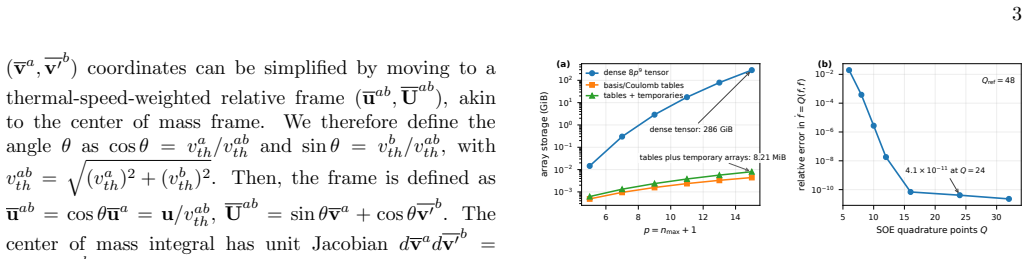
By adapting quantum chemistry Coulomb-integral methods, the six-dimensional integrals in the Landau operator are reduced to one-center Coulomb moments and separable exponential-sum contractions. This achieves a four-order-of-magnitude reduction in working memory, enabling numerical simulations of nonlinear relaxation that preserve invariants. The simulations demonstrate that finite-basis linearization alters the relaxation process and leads to a fourfold error in angular distributions.
What carries the argument
one-center Coulomb moments and separable exponential-sum contractions that evaluate the Landau operator without a dense tensor
If this is right
- Nonlinear relaxation tests become feasible with memory use reduced by four orders of magnitude.
- Simulations using the reduced operator preserve physical invariants.
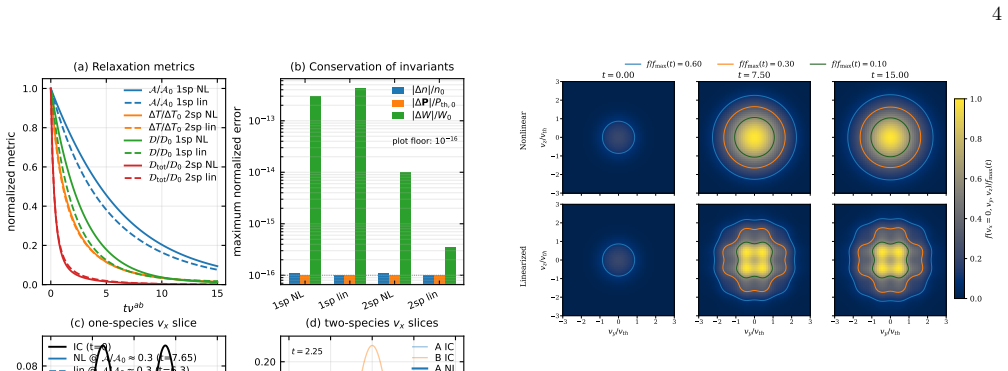
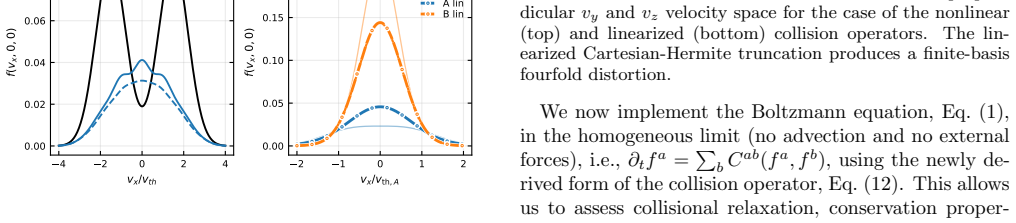
- Finite-basis linearization of the operator changes the relaxation dynamics and produces a fourfold angular error.
Where Pith is reading between the lines
- The same integral-reduction approach could be tested on other velocity-space collision operators that currently require dense tensors.
- Higher-resolution or longer-time nonlinear plasma simulations may now be accessible that were previously limited by memory.
- Cross-checks against analytic nonlinear solutions in simplified geometries would provide an independent accuracy benchmark.
Load-bearing premise
Quantum chemistry Coulomb integral reduction techniques can be ported to the plasma Landau operator while retaining exact nonlinear structure and numerical stability without introducing uncontrolled approximations or basis-dependent artifacts.
What would settle it
A direct comparison of the reduced operator against the full six-dimensional Landau operator on a known linear test case, checking whether invariants are preserved to machine precision and whether the reported angular error remains fourfold.
Figures
read the original abstract
Far-from-equilibrium plasmas require nonlinear Coulomb collisions, but direct three-dimensional Hermite discretization of the Landau operator needs an impractical dense tensor. By porting quantum chemistry Coulomb-integral methods, we reduce the six-dimensional integrals to one-center Coulomb moments and separable exponential-sum contractions. This gives a four-order-of-magnitude working-memory reduction and enables nonlinear relaxation tests. Numerical simulations preserve invariants and show that finite-basis linearization changes relaxation and produces a fourfold angular error.
Editorial analysis
A structured set of objections, weighed in public.
Referee Report
Summary. The paper claims that porting quantum chemistry Coulomb-integral techniques allows reduction of the six-dimensional Landau collision integrals to one-center Coulomb moments and separable exponential-sum contractions. This yields a four-order-of-magnitude working-memory reduction, enabling nonlinear relaxation simulations. The reported results show that invariants are preserved and that finite-basis linearization alters relaxation rates while producing a fourfold angular error.
Significance. If the reduction exactly preserves the nonlinear Landau operator without uncontrolled approximations or basis artifacts, the memory savings would make nonlinear Coulomb collisions feasible in three-dimensional velocity-space discretizations, addressing a key computational barrier in far-from-equilibrium plasma modeling. The invariant preservation and explicit comparison to linearization are strengths that would support broader adoption if verified.
major comments (2)
- [Abstract] Abstract: the central claim that the six-dimensional integrals 'exactly' factor into one-center moments plus separable contractions while retaining the full nonlinear structure is unsupported by any derivation, error bound, or numerical verification to machine precision; the reported fourfold angular error cannot be unambiguously attributed to linearization alone without ruling out artifacts from the reduction.
- [Numerical simulations] Numerical simulations section (implied by abstract): no evidence is provided that the quantum-chemistry auxiliary expansions or truncated sums (common in the source methods) are controlled for the singular 1/|v-v'|^3 kernel and velocity weighting of the Landau operator, raising the possibility that separability introduces basis-dependent errors that contaminate the relaxation-rate and angular-error claims.
minor comments (2)
- [Abstract] The abstract states a 'four-order-of-magnitude' memory reduction but does not specify the baseline tensor size or the precise contraction scheme used to achieve it.
- No mention of how the one-center Coulomb moments are computed or stored for the plasma velocity grid, which would be needed to assess practical implementation.
Simulated Author's Rebuttal
We thank the referee for their thorough review and valuable comments on our manuscript. We address each of the major comments below.
read point-by-point responses
-
Referee: [Abstract] Abstract: the central claim that the six-dimensional integrals 'exactly' factor into one-center moments plus separable contractions while retaining the full nonlinear structure is unsupported by any derivation, error bound, or numerical verification to machine precision; the reported fourfold angular error cannot be unambiguously attributed to linearization alone without ruling out artifacts from the reduction.
Authors: The manuscript's Section 2 derives the factorization using the quantum chemistry methods, showing that the reduction is exact in the sense that it preserves the full nonlinear structure without additional approximations beyond the basis truncation inherent to the discretization. We will revise the abstract to avoid the word 'exactly' if it causes confusion and add an explicit derivation in an appendix along with machine-precision verification on a test case. Additionally, we will include a comparison with a direct integration method on a coarse grid to confirm that the fourfold angular error is attributable to linearization and not the reduction technique. revision: yes
-
Referee: [Numerical simulations] Numerical simulations section (implied by abstract): no evidence is provided that the quantum-chemistry auxiliary expansions or truncated sums (common in the source methods) are controlled for the singular 1/|v-v'|^3 kernel and velocity weighting of the Landau operator, raising the possibility that separability introduces basis-dependent errors that contaminate the relaxation-rate and angular-error claims.
Authors: The numerical results section shows that the invariants are preserved to machine precision, which provides evidence that the expansions are adequately controlled for the kernel in question. To strengthen this, we will add convergence studies with respect to the number of exponential sum terms and basis size, specifically testing the singular kernel and different velocity weightings to demonstrate that basis-dependent errors are negligible compared to the observed differences between nonlinear and linearized cases. revision: yes
Circularity Check
No circularity: direct computational reduction technique
full rationale
The paper describes a methodological port of quantum-chemistry Coulomb-integral reductions to the six-dimensional Landau operator, yielding one-center moments and separable contractions that cut memory by four orders of magnitude. No load-bearing step reduces by construction to its own inputs, no parameters are fitted then relabeled as predictions, and no self-citation chain is invoked to justify uniqueness or an ansatz. The derivation chain is therefore self-contained against external benchmarks and receives the default non-circularity finding.
Axiom & Free-Parameter Ledger
Reference graph
Works this paper leans on
-
[1]
or using the symmetric tensorU ij =∂ 2u/∂ui∂uj = (δiju2 −u iuj)/u3 whereu=v−v ′ andu=|u|as C ab = Γab 2ma ∂ ∂vi Z dv′Uij f b ∂f a ∂vj − ma mb f a ∂f b ∂v ′ j ! ,(2) withf a =f a(v),f b =f b(v′), Γ ab = (qaqb)2 ln Λab/4πϵ2 0ma, ln Λ ab the Coulomb logarithm, and Einstein notation is used to sum over the indicesi andj. We now employ a basis function decompo...
-
[2]
Chandrasekhar, Stochastic Problems in Physics and Astronomy, Reviews of Modern Physics15, 1 (1943)
S. Chandrasekhar, Stochastic Problems in Physics and Astronomy, Reviews of Modern Physics15, 1 (1943)
1943
-
[3]
M. N. Rosenbluth, W. M. MacDonald, and D. L. Judd, Fokker-planck equation for an inverse-square force, Phys- ical Review107, 1 (1957)
1957
-
[4]
S. I. Braginskii, Transport processes in a plasma, Reviews of Plasma Physics1, 205 (1965)
1965
-
[5]
P. J. Catto and K. T. Tsang, Linearized gyro-kinetic equation with collisions, Physics of Fluids20, 396 (1977)
1977
-
[6]
Ji and E
J.-Y. Ji and E. D. Held, Exact linearized Coulomb colli- sion operator in the moment expansion, Physics of Plas- mas13, 102103 (2006)
2006
-
[7]
Sugama, Modern gyrokinetic formulation of collisional and turbulent transport in toroidally rotating plasmas, Reviews of Modern Plasma Physics1, 9 (2017)
H. Sugama, Modern gyrokinetic formulation of collisional and turbulent transport in toroidally rotating plasmas, Reviews of Modern Plasma Physics1, 9 (2017)
2017
-
[8]
B. J. Frei, J. Ball, A. C. Hoffmann, R. Jorge, P. Ricci, and L. Stenger, Development of advanced linearized gy- rokinetic collision operators using a moment approach, Journal of Plasma Physics87, 905870501 (2021)
2021
-
[9]
I. G. Abel, M. Barnes, S. C. Cowley, W. Dorland, and A. A. Schekochihin, Linearized model Fokker-Planck col- lision operators for gyrokinetic simulations. I. Theory, Physics of Plasmas15, 1 (2008)
2008
-
[10]
Sugama, T
H. Sugama, T. H. Watanabe, and M. Nunami, Linearized model collision operators for multiple ion species plas- mas and gyrokinetic entropy balance equations, Physics of Plasmas16, 112503 (2009)
2009
-
[11]
Lenard and I
A. Lenard and I. B. Bernstein, Plasma oscillations with diffusion in velocity space, Physical Review112, 1456 (1958)
1958
-
[12]
J. P. Dougherty, Model Fokker-Planck Equation for a Plasma and Its Solution, Physics of Fluids7, 1788 (1964)
1964
-
[13]
M. H. Rosen, W. Sengupta, I. Ochs, F. I. Parra, and G. W. Hammett, Enhanced collisional losses from a mag- netic mirror using the Lenard–Bernstein collision opera- tor, Journal of Plasma Physics91, E139 (2025)
2025
-
[14]
Pezzi, F
O. Pezzi, F. Valentini, and P. Veltri, Collisional Relax- ation of Fine Velocity Structures in Plasmas, Physical Review Letters116, 145001 (2016)
2016
-
[15]
B. A. Maruca, S. D. Bale, L. Sorriso-Valvo, J. C. Kasper, 6 and M. L. Stevens, Collisional Thermalization of Hydro- gen and Helium in Solar-Wind Plasma, Physical Review Letters111, 241101 (2013)
2013
-
[16]
Jorge, P
R. Jorge, P. Ricci, and N. F. Loureiro, A drift-kinetic analytical model for scrape-off layer plasma dynamics at arbitrary collisionality, Journal of Plasma Physics83, 905830606 (2017)
2017
-
[17]
Jorge, P
R. Jorge, P. Ricci, and N. F. Loureiro, Theory of the Drift-Wave Instability at Arbitrary Collisionality, Physi- cal Review Letters121, 165001 (2018)
2018
-
[18]
Ji and E
J.-Y. Ji and E. D. Held, Full Coulomb collision operator in the moment expansion, Physics of Plasmas16, 102108 (2009)
2009
-
[19]
Hirvijoki, M
E. Hirvijoki, M. Lingam, D. Pfefferl´ e, L. Comisso, J. Candy, and A. Bhattacharjee, Fluid moments of the nonlinear Landau collision operator, Physics of Plasmas 23, 080701 (2016)
2016
-
[20]
Pfefferl´ e, E
D. Pfefferl´ e, E. Hirvijoki, and M. Lingam, Exact colli- sional moments for plasma fluid theories, Physics of Plas- mas24, 28 (2017)
2017
-
[21]
Jorge, B
R. Jorge, B. J. Frei, and P. Ricci, Nonlinear gyrokinetic Coulomb collision operator, Journal of Plasma Physics 85, 905850604 (2019)
2019
-
[22]
Hunana, T
P. Hunana, T. Passot, E. Khomenko, D. Mart´ ınez- G´ omez, M. Collados, A. Tenerani, G. P. Zank, Y. Maneva, M. L. Goldstein, and G. M. Webb, Gener- alized Fluid Models of the Braginskii Type, The Astro- physical Journal Supplement Series260, 26 (2022)
2022
-
[23]
Grad, On the kinetic theory of rarefied gases, Com- munications on Pure and Applied Mathematics2, 331 (1949)
H. Grad, On the kinetic theory of rarefied gases, Com- munications on Pure and Applied Mathematics2, 331 (1949)
1949
-
[24]
N. F. Loureiro, A. A. Schekochihin, and A. Zocco, Fast collisionless reconnection and electron heating in strongly magnetized plasmas, Physical Review Letters 111, 025002 (2013)
2013
-
[25]
Numata and N
R. Numata and N. F. Loureiro, Ion and electron heating during magnetic reconnection in weakly collisional plas- mas, Journal of Plasma Physics81, 305810201 (2015)
2015
-
[26]
S. Servidio, A. Chasapis, W. H. Matthaeus, D. Perrone, F. Valentini, T. N. Parashar, P. Veltri, D. Gershman, C. T. Russell, B. Giles, S. A. Fuselier, T. D. Phan, and J. Burch, Magnetospheric Multiscale Observation of Plasma Velocity-Space Cascade: Hermite Representation and Theory, Physical Review Letters119, 10.1103/Phys- RevLett.119.205101 (2017)
-
[27]
A. S. Joglekar, B. J. Winjum, A. Tableman, H. Wen, M. Tzoufras, and W. B. Mori, Validation of OS- HUN against collisionless and collisional plasma physics, Plasma Physics and Controlled Fusion60, 064010 (2018)
2018
-
[28]
E. Lichko, J. Egedal, W. Daughton, and J. Kasper, Mag- netic Pumping as a Source of Particle Heating and Power- law Distributions in the Solar Wind, The Astrophysical Journal Letters850, 10.3847/2041-8213/aa9a33 (2017)
-
[29]
Pareschi, G
L. Pareschi, G. Russo, and G. Toscani, Fast Spectral Methods for the Fokker–Planck–Landau Collision Oper- ator, Journal of Computational Physics165, 216 (2000)
2000
-
[30]
R. Li, Y. Wang, and Y. Wang, Approximation to singu- lar quadratic collision model in Fokker-Planck-Landau equation, SIAM Journal on Scientific Computing42, 10.1137/18M1230268 (2020)
-
[31]
R. Li, Y. Ren, and Y. Wang, Hermite spectral method for Fokker-Planck-Landau equation modeling collisional plasma, Journal of Computational Physics 434, 10.1016/j.jcp.2021.110235 (2021)
-
[32]
S. F. Boys, Electronic wave functions - I. A general method of calculation for the stationary states of any molecular system, Proceedings of the Royal Society of London. A. Mathematical and Physical Sciences200, 542 (1950)
1950
-
[33]
Moshinsky, Transformation brackets for harmonic os- cillator functions, Nuclear Physics13, 104 (1959)
M. Moshinsky, Transformation brackets for harmonic os- cillator functions, Nuclear Physics13, 104 (1959)
1959
-
[34]
L. E. McMurchie and E. R. Davidson, One- and two- electron integrals over cartesian gaussian functions, Jour- nal of Computational Physics26, 218 (1978)
1978
-
[35]
J. Rys, M. Dupuis, and H. F. King, Computation of elec- tron repulsion integrals using the rys quadrature method, Journal of Computational Chemistry4, 154 (1983)
1983
-
[36]
Schwinger, On Gauge Invariance and Vacuum Polar- ization, Physical Review82, 664 (1951)
J. Schwinger, On Gauge Invariance and Vacuum Polar- ization, Physical Review82, 664 (1951)
1951
-
[37]
G. L. Delzanno, Multi-dimensional, fully-implicit, spec- tral method for the Vlasov–Maxwell equations with exact conservation laws in discrete form, Journal of Computa- tional Physics301, 338 (2015)
2015
-
[38]
J. Vencels, G. L. Delzanno, G. Manzini, S. Markidis, I. B. Peng, and V. Roytershteyn, SpectralPlasmaSolver: A Spectral Code for Multiscale Simulations of Collisionless, Magnetized Plasmas, Journal of Physics: Conference Se- ries719, 10.1088/1742-6596/719/1/012022 (2016)
-
[39]
Roytershteyn, S
V. Roytershteyn, S. Boldyrev, G. L. Delzanno, C. H. K. Chen, D. Groˇ selj, and N. F. Loureiro, Numerical Study of Inertial Kinetic-Alfv´ en Turbulence, The Astrophysical Journal870, 103 (2019)
2019
-
[40]
N. R. Mandell, W. Dorland, and M. Landreman, Laguerre-Hermite pseudo-spectral velocity formulation of gyrokinetics, Journal of Plasma Physics84, 905840108 (2018)
2018
-
[41]
B. J. Frei, R. Jorge, and P. Ricci, A gyrokinetic model for the plasma periphery of tokamak devices, Journal of Plasma Physics86, 905860205 (2020)
2020
-
[42]
S. P. Hirshman and D. J. Sigmar, Approximate Fokker- Planck collision operator for transport theory applica- tions, Physics of Fluids19, 1532 (1976)
1976
-
[43]
Rasch and A
J. Rasch and A. C. Yu, Efficient Storage Scheme for Pre- calculated Wigner 3j, 6j and Gaunt Coefficients, SIAM Journal on Scientific Computing25, 1416 (2012)
2012
-
[44]
E. Feldheim, ´Equations int´ egrales pour les polynomes d’Hermite ` a une et plusieurs variables, pour les polynomes de Laguerre, et pour les fonctions hy- perg´ eom´ etriques les plus g´ en´ erales, Annali della Scuola Normale Superiore di Pisa - Classe di Scienze9, 225 (1940)
1940
-
[45]
Helgaker, P
T. Helgaker, P. Jorgensen, and J. Olsen,Molecular Electronic-Structure Theory(John Wiley & Sons, Chich- ester, 2000) pp. 1–908
2000
-
[46]
Beylkin and L
G. Beylkin and L. Monz´ on, On approximation of func- tions by exponential sums, Applied and Computational Harmonic Analysis19, 17 (2005)
2005
-
[47]
Bradbury, R
J. Bradbury, R. Frostig, P. Hawkins, M. J. Johnson, C. Leary, D. Maclaurin, G. Necula, A. Paszke, J. Van- derPlas, S. Wanderman-Milne, and Q. Zhang, JAX: com- posable transformations of Python+NumPy programs (2018)
2018
discussion (0)
Sign in with ORCID, Apple, or X to comment. Anyone can read and Pith papers without signing in.