Censored broken adaptive ridge rank regression via induced smoothing
Pith reviewed 2026-07-01 05:06 UTC · model grok-4.3
The pith
Broken adaptive ridge penalty with induced smoothing gives oracle-efficient rank regression for right-censored AFT models.
A machine-rendered reading of the paper's core claim, the machinery that carries it, and where it could break.
Core claim
Under mild conditions the BAR-penalized smoothed Gehan rank estimator for the semiparametric AFT model possesses both the oracle property and the grouping effect, with analytic variance estimators available for the nonzero coefficients.
What carries the argument
Induced smoothing of the Gehan-type rank estimating function combined with the broken adaptive ridge (BAR) penalty, minimized by cyclic coordinate descent.
If this is right
- The estimator consistently selects the true support while automatically grouping correlated covariates.
- Analytic variance estimates are available for the nonzero regression coefficients without resampling.
- The same penalized smoothed objective extends directly to multivariate partly interval-censored outcomes.
- Cyclic coordinate descent produces stable coefficient paths even when the number of predictors is large.
Where Pith is reading between the lines
- The analytic variance formula could replace bootstrap or sandwich estimators in routine high-dimensional survival analysis.
- The grouping property may reduce effective dimension when predictors share biological pathways in genomic survival studies.
- The method supplies a concrete route to L0-like selection inside other semiparametric rank-based models.
Load-bearing premise
The induced smoothing approximation to the Gehan estimating function stays accurate enough for both estimation and inference once the BAR penalty is applied.
What would settle it
A Monte Carlo experiment in which the smoothed BAR estimator recovers a different support set or fails to group highly correlated predictors in the same way as the oracle estimator.
Figures

read the original abstract
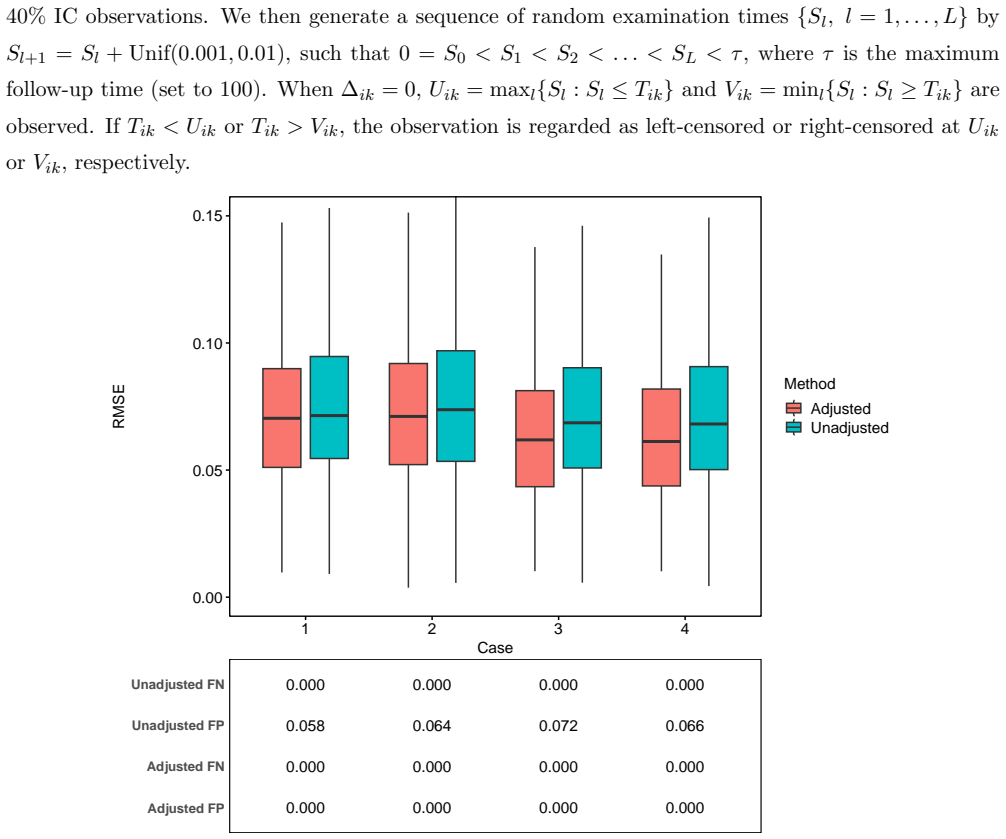
Broken adaptive ridge (BAR) penalty approximates $L_0$-regularization through iterative reweighting of L2 penalties. This penalty enjoys both the oracle property and the grouping effect for highly correlated covariates, making it particularly attractive for penalized regression with complex dependence among predictors. In this paper, we develop a BAR-penalized linear rank regression method for the semiparametric accelerated failure time model with right-censored data. Computational tractability is achieved by applying induced smoothing to the nonsmooth Gehan-type rank estimating function, yielding a more stable framework for estimation and inference. For scalable penalization, we develop a cyclic coordinate descent algorithm that minimizes the penalized objective function, and estimates the regression coefficients in a coordinate-wise manner. We further extend the proposed method to more complex survival endpoints, such as multivariate partly interval-censored (PIC) data. Under mild conditions, the proposed estimator satisfies both the oracle property and the grouping effect, and the variance estimator of the informative coefficients can be derived in analytic form. Numerical studies using synthetic data compare our approach to several well-known penalties, and demonstrate its superior selection accuracy and estimation efficiency across various scenarios. Furthermore, applications to right-censored outcomes from primary biliary cirrhosis, and correlated PIC outcomes from colorectal cancer further illustrate the practical utility of the proposed method. The R package aftPenCDA for implementing the method is available on R CRAN.
Editorial analysis
A structured set of objections, weighed in public.
Referee Report
Summary. The manuscript proposes a broken adaptive ridge (BAR) penalized linear rank regression estimator for the semiparametric accelerated failure time (AFT) model with right-censored data. Induced smoothing is applied to the Gehan-type rank estimating function to enable stable optimization, and a cyclic coordinate descent algorithm is developed for scalable computation. The central claims are that the resulting estimator satisfies the oracle property and grouping effect under mild conditions, that an analytic variance estimator exists for the nonzero coefficients, and that the approach extends to multivariate partly interval-censored data. Supporting evidence includes simulation comparisons with other penalties and two real-data applications; an R package is provided.
Significance. If the oracle property and analytic variance claims hold after accounting for the interaction between induced smoothing and BAR reweighting, the work would supply a computationally practical method for variable selection in censored rank regression that preserves the grouping effect for correlated covariates—an advantage over standard L1 penalties. The extension to partly interval-censored outcomes and the availability of reproducible software constitute additional strengths.
major comments (2)
- [§3.2, Theorem 1] §3.2, Theorem 1 (oracle property): The statement that the smoothed BAR estimator inherits the oracle property from the unsmoothed Gehan estimator under 'mild conditions' does not specify the required rate at which the induced-smoothing bandwidth h_n must shrink relative to n and the BAR penalty sequence λ_n. Because the BAR weights are updated iteratively from the current coefficient estimates, an O(h_n) approximation error can propagate through the reweighting path and potentially alter both selection consistency and the limiting distribution of the nonzero coefficients; the current proof sketch does not address uniform control of this error over the coordinate-descent iterates.
- [§3.3, Eq. (12)] §3.3, Eq. (12) (analytic variance): The sandwich-form variance estimator is derived under the assumption that the smoothed estimating function is asymptotically equivalent to the unsmoothed version at the oracle estimator. When the BAR penalty is active, the effective estimating equation changes at each iteration; it is not shown that the analytic variance remains consistent for the penalized estimator after the final reweighting step.
minor comments (3)
- [Abstract, §2.2] The abstract and §2.2 refer to 'mild conditions' without listing them; a concise statement of the precise assumptions (including bandwidth rate, penalty tuning, and censoring conditions) should be added to the introduction for readability.
- [§5] In the simulation section, the reported selection accuracy and estimation efficiency metrics lack accompanying standard errors or variability measures across replications, which would help readers gauge the stability of the reported superiority of BAR.
- [§2.3, §4] Notation for the induced-smoothing kernel and bandwidth is introduced in §2.3 but not carried consistently into the algorithm description in §4; a single notational table would improve clarity.
Simulated Author's Rebuttal
We thank the referee for the detailed and constructive review. The comments identify areas where the theoretical arguments require greater precision, and we will revise the manuscript to address them. Point-by-point responses follow.
read point-by-point responses
-
Referee: [§3.2, Theorem 1] §3.2, Theorem 1 (oracle property): The statement that the smoothed BAR estimator inherits the oracle property from the unsmoothed Gehan estimator under 'mild conditions' does not specify the required rate at which the induced-smoothing bandwidth h_n must shrink relative to n and the BAR penalty sequence λ_n. Because the BAR weights are updated iteratively from the current coefficient estimates, an O(h_n) approximation error can propagate through the reweighting path and potentially alter both selection consistency and the limiting distribution of the nonzero coefficients; the current proof sketch does not address uniform control of this error over the coordinate-descent iterates.
Authors: We agree that the rate condition on h_n and uniform control of the approximation error over the iterative reweighting steps must be stated explicitly. In the revision we will add the required conditions (h_n = o_p(n^{-1/2}) together with a suitable relation to λ_n) and expand the proof in the appendix to establish that the O(h_n) error remains negligible uniformly across coordinate-descent iterates, thereby preserving both selection consistency and the limiting distribution of the nonzero coefficients. revision: yes
-
Referee: [§3.3, Eq. (12)] §3.3, Eq. (12) (analytic variance): The sandwich-form variance estimator is derived under the assumption that the smoothed estimating function is asymptotically equivalent to the unsmoothed version at the oracle estimator. When the BAR penalty is active, the effective estimating equation changes at each iteration; it is not shown that the analytic variance remains consistent for the penalized estimator after the final reweighting step.
Authors: The referee correctly notes that consistency of the variance estimator after the final BAR reweighting step requires additional justification. We will revise the manuscript to include a short argument showing that, once the cyclic coordinate descent has converged, the smoothed estimating function evaluated at the final estimator remains asymptotically equivalent to its unsmoothed counterpart, ensuring that the sandwich variance formula remains consistent for the nonzero coefficients. revision: yes
Circularity Check
No significant circularity; derivation is algorithmic and theoretically grounded
full rationale
The paper introduces a BAR-penalized rank regression estimator for censored AFT models via induced smoothing and coordinate descent. The oracle property and grouping effect are asserted under mild conditions with analytic variance, presented as consequences of the semiparametric setup and penalization rather than tautological re-expressions of fitted quantities. No self-definitional loops, no fitted parameters renamed as predictions, and no load-bearing self-citations appear in the provided text. Numerical studies and real-data applications serve as external checks. The central claims remain independent of the input data by construction.
Axiom & Free-Parameter Ledger
Reference graph
Works this paper leans on
-
[1]
Anyaso-Samuel, S., Bandyopadhyay, D., and Datta, S. (2023). Pseudo-value regression of clustered multistate current status data with informative cluster sizes.Statistical Methods in Medical Research, 32(8):1494–1510
work page 2023
-
[2]
Breiman, L. (1996). Heuristics of instability and stabilization in model selection.The Annals of Statistics, 24(6):2350–2383
work page 1996
-
[3]
Brown, B. and Wang, Y. (2007). Induced smoothing for rank regression with censored survival times. Statist. Med, 26(4):828–836. 22
work page 2007
-
[4]
Buckley, J. and James, I. (1979). Linear regression with censored data.Biometrika, 66:429–436
work page 1979
-
[5]
Choi, T. and Choi, S. (2021). A fast algorithm for the accelerated failure time model with high-dimensional time-to-event data.Journal of Statistical Computation and Simulation, 91(16):3385—-3403
work page 2021
-
[6]
Choi, T., Choi, S., and Bandyopadhyay, D. (2025+). Rank estimation for the accelerated failure time model with partially interval-censored data.Statistica Sinica
work page 2025
-
[7]
Dai, L., Chen, K., Sun, Z., Liu, Z., and Li, G. (2018). Broken adaptive ridge regression and its asymptotic properties.Journal of Multivariate Analysis, 168:334–351
work page 2018
- [8]
-
[9]
Frommlet, F. and Nuel, G. (2016). An adaptive ridge procedure for l 0 regularization.PloS One, 11(2):e0148620
work page 2016
-
[10]
Fygenson, M. and Ritov, Y. (1994). Monotone estimating equations for censored data.The Annals of Statistics, 22(2):732–746
work page 1994
-
[11]
Heller, G. (2007). Smoothed rank regression with censored data.Journal of the American Statistical Association, 102:552–559
work page 2007
-
[12]
Hong, C., Wang, Y., and Cai, T. (2022). A divide-and-conquer method for sparse risk prediction and evaluation.Biostatistics, 23(2):397–411
work page 2022
-
[13]
Jin, Z., Lin, D., Wei, L., and Ying, Z. (2003). Rank-based inference for the accelerated failure time model. Biometrika, 90(2):341–353
work page 2003
-
[14]
Jin, Z., Lin, D. Y., and Ying, Z. (2006). On least-squares regression with censored data.Biometrika, 93:147–161
work page 2006
-
[15]
Johnson, B. A., Lin, D., and Zeng, D. (2008). Penalized estimating functions and variable selection in semiparametric regression models.Journal of the American Statistical Association, 103(482):672–680
work page 2008
-
[16]
Johnson, L. M. and Strawderman, R. L. (2009). Induced smoothing for the semiparametric accelerated failure time model: Asymptotics and extensions to clustered data.Biometrika, 96(3):577–590
work page 2009
-
[17]
Kawaguchi, E. S., Shen, J. I., Suchard, M. A., and Li, G. (2021). Scalable algorithms for large competing risks data.Journal of Computational and Graphical Statistics, 30(3):685–693
work page 2021
-
[18]
Kawaguchi, E. S., Suchard, M. A., Liu, Z., and Li, G. (2020). A surrogateℓ 0 sparse Cox’s regression with applications to sparse high-dimensional massive sample size time-to-event data.Statistics in Medicine, 39(6):675–686. 23
work page 2020
-
[19]
Lee, J., Choi, T., and Choi, S. (2024). Censored broken adaptive ridge regression in high-dimension. Computational Statistics, 39(6):3457–3482
work page 2024
-
[20]
Leurgans, S. (1987). Linear models, random censoring and synthetic data.Biometrika, 74(2):301–309
work page 1987
-
[21]
Li, N., Peng, X., Kawaguchi, E., Suchard, M. A., and Li, G. (2021). A scalable surrogateL 0 sparse regression method for generalized linear models with applications to large scale data.Journal of Statistical Planning and Inference, 213:262–281
work page 2021
-
[22]
Pan, C., Cai, B., and Wang, L. (2020). A Bayesian approach for analyzing partly interval-censored data under the proportional hazards model.Statistical Methods in Medical Research, 29(11):3192–3204
work page 2020
-
[23]
Sidhu, R. (2014). Final results from a randomized phase 3 study of FOLFIRI±panitumumab for second-line treatment of metastatic colorectal cancer.Annals of Oncology, 25(1):107–116
work page 2014
-
[24]
Son, M., Choi, T., Shin, S. J., Jung, Y., and Choi, S. (2022). Regularized linear censored quantile regression.Journal of the Korean Statistical Society, 51(2):589–607
work page 2022
-
[25]
Sun, Z., Liu, Y., Chen, K., and Li, G. (2022). Broken adaptive ridge regression for right-censored survival data.Annals of the Institute of Statistical Mathematics, 74(1):69–91
work page 2022
-
[26]
Tibshirani, R. (1996). Regression shrinkage and selection via the lasso.Journal of the Royal Statistical Society. Series B (Methodological), 58(1):267–288
work page 1996
-
[27]
Tsiatis, A. A. (1990). Estimating regression parameters using linear rank tests for censored data.The Annals of Statistics, 18(1):354–372
work page 1990
-
[28]
Wang, W., Lu, S.-E., Cheng, J. Q., Xie, M., and Kostis, J. B. (2022). Multivariate survival analysis in big data: A divide-and-combine approach.Biometrics, 78(3):852–866
work page 2022
-
[29]
Wang, Y.-G. and Zhao, Y. (2008). Weighted rank regression for clustered data analysis.Biometrics, 64(1):39–45
work page 2008
-
[30]
Wright, S. J. (2015). Coordinate descent algorithms.Mathematical Programming, 151(1):3–34
work page 2015
-
[31]
Xu, J., Leng, C., and Ying, Z. (2010). Rank-based variable selection with censored data.Statistics and Computing, 20(2):165–176
work page 2010
-
[32]
Zeng, D. and Lin, D. Y. (2008). Efficient resampling methods for nonsmooth estimating functions. Biostatistics, 9(2):355–363
work page 2008
-
[33]
Zhang, C.-H. (2010). Nearly unbiased variable selection under minimax concave penalty.The Annals of Statistics, 38(2):894–942. 24
work page 2010
-
[34]
Zhang, H. H. and Lu, W. (2007). Adaptive lasso for cox’s proportional hazards model.Biometrika, 94(3):691–703
work page 2007
-
[35]
Zhao, H., Wu, Q., Li, G., and Sun, J. (2020). Simultaneous estimation and variable selection for interval- censored data with broken adaptive ridge regression.Journal of the American Statistical Association, 115(529):204–216
work page 2020
-
[36]
Zou, H. (2006). The adaptive lasso and its oracle properties.Journal of the American Statistical Associ- ation, 101(476):1418–1429. 25
work page 2006
discussion (0)
Sign in with ORCID, Apple, or X to comment. Anyone can read and Pith papers without signing in.