Formation and Eruption of Filament Channel in Solar Active Region 12975: Insights from Observations and Simulations of Magnetic Field Evolution
Pith reviewed 2026-07-01 03:56 UTC · model grok-4.3
The pith
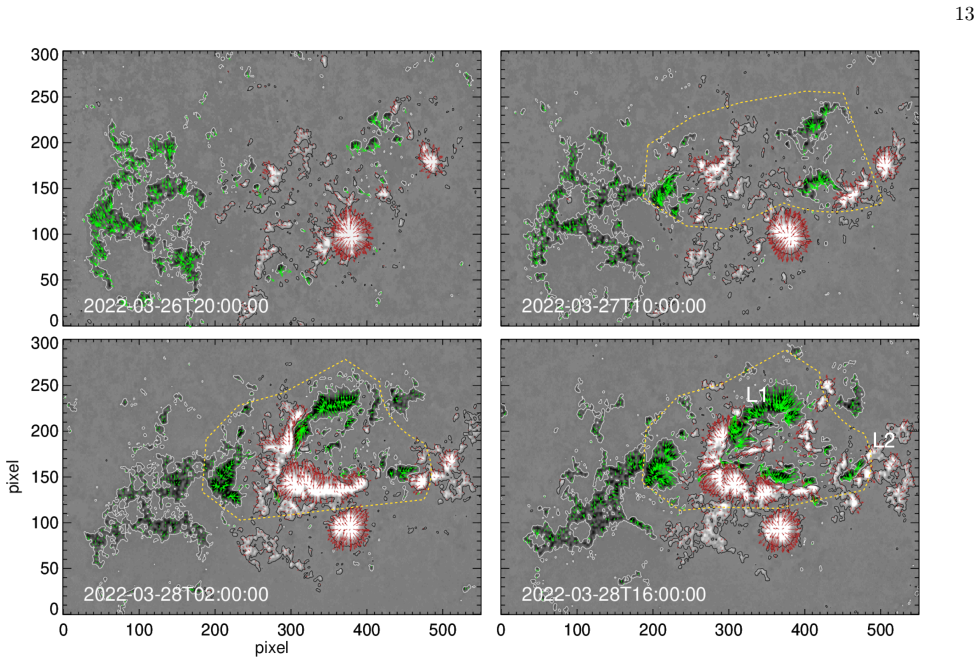
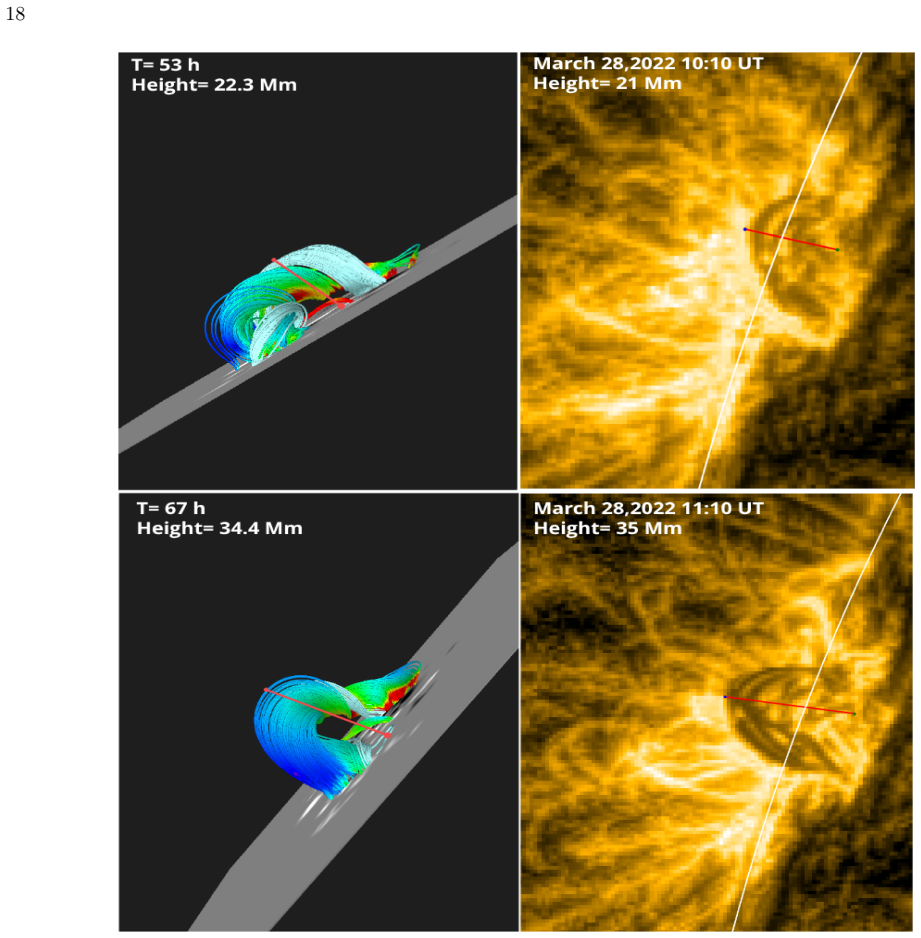
A magnetofrictional simulation driven by photospheric magnetograms reproduces the 50-hour buildup of a sigmoidal flux rope in active region 12975 and tracks its helicity evolution up to eruption.
A machine-rendered reading of the paper's core claim, the machinery that carries it, and where it could break.
Core claim
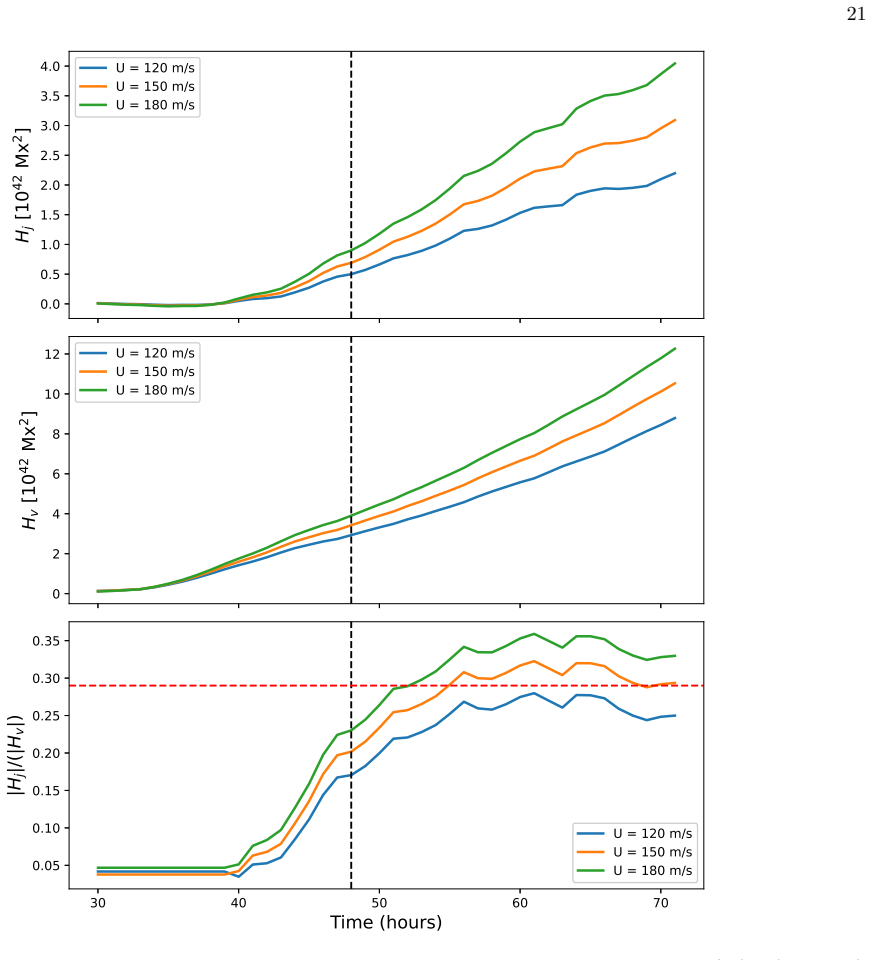
The time-dependent magnetofrictional simulation, initialized from magnetograms on 26 March and driven by derived electric fields, reproduces the observed coronal evolution including the gradual development of a sigmoidal twisted flux rope over approximately 50 hours. The modeled magnetic energy and helicity inside the domain track the observed injection; the current-carrying to total relative helicity ratio reaches 0.23 at the observed eruption time of 28 March 12:00 UT, while the torus-unstable regime is reached at a ratio of 0.32 about seven hours later. The flux rope forms adjacent to pre-existing magnetic fields, so a substantial portion of the coronal structure does not belong to the ro
What carries the argument
Time-dependent magnetofrictional (TMF) model driven by electric fields derived from a time series of photospheric vector magnetograms, used to evolve the three-dimensional coronal field and identify the flux-rope boundary via helicity ratios.
If this is right
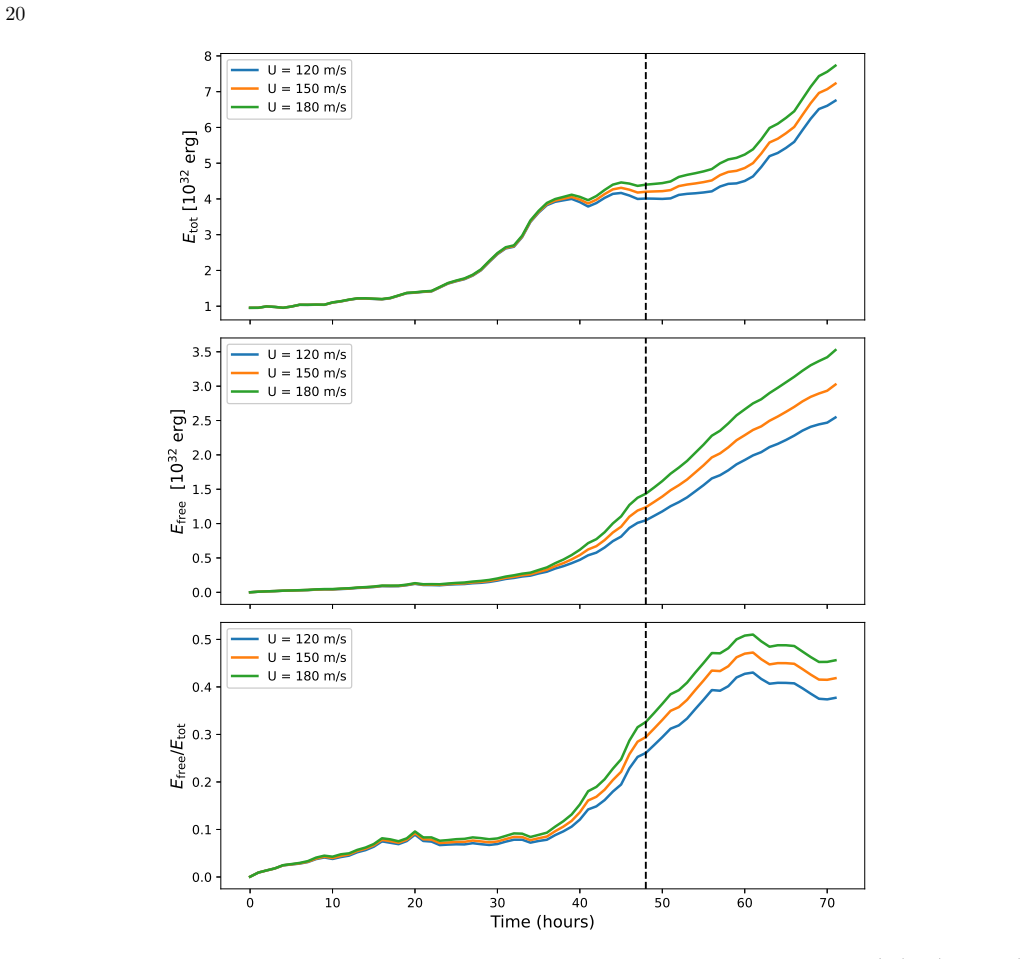
- Magnetic energy and helicity injection in the computational domain remain consistent with observed values throughout the 50-hour evolution.
- The current-carrying to total relative helicity ratio reaches 0.23 precisely at the observed eruption time.
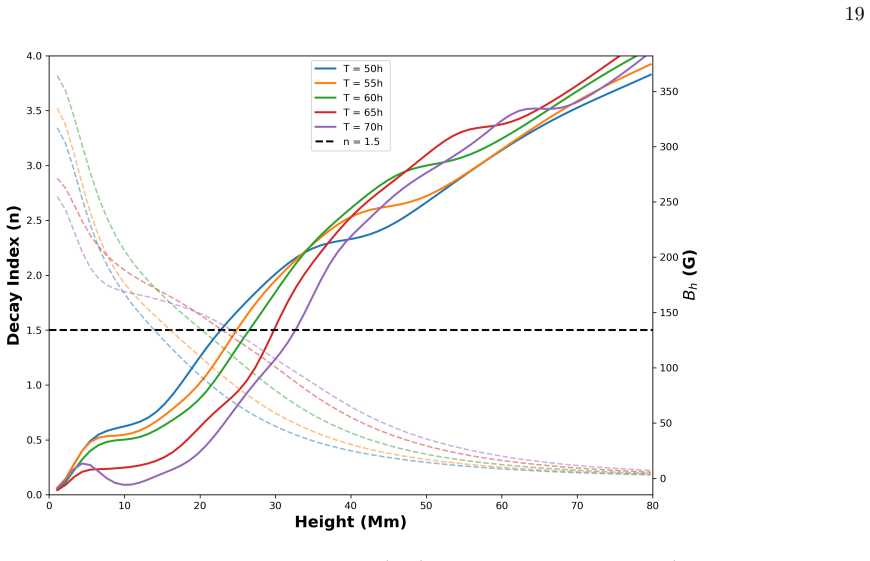
- Torus instability sets in only when the helicity ratio reaches 0.32, seven hours after the observed eruption.
- Because the rope forms next to pre-existing fields, the helicity thresholds deviate from the value 0.29 proposed in earlier studies.
Where Pith is reading between the lines
- Similar modeling of other active regions may need region-specific helicity thresholds rather than a universal 0.29 value.
- Improved methods to isolate the flux-rope volume from surrounding fields could tighten the agreement between simulated and observed eruption timing.
- The seven-hour offset between the 0.23 ratio and torus instability suggests additional triggers such as reconnection with adjacent fields may initiate the observed eruption.
Load-bearing premise
The magnetofrictional model and the photospheric electric fields derived from magnetograms correctly capture the three-dimensional coronal field evolution and permit reliable identification of the flux-rope boundary even when adjacent pre-existing fields are present.
What would settle it
A direct comparison showing that the simulated sigmoidal structure or the timing of the 0.23 helicity ratio does not match the observed filament-channel morphology or the 28 March 12:00 UT eruption time would falsify the reproduction claim.
Figures
read the original abstract
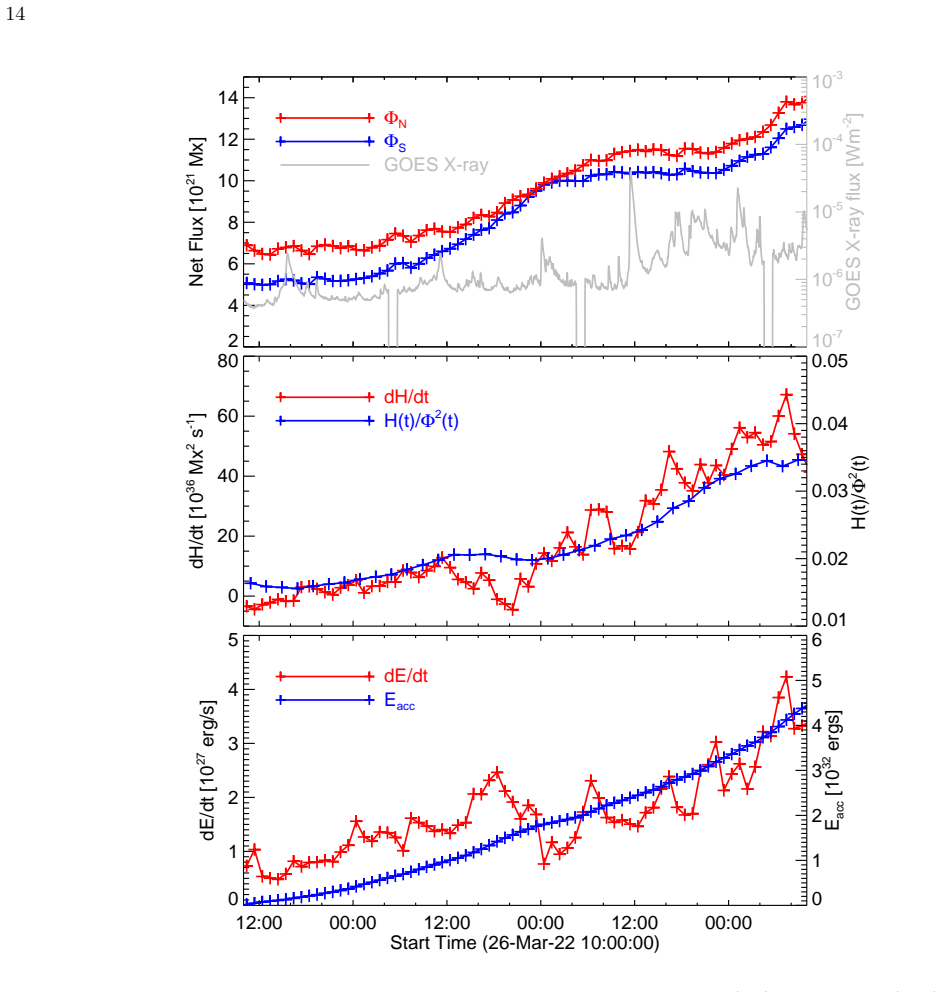
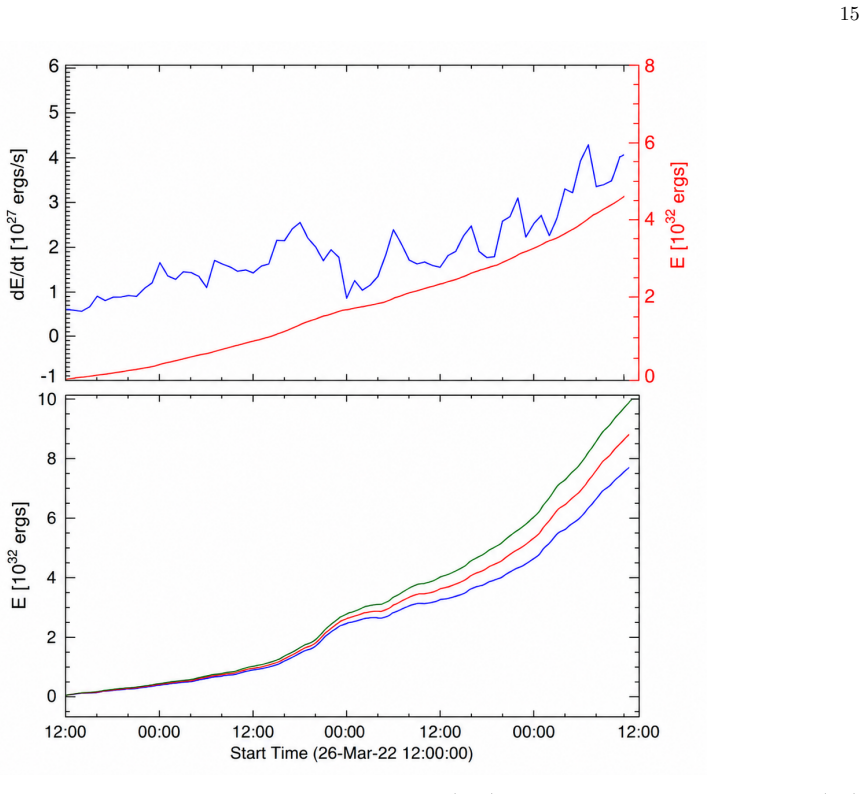
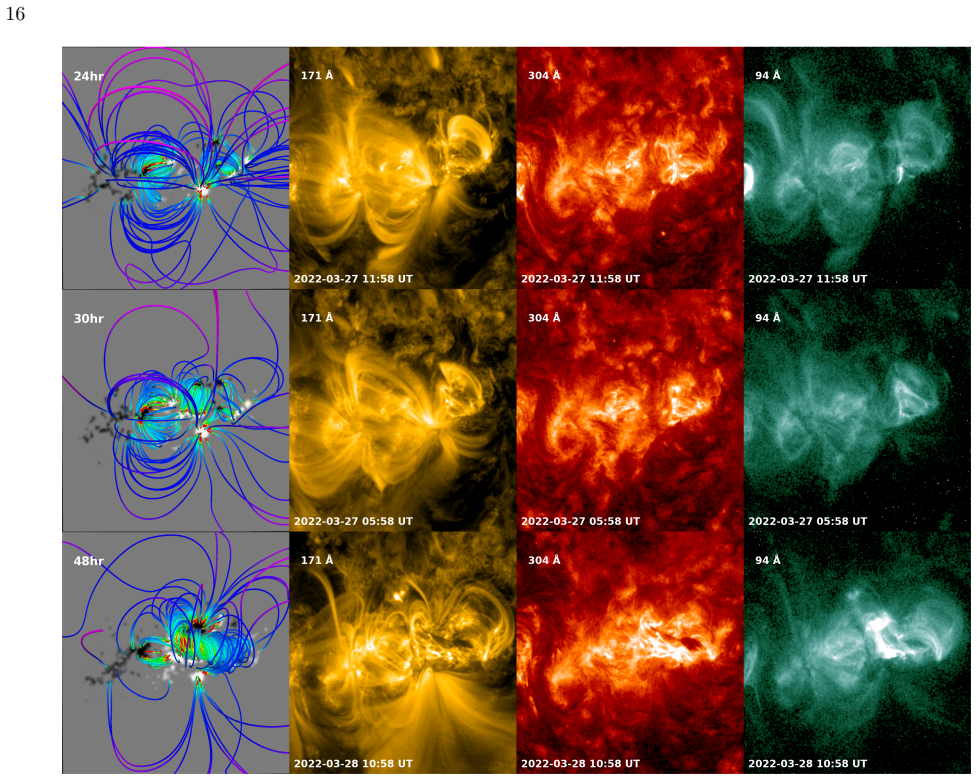
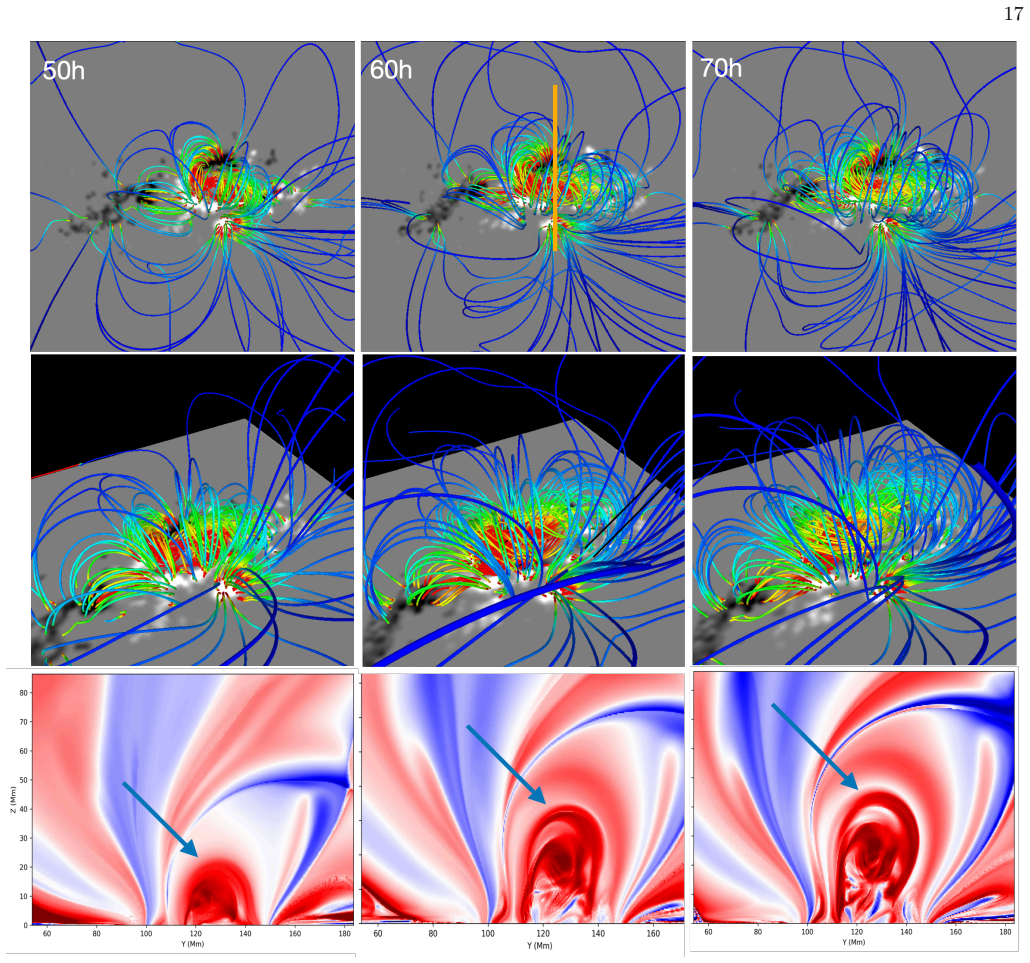
We studied the magnetic field evolution of active region (AR) 12975 using a time-dependent magnetofrictional (TMF) model. This AR produced two consecutive CMEs associated with M-class flares on March 28, 2022. The AR exhibited a simple bipolar configuration, with new bipolar flux emerging from March 27. These emerging flux regions evolved through shear motions, forming a filament-channel that ultimately erupted on March 28 at 12:00 UT. The simulation, initialized at 12:00 UT on March 26, is driven by electric fields derived from a time-series of photospheric vector-magnetograms. It reproduces the observed coronal evolution, including the gradual development of a sigmoidal, twisted flux rope (FR) over approximately 50 hours. The modeled temporal evolution of magnetic energy and helicity within the computational domain is consistent with the observed injection of both quantities. Furthermore, the ratio of current-carrying to total relative helicity reaches 0.23 at the time of observed eruption, however the torus-unstable regime is attained when the helicity ratio reaches 0.32, approximately 7 hr after the observed eruption. Notably, the FR forms adjacent to pre-existing magnetic fields, and a substantial portion of the coronal structure does not belong to the FR system. Consequently, the derived helicity thresholds vary and deviate from the proposed value of 0.29. While reproducing filament formation with high morphological accuracy, this study underscores the quantitative challenges involved in modeling and evaluating the eruptive behavior of different ARs.
Editorial analysis
A structured set of objections, weighed in public.
Referee Report
Summary. The manuscript applies a time-dependent magnetofrictional (TMF) model to active region 12975, initialized from vector magnetograms at 12:00 UT on 26 March 2022 and driven by derived photospheric electric fields. The simulation reproduces the gradual formation of a sigmoidal, twisted flux rope over ~50 hours, with modeled magnetic energy and helicity evolution consistent with observed injection. It reports that the ratio of current-carrying to total relative helicity reaches 0.23 at the observed eruption time (28 March 12:00 UT), while the torus-unstable regime is reached at a ratio of 0.32 approximately 7 hours later. The study notes that the flux rope forms adjacent to pre-existing fields, with a substantial portion of the coronal structure not belonging to the FR system, causing the derived thresholds to deviate from the literature value of 0.29.
Significance. If the 3D field evolution and FR boundary can be shown to be robust, the work provides a concrete example of how observation-driven TMF modeling can link photospheric driving to coronal eruption triggers, while underscoring quantitative difficulties in applying helicity-based instability criteria to real ARs that contain mixed flux systems. The morphological fidelity to the observed filament channel is a clear strength.
major comments (2)
- [Abstract and helicity results section] Abstract and § on helicity results: the reported values 0.23 (at observed eruption) and 0.32 (torus onset) rest on the separation of the erupting FR volume from adjacent pre-existing fields. The manuscript states that “a substantial portion of the coronal structure does not belong to the FR system,” yet provides no explicit criteria, isosurface thresholds, or connectivity-based method for defining this volume in the 3D grid; without such documentation the numerical thresholds lose quantitative meaning.
- [Results on torus instability timing] Results on torus instability timing: the 7-hour delay between observed eruption and the model reaching the 0.32 ratio is presented as a finding, but the manuscript does not quantify how sensitive this timing is to plausible variations in the FR boundary definition or to uncertainties in the input electric-field maps; this sensitivity directly affects the claim that the model reproduces the eruptive behavior.
minor comments (2)
- Figure captions should explicitly state the integration volume used for the global energy and helicity time series versus the sub-volume used for the FR-specific ratio.
- The abstract states consistency with observed injection but does not report the quantitative metric (e.g., correlation coefficient or normalized rms difference) used to establish that consistency.
Simulated Author's Rebuttal
We thank the referee for the constructive comments. We address each major point below, agreeing to document the FR volume definition explicitly while noting that full quantitative sensitivity analysis lies beyond the present study scope.
read point-by-point responses
-
Referee: [Abstract and helicity results section] Abstract and § on helicity results: the reported values 0.23 (at observed eruption) and 0.32 (torus onset) rest on the separation of the erupting FR volume from adjacent pre-existing fields. The manuscript states that “a substantial portion of the coronal structure does not belong to the FR system,” yet provides no explicit criteria, isosurface thresholds, or connectivity-based method for defining this volume in the 3D grid; without such documentation the numerical thresholds lose quantitative meaning.
Authors: We agree the separation criteria require explicit documentation. The revised manuscript will add a dedicated paragraph describing the method: magnetic connectivity tracing from the photospheric polarity inversion line combined with a current-carrying helicity density isosurface threshold (0.01 G²) to isolate the sigmoidal FR from adjacent pre-existing flux. This will make the 0.23 and 0.32 ratios reproducible and restore quantitative meaning. revision: yes
-
Referee: [Results on torus instability timing] Results on torus instability timing: the 7-hour delay between observed eruption and the model reaching the 0.32 ratio is presented as a finding, but the manuscript does not quantify how sensitive this timing is to plausible variations in the FR boundary definition or to uncertainties in the input electric-field maps; this sensitivity directly affects the claim that the model reproduces the eruptive behavior.
Authors: A full sensitivity study would require new TMF runs with varied FR boundaries and perturbed electric-field maps, which exceeds the scope of the current work. We will add a brief qualitative discussion noting that the 7-hour offset arises from the mixed-flux configuration (FR adjacent to pre-existing fields), consistent with the manuscript's emphasis on quantitative challenges in real ARs. The core claim of morphological reproduction and consistent energy/helicity injection remains unchanged. revision: no
- Quantitative sensitivity of the 7-hour torus-instability delay to FR boundary definition and electric-field map uncertainties
Circularity Check
No circularity: simulation driven by external magnetogram data with independent comparison to observations
full rationale
The paper initializes a time-dependent magnetofrictional model from observed vector magnetograms, derives photospheric electric fields from the time series, and evolves the coronal field forward. Reported quantities (magnetic energy, helicity injection, current-carrying to total relative helicity ratio of 0.23 at observed eruption time, torus instability at 0.32) are computed directly from the simulated volume at times fixed by external observations. The abstract explicitly notes deviations from the literature value 0.29 due to adjacent pre-existing fields and acknowledges quantitative challenges, rather than forcing agreement. No equation reduces the helicity ratio or instability timing to a fitted parameter defined within the paper, no self-citation chain bears the central claim, and the derivation remains self-contained against the independent observational benchmarks.
Axiom & Free-Parameter Ledger
axioms (1)
- domain assumption The magnetofrictional model accurately evolves the coronal magnetic field when driven by photospheric electric fields derived from observed vector magnetograms.
Reference graph
Works this paper leans on
-
[1]
1996, A&AS, 117, 393, doi: 10.1051/aas:1996164
SExtractor: Software for source extraction. , year = 1996, volume =. doi:10.1051/aas:1996164 , adsurl =
-
[2]
Berger, M. A. and Field, G. B. , title =. Journal of Fluid Mechanics , volume =. 1984 , doi =
1984
-
[3]
Solar Physics , volume =
Demoulin, Pascal and Berger, Mitchell , title =. Solar Physics , volume =. 2003 , doi =
2003
-
[4]
, title =
Schuck, Peter W. , title =. The Astrophysical Journal , volume =. 2006 , doi =
2006
-
[5]
The Astrophysical Journal , volume=
Measurement of magnetic helicity injection and free energy loading into the solar corona , author=. The Astrophysical Journal , volume=. 2002 , publisher=
2002
-
[6]
Astrophys
Schuck, Peter , title =. Astrophys. J. , volume =. 2008 , doi =
2008
-
[7]
Investigation of Helicity and Energy Flux Transport in Three Emerging Solar Active Regions. , year = 2015, volume =. doi:10.1088/0004-637X/806/2/245 , adsurl =
-
[8]
and Schuck, P
Liu, Y. and Schuck, P. W. , title =. The Astrophysical Journal , volume =. 2012 , doi =
2012
-
[9]
Lamport, Leslie , year=
-
[10]
Different styles & systems of referencing: Guidance on citing references for students at the University of Reading , year =
-
[11]
Avoiding unintentional plagiarism: Guidance on citing references for students at the University of Reading , year =
-
[12]
Brummell and J
Yang Liu and Rudolf Komm and Nicholas H. Brummell and J. Todd Hoeksema and Bhishek Manek and Gherardo Valori , title =. The Astrophysical Journal , volume =. 2024 , doi =
2024
-
[13]
astro-ph.SR , year =
Shin Toriumi and Sung-Hong Park , title =. astro-ph.SR , year =
-
[14]
2014 , address =
Eric Priest , title =. 2014 , address =
2014
-
[15]
1998 , address =
Arnab Rai Choudhuri , title =. 1998 , address =
1998
-
[16]
Zirker , title =
Jack B. Zirker , title =. 2002 , address =
2002
-
[17]
Velocity Fields in the Solar Atmosphere. I. Preliminary Report. , year = 1962, volume =. doi:10.1086/147285 , adsurl =
-
[18]
The Astrophysical Journal , volume =
Jongchul Chae , title =. The Astrophysical Journal , volume =. 2001 , doi =
2001
-
[19]
Mark C. M. Cheung and Marc L. DeRosa , title =. The Astrophysical Journal , volume =. 2012 , doi =
2012
-
[20]
Lumme and J
E. Lumme and J. Pomoell and D. J. Price and others , title =. Astronomy & Astrophysics , volume =. 2022 , doi =
2022
-
[21]
Riley, Pete and Linker, J. A. and Mikić, Z. and Lionello, R. and Ledvina, S. A. and Luhmann, J. G. , title =. The Astrophysical Journal , volume =. 2006 , doi =
2006
-
[22]
Pomoell and E
J. Pomoell and E. Lumme and E. Kilpua , title =. Solar Physics , volume =. 2019 , doi =
2019
-
[23]
W. H. Yang and P. A. Sturrock and S. K. Antiochos , title =. The Astrophysical Journal , volume =. 1986 , doi =
1986
-
[24]
Vemareddy, P. , title =. 2024 , month =. doi:10.3847/1538-4357/ad8089 , url =
-
[25]
The Journal of Open Source Software , volume =
Pencil Code Collaboration and Axel Brandenburg and Anders Johansen and Philippe Bourdin and Wolfgang Dobler and Wladimir Lyra and Matthias Rheinhardt and Sven Bingert and Nils Haugen and Antony Mee and Frederick Gent and Natalia Babkovskaia and Chao-Chin Yang and Tobias Heinemann and Boris Dintrans and Dhrubaditya Mitra and Simon Candelaresi and Jörn Warn...
arXiv 2021
-
[26]
R. A. Howard and J. D. Moses and A. Vourlidas and J. S. Newmark and D. G. Socker and S. P. Plunkett and C. M. Korendyke and J. W. Cook and A. Hurley and J. M. Davila and W. T. Thompson and O. C. St Cyr and E. Mentzell and K. Mehalick and J. R. Lemen and J. P. Wuelser and D. W. Duncan and T. D. Tarbell and C. J. Wolfson and A. Moore and R. A. Harrison and ...
-
[27]
J. R. Lemen and A. M. Title and D. J. Akin and P. F. Boerner and C. Chou and J. F. Drake and D. W. Duncan and C. G. Edwards and F. M. Friedlaender and G. F. Heyman and N. E. Hurlburt and N. L. Katz and G. D. Kushner and M. Levay and R. W. Lindgren and D. P. Mathur and E. L. McFeaters and S. Mitchell and R. A. Rehse and C. J. Schrijver and L. A. Springer a...
-
[28]
J. Schou and P. H. Scherrer and R. I. Bush and R. Wachter and S. Couvidat and M. C. Rabello-Soares and R. S. Bogart and J. T. Hoeksema and Y. Liu and T. L. Duvall and D. J. Akin and B. A. Allard and J. W. Miles and R. Rairden and R. A. Shine and T. D. Tarbell and A. M. Title and C. J. Wolfson and D. F. Elmore and A. A. Norton and S. Tomczyk , title =. Sol...
-
[29]
W. Dean Pesnell and B. J. Thompson and P. C. Chamberlin , title =. Solar Physics , year =. doi:10.1007/s11207-011-9841-3 , url =
-
[30]
Peter W. Schuck and Spiro K. Antiochos , title =. The Astrophysical Journal , year =. doi:10.3847/1538-4357/ab298a , url =
-
[31]
M. G. Bobra and X. Sun and J. T. Hoeksema and others , title =. Solar Physics , year =. doi:10.1007/s11207-014-0529-3 , url =
-
[32]
J. W. Harvey and F. Hill and R. P. Hubbard and others , title =. Science , year =. doi:10.1126/science.272.5266.1284 , url =
-
[33]
M. The Solar Orbiter mission. Science overview , journal =. 2020 , volume =. doi:10.1051/0004-6361/202038467 , archivePrefix =. 2009.00861 , primaryClass =
-
[34]
G. A. Gary , title=. ApJS , volume=. 1989 , pages=
1989
-
[35]
Lumme, E. and Pomoell, J. and Kilpua, E. K. J. , title =. Solar Physics , year =. doi:10.1007/s11207-017-1214-0 , archivePrefix =. 1712.05757 , primaryClass =
work page internal anchor Pith review Pith/arXiv arXiv doi:10.1007/s11207-017-1214-0
-
[36]
Magnetic Energy and Helicity in Two Emerging Active Regions in the Sun. , keywords =. doi:10.1088/0004-637X/761/2/105 , adsurl =
-
[37]
Lin, H. and Kuhn, J. R. and Coulter, R. , title =. 2004 , month =. doi:10.1086/425217 , url =
-
[38]
Measurement of magnetic field and relativistic electrons along a solar flare current sheet. Nature Astronomy , keywords =. doi:10.1038/s41550-020-1147-7 , archivePrefix =. 2005.12757 , primaryClass =
-
[39]
Coronal Temperature, Density, and Magnetic Field Maps of a Solar Active Region Using the Owens Valley Solar Array. , keywords =. doi:10.1086/173614 , adsurl =
-
[40]
Liu, Yang and Welsch, Brian T. and Valori, Gherardo and K. Georgoulis, Manolis and Guo, Yang and Pariat, Etienne and Park, Sung-Hong and Thalmann, Julia K. , title =. 2023 , month =. doi:10.3847/1538-4357/aca3a6 , url =
-
[41]
Coronal magnetic field measurement using loop oscillations observed by Hinode/EIS. , keywords =. doi:10.1051/0004-6361:200810186 , adsurl =
-
[42]
Pötzi , title =. 2021 , month =. doi:https://doi.org/10.1007/s11207-021-01903-4 , url =
-
[44]
Kilpua and H
E. Kilpua and H. E. J. Koskinen and T. I. Pulkkinen , title=. Living Reviews in Solar Physics , volume=. 2017 , pages=
2017
-
[45]
GEOPHYSICAL MONOGRAPH-AMERICAN GEOPHYSICAL UNION , volume=
Theory of coronal mass ejections , author=. GEOPHYSICAL MONOGRAPH-AMERICAN GEOPHYSICAL UNION , volume=. 2001 , publisher=
2001
-
[46]
E. R. Priest and T. G. Forbes , title=. Astronomy and Astrophysics Review , volume=. 2002 , pages=
2002
-
[47]
Lin and M
H. Lin and M. J. Penn and S. Tomczyk , title=. The Astrophysical Journal Letters , volume=. 2000 , pages=
2000
-
[48]
Gieseler and N
J. Gieseler and N. Dresing and C. Palmroos and J. L. Freiherr von Forstner and D. J. Price and R. Vainio and A. Kouloumvakos and L. Rodríguez-García and D. Trotta and V. G. Solar-MACH: An open-source tool to analyze solar magnetic connection configurations , journal=. 2023 , pages=
2023
-
[49]
The Astrophysical Journal , volume=
Evolution of magnetic field and energy in a major eruptive active region based on SDO/HMI observation , author=. The Astrophysical Journal , volume=. 2012 , publisher=
2012
-
[50]
Green, L. M. and Kliem, B. and Wallace, A. J. , title =. Astronomy & Astrophysics , year =. doi:10.1051/0004-6361/201015146 , adsurl =
-
[51]
Patsourakos, S. and Vourlidas, A. and Stenborg, G. , title =. The Astrophysical Journal , year =. doi:10.1088/0004-637X/764/2/125 , adsurl =
-
[52]
Kliem, B. and T. Torus Instability , journal =. 2006 , volume =. doi:10.1103/PhysRevLett.96.255002 , adsurl =
-
[53]
Model for the Coupled Evolution of Subsurface and Coronal Magnetic Fields in Solar Active Regions , journal =. 2007 , month = apr, volume =. doi:10.1086/512849 , keywords =
-
[54]
Magnetic Energy and Helicity Fluxes at the Photospheric Level. , keywords =. doi:10.1023/A:1025679813955 , adsurl =
-
[55]
Exploring the coronal evolution of AR 12473 using time-dependent, data-driven magnetofrictional modelling. , keywords =. doi:10.1051/0004-6361/202038925 , adsurl =
-
[56]
Time-dependent data-driven coronal simulations of AR 12673 from emergence to eruption. , keywords =. doi:10.1051/0004-6361/201935535 , adsurl =
-
[57]
Journal of Geophysical Research (Space Physics) , keywords =
A catalog of white light coronal mass ejections observed by the SOHO spacecraft. Journal of Geophysical Research (Space Physics) , keywords =. doi:10.1029/2003JA010282 , adsurl =
-
[58]
A Catastrophe Mechanism for Coronal Mass Ejections. , keywords =. doi:10.1086/170051 , adsurl =
-
[59]
A review on the genesis of coronal mass ejections. , keywords =. doi:10.1029/2000JA000005 , adsurl =
-
[60]
Linear Force-free Magnetic Fields for Solar Extrapolation and Interpretation. , keywords =. doi:10.1086/191316 , adsurl =
-
[61]
Computational Modeling of Magnetic Fields in Solar Active Regions. , keywords =. doi:10.1007/BF00226267 , adsurl =
-
[62]
Nonlinear Force-free Field Modeling of a Solar Active Region around the Time of a Major Flare and Coronal Mass Ejection. , keywords =. doi:10.1086/527413 , archivePrefix =. 0712.0023 , primaryClass =
work page internal anchor Pith review Pith/arXiv arXiv doi:10.1086/527413
-
[63]
A Critical Assessment of Nonlinear Force-Free Field Modeling of the Solar Corona for Active Region 10953. , keywords =. doi:10.1088/0004-637X/696/2/1780 , archivePrefix =. 0902.1007 , primaryClass =
work page internal anchor Pith review Pith/arXiv arXiv doi:10.1088/0004-637x/696/2/1780
-
[64]
Magnetic Field Extrapolations in the Corona: Success and Future Improvements
Magnetic Field Extrapolations into the Corona: Success and Future Improvements. , keywords =. doi:10.1007/s11207-013-0367-8 , archivePrefix =. 1307.3844 , primaryClass =
work page internal anchor Pith review Pith/arXiv arXiv doi:10.1007/s11207-013-0367-8
-
[65]
Coronal Magnetic Field Models. , keywords =. doi:10.1007/s11214-015-0178-3 , adsurl =
-
[66]
Nonlinear Force-free Field Extrapolation of a Coronal Magnetic Flux Rope Supporting a Large-scale Solar Filament from a Photospheric Vector Magnetogram. , keywords =. doi:10.1088/2041-8205/786/2/L16 , archivePrefix =. 1403.7807 , primaryClass =
work page internal anchor Pith review Pith/arXiv arXiv doi:10.1088/2041-8205/786/2/l16 2041
-
[67]
A Twisted Flux Rope as the Magnetic Structure of a Filament in Active Region 10953 Observed by Hinode. , keywords =. doi:10.1088/0004-637X/715/2/1566 , adsurl =
-
[68]
Mean Field Model for the Formation of Filament Channels on the Sun. , keywords =. doi:10.1086/309265 , adsurl =
-
[69]
Coronal Mass Ejection: Initiation, Magnetic Helicity, and Flux Ropes. I. Boundary Motion-driven Evolution. , keywords =. doi:10.1086/345501 , adsurl =
-
[70]
Inoue, S. and Hayashi, K. and Magara, T. and Choe, G. S. and Park, Y. D. , title =. 2014 , month =. doi:10.1088/0004-637X/788/2/182 , url =
-
[71]
Measurement of Magnetic Helicity Injection and Free Energy Loading into the Solar Corona. , keywords =. doi:10.1086/342171 , adsurl =
-
[72]
and Eden, Thomas and Eparvier, Francis G
Woods, Thomas N. and Eden, Thomas and Eparvier, Francis G. and Jones, Andrew R. and Woodraska, Donald L. and Chamberlin, Phillip C. and Machol, Janet L. , title =. Journal of Geophysical Research: Space Physics , volume =. 2024 , doi =
2024
-
[73]
The Large Angle Spectroscopic Coronagraph (LASCO). , keywords =. doi:10.1007/BF00733434 , adsurl =
-
[74]
Formation and eruption of sigmoidal structure from a weak field region of NOAA 11942
Formation and Eruption of Sigmoidal Structure from a Weak Field Region of NOAA 11942. , keywords =. doi:10.3847/1538-4357/ab0a06 , archivePrefix =. 1902.08105 , primaryClass =
work page internal anchor Pith review Pith/arXiv arXiv doi:10.3847/1538-4357/ab0a06 1902
-
[75]
Advances in Nonlinear Dynamics , editor =
Topological quantities in magnetohydrodynamics. Advances in Nonlinear Dynamics , editor =. doi:10.1201/9780203493137.ch10 , adsurl =
-
[76]
Testing magnetic helicity conservation in a solar-like active event
Testing magnetic helicity conservation in a solar-like active event. , keywords =. doi:10.1051/0004-6361/201525811 , archivePrefix =. 1506.09013 , primaryClass =
work page internal anchor Pith review Pith/arXiv arXiv doi:10.1051/0004-6361/201525811
-
[77]
Effects of optimisation parameters on data-driven magnetofrictional modelling of active regions. , keywords =. doi:10.1051/0004-6361/202244650 , archivePrefix =. 2305.16080 , primaryClass =
-
[79]
Advances in Space Research , year = 2007, month = jan, volume = 39, number = 11, pages =
Recent theoretical and observational developments in magnetic helicity studies. Advances in Space Research , year = 2007, month = jan, volume = 39, number = 11, pages =. doi:10.1016/j.asr.2006.12.037 , adsurl =
-
[80]
Priest, E. R. and Forbes, T. G. , title =. Astronomy and Astrophysics Review , year =
-
[81]
Zuccarello, F. P. and Pariat, E. and Valori, G. and Linan, L. , title =. The Astrophysical Journal , year =
-
[82]
and Leake, J
Pariat, E. and Leake, J. E. and Valori, G. and Linton, M. G. and Zuccarello, F. P. and Dalmasse, K. , title =. Astronomy & Astrophysics , volume =. 2017 , doi =
2017
discussion (0)
Sign in with ORCID, Apple, or X to comment. Anyone can read and Pith papers without signing in.