Bolometric correction for cosmologically redshifted stars with dust: an update to the YBC database
Pith reviewed 2026-07-01 03:51 UTC · model grok-4.3
The pith
Bolometric corrections for redshifted stars with dust show larger color dispersions at high redshift, allowing tighter stellar parameter estimates than for local stars when redshift is known.
A machine-rendered reading of the paper's core claim, the machinery that carries it, and where it could break.
Core claim
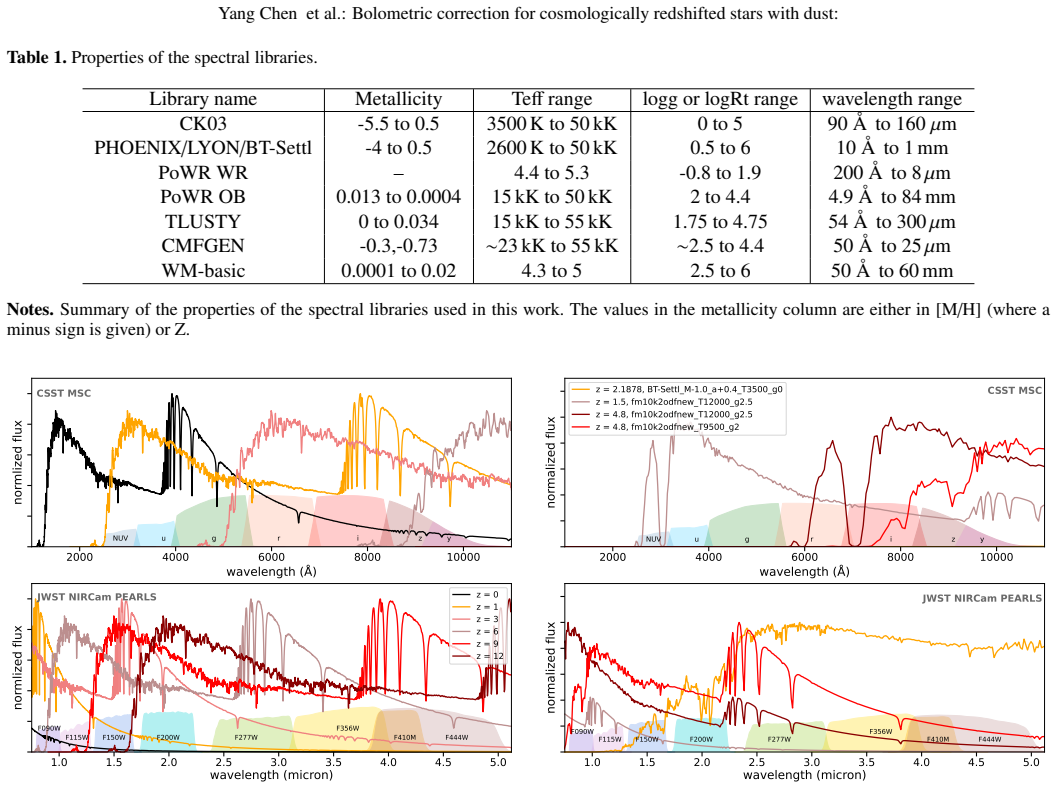
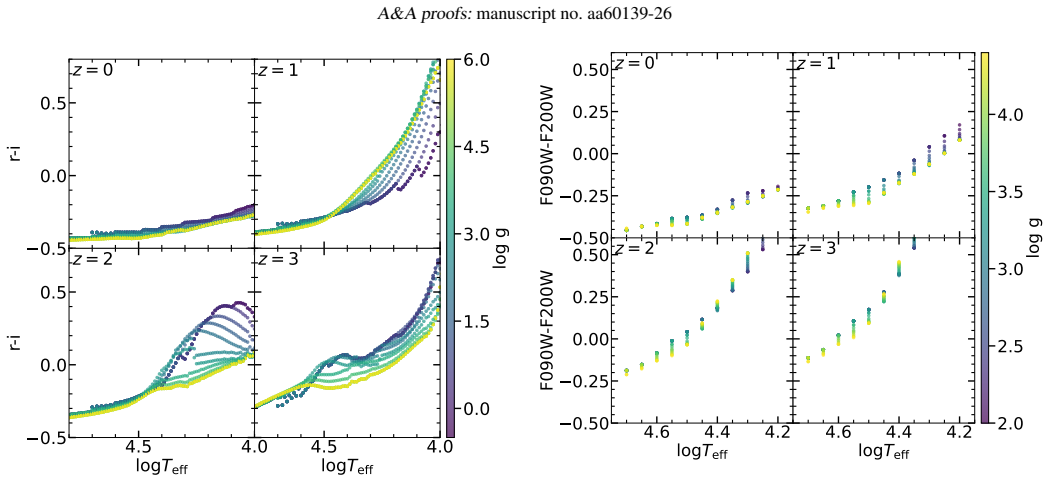
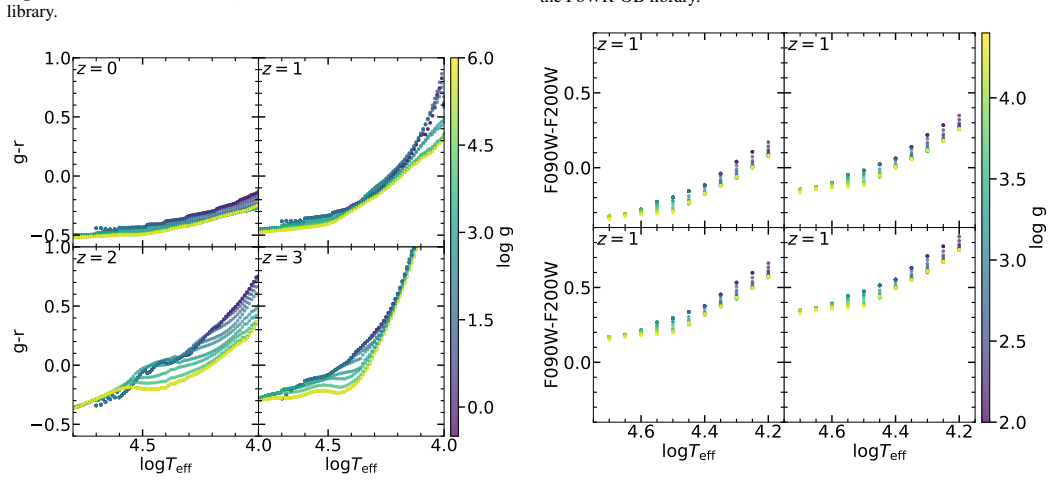
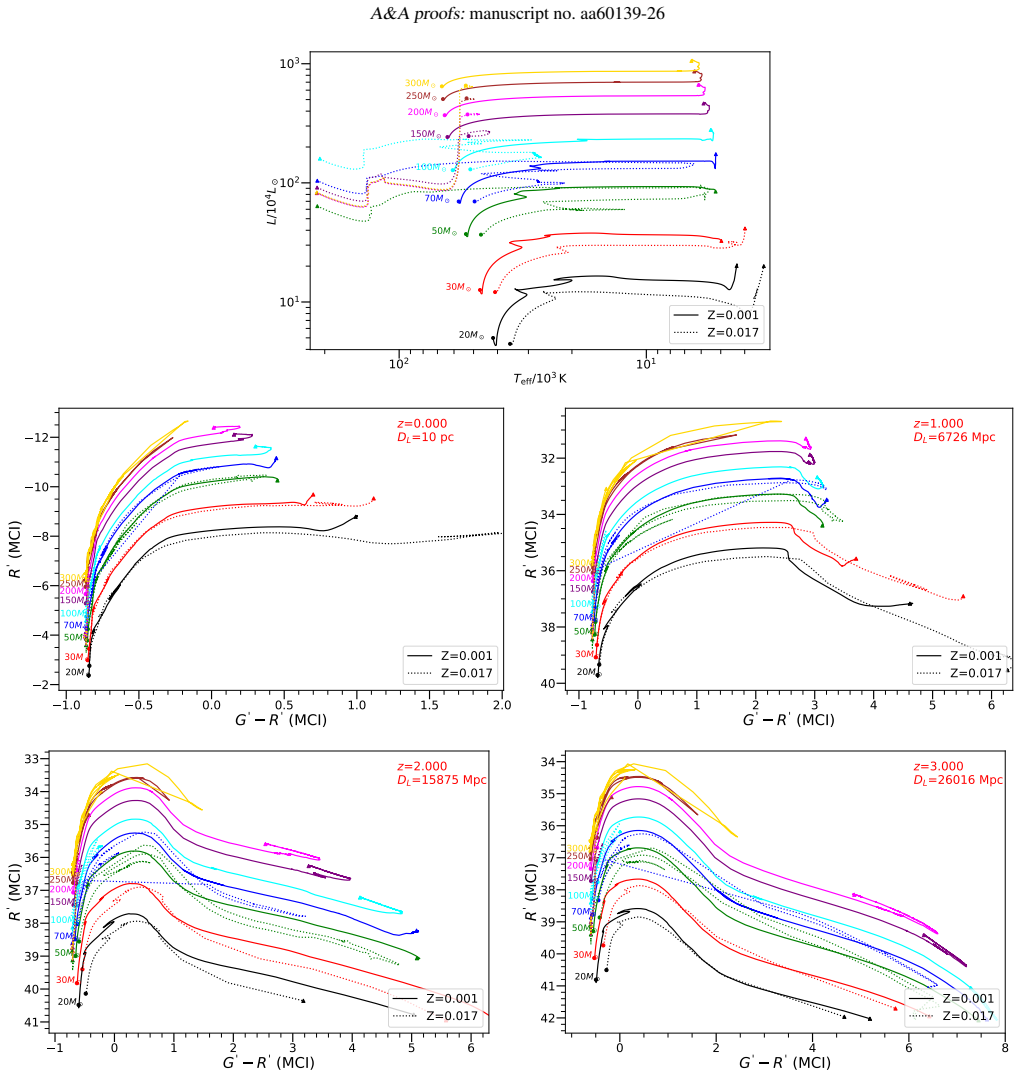
We update the YBC database to zYBC by redshifting stellar spectra from libraries (including new NLTE models for O and B stars), attenuating them by extinction curves for both host-galaxy and Milky Way dust, and convolving with photometric filter curves. The resulting colors versus effective temperature at various redshifts show non-monotonic behaviors. The relations display larger dispersions at high redshift than at zero redshift, indicating that the stellar parameters of high-redshift stars can be better determined than those of local counterparts when redshifts are reliably known through other methods and photometric data are of high enough quality.
What carries the argument
The zYBC computation pipeline that redshifts spectra, applies host-galaxy and Milky Way extinction curves, then convolves with filter transmissions to produce bolometric corrections.
If this is right
- Colors versus effective temperature display non-monotonic behaviors at different redshifts for the supported photometric systems.
- The color-Teff relations exhibit larger dispersions at high redshift than at zero redshift.
- Stellar parameters of high-redshift stars can be determined more accurately than local counterparts given known redshifts and adequate photometry.
- Different amounts of extinction produce noticeable differences in the computed corrections.
- The database supports direct use with HST/WFC3, JWST/NIRCam, and CSST observations of high-redshift stars.
Where Pith is reading between the lines
- The larger dispersions at high redshift could reduce uncertainties when comparing stellar models to lensed high-redshift candidates observed by JWST.
- The corrections might improve estimates of early-universe star formation rates by providing more accurate luminosities once redshifts are fixed.
- Extending the same redshifting-plus-extinction method to additional future filter sets would allow consistent parameter fitting across multiple surveys.
Load-bearing premise
The spectral libraries and extinction curves remain valid when applied to cosmologically redshifted high-redshift stars.
What would settle it
High-quality photometry and an independent redshift for a high-redshift star candidate whose derived parameters from fitting with zYBC corrections disagree substantially with those from spectroscopy or lensing magnification.
Figures
read the original abstract
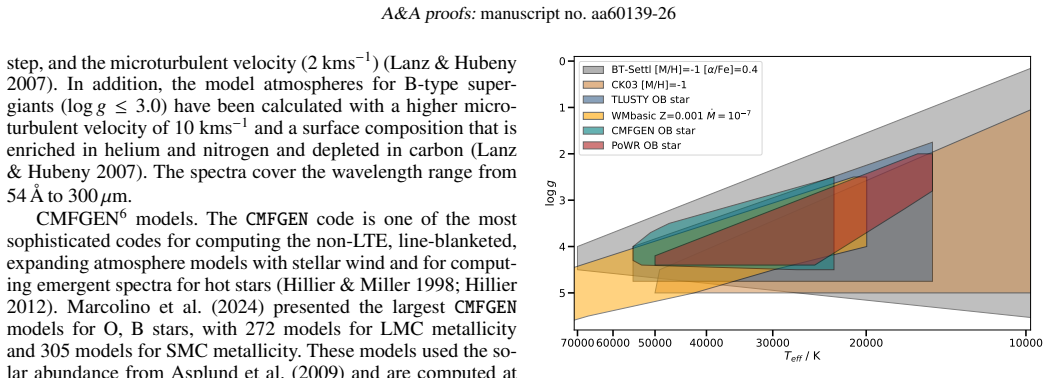
Observations from HST & JWST continue to reveal gravitationally magnified high-redshift star candidates, resulting in increasing demand for accurate stellar bolometric corrections to compare stellar models with observational data. We update YBC stellar bolometric correction database by incorporating bolometric corrections for cosmologically redshifted stars, called zYBC. The bolometric corrections are derived by redshifting stellar spectra from libraries, attenuated by extinction curves for both the dust in the host galaxy and the Milky Way, and followed by convolution with the transmission curves of photometric filters. Our methodology incorporates the effects due to the cosmological K-correction and the dust. Besides the spectral libraries in earlier YBC, we add NLTE-based spectral libraries for O, B stars, which are better suited for hot massive stars, particularly wind-included PoWR and CMFGEN models. The database supports key photometric systems for high-redshift studies, such as HST/WFC3, JWST/NIRCam, and CSST's MSC and MCI, and maintains the flexibility to incorporate additional photometric systems upon request. As examples, we present colors as functions of Teff at various redshifts for several photometric systems, which exhibit non-monotonic behaviors and demonstrate the necessity for a dedicated modelling. In particular, we find that the relations show larger dispersions at high redshift than the zero redshift case. This indicates that the stellar parameters of high redshift stars can be better determined than those of their local counterparts, given their redshifts reliably determined through other methods and their photometric data are of high enough quality for physical parameter determination through spectral-fitting. We also show the difference in the effect brought by the different amount of extinctions. zYBC represents a valuable resource for high-redshift star research.
Editorial analysis
A structured set of objections, weighed in public.
Referee Report
Summary. The manuscript updates the YBC bolometric correction database to zYBC by redshifting spectra from existing libraries plus new NLTE PoWR and CMFGEN grids for hot stars, applying host-galaxy and Milky Way extinction curves, and convolving with filter transmissions for HST/WFC3, JWST/NIRCam, and CSST systems. It presents example color-Teff relations at multiple redshifts that are non-monotonic and exhibit larger dispersion than the z=0 case, from which the authors conclude that high-redshift stellar parameters can be better recovered when redshift is known independently.
Significance. If the assumptions hold, zYBC supplies a practical resource for converting observed photometry of high-z star candidates into bolometric luminosities while incorporating K-corrections and dust. The addition of wind-inclusive NLTE grids and the database's extensibility to new filter sets are concrete strengths for massive-star work with JWST.
major comments (2)
- [Abstract] Abstract: the statement that 'the relations show larger dispersions at high redshift than the zero redshift case. This indicates that the stellar parameters of high redshift stars can be better determined' is presented without any accompanying error-budget calculation, mock recovery test, or comparison of parameter covariances; the inference is therefore unsupported by the reported results.
- [Methodology] Methodology (redshifting + extinction procedure): the computation assumes that local spectral libraries and the adopted host+MW extinction curves remain accurate once spectra are shifted to observed-frame wavelengths and attenuated at the source redshift, yet no sensitivity test or comparison to high-z metallicity/wind/dust models is shown; this assumption is load-bearing for both the tabulated corrections and the dispersion trends.
minor comments (1)
- [Abstract] The abstract refers to 'non-monotonic behaviors' without identifying the specific color indices or redshift ranges in which they appear; a brief example or reference to the relevant figure would improve clarity.
Simulated Author's Rebuttal
We thank the referee for the constructive report and the recommendation for major revision. We address both major comments below with revisions to the abstract and added discussion of limitations. The core database extension and example results remain unchanged as they are based on the reported computations.
read point-by-point responses
-
Referee: [Abstract] Abstract: the statement that 'the relations show larger dispersions at high redshift than the zero redshift case. This indicates that the stellar parameters of high redshift stars can be better determined' is presented without any accompanying error-budget calculation, mock recovery test, or comparison of parameter covariances; the inference is therefore unsupported by the reported results.
Authors: We agree the original phrasing overstates the implication. The larger dispersion is a direct outcome of the redshifted and attenuated color-Teff relations we computed, but inferring improved parameter recovery requires additional analysis (e.g., covariance or recovery tests) that is not performed. We have revised the abstract to remove the claim of better determination and now state only that the non-monotonic relations and increased dispersion demonstrate the need for dedicated high-z modeling when redshift is known independently. A short qualifying sentence has been added in the results section. revision: yes
-
Referee: [Methodology] Methodology (redshifting + extinction procedure): the computation assumes that local spectral libraries and the adopted host+MW extinction curves remain accurate once spectra are shifted to observed-frame wavelengths and attenuated at the source redshift, yet no sensitivity test or comparison to high-z metallicity/wind/dust models is shown; this assumption is load-bearing for both the tabulated corrections and the dispersion trends.
Authors: The assumption is indeed central. Generating or comparing against high-z-specific NLTE grids with altered metallicities, wind parameters, or dust properties would require substantial new modeling effort outside the scope of this database update, which extends existing libraries. We have added an explicit limitations paragraph in the methodology section acknowledging that the tabulated corrections inherit the applicability limits of the input libraries and curves, and that future updates could incorporate high-z tailored models. No new sensitivity tests are added at this stage. revision: partial
Circularity Check
No circularity; forward computation from external libraries
full rationale
The paper performs a direct forward computation to generate zYBC bolometric corrections by redshifting spectra from external libraries (including added PoWR/CMFGEN NLTE grids), applying host-galaxy and Milky Way extinction curves, and convolving with filter transmissions. The reported increase in dispersion of color-Teff relations at high redshift is an output of this procedure, not an input parameter that is fitted and then renamed as a prediction. No self-citations bear the load of the central claims, no uniqueness theorems are invoked, and no ansatzes are smuggled in; the derivation chain remains self-contained against the cited external spectral libraries and curves.
Axiom & Free-Parameter Ledger
Reference graph
Works this paper leans on
-
[1]
& Hauschildt, P
Allard, F. & Hauschildt, P. H. 1995, ApJ, 445, 433
1995
-
[2]
H., Alexander, D
Allard, F., Hauschildt, P. H., Alexander, D. R., & Starrfield, S. 1997, ARA&A, 35, 137
1997
-
[3]
Allard, F., Homeier, D., Freytag, B., & Sharp, C. M. 2012, in EAS Publications
2012
-
[4]
J., & Scott, P
Asplund, M., Grevesse, N., Sauval, A. J., & Scott, P. 2009, ARA&A, 47, 481
2009
-
[5]
Bessell, M. S. 2005, ARA&A, 43, 293
2005
-
[6]
S., Castelli, F., & Plez, B
Bessell, M. S., Castelli, F., & Plez, B. 1998, A&A, 333, 231
1998
-
[7]
Blanton, M. R. & Roweis, S. 2007, AJ, 133, 734
2007
-
[8]
C., Gordon, K
Bohlin, R. C., Gordon, K. D., & Tremblay, P.-E. 2014, PASP, 126, 711
2014
-
[9]
& Charlot, S
Bruzual, G. & Charlot, S. 2003, MNRAS, 344, 1000 Article number, page 9 of 11 A&A proofs:manuscript no. aa60139-26 101 102 Teff/103 K 101 102 103 L/104L 20M 30M 50M 70M 100M 150M 200M 250M 300M Z=0.001 Z=0.017 1.0 0.5 0.0 0.5 1.0 1.5 2.0 G' R' (MCI) 12 10 8 6 4 2 R' (MCI) 20M 30M 50M 70M 100M 150M 200M 250M 300M z=0.000 DL=10 pc Z=0.001 Z=0.017 1 0 1 2 3 ...
2003
-
[10]
C., et al
Calzetti, D., Armus, L., Bohlin, R. C., et al. 2000, ApJ, 533, 682
2000
-
[11]
A., Clayton, G
Cardelli, J. A., Clayton, G. C., & Mathis, J. S. 1989, ApJ, 345, 245
1989
-
[12]
& VandenBerg, D
Casagrande, L. & VandenBerg, D. A. 2014, MNRAS, 444, 392
2014
-
[13]
& Kurucz, R
Castelli, F. & Kurucz, R. L. 2003, in IAU Symposium, V ol. 210, Modelling of Stellar Atmospheres, ed. N. Piskunov, W. W. Weiss, & D. F. Gray, A20
2003
-
[14]
2015, MNRAS, 452, 1068
Chen, Y ., Bressan, A., Girardi, L., et al. 2015, MNRAS, 452, 1068
2015
-
[15]
2013, ARA&A, 51, 393
Conroy, C. 2013, ARA&A, 51, 393
2013
-
[16]
Cox, A. N. 2000, Allen’s astrophysical quantities
2000
-
[17]
M., Sun, B., Yan, H., et al
Diego, J. M., Sun, B., Yan, H., et al. 2023, A&A, 679, A31
2023
-
[18]
2002, A&A, 391, 195
Girardi, L., Bertelli, G., Bressan, A., et al. 2002, A&A, 391, 195
2002
-
[19]
2019, MNRAS, 488, 696 Gräfener, G., Koesterke, L., & Hamann, W.-R
Girardi, L., Costa, G., Chen, Y ., et al. 2019, MNRAS, 488, 696 Gräfener, G., Koesterke, L., & Hamann, W.-R. 2002, A&A, 387, 244
2019
-
[20]
& Sauval, A
Grevesse, N. & Sauval, A. J. 1998, Space Sci. Rev., 85, 161
1998
-
[21]
2019, A&A, 621, A85
Hainich, R., Ramachandran, V ., Shenar, T., et al. 2019, A&A, 621, A85
2019
-
[22]
& Gräfener, G
Hamann, W.-R. & Gräfener, G. 2004, A&A, 427, 697
2004
-
[23]
Hillier, D. J. 2012, in IAU Symposium, V ol. 282, From Interacting Binaries to Exoplanets: Essential Modeling Tools, ed. M. T. Richards & I. Hubeny, 229– 234
2012
-
[24]
Hillier, D. J. & Miller, D. L. 1998, ApJ, 496, 407
1998
-
[25]
L., Diego, J
Kelly, P. L., Diego, J. M., Rodney, S., et al. 2018, Nature Astronomy, 2, 334
2018
-
[26]
1996, PASP, 108, 190
Kim, A., Goobar, A., & Perlmutter, S. 1996, PASP, 108, 190
1996
-
[27]
Klessen, R. S. & Glover, S. C. O. 2023, ARA&A, 61, 65
2023
-
[28]
Kurucz, R. L. 1979, ApJS, 40, 1
1979
-
[29]
& Hubeny, I
Lanz, T. & Hubeny, I. 2003, ApJS, 146, 417
2003
-
[30]
& Hubeny, I
Lanz, T. & Hubeny, I. 2007, ApJS, 169, 83
2007
-
[31]
2024, MNRAS, 527, 9480
Lecroq, M., Charlot, S., Bressan, A., et al. 2024, MNRAS, 527, 9480
2024
-
[32]
& Dickinson, M
Madau, P. & Dickinson, M. 2014, ARA&A, 52, 415 Article number, page 10 of 11 Yang Chen et al.: Bolometric correction for cosmologically redshifted stars with dust:
2014
-
[33]
Mamajek, E. E., Torres, G., Prsa, A., et al. 2015, arXiv e-prints [arXiv:1510.06262]
work page internal anchor Pith review Pith/arXiv arXiv 2015
-
[34]
C., Martins, F., & Hillier, D
Marcolino, W., Bouret, J. C., Martins, F., & Hillier, D. J. 2024, A&A, 690, A318
2024
-
[35]
& Palacios, A
Martins, F. & Palacios, A. 2017, A&A, 598, A56
2017
-
[36]
& Palacios, A
Martins, F. & Palacios, A. 2021, A&A, 645, A67
2021
-
[37]
& Palacios, A
Martins, F. & Palacios, A. 2022, A&A, 659, A163
2022
-
[38]
K., Zitrin, A., Jiménez-Teja, Y ., et al
Meena, A. K., Zitrin, A., Jiménez-Teja, Y ., et al. 2023, ApJ, 944, L6 O’Donnell, J. E. 1994, ApJ, 422, 158
2023
-
[39]
Oke, J. B. & Gunn, J. E. 1983, ApJ, 266, 713
1983
-
[40]
2010, A&A, 516, A13
Palacios, A., Gebran, M., Josselin, E., et al. 2010, A&A, 516, A13
2010
-
[41]
Pauldrach, A., Puls, J., & Kudritzki, R. P. 1986, A&A, 164, 86 Planck Collaboration, Aghanim, N., Akrami, Y ., et al. 2020, A&A, 641, A6
1986
-
[42]
& Harris, W
Reina-Campos, M. & Harris, W. E. 2024, MNRAS, 531, 4099
2024
-
[43]
A., Balestra, I., Bradac, M., et al
Rodney, S. A., Balestra, I., Bradac, M., et al. 2018, Nature Astronomy, 2, 324
2018
-
[44]
& Narayanan, D
Salim, S. & Narayanan, D. 2020, ARA&A, 58, 529
2020
-
[45]
2012, A&A, 540, A144
Sander, A., Hamann, W.-R., & Todt, H. 2012, A&A, 540, A144
2012
-
[46]
1989, A&A, 210, 236
Schmutz, W., Hamann, W.-R., & Wessolowski, U. 1989, A&A, 210, 236
1989
-
[47]
2014, ARA&A, 52, 487
Smith, N. 2014, ARA&A, 52, 487
2014
-
[48]
2015, A&A, 579, A75
Todt, H., Sander, A., Hainich, R., et al. 2015, A&A, 579, A75
2015
-
[49]
Vink, J. S. 2022, ARA&A, 60, 203
2022
-
[50]
S., de Koter, A., & Lamers, H
Vink, J. S., de Koter, A., & Lamers, H. J. G. L. M. 2001, A&A, 369, 574
2001
-
[51]
2011, Ap&SS, 331, 1
Walcher, J., Groves, B., Budavári, T., & Dale, D. 2011, Ap&SS, 331, 1
2011
-
[52]
M., et al
Welch, B., Coe, D., Diego, J. M., et al. 2022, Nature, 603, 815
2022
-
[53]
A., Cohen, S
Windhorst, R. A., Cohen, S. H., Jansen, R. A., et al. 2023, AJ, 165, 13
2023
-
[54]
2025, ApJ, 987, 94 Article number, page 11 of 11
Zheng, W., Fu, X., Chen, Y ., et al. 2025, ApJ, 987, 94 Article number, page 11 of 11
2025
discussion (0)
Sign in with ORCID, Apple, or X to comment. Anyone can read and Pith papers without signing in.