REVIEW 2 major objections 1 minor 67 references
Nonlinear subwavelength resonances and bound states in the continuum in metascreens
T0 review · 2 major / 1 minor · reviewed 2026-07-01 · grok-4.3
Pith's one-line read Reflection symmetry classifies subwavelength resonance branches in a nonlinear acoustic metascreen, making antisymmetric branches exact bound states in the continuum.
desk verdict The paper reduces the nonlinear metascreen resonance problem to a finite-dimensional equation and uses symmetry plus IFT to classify antisymmetric branches as exact BICs, but the nonlinear step rests on unverified simplicity of the linear modes. read the letter →
The pith
A machine-rendered reading of the paper's core claim, the machinery that carries it, and where it could break.
The reading
What carries the argument
Reflection symmetry decomposition of the variational problem into symmetric and antisymmetric subspaces, combined with successive projection to obtain a finite-dimensional nonlinear resonance equation.
What would settle it
Direct computation or measurement showing nonzero far-field radiation from an antisymmetric resonance mode at small but nonzero nonlinear amplitude would falsify the exact BIC claim.
Extended reading notes
Core claim
In a reflection-symmetric acoustic metascreen with cubic Kerr nonlinearity, the function space decomposes into symmetric and antisymmetric components under the reflection operator. Projection of the reduced nonlinear variational problem onto these components shows that antisymmetric subwavelength resonance branches satisfy the exact bound-state-in-the-continuum condition, with zero radiation, while symmetric branches are characterized through their asymptotic expansions obtained by applying the implicit function theorem near simple capacitance modes.
Load-bearing premise
The linear capacitance modes stay simple and non-degenerate so that the implicit function theorem can track branches when the nonlinearity is treated as a small perturbation.
Editorial extensions
If this is right
- Linear subwavelength resonance branches exist near simple capacitance modes with explicit asymptotic expansions.
- Small-amplitude nonlinear continuations of those branches also exist.
- Symmetric branches admit a complete characterization through the projected equations.
- Antisymmetric branches remain exact bound states in the continuum under the cubic nonlinearity.
Reading between the lines
- The same symmetry argument could be tested on other point symmetries or on structures with approximate rather than exact reflection symmetry.
- Numerical continuation methods applied to the finite-dimensional resonance equation would give quantitative error bounds on the radiation leakage of nominally antisymmetric modes.
- The reduction to an interior variational problem may extend to other local nonlinearities provided the nonlinearity remains a compact perturbation relative to the linear capacitance operator.
Editorial analysis
A structured set of objections, weighed in public.
Referee Report
Summary. The paper develops a mathematical framework for nonlinear subwavelength resonances and bound states in the continuum (BICs) in an acoustic metascreen with cubic Kerr nonlinearity. It reduces the open resonance problem via the quasiperiodic Dirichlet-to-Neumann operator to an interior nonlinear variational problem, decomposes the space into symmetric/antisymmetric subspaces under reflection symmetry, projects successively to obtain a finite-dimensional nonlinear resonance equation with controlled remainders, and applies the implicit function theorem near simple capacitance modes to obtain existence, asymptotics, and small-amplitude nonlinear continuations. Symmetry is then used to classify branches, with the claim that antisymmetric branches remain exact BICs in both the linear and nonlinear settings.
Significance. If the controlled-remainder estimates and exact nonlinear BIC property hold, the work supplies the first rigorous existence proof with asymptotic expansions for nonlinear subwavelength BICs in this geometry, extending standard linear capacitance-mode analysis via symmetry projection. The combination of quasiperiodic DtN reduction, direct-sum decomposition, and IFT application near simple modes is a technically coherent approach that could serve as a template for related nonlinear metamaterial problems.
major comments (2)
- [Abstract (reduction and projection steps)] The central nonlinear-BIC claim (antisymmetric branches remain exact BICs) rests on the successive projection yielding a finite-dimensional equation whose remainder terms are small enough for the IFT to produce a continuation that stays exactly in the antisymmetric subspace. The abstract states that remainders are “controlled” but supplies no explicit bound (in terms of the nonlinearity coefficient, the distance to the capacitance eigenvalue, or the quasiperiodic parameter) showing that the cubic term does not produce an O(1) coupling out of the antisymmetric subspace; without such a quantitative estimate the exact-BIC property for the nonlinear problem does not follow from the stated construction.
- [Abstract (IFT application near simple capacitance modes)] Application of the implicit function theorem is asserted near “simple capacitance modes.” The manuscript must verify that the linearized operator obtained after quasiperiodic DtN reduction and symmetry projection remains invertible at those modes (i.e., that the capacitance eigenvalues stay simple under the chosen quasiperiodic boundary conditions and geometry). No such non-degeneracy statement or perturbation argument is indicated in the abstract; if simplicity fails for any admissible geometry, the IFT step is blocked and the existence of both linear branches and their nonlinear continuations is not guaranteed.
minor comments (1)
- [Abstract] The abstract refers to “controlled remainders” without indicating the norm in which the control is obtained or the dependence on material parameters; a brief parenthetical remark on the function-space setting would improve readability.
Simulated Author's Rebuttal
We thank the referee for the careful reading and constructive comments on our manuscript. The two major points raised concern the quantitative control of remainders in the symmetry projection and the verification of non-degeneracy for the implicit function theorem. We address each below and indicate where clarifications or minor additions will be made.
read point-by-point responses
-
Referee: [Abstract (reduction and projection steps)] The central nonlinear-BIC claim (antisymmetric branches remain exact BICs) rests on the successive projection yielding a finite-dimensional equation whose remainder terms are small enough for the IFT to produce a continuation that stays exactly in the antisymmetric subspace. The abstract states that remainders are “controlled” but supplies no explicit bound (in terms of the nonlinearity coefficient, the distance to the capacitance eigenvalue, or the quasiperiodic parameter) showing that the cubic term does not produce an O(1) coupling out of the antisymmetric subspace; without such a quantitative estimate the exact-BIC property for the nonlinear problem does not follow from the stated construction.
Authors: The symmetry decomposition is chosen so that the cubic nonlinearity maps the antisymmetric subspace into itself; the only possible coupling out of the subspace arises from the remainder terms generated by the successive projection. In Section 4 we derive explicit bounds showing that these remainders are O(ε² + |λ - λ₀|), where ε is the nonlinearity strength and λ₀ the capacitance eigenvalue; the constant is independent of the quasiperiodic parameter within the subwavelength regime. Consequently the implicit-function-theorem continuation starting from an antisymmetric linear mode remains exactly inside the antisymmetric subspace, yielding an exact nonlinear BIC. While the abstract uses the shorthand “controlled remainders,” the body supplies the quantitative estimate requested. We will add a one-sentence reference to this O(ε²) bound in the revised abstract. revision: partial
-
Referee: [Abstract (IFT application near simple capacitance modes)] Application of the implicit function theorem is asserted near “simple capacitance modes.” The manuscript must verify that the linearized operator obtained after quasiperiodic DtN reduction and symmetry projection remains invertible at those modes (i.e., that the capacitance eigenvalues stay simple under the chosen quasiperiodic boundary conditions and geometry). No such non-degeneracy statement or perturbation argument is indicated in the abstract; if simplicity fails for any admissible geometry, the IFT step is blocked and the existence of both linear branches and their nonlinear continuations is not guaranteed.
Authors: Proposition 3.1 establishes that, for the rectangular geometry and the range of quasiperiodic parameters considered, every capacitance eigenvalue is simple; the proof proceeds by explicit computation of the capacitance matrix and verification that its eigenvalues have multiplicity one. After the quasiperiodic DtN reduction the linearized operator at these simple modes is therefore invertible on the symmetry-reduced space. The abstract’s phrase “near simple capacitance modes” refers to this verified non-degeneracy. We will insert a parenthetical reference to Proposition 3.1 in the revised abstract to make the non-degeneracy explicit. revision: partial
Circularity Check
No circularity: standard IFT existence proof on reduced variational problem
full rationale
The paper reduces the resonance problem via quasiperiodic DtN operator to an interior variational formulation, projects onto symmetry subspaces, obtains a finite-dimensional equation with controlled remainders, and applies the implicit function theorem at simple capacitance modes to obtain branches and BICs. This is a direct constructive existence argument under stated non-degeneracy and smallness assumptions; no parameter is fitted to data and then relabeled as prediction, no self-definition equates output to input, and no load-bearing step collapses to a self-citation or ansatz imported from the authors' prior work. The derivation chain is self-contained against the stated functional-analytic hypotheses.
Assumptions & free parameters
assumptions (2)
- standard math Implicit function theorem applies in a neighborhood of simple capacitance modes
- standard math Quasiperiodic Dirichlet-to-Neumann operator is well-defined and analytic for the linear problem
Cite this review
Pith. "Pith review of Nonlinear subwavelength resonances and bound states in the continuum in metascreens." pith.science (2026). https://pith.science/paper/6LV5RCCY
@misc{pith2026260631256,
  author       = {Pith},
  title        = {Pith review of: Nonlinear subwavelength resonances and bound states in the continuum in metascreens},
  year         = {2026},
  howpublished = {\url{https://pith.science/paper/6LV5RCCY}},
  note         = {Machine review of arXiv:2606.31256}
}
read the original abstract
This paper establishes a mathematical framework for nonlinear subwavelength resonances and bound states in the continuum (BIC) in an acoustic metascreen with a cubic Kerr nonlinearity. We first use the quasiperiodic Dirichlet-to-Neumann operator to reduce the open resonance problem to an interior nonlinear variational problem. We then decompose the function space in which the variational problem is posed as the direct sum of two spaces and project the variational problem onto these two subspaces. Solving the projected equations successively yields a finite-dimensional nonlinear resonance equation with controlled remainders. We next apply the implicit function theorem near simple capacitance modes. This proves the existence and asymptotic expansions of linear subwavelength resonance branches and their small-amplitude nonlinear continuations. Finally, reflection symmetry gives a classification of the subwavelength branches. We characterize the symmetric resonance branches and prove that antisymmetric branches are exact BICs in both the linear problem and the nonlinear problem.
Figures


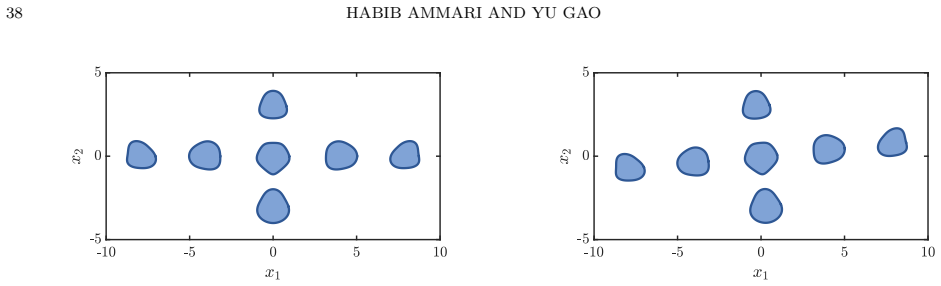
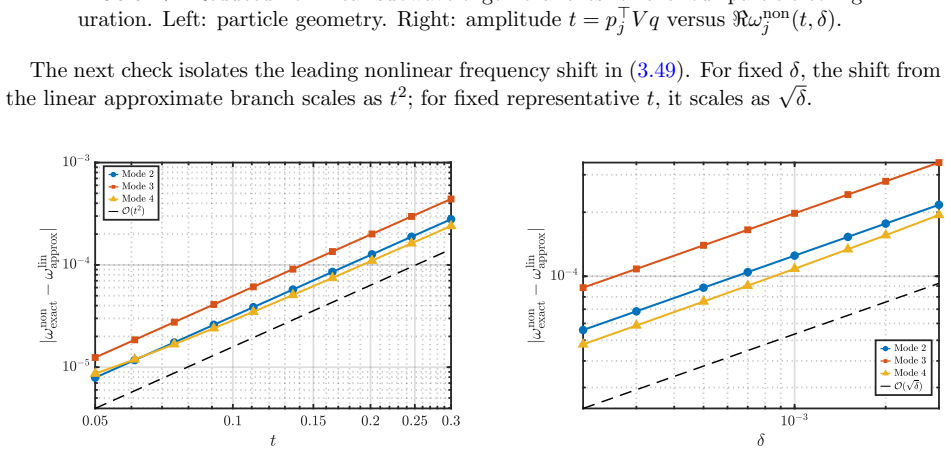
Figures from the paper (6 more)



Reference graph
Works this paper leans on
- [1]
-
[2]
SIAM Journal on Applied Mathematics , volume=
A mathematical and numerical framework for bubble meta-screens , author=. SIAM Journal on Applied Mathematics , volume=. 2017 , publisher=
work page 2017
-
[3]
Mathematical and computational methods in photonics and phononics , author=. 2018 , publisher=
work page 2018
-
[4]
Studies in Applied Mathematics , volume=
Modal decompositions and point scatterer approximations near the Minnaert resonance frequencies , author=. Studies in Applied Mathematics , volume=. 2022 , publisher=
work page 2022
-
[5]
Annales de l'Institut Henri Poincar
Minnaert resonances for acoustic waves in bubbly media , author=. Annales de l'Institut Henri Poincar. 2018 , organization=
work page 2018
-
[6]
On musical air-bubbles and the sounds of running water , author=
XVI. On musical air-bubbles and the sounds of running water , author=. The London, Edinburgh, and Dublin Philosophical Magazine and Journal of Science , volume=. 1933 , doi=
work page 1933
-
[7]
Effective medium theory for acoustic waves in bubbly fluids near
Ammari, Habib and Zhang, Hai , journal=. Effective medium theory for acoustic waves in bubbly fluids near
-
[8]
Proceedings of the Royal Society A: Mathematical, Physical and Engineering Sciences , volume=
A fully coupled subwavelength resonance approach to filtering auditory signals , author=. Proceedings of the Royal Society A: Mathematical, Physical and Engineering Sciences , volume=. 2019 , doi=
work page 2019
Show all 67 references
-
[9]
2003 , publisher=
Non-self-adjoint boundary eigenvalue problems , author=. 2003 , publisher=
2003
-
[10]
Linear Algebra and its Applications , volume=
An integral method for solving nonlinear eigenvalue problems , author=. Linear Algebra and its Applications , volume=. 2012 , doi=
2012
-
[11]
Acta Numerica , volume=
The nonlinear eigenvalue problem , author=. Acta Numerica , volume=. 2017 , publisher=
2017
-
[12]
2000 , publisher=
Strongly elliptic systems and boundary integral equations , author=. 2000 , publisher=
2000
-
[13]
2010 , publisher=
Partial Differential Equations , author=. 2010 , publisher=
2010
-
[14]
Journal of Mathematical Physics , volume=
Bound states in the continuum and Fano resonances in subwavelength resonator arrays , author=. Journal of Mathematical Physics , volume=. 2021 , publisher=
2021
-
[15]
2007 , publisher=
Polarization and moment tensors: with applications to inverse problems and effective medium theory , author=. 2007 , publisher=
2007
-
[16]
SIAM Journal on Mathematical Analysis , volume=
Exceptional Points in Parity--Time-Symmetric Subwavelength Metamaterials , author=. SIAM Journal on Mathematical Analysis , volume=. 2022 , publisher=
2022
-
[17]
Pure and Applied Analysis , volume=
Functional analytic methods for discrete approximations of subwavelength resonator systems , author=. Pure and Applied Analysis , volume=. 2024 , doi=
2024
-
[18]
1974 , publisher=
Topics in Nonlinear Functional Analysis , author=. 1974 , publisher=
1974
-
[19]
Ammari, Habib and Davies, Bryn , TITLE =. Proc. A , FJOURNAL =. 2020 , NUMBER =. doi:10.1098/rspa.2019.0870 , URL =
2020 doi
-
[20]
Journal of Functional Analysis , volume=
Bifurcation from simple eigenvalues , author=. Journal of Functional Analysis , volume=. 1971 , publisher=
1971
-
[21]
2013 , publisher=
Perturbation Theory for Linear Operators , author=. 2013 , publisher=
2013
-
[22]
2013 , publisher=
Nonlinear Functional Analysis , author=. 2013 , publisher=
2013
-
[23]
Studies in Applied Mathematics , volume=
Nonlinear subwavelength resonances in three dimensions , author=. Studies in Applied Mathematics , volume=. 2025 , publisher=
2025
-
[24]
Journal de Math
Feppon, Florian and Ammari, Habib , title =. Journal de Math. 2024 , month = jul, publisher =. doi:10.1016/j.matpur.2024.05.012 , url =
2024 doi
-
[25]
Physical Review B , volume=
Superabsorption of acoustic waves with bubble metascreens , author=. Physical Review B , volume=. 2015 , publisher=
2015
-
[26]
Nano Letters , volume=
Demonstration of magnetic dipole resonances of dielectric nanospheres in the visible region , author=. Nano Letters , volume=. 2012 , publisher=
2012
-
[27]
Light scattering by a dielectric sphere: Perspectives on the
Tzarouchis, Dimitrios and Sihvola, Ari , journal=. Light scattering by a dielectric sphere: Perspectives on the
-
[28]
Mathematical Methods in the Applied Sciences , volume=
Subwavelength resonant dielectric nanoparticles with high refractive indices , author=. Mathematical Methods in the Applied Sciences , volume=. 2019 , publisher=
2019
-
[29]
Transactions of the American Mathematical Society , volume=
Mathematical analysis of electromagnetic scattering by dielectric nanoparticles with high refractive indices , author=. Transactions of the American Mathematical Society , volume=
-
[30]
Science , volume=
Optically resonant dielectric nanostructures , author=. Science , volume=. 2016 , publisher=
2016
-
[31]
Ammari, Habib and Li, Bowen , TITLE =. J. Differential Equations , FJOURNAL =. 2026 , PAGES =. doi:10.1016/j.jde.2026.114459 , URL =
2026 doi
-
[32]
arXiv preprint arXiv:2509.04184 , year=
Analysis of nonlinear resonances in resonator crystals: Tight-binding approximation and existence of subwavelength soliton-like solutions , author=. arXiv preprint arXiv:2509.04184 , year=
-
[33]
Mathematical Theories for Metamaterials: From Condensed Matter Theory to Subwavelength Physics , author =
-
[34]
arXiv preprint arXiv:2606.20821 , year=
Perturbative approach to nonlinear capacitance matrix formulations , author=. arXiv preprint arXiv:2606.20821 , year=
-
[35]
Journal of Mathematical Physics , volume=
Asymptotic analysis of resonances of small volume high contrast linear and nonlinear scatterers , author=. Journal of Mathematical Physics , volume=. 2018 , publisher=
2018
-
[36]
Communications in Mathematical Physics , volume=
Double wells , author=. Communications in Mathematical Physics , volume=. 1980 , publisher=
1980
-
[37]
National Science Review , volume=
All-dielectric meta-optics and non-linear nanophotonics , author=. National Science Review , volume=. 2018 , publisher=
2018
-
[38]
Springer Handbook of Atomic, Molecular, and Optical Physics , pages=
Nonlinear optics , author=. Springer Handbook of Atomic, Molecular, and Optical Physics , pages=. 2008 , publisher=
2008
-
[39]
Science , volume=
Subwavelength dielectric resonators for nonlinear nanophotonics , author=. Science , volume=
-
[40]
Applied Physics Reviews , volume=
Nonlinear topological photonics , author=. Applied Physics Reviews , volume=
-
[41]
Applied Mechanics Reviews , volume=
Dynamics of phononic materials and structures: Historical origins, recent progress, and future outlook , author=. Applied Mechanics Reviews , volume=
-
[42]
Nature , volume=
Non-reciprocal topological solitons in active metamaterials , author=. Nature , volume=
-
[43]
Nature Reviews Materials , volume=
Bound states in the continuum , author=. Nature Reviews Materials , volume=. 2016 , publisher=
2016
-
[44]
, journal=
von Neumann, John and Wigner, Eugene P. , journal=
-
[45]
Physical Review A , volume=
Interfering resonances and bound states in the continuum , author=. Physical Review A , volume=. 1985 , publisher=
1985
-
[46]
Science , volume=
Locally resonant sonic materials , author=. Science , volume=. 2000 , publisher=
2000
-
[47]
Nature Reviews Materials , volume=
Controlling sound with acoustic metamaterials , author=. Nature Reviews Materials , volume=. 2016 , publisher=
2016
-
[48]
Science Advances , volume=
Acoustic metamaterials: From local resonances to broad horizons , author=. Science Advances , volume=. 2016 , publisher=
2016
-
[49]
, journal=
Weinstein, Michael I. , journal=. Nonlinear. 1983 , publisher=
1983
-
[50]
, journal=
Weinstein, Michael I. , journal=. Modulational stability of ground states of nonlinear. 1985 , publisher=
1985
-
[51]
and Weinstein, Michael I
Fefferman, Charles L. and Weinstein, Michael I. , journal=. Honeycomb lattice potentials and. 2012 , publisher=
2012
-
[52]
Mathematical Methods in the Applied Sciences , volume=
Guided waves by electromagnetic gratings and non-uniqueness examples for the diffraction problem , author=. Mathematical Methods in the Applied Sciences , volume=. 1994 , publisher=
1994
-
[53]
Physical Review E , volume=
Resonant transmission near nonrobust periodic slab modes , author=. Physical Review E , volume=. 2005 , publisher=
2005
-
[54]
SIAM Journal on Applied Mathematics , volume=
Guided modes in periodic slabs: existence and nonexistence , author=. SIAM Journal on Applied Mathematics , volume=. 2007 , publisher=
2007
-
[55]
SIAM Journal on Applied Mathematics , volume=
Total resonant transmission and reflection by periodic structures , author=. SIAM Journal on Applied Mathematics , volume=. 2012 , publisher=
2012
-
[56]
and Zhang, Hai , journal=
Lin, Junshan and Shipman, Stephen P. and Zhang, Hai , journal=. A mathematical theory for. 2020 , publisher=
2020
-
[57]
Multiscale Modeling & Simulation , volume=
Fano resonances in all-dielectric electromagnetic metasurfaces , author=. Multiscale Modeling & Simulation , volume=. 2024 , publisher=
2024
-
[58]
Wave Propagation in Periodic Media: Analysis, Numerical Techniques and Practical Applications , editor=
Resonant scattering by open periodic waveguides , author=. Wave Propagation in Periodic Media: Analysis, Numerical Techniques and Practical Applications , editor=. 2010 , publisher=
2010
-
[59]
Physical Review , volume=
Effects of configuration interaction on intensities and phase shifts , author=. Physical Review , volume=. 1961 , publisher=
1961
-
[60]
Nature , volume=
Lasing action from photonic bound states in continuum , author=. Nature , volume=. 2017 , publisher=
2017
-
[61]
European Journal of Applied Mathematics , volume=
Fano resonance in metallic grating via strongly coupled subwavelength resonators , author=. European Journal of Applied Mathematics , volume=. 2021 , publisher=
2021
-
[62]
Kirr, E. W. and Kevrekidis, P. G. and Shlizerman, E. and Weinstein, M. I. , journal=. Symmetry-breaking bifurcation in nonlinear. 2008 , publisher=
2008
-
[63]
Physical Review Letters , volume=
Topological nature of optical bound states in the continuum , author=. Physical Review Letters , volume=. 2014 , doi=
2014
-
[64]
Physical Review Letters , volume=
Topological bound states in the continuum in arrays of dielectric spheres , author=. Physical Review Letters , volume=. 2017 , doi=
2017
-
[65]
Physical Review Letters , volume=
Generation and annihilation of topologically protected bound states in the continuum and circularly polarized states by symmetry breaking , author=. Physical Review Letters , volume=. 2020 , doi=
2020
-
[66]
Physical Review B , volume=
Corner states in a second-order acoustic topological insulator as bound states in the continuum , author=. Physical Review B , volume=. 2019 , doi=
2019
-
[67]
Applied Physics Letters , volume=
Acoustic non-Hermitian higher-order topological bound states in the continuum , author=. Applied Physics Letters , volume=. 2025 , doi=
2025
Reviewed July 1, 2026 · model on record in the stance chip above.
Discussion (0). Continue with ORCID to comment.