On existence of a collapsed bubble with surface tension in viscous incompressible fluid
Pith reviewed 2026-07-01 04:49 UTC · model grok-4.3
The pith
A bubble in viscous incompressible fluid with surface tension collapses in finite time forming a splash singularity without principal curvatures blowing up.
A machine-rendered reading of the paper's core claim, the machinery that carries it, and where it could break.
Core claim
We prove that there exists a bubble evolving by this free boundary problem which collapses in a finite time without blowing up of principal curvatures of its boundary. In other words, what is called a splash singularity is formed in a finite time. This type of result is also valid for a bounded initial domain. To construct such an example, we introduce the notion of a domain with δ-wing which is a flat Riemannian manifold that is not embedded in R^d, but it covers the δ-neighborhood of the original domain whose boundary is self-intersected.
What carries the argument
The δ-wing domain, a flat Riemannian manifold not embedded in R^d that covers the δ-neighborhood of the self-intersecting boundary, enabling construction of a valid initial domain for the free boundary problem.
Load-bearing premise
The δ-wing manifold construction produces a solution to the one-phase free-boundary Navier-Stokes system with surface tension.
What would settle it
A direct computation on the constructed initial domain showing that principal curvatures become unbounded at or before the collapse time.
Figures
read the original abstract
We consider the one-phase free boundary problem for the incompressible Navier-Stokes equations in $\mathbb{R}^d$ ($d\ge2$). The surface tension is taken into account. The initial domain, which is the outside of a bubble, is an exterior domain. We prove that there exists a bubble evolving by this free boundary problem which collapses in a finite time without blowing up of principal curvatures of its boundary. In other words, what is called a splash singularity is formed in a finite time. This type of result is also valid for a bounded initial domain. To construct such an example, we introduce the notion of a domain with $\delta$-wing which is a flat Riemannian manifold that is not embedded in $\mathbb{R}^d$, but it covers the $\delta$-neighborhood of the original domain whose boundary is self-intersected.
Editorial analysis
A structured set of objections, weighed in public.
Referee Report
Summary. The paper claims to prove existence of a solution to the one-phase free-boundary incompressible Navier-Stokes system with surface tension (exterior or bounded domain in R^d, d≥2) in which a bubble collapses in finite time, forming a splash singularity without blow-up of principal curvatures. The proof introduces an auxiliary flat non-embedded Riemannian manifold (the δ-wing) that covers a δ-neighborhood of a self-intersecting initial boundary, solves the free-boundary problem on this manifold, and projects the resulting flow back to the original domain in R^d.
Significance. If the projection step is rigorously justified, the result would supply the first explicit construction of a curvature-bounded splash singularity for viscous flow with surface tension, a question left open by prior work on inviscid or tension-free cases.
major comments (2)
- [δ-wing construction paragraph and §2] The paragraph introducing the δ-wing notion (and the subsequent construction in §2): the manuscript asserts that the solution on the non-embedded manifold yields a valid weak solution of the original system in R^d, but supplies no explicit verification that the projected velocity, normal, and mean-curvature fields satisfy the distributional form of the Navier-Stokes equations and the curvature-dependent surface-tension condition when tested against functions supported away from the self-intersection locus.
- [§3–4 (weak formulation and projection)] The argument that the kinematic free-boundary condition descends under projection (presumably §3 or §4): because the manifold sheets overlap, it is not shown that the normal velocity is unambiguously defined or that the weak form of the incompressibility and transport conditions holds across the overlapping region at times approaching the splash time.
minor comments (2)
- [Abstract] The abstract states the result also holds for bounded domains, yet the manuscript provides no separate statement or modification of the δ-wing construction for that case.
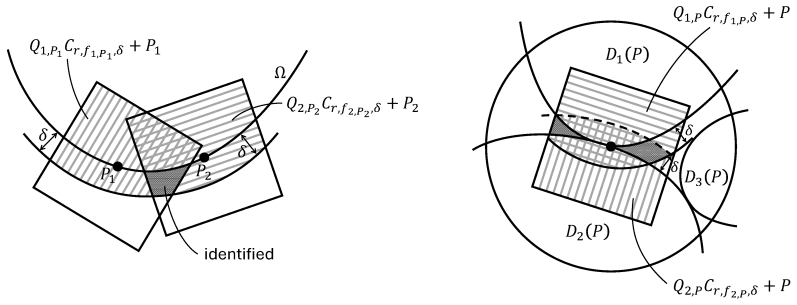
- [§2] Notation for the covering map and the δ-neighborhood is introduced without an explicit diagram or coordinate description, making it difficult to track how the flat metric interacts with the surface-tension term.
Simulated Author's Rebuttal
We thank the referee for the careful reading and for identifying points where the projection argument requires more explicit justification. The comments focus on verifying that the projected fields satisfy the weak formulations away from the self-intersection and that the kinematic condition is well-defined under overlap. We address each point below and will incorporate clarifications in the revised manuscript.
read point-by-point responses
-
Referee: [δ-wing construction paragraph and §2] The paragraph introducing the δ-wing notion (and the subsequent construction in §2): the manuscript asserts that the solution on the non-embedded manifold yields a valid weak solution of the original system in R^d, but supplies no explicit verification that the projected velocity, normal, and mean-curvature fields satisfy the distributional form of the Navier-Stokes equations and the curvature-dependent surface-tension condition when tested against functions supported away from the self-intersection locus.
Authors: The δ-wing is constructed as a flat Riemannian manifold covering a δ-neighborhood of the self-intersecting boundary, with the projection being a local isometry away from the self-intersection locus. Consequently, the velocity, normal, and mean-curvature fields coincide with their manifold counterparts on the support of any test function that avoids the locus. We agree, however, that an explicit verification of the distributional Navier-Stokes equations and the surface-tension condition in this setting would strengthen the exposition. In the revision we will insert a short lemma in §2 that carries out this verification directly from the weak form on the manifold. revision: yes
-
Referee: [§3–4 (weak formulation and projection)] The argument that the kinematic free-boundary condition descends under projection (presumably §3 or §4): because the manifold sheets overlap, it is not shown that the normal velocity is unambiguously defined or that the weak form of the incompressibility and transport conditions holds across the overlapping region at times approaching the splash time.
Authors: On the δ-wing the normal velocity is unambiguously defined with respect to the manifold metric; the overlap is resolved by the covering-space construction, so that the projected fields satisfy the weak incompressibility and transport equations in the distributional sense on the original domain. Near the splash time the sheets approach each other but remain separated by a positive distance controlled by δ until the limiting time. We acknowledge that the manuscript could make this descent more transparent. In the revision we will add a paragraph in §4 that records the passage to the limit for test functions whose support intersects the overlapping region, using the uniform bounds already obtained on the manifold. revision: partial
Circularity Check
No circularity: existence via independent δ-wing construction
full rationale
The paper's derivation introduces an auxiliary non-embedded flat Riemannian manifold (δ-wing) to construct a suitable initial domain whose boundary self-intersects, then solves the one-phase free-boundary Navier-Stokes system with surface tension on this manifold. The resulting flow is asserted to yield the desired splash singularity upon projection. No step reduces a claimed prediction or uniqueness result to a fitted parameter, self-definition, or load-bearing self-citation; the argument is a direct existence construction whose validity rests on the properties of the manifold and the PDE, not on renaming or re-deriving its own inputs. The provided text contains no equations or citations that exhibit the enumerated circular patterns.
Axiom & Free-Parameter Ledger
axioms (1)
- domain assumption The one-phase free boundary problem for incompressible Navier-Stokes equations with surface tension is well-posed in the chosen function spaces for the constructed initial data.
invented entities (1)
-
domain with δ-wing
no independent evidence
Reference graph
Works this paper leans on
-
[1]
H. Abels, The initial-value problem for the Navier-Stokes equations with a free surface in Lq-Sobolev spaces,Adv. Differential Equations,10(2005), 45–64.https://doi.org/10. 57262/ade/1355867895
-
[2]
Allain, Small-time existence for the Navier-Stokes equations with a free surface,Appl
G. Allain, Small-time existence for the Navier-Stokes equations with a free surface,Appl. Math. Optim.,16(1987), 37–50.https://doi.org/10.1007/BF01442184
-
[3]
J. T. Beale, The initial value problem for the Navier-Stokes equations with a free sur- face,Comm. Pure Appl. Math.,34(1981), 359–392.https://doi.org/10.1002/cpa. 3160340305 45
work page doi:10.1002/cpa 1981
-
[4]
M. Bolkart, Y. Giga, OnL ∞-BM Oestimates for derivatives of the Stokes semigroup, Math. Z.,284(2016), 1163–1183.https://doi.org/10.1007/s00209-016-1693-y
-
[5]
A. Castro, D. C´ ordoba, C. Fefferman, F. Gancedo, J. G´ omez-Serrano, Splash singularities for the free boundary Navier-Stokes equations,Ann. PDE,5(2019), Paper No. 12, 117 pp. https://doi.org/10.1007/s40818-019-0068-1
-
[6]
A. Castro, D. C´ ordoba, C. Fefferman, F. Gancedo, J. G´ omez-Serrano, Finite time singu- larities for the free boundary incompressible Euler equations,Ann. of Math. (2),178 (2013), 1061–1134.https://doi.org/10.4007/annals.2013.178.3.6
-
[7]
D. Coutand, S. Shkoller, On the splash singularity for the free-surface of a Navier-Stokes fluid,Ann. Inst. H. Poincar´ e C Anal. Non Lin´ eaire,36(2019), 475–503.https://doi. org/10.1016/j.anihpc.2018.06.004
-
[8]
R. Danchin, M. Hieber, P. B. Mucha, P. Tolksdorf, Free boundary problems via Da Prato- Grisvard theory,Mem. Amer. Math. Soc.,311(2025), no. 1578, v+148 pp.https: //doi.org/10.1090/memo/1578
-
[9]
I. V. Denisova, V. A. Solonnikov,Motion of a drop in an incompressible fluid, Translated from the 2020 Russian language edition.Adv. Math. Fluid Mech., Lect. Notes Math. Fluid Mech.Reprint of the 1998 edition. Birkh¨ auser/Springer, Cham, 2021.https://doi.org/ 10.1007/978-3-030-70053-9
-
[10]
E. Di Iorio, P. Marcati, S. Spirito, Splash singularity for a free-boundary incompressible viscoelastic fluid model,Adv. Math.,368(2020), 107124, 64 pp.https://doi.org/10. 1016/j.aim.2020.107124
-
[11]
E. Di Iorio, P. Marcati, S. Spirito, Splash singularities for a general Oldroyd model with finite Weissenberg number,Arch. Ration. Mech. Anal.,235(2020), 1589–1660.https: //doi.org/10.1007/s00205-019-01451-z
-
[12]
L. C. Evans,Partial differential equations, Grad. Stud. Math., 19, Providence, RI: Amer- ican Mathematical Society, 2010
2010
-
[13]
G. P. Galdi,An introduction to the mathematical theory of the Navier-Stokes equations: Steady-state problems, Springer Monogr. Math. 2 Eds., New York: Springer, 2011.https: //doi.org/10.1007/978-0-387-09620-9
-
[14]
Y. Giga, K. Ito, On pinching of curves moved by surface diffusion,Commun. Appl. Anal., 2(1998), 393–405
1998
-
[15]
Gilbarg, N
D. Gilbarg, N. S, Trudinger,Elliptic partial differential equations of second order, Reprint of the 1998 edition. Classics Math. Berlin: Springer-Verlag, 2001. 46
1998
-
[16]
Y. Guo, I. Tice, Local well-posedness of the viscous surface wave problem without surface tension,Anal. PDE,6(2013), 287–369.https://doi.org/10.2140/apde.2013.6.287
-
[17]
Y. Guo, I. Tice, Decay of viscous surface waves without surface tension in horizontally infinite domains,Anal. PDE,6(2013), 1429–1533.https://doi.org/10.2140/apde. 2013.6.1429
-
[18]
Hanzawa, Classical solutions of the Stefan problem,Tˆ ohoku Math
E.-I. Hanzawa, Classical solutions of the Stefan problem,Tˆ ohoku Math. Journ.,33(1981), 297–335.https://doi.org/10.2748/tmj/1178229399
-
[19]
C. Hao, S. Yang, Splash singularity for the free boundary incompressible viscous MHD, J. Differential Equations,379(2024), 26–103.https://doi.org/10.1016/j.jde.2023. 10.001
-
[20]
J. Neˇ cas,Direct methods in the theory of elliptic equations, Translated from the 1967 French original by G. Tronel, A. Kufner. Editorial coordination and preface by ˇS. Nev- casov´ a and a contribution by C. G. Simader, Springer Monogr. Math., Heidelberg: Springer, 2012.https://doi.org/10.1007/978-3-642-10455-8
-
[21]
T. Ogawa, S. Shimizu, MaximalL 1-regularity of the heat equation and application to a free boundary problem of the Navier-Stokes equations near the half-space,J. Elliptic Parabol. Equ.,7(2021), 509–535.https://doi.org/10.1007/s41808-021-00133-w
-
[22]
K. Oishi, Y. Shibata, On the global well-posedness and decay of a free boundary problem of the Navier-Stokes equation in unbounded domains,Mathematics,10(2022), 774. https://doi.org/10.3390/math10050774
-
[23]
Pr¨ uss, G
J. Pr¨ uss, G. Simonett,Moving interfaces and quasilinear parabolic evolution equations, Monogr. Math., 105, Birkh¨ auser/Springer, [Cham], 2016.https://doi.org/10.1007/ 978-3-319-27698-4
2016
-
[24]
H. Saito, Y. Shibata, On the global wellposedness of free boundary problem for the Navier- Stokes system with surface tension,J. Differential Equations,384(2024), 1–92.https: //doi.org/10.1016/j.jde.2023.11.020
-
[25]
H. Saito, Y. Shibata, Global solvability for viscous free surface flows of infinite depth in three and higher dimensions,Nonlinear Anal.,264(2026), Paper No. 113985, 58 pp. https://doi.org/10.1016/j.na.2025.113985
-
[26]
Sawano,Theory of Besov spaces, Dev
Y. Sawano,Theory of Besov spaces, Dev. Math., 56, Singapore: Springer, 2018
2018
-
[27]
Y. Shibata, Local well-posedness of free surface problems for the Navier-Stokes equations in a general domain,Discrete Contin. Dyn. Syst. Ser. S,9(2016), 315–342.https: //doi.org/10.3934/dcdss.2016.9.315 47
-
[28]
Y. Shibata, Global wellposedness of a free boundary problem for the Navier-Stokes equations in an exterior domain,Fluid Mech. Res. Int.,1(2017), 56–72.https: //doi.org/10.15406/fmrij.2017.01.00008
-
[29]
Y. Shibata, On the local wellposedness of free boundary problem for the Navier-Stokes equations in an exterior domain,Commun. Pure Appl. Anal.,17(2018), 1681–1721. https://doi.org/10.3934/cpaa.2018081
-
[30]
Y. Shibata, On theL p-Lq decay estimate for the Stokes equations with free boundary conditions in an exterior domain,Asymptot. Anal.,107(2018), 33–72.https://doi. org/10.3233/ASY-171449
-
[31]
Y. Shibata,Rboundedness, maximal regularity and free boundary problems for the Navier Stokes equations,Mathematical analysis of the Navier-Stokes equations, 193–462. Lecture Notes in Math., 2254, Fond. CIME/CIME Found. Subser., Springer, Cham, 2020.https: //doi.org/10.1007/978-3-030-36226-3_3
-
[32]
Shibata, S
Y. Shibata, S. Inna,On the maximalL p-Lq theory arising in the study of a free boundary problem for the Navier-Stokes equations, FMRIJ-18-eBook-220, 2018. Available from: https://medcraveebooks.com/ebooks/view_eBook/76
2018
-
[33]
Y. Shibata, S. Shimizu, On a free boundary problem for the Navier-Stokes equations, Differ. Integral Equ.,20(2007), no. 3, 241–276.https://doi.org/10.57262/die/ 1356039501
-
[34]
Y. Shibata, K. Watanabe, MaximalL 1-regularity of the Navier-Stokes equations with free boundary conditions via a generalized semigroup theory,J. Differential Equations,426 (2025), 495–605.https://doi.org/10.1016/j.jde.2025.01.060
-
[35]
C. G. Simader, H. Sohr,The Dirichlet problem for the Laplacian in bounded and unbounded domains, A new approach to weak, strong and(2 +k)-solutions in Sobolev-type spaces, Pitman Res. Notes Math. Ser., 360, Longman, Harlow, 1996
1996
-
[36]
V. A. Solonnikov, Solvability of a problem on the motion of a viscous incompressible fluid bounded by a free surface (Russian),Izv. Akad. Nauk SSSR Ser. Mat.,41(1977), 1388–
1977
-
[37]
USSR-Izv.,11(1977), 1323–1358.https://doi.org/10
English transl.:Math. USSR-Izv.,11(1977), 1323–1358.https://doi.org/10. 1070/IM1977v011n06ABEH001770
1977
-
[38]
V. A. Solonnikov, Solvability of the problem of evolution of an isolated amount of a viscous incompressible capillary fluid (Russian), Mathematical questions in the theory of wave propagation, 14,Zap. Nauchn. Sem. Leningrad. Otdel. Mat. Inst. Steklov. (LOMI), 140(1984), 179–186. English transl.:J. Soviet Math.,32(1986), 223–238.https: //doi.org/10.1007/BF...
-
[39]
V. A. Solonnikov, On the transient motion of an isolated volume of viscous incom- pressible fluid (Russian),Izv. Akad. Nauk SSSR Ser. Mat.,51(1987), 1065–1087. English transl.:Math. USSR-Izv.,31(1988), 381–405.https://doi.org/10.1070/ IM1988v031n02ABEH001081
1987
-
[40]
V. A. Solonnikov, On nonstationary motion of a finite isolated mass of self-gravitating fluid (Russian),Algebra i Analiz,1(1989), 207–249. English transl.:Leningrad Math. J., 1(1990), 227–276
1989
-
[41]
V. A. Solonnikov, An initial-boundary value problem for a Stokes system that arises in the study of a problem with a free boundary (Russian), Boundary value problems of mathematical physics, 14 (Russian),Trudy Mat. Inst. Steklov.,188(1990), 150–188, 192. English transl.:Proc. Steklov Inst. Math.,3(1991), 191–239
1990
-
[42]
V. A. Solonnikov, Solvability of a problem on the evolution of a viscous incompressible fluid, bounded by a free surface, on a finite time interval (Russian),Algebra i Analiz,3 (1991), 222–257. English transl.:St. Petersburg Math. J.,3(1992), 189–220
1991
-
[43]
V. A. Solonnikov, I. V. Denisova, Classical well-posedness of free boundary problems in viscous incompressible fluid mechanics,Handbook of Mathematical Analysis in Mechanics of Viscous Fluids(eds. Y. Giga, A. Novotn´ y), Springer, Cham, 2018, 1135–1220.https: //doi.org/10.1007/978-3-319-10151-4_27-2
-
[44]
V. A. Solonnikov, V. E. ˇSˇ cadilov, On a boundary value problem for a stationary system of Navier-Stokes equations,Proc. Steklov Inst. Math.,125(1973), 186–199
1973
-
[45]
Silvester, Large time existence for small viscous surface waves without surface tension, Comm
D. Silvester, Large time existence for small viscous surface waves without surface tension, Comm. Partial Differential Equations,15(1990), 823–903.https://doi.org/10.1080/ 03605309908820709
1990
-
[46]
A. Tani, Small-time existence for the three-dimensional Navier-Stokes equations for an incompressible fluid with a free surface,Arch. Rational Mech. Anal.,133(1996), 299– 331.https://doi.org/10.1007/BF00375146 (Y. Giga)Email address:labgiga@ms.u-tokyo.ac.jp (Z. Gu)Email address:guzy@szu.edu.cn 49
discussion (0)
Sign in with ORCID, Apple, or X to comment. Anyone can read and Pith papers without signing in.