Multi-band power color-color diagrams of three black hole X-ray binaries observed with Insight-HXMT
Pith reviewed 2026-07-01 04:45 UTC · model grok-4.3
The pith
Insight-HXMT power color-color diagrams of three black hole binaries follow RXTE trajectories in hard states and flag the very high state by hue alone.
A machine-rendered reading of the paper's core claim, the machinery that carries it, and where it could break.
Core claim
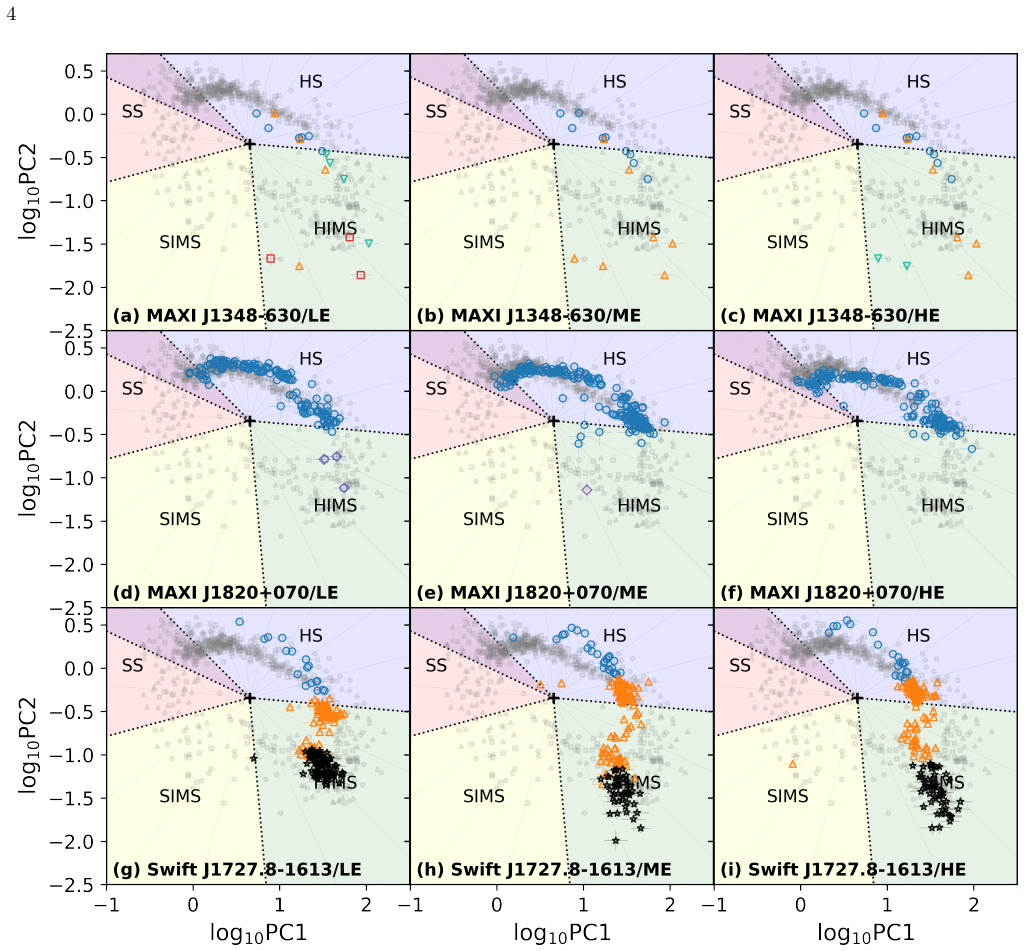
The trajectories of Insight-HXMT data in the power color-color diagrams are generally consistent with those of RXTE for hard and hard-intermediate states; the very high state is identifiable as a hue similar to the hard-intermediate state but without a loop pattern; and hue and hardness, though anti-correlated, give consistent timings for spectral state transitions across the three sources.
What carries the argument
Power color-color diagram whose axes are ratios of integrated power in separate frequency bands; position on the diagram is quantified by a single angle called hue that labels spectral state.
If this is right
- The same hue boundaries can be used to classify hard and hard-intermediate states in future Insight-HXMT outbursts.
- The very high state can be recognized on the diagram by its hue value even when no closed loop appears.
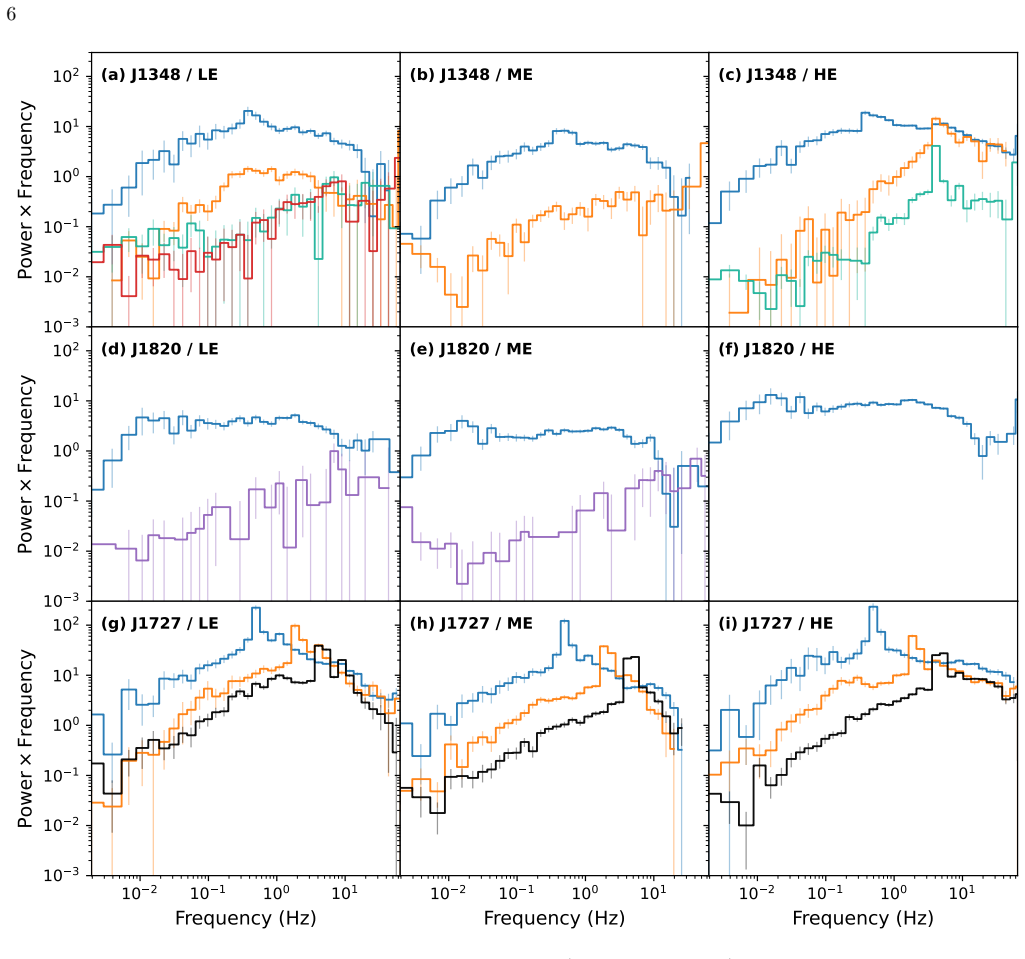
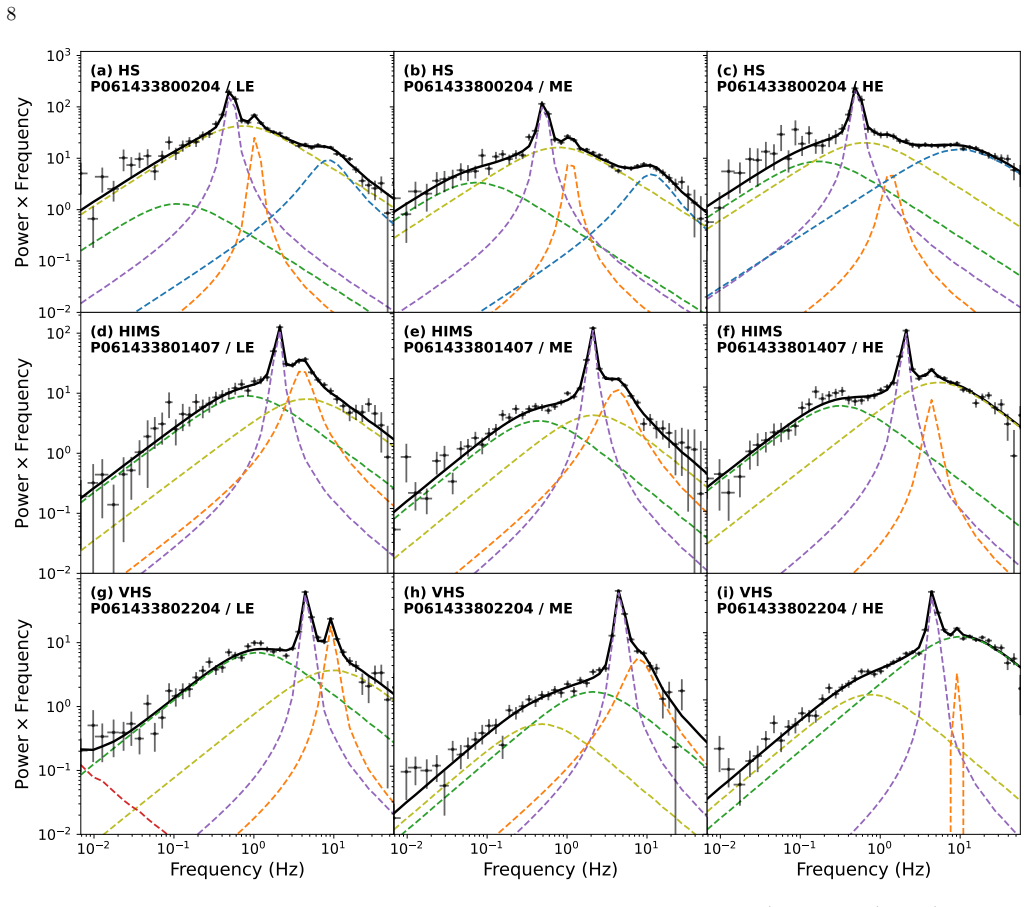
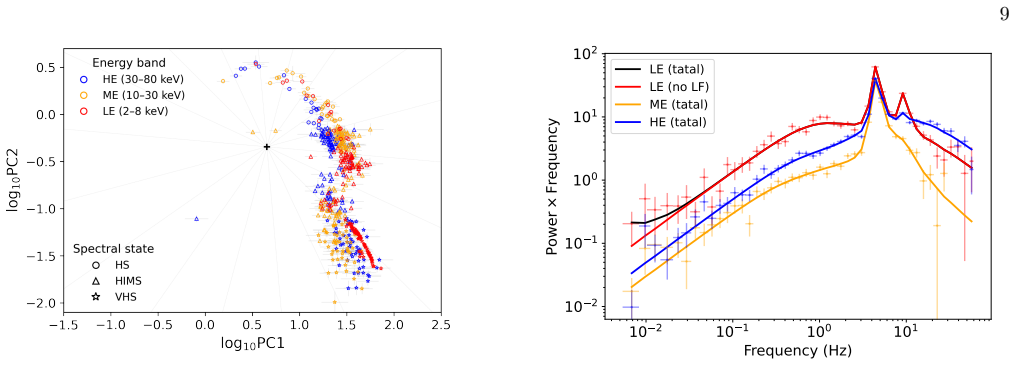
- Multi-band power colors remain consistent across 2-80 keV for most sources except when an extra low-frequency component appears at low energies.
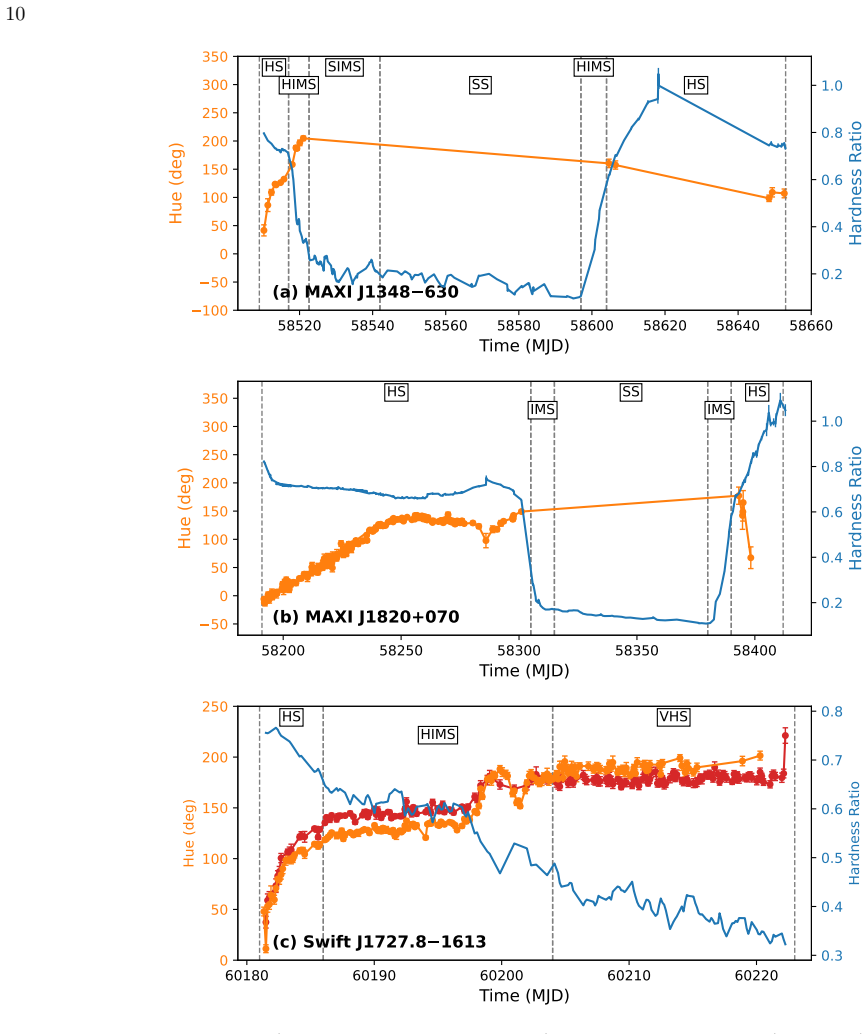
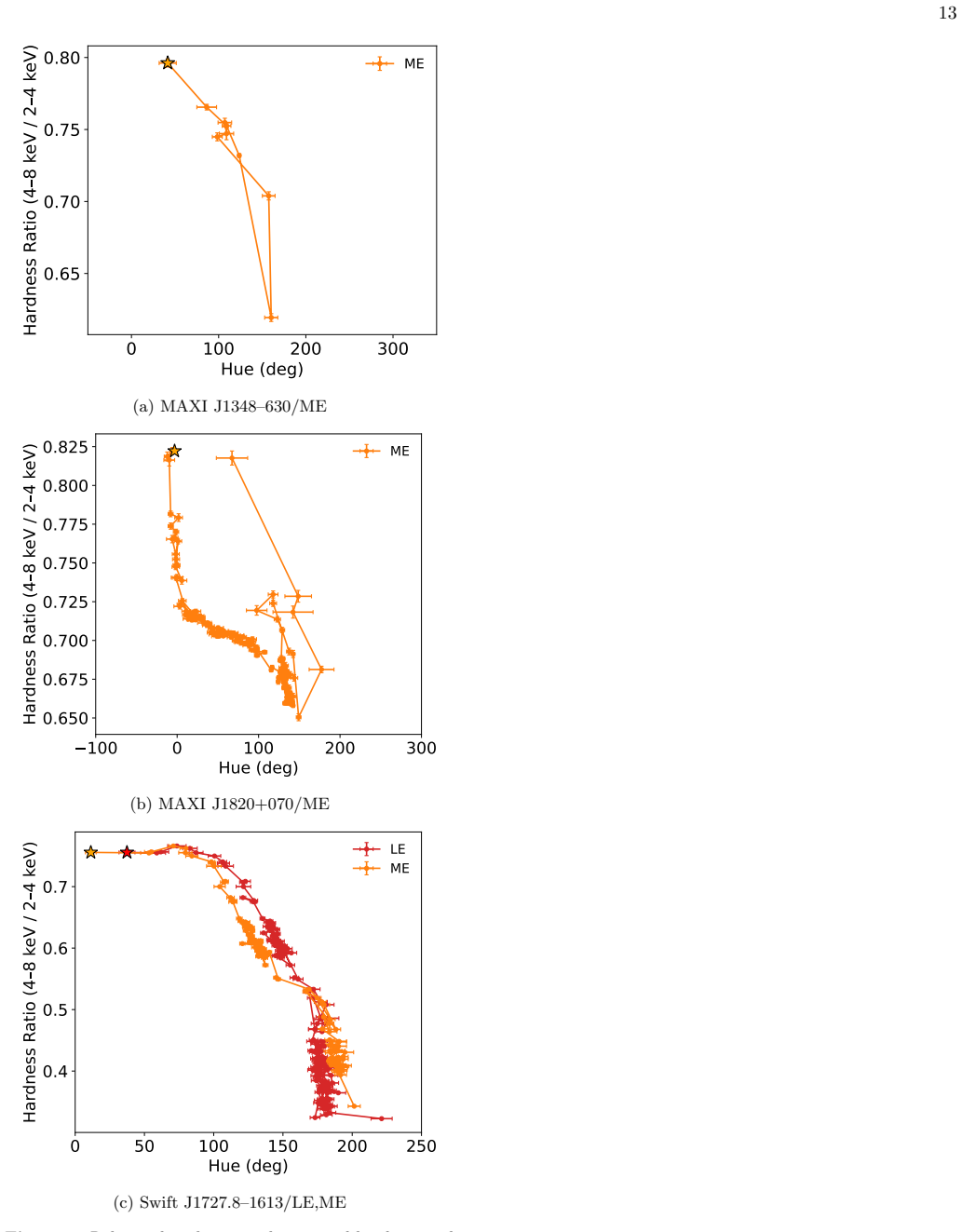
- Hue and hardness supply interchangeable clocks for the timing of state changes.
Where Pith is reading between the lines
- The method could be ported to other wide-band X-ray instruments once their frequency responses are cross-calibrated.
- Deviations driven by type-A QPOs or averaged power spectra indicate that short-timescale power spectra may need separate treatment.
- The absence of a loop in the very high state offers a potential new diagnostic that future monitoring programs could test on additional sources.
Load-bearing premise
The hue regions and power-color definitions calibrated on RXTE data can be applied directly to Insight-HXMT observations without corrections for detector response or energy coverage.
What would settle it
A set of hard-state observations in which most Insight-HXMT points lie outside the RXTE-defined hue regions by more than the reported scatter.
Figures
read the original abstract
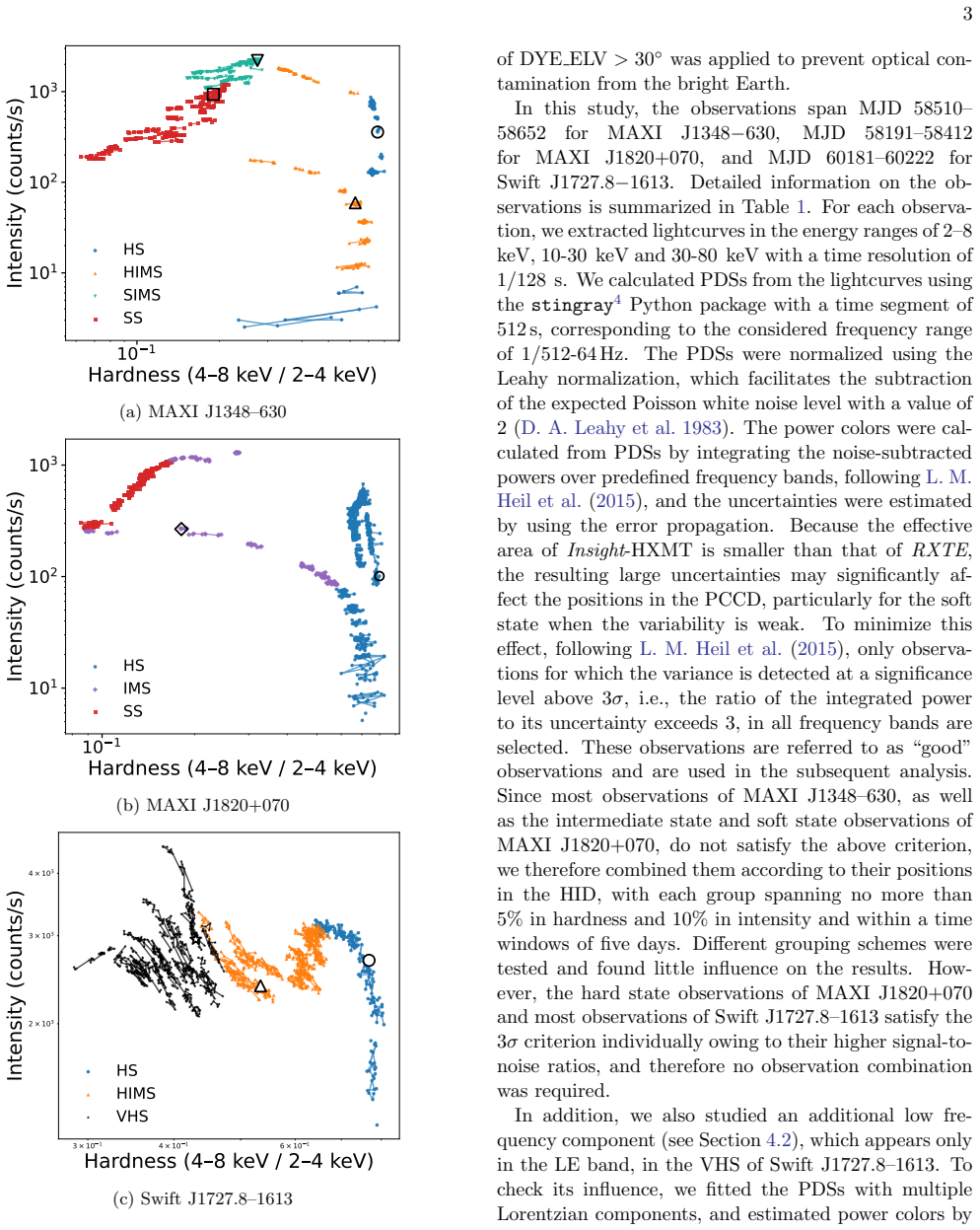
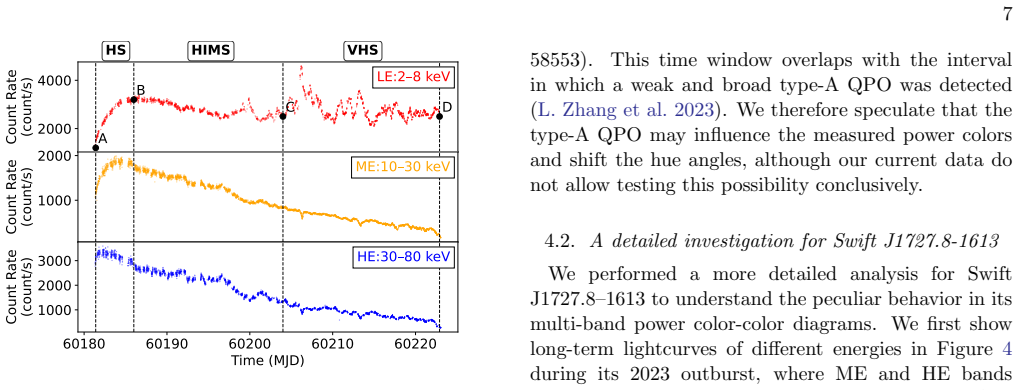
Power color-color diagrams (PCCDs) provide a useful diagnostic tool for studying the evolution of outbursts in black hole X-ray binaries. In this paper, we present power color-color diagrams of three sources (MAXI J1348-630, MAXI J1820+070 and Swift J1727.8-1613) observed with Insight-HXMT in a wide energy range of 2-80 keV. We compared the hue regions defined by RXTE, which are associated with different spectral states, with the Insight-HXMT results. We find that, for hard and hard-intermediate states, the trajectories of Insight-HXMT in the power color-color diagrams are generally consistent with those of RXTE. In the soft and soft-intermediate states, weak variability generally prevents robust hue constraints. Nevertheless, a few points in MAXI J1348-630 deviate from the RXTE-defined regions, possibly because of averaged variable power spectra and the presence of a type-A QPO. The trajectories of MAXI J1348-630 and MAXI J1820+070 exhibited roughly consistent patterns over different energy bands, whereas Swift J1727.8-1613 was an exception during its very high state, caused by an additional low-frequency component in the low-energy band. We found that the very high state can be identified through the power color-color diagram, exhibiting a hue similar to that of the hard-intermediate state but not forming a loop pattern. We also investigated the relationship between hue and hardness and found that, although they are generally anti-correlated, they provide consistent timing for the spectral state transitions.
Editorial analysis
A structured set of objections, weighed in public.
Referee Report
Summary. The paper constructs power color-color diagrams (PCCDs) from Insight-HXMT observations (2-80 keV) of three black hole X-ray binaries (MAXI J1348-630, MAXI J1820+070, Swift J1727.8-1613). It compares the resulting trajectories and hue values against RXTE-defined hue regions associated with spectral states, reports general consistency in hard and hard-intermediate states, notes deviations in soft states possibly due to averaged spectra or type-A QPOs, identifies the very high state via PCCD patterns, and finds that hue and hardness are generally anti-correlated while providing consistent transition timing.
Significance. If the transferability of RXTE hue boundaries holds after instrumental corrections, the work provides a useful multi-band, multi-source extension of the PCCD diagnostic to HXMT data, reinforcing its value for tracking outburst evolution and state identification across instruments. The explicit comparison of energy-band trajectories and the hue-hardness relation add observational constraints on state-transition diagnostics.
major comments (2)
- [Abstract, §3] Abstract and §3 (results on hard/hard-intermediate states): the central consistency claim for hard and hard-intermediate states requires that RXTE-derived power-color definitions and hue boundaries map directly onto HXMT measurements. Differences in effective area, energy resolution, and 2-80 keV coverage between HXMT and RXTE/PCA, together with averaging of variable power spectra, can alter frequency-bin powers and shift points across hue boundaries; the manuscript provides no quantitative assessment, response-matrix folding, or band-correction test of this transferability, leaving the consistency statements dependent on an unverified premise.
- [§2, Abstract] §2 (data analysis) and abstract: no error bars, data-selection criteria, or segment-averaging details are reported for the power spectra used to compute the colors; without these, the robustness of the reported trajectories and the attribution of soft-state deviations cannot be evaluated quantitatively.
minor comments (2)
- [Figures, §3] Figure captions and §3: clarify whether the multi-band PCCDs are constructed from simultaneous or separate energy-band power spectra and state the exact frequency boundaries adopted for each color.
- [§4] §4 (discussion): the statement that hue and hardness provide 'consistent timing' for transitions would benefit from a quantitative metric (e.g., time offsets or correlation coefficient) rather than qualitative description.
Simulated Author's Rebuttal
We thank the referee for their constructive comments and recommendation. We respond point-by-point to the major comments below.
read point-by-point responses
-
Referee: [Abstract, §3] Abstract and §3 (results on hard/hard-intermediate states): the central consistency claim for hard and hard-intermediate states requires that RXTE-derived power-color definitions and hue boundaries map directly onto HXMT measurements. Differences in effective area, energy resolution, and 2-80 keV coverage between HXMT and RXTE/PCA, together with averaging of variable power spectra, can alter frequency-bin powers and shift points across hue boundaries; the manuscript provides no quantitative assessment, response-matrix folding, or band-correction test of this transferability, leaving the consistency statements dependent on an unverified premise.
Authors: We acknowledge that the manuscript applies the RXTE power-color definitions and hue boundaries directly to the HXMT data without quantitative tests such as response-matrix folding or explicit band corrections. The consistency reported for hard and hard-intermediate states is therefore empirical. We agree this leaves the transferability as an unverified premise and will revise the abstract and §3 to add an explicit discussion of potential instrumental effects (energy resolution, effective area, and averaging) together with a clear caveat that the hue boundaries have not been re-derived for HXMT. A full folding analysis is beyond the present scope but the added discussion will qualify the claims. revision: partial
-
Referee: [§2, Abstract] §2 (data analysis) and abstract: no error bars, data-selection criteria, or segment-averaging details are reported for the power spectra used to compute the colors; without these, the robustness of the reported trajectories and the attribution of soft-state deviations cannot be evaluated quantitatively.
Authors: We agree that these methodological details are missing and limit quantitative evaluation. The revised §2 will specify the data-selection criteria, segment lengths and overlap used for averaging, the exact procedure for computing the power spectra, and how uncertainties are estimated and propagated into the power colors (including whether error bars are shown on the PCCDs). Corresponding clarifications will be added to the abstract where appropriate. revision: yes
Circularity Check
No circularity: purely observational comparison to external RXTE reference
full rationale
The paper computes power-color ratios directly from Insight-HXMT light curves in defined frequency bands and plots the resulting points against hue boundaries taken from the independent RXTE literature. No parameters are fitted to the HXMT data and then re-used as predictions; no self-citations supply load-bearing uniqueness theorems or ansatzes; the hue regions themselves are imported from prior external work rather than redefined within the present manuscript. The reported consistency (or deviations) in hard and soft states is therefore a direct empirical measurement against an external benchmark, not a reduction to the paper's own inputs.
Axiom & Free-Parameter Ledger
axioms (1)
- domain assumption RXTE-defined hue regions and power-color definitions apply without major instrumental corrections to Insight-HXMT observations.
Reference graph
Works this paper leans on
-
[1]
Astronomy & Astrophysics , volume=
A catalogue of low-mass X-ray binaries in the Galaxy, LMC, and SMC , author=. Astronomy & Astrophysics , volume=. 2007 , publisher=
2007
-
[2]
Formation of low-mass X-ray binaries. II. Common envelope evolution of primordial binaries with extreme mass ratios , author=. The Astrophysical Journal , volume=. 1998 , publisher=
1998
-
[3]
X-ray properties of black-hole binaries , author=. Annu. Rev. Astron. Astrophys. , volume=. 2006 , publisher=
2006
-
[4]
Philosophical Transactions of the Royal Society of London
Accretion flows in X--ray binaries , author=. Philosophical Transactions of the Royal Society of London. Series A: Mathematical, Physical and Engineering Sciences , volume=. 2002 , publisher=
2002
-
[5]
The Jet Paradigm: From Microquasars to Quasars , pages=
States and transitions in black hole binaries , author=. The Jet Paradigm: From Microquasars to Quasars , pages=. 2009 , publisher=
2009
-
[6]
Monthly Notices of the Royal Astronomical Society , volume=
A global spectral study of black hole X-ray binaries , author=. Monthly Notices of the Royal Astronomical Society , volume=. 2010 , publisher=
2010
-
[7]
Cambridge, UK: Cam , volume=
X-ray Binaries , author=. Cambridge, UK: Cam , volume=
-
[8]
Black hole binaries , author=. arXiv preprint astro-ph/0306213 , year=
work page internal anchor Pith review Pith/arXiv arXiv
-
[9]
Astrophysics and Space Science: From X-Ray Binaries to Quasars: Black Holes on all Mass Scales , pages=
A unified model for black hole X-ray binary jets? , author=. Astrophysics and Space Science: From X-Ray Binaries to Quasars: Black Holes on all Mass Scales , pages=. 2005 , publisher=
2005
-
[10]
Monthly Notices of the Royal Astronomical Society , volume=
Fast variability as a tracer of accretion regimes in black hole transients , author=. Monthly Notices of the Royal Astronomical Society , volume=. 2011 , publisher=
2011
-
[11]
Power-Colours: Simple X-ray Binary Variability Comparison
Power colours: simple X-ray binary variability comparison. , keywords =. doi:10.1093/mnras/stv191 , archivePrefix =. 1405.2024 , primaryClass =
work page internal anchor Pith review Pith/arXiv arXiv doi:10.1093/mnras/stv191 2024
-
[12]
8--1613 Observed with Insight-HXMT , author=
Spectral Analysis of the X-Ray Flares in the 2023 Outburst of the New Black Binary Transient Swift J1727. 8--1613 Observed with Insight-HXMT , author=. The Astrophysical Journal , volume=. 2025 , publisher=
2023
-
[13]
8- 1613 with Insight-HXMT , author=
Timing analysis of the newly discovered black hole candidate Swift J1727. 8- 1613 with Insight-HXMT , author=. Monthly Notices of the Royal Astronomical Society , volume=. 2024 , publisher=
2024
-
[14]
Monthly Notices of the Royal Astronomical Society , volume=
Are there three peaks in the power spectra of GX 339-4 and Cyg X-1? , author=. Monthly Notices of the Royal Astronomical Society , volume=. 2000 , publisher=
2000
-
[15]
XRBcats: Galactic low-mass X-ray binary catalogue. , keywords =. doi:10.1051/0004-6361/202346522 , archivePrefix =. 2303.16168 , primaryClass =
-
[16]
A review of quasi-periodic oscillations from black hole X-ray binaries: Observation and theory. , keywords =. doi:10.1016/j.newar.2020.101524 , archivePrefix =. 2001.08758 , primaryClass =
-
[17]
Publications of the Astronomical Society of Japan , volume=
The MAXI mission on the ISS: science and instruments for monitoring all-sky X-ray images , author=. Publications of the Astronomical Society of Japan , volume=. 2009 , publisher=
2009
-
[18]
and Negoro, H
Yatabe, F. and Negoro, H. and Nakajima, M. and others , title =. The Astronomer’s Telegram , number =
-
[19]
The Astrophysical Journal Letters , volume=
Discovery of the Black Hole X-Ray Binary Transient MAXI J1348--630 , author=. The Astrophysical Journal Letters , volume=. 2020 , publisher=
2020
-
[20]
Monthly Notices of the Royal Astronomical Society , volume=
NICER observations reveal that the X-ray transient MAXI J1348- 630 is a black hole X-ray binary , author=. Monthly Notices of the Royal Astronomical Society , volume=. 2020 , publisher=
2020
-
[21]
The Astrophysical Journal Letters , volume=
Time-lag between disk and corona radiation leads to hysteresis effect observed in black hole X-ray binary MAXI J1348-630 , author=. The Astrophysical Journal Letters , volume=. 2021 , publisher=
2021
-
[22]
Monthly Notices of the Royal Astronomical Society , volume=
Estimation of spin and mass of the black hole in MAXI J1348--630 from the soft state using NICER and NuSTAR observations , author=. Monthly Notices of the Royal Astronomical Society , volume=. 2022 , publisher=
2022
-
[23]
Monthly Notices of the Royal Astronomical Society: Letters , volume=
Measuring the distance to the black hole candidate X-ray binary MAXI J1348--630 using H i absorption , author=. Monthly Notices of the Royal Astronomical Society: Letters , volume=. 2021 , publisher=
2021
-
[24]
Publications of the Astronomical Society of Japan , volume=
Discovery and state transitions of the new Galactic black hole candidate MAXI J1535- 571 , author=. Publications of the Astronomical Society of Japan , volume=. 2018 , publisher=
2018
-
[25]
The Astronomer's Telegram , volume=
MAXI J1535-571: Swift detection and localization , author=. The Astronomer's Telegram , volume=
-
[26]
The Astrophysical Journal Letters , volume=
A NICER spectrum of MAXI J1535--571: near-maximal black hole spin and potential disk warping , author=. The Astrophysical Journal Letters , volume=. 2018 , publisher=
2018
-
[27]
The astronomer's telegram , volume=
Extremely Bright Radio and (Sub-) Millimetre Detections of MAXI J1535-571 , author=. The astronomer's telegram , volume=
-
[28]
and Nakahira, S
Shidatsu, M. and Nakahira, S. and Negoro, H. and Kawai, N. and Ueno, S. and Tomida, H. and Ishikawa, M. and Sugawara, Y. and Isobe, N. and Shimomukai, R. and Mihara, T. and Sugizaki, M. and Iwakiri, W. and Yatabe, F. and Takao, Y. and Matsuoka, M. and others , year =. MAXI J1535-571 currently shows softest spectrum , journal =
-
[29]
Monthly Notices of the Royal Astronomical Society , volume=
The comptonizing medium of the black hole X-ray binary MAXI J1535- 571 through type-C quasi-periodic oscillations , author=. Monthly Notices of the Royal Astronomical Society , volume=. 2023 , publisher=
2023
-
[30]
The Astrophysical Journal Letters , volume=
ASASSN-18ey: the rise of a new black hole X-ray binary , author=. The Astrophysical Journal Letters , volume=. 2018 , publisher=
2018
-
[31]
The Astronomer's Telegram , volume=
Optical observations of MAXI J1820+ 070 suggest it is a black hole X-ray binary , author=. The Astronomer's Telegram , volume=
-
[32]
Monthly Notices of the Royal Astronomical Society , volume=
The accretion--ejection connection in the black hole X-ray binary MAXI J1820+ 070 , author=. Monthly Notices of the Royal Astronomical Society , volume=. 2025 , publisher=
2025
-
[33]
Stiele, H. and Kong, A. K. H. NICER and Swift/XRT monitoring of the 2023 outburst of Swift J1727.7 1613. Astron. Astrophys. 2024. doi:10.1051/0004-6361/202450657. arXiv:2410.07333
-
[34]
8-1613 , author=
NICER, NuSTAR, and Insight-HXMT views to the newly discovered black hole X-ray binary swift J1727. 8-1613 , author=. The Astrophysical Journal Letters , volume=. 2024 , publisher=
2024
-
[35]
8- 162 , author=
Evidence for inflows and outflows in the nearby black hole transient Swift J1727. 8- 162 , author=. Astronomy & Astrophysics , volume=. 2024 , publisher=
2024
-
[36]
The Astrophysical Journal , volume=
Advection-dominated accretion and the spectral states of black hole X-ray binaries: application to Nova Muscae 1991 , author=. The Astrophysical Journal , volume=. 1997 , publisher=
1991
-
[37]
Modelling the behaviour of accretion flows in X-ray binaries
Modelling the behaviour of accretion flows in X-ray binaries. Everything you always wanted to know about accretion but were afraid to ask. , keywords =. doi:10.1007/s00159-007-0006-1 , archivePrefix =. 0708.0148 , primaryClass =
work page internal anchor Pith review Pith/arXiv arXiv doi:10.1007/s00159-007-0006-1
-
[38]
Modelling variability in black hole binaries: linking simulations to observations. , keywords =. doi:10.1111/j.1365-2966.2011.19885.x , archivePrefix =. 1108.0789 , primaryClass =
-
[39]
Monthly Notices of the Royal Astronomical Society , volume=
Patterns of energy-dependent variability from Comptonization , author=. Monthly Notices of the Royal Astronomical Society , volume=. 2005 , publisher=
2005
-
[40]
The Astrophysical Journal , year=
On searches for pulsed emission with application to four globular cluster X-ray sources - NGC 1851, 6441, 6624, and 6712 , author=. The Astrophysical Journal , year=
-
[41]
Science China Physics, Mechanics & Astronomy , volume =
Chen, Yong and Cui, Wei and Li, Wei and others , title =. Science China Physics, Mechanics & Astronomy , volume =. 2020 , doi =
2020
-
[42]
Science China Physics, Mechanics & Astronomy , volume =
Cao, Xinwu and Jiang, Wei and Meng, Bo and others , title =. Science China Physics, Mechanics & Astronomy , volume =. 2020 , doi =
2020
-
[43]
Science China Physics, Mechanics & Astronomy , volume =
Liu, Chuan and Zhang, Yan and Li, Xiaobo and others , title =. Science China Physics, Mechanics & Astronomy , volume =. 2020 , doi =
2020
-
[44]
Monthly Notices of the Royal Astronomical Society , volume=
A possible overall scenario for the outburst evolution of MAXI J1820+ 070 revealed by Insight-HXMT , author=. Monthly Notices of the Royal Astronomical Society , volume=. 2023 , publisher=
2023
-
[45]
arXiv preprint arXiv:2509.06487 , year=
The full jet production cycle observed during fast state transitions in the black hole X-ray binary MAXI J1348 - 630 , author=. arXiv preprint arXiv:2509.06487 , year=
-
[46]
2024 , eprint=
The Broadband X-ray Spectral Properties during the Rising Phases of the Outburst of the New Black Hole X-ray Binary Candidate Swift J1727.8-1613 , author=. 2024 , eprint=
2024
-
[47]
Temporal Evolution of Quasiperiodic Oscillations in an Accreting Black Hole Swift J1727.8-1613: Coevolution of the Disk─Corona during the State Transition. , keywords =. doi:10.3847/1538-4357/ae058a , archivePrefix =. 2506.21131 , primaryClass =
-
[48]
The Astrophysical Journal , volume=
Variability as a Predictor for the Hard-to-soft State Transition in GX 339- 4 , author=. The Astrophysical Journal , volume=. 2023 , publisher=
2023
-
[49]
Tracking the X-Ray Polarization of the Black Hole Transient Swift J1727.8 1613 during a State Transition. , keywords =. doi:10.3847/1538-4357/ad3faf , archivePrefix =. 2311.05497 , primaryClass =
-
[50]
Dynamic disk-corona coupling during the state transition of Swift J1727.8-1613
Daily fluctuations propagate damply through the accretion disk of Swift J1727.8-1613. arXiv e-prints , keywords =. doi:10.48550/arXiv.2508.01384 , archivePrefix =. 2508.01384 , primaryClass =
work page internal anchor Pith review Pith/arXiv arXiv doi:10.48550/arxiv.2508.01384
-
[51]
Gardenier, D W and Uttley, P , year=. A model-independent comparison of the variability of accreting neutron stars and black holes , volume=. Monthly Notices of the Royal Astronomical Society , publisher=. doi:10.1093/mnras/sty2524 , number=
-
[52]
Astronomy & Astrophysics , volume=
Rapid jet production and suppression during fast state transitions in the black hole X-ray binary MAXI J1348--630 , author=. Astronomy & Astrophysics , volume=. 2026 , publisher=
2026
-
[53]
Monthly Notices of the Royal Astronomical Society , volume=
Type-A quasi-periodic oscillation in the black hole transient MAXI J1348- 630 , author=. Monthly Notices of the Royal Astronomical Society , volume=. 2023 , publisher=
2023
-
[54]
NICER uncovers the transient nature of the type-B quasi-periodic oscillation in the black hole candidate MAXI J1348-630. , keywords =. doi:10.1093/mnras/stab1553 , archivePrefix =. 2105.12338 , primaryClass =
-
[55]
Transitions and Origin of the Type-B Quasi-periodic Oscillations in the Black Hole X-Ray Binary MAXI J1348-630. , keywords =. doi:10.3847/1538-4357/ac88c6 , archivePrefix =. 2208.07066 , primaryClass =
-
[56]
Transitional Dynamics: Unveiling the Coexistence and Interplay of Type B and Type C Quasiperiodic Oscillations in MAXI J1348-630. , keywords =. doi:10.3847/1538-4357/ae2ad2 , archivePrefix =. 2512.13124 , primaryClass =
discussion (0)
Sign in with ORCID, Apple, or X to comment. Anyone can read and Pith papers without signing in.