An Empirical Analysis of High-Performance Computing Education in Germany
Pith reviewed 2026-07-01 03:32 UTC · model grok-4.3
The pith
German universities teach HPC mostly as theory with limited hands-on cluster access for students.
A machine-rendered reading of the paper's core claim, the machinery that carries it, and where it could break.
Core claim
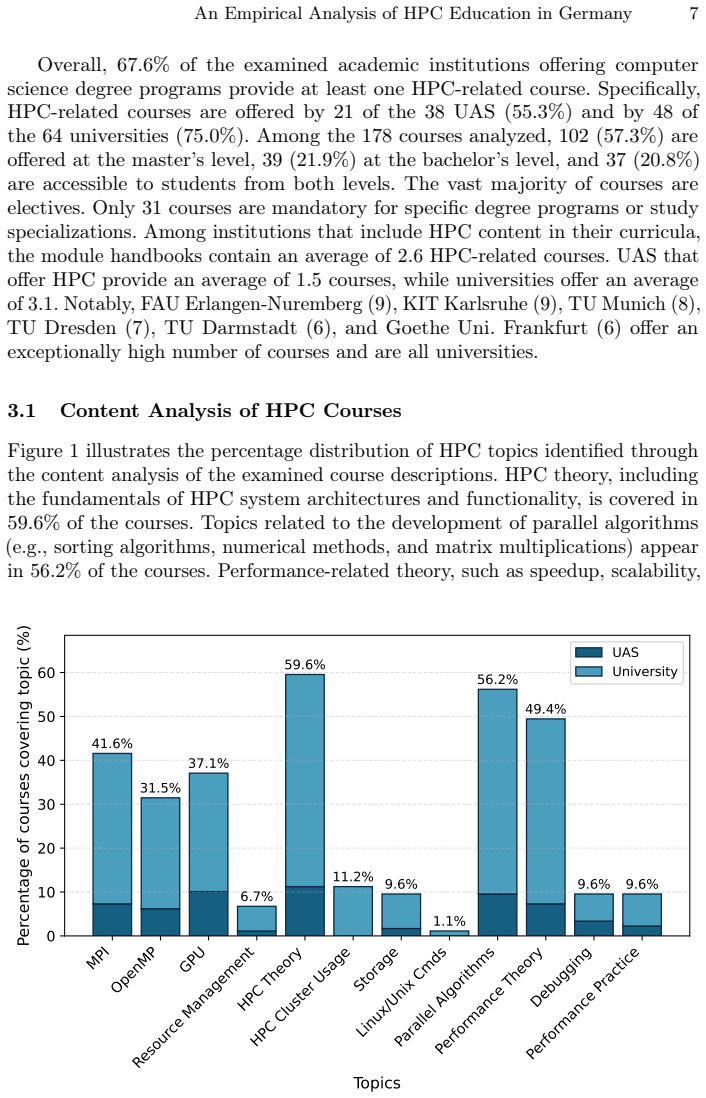
An empirical review of 178 HPC-related courses shows that German higher education places HPC instruction predominantly at the master's level as electives, with limited bachelor's integration, and that restricted documented access to local HPC clusters for teaching purposes correlates with reduced curricular emphasis on practical competencies including cluster usage, resource management, parallel debugging, and performance analysis.
What carries the argument
The statistical association drawn between documented teaching access to institutional HPC clusters and the practical-competency coverage recorded in module handbooks.
If this is right
- HPC courses remain mostly elective modules at the master's level with limited bachelor's integration.
- Most institutions that operate clusters do not document them for educational use.
- Restricted teaching access associates with measurably lower emphasis on practical competencies such as parallel debugging and performance analysis.
- The overall pattern produces a documented imbalance between theoretical and applied HPC instruction.
Where Pith is reading between the lines
- Increasing documented teaching access to existing clusters could shift curricula toward more practical competency coverage.
- The same method of handbook-plus-infrastructure review could be applied in other countries to test whether the imbalance is Germany-specific.
- Institutional policies that reserve clusters exclusively for research may unintentionally limit student preparation for real HPC workloads.
Load-bearing premise
Module handbooks and course catalogs accurately reflect the competencies actually taught and practiced in the courses.
What would settle it
Direct observation or instructor surveys documenting substantial practical HPC activities in courses whose handbooks list few such components would undermine the reported imbalance.
Figures
read the original abstract
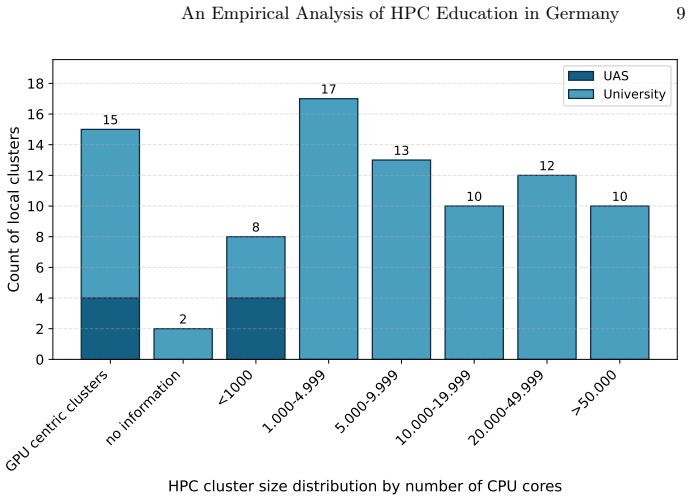
The growing importance of High-Performance Computing (HPC) requires the systematic integration of parallel programming and performance-oriented competencies into computational science curricula. Effective HPC education combines theoretical foundations with practical experience on real cluster infrastructures, enabling students to understand scalability, efficiency, and architectural differences between shared and distributed memory systems. However, cross-institutional evidence on how HPC education is implemented, and how curricula relate to locally available infrastructure, remains limited. We address this gap through a systematic empirical assessment of HPC education at 102 academic institutions in Germany. Based on module handbooks and course catalogs, we identified 178 HPC-related courses and evaluated their competency coverage and curricular placement. We additionally assessed local academic HPC cluster infrastructures with respect to availability, size, and documented accessibility for teaching. The results show that 67.6% of institutions offer at least one HPC-related course, but these offerings are predominantly elective modules at the master's level, with limited integration in bachelor's programs. Although 61.8% of institutions operate HPC clusters, only 23.0% explicitly document their availability for educational use, as infrastructures are mainly reserved for research. Statistical analysis indicates a significant association between restricted teaching access and reduced curricular emphasis on practical competencies such as resource management, cluster usage, parallel debugging, and performance analysis. Overall, the findings reveal a structural imbalance between theoretical instruction and the development of practical HPC competencies in German higher education.
Editorial analysis
A structured set of objections, weighed in public.
Referee Report
Summary. The paper conducts a systematic document review of module handbooks and course catalogs from 102 German academic institutions, identifying 178 HPC-related courses. It evaluates competency coverage (theoretical foundations versus practical skills such as resource management, cluster usage, parallel debugging, and performance analysis), curricular placement (predominantly master's electives), and correlates these with local HPC cluster availability (61.8% of institutions) and documented teaching access (only 23.0%). Statistical tests show a significant association between restricted cluster access and lower emphasis on practical competencies, leading to the claim of a structural imbalance favoring theory over practice in German HPC education.
Significance. If the proxy validity of handbooks holds, the study supplies the first large-scale, cross-institutional empirical baseline on HPC education in Germany. The scale (102 institutions, 178 courses) and the infrastructure correlation are strengths that could inform national curriculum guidelines and funding priorities for computational science programs.
major comments (2)
- [Methods] Methods (document review and competency coding): competency coverage for practical skills (resource management, parallel debugging, performance analysis) is inferred exclusively from module handbook descriptions without any triangulation against actual syllabi, assignments, or instructor reports. This assumption is load-bearing for the central imbalance claim and the reported association with restricted cluster access; if handbooks systematically list aspirational rather than delivered content, both the imbalance statistic and the infrastructure correlation become unreliable.
- [Results] Results (statistical association): the claim of a 'significant association' between restricted teaching access and reduced practical competencies is presented without reporting the exact test statistic, p-value, effect size, or control for confounders such as institution size or discipline. This detail is required to assess whether the association supports the structural-imbalance conclusion.
minor comments (2)
- [Abstract] The abstract and methods should explicitly state the inter-rater reliability or coding protocol used for the 178 courses to allow reproducibility.
- [Results] Table or figure presenting the competency coverage breakdown by institution type or level (bachelor vs. master) would improve clarity of the placement findings.
Simulated Author's Rebuttal
We thank the referee for the constructive feedback, which helps clarify the methodological foundations and statistical reporting in our study. We respond to each major comment below and indicate planned revisions.
read point-by-point responses
-
Referee: [Methods] Methods (document review and competency coding): competency coverage for practical skills (resource management, parallel debugging, performance analysis) is inferred exclusively from module handbook descriptions without any triangulation against actual syllabi, assignments, or instructor reports. This assumption is load-bearing for the central imbalance claim and the reported association with restricted cluster access; if handbooks systematically list aspirational rather than delivered content, both the imbalance statistic and the infrastructure correlation become unreliable.
Authors: We acknowledge that module handbooks provide only a proxy for delivered content and may include aspirational elements. This is a recognized limitation of large-scale document-based curriculum studies, chosen here to enable systematic coverage of 102 institutions. In revision we will add an explicit subsection in Methods and a dedicated Limitations paragraph discussing proxy validity, citing comparable studies in higher-education research, and outlining the need for future triangulation via instructor surveys or syllabus collection. revision: yes
-
Referee: [Results] Results (statistical association): the claim of a 'significant association' between restricted teaching access and reduced practical competencies is presented without reporting the exact test statistic, p-value, effect size, or control for confounders such as institution size or discipline. This detail is required to assess whether the association supports the structural-imbalance conclusion.
Authors: We agree that the statistical details must be reported explicitly. The revised Results section will state the exact test (chi-square test of independence), the test statistic, p-value, effect size (Cramér’s V), and the outcome of stratified checks by institution size and type (university vs. university of applied sciences). These additions will allow readers to evaluate the robustness of the reported association. revision: yes
Circularity Check
Purely observational empirical study with no derivations or self-referential elements
full rationale
The paper is an empirical assessment that counts and classifies 178 HPC-related courses from module handbooks and catalogs across 102 German institutions, evaluates cluster infrastructures, and reports statistical associations. No equations, fitted parameters, predictions, or derivations appear in the provided text. Results are presented as direct observations from external institutional documents rather than constructed from internal definitions or self-citations. This matches the default expectation of no significant circularity for observational work.
Axiom & Free-Parameter Ledger
axioms (1)
- domain assumption Module handbooks and course catalogs accurately reflect the curriculum and competencies covered in actual courses.
Reference graph
Works this paper leans on
-
[1]
Sustainability13(2021).https://doi.org/10.3390/su132111782
Al-Jody, T., Aagela, H., Holmes, V.: Inspiring the Next Generation of HPC En- gineers with Reconfigurable, Multi-Tenant Resources for Teaching and Research. Sustainability13(2021).https://doi.org/10.3390/su132111782
-
[2]
In: Proceedings of EduHPC (2018).https://doi.org/10.1109/EduHPC.2018.00008
Banchelli, F., Mantovani, F.: Filling the Gap Between Education and Industry: Evidence-Based Methods for Introducing Undergraduate Students to HPC. In: Proceedings of EduHPC (2018).https://doi.org/10.1109/EduHPC.2018.00008
-
[3]
Bischof, C.: Hessisches Kompetenzzentrum für Hochleistungsrechnen (HKHLR) (2026),https://www.hkhlr.de/de
2026
-
[4]
Journal of Parallel and Distributed Computing201(2025)
Bouvry, P., Brorsson, M., Canal, R., Eftekhari, A., Höfinger, S., Smets, D., Köstler, H., Kozubek, T., Krishnasamy, E., Llosa, J., Lukas-Rother, A., Martorell, X., Pleiter, D., Proykova, A., Sancho, M., Schenk, O., Silvano, C.: The European Master for HPC Curriculum. Journal of Parallel and Distributed Computing201(2025). https://doi.org/10.1016/j.jpdc.20...
-
[5]
The Lustre Storage Architecture
Braam, P.: The Lustre Storage Architecture (2019),http://arxiv.org/abs/1903. 01955, arXiv:1903.01955
work page internal anchor Pith review Pith/arXiv arXiv 2019
-
[6]
BSC Tools: Extrae (2026),https://tools.bsc.es/extrae
2026
-
[7]
BSC Tools: Paraver (2026),https://tools.bsc.es/paraver
2026
-
[8]
bwHPC: High Performance Computing, Data Intensive Computing and Large Scale Scientific Data Management in Baden-Württemberg (2025),https://www.bwhpc.de
2025
-
[9]
In: Practice and Experience in Advanced Research Computing
Callaghan, S., Filinger, W., Zhukov, I., Lederer, H., Urbanic, J.: Fifteen Years of International HPC Summer School. In: Practice and Experience in Advanced Research Computing. ACM (2025).https://doi.org/10.1145/3708035.3736011
-
[10]
Diehl, P., Li, Y.W., Junghans, C., Holmen, J.K., MacCarthy, E., Parete-Koon, S., He, Y.H., Hartman-Baker, R., Lively, C., Gott, K., Gupta, L., Streu, K., Ghadar, Y., Kinsley, P., Herriman, J., Draeger, E.W., Eijkhout, V., Mehringer, S.: Shaping the Future Workforce: Challenges and Lessons Learned in HPC Education from National Labs and Computing Centers (...
-
[11]
The Journal of Computational Science Education (2021).https://doi.org/10.22369/issn.2153-4136/12/3/2
Döpper, T., Große-Wöhrmann, B., Lindner, D., Milakovic, D., Oexle, J., Resch, M.M., Scheel, O., Slotosch, S., Widmaier, L.: Expanding HLRS Academic HPC Sim- ulation Training Programs to More Target Groups. The Journal of Computational Science Education (2021).https://doi.org/10.22369/issn.2153-4136/12/3/2
-
[12]
Education and Information Technologies29(2024)
Hebert, J., Hratisch, R., Gomes, R., Kunkel, W., Marshall, D., Ghosh, A., Doss, I., Ma, Y., Stedman, D., Stinson, B., Varghese, A., Mohr, M., Rozario, P., Bhattacharyya, S.: High-Performance Computing in Undergraduate Edu- cation at Primarily Undergraduate Institutions in Wisconsin: Progress, Chal- lenges, and Opportunities. Education and Information Tech...
-
[13]
Herold, F., Breuner, S., Heichler, J.: An Introduction to BeeGFS. Tech. rep., ThinkParQ, Kaiserslautern, Germany (2014), https://www.beegfs.io/docs/ whitepapers/Introduction_to_BeeGFS_by_ThinkParQ.pdf An Empirical Analysis of HPC Education in Germany 15
2014
-
[14]
Hewlett Packard Enterprise: El Capitan (2025), https://www.hpe.com/us/en/ compute/hpc/lawrence-livermore-national-laboratory.html
2025
-
[15]
Informationstechnische Gesellschaft im VDE and Gesellschaft für Infor- matik e.V.: Curriculum für Bachelor- und Masterstudiengänge Technische Informatik (March 2018), https://dl.gi.de/server/api/core/bitstreams/ 031111d5-9360-43e7-aed4-54bb34950308/content
2018
-
[16]
Jülich Supercomputing Centre: JUPITER|The Arrival of Exascale in Europe (2025), https://www.fz-juelich.de/en/jsc/jupiter
2025
-
[17]
Knüpfer, A., Brunst, H., Doleschal, J., Jurenz, M., Lieber, M., Mickler, H., Müller, M.S., Nagel, W.E.: The Vampir Performance Analysis Tool-Set. In: Tools for High Performance Computing - Proceedings of the International Workshop on Parallel ToolsforHPC.Springer(2008). https://doi.org/10.1007/978-3-540-68564-7_9
-
[18]
Leibniz Supercomputing Centre: SuperMUC-NG (2026),https://doku.lrz.de/ supermuc-ng-10745965.html
2026
-
[19]
nhr-verein.de/
NHR-Verein e.V.: Nationales Hochleistungsrechnen (2026), https://www. nhr-verein.de/
2026
-
[20]
II - Big Data, Energy, and Distributed Computing
Prasad, S.K., Weems, C.C., Sussman, A., Gupta, A., Estrada, T., Vaidyanathan, R., Ghafoor, S.K., Kant, K., Stunkel, C.B.: NSF/IEEE-TCPP Curriculum on Parallel and Distributed Computing for Undergraduates - V. II - Big Data, Energy, and Distributed Computing. In: Proceedings of the Technical Symposium on Computer Science Education. ACM (2023).https://doi.o...
-
[21]
In: Proceedings of the Working Group Reports on ITiCSE
Raj, R.K., Romanowski, C.J., Impagliazzo, J., Aly, S.G., Becker, B.A., Chen, J., Ghafoor, S., Giacaman, N., Gordon, S.I., Izu, C., Rahimi, S., Robson, M.P., Thota, N.: High Performance Computing Education: Current Challenges and Future Directions. In: Proceedings of the Working Group Reports on ITiCSE. ACM (2020). https://doi.org/10.1145/3437800.3439203
-
[22]
The Journal of Computational Science Education (2024).https://doi.org/10
Raoofy, A., Elis, B., Bode, V., Chung, M.T., Breiter, S., Schlemon, M., Herr, D.F., Fuerlinger, K., Schulz, M., Weidendorfer, J.: BEAST Lab: A Practical Course on Experimental Evaluation of Diverse Modern HPC Architectures and Accelerators. The Journal of Computational Science Education (2024).https://doi.org/10. 22369/issn.2153-4136/15/1/5
2024
-
[23]
Roth, A.L.: HPC at German Universities - Data analysis references [Data set] (2025).https://doi.org/10.5281/zenodo.18722580
-
[24]
Samuel, J., Brennan-Tonetta, M., Samuel, Y., Subedi, P., Smith, J.: Strategies for Democratization of Supercomputing: Availability, Accessibility and Usability of High Performance Computing for Education and Practice of Big Data Analytics (2021),https://arxiv.org/abs/2104.09091, arXiv:2104.09091
-
[25]
Strohmaier, E., Dongarra, J., Simon, H., Meuer, H.: Top500 The List (2025), https://top500.org
2025
-
[26]
University Paderborn: HPC.NRW (2026),https://hpc.dh.nrw/de/
2026
-
[27]
Wofford, J.L., Lueninghoener, C.: The Supercomputer Institute: A Systems-Focused Approach to HPC Training and Education. The Journal of Computational Science Education (2020).https://doi.org/10.22369/issn.2153-4136/11/1/12
discussion (0)
Sign in with ORCID, Apple, or X to comment. Anyone can read and Pith papers without signing in.