Spatial Model Checking of Images via Minimised Models and Branching Bisimilarity
Pith reviewed 2026-07-01 03:38 UTC · model grok-4.3
The pith
Encoding quasi-discrete closure models as labelled transition systems lets branching bisimilarity algorithms compute CoPa equivalence classes correctly.
A machine-rendered reading of the paper's core claim, the machinery that carries it, and where it could break.
Core claim
For CoPa bisimilarity on quasi-discrete closure models, the encoding of closure models as labelled transition systems preserves CoPa equivalence classes, so that branching bisimilarity algorithms compute the correct partitions and thereby enable effective minimisation of spatial models.
What carries the argument
The encoding of quasi-discrete closure models as labelled transition systems, which transfers CoPa equivalence to branching bisimilarity partitions.
If this is right
- The minimisation procedure is correct with respect to CoPa bisimilarity.
- Model checking of spatial properties on the minimised models produces the same results as on the original models.
- The relationship between equivalence classes and pixels in the source image is preserved by the toolchain.
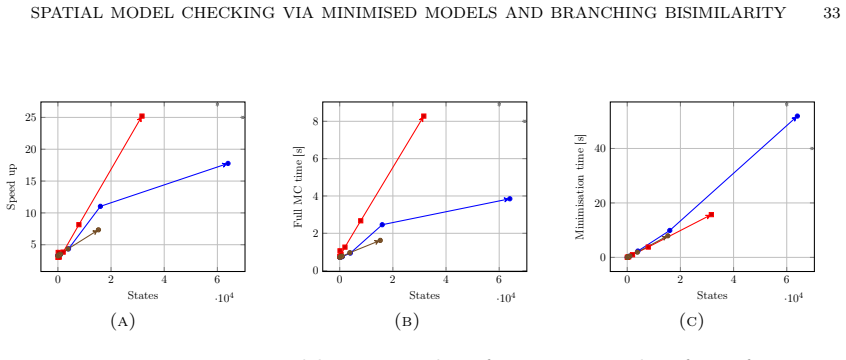
- Benchmark examples demonstrate a speed-up in checking spatial properties for models of realistic size.
Where Pith is reading between the lines
- The same encoding strategy could be tested on closure models derived from three-dimensional voxel data.
- Integration with existing image segmentation tools might allow automatic generation of the input closure models from raw pixel data.
- The approach opens the possibility of applying other bisimulation-minimisation variants if they can be shown to preserve the same reachability modalities.
Load-bearing premise
The encoding of quasi-discrete closure models as labelled transition systems preserves CoPa equivalence classes.
What would settle it
A concrete quasi-discrete closure model and a spatial property such that the minimised model obtained via the encoding yields a different truth value for the property than the original model.
Figures
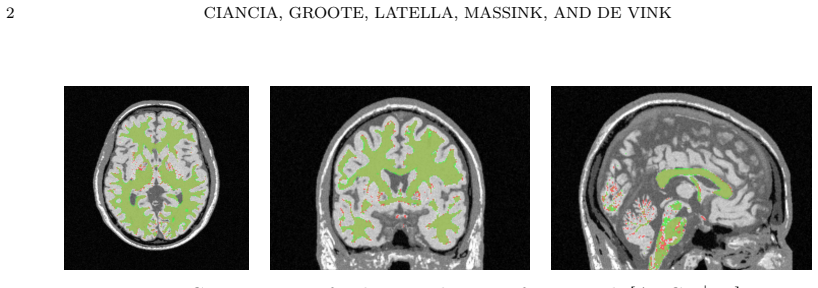
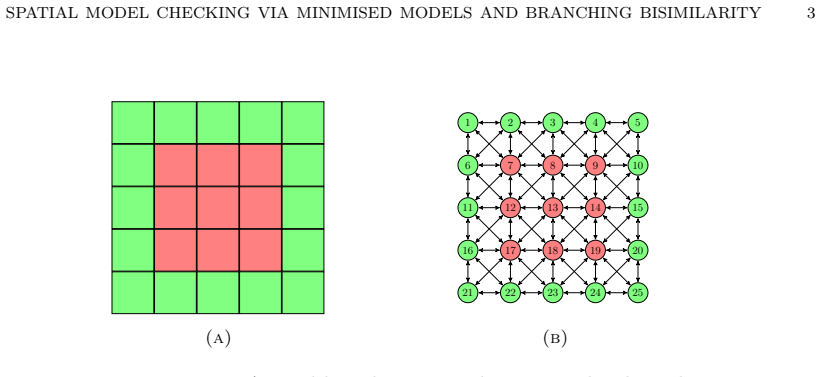
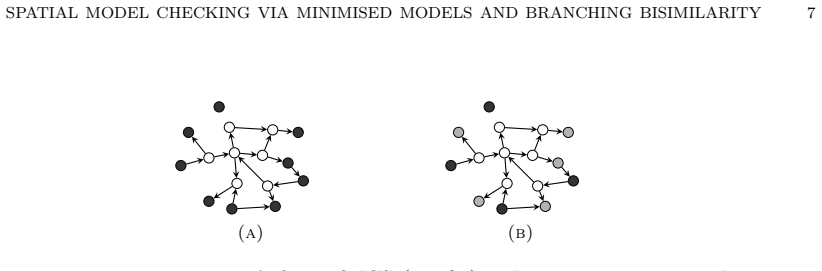
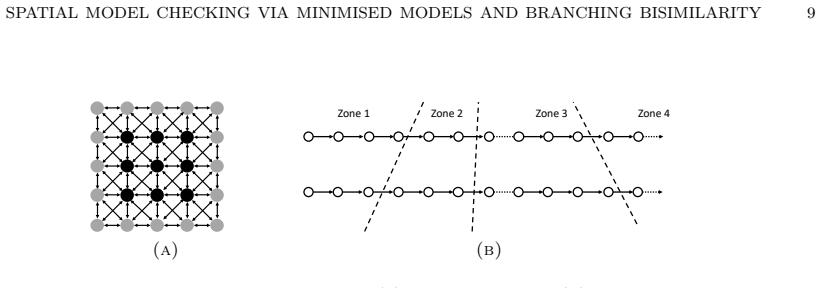
read the original abstract
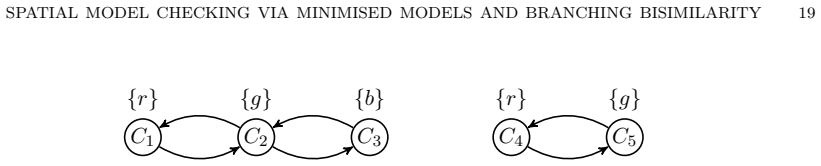
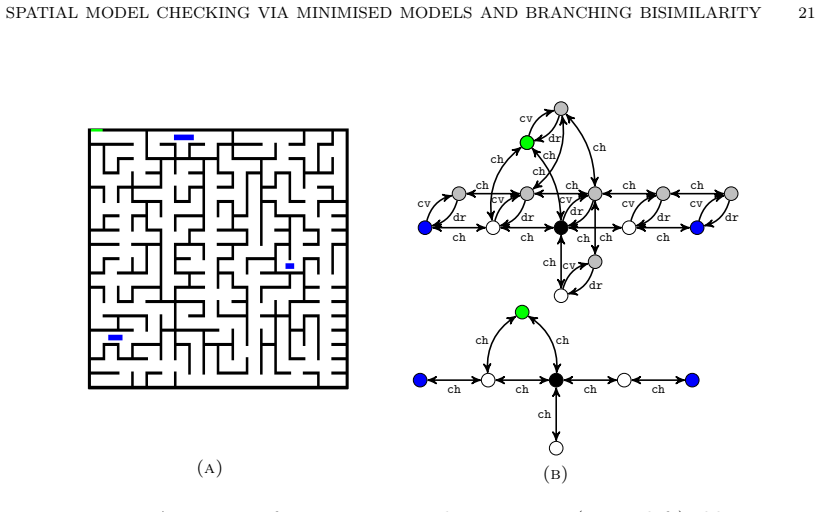
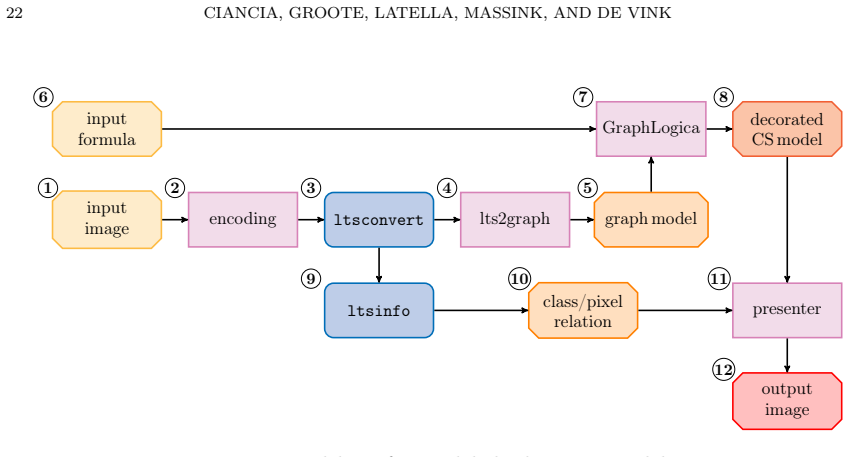
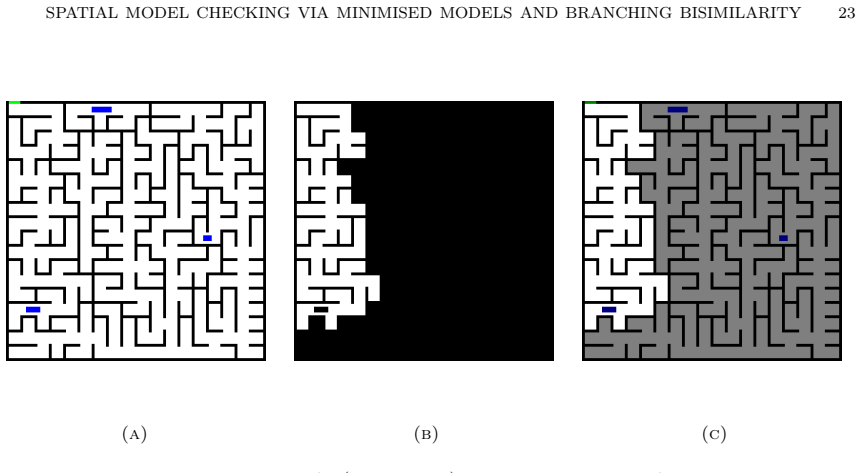
Spatial models are of increasing interest in traditional computer science domains and beyond. Spatial minimisation procedures are crucial for efficient model checking of such models that are often large in size. For the recent notion of spatial bisimilarity for quasi-discrete closure models, called `Compatible Paths' (CoPa) bisimilarity, an effective minimisation method is proposed, and shown to be correct. Reasoning about space represented by quasi-discrete closure models involves two different conditional reachability modalities: a forward reachability, similar to that used in temporal logic, and a backward modality, representing the fact that a point can be reached from another point, under certain conditions. The core of our minimisation method is the encoding of closure models as labelled transition systems, enabling minimisation algorithms for branching bisimilarity to compute CoPa equivalence classes. A prototype toolchain, VoxMinX, is proposed to validate the minimisation method. VoxMinX preserves the relationship between equivalence classes and sets of pixels in the original image. Experimental validation of the toolchain via benchmark examples demonstrates a promising speed-up in model checking of spatial properties for models of realistic size.
Editorial analysis
A structured set of objections, weighed in public.
Referee Report
Summary. The paper proposes a minimisation procedure for Compatible Paths (CoPa) bisimilarity on quasi-discrete closure models by encoding them as labelled transition systems (LTS), so that standard branching bisimilarity algorithms compute the CoPa partitions. It presents the VoxMinX toolchain that preserves the correspondence between equivalence classes and pixel sets in images, and reports experimental speed-ups on benchmark spatial model-checking tasks.
Significance. If the encoding is shown to preserve CoPa equivalence classes bidirectionally, the method would allow reuse of mature branching-bisimilarity tools for spatial verification, yielding practical speed-ups on realistically sized image models while maintaining the link to the original pixel sets. The experimental component and the toolchain constitute concrete strengths.
major comments (1)
- [Encoding and correctness argument (core of the minimisation method)] The bidirectional preservation claim (points p,q are CoPa-bisimilar iff their LTS images are branching-bisimilar) is load-bearing for the entire minimisation method. The abstract states that the encoding is shown correct, yet the manuscript must supply an explicit argument that both the forward and backward conditional reachability modalities, together with the compatibility condition on paths, are faithfully represented by the LTS transition relation and labels; any gap here would mean the computed partitions are not exactly the CoPa classes.
minor comments (2)
- [Toolchain description] The relationship between the original pixel sets and the equivalence classes after minimisation should be stated more explicitly in the description of VoxMinX.
- [Experimental validation] Benchmark tables would benefit from reporting both the size of the original model and the size of the minimised model alongside the observed speed-up factors.
Simulated Author's Rebuttal
We thank the referee for the thorough review and for identifying the need for greater explicitness in the correctness argument. We address the major comment below.
read point-by-point responses
-
Referee: The bidirectional preservation claim (points p,q are CoPa-bisimilar iff their LTS images are branching-bisimilar) is load-bearing for the entire minimisation method. The abstract states that the encoding is shown correct, yet the manuscript must supply an explicit argument that both the forward and backward conditional reachability modalities, together with the compatibility condition on paths, are faithfully represented by the LTS transition relation and labels; any gap here would mean the computed partitions are not exactly the CoPa classes.
Authors: We agree that an explicit, self-contained argument for bidirectional preservation is essential. The current manuscript states correctness but does not spell out the details for the backward modality and the path-compatibility condition in a single place. In the revision we will add a dedicated subsection (new Section 4.3) that (i) recalls the definitions of the two conditional reachability modalities and the compatibility predicate, (ii) shows how each is encoded by the LTS transition relation and labels, and (iii) proves both directions of the equivalence (CoPa bisimilarity iff branching bisimilarity on the image LTS). This will make the load-bearing claim fully rigorous. revision: yes
Circularity Check
No circularity: correctness via explicit bidirectional preservation proof for the LTS encoding
full rationale
The core claim is that an encoding of quasi-discrete closure models into LTSs preserves CoPa equivalence classes in both directions, allowing standard branching-bisimilarity minimisation algorithms to compute the correct partitions. This is a standard reduction whose soundness rests on a preservation argument relating the closure operator and compatible-paths condition to the transition relation and labels; the argument is not shown to reduce to a self-citation, a fitted parameter, or a definitional identity. No self-definitional, fitted-input, or uniqueness-imported-from-authors patterns appear. The method is therefore self-contained against external branching-bisimilarity algorithms.
Axiom & Free-Parameter Ledger
axioms (2)
- domain assumption Quasi-discrete closure models and CoPa bisimilarity are well-defined and the relevant notions from prior work
- standard math Branching bisimilarity minimisation algorithms for LTS are correct and available
Reference graph
Works this paper leans on
-
[1]
Jansen , editor =
Jan Friso Groote and David N. Jansen , editor =. A State-Based O(m log n) Partitioning Algorithm for Branching Bisimilarity , booktitle =. 2025 , url =
2025
-
[2]
Tools and Algorithms for the Construction and Analysis of Systems - 32nd International Conference,
Martens, Jan and Laveaux, Maurice , title =. Tools and Algorithms for the Construction and Analysis of Systems - 32nd International Conference,. 2026 , url =. doi:10.1007/978-3-032-22752-2 , isbn =
-
[3]
Practical Polyhedral Model Checking
Andriaccio, Yuri and Ciancia, Vincenzo and Latella, Diego and Massink, Mieke. Practical Polyhedral Model Checking. Journeys Between Formal Methods and the Railway Industry: Essays Dedicated to Alessandro Fantechi on the Occasion of His 70th Birthday. 2026. doi:10.1007/978-3-032-12484-5_8
-
[4]
Model Checking in Space with Applications to Medical Image Analysis - Invited Abstract , booktitle =
Gina Belmonte and Vincenzo Ciancia and Diego Latella and Mieke Massink , editor =. Model Checking in Space with Applications to Medical Image Analysis - Invited Abstract , booktitle =. 2026 , url =
2026
-
[5]
Ten Years of Spatial Model Checking , booktitle =
Vincenzo Ciancia and Diego Latella and Mieke Massink , editor =. Ten Years of Spatial Model Checking , booktitle =. 2025 , url =
2025
- [6]
-
[7]
de Vink , title =
Nick Bezhanishvili and Laura Bussi and Vincenzo Ciancia and David Gabelaia and Mamuka Jibladze and Diego Latella and Mieke Massink and Erik P. de Vink , title =. Log. Methods Comput. Sci. , volume =. 2026 , url =
2026
-
[8]
and Weijland, W.P
Baeten, J.C.M. and Weijland, W.P. , title=. 1990 , collection=
1990
-
[9]
2014 , url =
Jan Friso Groote and Mohammad Reza Mousavi , title =. 2014 , url =
2014
-
[10]
and Liu, Xiaoxiao and Ibanez, Luis and Jomier, Julien and Marion, Charles , TITLE=
McCormick, Matthew M. and Liu, Xiaoxiao and Ibanez, Luis and Jomier, Julien and Marion, Charles , TITLE=. Frontiers in Neuroinformatics , VOLUME=. 2014 , URL=
2014
-
[11]
Bradley C. Lowekamp and David T. Chen and Luis Ib. The Design of SimpleITK , journal =. 2013 , url =. doi:10.3389/FNINF.2013.00045 , timestamp =
-
[12]
Michele Loreti and Michela Quadrini , title =. Log. Methods Comput. Sci. , volume =. 2023 , url =. doi:10.46298/LMCS-19(3:8)2023 , timestamp =
-
[13]
Vincenzo Ciancia and David Gabelaia and Diego Latella and Mieke Massink and Vink, Erik P. de , editor =. On Bisimilarity for Polyhedral Models and. Formal Techniques for Distributed Objects, Components, and Systems - 43rd. 2023 , url =. doi:10.1007/978-3-031-35355-0\_9 , timestamp =
-
[14]
Nick Bezhanishvili and Vincenzo Ciancia and David Gabelaia and Mamuka Jibladze and Diego Latella and Mieke Massink and Vink, Erik P. de , editor =. Weak Simplicial Bisimilarity for Polyhedral Models and. Formal Techniques for Distributed Objects, Components, and Systems - 44th. 2024 , url =. doi:10.1007/978-3-031-62645-6\_2 , timestamp =
-
[15]
On Bisimilarity for Quasi-discrete Closure Spaces , author =. 2025 , month =. doi:10.46298/lmcs-21(3:21)2025 , journal =
-
[16]
Jaeger and Simon A
Fabian Isensee and Paul F. Jaeger and Simon A. A. Kohl and Jens Petersen and Klaus H. Maier-Hein , title =. Nature Methods , publisher =. 2021 , url =
2021
-
[17]
Fabian Isensee and Tassilo Wald and Constantin Ulrich and Michael Baumgartner and Saikat Roy and Klaus H. Maier. Medical Image Computing and Computer Assisted Intervention -. 2024 , url =
2024
-
[18]
Gina Belmonte and Vincenzo Ciancia and Mieke Massink , title =. Artif. Intell. Medicine , publisher =. 2025 , url =
2025
-
[19]
de , editor =
Vincenzo Ciancia and Jan Friso Groote and Diego Latella and Mieke Massink and Vink, Erik P. de , editor =. Minimisation of Spatial Models Using Branching Bisimilarity , booktitle =. 2023 , url =
2023
-
[20]
Ciancia, Vincenzo and Groote, Jan Friso and Latella, Diego and Massink, Mieke and de Vink, Erik P. , title =. doi:10.5281/zenodo.7393236 , url =
-
[21]
2022 , doi =
Vincenzo Ciancia and Jan Friso Groote and Diego Latella and Mieke Massink and Erik P. 2022 , doi =
2022
-
[22]
2009 , isbn =
Robin Milner , title =. 2009 , isbn =
2009
-
[23]
Ariadne: Topology Aware Adaptive Security for Cyber-Physical Systems , booktitle =
Christos Tsigkanos and Liliana Pasquale and Carlo Ghezzi and Bashar Nuseibeh , editor =. Ariadne: Topology Aware Adaptive Security for Cyber-Physical Systems , booktitle =. 2015 , url =
2015
-
[24]
Gordon , editor =
Luca Cardelli and Andrew D. Gordon , editor =. Anytime, Anywhere: Modal Logics for Mobile Ambients , booktitle =. 2000 , url =
2000
-
[25]
A spatial logic for concurrency (part
Lu. A spatial logic for concurrency (part. Inf. Comput. , volume =. 2003 , url =
2003
-
[26]
Cohn and Jochen Renz , editor =
Anthony G. Cohn and Jochen Renz , editor =. Qualitative Spatial Representation and Reasoning , booktitle =. 2008 , url =
2008
-
[27]
, School =
Aiello, M. , School =. Spatial Reasoning: Theory and Practice , Year =
-
[28]
, journal =
Aiello, M. , journal =. The topo-approach to spatial representation and reasoning , volume =
-
[29]
Spatial Model Checking with mCRL2
Floris Zeven. Spatial Model Checking with mCRL2. 2022
2022
-
[30]
van and W
Glabbeek, Rob J. van and W. P. Weijland , title =. J. 1996 , url =
1996
-
[31]
Jansen and Jan Friso Groote and Jeroen J.A
David N. Jansen and Jan Friso Groote and Jeroen J.A. Keiren and Anton Wijs , editor =. An. Tools and Algorithms for the Construction and Analysis of Systems - 26th International Conference,. 2020 , url =
2020
-
[32]
Olav Bunte and Jan Friso Groote and Jeroen J. A. Keiren and Maurice Laveaux and Thomas Neele and Erik P. de Vink and Wieger Wesselink and Anton Wijs and Tim A. C. Willemse , editor =. The. Tools and Algorithms for the Construction and Analysis of Systems - 25th International Conference,. 2019 , url =
2019
-
[33]
Smyth and Julian Webster , editor =
Michael B. Smyth and Julian Webster , editor =. Discrete Spatial Models , booktitle =. 2007 , url =
2007
-
[34]
2007 , url =
Handbook of Modal Logic , series =. 2007 , url =
2007
-
[35]
and Griffin, M
Aubert-Broche, B. and Griffin, M. and Pike, G.B. and Evans, A.C. and Collins, D.L. , journal=. Twenty New Digital Brain Phantoms for Creation of Validation Image Data Bases , year=
-
[36]
Marchetti and Noel C.F
Michael A. Marchetti and Noel C.F. Codella and Stephen W. Dusza and David A. Gutman and Brian Helba and Aadi Kalloo and Nabin Mishra and Cristina Carrera and M. Emre Celebi and Jennifer L. DeFazio and Natalia Jaimes and Ashfaq A. Marghoob and Elizabeth Quigley and Alon Scope and Oriol Y\'. Results of the 2016 International Skin Imaging Collaboration Inter...
2016
-
[37]
SpaTeL: a novel spatial-temporal logic and its applications to networked systems , booktitle =
Iman Haghighi and Austin Jones and Zhaodan Kong and Ezio Bartocci and Radu Grosu and Calin Belta , editor =. SpaTeL: a novel spatial-temporal logic and its applications to networked systems , booktitle =. 2015 , url =
2015
-
[38]
Feasibility of Spatial Model Checking for Nevus Segmentation , booktitle =
Gina Belmonte and Giovanna Broccia and Vincenzo Ciancia and Diego Latella and Mieke Massink , editor =. Feasibility of Spatial Model Checking for Nevus Segmentation , booktitle =. 2021 , url =
2021
-
[39]
Smolka and Flavio Corradini and Anita Wasilewska and Emilia Entcheva and Ezio Bartocci , title =
Radu Grosu and Scott A. Smolka and Flavio Corradini and Anita Wasilewska and Emilia Entcheva and Ezio Bartocci , title =. Commun. 2009 , url =
2009
-
[40]
Michele Loreti and Michela Quadrini , title =. CoRR , volume =. 2021 , url =. 2105.08708 , timestamp =
-
[41]
2022 , month = Nov, keywords =
Nick Bezhanishvili and Vincenzo Ciancia and David Gabelaia and Gianluca Grilletti and Diego Latella and Mieke Massink , url =. 2022 , month = Nov, keywords =. doi:10.46298/lmcs-18(4:7)2022 , journal =
-
[42]
Colin Stirling , title =
-
[43]
Natasha Kurtonina and Maarten de Rijke , title =. J. Log. Lang. Inf. , volume =. 1997 , url =
1997
-
[44]
Logical Methods in Computer Science , volume =
Laura Nenzi and Luca Bortolussi and Vincenzo Ciancia and Michele Loreti and Mieke Massink , title =. Logical Methods in Computer Science , volume =. 2018 , url =
2018
-
[45]
A Tool-Chain for Statistical Spatio-Temporal Model Checking of Bike Sharing Systems , booktitle =
Vincenzo Ciancia and Diego Latella and Mieke Massink and Rytis Paskauskas and Andrea Vandin , editor =. A Tool-Chain for Statistical Spatio-Temporal Model Checking of Bike Sharing Systems , booktitle =. 2016 , url =
2016
-
[46]
Analysing Spatial Properties on Neighbourhood Spaces , booktitle =
Sven Linker and Fabio Papacchini and Michele Sevegnani , editor =. Analysing Spatial Properties on Neighbourhood Spaces , booktitle =. 2020 , url =
2020
-
[47]
An Experimental Spatio-Temporal Model Checker , booktitle =
Vincenzo Ciancia and Gianluca Grilletti and Diego Latella and Michele Loreti and Mieke Massink , editor =. An Experimental Spatio-Temporal Model Checker , booktitle =. 2015 , url =
2015
-
[48]
Vaandrager , editor =
Jan Friso Groote and Frits W. Vaandrager , editor =. An Efficient Algorithm for Branching Bisimulation and Stuttering Equivalence , booktitle =. 1990 , url =
1990
-
[49]
Embedding
Vincenzo Ciancia and Diego Latella and Mieke Massink , editor =. Embedding. Models, Languages, and Tools for Concurrent and Distributed Programming - Essays Dedicated to Rocco De Nicola on the Occasion of His 65th Birthday , series =. 2019 , url =
2019
-
[50]
Randell and Gabriel Landini and Antony Galton , title =
David A. Randell and Gabriel Landini and Antony Galton , title =. 2013 , url =
2013
-
[51]
Vincenzo Ciancia and Stephen Gilmore and Gianluca Grilletti and Diego Latella and Michele Loreti and Mieke Massink , title =. Int. J. Softw. Tools Technol. Transf. , volume =. 2018 , url =
2018
-
[52]
Specifying and Verifying Properties of Space , booktitle =
Vincenzo Ciancia and Diego Latella and Michele Loreti and Mieke Massink , editor =. Specifying and Verifying Properties of Space , booktitle =. 2014 , url =
2014
-
[53]
Vincenzo Ciancia and Diego Latella and Mieke Massink and Vink, Erik P. de , editor =. A Journey From Process Algebra via Timed Automata to Model Learning - Essays Dedicated to Frits Vaandrager on the Occasion of His 60th Birthday , series =. doi:10.1007/978-3-031-15629-8\_6 , year =
-
[54]
Vincenzo Ciancia and Diego Latella and Mieke Massink and Vink, Erik de , year=
-
[55]
Vincenzo Ciancia and Diego Latella and Mieke Massink and Vink, Erik P. de , title =. CoRR , volume =. 2021 , url =. 2105.06690 , timestamp =
-
[56]
Jansen and Jeroen J
Jan Friso Groote and David N. Jansen and Jeroen J. A. Keiren and Anton Wijs , title =. 2017 , url =
2017
-
[57]
VoxLogicA:
Gina Belmonte and Vincenzo Ciancia and Diego Latella and Mieke Massink , editor =. VoxLogicA:. Tools and Algorithms for the Construction and Analysis of Systems - 25th International Conference,. 2019 , url =
2019
-
[58]
Innovating Medical Image Analysis via Spatial Logics , booktitle =
Gina Belmonte and Vincenzo Ciancia and Diego Latella and Mieke Massink , editor =. Innovating Medical Image Analysis via Spatial Logics , booktitle =. 2019 , url =
2019
-
[59]
Spatial logics and model checking for medical imaging , journal =
Fabrizio. Spatial logics and model checking for medical imaging , journal =. 2020 , url =
2020
-
[60]
Browne and Edmund M
Michael C. Browne and Edmund M. Clarke and Orna Grumberg , title =. Theor. Comput. Sci. , volume =. 1988 , url =
1988
-
[61]
2020 , eprint=
Towards Spatial Bisimilarity for Closure Models: Logical and Coalgebraic Characterisations , author=. 2020 , eprint=
2020
-
[62]
Logical Methods in Computer Science , volume =
Vincenzo Ciancia and Diego Latella and Michele Loreti and Mieke Massink , title =. Logical Methods in Computer Science , volume =. 2016 , url =
2016
-
[63]
A generalized topological view of motion in discrete space
Galton, A. A generalized topological view of motion in discrete space. 2003
2003
-
[64]
Modal Logics of Space , booktitle =
Benthem, Johan van and Guram Bezhanishvili , editor =. Modal Logics of Space , booktitle =. 2007 , url =
2007
-
[65]
Benthem, Johan van and Nick Bezhanishvili and Sebastian Enqvist and Junhua Yu , title =. Rev. Symb. Log. , volume =. 2017 , url =
2017
-
[66]
2020 , NOTE =
Morris,. 2020 , NOTE =
2020
-
[67]
2003 , NOTE =
Hansen,. 2003 , NOTE =
2003
-
[68]
2009 , MONTH = Apr, KEYWORDS =
Hansen,. 2009 , MONTH = Apr, KEYWORDS =
2009
-
[69]
Universal coalgebra: a theory of systems
Rutten, J. Universal coalgebra: a theory of systems. 2000
2000
-
[70]
and Massink, M
Latella, D. and Massink, M. and Vink, E.P. de. Bisimulation of Labeled State-to-Function Transition Systems Coalgebraically. 2015
2015
-
[71]
Ad\'amek and H.-E
J. Ad\'amek and H.-E. Porst , title =. Theoretical Computer Science , year = 2004, volume = 311, pages =
2004
-
[72]
Ad\'amek and S
J. Ad\'amek and S. Milius and L.S. Moss , title =
-
[73]
Back and Forth Bisimulations , booktitle =
Rocco. Back and Forth Bisimulations , booktitle =. 1990 , url =
1990
-
[74]
van , editor =
Glabbeek, Rob J. van , editor =. The Linear Time-Branching Time Spectrum (Extended Abstract) , booktitle =. 1990 , url =
1990
-
[75]
1989 , isbn =
Robin Milner , title =. 1989 , isbn =
1989
-
[76]
Rieser , title =
A. Rieser , title =. Topology and its Applications , year = 2021, volume = 296, pages = 107613, url =
2021
-
[77]
Ciancia, Vincenzo and Mieke Massink , title =
-
[78]
Bradfield and Colin Stirling , editor =
Julian C. Bradfield and Colin Stirling , editor =. Modal mu-calculi , booktitle =. 2007 , url =
2007
-
[79]
Theories and Experiences for Real-Time System Development
Theories and Experiences for Real-Time System Development. Theories and Experiences for Real-Time System Development
-
[80]
Handbook of Process Algebra
Handbook of Process Algebra. Handbook of Process Algebra
discussion (0)
Sign in with ORCID, Apple, or X to comment. Anyone can read and Pith papers without signing in.