Multi-wavelength Emission Modeling from Accretion Flows around Isolated Black Holes Including Magnetic Flux Transport
Pith reviewed 2026-07-01 04:33 UTC · model grok-4.3
The pith
Magnetic flux transport controls whether isolated black holes form magnetically arrested disks emitting detectable infrared and X-rays
A machine-rendered reading of the paper's core claim, the machinery that carries it, and where it could break.
Core claim
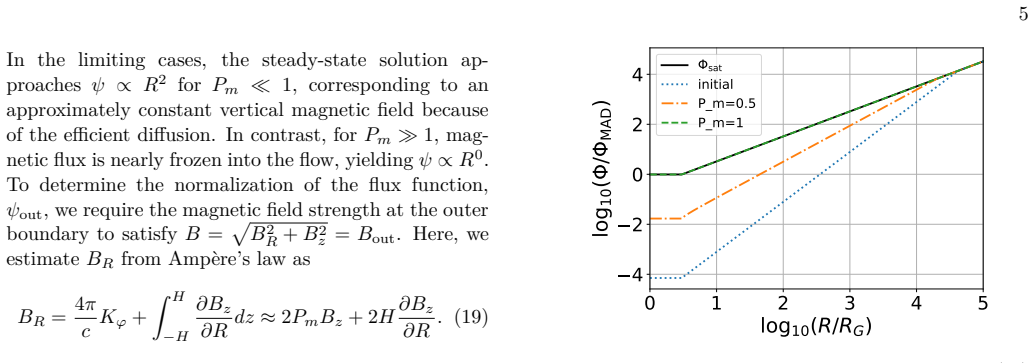
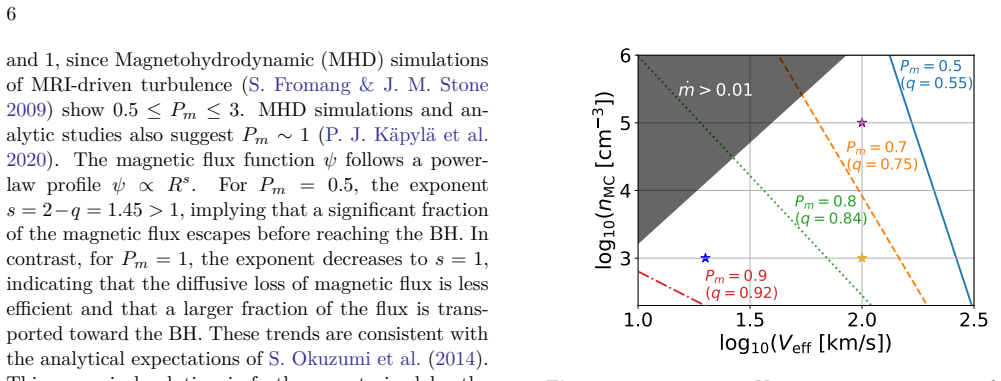
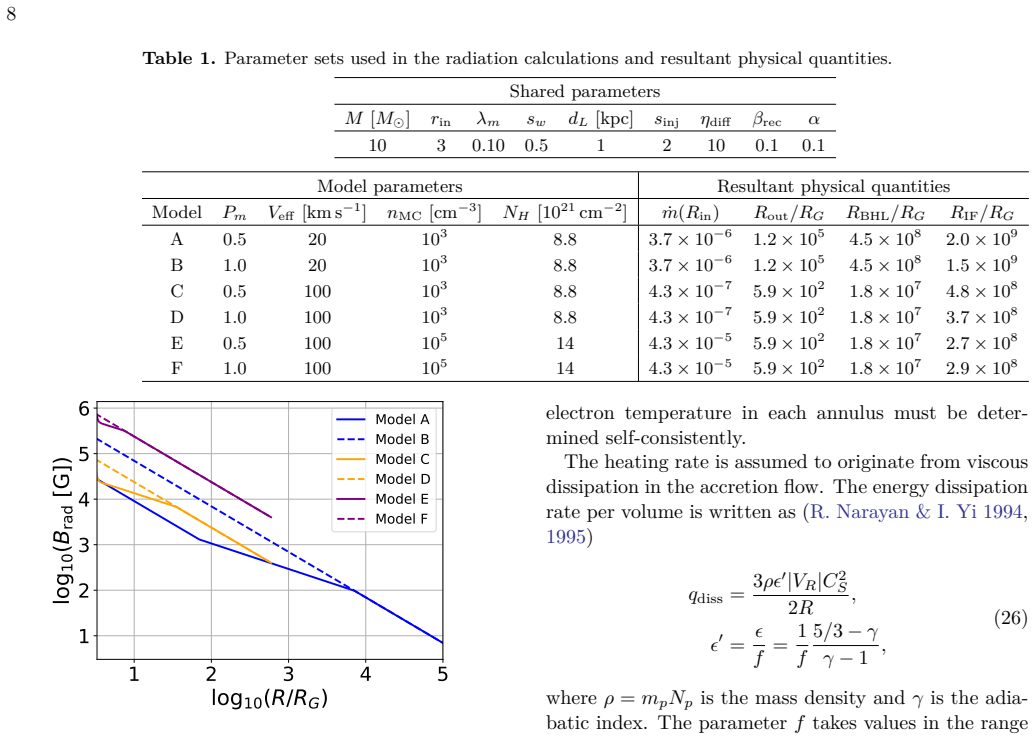
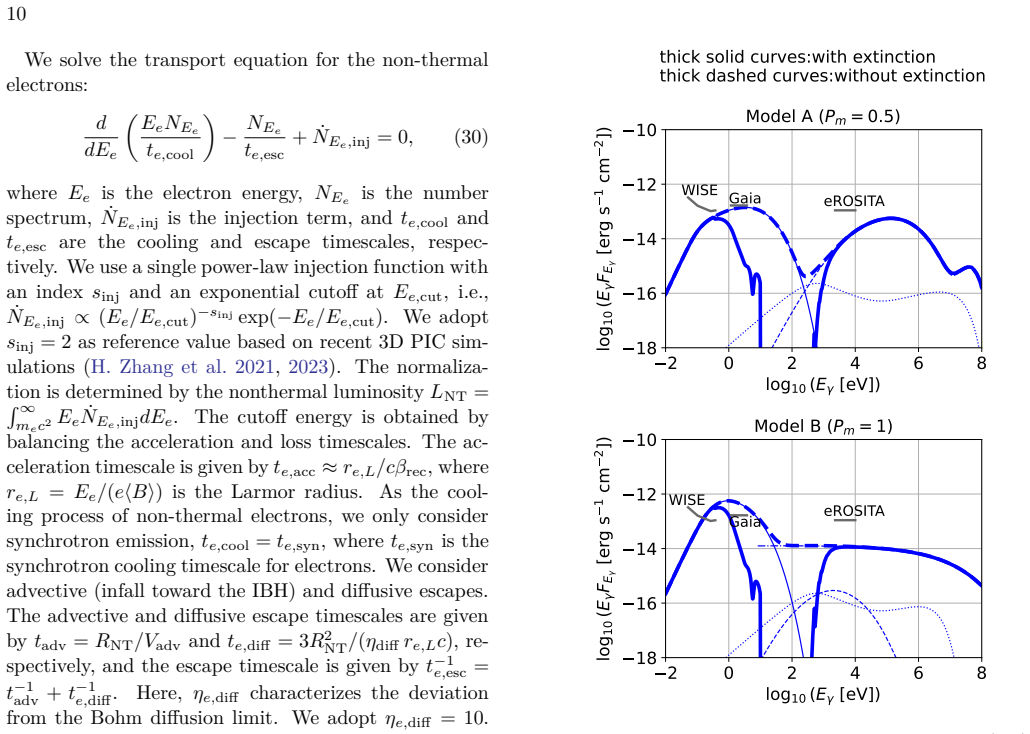
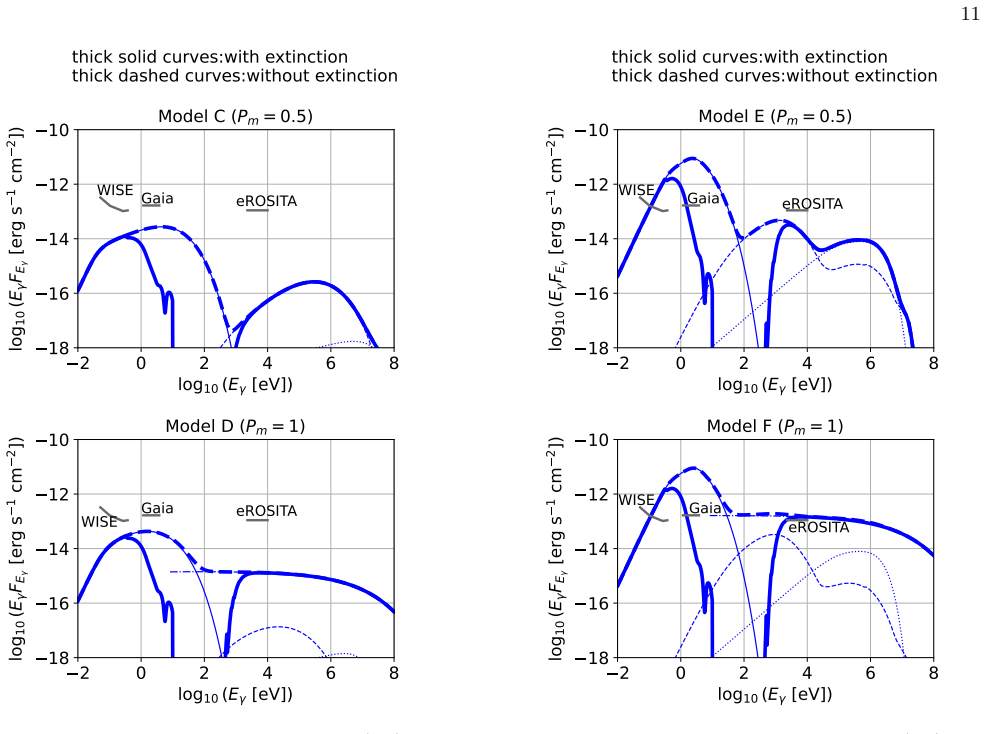
Isolated stellar-mass black holes accrete from molecular clouds and form disks in which magnetic flux transport, parameterized by the magnetic Prandtl number Pm, decides whether magnetically arrested disks form for Pm greater than or equal to 1 with magnetic flux at saturation. Outer disk parts around 100 gravitational radii then emit infrared photons detectable by WISE. X-ray emission is nonthermal for Pm=1 and inverse-Compton dominated for Pm=0.5, making X-ray detection plausible in dense filaments for Pm at least 1. Magnetic flux transport therefore shapes the multiwavelength observational signatures of these black holes.
What carries the argument
The 1D radial accretion disk model that incorporates magnetic flux transport controlled by the magnetic Prandtl number Pm, which sets whether the disk reaches magnetic flux saturation and determines the resulting infrared and X-ray emission properties.
If this is right
- Magnetically arrested disks form for Pm ≳ 1 where magnetic flux reaches saturation.
- Outer disk regions at around 100 gravitational radii emit infrared photons detectable by WISE, a feature absent from one-zone models.
- X-ray emission is nonthermal for Pm=1 but inverse-Compton dominated for Pm=0.5.
- X-ray detection is plausible in dense molecular-cloud filaments for Pm ≥ 1 but challenging for Pm < 1.
Where Pith is reading between the lines
- Targeted multi-wavelength searches in molecular clouds could use the infrared component to test the predicted dependence on magnetic Prandtl number.
- If the radial predictions hold, similar modeling may help interpret low-luminosity accretion in other systems where flux transport affects visibility.
- Time-dependent extensions of the model could reveal whether flux transport also controls variability patterns in the emitted light.
Load-bearing premise
The one-dimensional radial disk structure and the specific prescription for magnetic flux transport controlled by the magnetic Prandtl number accurately capture the multi-wavelength emission without major changes from three-dimensional effects or alternative transport rules.
What would settle it
A sensitive infrared survey of molecular clouds that finds no sources at the flux levels predicted from outer accretion disks around isolated black holes, or X-ray observations that fail to show the expected shift from nonthermal to inverse-Compton spectra as environment density changes.
Figures
read the original abstract
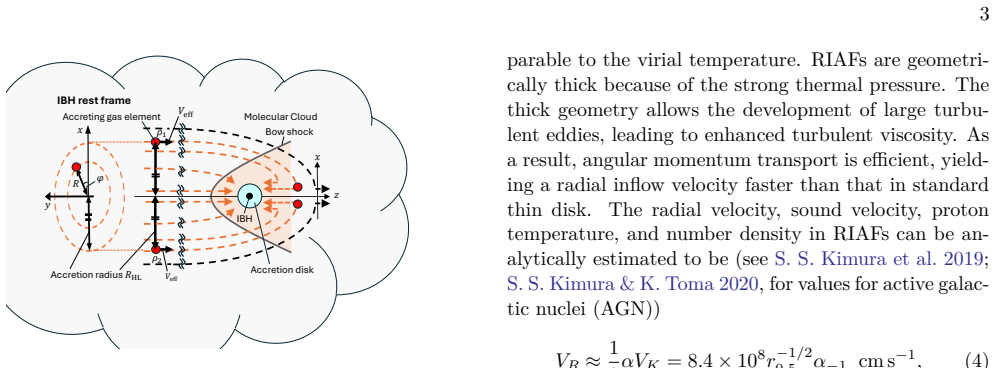
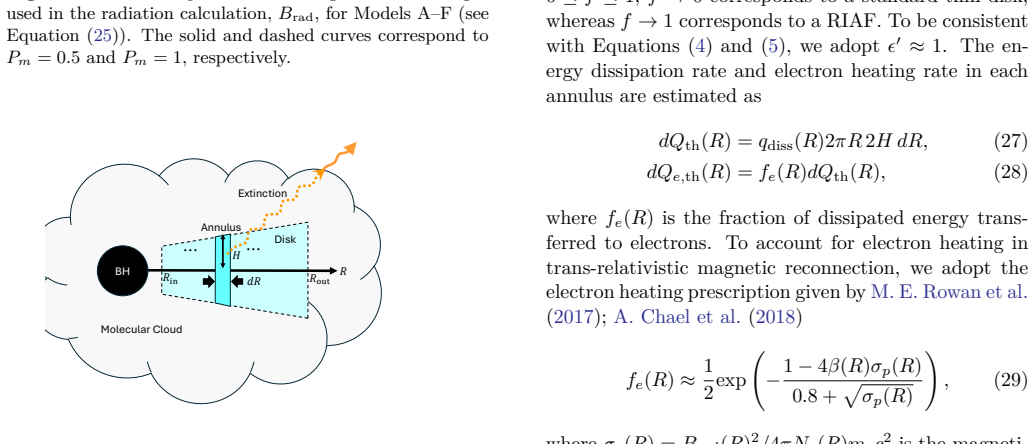
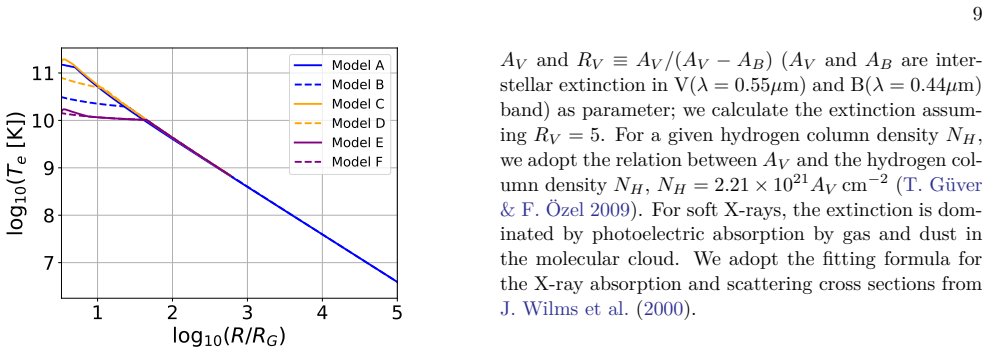
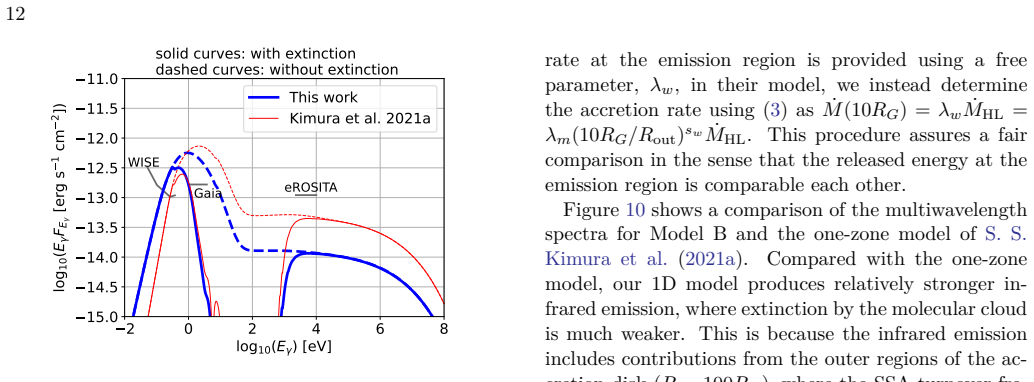
Isolated stellar-mass black holes (IBHs) are expected to be abundant in the Milky Way, yet their electromagnetic signatures remain largely undetected. We investigate the detectability of IBHs in molecular clouds using a 1D, multi-wavelength emission model that incorporates magnetic flux transport controlled by the magnetic Prandtl number $P_m$. We find that magnetically arrested disks (MADs) form for $P_m\gtrsim 1$, where the magnetic flux threading the black hole is in a saturation value. On the other hand, MAD formation is restricted to a limited parameter range for $P_m<1$, In our model, outer parts of accretion disks, around 100 gravitational radii, efficiently emit infrared photons detectable by WISE. This feature is not captured by the conventional one-zone model. X-ray emission depends strongly on $P_m$; For $P_m=1$ where MAD is formed, X-ray emission is dominated by nonthermal radiation, whereas inverse Compton emission becomes dominant for $P_m=0.5$ where the magnetic field is weaker than the saturation value. X-ray detection is plausible if they are in dense molecular-cloud filaments for $P_m\ge1$, although it is challenging for $P_m< 1$. These results demonstrate that magnetic flux transport plays a key role in shaping the multiwavelength observational signatures of IBHs.
Editorial analysis
A structured set of objections, weighed in public.
Referee Report
Summary. The paper develops a 1D radial multi-wavelength emission model for accretion onto isolated stellar-mass black holes that incorporates magnetic flux transport controlled by the magnetic Prandtl number Pm. It reports that magnetically arrested disks form for Pm ≳ 1, that outer disk regions near 100 gravitational radii produce infrared emission detectable by WISE (unlike conventional one-zone models), that X-ray emission is nonthermal for Pm=1 but inverse-Compton dominated for Pm=0.5, and that X-ray detection is plausible in dense molecular-cloud filaments for Pm ≥ 1.
Significance. If the 1D model and Pm prescription hold, the work supplies concrete, Pm-dependent predictions for the infrared and X-ray signatures of isolated black holes that differ from one-zone expectations and could guide targeted searches in molecular clouds. The parametric exploration of magnetic flux transport is a clear strength.
major comments (2)
- [abstract / model section] The central claims on infrared emission at ~100 r_g and the Pm-dependent X-ray mechanisms rest on the 1D radial structure plus the specific Pm-controlled flux-transport prescription; no explicit tests are shown demonstrating that these predictions remain unchanged under 3D turbulence, non-axisymmetric effects, or alternative advection/diffusion schemes (abstract and model description).
- [methods / results] The manuscript states clear parametric results but provides neither the full derivation steps for the temperature profile and emission components, numerical resolution tests, nor direct comparison to prior codes, making it impossible to verify that the reported fluxes follow from the stated equations rather than unstated choices (abstract).
minor comments (1)
- [abstract] Minor grammatical issue in abstract: "for Pm<1, In our model" should be rephrased for clarity.
Simulated Author's Rebuttal
We thank the referee for the constructive report and for recognizing the value of the parametric Pm exploration. We address each major comment below. The work is a 1D model by design to enable broad parameter studies; this imposes inherent limitations relative to 3D simulations that we will clarify in revision.
read point-by-point responses
-
Referee: [abstract / model section] The central claims on infrared emission at ~100 r_g and the Pm-dependent X-ray mechanisms rest on the 1D radial structure plus the specific Pm-controlled flux-transport prescription; no explicit tests are shown demonstrating that these predictions remain unchanged under 3D turbulence, non-axisymmetric effects, or alternative advection/diffusion schemes (abstract and model description).
Authors: We acknowledge that the reported IR and X-ray predictions are obtained within the 1D radial framework and the chosen Pm-dependent flux-transport scheme. Explicit verification against 3D turbulence, non-axisymmetric flows, or alternative advection/diffusion prescriptions would require dedicated 3D MHD simulations, which lie outside the scope of the present study. We will add a new subsection in the model description that explicitly states the 1D assumptions, discusses possible impacts of 3D effects, and notes that the qualitative Pm trends are expected to be robust within the adopted framework. No quantitative 3D tests can be provided without new simulations. revision: partial
-
Referee: [methods / results] The manuscript states clear parametric results but provides neither the full derivation steps for the temperature profile and emission components, numerical resolution tests, nor direct comparison to prior codes, making it impossible to verify that the reported fluxes follow from the stated equations rather than unstated choices (abstract).
Authors: We will revise the methods section to include the complete step-by-step derivation of the temperature profile and the expressions for each emission component (synchrotron, inverse-Compton, bremsstrahlung). A short paragraph describing the numerical resolution tests performed and the adopted radial grid will be added. Direct comparisons of the one-zone limit and selected multi-zone fluxes against previously published one-zone calculations will also be included to confirm consistency with the underlying equations. revision: yes
Circularity Check
No circularity: model outputs are direct consequences of varying the input parameter Pm in a 1D radial structure
full rationale
The paper constructs a 1D multi-wavelength emission model in which magnetic flux transport is parameterized by the magnetic Prandtl number Pm. All reported results—formation of MADs for Pm ≳ 1, infrared emission from ~100 r_g, and Pm-dependent X-ray mechanisms—are obtained by running the model across different fixed values of Pm. No equation or result is obtained by fitting model outputs back to the same data used to set Pm, no quantity is defined in terms of itself, and no load-bearing step reduces to a self-citation whose content is unverified. The derivation chain therefore remains self-contained and non-circular.
Axiom & Free-Parameter Ledger
free parameters (1)
- magnetic Prandtl number Pm
axioms (2)
- domain assumption 1D radial structure suffices to capture multi-wavelength emission
- domain assumption Standard thin-disk radiative processes apply at the quoted radii
Reference graph
Works this paper leans on
-
[1]
Abbott, R., Abbott, T. D., Acernese, F., et al. 2023, Physical Review X, 13, 041039, doi: 10.1103/PhysRevX.13.041039
-
[2]
2002, MNRAS, 329, 355, doi: 10.1046/j.1365-8711.2002.04988.x
Agol, E., & Kamionkowski, M. 2002, MNRAS, 334, 553, doi: 10.1046/j.1365-8711.2002.05523.x André, P., Di Francesco, J., Ward-Thompson, D., et al. 2014, in Protostars and Planets VI, ed. H. Beuther, R. S
-
[3]
Klessen, C. P. Dullemond, & T. Henning, 27–51, doi: 10.2458/azu_uapress_9780816531240-ch002
-
[4]
Aramaki, T., Adrian, P. O. H., Karagiorgi, G., & Odaka, H. 2020, Astroparticle Physics, 114, 107, doi: 10.1016/j.astropartphys.2019.07.002
-
[5]
Armitage, P. J., & Natarajan, P. 1999, ApJL, 523, L7, doi: 10.1086/312261
-
[6]
Armstrong, J. W., Rickett, B. J., & Spangler, S. R. 1995, ApJ, 443, 209, doi: 10.1086/175515
-
[7]
2016, ApJ, 826, 77, doi: 10.3847/0004-637X/826/1/77
Ball, D., Özel, F., Psaltis, D., & Chan, C.-k. 2016, ApJ, 826, 77, doi: 10.3847/0004-637X/826/1/77
-
[8]
Barkov, M. V., Khangulyan, D. V., & Popov, S. B. 2012, MNRAS, 427, 589, doi: 10.1111/j.1365-2966.2012.22029.x
-
[9]
, year = 1999, month = oct, volume =
Blandford, R. D., & Begelman, M. C. 1999, MNRAS, 303, L1, doi: 10.1046/j.1365-8711.1999.02358.x
-
[10]
2022, A&A, 660, A5, doi: 10.1051/0004-6361/202142821 15
Bosch-Ramon, V. 2022, A&A, 660, A5, doi: 10.1051/0004-6361/202142821 15
-
[11]
Brown, G. E., & Bethe, H. A. 1994, ApJ, 423, 659, doi: 10.1086/173844
-
[12]
2011, ApJ, 737, 94, doi: 10.1088/0004-637X/737/2/94
Cao, X. 2011, ApJ, 737, 94, doi: 10.1088/0004-637X/737/2/94
-
[13]
Caputo, R., Ajello, M., Kierans, C. A., et al. 2022, Journal of Astronomical Telescopes, Instruments, and Systems, 8, 044003, doi: 10.1117/1.JATIS.8.4.044003
-
[14]
Cardelli, J. A., Clayton, G. C., & Mathis, J. S. 1989, ApJ, 345, 245, doi: 10.1086/167900
-
[15]
2018, MNRAS, 478, 5209, doi: 10.1093/mnras/sty1261
Chael, A., Rowan, M., Narayan, R., Johnson, M., & Sironi, L. 2018, MNRAS, 478, 5209, doi: 10.1093/mnras/sty1261
-
[16]
Chisholm, J. R., Dodelson, S., & Kolb, E. W. 2003, ApJ, 596, 437, doi: 10.1086/377628
-
[17]
M., Casares, J., Muñoz-Darias, T., et al
Corral-Santana, J. M., Casares, J., Muñoz-Darias, T., et al. 2016, A&A, 587, A61, doi: 10.1051/0004-6361/201527130
-
[18]
Troland, T. H. 2010, ApJ, 725, 466, doi: 10.1088/0004-637X/725/1/466
-
[19]
Draine, B. T. 2011, Physics of the Interstellar and Intergalactic Medium
2011
-
[20]
2004, NewAR, 48, 843, doi: 10.1016/j.newar.2004.06.001
Edgar, R. 2004, NewAR, 48, 843, doi: 10.1016/j.newar.2004.06.001
work page internal anchor Pith review doi:10.1016/j.newar.2004.06.001 2004
-
[21]
2023a, MNRAS, 518, 1057, doi: 10.1093/mnras/stac3140
El-Badry, K., Rix, H.-W., Quataert, E., et al. 2023a, MNRAS, 518, 1057, doi: 10.1093/mnras/stac3140
-
[22]
2023b, MNRAS, 521, 4323, doi: 10.1093/mnras/stad799
El-Badry, K., Rix, H.-W., Cendes, Y., et al. 2023b, MNRAS, 521, 4323, doi: 10.1093/mnras/stad799
-
[23]
Nahar, S. N. 1992, ApJ, 387, 95, doi: 10.1086/171063
-
[24]
Fromang, S., & Stone, J. M. 2009, A&A, 507, 19, doi: 10.1051/0004-6361/200912752
-
[25]
Nakamura, K. E. 1998, ApJL, 495, L85, doi: 10.1086/311220 Gaia Collaboration, Brown, A. G. A., Vallenari, A., et al. 2021, A&A, 649, A1, doi: 10.1051/0004-6361/202039657 Gaia Collaboration, Panuzzo, P., Mazeh, T., et al. 2024, A&A, 686, L2, doi: 10.1051/0004-6361/202449763
-
[26]
Guan, X., & Gammie, C. F. 2011, ApJ, 728, 130, doi: 10.1088/0004-637X/728/2/130
-
[27]
2020, Physics of Plasmas, 27, 080501, doi: 10.1063/5.0012094 Güver, T., & Özel, F
Guo, F., Liu, Y.-H., Li, X., et al. 2020, Physics of Plasmas, 27, 080501, doi: 10.1063/5.0012094 Güver, T., & Özel, F. 2009, MNRAS, 400, 2050, doi: 10.1111/j.1365-2966.2009.15598.x
-
[28]
F., & Krolik, J
Hawley, J. F., & Krolik, J. H. 2013, in Astronomical Society of the Pacific Conference Series, Vol. 474, Numerical Modeling of Space Plasma Flows (ASTRONUM2012), ed. N. V. Pogorelov, E. Audit, & G. P. Zank, 59
2013
-
[29]
Heyer, M., Krawczyk, C., Duval, J., & Jackson, J. M. 2009, ApJ, 699, 1092, doi: 10.1088/0004-637X/699/2/1092
-
[30]
2023, ApJ, 946, 77, doi: 10.3847/1538-4357/acbfb5
Hoshino, M. 2023, ApJ, 946, 77, doi: 10.3847/1538-4357/acbfb5
-
[31]
2017, MNRAS, 470, 3332, doi: 10.1093/mnras/stx1337
Murase, K. 2017, MNRAS, 470, 3332, doi: 10.1093/mnras/stx1337
-
[32]
Jacquemin-Ide, J., Begelman, M. C., Lowell, B., et al. 2025, arXiv e-prints, arXiv:2510.25842, doi: 10.48550/arXiv.2510.25842
-
[33]
2023, MNRAS, 526, 2924, doi: 10.1093/mnras/stad2935
Jia, H., Ripperda, B., Quataert, E., et al. 2023, MNRAS, 526, 2924, doi: 10.1093/mnras/stad2935
-
[34]
Jolehkaran, S. A., Brendel, L., & Kuiper, R. 2025, A&A, 694, A239, doi: 10.1051/0004-6361/202451658 Käpylä, P. J., Rheinhardt, M., Brandenburg, A., & Käpylä, M. J. 2020, A&A, 636, A93, doi: 10.1051/0004-6361/201935012
-
[35]
Kim, Y., & Most, E. R. 2025, PhRvD, 111, 083025, doi: 10.1103/PhysRevD.111.083025
-
[36]
S., Kashiyama, K., & Hotokezaka, K
Kimura, S. S., Kashiyama, K., & Hotokezaka, K. 2021a, ApJL, 922, L15, doi: 10.3847/2041-8213/ac35dc
-
[37]
S., Sudoh, T., Kashiyama, K., & Kawanaka, N
Kimura, S. S., Sudoh, T., Kashiyama, K., & Kawanaka, N. 2021b, ApJ, 915, 31, doi: 10.3847/1538-4357/abff58
-
[38]
Kimura, S. S., & Toma, K. 2020, ApJ, 905, 178, doi: 10.3847/1538-4357/abc343
-
[39]
2025, ApJL, 981, L36, doi: 10.3847/2041-8213/adb841
Zhang, B. 2025, ApJL, 981, L36, doi: 10.3847/2041-8213/adb841
-
[40]
Kimura, S. S., Tomida, K., & Murase, K. 2019, MNRAS, 485, 163, doi: 10.1093/mnras/stz329
-
[41]
Kin, K., Kuze, R., & Kimura, S. S. 2025, ApJ, 985, 251, doi: 10.3847/1538-4357/adcb3d Könyves, V., André, P., Men’shchikov, A., et al. 2015, A&A, 584, A91, doi: 10.1051/0004-6361/201525861
-
[42]
2024, ApJ, 973, 5, doi: 10.3847/1538-4357/ad5feb
Koshimoto, N., Kawanaka, N., & Tsuna, D. 2024, ApJ, 973, 5, doi: 10.3847/1538-4357/ad5feb
-
[43]
Lalakos, A., Tchekhovskoy, A., Most, E. R., et al. 2025, PhRvD, 112, 123044, doi: 10.1103/zkq5-bj75
-
[44]
Lam, C. Y., & Lu, J. R. 2023, ApJ, 955, 116, doi: 10.3847/1538-4357/aced4a
-
[45]
Lee, A. T., Cunningham, A. J., McKee, C. F., & Klein, R. I. 2014, ApJ, 783, 50, doi: 10.1088/0004-637X/783/1/50
-
[46]
Lubow, S. H., Papaloizou, J. C. B., & Pringle, J. E. 1994, MNRAS, 267, 235, doi: 10.1093/mnras/267.2.235
-
[47]
2024, ApJ, 965, 175
Manikantan, V., Kaaz, N., Jacquemin-Ide, J., et al. 2024, ApJ, 965, 175
2024
-
[48]
1997, ApJ, 489, 791, doi: 10.1086/304817
Manmoto, T., Mineshige, S., & Kusunose, M. 1997, ApJ, 489, 791, doi: 10.1086/304817
-
[49]
Martin, R. G., Nixon, C. J., Pringle, J. E., & Livio, M. 2019, New Astronomy, 70, 7, doi: 10.1016/j.newast.2019.01.001 16
-
[50]
2025, A&A, 700, A49, doi: 10.1051/0004-6361/202554910
Palacio, S. 2025, A&A, 700, A49, doi: 10.1051/0004-6361/202554910
-
[51]
McKinney, J. C., Tchekhovskoy, A., & Blandford, R. D. 2012, MNRAS, 423, 3083, doi: 10.1111/j.1365-2966.2012.21074.x Miville-Deschênes, M.-A., Murray, N., & Lee, E. J. 2017, ApJ, 834, 57, doi: 10.3847/1538-4357/834/1/57
-
[52]
Murchikova, L., & Sahu, K. C. 2025, ApJL, 988, L12, doi: 10.3847/2041-8213/ade7f8
-
[53]
2025, PASP, 137, 034203, doi: 10.1088/1538-3873/adb6d6
Nagarajan, P., & El-Badry, K. 2025, PASP, 137, 034203, doi: 10.1088/1538-3873/adb6d6
-
[54]
Narayan, R., Igumenshchev, I. V., & Abramowicz, M. A. 2003, PASJ, 55, L69, doi: 10.1093/pasj/55.6.L69
-
[55]
Narayan, R., Sądowski, A., Penna, R. F., & Kulkarni, A. K. 2012, MNRAS, 426, 3241, doi: 10.1111/j.1365-2966.2012.22002.x
-
[56]
1994, ApJL, 428, L13, doi: 10.1086/187381
Narayan, R., & Yi, I. 1994, ApJL, 428, L13, doi: 10.1086/187381
-
[57]
1995, ApJ, 452, 710, doi: 10.1086/176343
Narayan, R., & Yi, I. 1995, ApJ, 452, 710, doi: 10.1086/176343
-
[58]
2024, MNRAS, 528, 2588, doi: 10.1093/mnras/stae195
Ogata, E., Ohsuga, K., Fukushima, H., & Yajima, H. 2024, MNRAS, 528, 2588, doi: 10.1093/mnras/stae195
-
[59]
2014, ApJ, 785, 127, doi: 10.1088/0004-637X/785/2/127
Okuzumi, S., Takeuchi, T., & Muto, T. 2014, ApJ, 785, 127, doi: 10.1088/0004-637X/785/2/127
-
[60]
2020, A&A, 638, A94, doi: 10.1051/0004-6361/201936557
Olejak, A., Belczynski, K., Bulik, T., & Sobolewska, M. 2020, A&A, 638, A94, doi: 10.1051/0004-6361/201936557
-
[61]
2011, ApJ, 739, 2, doi: 10.1088/0004-637X/739/1/2
Park, K., & Ricotti, M. 2011, ApJ, 739, 2, doi: 10.1088/0004-637X/739/1/2
-
[62]
2012, ApJ, 747, 9, doi: 10.1088/0004-637X/747/1/9
Park, K., & Ricotti, M. 2012, ApJ, 747, 9, doi: 10.1088/0004-637X/747/1/9
-
[63]
2013, ApJ, 767, 163, doi: 10.1088/0004-637X/767/2/163
Park, K., & Ricotti, M. 2013, ApJ, 767, 163, doi: 10.1088/0004-637X/767/2/163
-
[64]
Pesce, D. W., Palumbo, D. C. M., Narayan, R., et al. 2021, ApJ, 923, 260, doi: 10.3847/1538-4357/ac2eb5
-
[65]
2021, A&A, 647, A1, doi: 10.1051/0004-6361/202039313
Predehl, P., Andritschke, R., Arefiev, V., et al. 2021, A&A, 647, A1, doi: 10.1051/0004-6361/202039313
-
[66]
Ripperda, B., Bacchini, F., & Philippov, A. A. 2020, ApJ, 900, 100, doi: 10.3847/1538-4357/ababab
-
[67]
2022, ApJL, 924, L32, doi: 10.3847/2041-8213/ac46a1
Ripperda, B., Liska, M., Chatterjee, K., et al. 2022, ApJL, 924, L32, doi: 10.3847/2041-8213/ac46a1
-
[68]
M., Heyer, M., Rathborne, J., & Simon, R
Roman-Duval, J., Jackson, J. M., Heyer, M., Rathborne, J., & Simon, R. 2010, ApJ, 723, 492, doi: 10.1088/0004-637X/723/1/492
-
[69]
Rowan, M. E., Sironi, L., & Narayan, R. 2017, ApJ, 850, 29, doi: 10.3847/1538-4357/aa9380
-
[70]
2013, MNRAS, 436, 3856, doi: 10.1093/mnras/stt1881
Sadowski, A., Narayan, R., Penna, R., & Zhu, Y. 2013, MNRAS, 436, 3856, doi: 10.1093/mnras/stt1881
-
[71]
C., Anderson, J., Casertano, S., et al
Sahu, K. C., Anderson, J., Casertano, S., et al. 2022, ApJ, 933, 83, doi: 10.3847/1538-4357/ac739e
-
[72]
I., & Sunyaev, R
Shakura, N. I., & Sunyaev, R. A. 1973, A&A, 24, 337
1973
-
[73]
The physics of compact objects
Shapiro, S. L., & Teukolsky, S. A. 1983, Black holes, white dwarfs and neutron stars. The physics of compact objects, doi: 10.1002/9783527617661
-
[74]
2014, ApJL, 783, L21, doi: 10.1088/2041-8205/783/1/L21
Sironi, L., & Spitkovsky, A. 2014, ApJL, 783, L21, doi: 10.1088/2041-8205/783/1/L21
-
[75]
Sironi, L., Uzdensky, D. A., & Giannios, D. 2025, ARA&A, 63, 127, doi: 10.1146/annurev-astro-020325-115713 Sądowski, A., Narayan, R., Penna, R., & Zhu, Y. 2013, MNRAS, 436, 3856, doi: 10.1093/mnras/stt1881
-
[76]
2020, MNRAS, 495, 2966, doi: 10.1093/mnras/staa1394
Sugimura, K., & Ricotti, M. 2020, MNRAS, 495, 2966, doi: 10.1093/mnras/staa1394
-
[77]
Suzuki, T. K., & Inutsuka, S.-i. 2014, ApJ, 784, 121, doi: 10.1088/0004-637X/784/2/121
-
[78]
Tanikawa, A., Wang, L., Fujii, M. S., et al. 2025, The Open Journal of Astrophysics, 8, 79, doi: 10.33232/001c.141294
-
[79]
Gladstone, J. C. 2016, VizieR Online Data Catalog: WATCHDOG: an all-sky database of Galactic BHXBs (Tetarenko+, 2016)„ VizieR On-line Data Catalog: J/ApJS/222/15. Originally published in: 2016ApJS..222...15T doi: 10.26093/cds/vizier.22220015
-
[80]
2018, MNRAS, 477, 791, doi: 10.1093/mnras/sty699
Tsuna, D., Kawanaka, N., & Totani, T. 2018, MNRAS, 477, 791, doi: 10.1093/mnras/sty699
discussion (0)
Sign in with ORCID, Apple, or X to comment. Anyone can read and Pith papers without signing in.