Non-Uniqueness for Nonlinear Fokker--Planck Equations and Their Associated Distribution-Dependent SDEs
Pith reviewed 2026-07-01 04:12 UTC · model grok-4.3
The pith
Divergence-free drifts in C_t L^{d-} allow infinitely many distinct solutions to distribution-dependent SDEs from stationary initial densities.
A machine-rendered reading of the paper's core claim, the machinery that carries it, and where it could break.
Core claim
We construct a divergence-free drift v in C_t L^{d-} such that the DDSDE admits infinitely many distinct solutions starting from the stationary initial density. For d greater than or equal to 3 and every prescribed N, we construct a divergence-free drift for which the DDSDE admits at least N distinct stationary martingale solutions. Both results are obtained first at the level of the nonlinear Fokker-Planck equation and then transferred to the SDE by the superposition principle.
What carries the argument
The superposition principle converting non-unique solutions of the nonlinear Fokker-Planck equation into non-unique martingale solutions of the DDSDE, applied after explicit construction of suitable divergence-free drifts.
If this is right
- The DDSDE starting from a stationary density can possess infinitely many distinct solutions when the drift is divergence-free and lies in C_t L^{d-}.
- For d at least 3 the number of distinct stationary martingale solutions can be made larger than any prescribed finite number by suitable choice of drift.
- Non-uniqueness of equilibria occurs at the regularity level where well-posedness is anticipated in several other models of distribution-dependent dynamics.
- The multiplicity of stationary states mirrors multistability phenomena observed in physical systems.
Where Pith is reading between the lines
- Similar constructions may be possible for drifts that are not divergence-free or for equations with different diffusion coefficients.
- The results suggest examining whether non-uniqueness persists when the drift depends on the density in more general ways than the present structural assumptions allow.
- It would be natural to test whether the same drifts produce non-uniqueness for the corresponding nonlinear Fokker-Planck equations with additional interaction terms.
Load-bearing premise
The structural assumptions that permit construction of divergence-free drifts in C_t L^{d-} for which the superposition principle applies to produce multiple solutions.
What would settle it
A proof that every DDSDE with divergence-free drift in C_t L^{d-} has at most one martingale solution starting from the stationary density would falsify the claim.
Figures
read the original abstract
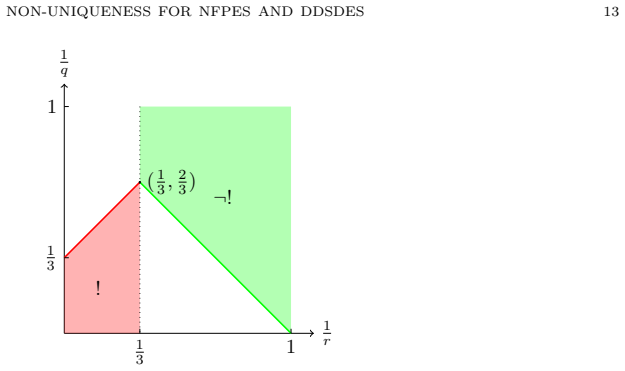
In this paper, we study distribution-dependent stochastic differential equations on the domain $\mathcal O=\mathbb T^d$ or $\mathbb R^d$, $d\geq 2$, of the form \begin{align*} {\rm d}X_t = v(t,X_t,\rho_t)\,{\rm d}t + \sqrt{2}\, \sigma(t,X_t,\rho_t)\,{\rm d}W_t, \qquad \rho_t:=\frac{{\rm d}\mu_t}{{\rm d}x}, \end{align*} where $\mu_t=\operatorname{Law}(X_t)$. Our main construction is carried out at the level of the associated nonlinear Fokker--Planck equations. We first build non-unique probability solutions to these PDEs and then use the superposition principle to obtain non-unique martingale solutions to the corresponding DDSDEs. We establish two main non-uniqueness results concerning stationary states, both on the torus and in the whole space, under the corresponding structural assumptions. First, we construct a divergence-free drift $v\in C_tL^{d-}$ such that the DDSDE admits \emph{infinitely many} distinct solutions starting from the stationary initial density. This result lies at the natural critical regularity threshold: in several models, well-posedness is expected for drifts in $C_tL^{d+}$. Second, for $d\geq 3$ and every prescribed $N\in\mathbb{N}$, we construct a divergence-free drift for which the DDSDE admits at least $N$ distinct stationary martingale solutions. The resulting multiplicity of equilibrium states is reminiscent of multistability and phase-transition phenomena in physical systems.
Editorial analysis
A structured set of objections, weighed in public.
Referee Report
Summary. The paper constructs, for d≥2 on the torus or R^d, divergence-free drifts v∈C_t L^{d−} such that the nonlinear Fokker–Planck equation admits non-unique probability solutions; it then invokes the superposition principle to transfer this non-uniqueness to martingale solutions of the associated distribution-dependent SDE. Two main results are claimed: (i) infinitely many distinct solutions starting from the stationary initial density, and (ii) for d≥3 and any prescribed N, at least N distinct stationary martingale solutions.
Significance. If the constructions are correct and the superposition step is justified, the results establish non-uniqueness at the critical regularity threshold C_t L^{d−}, where well-posedness is expected to fail in several models. The explicit divergence-free constructions and the multiplicity of equilibria provide concrete examples relevant to multistability questions; the paper’s use of explicit drift constructions (rather than parameter fitting) is a strength.
major comments (2)
- [Abstract and § on superposition application (likely §3–4)] The transition from non-unique PDE solutions to non-unique DDSDE solutions relies on the superposition principle, but the coefficients (v,σ) depend on the law ρ_t. Standard superposition results (Trevisan, Figalli) are stated for linear Fokker–Planck equations with law-independent coefficients. The manuscript must verify that the constructed (v,σ) satisfy the hypotheses of a nonlinear superposition theorem (or prove a suitable extension) when multiple stationary measures coexist; this verification is load-bearing for both main claims.
- [Construction of v (likely §2)] The structural assumptions on v that permit the explicit construction of divergence-free fields in C_t L^{d−} while preserving the required integrability for the nonlinear FP equation are not fully detailed in the provided abstract; the reader cannot confirm that the constructed v remains admissible under the law-dependent map without seeing the precise regularity and divergence-free conditions used in the construction.
minor comments (2)
- [Introduction] Notation for the domain O = T^d or R^d and the precise meaning of C_t L^{d−} should be stated once at the beginning of §1 rather than only in the abstract.
- [Theorem statements] The abstract mentions “the corresponding structural assumptions” for the two results; these assumptions should be listed explicitly in the statement of the main theorems.
Simulated Author's Rebuttal
We thank the referee for the careful reading and for identifying these two points. Below we respond to each major comment. The first requires a clarification that we will supply in revision; the second is already addressed in the body of the manuscript.
read point-by-point responses
-
Referee: The transition from non-unique PDE solutions to non-unique DDSDE solutions relies on the superposition principle, but the coefficients (v,σ) depend on the law ρ_t. Standard superposition results (Trevisan, Figalli) are stated for linear Fokker–Planck equations with law-independent coefficients. The manuscript must verify that the constructed (v,σ) satisfy the hypotheses of a nonlinear superposition theorem (or prove a suitable extension) when multiple stationary measures coexist; this verification is load-bearing for both main claims.
Authors: We agree that the standard linear superposition theorems do not apply verbatim. In our setting the drift is of the form v(t,x,ρ_t) with ρ_t the law of the process, so each candidate solution ρ generates its own linear Fokker–Planck equation with frozen coefficients v(·,·,ρ) and σ(·,·,ρ). Because our explicit constructions produce divergence-free fields belonging to C_t L^{d−} that are uniformly integrable with respect to the family of measures appearing in the non-uniqueness set, the hypotheses of the superposition principle (local integrability of the drift, non-degeneracy of σ, and continuity of the coefficient map in the weak topology) are satisfied for every such frozen equation. Consequently the superposition principle yields a martingale solution for each distinct ρ, giving the claimed non-uniqueness for the DDSDE. We will add a short dedicated paragraph (new §3.3) that records this verification and cites the relevant nonlinear extensions of the superposition principle. revision: partial
-
Referee: The structural assumptions on v that permit the explicit construction of divergence-free fields in C_t L^{d−} while preserving the required integrability for the nonlinear FP equation are not fully detailed in the provided abstract; the reader cannot confirm that the constructed v remains admissible under the law-dependent map without seeing the precise regularity and divergence-free conditions used in the construction.
Authors: Section 2 of the manuscript contains the precise structural assumptions: v is constructed as a time-dependent, divergence-free vector field belonging to C([0,∞); L^{d−ε}(O)) for every ε>0, with the explicit formula given in (2.3)–(2.5) on the torus and the analogous formula (2.12) in R^d. The law dependence enters only through a mollification of the density that preserves both the divergence-free property and the L^{d−} integrability; this is verified by direct computation in Lemma 2.4 and Proposition 2.6. Because the same v is used for every solution in the non-uniqueness family, the map ρ ↦ v(·,·,ρ) maps the admissible set of densities into itself, guaranteeing that every constructed solution remains a weak solution of the nonlinear Fokker–Planck equation. These details are already present in the full text; no change to the manuscript is required. revision: no
Circularity Check
No significant circularity: explicit constructions with external superposition
full rationale
The derivation proceeds by explicit construction of divergence-free drifts v in C_t L^{d-} that yield multiple probability solutions to the nonlinear Fokker-Planck equation on the torus or R^d, followed by invocation of the (standard, externally cited) superposition principle to transfer non-uniqueness to martingale solutions of the DDSDE. No equation or claim reduces by definition to its own inputs, no fitted parameter is relabeled as a prediction, and no load-bearing step rests on a self-citation chain. The central results are therefore independent of the target non-uniqueness statements.
Axiom & Free-Parameter Ledger
axioms (2)
- domain assumption The superposition principle applies to transfer non-unique probability solutions of the nonlinear Fokker-Planck equation to non-unique martingale solutions of the DDSDE.
- domain assumption Suitable divergence-free drifts exist in the space C_t L^{d-} with the properties needed for the non-uniqueness constructions.
Reference graph
Works this paper leans on
-
[1]
Bogovskii, Solution of the first boundary value problem for an equation of continuity of an incompress- ible medium
[Bog79] M.E. Bogovskii, Solution of the first boundary value problem for an equation of continuity of an incompress- ible medium. Dokl. Akad. Nauk SSSR. 248 (1979), (5), 1037-1040. [BA94] M. Ben-Artzi. Global solutions of two-dimensional Navier-Stokes and Euler equations. Arch. Rational Mech. Anal. 128, 329–358 (1994). [BCDL21] E. Bru´ e, M. Colombo, C. D...
1979
-
[2]
[BDLIS15] T
Journal of the European Mathematical Society, 2021, 24(9): 3333-3378. [BDLIS15] T. Buckmaster, C. De Lellis, P. Isett, and L. Sz´ ekelyhidi Jr. Anomalous dissipation for 1/5-H¨ older Euler flows. Annals of Mathematics 182(1):127–172,
2021
-
[3]
Bedrossian, and S
[BH17] J. Bedrossian, and S. He. ”Suppression of blow-up in Patlak–Keller–Segel via shear flows.” SIAM Journal on Mathematical Analysis 49.6 (2017): 4722-4766. [BFH20] D. Breit, E. Feireisl, and M. Hofmanov´ a. On solvability and ill-posedness of the compressible Euler system subject to stochastic forces. Anal. PDE, 13(2):371–402,
2017
-
[4]
[BKRS22] V. I. Bogachev, N. V. Krylov, M. R¨ ockner, S. V. Shaposhnikov, (2022). Fokker–Planck–Kolmogorov Equa- tions (Vol. 207). American Mathematical Society. [BMS21] J. Burczak, S. Modena and L. Sz´ ekelyhidi. Non uniqueness of power-law flows. Communications in Mathe- matical Physics 388(1): 199-243,
2022
-
[5]
Barbu, and M
60 HUAXIANG L ¨U [BR21] V. Barbu, and M. R¨ ockner. ”Solutions for nonlinear Fokker–Planck equations with measures as initial data and McKean-Vlasov equations.” Journal of Functional Analysis 280.7 (2021): 108926. [BR22] V. Barbu, and M. R¨ ockner. ”The invariance principle for nonlinear Fokker–Planck equations.” Journal of Differential Equations 315 (202...
2021
-
[6]
[CGPS20] J. A. Carrillo, R.S. Gvalani, G.A. Pavliotis and A. Schlichting. Long-time behaviour and phase transitions for the McKean–Vlasov equation on the torus[J]. Archive for Rational Mechanics and Analysis, 2020, 235(1): 635-690. [CGSW15] G. Crippa, N. Gusev, S. Spirito, and E. Wiedemann. Non-uniqueness and prescribed energy for the continuity equation....
2020
-
[7]
Cheskidov, and X
[CL21] A. Cheskidov, and X. Luo. Nonuniqueness of weak solutions for the transport equation at critical space regularity. Annals of PDE 7 (2021): 1-45. [CL22a] A. Cheskidov, and X. Luo. Sharp nonuniqueness for the Navier–Stokes equations. Inventiones mathematicae: 1-68,
2021
-
[8]
Cheskidov, and X
[CL23] A. Cheskidov, and X. Luo.L 2-Critical Nonuniqueness for the 2D Navier-Stokes Equations. Annals of PDE, 2023, 9(2):
2023
-
[9]
Cie´ slak, and W
[CO22] T. Cie´ slak, and W. S. O˙ za´ nski. ”A partial uniqueness result and an asymptotically sharp nonuniqueness result for the Zhikov problem on the torus.” Calculus of Variations & Partial Differential Equations 61.3 (2022). [CP10] L. Chayes, and V. Panferov, The McKean-Vlasov equation in finite volume, J. Stat. Phys., 138 (2010), 351–380. [CRF22] P.-...
2022
-
[10]
[DT16] M. H. Duong, and J. Tugaut: Stationary solutions of the Vlasov-Fokker-Planck equation: Existence, charac- terization and phase-transition, Applied Mathematics Letters, 52 (2016), 38–45. [EN78a] R. S. Ellis and C. M. Newman. Limit theorems for sums of dependent random variables occurring in statistical mechanics, Z. Wahr. verw Geb. 44:117-139 (1978)...
2016
-
[11]
Frank, A
[FD01] T.D. Frank, A. Daffertshofer, H-theorem for nonlinear Fokker–Planck equations related to generalized ther- mostat ics, Phys. A, Stat. Mech. Appl. 292 (2001) 455–474. [GG05] I. Gallagher and T. Gallay. Uniqueness for the two-dimensional Navier-Stokes equation with a measure as initial vorticity. Math. Ann., 332(2):287–327,
2001
-
[12]
[GG25] L. Galeati, M. Gerencs´ er. Solution theory of fractional SDEs in complete subcritical regimes. Forum of Mathematics, Sigma. Cambridge University Press, 2025, 13: e12. [GKN23] V. Giri, H. Kwon, M. Novack. TheL 3-based strong Onsager theorem. arXiv preprint arXiv:2305.18509,
-
[13]
[GR24] V. Giri, R. O. Radu. The 2d onsager conjecture: a newton-nash iteration. Inventiones mathematicae, 2024, 238(2): 691-768. [Gru25] S. Grube. ”Strong solutions to McKean–Vlasov SDEs associated to a class of degenerate Fokker–Planck equations with coefficients of Nemytskii-type.” Probability Theory and Related Fields 194.3 (2026): 1495-1535. [HKY25] z...
2024
-
[14]
Herrmann, and J
[HT10] S. Herrmann, and J. Tugaut: Non-uniqueness of stationary measures for self-stabilizing processes, Stoch. Proc. Appl., 120 (2010), 1215–1246. [HW23] X. Huang and F.-Y. Wang. Singular McKean-Vlasov (reflecting) SDEs with distribution dependent noise.Journal of Mathematical Analysis and Applications 514.1 (2022), p. 126301. [HWY24] x. Huang, S. Wang, ...
2010
-
[15]
Hofmanov´ a, R
[HZZ24] M. Hofmanov´ a, R. Zhu, and X. Zhu. Non-uniqueness in law of stochastic 3D Navier–Stokes equations. J. Eur. Math. Soc. 26, 163–260 (2024). [HZZ25] M. Hofmanov´ a, R. Zhu, and X. Zhu. Non-unique ergodicity for deterministic and stochastic 3D Navier–Stokes and Euler equations. Archive for Rational Mechanics and Analysis 2025 249:33. [Ise18] P. Isett...
2024
-
[16]
[IXZ21] G. Iyer, X. Xu, and A. Zlatoˇ s. ”Convection-induced singularity suppression in the Keller-Segel and other non-linear PDEs.” Transactions of the American Mathematical Society 374.9 (2021): 6039-6058. [Jos19] M. Josien. Decomposition and pointwise estimates of periodic Green functions of some elliptic equations with periodic oscillatory coefficient...
2021
- [17]
- [18]
-
[19]
Keller, and L
[KS70] E.F. Keller, and L. A. Segel. ”Initiation of slime mold aggregation viewed as an instability.” Journal of theoretical biology 26.3 (1970): 399-415. [KS71] E.F. Keller, and L. A. Segel. ”Traveling bands of chemotactic bacteria: a theoretical analysis.” Journal of theoretical biology 30.2 (1971): 235-248. [KR05] N. V. Krylov and M. R¨ ockner. Strong ...
1970
-
[20]
[Lan36] L.D. Landau. The transport equation in the case of Coulomb interactions. Collected papers of LD Landau (1936): 163-170. [LM22] Z. Liu, and J. Ma. Existence, uniqueness and exponential ergodicity under Lyapunov conditions for McKean- Vlasov SDEs with Markovian switching. Journal of Differential Equations 337 (2022): 138-167. [Luo19] X. Luo. Station...
- [21]
-
[22]
[LZ25a] H. L¨ u, X. Zhu. Sharp Non-uniqueness of Solutions to 2D Navier-Stokes Equations with Space-Time White Noise. The Annals of Applied Probability, 2025, 35(3): 1980-2030. 62 HUAXIANG L ¨U [LZ25b] H. L¨ u, X. Zhu. Non-unique Ergodicity for the 2D Stochastic Navier-Stokes Equations with Derivative of Space-Time White Noise. Journal of Differential Equ...
2025
-
[23]
arXiv:2412.10404. [MNY24b] C. Miao, Y. Nie, W. Ye. Sharp non-uniqueness for the Navier-Stokes equations inR
-
[24]
arXiv:2412.09637. [MS18] S. Modena, L. Sz´ ekelyhidi. Non-uniqueness for the transport equation with Sobolev vector fields. Ann. PDE 4(2), 38 (2018) [MS19] S. Modena, L. Sz´ ekelyhidi. Non-renormalized solutions to the continuity equation. Calc. Var. Partial Differ. Equ. 58(6), 30 (2019) [MS20] S. Modena, and G. Sattig. Convex integration solutions to the...
-
[25]
[NV23] M. Novack, V. Vicol. An intermittent Onsager theorem. Inventiones mathematicae, 2023, 233(1): 223-323. [PS23] J. Pitcho, M Sorella. Almost everywhere non-uniqueness of integral curves for divergence-free sobolev vector fields. SIAM Journal on Mathematical Analysis, 2023, 55(5): 4640-4663. [RZ21] M. R¨ ockner, X. Zhang. Well-posedness of distributio...
-
[26]
Scheutzow
[Sch87] M. Scheutzow. Uniqueness and non-uniqueness of solutions of Vlasov-McKean equations. In: Journal of the Australian Mathematical Society 43.2 (1987), pp. 246
1987
-
[27]
Nonlinear reflecting diffusion process, and the propagation of chaos and fluctuations asso- ciated
[Szn84] A.-S. Sznitman. “Nonlinear reflecting diffusion process, and the propagation of chaos and fluctuations asso- ciated”. In: Journal of functional analysis 56.3 (1984), pp. 311–336. [SNC07] V. Schw¨ ammle, F.D. Nobre, E.M.F. Curado, Consequences of the H-theorem from nonlinear Fokker–Planck equa tions, Phys. Rev. E 76 (2007) 041123. [Tre14] D. Trevis...
1984
-
[28]
Trevisan
[Tre16] D. Trevisan. Well-posedness of multidimensional diffusion processes,Electronic J. Probab., 21 (2016), 1-41. [Tsa09] C. Tsalis, Introduction to Nonextensive Statistical Mechanics. Approaching a Complex World, Springer- Verlag, Berlin,
2016
-
[29]
[Tug10] J. Tugaut. : Convergence to the equilibria for self-stabilizing processes in double well land scape, Ann. Probab., 41 (2010). [Tug13] J. Tugaut. ”Self-stabilizing processes in multi-wells landscape inR d-Convergence.” Stochastic Processes and Their Applications 123.5 (2013): 1780-1801. [Vil98] C. Villani. On a new class of weak solutions to the sp...
2010
-
[30]
[Zha23] S. Q. Zhang. Existence and non-uniqueness of stationary distributions for distribution dependent SDEs. Electronic Journal of Probability, 2023, 28: 1-34. [Zha25] G. Zhao. Existence and uniqueness for McKean-Vlasov equations with singular interactions. Potential Anal- ysis, 2025, 62(3): 625-653. [Zhi04] V. V. Zhikov. ”Remarks on the uniqueness of a...
2023
discussion (0)
Sign in with ORCID, Apple, or X to comment. Anyone can read and Pith papers without signing in.