Power law scaling for classification accuracy in physical neural networks
Pith reviewed 2026-07-01 02:17 UTC · model grok-4.3
The pith
Classification loss in physical neural networks follows a power law in the Hotelling Trace Criterion, with data from different substrates collapsing on task-specific curves.
A machine-rendered reading of the paper's core claim, the machinery that carries it, and where it could break.
Core claim
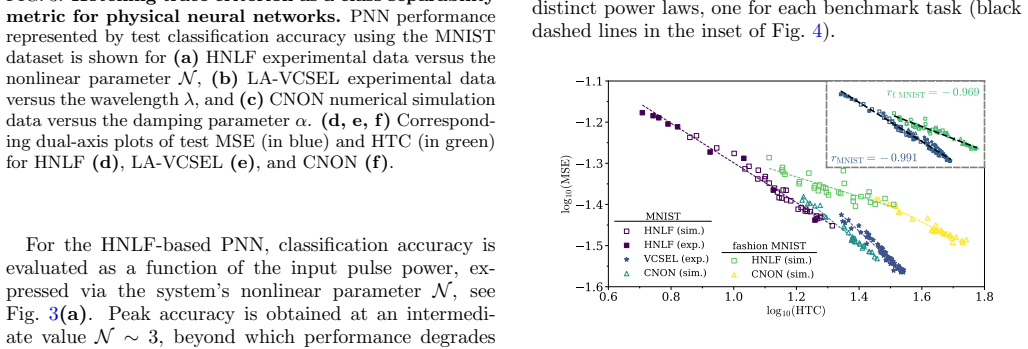
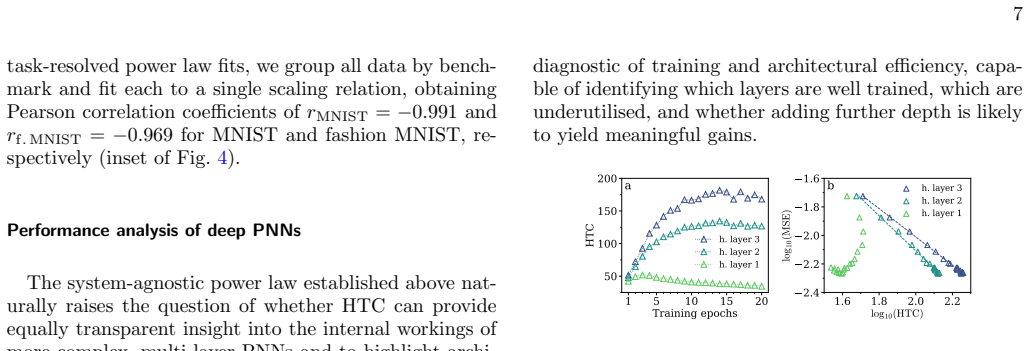
Classification loss follows a power law in HTC, with Pearson correlation coefficients exceeding 0.99 for MNIST and ≈0.97 for Fashion-MNIST. Experimental and simulated data from physically distinct systems collapse onto a single scaling curve determined by the task rather than the substrate. Applying HTC layer-by-layer during training reveals that gradient-based optimisation distributes representational capacity unevenly across PNN layers.
What carries the argument
The Hotelling Trace Criterion (HTC), a task-conditioned measure of PNN-state separability evaluated without training.
If this is right
- Performance predictions for new systems require only the HTC measurement once the task-specific exponent is calibrated.
- HTC can diagnose training efficiency by showing uneven capacity distribution across layers.
- HTC acts as a substrate-agnostic figure of merit for comparing different physical neural network implementations.
Where Pith is reading between the lines
- This approach may allow hardware designers to optimize physical parameters directly for higher HTC values on target tasks.
- The task-determined scaling suggests similar laws could apply to other computational tasks like regression if the separability measure is adapted.
- Universal collapse across substrates points to a deeper connection between physical dynamics and information processing independent of specific implementation details.
Load-bearing premise
The power-law relationship between HTC and classification loss generalizes across arbitrary physical substrates and tasks once a task-specific exponent has been calibrated on a small set of trained systems.
What would settle it
Measuring HTC and classification loss on a new physical system for MNIST and finding that the points do not lie on the previously established power-law curve would falsify the claim.
Figures

read the original abstract
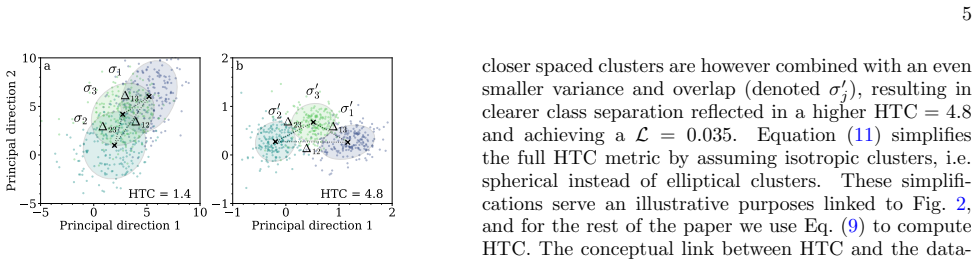
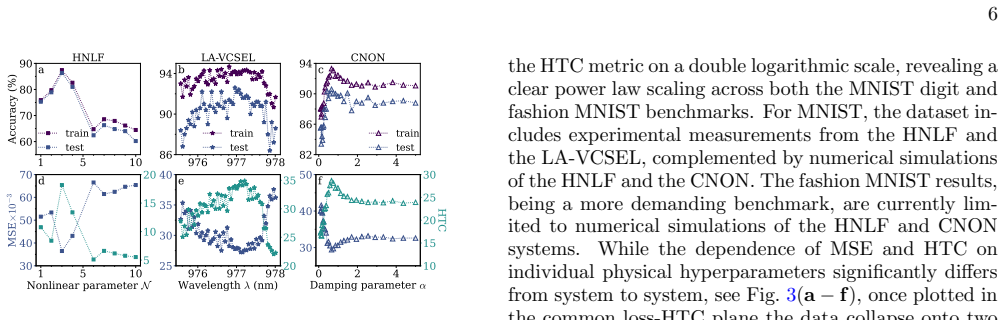
Physical neural networks (PNNs) harness the intrinsic complexity of physical systems to perform neural computation, potentially at speeds and energy efficiencies inaccessible to conventional digital hardware. Yet, a principled framework for quantifying and predicting their computing accuracy across diverse substrates has remained elusive. Here we introduce the Hotelling Trace Criterion (HTC), a task-conditioned measure of PNN- state separability that can be evaluated without training. We demonstrate that it predicts PNN classification performance with high fidelity across highly nonlinear optical fibres, vertical-cavity surface-emitting lasers, and coupled nonlinear oscillator networks, for benchmark tasks of different difficulty. Classification loss follows a power law in HTC, with Pearson correlation coefficients exceeding 0.99 for MNIST and $\approx$0.97 for Fashion-MNIST, noteworthy experimental and simulated data from physically distinct systems collapse onto a single scaling curve determined by the task rather than the substrate. Applying HTC layer-by-layer during training further reveals that gradient-based optimisation distributes representational capacity unevenly across PNN layers, providing a quantitative diagnostic of training and architecture efficiency invisible to standard loss monitoring. Crucially, once the scaling exponent is established from a small number of trained calibration systems, all further performance predictions require no training since performance can be derived from the much more efficient HTC measurement. These results establish HTC as a substrate-agnostic figure of merit for comparing and scaling PNNs, advancing the field further towards a complete theory connecting fundamental hardware parameters to task performance through universal scaling laws.
Editorial analysis
A structured set of objections, weighed in public.
Referee Report
Summary. The manuscript introduces the Hotelling Trace Criterion (HTC) as a task-conditioned, training-free measure of state separability in physical neural networks (PNNs). It claims that classification loss follows a power-law relationship with HTC across physically distinct systems (nonlinear fibres, VCSELs, coupled oscillators), with Pearson correlations >0.99 on MNIST and ≈0.97 on Fashion-MNIST; data from these systems collapse onto task-specific curves, so that a task-specific exponent calibrated on a small set of trained systems enables subsequent training-free performance prediction from HTC alone. The work also reports that layer-by-layer HTC during training reveals uneven distribution of representational capacity.
Significance. If the power-law relationship and cross-substrate collapse are robust, the result would be significant: it supplies a substrate-agnostic, low-cost figure of merit that connects hardware parameters to task performance via a simple scaling law and supplies a diagnostic for training efficiency invisible to standard loss curves. The training-free prediction aspect, once the exponent is fixed, would be a practical advance for the field.
major comments (2)
- [Abstract] Abstract: the reported Pearson correlations (>0.99 and ≈0.97) are presented without error bars, the number of data points entering each fit, or the precise data-selection criteria; these omissions are load-bearing for the central claim that HTC predicts performance “with high fidelity.”
- [Abstract] Abstract: the scaling exponent is obtained by fitting a small number of trained calibration systems and is then used to predict performance from HTC alone; the manuscript must quantify how sensitive the claimed training-free regime is to the choice and number of calibration systems.
Simulated Author's Rebuttal
We thank the referee for their constructive comments, which highlight important aspects of statistical rigor and robustness in our presentation. We address each major comment point by point below.
read point-by-point responses
-
Referee: [Abstract] Abstract: the reported Pearson correlations (>0.99 and ≈0.97) are presented without error bars, the number of data points entering each fit, or the precise data-selection criteria; these omissions are load-bearing for the central claim that HTC predicts performance “with high fidelity.”
Authors: We agree that these details should be explicit. In the revised manuscript we will add to the abstract (or a concise parenthetical) the number of data points underlying each reported correlation, the precise selection criteria used to include configurations, and error bars or bootstrap-derived uncertainties on the Pearson coefficients. The underlying counts and criteria are already documented in the methods and supplementary figures; the revision will simply surface them at the abstract level without altering the reported values. revision: yes
-
Referee: [Abstract] Abstract: the scaling exponent is obtained by fitting a small number of trained calibration systems and is then used to predict performance from HTC alone; the manuscript must quantify how sensitive the claimed training-free regime is to the choice and number of calibration systems.
Authors: We acknowledge the value of quantifying calibration sensitivity. In the revised version we will include an additional analysis (main text or supplementary) that tests the stability of the fitted exponent and downstream predictions under leave-one-out cross-validation and under systematic variation in the number of calibration systems. This will demonstrate the minimal number of systems required for reliable training-free extrapolation and the variability introduced by different calibration subsets. revision: yes
Circularity Check
No significant circularity; empirical scaling law validated externally
full rationale
HTC is defined independently as a training-free separability metric. The power-law relation (loss ~ HTC^alpha) is reported as an empirical fit with high Pearson correlations across distinct physical substrates (fibres, VCSELs, oscillators) and tasks; data collapse onto task-specific curves is presented as experimental evidence, not a definitional identity. Calibration of the task-specific exponent on a small set of systems followed by HTC-based prediction on new systems is a standard empirical scaling procedure, not a reduction of the output to the fitted inputs by construction. No self-citations, uniqueness theorems, or ansatzes are invoked to force the result. The chain is self-contained against the reported benchmarks.
Axiom & Free-Parameter Ledger
free parameters (1)
- task-specific scaling exponent
axioms (1)
- domain assumption HTC computed on untrained PNN states is a faithful proxy for the separability achieved after gradient-based training
Reference graph
Works this paper leans on
-
[1]
Ermolaev, Andrei V. and Hary, Mathilde and Leybov, Lev and Ryczkowski, Piotr and Skalli, Anas and Brunner, Daniel and Genty, Goëry and Dudley, John M. , year =. Limits of nonlinear and dispersive fiber propagation for an optical fiber-based extreme learning machine , volume =. Optics Letters , publisher =. doi:10.1364/ol.562186 , number =
-
[2]
Nature communications , volume=
Toward a formal theory for computing machines made out of whatever physics offers , author=. Nature communications , volume=. 2023 , publisher=
2023
-
[3]
arXiv preprint arXiv:2601.15340 , year=
Learning Nonlinear Heterogeneity in Physical Kolmogorov-Arnold Networks , author=. arXiv preprint arXiv:2601.15340 , year=
-
[4]
Dudley, J. M. and Genty, G. and Heidt, A. and Sylvestre, T. and Travers, J. C. and Taylor, J. R. , year =. Fibre supercontinuum generation: Progress and perspectives , volume =. Europhysics Letters EPL , publisher =
-
[5]
, publisher =
Agrawal, Govind P. , publisher =. Nonlinear Fiber Optics , year =
-
[6]
Dudley and Goëry Genty , journal =
Mikko Närhi and Lauri Salmela and Juha Toivonen and Cyril Billet and John M. Dudley and Goëry Genty , journal =. Machine learning analysis of extreme events in optical fibre modulation instability , year =. doi:10.1038/s41467-018-07355-y , publisher =
-
[7]
Dudley, J. M. and Genty, G. and Coen, S. , title =. Reviews of Modern Physics , year =. doi:10.1103/RevModPhys.78.1135 , issue =
-
[8]
and Feehan, James S
Heidt, Alexander M. and Feehan, James S. and Price, Jonathan H. V. and Feurer, Thomas , journal =. Limits of coherent supercontinuum generation in normal dispersion fibers , year =
-
[9]
On the implementation of nonlinearities in optical neural networks: opinion , year =
Niyazi Ulas Dinc and Ilker Oguz and Mustafa Yildirim and Christophe Moser and Demetri Psaltis , journal =. On the implementation of nonlinearities in optical neural networks: opinion , year =
-
[10]
Dudley and Goëry Genty and Arnaud Mussot and Amin Chabchoub and Fr
John M. Dudley and Goëry Genty and Arnaud Mussot and Amin Chabchoub and Fr. Nature Reviews Physics , title =. 2019 , number =. doi:10.1038/s42254-019-0100-0 , publisher =
-
[11]
Fran. Optics Express , title =. 2012 , number =. doi:10.1364/OE.20.022783 , keywords =
-
[12]
and Rimoldi, Cristina and Falk, Tiago H
Fischer, Bennet and Chemnitz, Mario and Zhu, Yi and Perron, Nicolas and Roztocki, Piotr and Maclellan, Benjamin and Di Lauro, Luigi and Aadhi, A. and Rimoldi, Cristina and Falk, Tiago H. and Morandotti, Roberto , journal =. Neuromorphic Computing via Fission-based Broadband Frequency Generation , year =. doi:10.1002/advs.202303835 , earlyaccessdate =
-
[13]
Aashu Jha and Chaoran Huang and Paul R. Prucnal , journal =. Reconfigurable all-optical nonlinear activation functions for neuromorphic photonics , year =. doi:10.1364/OL.398234 , keywords =
-
[14]
L. Larger and M. C. Soriano and D. Brunner and L. Appeltant and J. M. Gutierrez and L. Pesquera and C. R. Mirasso and I. Fischer , journal =. Photonic information processing beyond Turing: an optoelectronic implementation of reservoir computing , year =. doi:10.1364/OE.20.003241 , keywords =
-
[15]
Lee, Kevin F. and Fermann, Martin E. , journal =. Supercontinuum neural network and analog computing evaluation , year =. doi:10.1103/PhysRevA.109.033521 , eissn =
-
[16]
Nanophotonics , doi =
Optical neuromorphic computing via temporal up-sampling and trainable encoding on a telecom device platform , author =. Nanophotonics , doi =
-
[17]
Research progress in optical neural networks: theory, applications and developments , year =
Liu, Jia and Wu, Qiuhao and Sui, Xiubao and Chen, Qian and Gu, Guohua and Wang, Liping and Li, Shengcai , journal =. Research progress in optical neural networks: theory, applications and developments , year =. doi:10.1186/s43074-021-00026-0 , publisher =
-
[18]
Marcucci, Giulia and Pierangeli, Davide and Conti, Claudio , journal =. Theory of Neuromorphic Computing by Waves: Machine Learning by Rogue Waves, Dispersive Shocks, and Solitons , year =. doi:10.1103/PhysRevLett.125.093901 , issue =
-
[19]
Journal of Physics: Photonics , volume =
A complete, parallel and autonomous photonic neural network in a semiconductor multimode laser , author =. Journal of Physics: Photonics , volume =. 2021 , publisher =
2021
-
[20]
Nature communications , volume=
Parallel photonic information processing at gigabyte per second data rates using transient states , author=. Nature communications , volume=. 2013 , publisher=
2013
-
[21]
Optical Materials Express , volume=
Computational metrics and parameters of an injection-locked large area semiconductor laser for neural network computing , author=. Optical Materials Express , volume=. 2022 , publisher=
2022
-
[22]
Azzam and Jonathan George and Alexander V
Mario Miscuglio and Armin Mehrabian and Zibo Hu and Shaimaa I. Azzam and Jonathan George and Alexander V. Kildishev and Matthew Pelton and Volker J. Sorger , journal =. All-optical nonlinear activation function for photonic neural networks. [. 2018 , number =. doi:10.1364/OME.8.003851 , keywords =
-
[23]
Optical computing with supercontinuum generation in photonic crystal fibers , volume =
Azka Maula Iskandar Muda and Uğur Teğin , journal =. Optical computing with supercontinuum generation in photonic crystal fibers , volume =. 2024 , abstract =
2024
-
[24]
Oguz, Ilker and Hsieh, Jih-Liang and Dinc, Niyazi Ulas and Te. Advanced Photonics , title =. 2024 , issn =. doi:10.1117/1.ap.6.1.016002 , publisher =
-
[25]
Nature Computational Science , title =
Te. Nature Computational Science , title =. 2021 , issn =. doi:10.1038/s43588-021-00112-0 , publisher =
-
[26]
Nonlinear processing with linear optics , year =
Yildirim, Mustafa and Dinc, Niyazi Ulas and Oguz, Ilker and Psaltis, Demetri and Moser, Christophe , journal =. Nonlinear processing with linear optics , year =. doi:10.1038/s41566-024-01494-z , earlyaccessdate =
-
[27]
Nonlinear optical feature generator for machine learning , year =
Yildirim, Mustafa and Oguz, Ilker and Kaufmann, Fabian and Escale, Marc Reig and Grange, Rachel and Psaltis, Demetri and Moser, Christophe , journal =. Nonlinear optical feature generator for machine learning , year =. doi:10.1063/5.0158611 , orcid-numbers =
-
[28]
All-optical neural network with nonlinear activation functions , year =
Ying Zuo and Bohan Li and Yujun Zhao and Yue Jiang and You-Chiuan Chen and Peng Chen and Gyu-Boong Jo and Junwei Liu and Shengwang Du , journal =. All-optical neural network with nonlinear activation functions , year =. doi:10.1364/OPTICA.6.001132 , keywords =
-
[29]
Holography in artificial neural networks , volume =
Psaltis, Demetri and Brady, David and Gu, Xiang-Guang and Lin, Steven , year =. Holography in artificial neural networks , volume =. Nature , publisher =. doi:10.1038/343325a0 , number =
-
[30]
Wetzstein, Gordon and Ozcan, Aydogan and Gigan, Sylvain and Fan, Shanhui and Englund, Dirk and Soljačić, Marin and Denz, Cornelia and Miller, David A. B. and Psaltis, Demetri , year =. Inference in artificial intelligence with deep optics and photonics , volume =. Nature , publisher =. doi:10.1038/s41586-020-2973-6 , number =
-
[31]
Stumpf, M. C. and Pekarek, S. and Oehler, A. E. H. and S\". Self-referencable frequency comb from a 170-fs, 1.5- m solid-state laser oscillator , volume =. Applied Physics B , publisher =. 2010 , pages =. doi:10.1007/s00340-009-3854-8 , number =
-
[32]
Corwin, K. L. and Newbury, N. R. and Dudley, J. M. and Coen, S. and Diddams, S. A. and Weber, K. and Windeler, R. S. , year =. Fundamental Noise Limitations to Supercontinuum Generation in Microstructure Fiber , volume =. Physical Review Letters , publisher =
-
[33]
Brainis, E. and Amans, D. and Massar, S. , year =. Scalar and vector modulation instabilities induced by vacuum fluctuations in fibers: Numerical study , volume =. Physical Review A , pages =. doi:10.1103/physreva.71.023808 , number =
-
[34]
Nanophotonics , volume =
Nonlinear inference capacity of fiber-optical extreme learning machines , author =. Nanophotonics , volume =
-
[35]
Rampur, Anupamaa and Spangenberg, Dirk-Mathys and Sierro, Benoît and H\". Perspective on the next generation of ultra-low noise fiber supercontinuum sources and their emerging applications in spectroscopy, imaging, and ultrafast photonics , volume =. Applied Physics Letters , publisher =. doi:10.1063/5.0053436 , number =
-
[36]
Optical computing with supercontinuum generation in photonic crystal fibers , volume =
Iskandar Muda and Azka Maula and Te. Optical computing with supercontinuum generation in photonic crystal fibers , volume =. Optics Express , publisher =. 2025 , pages =. doi:10.1364/oe.539374 , number =
-
[37]
Ort\'. A Unified Framework for Reservoir Computing and Extreme Learning Machines based on a Single Time-delayed Neuron , volume =. Scientific Reports , publisher =. doi:10.1038/srep14945 , number =
-
[38]
, year =
Zhu, Zhaoming and Brown, Thomas G. , year =. Polarization properties of supercontinuum spectra generated in birefringent photonic crystal fibers , volume =. Journal of the Optical Society of America B , publisher =
-
[39]
and Knight, Jonathan C
Coen, Stéphane and Chau, Alvin Hing Lun and Leonhardt, Rainer and Harvey, John D. and Knight, Jonathan C. and Wadsworth, William J. and Russell, Philip St. J. , year =. Supercontinuum generation by stimulated Raman scattering and parametric four-wave mixing in photonic crystal fibers , volume =. Journal of the Optical Society of America B , publisher =
-
[40]
Extreme learning machine: Theory and applications , year =
Huang, Guang-Bin and Zhu, Qin-Yu and Siew, Chee-Kheong , journal =. Extreme learning machine: Theory and applications , year =. doi:10.1016/j.neucom.2005.12.126 , publisher =
-
[41]
Huang, Chaoran and Sorger, Volker J. and Miscuglio, Mario and Al-Qadasi, Mohammed and Mukherjee, Avilash and Lampe, Lutz and Nichols, Mitchell and Tait, Alexander N. and Ferreira de Lima, Thomas and Marquez, Bicky A. and Wang, Jiahui and Chrostowski, Lukas and Fok, Mable P. and Brunner, Daniel and Fan, Shanhui and Shekhar, Sudip and Prucnal, Paul R. and S...
-
[42]
and Pandit, Tej and Merkel, Cory and Kubendran, Rajkumar and Aimone, James B
Kudithipudi, Dhireesha and Schuman, Catherine and Vineyard, Craig M. and Pandit, Tej and Merkel, Cory and Kubendran, Rajkumar and Aimone, James B. and Orchard, Garrick and Mayr, Christian and Benosman, Ryad and Hays, Joe and Young, Cliff and Bartolozzi, Chiara and Majumdar, Amitava and Cardwell, Suma George and Payvand, Melika and Buckley, Sonia and Kulka...
-
[43]
Optically accelerated extreme learning machine using hot atomic vapors , year =
Azam, Pierre and Kaiser, Robin , journal =. Optically accelerated extreme learning machine using hot atomic vapors , year =. doi:10.1103/physrevapplied.22.034041 , publisher =
-
[44]
Wu, Lin and Chunhua Shen and Hengel, Anton van den , journal =. Deep linear discriminant analysis on fisher networks: A hybrid architecture for person re-identification , year =. doi:10.1016/j.patcog.2016.12.022 , publisher =
-
[45]
Generalized Fisher Score for Feature Selection
Gu, Quanquan and Li, Zhenhui and Han, Jiawei , title =. 2012 , copyright =. doi:10.48550/ARXIV.1202.3725 , keywords =
work page internal anchor Pith review Pith/arXiv arXiv doi:10.48550/arxiv.1202.3725 2012
-
[46]
Carroll, T. L. , journal =. Do reservoir computers work best at the edge of chaos? , year =. doi:10.1063/5.0038163 , publisher =
-
[47]
Momeni, Ali and Rahmani, Babak and Scellier, Benjamin and Wright, Logan G. and McMahon, Peter L. and Wanjura, Clara C. and Li, Yuhang and Skalli, Anas and Berloff, Natalia G. and Onodera, Tatsuhiro and Oguz, Ilker and Morichetti, Francesco and del Hougne, Philipp and Le Gallo, Manuel and Sebastian, Abu and Mirhoseini, Azalia and Zhang, Cheng and Marković,...
-
[48]
and Czyszanowski, Tomasz and Brunner, Daniel , title =
Skalli, Anas and Sunada, Satoshi and Goldmann, Mirko and Gebski, Marcin and Reitzenstein, Stephan and Lott, James A. and Czyszanowski, Tomasz and Brunner, Daniel , title =. 2025 , copyright =. doi:10.48550/ARXIV.2503.16943 , keywords =
-
[49]
Scalable Photonic Neural Networks via Surrogate Scattering-Matrix Inverse Design
Muda, Azka Maula Iskandar and Teğin, Uğur , title =. 2026 , copyright =. doi:10.48550/ARXIV.2604.21301 , keywords =
work page internal anchor Pith review Pith/arXiv arXiv doi:10.48550/arxiv.2604.21301 2026
-
[50]
Linear discriminant analysis: A detailed tutorial , year =
Tharwat, Alaa and Gaber, Tarek and Ibrahim, Abdelhameed and Hassanien, Aboul Ella , journal =. Linear discriminant analysis: A detailed tutorial , year =. doi:10.3233/aic-170729 , month = May, publisher =
-
[51]
The Generalization of Student’s Ratio , year =
Hotelling, Harold , journal =. The Generalization of Student’s Ratio , year =. doi:10.1214/aoms/1177732979 , publisher =
-
[52]
Berkeley Symp
Harold Hotelling , title =. Berkeley Symp. on Math. Statist. and Prob. , pages =. 1951 , volume =
1951
-
[53]
Hotelling, H. , journal =. Analysis of a complex of statistical variables into principal components. , year =. doi:10.1037/h0071325 , publisher =
-
[54]
Discriminative clustering via extreme learning machine , year =
Huang, Gao and Liu, Tianchi and Yang, Yan and Lin, Zhiping and Song, Shiji and Wu, Cheng , journal =. Discriminative clustering via extreme learning machine , year =. doi:10.1016/j.neunet.2015.06.002 , publisher =
-
[55]
Mohammed, A.A. and Minhas, R. and Jonathan Wu, Q.M. and Sid-Ahmed, M.A. , journal =. Human face recognition based on multidimensional PCA and extreme learning machine , year =. doi:10.1016/j.patcog.2011.03.013 , publisher =
-
[56]
Ramachandran, Rahul Uma and Massar, Serge , title =. 2026 , copyright =. doi:10.48550/ARXIV.2605.19152 , keywords =
work page internal anchor Pith review Pith/arXiv arXiv doi:10.48550/arxiv.2605.19152 2026
-
[57]
1972 , url =
Keinosuke Fukunaga , title =. 1972 , url =
1972
-
[58]
Rao, M. M. , journal =. Discriminant analysis , year =. doi:10.1007/bf02865898 , publisher =
-
[59]
Minimum Class Variance Extreme Learning Machine for Human Action Recognition , year =
Iosifidis, Alexandros and Tefas, Anastasios and Pitas, Ioannis , journal =. Minimum Class Variance Extreme Learning Machine for Human Action Recognition , year =. doi:10.1109/tcsvt.2013.2269774 , publisher =
-
[60]
Fiete, R. D. and Barrett, H. H. and Smith, W. E. and Myers, K. J. , journal =. Hotelling trace criterion and its correlation with human-observer performance , year =. doi:10.1364/josaa.4.000945 , publisher =
-
[61]
Lawley, D. N. , journal =. A Generalization of Fisher’s z Test , year =. doi:10.2307/2332232 , publisher =
-
[62]
, publisher =
Bishop, Christopher M. , publisher =. Pattern Recognition and Machine Learning , year =
-
[63]
Photonic neuromorphic computing using vertical cavity semiconductor lasers , year =
Skalli, Anas and Robertson, Joshua and Owen-Newns, Dafydd and Hejda, Matej and Porte, Xavier and Reitzenstein, Stephan and Hurtado, Antonio and Brunner, Daniel , journal =. Photonic neuromorphic computing using vertical cavity semiconductor lasers , year =. doi:10.1364/ome.450926 , publisher =
-
[64]
Multilayer Fisher extreme learning machine for classification , year =
Lai, Jie and Wang, Xiaodan and Xiang, Qian and Wang, Jian and Lei, Lei , journal =. Multilayer Fisher extreme learning machine for classification , year =. doi:10.1007/s40747-022-00867-7 , publisher =
-
[65]
Smith, Warren E. and Barrett, Harrison H. , journal =. Hotelling trace criterion as a figure of merit for the optimization of imaging systems , year =. doi:10.1364/josaa.3.000717 , publisher =
-
[66]
Nature communications , volume=
Information processing using a single dynamical node as complex system , author=. Nature communications , volume=. 2011 , publisher=
2011
-
[67]
and Farhat, N
Psaltis, D. and Farhat, N. H. , title =. Opt.\ Lett. , volume =. 1985 , doi =
1985
-
[68]
and Soriano, M
Larger, L. and Soriano, M. C. and Brunner, D. and Appeltant, L. and Gutierrez, J. M. and Pesquera, L. and Mirasso, C. R. and Fischer, I. , title =. Opt.\ Express , volume =. 2012 , doi =
2012
-
[69]
and Schneider, B
Duport, F. and Schneider, B. and Smerieri, A. and Haelterman, M. and Massar, S. , title =. Opt.\ Express , volume =. 2012 , doi =
2012
-
[70]
and Riou, M
Torrejon, J. and Riou, M. and Araujo, F. A. and Tsunegi, S. and Khalsa, G. and Querlioz, D. and Bortolotti, P. and Cros, V. and Yakushiji, K. and Fukushima, A. and Kubota, H. and Yuasa, S. and Stiles, M. D. and Grollier, J. , title =. Nature , volume =. 2017 , doi =
2017
-
[71]
and Talatchian, P
Romera, M. and Talatchian, P. and Tsunegi, S. and Araujo, F. A. and Cros, V. and Bortolotti, P. and Yakushiji, K. and Fukushima, A. and Kubota, H. and Yuasa, S. and Ernoult, M. and Vodenicarevic, D. and Hirtzlin, T. and Locatelli, N. and Querlioz, D. and Grollier, J. , title =. Nature , volume =. 2018 , doi =
2018
-
[72]
and Mejaouri, S
Dion, G. and Mejaouri, S. and Sylvestre, J. , title =. J.\ Appl.\ Phys. , volume =. 2018 , doi =
2018
-
[73]
and Brunner, D
Hary, M. and Brunner, D. and Leybov, L. and Ryczkowski, P. and Dudley, J. M. and Genty, G. , title =. Nanophotonics , volume =. 2025 , doi =
2025
-
[74]
and Verstraeten, D
Dambre, J. and Verstraeten, D. and Schrauwen, B. and Massar, S. , title =. Sci.\ Rep. , volume =. 2012 , doi =
2012
-
[75]
Nature , volume=
Deep physical neural networks trained with backpropagation , author=. Nature , volume=. 2022 , publisher=
2022
-
[76]
Journal of Lightwave Technology , volume=
40 Gbps with electrically parallel triple and septuple 980 nm VCSEL arrays , author=. Journal of Lightwave Technology , volume=. 2020 , publisher=
2020
-
[77]
Nature Photonics , volume=
Photonics for artificial intelligence and neuromorphic computing , author=. Nature Photonics , volume=. 2021 , publisher=
2021
-
[78]
and Angelatos, G
Hu, F. and Angelatos, G. and Khan, S. A. and Vives, M. and T\". Tackling Sampling Noise in Physical Systems for Machine Learning Applications: Fundamental Limits and Eigentasks , journal =. 2023 , doi =
2023
-
[79]
arXiv preprint arXiv:2605.19152 , year=
Information Processing Capacity of Stationary Physical Systems: Theory, Data-efficient Estimation Methods, and Photonic Demonstration , author=. arXiv preprint arXiv:2605.19152 , year=
-
[80]
Nature Reviews Physics , volume=
Physics for neuromorphic computing , author=. Nature Reviews Physics , volume=. 2020 , publisher=
2020
discussion (0)
Sign in with ORCID, Apple, or X to comment. Anyone can read and Pith papers without signing in.