Unveiling Radio Transients with SKAO Telescopes
Pith reviewed 2026-07-01 04:26 UTC · model grok-4.3
The pith
The SKAO will discover rare radio transients that provide new insights into high energy density, strong gravity, and intense magnetic fields.
A machine-rendered reading of the paper's core claim, the machinery that carries it, and where it could break.
Core claim
With its sensitivity, broad spectral coverage, wide field of view, and high survey speed, SKAO will allow us to discover and understand rare events that provide powerful new insights into regimes of high energy density, strong gravity, and intense magnetic fields. Complemented by a suite of multi-wavelength and multi-messenger facilities, and supported by a network of smaller existing radio telescopes and new computational capabilities, SKAO will unveil the most powerful and exotic events in our Universe, addressing some of the key questions in modern astrophysics and cosmology.
What carries the argument
The SKAO's sensitivity, broad spectral coverage, wide field of view, and high survey speed applied to transient observations across nanosecond to decade timescales.
If this is right
- Discovery of additional merging neutron stars and their associated signals.
- New observations of the launching of powerful relativistic jets from compact objects.
- Improved characterisation of highly-magnetised compact objects and stellar explosions.
- Progress on open questions in astrophysics and cosmology through coordinated multi-messenger data.
Where Pith is reading between the lines
- Coordination between SKAO and existing smaller telescopes could become a standard model for maximising transient detection rates.
- The emphasis on nanosecond to decade timescales suggests SKAO data archives may enable retrospective searches for previously missed events.
- If the predicted rare events are found, models of compact object populations may require revision to match the observed rates.
Load-bearing premise
The SKAO will be completed and will deliver the stated sensitivity, spectral coverage, field of view, and survey speed as designed, with complementary multi-wavelength and multi-messenger facilities available and coordinated.
What would settle it
After SKAO operations begin, extensive surveys yield no increase in detections of rare transients and no new constraints on high-energy density, strong gravity, or intense magnetic field regimes.
Figures
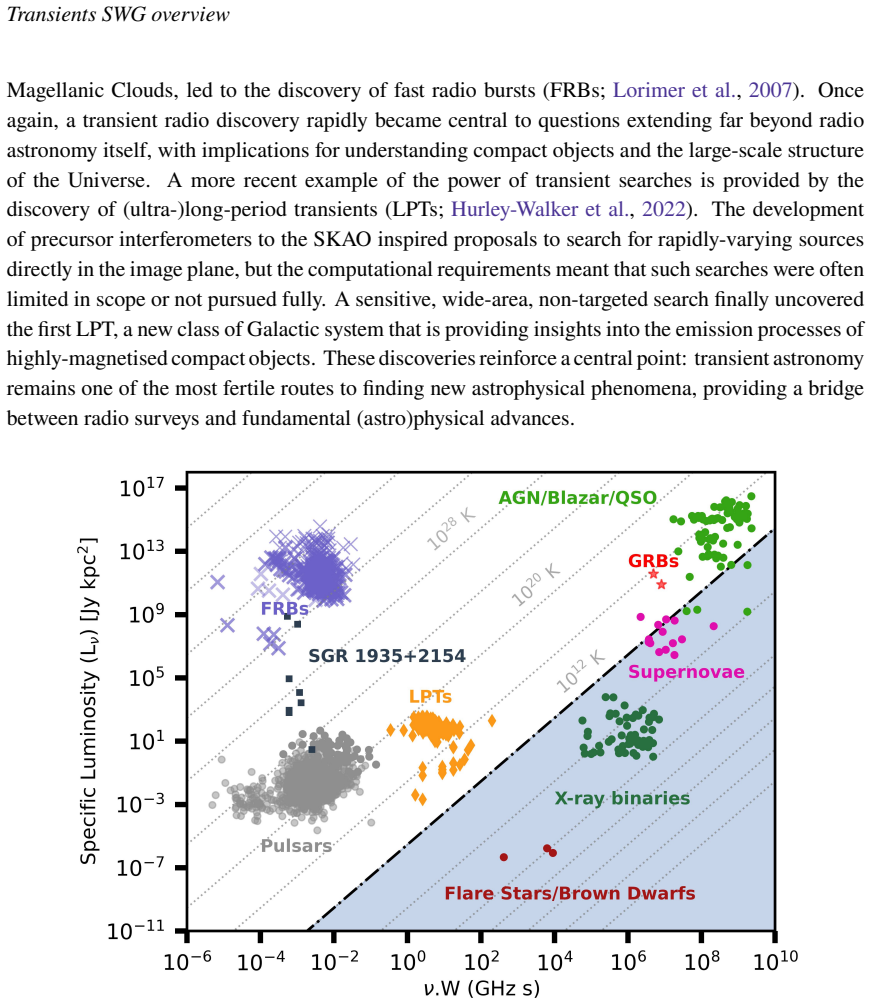
read the original abstract
Transient astrophysics provides a set of unique laboratories for studying fundamental physics. From the launching of powerful relativistic jets to merging neutron stars, highly-magnetised compact objects, or stellar explosions, transients probe the Universe at its most extreme. The SKAO will provide an unrivalled set of capabilities for transient observations on timescales from nanoseconds to decades, opening new discovery space. With its sensitivity, broad spectral coverage, wide field of view, and high survey speed, SKAO will allow us to discover and understand rare events that provide powerful new insights into regimes of high energy density, strong gravity, and intense magnetic fields. Complemented by a suite of multi-wavelength and multi-messenger facilities, and supported by a network of smaller existing radio telescopes and new computational capabilities, SKAO will unveil the most powerful and exotic events in our Universe, addressing some of the key questions in modern astrophysics and cosmology.
Editorial analysis
A structured set of objections, weighed in public.
Referee Report
Summary. The manuscript is a science white paper describing the prospective capabilities of the Square Kilometre Array Observatory (SKAO) for radio transient astrophysics. It enumerates the array's design parameters (sensitivity, spectral coverage, field of view, survey speed) and argues that these will enable discovery and study of rare transients on timescales from nanoseconds to decades, yielding insights into high-energy-density regimes, strong gravity, and intense magnetic fields when combined with multi-wavelength and multi-messenger facilities plus supporting radio telescopes and computational resources.
Significance. If the SKAO meets its stated design specifications, the white paper supplies a useful planning document that maps specific instrumental strengths onto open questions in transient science. It correctly identifies the value of coordinated multi-messenger follow-up and existing smaller arrays, providing a clear science case without advancing new quantitative forecasts or derivations.
Simulated Author's Rebuttal
We thank the referee for their positive review and recommendation to accept the manuscript. The referee's summary accurately reflects the scope of this science white paper on SKAO transient capabilities.
Circularity Check
No significant circularity
full rationale
The document is a descriptive science white paper enumerating the design capabilities of the SKAO for radio transient science. It advances no equations, derivations, fitted parameters, quantitative predictions, or uniqueness theorems. All claims are conditional on external design specifications and complementary facilities. No load-bearing steps reduce to self-definition, fitted inputs, or self-citation chains; the text is self-contained against external benchmarks.
Axiom & Free-Parameter Ledger
Reference graph
Works this paper leans on
-
[1]
An et al
T. An et al. InAdvancing Astrophysics with the SKA – II (AASKAII). 2026a. arXiv search: Report number AASKAII/TaoAn02. T. An et al. InAdvancing Astrophysics with the SKA – II (AASKAII). 2026b. arXiv search: Report number AASKAII/TaoAn03. T. An et al. InAdvancing Astrophysics with the SKA – II (AASKAII). 2026c. arXiv search: Report number AASKAII/TaoAn01. ...
2026
-
[2]
doi: 10.1016/j.newar.2004.09.038. A. P. Curtin et al. InAdvancing Astrophysics with the SKA – II (AASKAII)
-
[3]
doi: 10.1038/s41550-025-02491-0. L. N. Driessen et al. InAdvancing Astrophysics with the SKA – II (AASKAII)
-
[4]
doi: 10.22323/1.215.0051. R. Fender et al.Astronomy and Geophysics, 64(6):6.24–6.30, Dec
-
[5]
doi: 10.1093/astrogeo/ atad059. S. Giarratana et al. InAdvancing Astrophysics with the SKA – II (AASKAII)
-
[6]
T.H.Hankins,J.S.Kern,J.C.Weatherall,andJ.A.Eilek.Nature,422(6928):141–143,Mar.2003
arXiv search: Report number AASKAII/Giarratana01. T.H.Hankins,J.S.Kern,J.C.Weatherall,andJ.A.Eilek.Nature,422(6928):141–143,Mar.2003. doi: 10.1038/nature01477. A. Hewish et al.Nature, 217(5130):709–713, Feb
-
[7]
doi: 10.1038/217709a0. R. A. Hulse and J. H. Taylor.ApJL, 195:L51–L53, Jan
-
[8]
N.Hurley-Walkeretal.Nature,601(7894):526–530,Jan.2022
doi: 10.1086/181708. N.Hurley-Walkeretal.Nature,601(7894):526–530,Jan.2022. doi: 10.1038/s41586-021-04272-x. B.C.Joshi,A.Karastergiou,andM.Burgay.InAdvancingAstrophysicswiththeSKA–II(AASKAII)
-
[9]
doi: 10.1086/180305. 9 Transients SWG overview Y. Kovalev et al. InAdvancing Astrophysics with the SKA – II (AASKAII)
-
[10]
doi: 10.1126/science.1147532. T. Murphy and D. L. Kaplan.PASA, 43:e006, Jan
-
[11]
doi: 10.1017/pasa.2025.10128. E. Petroff, J. W. T. Hessels, and D. R. Lorimer.A&ARv, 30(1):2, Dec
-
[12]
doi: 10.1086/174038. F.Röschetal. InAdvancingAstrophysicswiththeSKA–II(AASKAII).2026. arXivsearch: Report number AASKAII/Rosch01. X. Shu et al. InAdvancing Astrophysics with the SKA – II (AASKAII)
discussion (0)
Sign in with ORCID, Apple, or X to comment. Anyone can read and Pith papers without signing in.