A conceptual model for the evo-devo role of transposable elements and its implications for the ageing phenomenon
Pith reviewed 2026-07-01 02:17 UTC · model grok-4.3
The pith
Transposable elements contribute to ageing by releasing regulatory activity late in life after early repression.
A machine-rendered reading of the paper's core claim, the machinery that carries it, and where it could break.
Core claim
The proposal acknowledges that these elements facilitate the expansion and diversification of gene regulatory networks by providing transcription factor binding sites. To minimise disruption, their regulatory activity is tightly repressed by epigenetic mechanisms during early development, which may be progressively released by genetically driven, age-associated epigenetic changes in later life, thereby contributing to transcriptional pseudo-randomness and ageing-associated phenotypes. Within this framework, transposable elements are integrated into a unified view of evolution, development and ageing, providing a conceptual basis for their dual role in regulatory innovation and age-related de
What carries the argument
Progressive release of epigenetically repressed transposable element regulatory activity driven by genetically programmed age-associated epigenetic changes.
If this is right
- Ageing phenotypes arise in part from transcriptional pseudo-randomness caused by released transposable element activity.
- The same transposable elements that enable regulatory network diversification early in life contribute to age-related decline later.
- Developmental genes can influence late-life phenotypes through their effects on the timing of epigenetic changes affecting transposable elements.
- Evolution optimizes the timing of these epigenetic modifications to balance regulatory innovation against somatic costs.
Where Pith is reading between the lines
- The timing of epigenetic release could be a selectable trait that trades off early developmental flexibility against later lifespan.
- Disruption of age-related epigenetic drift might reduce the contribution of transposable elements to transcriptional noise.
- The model connects mobile element activity to the broader process of somatic experimentation described in the Evolvable Soma Theory.
Load-bearing premise
Age-associated epigenetic changes progressively release the epigenetic repression of transposable element regulatory activity in later life.
What would settle it
Direct observation that transposable element transcription and regulatory activity show no increase with age and no correlation with ageing-associated phenotypes in tissues.
Figures
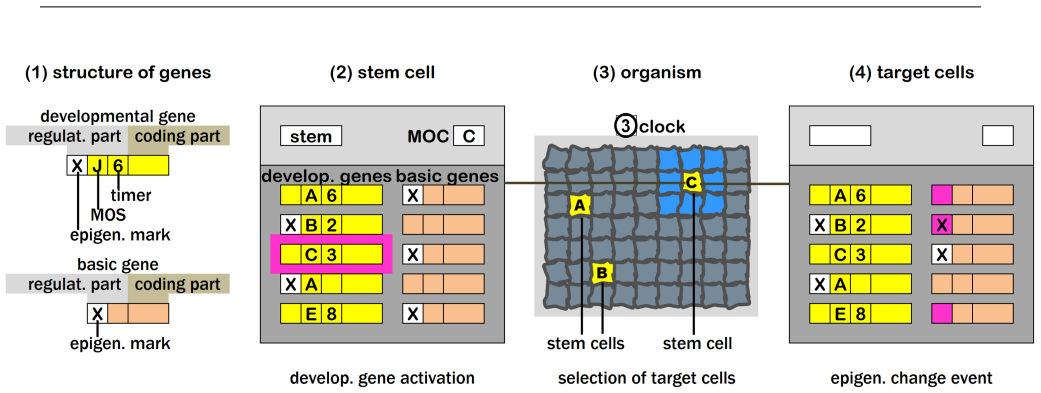


read the original abstract
The Evolvable Soma Theory of Ageing is a recently proposed model that frames development as a continuous process of change accompanying organisms throughout the lifespan. This process is driven by developmental genes which encode epigenetic changes on target cells, whereas ageing reflects the expression of late-acting modifications, that are subject to ongoing evolutionary optimisation and function as somatic "experiments" to explore phenotypic novelty. In this work we examine the role of transposable elements in the model. Our proposal acknowledges that these elements facilitate the expansion and diversification of gene regulatory networks by providing transcription factor binding sites. To minimise disruption, their regulatory activity is tightly repressed by epigenetic mechanisms during early development, which may be progressively released by genetically driven, age-associated epigenetic changes in later life, thereby contributing to transcriptional pseudo-randomness and ageing-associated phenotypes. Within this framework, transposable elements are integrated into a unified view of evolution, development and ageing, providing a conceptual basis for their dual role in regulatory innovation and age-related decline.
Editorial analysis
A structured set of objections, weighed in public.
Referee Report
Summary. The manuscript presents a conceptual model integrating transposable elements (TEs) into the Evolvable Soma Theory of Ageing. TEs are proposed to facilitate expansion and diversification of gene regulatory networks by providing transcription factor binding sites. Their regulatory activity is described as tightly repressed by epigenetic mechanisms during early development, with this repression potentially progressively released by genetically driven, age-associated epigenetic changes in later life, thereby contributing to transcriptional pseudo-randomness and ageing-associated phenotypes. The framework aims to unify evolution, development, and ageing through this dual role of TEs.
Significance. If the proposed linkages hold, the model supplies a conceptual scaffold for viewing TEs as contributors to both regulatory innovation and age-related transcriptional dysregulation, which could orient future studies on epigenetic control of TEs across lifespan stages. As a purely interpretive proposal without derivations, data, or explicit predictions, its significance rests on its capacity to stimulate targeted empirical work rather than on immediate explanatory power.
major comments (1)
- [Abstract] Abstract: the claim that age-associated epigenetic changes 'may be progressively released' the repression of TE regulatory activity is presented as an integrative hypothesis but is defined entirely in terms of the Evolvable Soma Theory's premises on somatic experiments and late-acting modifications; no independent mechanistic references or external benchmarks are supplied, rendering the linkage circular and the central claim dependent on untested assumptions about progressive release.
minor comments (1)
- The manuscript would benefit from an explicit section (or subsection) enumerating concrete, falsifiable predictions that could be tested to evaluate the proposed release of TE repression during ageing.
Simulated Author's Rebuttal
We thank the referee for their careful reading and constructive feedback on our conceptual model. We respond point-by-point to the single major comment and indicate planned revisions where appropriate.
read point-by-point responses
-
Referee: [Abstract] Abstract: the claim that age-associated epigenetic changes 'may be progressively released' the repression of TE regulatory activity is presented as an integrative hypothesis but is defined entirely in terms of the Evolvable Soma Theory's premises on somatic experiments and late-acting modifications; no independent mechanistic references or external benchmarks are supplied, rendering the linkage circular and the central claim dependent on untested assumptions about progressive release.
Authors: The manuscript is explicitly framed as a conceptual integration of transposable elements into the existing Evolvable Soma Theory rather than an independent mechanistic proposal. The progressive release of TE repression is advanced as a direct implication of the theory's core premises concerning late-acting, genetically driven epigenetic modifications that function as somatic experiments. This dependence on the parent framework is intentional and is stated in the abstract and introduction; it is not presented as an empirically validated mechanism. We agree that the current wording in the abstract does not sufficiently foreground this dependence or the hypothetical status of the extension. We will therefore revise the abstract to (i) explicitly note that the proposed TE contribution rests on the Evolvable Soma Theory's assumptions about age-associated epigenetic dynamics and (ii) emphasize that the model is offered as a scaffold for future empirical work rather than a standalone claim. No independent mechanistic references exist within the scope of a purely interpretive paper, so none will be added. revision: partial
Circularity Check
No significant circularity identified
full rationale
The manuscript is a conceptual proposal that embeds transposable elements within the Evolvable Soma Theory of Ageing. It presents no derivations, equations, quantitative predictions, or logical steps that reduce by construction to the paper's own inputs. The integration of TE regulatory activity (repressed early, "may be progressively released" later by age-associated epigenetic changes) is explicitly framed as a hypothesis within the pre-existing framework rather than a derived or fitted result. No self-citation load-bearing chains, ansatzes, or uniqueness theorems are invoked to force the central claims. The text operates at the level of framework construction and remains self-contained as an integrative hypothesis without internal circular reductions.
Axiom & Free-Parameter Ledger
axioms (2)
- domain assumption Development is a continuous process of change driven by developmental genes which encode epigenetic changes on target cells.
- domain assumption Ageing reflects the expression of late-acting modifications that are subject to ongoing evolutionary optimisation and function as somatic experiments.
invented entities (1)
-
somatic experiments
no independent evidence
Reference graph
Works this paper leans on
- [1]
-
[2]
Atwood, C. S. and others , year =. The reproductive-cell cycle theory of aging: an update , journal =
-
[3]
Bao, J. and Yan, W. , year =. Male germline control of transposable elements , journal =
-
[4]
Beck, C. R. and Garcia-Perez, J. L. and Badge, R. M. and Moran, J. V. , year =. LINE-1 Elements in Structural Variation and Disease , journal =
-
[5]
Aptekmann, A. A. and Bulavka, D. and Nadra, A. D. and Sánchez, I. E. , year =. Transcription factor specificity limits the number of. PLOS ONE , volume =
-
[6]
Atwood, C. S. and Bowen, R. L. , year =. The reproductive-cell cycle theory of aging: an update , journal =
-
[7]
Braveman, P. and Gottlieb, L. , year =. The social determinants of health: it's time to consider the causes of the causes , journal =
-
[8]
Britten, R. J. and Davidson, E. H. , year =. Gene regulation for higher cells: a theory , journal =
-
[9]
Chang, N.-C. and others , year =. Zebrafish transposable elements show extensive diversification in age, genomic distribution, and developmental expression , journal =
-
[10]
Chuong, E. B. and Elde, N. C. and Feschotte, C. , year =. Regulatory activities of transposable elements: from conflicts to benefits , journal =
-
[11]
Collier, L. and Largaespada, D. , year =. Transposable elements and the dynamic somatic genome , journal =
-
[12]
Cossetti, C. and others , year =. Soma-to-germline transmission of. PLOS ONE , volume =
-
[13]
Du, A. Y. and others , year =. Regulatory transposable elements in the encyclopedia of DNA elements , journal =
- [14]
-
[15]
Feschotte, C. and Jiang, N. and Wessler, S. R. , year =. Plant transposable elements: where genetics meets genomics , journal =
- [16]
- [17]
- [18]
- [19]
-
[20]
Fontana, A. and Wr\'obel, B. , year =. A model of evolution of development based on Germline Penetration of new ``no-junk''. Genes , volume =
-
[21]
Fontana, A. and Wr\'obel, B. , year =. Pseudorandomness of gene expression: a new evo-devo theory of ageing , journal =
- [22]
-
[23]
Fontana, A. and Kyriazis, M. , year =. How evolution makes us age: introducing the evolvable soma theory of ageing , journal =
-
[24]
Fontana, A. and Wr\'obel, B. , year =. Evolvability in artificial development of large, complex structures and the principle of terminal addition , journal =
-
[25]
Fontana, A. and Kyriazis, M. , year =. Evolvable Soma Theory of Ageing: insights from computer simulations , journal =
-
[26]
Fontana, A. and Kyriazis, M. , year =. Evo-devo computational comparison of Evolvable Soma Theory of Ageing and Standard Evolutionary Ageing Theory , booktitle =
- [27]
-
[28]
Giaimo, S , year =. Medawar and. History and Philosophy of the Life Sciences , volume =
- [29]
- [30]
-
[31]
Gould, S. J. , year =. Ontogeny and phylogeny , publisher =
-
[32]
Gregory, T. R. , year =. Genome size evolution in animals , booktitle =
- [33]
-
[34]
Hamilton, W. D. , year =. The genetical evolution of social behaviour , journal =
-
[35]
Ilık. I. A. and Yang, X. and Zhang, Z.Z.Z. and Aktaş, T. , year =. Transcriptional and post-transcriptional regulation of transposable elements and their roles in development and disease , journal =
-
[36]
Jablonka, E. and Lamb, M. J. , year =. Evolution in four dimensions: genetic, epigenetic, behavioral, and symbolic variation in the history of life , publisher =
-
[37]
Jacques, P. E. and Jeyakani, J. Bourque, G. , year =. The majority of primate-specific regulatory sequences are derived from transposable elements , journal =
-
[38]
Jenuwein, T. and Allis, C. D. , year =. Translating the histone code , journal =
-
[39]
Kazazian, H. H. , year =. Mobile elements: drivers of genome evolution , journal =
-
[40]
Kirkwood, T. B. L. and Austad, S. N. , year =. Why do we age? , journal =
-
[41]
Koh, W. and others , year =. Noninvasive in vivo monitoring of tissue-specific global gene expression in humans , journal =
-
[42]
Koonin, E. V. , year =. Orthologs, paralogs, and evolutionary genomics , journal =
-
[43]
Kunarso, G. and others , year =. Transposable elements have rewired the core regulatory network of human embryonic stem cells , journal =
-
[44]
Lawson, H. A. and Liang, Y. and Wang, T. , year =. Transposable elements in mammalian chromatin organization , journal =
-
[45]
Levine, M. E. and others , year =. An epigenetic biomarker of aging for lifespan and healthspan , journal =
-
[46]
Lippman, Z. and others , year =. Role of transposable elements in heterochromatin and epigenetic control , journal =
-
[47]
Lopez-Otin, C. and others , year =. The hallmarks of aging , journal =
-
[48]
Lowe, C. B. and Bejerano, G. and Haussler, D. , year =. Thousands of human mobile element fragments undergo strong purifying selection near developmental genes , journal =
-
[49]
Lu, Y. R. and Tian, X. and Sinclair, D. A. , year =. The Information Theory of Aging , journal =
- [50]
-
[51]
Micale, L. and others , year =. A fish-specific transposable element shapes the repertoire of p53 target genes in zebrafish , journal =
-
[52]
Mills, R. E. and Bennett, E. A. and Iskow, R. C. and Devine, S. E. , year =. Which transposable elements are active in the human genome? , journal =
-
[53]
Evolution: the extended synthesis , editor =
M. Evolution: the extended synthesis , editor =. 2010 , title =
work page 2010
-
[54]
Muotri, A. R. and others , year =. Somatic mosaicism in neuronal precursor cells mediated by. Nature , volume =
- [55]
-
[56]
Oliver, K. R. and Greene, W. K. , year =. Transposable elements: powerful facilitators of evolution , journal =
-
[57]
Orgel, L. E. and Crick, F. H. C. , year =. Selfish. Nature , volume =
-
[58]
Perry, R. B.-T. and Ulitsky, I. , year =. The functions of long noncoding. Development , volume =
-
[59]
Plant, T. M. and Witchel, S. F. , year =. Puberty in nonhuman primates and humans , booktitle =
-
[60]
Raff, R. A. , year =. The shape of life: genes, development, and the evolution of animal form , publisher =
-
[61]
Rebollo, R. and Romanish, M. T. and Mager, D. L. , year =. Transposable elements: an abundant and natural source of regulatory sequences for host genes , journal =
-
[62]
Rebollo, R. and Zhang, Y. and Mager, D. L. , year =. Transposable elements: not as quiet as a mouse , journal =
-
[63]
Reik, W. and Dean, W. and Walter, J. , year =. Epigenetic reprogramming in mammalian development , journal =
-
[64]
Rinn, J. L. , year =. lnc. Cold Spring Harbor Perspectives in Biology , volume =
-
[65]
Rogers, C. D. and others , year =. Pluripotency of a founding field: rebranding developmental biology , journal =
-
[66]
Shapiro, J. A. , year =. Evolution: a view from the 21st century , publisher =
-
[67]
Smith, K. and Spadafora, C. , year =. Sperm-mediated gene transfer: applications and implications , journal =
-
[68]
Stewart, A. J. and Hannenhalli, S. Plotkin, J. B. , year =. Why transcription factor binding sites are ten nucleotides long , journal =
-
[69]
Sundaram, V. and others , year =. Widespread contribution of transposable elements to the innovation of gene regulatory networks , journal =
-
[70]
Testori, A. and others , year =. The role of transposable elements in shaping the combinatorial interaction of transcription factors , journal =
-
[71]
Thierry, A. R. and others , year =. Origins, structures, and functions of circulating. Cancer and Metastasis Reviews , volume =
-
[72]
Thomas, C. A. and Paquola, A. C. M. and Muotri, A. R. , year =. LINE-1 retrotransposition in the nervous system , journal =
-
[73]
Yang, J. H. and others , year =. Loss of epigenetic information as a cause of mammalian aging , journal =
-
[74]
Vaupel, J. W. and Manton, K. G. and Stallard, E. , year =. The impact of heterogeneity in individual frailty on the dynamics of mortality , journal =
- [75]
-
[76]
Wan, J. C. M. and others , year =. Liquid biopsies come of age: towards implementation of circulating tumour. Nature Reviews Cancer , volume =
-
[77]
Wang, S. and others , year =. Multi-platform framework for mapping somatic retrotransposition in human tissues , journal =
-
[78]
Wasserzug-Pash, P. and others , year =. Loss of heterochromatin and retrotransposon silencing as determinants in oocyte aging , journal =
- [79]
- [80]
discussion (0)
Sign in with ORCID, Apple, or X to comment. Anyone can read and Pith papers without signing in.