Effect of different clustering approaches on the multilevel fast multipole method for the Helmholtz equation
Pith reviewed 2026-07-01 04:16 UTC · model grok-4.3
The pith
Clustering approaches strongly influence the efficiency and stability of the multilevel fast multipole method for the Helmholtz equation.
A machine-rendered reading of the paper's core claim, the machinery that carries it, and where it could break.
Core claim
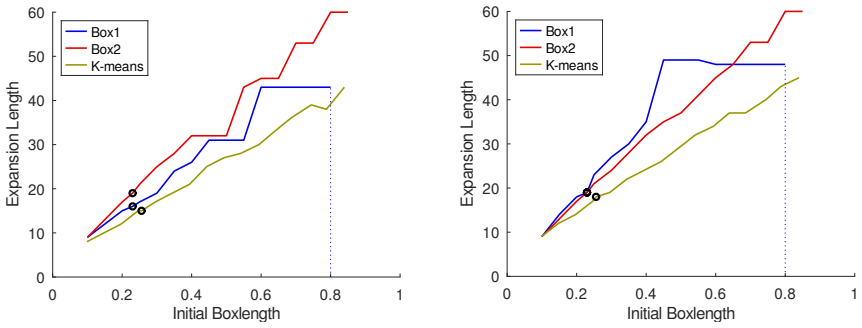
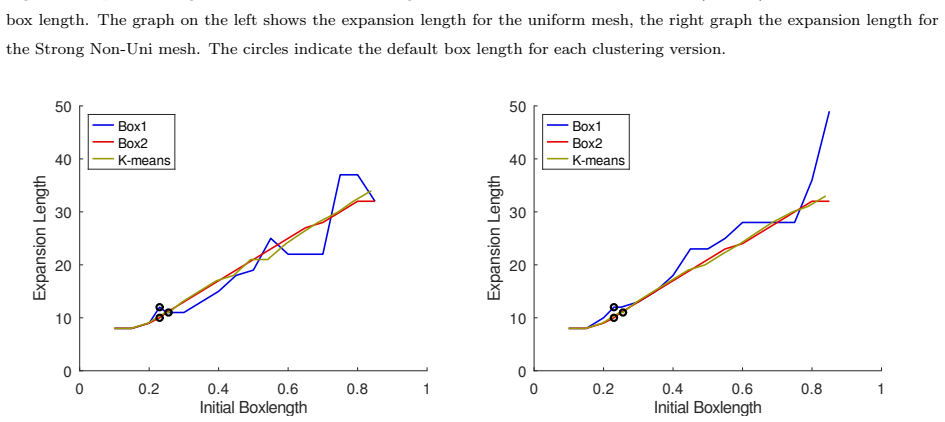
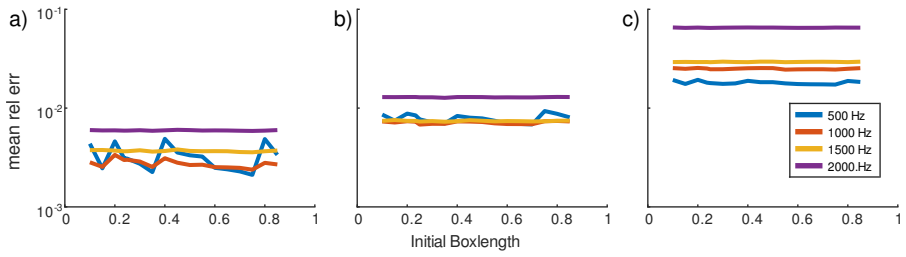
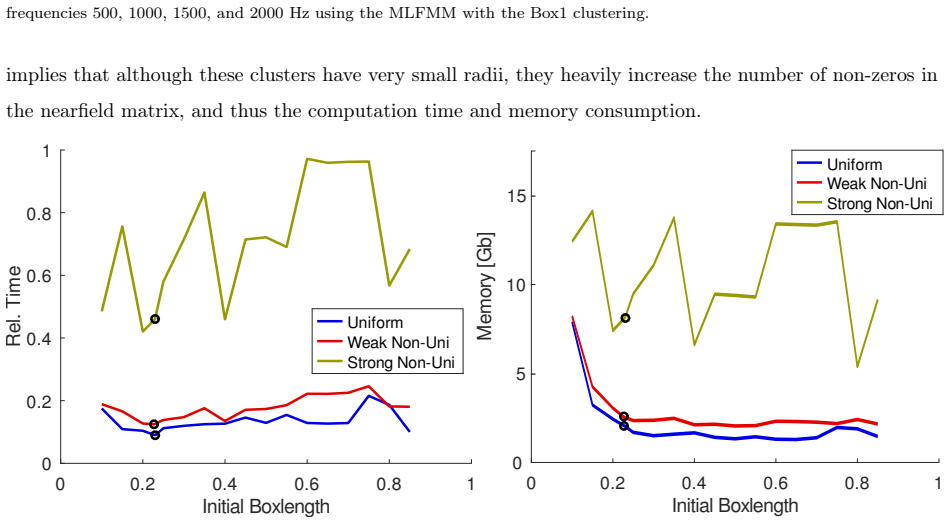
The clustering process has a huge impact on the efficiency and stability of the FMM, and wrong clustering can lead to numerical problems and instabilities of the FMM-BEM. This effect is observed for both uniform and non-uniform element size meshes, showing that the assumption of roughly equal element sizes does not always hold in applications.
What carries the argument
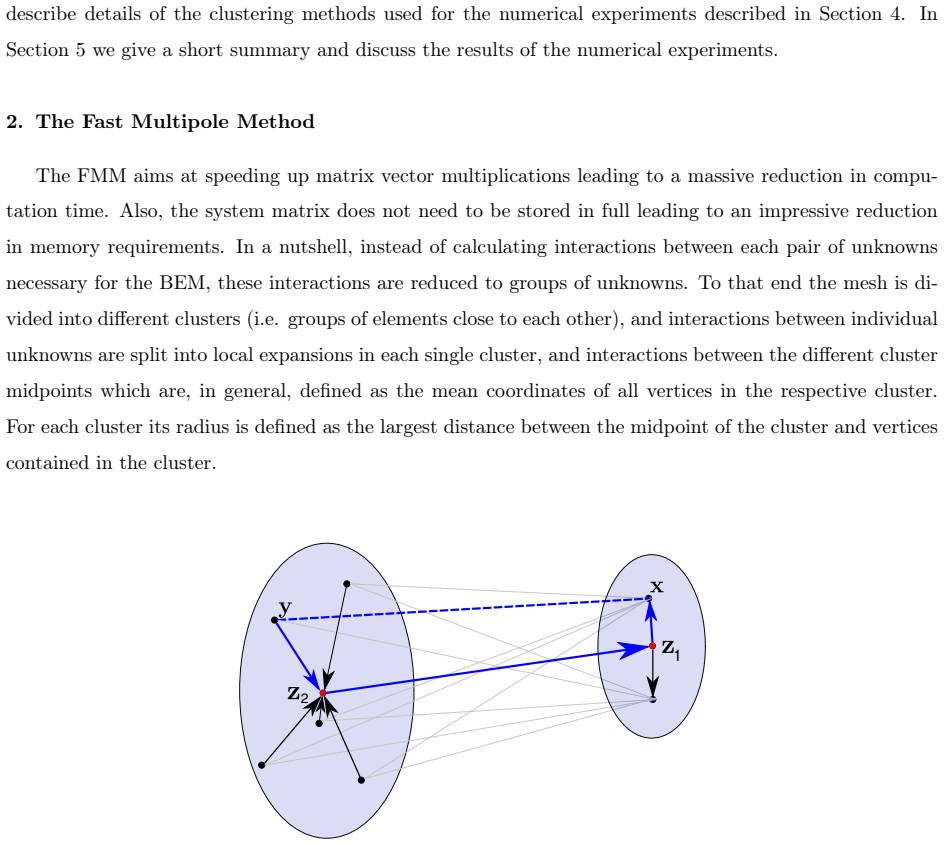
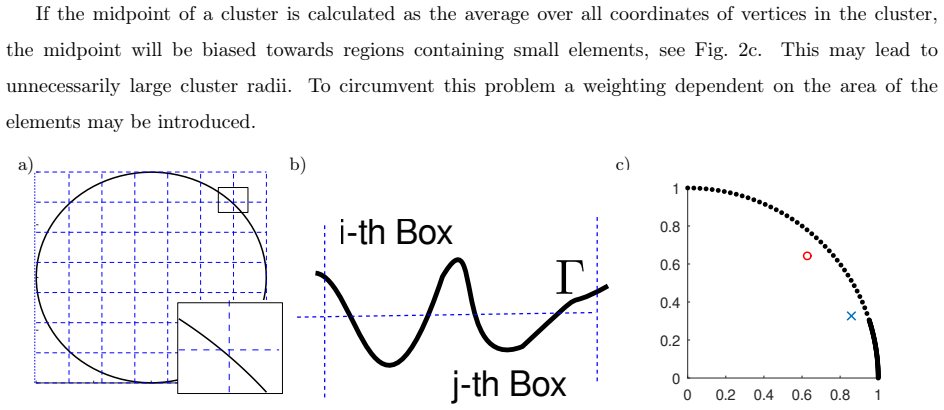
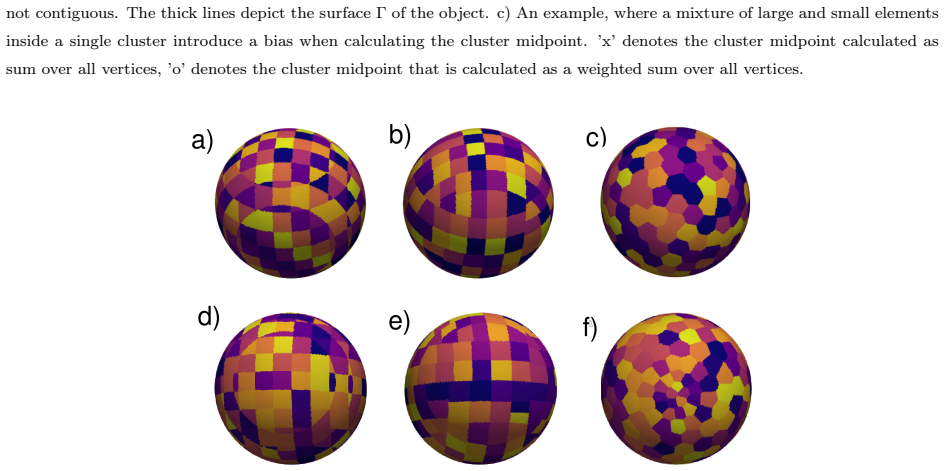
The formation of clusters from boundary elements, where cluster size in number of elements and spatial extent controls the behavior of the multilevel fast multipole expansions in the Helmholtz BEM.
If this is right
- Suitable clustering maintains both computational efficiency and numerical stability of the FMM-BEM.
- Unsuitable clustering produces instabilities that are more severe on meshes with non-uniform element sizes.
- Clustering strategies must incorporate information about element size variation instead of assuming uniformity.
- The clustering choice can decide whether an FMM-BEM run completes without numerical failure.
Where Pith is reading between the lines
- FMM software for boundary element work should expose several clustering options together with mesh-based selection rules.
- Clustering sensitivity may appear in fast multipole applications outside the Helmholtz equation.
- Mesh-aware or adaptive clustering routines could reduce the instabilities seen with fixed clustering methods.
Load-bearing premise
The observed effects on stability and efficiency arise primarily from the clustering approach rather than from other aspects of the FMM implementation or the specific properties of the test meshes.
What would settle it
Identical FMM-BEM code run on the same non-uniform mesh but with only the clustering algorithm swapped, producing consistent stability changes that track the clustering choice across repeated trials.
Figures
read the original abstract
The fast multipole method (FMM) is an important component for the boundary element method (BEM), because with the FMM the efficiency and feasibility of the BEM can be enhanced to a large degree. Part of the FMM is grouping the elements of the boundary element mesh into different clusters. The size of these clusters in terms of number of elements and spatial expansion has a huge impact on the efficiency and stability of the method. However, while the theory behind the multipole expansion has been broadly researched, the clustering process itself and its effect on the FMM has been neglected in comparison. Most of the time, for example, it is implicitly assumed that the elements of the mesh have about the same size, which is often not the case in practical applications, e.g., when calculating the sound field around the human head. In this study we compare different types of clustering approaches with respect to stability and efficiency of the underlying FMM applied to meshes that have uniform as well as non-uniform element sizes. Also, some examples are provided for cases where a wrong clustering can lead to numerical problems and instabilities of the FMM-BEM.
Editorial analysis
A structured set of objections, weighed in public.
Referee Report
Summary. The manuscript investigates the effect of different clustering approaches on the stability and efficiency of the multilevel fast multipole method (FMM) within the boundary element method (BEM) for the Helmholtz equation. It compares clustering strategies on meshes with uniform versus non-uniform element sizes and provides examples where inappropriate clustering leads to numerical instabilities in the FMM-BEM.
Significance. If the comparisons were supported by quantitative data isolating clustering effects, the work would address a practical but under-examined implementation detail relevant to applications with adaptive meshes (e.g., acoustic BEM on complex geometries). The current abstract and description, however, contain no numerical results, error metrics, timing data, or controlled experiments, so the claimed 'huge impact' on stability and efficiency cannot be evaluated.
major comments (2)
- [Abstract] The central claim that clustering has a 'huge impact' on stability and that 'wrong clustering can lead to numerical problems' is asserted in the abstract without any supporting data, tables, or figures quantifying efficiency (e.g., CPU time, memory) or stability (e.g., condition numbers, residual norms, or failure rates). This absence prevents assessment of whether the observed effects are attributable to clustering rather than other FMM parameters.
- [Abstract / Introduction] No description is given of the controls used to hold fixed other FMM components (multipole expansion order, translation operators, quadrature rules, or preconditioners) while varying only the clustering method. Without such isolation, differences in stability cannot be confidently attributed to clustering alone, as noted by the stress-test concern.
minor comments (1)
- [Abstract] The abstract refers to 'the theory behind the multipole expansion' but provides no citations or brief recap of the relevant FMM theory for the Helmholtz kernel.
Simulated Author's Rebuttal
We thank the referee for the detailed comments. The manuscript presents concrete numerical examples of instabilities on non-uniform meshes, but we agree the abstract can be strengthened to better signal the quantitative content. We respond point by point below.
read point-by-point responses
-
Referee: [Abstract] The central claim that clustering has a 'huge impact' on stability and that 'wrong clustering can lead to numerical problems' is asserted in the abstract without any supporting data, tables, or figures quantifying efficiency (e.g., CPU time, memory) or stability (e.g., condition numbers, residual norms, or failure rates). This absence prevents assessment of whether the observed effects are attributable to clustering rather than other FMM parameters.
Authors: The abstract is a concise summary; the body of the manuscript supplies the supporting evidence through explicit examples and figures that demonstrate instabilities (e.g., solver divergence or elevated residuals) when clustering is mismatched to non-uniform element sizes. These examples isolate the clustering choice while other parameters remain fixed. We will revise the abstract to explicitly note that quantitative demonstrations appear in the results section, including references to the observed failure modes. revision: partial
-
Referee: [Abstract / Introduction] No description is given of the controls used to hold fixed other FMM components (multipole expansion order, translation operators, quadrature rules, or preconditioners) while varying only the clustering method. Without such isolation, differences in stability cannot be confidently attributed to clustering alone, as noted by the stress-test concern.
Authors: The experimental design in the methods and results sections keeps the multipole order, translation operators, quadrature, and preconditioner identical across all clustering variants, varying only the clustering strategy. We acknowledge that an explicit statement of these controls would make the isolation clearer. We will insert a dedicated paragraph in the introduction (or a short methods subsection) that lists the fixed parameters and confirms the single-variable design. revision: yes
Circularity Check
No circularity: empirical comparison study with no derivations or predictions.
full rationale
The paper is a direct numerical comparison of clustering methods applied to FMM-BEM on uniform and non-uniform meshes. It reports observed effects on efficiency and stability without any claimed first-principles derivations, fitted parameters renamed as predictions, or load-bearing self-citations that reduce the central claim to its own inputs. The abstract and described content contain no equations or theoretical steps that could exhibit self-definition or construction equivalence. This matches the default expectation for non-derivational empirical work.
Axiom & Free-Parameter Ledger
Reference graph
Works this paper leans on
-
[1]
Coifman, V
R. Coifman, V. Rokhlin, S. Wandzura, The fast multipole method for the wave equation: A pedestrian prescription, IEEE Trans. Antennas Propag. 35 (3) (1993) 7–12
1993
-
[2]
Rokhlin, Rapid solution of integral equations of scattering theory in two dimensions, J
V. Rokhlin, Rapid solution of integral equations of scattering theory in two dimensions, J. Comput. Phys. 86 (2) (1990) 414–439
1990
-
[3]
Rokhlin, Diagonal forms of translation operators for the Helmholtz equation in three dimensions, Appl
V. Rokhlin, Diagonal forms of translation operators for the Helmholtz equation in three dimensions, Appl. Comput. Harmon. Anal. 1 (December 1993) 82–93
1993
-
[4]
Amini, A
S. Amini, A. Profit, Multi-level fast multipole solution of the scattering problem, Eng. Anal. Bound. Elem. 27 (2003) 547–564
2003
-
[5]
Cecka, E
C. Cecka, E. Darve, Fourier based fast multipole method for the Helmholtz equation, SIAM J. Sci. Comput. 35 (1) (2013) A79–A103. 26
2013
-
[6]
Amini, A
S. Amini, A. Profit, Analysis of the truncation errors in the fast multipole method for scattering problems, J. Comput. Appl. Math. 115 (2000) 23–33
2000
-
[7]
Sauter, C
S. Sauter, C. Schwab, Boundary Element Methods, Springer Series in Computational Mathematics, Springer Berlin Heidelberg, 2010
2010
-
[8]
Cheng, W
H. Cheng, W. Crutchfield, Z. Gimbutas, L. Greengard, J. F. Ethridge, J. Huang, V. Rokhlin, N. Yarvin, J. Zhao, A wideband fast multipole method for the Helmholtz equation in three dimensions, J. Comput. Phys. 216 (2006) 300–325
2006
-
[10]
Y. Li, O. Atak, W. Desmet, Novel and efficient implementation of multi-level fast multipole indirect bem for industrial helmholtz problems, Engn. Anal. Bound. Elem. 159 (2024) 150–163.doi:10.1016/ j.enganabound.2023.11.027
2024
-
[11]
D. Yun, H. Jung, H. Kang, D. Seo, Acceleration of the Multi-Level Fast Multipole Algortihm Using K-Means Clustering, Electronics 9 (2020)
2020
-
[12]
F. Brinkmann, W. Kreuzer, J. Thomsen, S. Dombrovskis, K. Pollack, S. Weinzierl, P. Majdak, Recent Advances in an Open Software for Numerical HRTF Calculation, J. Audio Eng. Soc. 71 (7/8) (2023) 502–514.doi:10.17743/jaes.2022.0078
-
[13]
H. Ziegelwanger, W. Kreuzer, P. Majdak, A priori mesh grading for the numerical calculation of the head-related transfer functions, Appl. Acoust. 114 (2016) 99–110.doi:https://doi.org/10.1016/j. apacoust.2016.07.005
work page doi:10.1016/j 2016
-
[14]
Rahola, Diagonal forms of the translation operators in the fast multipole algorithm for scattering problems, BIT 36 (2) (1996) 333–358
J. Rahola, Diagonal forms of the translation operators in the fast multipole algorithm for scattering problems, BIT 36 (2) (1996) 333–358
1996
-
[15]
E.Darve, Thefastmultipolemethod: Numericalimplementation, J.Comput.Phys.160(2000)195–240. doi:10.1006/jcph.2000.6451
-
[16]
Greengard, J
L. Greengard, J. Huang, V. Rokhlin, S. Wandzura, Accelerating fast multipole methods for the helmholtz equation at low frequencies, IEEE Comput. Sci. Eng. 5 (3) (1998) 32–38
1998
-
[17]
Eaton, D
J. Eaton, D. Bateman, S. Hauberg, R. Wehbring, GNU Octave version 9.4.0 manual: a high-level interactive language for numerical computations (2024). URLhttps://www.gnu.org/software/octave/doc/v9.4.0/ 27
2024
-
[18]
Møller, Fundamentals of binaural technology, Appl
H. Møller, Fundamentals of binaural technology, Appl. Acoust. 36 (1992) 171–218
1992
-
[19]
H. Ziegelwanger, W. Kreuzer, P. Majdak, Mesh2HRTF: An open-source software package for the nu- merical calculation of head-related transfer functions, in: Proceeding of the 22nd International Congress on Sound and Vibration, Florence, Italy, 2015.doi:10.13140/RG.2.1.1707.1128
-
[20]
Y. Wang, G. Yu, A statistical shape model–based framework for virtual head generation and head- related transfer function database construction, Applied Acoustics 254 (2026) 111400.doi:https: //doi.org/10.1016/j.apacoust.2026.111400. 28
discussion (0)
Sign in with ORCID, Apple, or X to comment. Anyone can read and Pith papers without signing in.