Attention and Social Learning
Pith reviewed 2026-07-01 02:17 UTC · model grok-4.3
The pith
Many people fail to recognize or respond to peers' accuracy incentives even when those incentives are transparent.
A machine-rendered reading of the paper's core claim, the machinery that carries it, and where it could break.
Core claim
In the incentivized laboratory experiment, most subjects fail to consistently understand that peers with stronger incentives are more accurate, perform worse on individual attention tasks, and do not pay more attention when paired with lower-incentive peers in the social-learning task, producing behavior inconsistent with leading models of flexible costly information acquisition.
What carries the argument
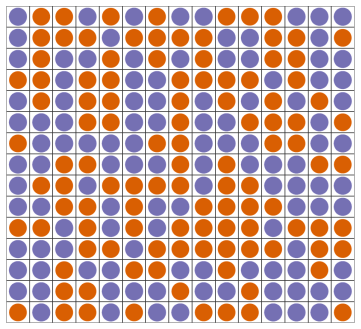
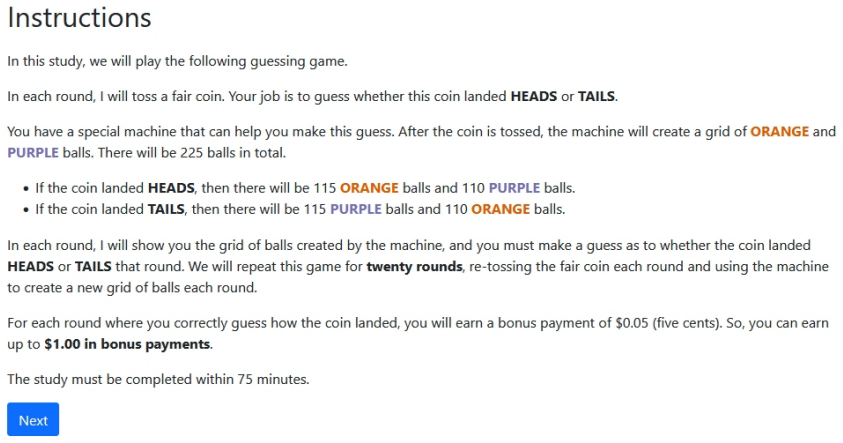
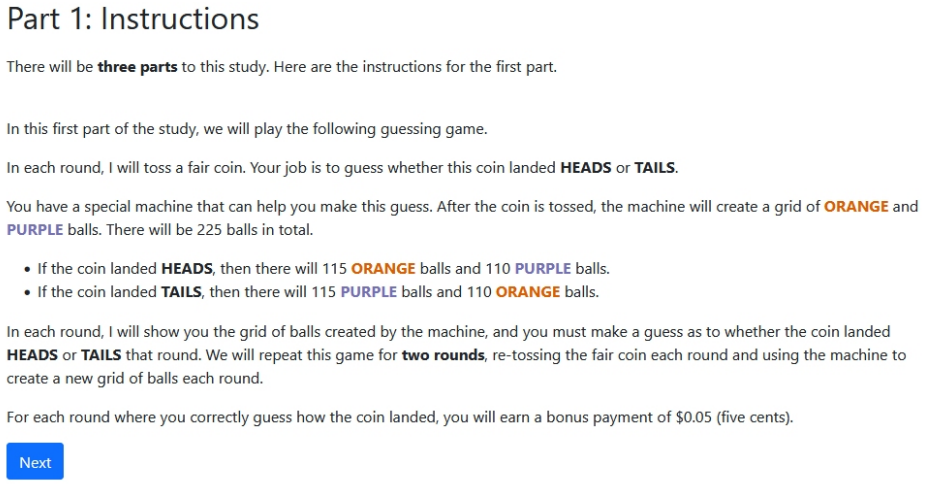
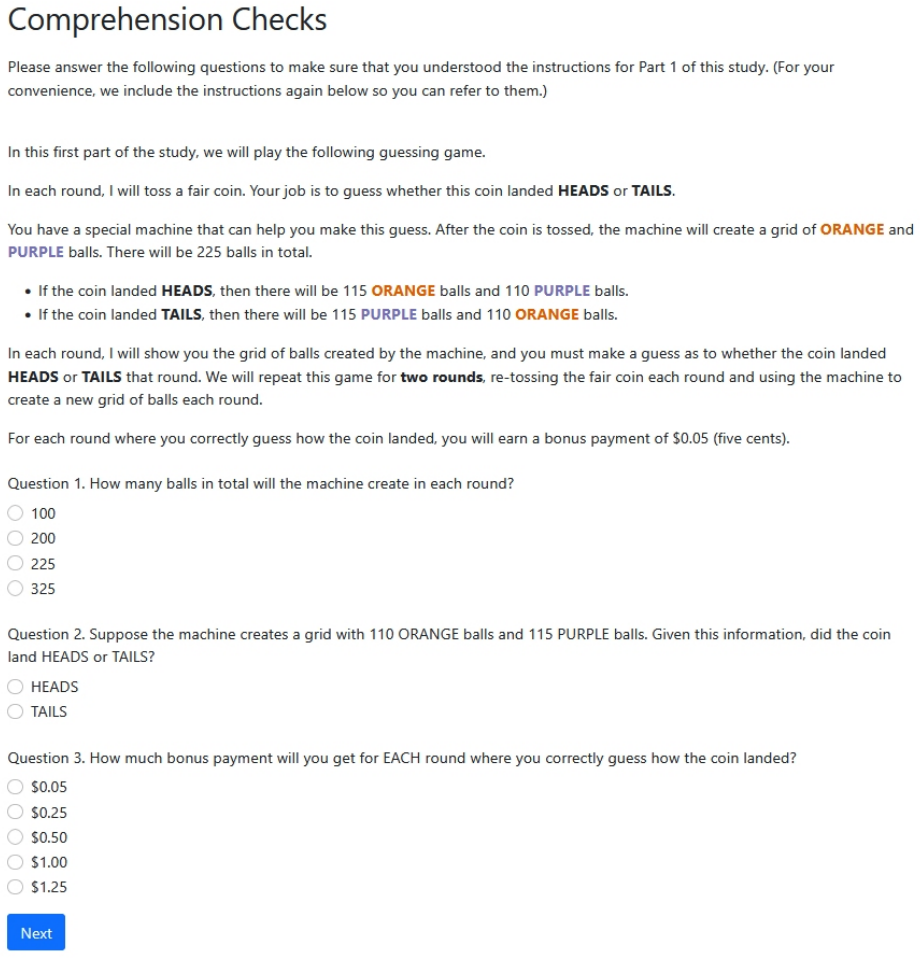
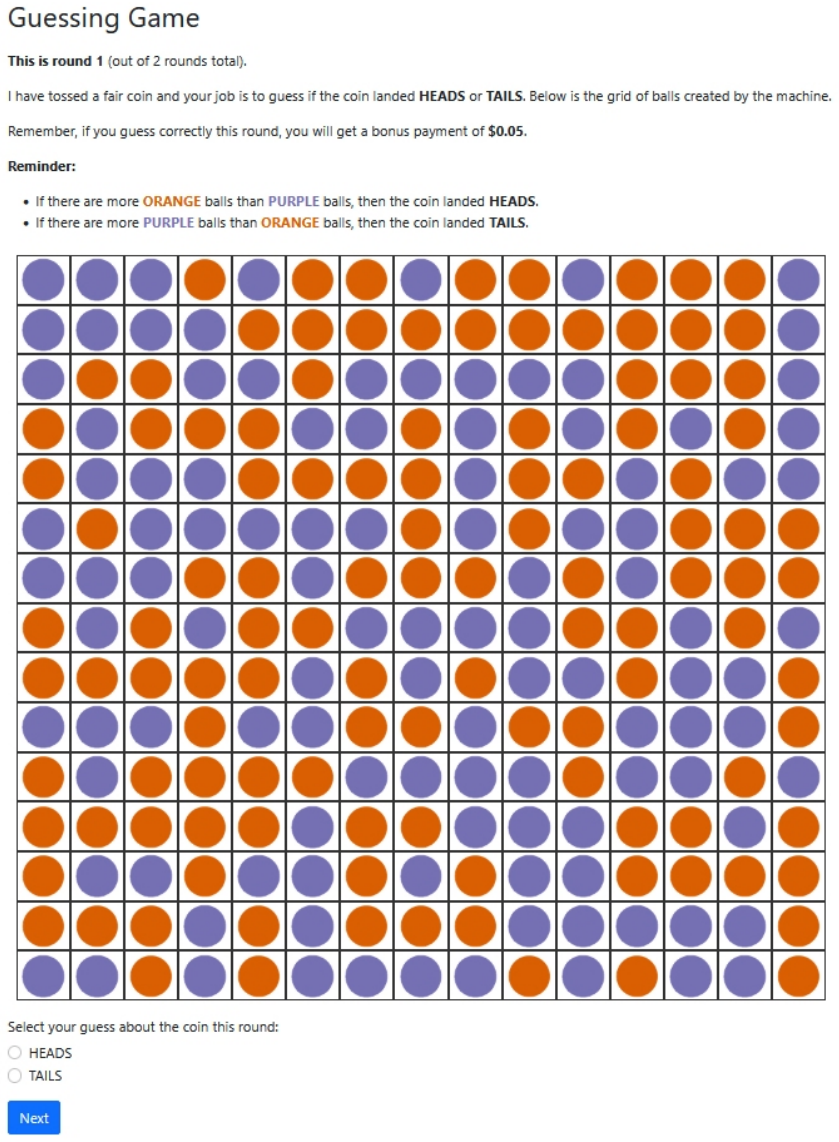
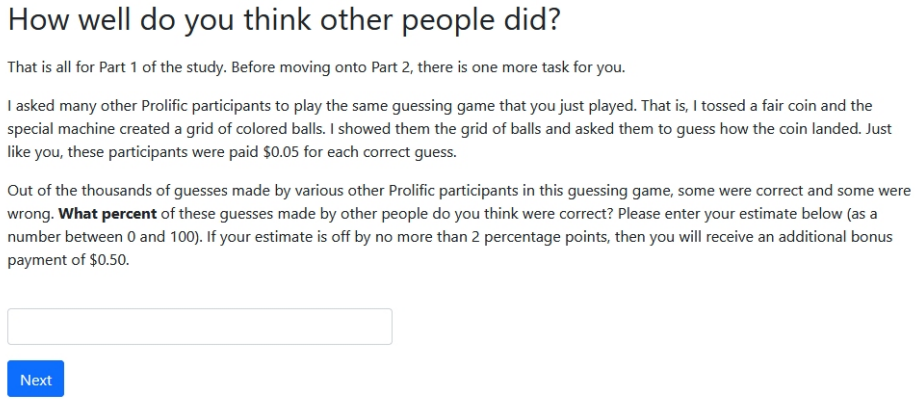
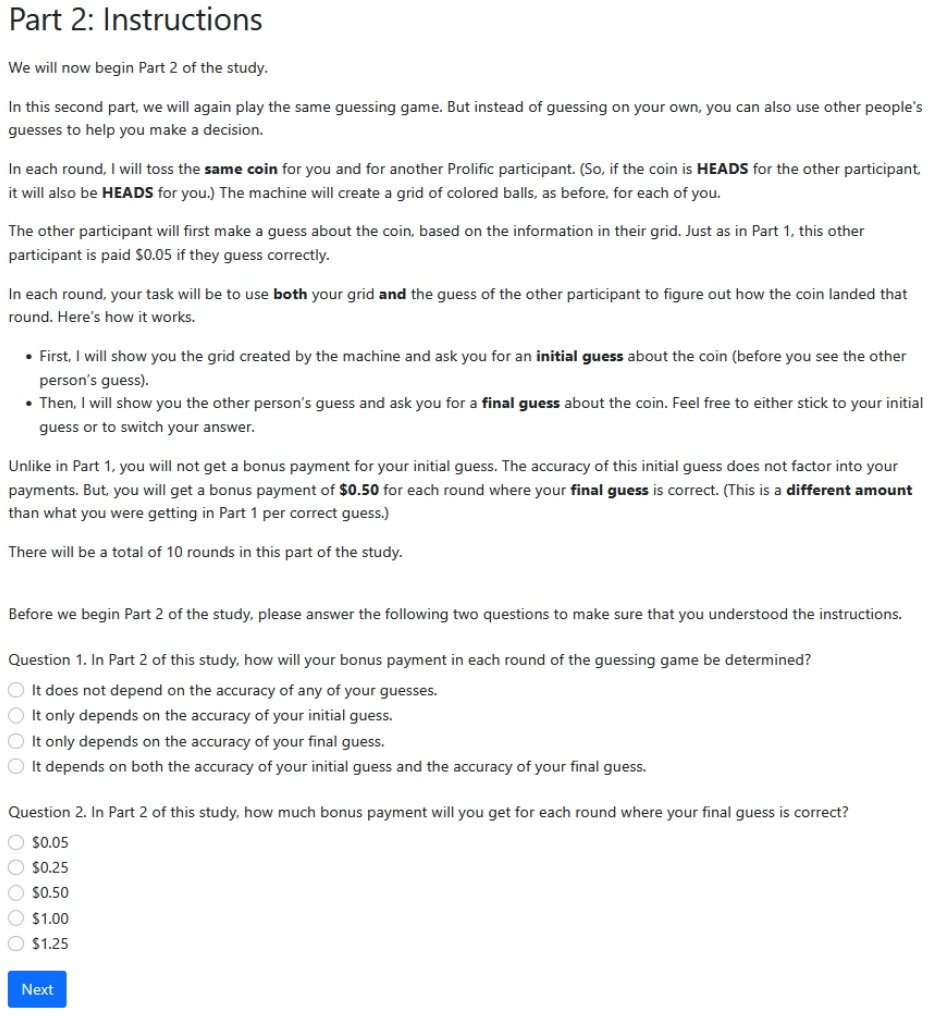
Two linked laboratory tasks—an individual attention task under high or low accuracy incentives, and a social-learning task in which subjects observe a peer's guess after their own attention task—used to measure responses to peers' incentives.
If this is right
- Social learning from peers will often fail to exploit differences in accuracy driven by incentives.
- Standard models assuming rational costly information acquisition will overstate how much people adjust to observed incentive differences.
- Aggregation of guesses from heterogeneous-incentive peers will be less accurate than predicted by rational inference.
- Individual performance in attention tasks correlates with the ability to account for others' incentives.
Where Pith is reading between the lines
- Real-world settings with opaque or mixed incentives, such as online advice or team decisions, may show even weaker responses than the lab results.
- Training or interface designs that make incentive differences more salient could improve social learning outcomes.
- The correlation between individual attention performance and social inference suggests a common underlying limitation in processing incentive information.
Load-bearing premise
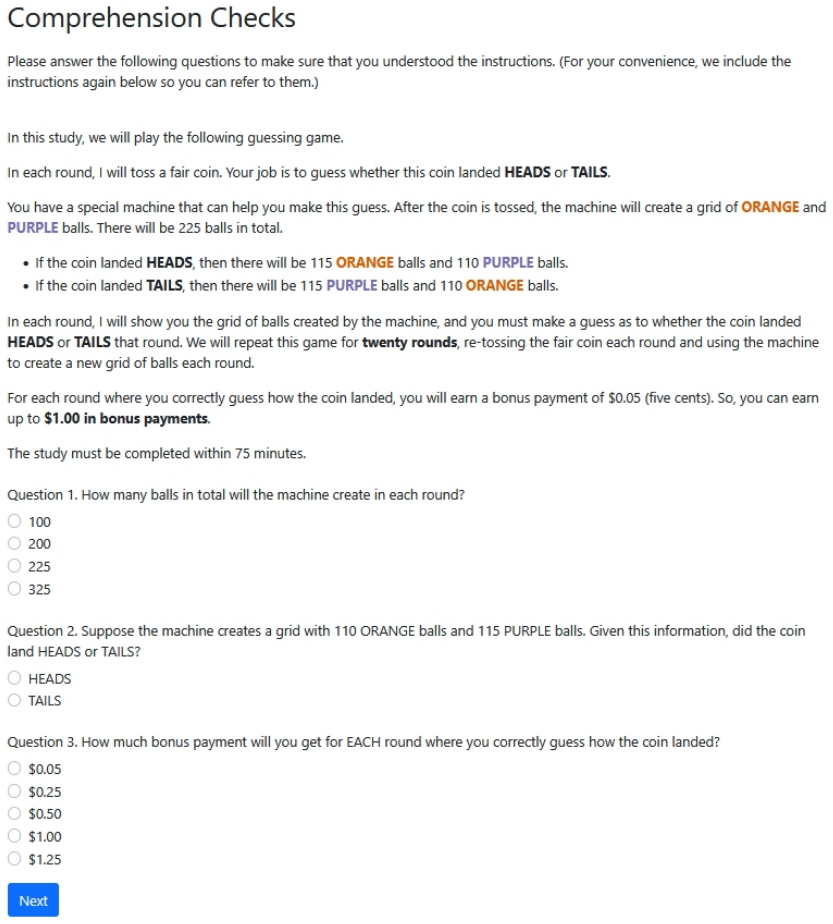
The experimental tasks isolate responses to peers' incentives without the observed failures stemming from subjects misunderstanding the instructions or task structure.
What would settle it
Subjects who consistently predict higher accuracy for higher-incentivized peers and increase their own attention when paired with lower-incentivized peers in repeated trials of the same tasks would contradict the central finding.
Figures




read the original abstract
In an incentivized laboratory experiment, we study how people account for and respond to others' incentives for paying attention. Participants learn a binary state from an attention task under high or low accuracy incentives. We ask subjects to predict their peers' accuracy based on the peers' incentives and to aggregate answers from multiple peers with different incentives. Most subjects fail to consistently understand that peers with stronger incentives are more accurate, and these subjects also perform worse in individual attention tasks. Subjects also participate in a social-learning task where they first learn the binary state from an attention task, then observe a peer's guess about the state in the same task, and finally make a guess themselves. We find behavior in these tasks is inconsistent with leading models of flexible costly information acquisition. In particular, subjects fail to pay more attention when paired with lower incentive peers. Overall, we find that many decision-makers do not respond to others' incentives for accuracy even when those incentives are transparent.
Editorial analysis
A structured set of objections, weighed in public.
Referee Report
Summary. The paper reports results from an incentivized laboratory experiment on how subjects account for peers' incentives for accuracy in a binary-state attention task. It finds that most subjects fail to consistently recognize that higher-incentive peers are more accurate (and these subjects also perform worse individually), and that behavior in a subsequent social-learning task—where subjects observe a peer's guess before making their own—is inconsistent with leading models of flexible costly information acquisition, specifically failing to increase attention when paired with lower-incentive peers.
Significance. If the central behavioral findings hold after verification that task comprehension does not confound the results, the paper would provide direct evidence that many decision-makers do not incorporate others' incentives into information acquisition or aggregation even when incentives are transparent. This would challenge standard costly-information-acquisition frameworks and suggest limits on rational social learning, with potential implications for models of attention, information aggregation, and organizational decision-making.
major comments (2)
- [Abstract and §3] Abstract and §3 (Experimental Design): The headline claim that subjects 'fail to pay more attention when paired with lower incentive peers' (inconsistent with flexible costly-information models) rests on the assumption that the social-learning task isolates responses to peers' incentives without subjects misunderstanding the incentive-accuracy mapping or task structure. The abstract itself reports that many subjects fail to understand that higher-incentive peers are more accurate; without explicit verification of comprehension (e.g., quiz performance, exclusion rules, or debriefing data) or design features that separate own-incentive effects from peer-incentive effects, the non-response could be an artifact of confusion rather than a substantive model failure.
- [Results] Results section: The abstract summarizes directional findings on attention and accuracy but supplies no sample size, statistical tests, exclusion rules, or raw data summaries. This omission makes it impossible to assess whether the reported inconsistencies with costly-information models survive standard robustness checks or are driven by a small subset of confused subjects.
minor comments (1)
- [Abstract] The abstract and introduction could more clearly distinguish the two tasks (individual attention vs. social-learning) and state the exact hypotheses tested against the costly-information models.
Simulated Author's Rebuttal
We thank the referee for the constructive comments, which highlight important issues around task comprehension and the presentation of results. We respond to each major comment below and indicate where revisions will be made to the manuscript.
read point-by-point responses
-
Referee: [Abstract and §3] Abstract and §3 (Experimental Design): The headline claim that subjects 'fail to pay more attention when paired with lower incentive peers' (inconsistent with flexible costly-information models) rests on the assumption that the social-learning task isolates responses to peers' incentives without subjects misunderstanding the incentive-accuracy mapping or task structure. The abstract itself reports that many subjects fail to understand that higher-incentive peers are more accurate; without explicit verification of comprehension (e.g., quiz performance, exclusion rules, or debriefing data) or design features that separate own-incentive effects from peer-incentive effects, the non-response could be an artifact of confusion rather than a substantive model failure.
Authors: The experiment includes a prediction task in which subjects forecast peers' accuracy conditional on the peers' incentives; this serves as our measure of whether subjects understand the incentive-accuracy mapping. The social-learning task is administered after this prediction stage, and the design holds own incentives constant while varying only the observed peer's incentive. We agree that the manuscript would benefit from a more explicit discussion of how these features address potential confusion and from reporting any available comprehension-related data or exclusion criteria. We will add this material in the revision. At the same time, the core inconsistency with flexible costly-information models is that subjects do not increase attention when paired with lower-incentive peers even though the design makes the peer's incentive transparent; we do not claim this holds only among those who fully understand the mapping, but we will clarify the conditional patterns where possible. revision: partial
-
Referee: [Results] Results section: The abstract summarizes directional findings on attention and accuracy but supplies no sample size, statistical tests, exclusion rules, or raw data summaries. This omission makes it impossible to assess whether the reported inconsistencies with costly-information models survive standard robustness checks or are driven by a small subset of confused subjects.
Authors: We acknowledge that the abstract omits these details, which limits the ability to evaluate the findings at a glance. The full manuscript contains the sample size, the statistical tests used, exclusion rules, and summary statistics on accuracy and attention. In the revised version we will move key sample-size, test, and exclusion information into the abstract and add a concise table or paragraph of raw-data summaries in the results section so that readers can immediately assess robustness and the role of comprehension. revision: yes
Circularity Check
No circularity: direct experimental observations without derivations or fitted predictions
full rationale
The paper presents results from an incentivized laboratory experiment on attention and social learning tasks. No equations, derivations, model fittings, or parameter estimations appear in the provided text or abstract. Behavioral findings (e.g., failure to respond to peers' incentives) are reported as direct observations and compared to existing models, without any quantities being defined in terms of the same data or reducing to self-citations. The central claims rest on empirical patterns rather than any self-referential construction.
Axiom & Free-Parameter Ledger
axioms (1)
- domain assumption Subjects comprehend the incentive structure and treat the attention task as a costly information-acquisition problem comparable to theoretical models
Reference graph
Works this paper leans on
-
[1]
Behavioral and Structural Barriers to Information Aggregation in Networks,
Agranov, M., B. Gillen, and D. Persitz(2025): “Behavioral and Structural Barriers to Information Aggregation in Networks,”Working Paper
work page 2025
-
[2]
Rational inattention in games: experimental evidence,
Almog, D. and D. Martin(2024): “Rational inattention in games: experimental evidence,”Experimental Economics, 27, 715–742
work page 2024
-
[3]
Overinference from weak signals and underin- ference from strong signals,
Augenblick, N., E. Lazarus, and M. Thaler(2025): “Overinference from weak signals and underin- ference from strong signals,”Quarterly Journal of Economics, 140, 335–401
work page 2025
-
[4]
Over-and underreaction to information,
Ba, C., J. A. Bohren, and A. Imas(2025): “Over-and underreaction to information,”Working Paper
work page 2025
-
[5]
Errors in probabilistic reasoning and judgment biases,
Benjamin, D. J.(2019): “Errors in probabilistic reasoning and judgment biases,”Handbook of Behavioral Economics: Applications and Foundations 1, 2, 69–186
work page 2019
-
[6]
Modeling information acquisition via f-divergence and duality,
Bloedel, A., T. Denti, and L. Pomatto(2025): “Modeling information acquisition via f-divergence and duality,”arXiv preprint arXiv:2510.03482. 19
-
[7]
Is attention produced optimally? theory and evidence from experiments with bandwidth enhancements,
Bronchetti, E. T., J. B. Kessler, E. B. Magenheim, D. Taubinsky, and E. Zwick(2023): “Is attention produced optimally? theory and evidence from experiments with bandwidth enhancements,” Econometrica, 91, 669–707
work page 2023
-
[8]
Rational inattention, competitive supply, and psychometrics,
Caplin, A., D. Csaba, J. Leahy, and O. Nov(2020): “Rational inattention, competitive supply, and psychometrics,”Quarterly Journal of Economics, 135, 1681–1724
work page 2020
-
[9]
Conlon, J. J., M. Mani, G. Rao, M. W. Ridley, and F. Schilbach(2022): “Not learning from others,”Working Paper
work page 2022
-
[10]
Experimental tests of rational inattention,
Dean, M. and N. Neligh(2023): “Experimental tests of rational inattention,”Journal of Political Econ- omy, 131, 3415–3461
work page 2023
-
[11]
Posterior separable cost of information,
Denti, T.(2022): “Posterior separable cost of information,”American Economic Review, 112, 3215–3259. K¨ubler, D. and G. Weizs ¨acker(2004): “Limited depth of reasoning and failure of cascade formation in the laboratory,”Review of Economic Studies, 71, 425–441
work page 2022
-
[12]
Predicting choice from information costs,
Lipnowski, E. and D. Ravid(2022): “Predicting choice from information costs,”arXiv preprint arXiv:2205.10434
-
[13]
The wald problem and the relation of sequential sampling and ex-ante information costs,
Morris, S. and P. Strack(2019): “The wald problem and the relation of sequential sampling and ex-ante information costs,”Working Paper
work page 2019
-
[14]
Implications of rational inattention,
Sims, C. A.(2003): “Implications of rational inattention,”Journal of Monetary Economics, 50, 665–690
work page 2003
-
[15]
Rationally inattentive and strategically (Un)sophisticated,
Spurlino, E.(2025): “Rationally inattentive and strategically (Un)sophisticated,”Experimental Eco- nomics, 28, 698–727
work page 2025
-
[16]
Sharing without clicking on news in social media,
Sundar, S. S., E. C. Snyder, M. Liao, J. Yin, J. W ang, and G. Chi(2025): “Sharing without clicking on news in social media,”Nature Human Behaviour, 9, 156–168. Weizs¨acker, G.(2010): “Do we follow others when we should? A simple test of rational expectations,” American Economic Review, 100, 2340–2360. A Proofs This section will prove Proposition 1 and Pr...
work page 2025
discussion (0)
Sign in with ORCID, Apple, or X to comment. Anyone can read and Pith papers without signing in.