An Open-Source Tool for Reproducible Freeway Network Extraction from OpenStreetMap
Pith reviewed 2026-07-01 03:43 UTC · model grok-4.3
The pith
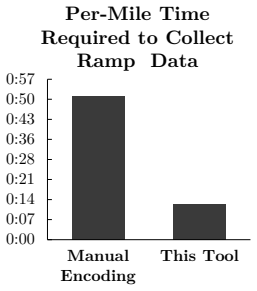
An open-source tool extracts freeway networks from OpenStreetMap via an extract-first-then-validate workflow that requires roughly one-third the analyst effort of manual ramp encoding.
A machine-rendered reading of the paper's core claim, the machinery that carries it, and where it could break.
Core claim
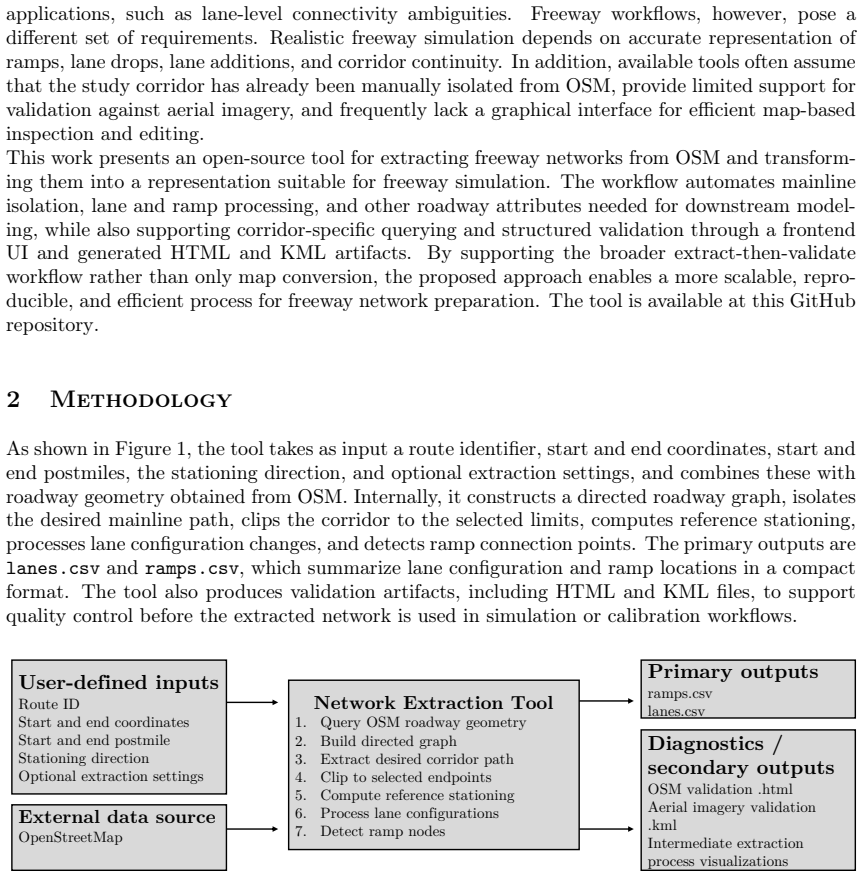
The tool supplies a complete workflow—corridor querying, extraction logic that resolves inconsistent route references, ambiguous interchange paths, managed-lane interference, and ramp classification problems, plus frontend visual inspection and dual validation—that turns OSM data into simulation-ready freeway networks. On tested corridors the extract-first-then-validate sequence needed about one-third the effort of manual ramp encoding from scratch, and deployment across Orange County showed OSM sufficiently accurate for many freeway traffic studies.
What carries the argument
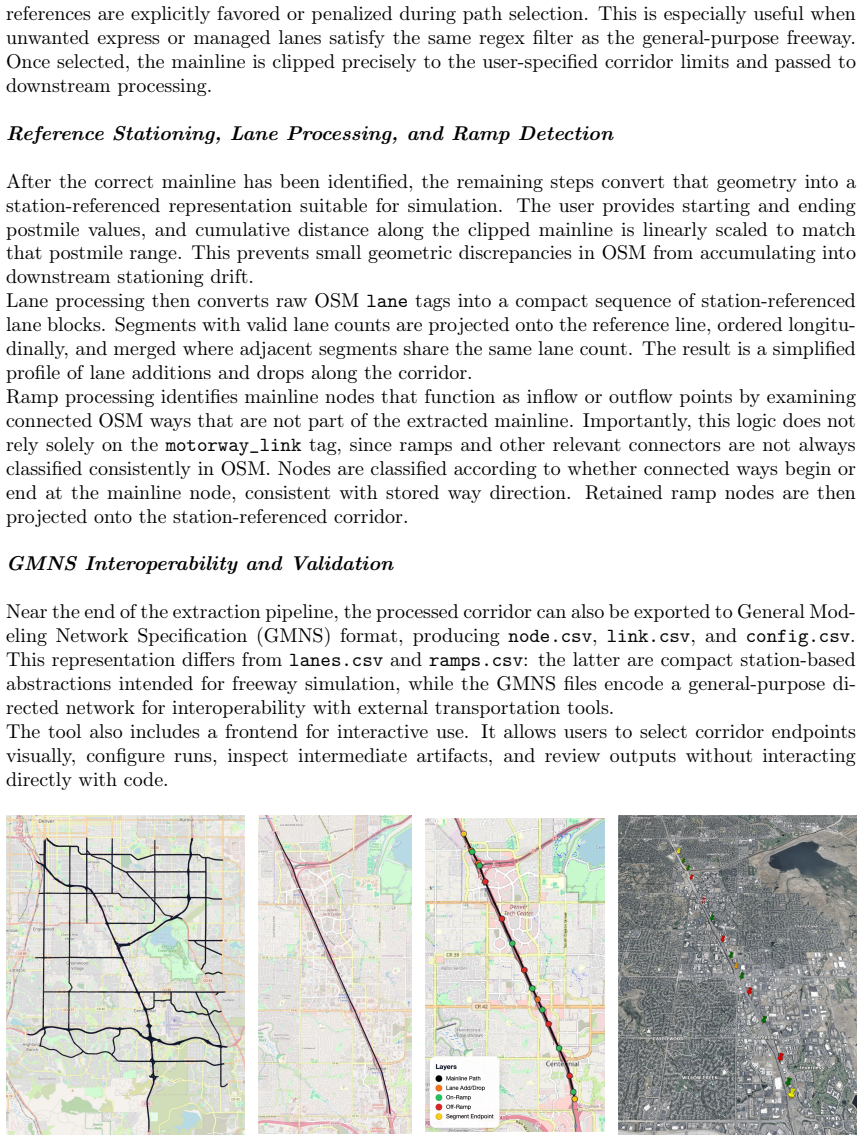
The extraction logic that resolves inconsistent route references, ambiguous path selection through interchanges, managed-lane interference, incomplete corridor capture, and inconsistent ramp classifications, paired with a locally hosted frontend for defining queries and inspecting segments.
If this is right
- Freeway simulation studies can expand from single corridors to regional networks with far less per-mile preparation time.
- Network inputs become reproducible across different analysts because the workflow is scripted and version-controlled rather than manual.
- OSM can serve as the default source for many freeway studies in well-mapped regions without custom digitization.
- Validation overhead stays low enough (averaging 41 seconds per mile in the California deployment) to support iterative model updates.
Where Pith is reading between the lines
- The same workflow could be adapted for arterial or mixed networks if the extraction rules are extended beyond freeway-specific patterns.
- In regions with lower OSM quality the validation step would surface exactly which segments need manual correction, turning the tool into a data-improvement aid.
- Direct export to common simulation packages would further shrink the remaining setup time after extraction.
- Re-running the tool on updated OSM snapshots would let studies track how network changes affect model outputs over time.
Load-bearing premise
The extraction logic correctly resolves recurring OSM freeway data issues and the validation steps against OSM and aerial imagery are enough to confirm the output matches ground truth for traffic-study purposes.
What would settle it
A corridor where the tool's output network requires more than half the manual effort of direct ramp encoding, or where validation against imagery reveals systematic geometry mismatches, would falsify the efficiency and accuracy claims.
Figures
read the original abstract
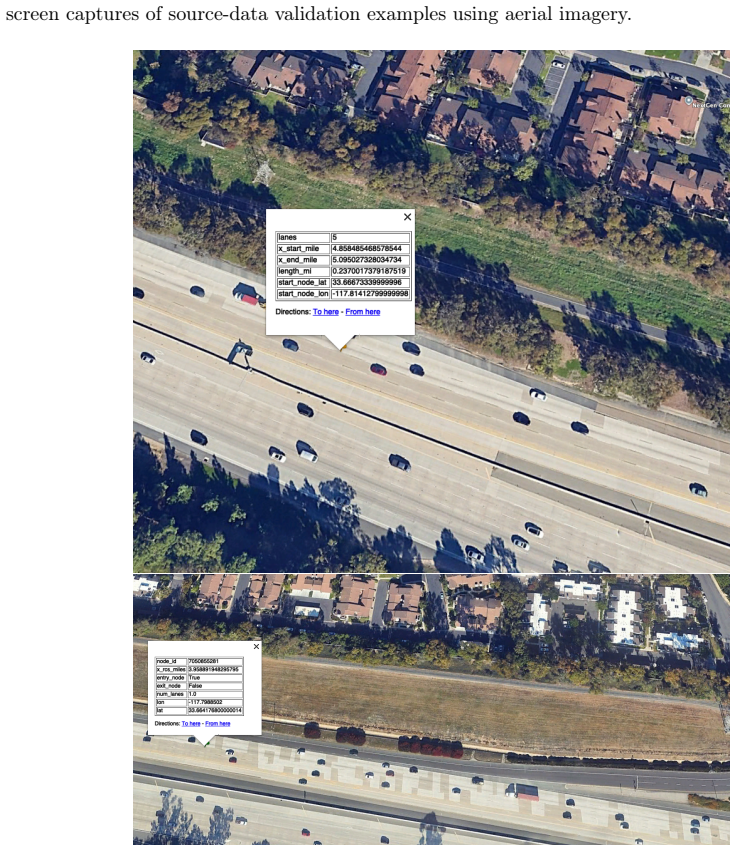
Freeway simulation is often difficult to deploy at scale not only because of model formulation, but because preparing road network inputs remains a manual, corridor-specific, and difficult-to-reproduce task. This paper presents an open-source tool that extracts freeway networks from OpenStreetMap (OSM) and converts them into a compact, station-referenced representation suitable for downstream freeway simulation. Unlike existing tools that primarily support arterial or general network conversion tasks, the proposed workflow is designed around the specific requirements of freeway traffic studies. The tool supports not only OSM data cleaning and conversion, but also the broader workflow required in practice: corridor-specific querying, visual inspection of extracted segments, extraction validation against OSM, and source-data validation against aerial imagery. A locally hosted frontend allows users to define corridor-specific queries, select endpoints visually, and inspect extracted segments. The extraction logic is designed to address several recurring challenges in freeway OSM data, including inconsistent route references, ambiguous path selection through interchanges, managed-lane interference, incomplete corridor capture from naive bounding-box queries, and inconsistent ramp classifications. The workflow was first tested on two prototype corridors, where the extract-first-then-validate approach proposed here required roughly one-third the analyst effort of manual ramp encoding from scratch. It was then deployed across 359.6 miles of freeway in Orange County, California, with total processing and validation averaging about 41 seconds per mile. This deployment also suggests that, in a well-mapped region, OSM is sufficiently accurate for many freeway traffic studies. Overall, the tool provides a more scalable and reproducible foundation for freeway network preparation.
Editorial analysis
A structured set of objections, weighed in public.
Referee Report
Summary. The paper presents an open-source tool for extracting freeway networks from OpenStreetMap (OSM) tailored to traffic simulation needs. It describes a workflow addressing OSM-specific issues (inconsistent route references, ambiguous interchanges, managed lanes, incomplete bounding-box capture, inconsistent ramp classifications) via corridor querying, visual inspection, OSM validation, and aerial imagery checks, supported by a locally hosted frontend. Prototype tests on two corridors report the extract-first-then-validate method requiring roughly one-third the analyst effort of manual ramp encoding; a 359.6-mile deployment in Orange County, CA, averaged 41 seconds per mile and suggests OSM sufficiency for many studies in well-mapped regions.
Significance. If the extraction logic and validation steps hold, the work addresses a practical bottleneck in freeway simulation deployment by providing a scalable, reproducible, open-source alternative to manual network preparation. The freeway-specific design and inclusion of end-to-end workflow elements (querying through validation) are strengths that could aid reproducibility in the field. The reported effort reduction and processing times offer concrete evidence of practicality, though the absence of accuracy quantification limits the strength of the reproducibility and sufficiency claims.
major comments (3)
- [Abstract] Abstract: The claim that the extract-first-then-validate approach 'required roughly one-third the analyst effort of manual ramp encoding from scratch' on two prototype corridors provides no details on effort measurement methodology, corridor selection criteria, or the precise baseline procedure, which is load-bearing for the central scalability/reproducibility argument.
- [Abstract] Abstract: The deployment result that 'OSM is sufficiently accurate for many freeway traffic studies' in well-mapped regions rests only on the 41 s/mile processing time across 359.6 miles, with no reported counts of discrepancies found/corrected, precision/recall against ground truth, or per-issue resolution statistics for the listed OSM challenges.
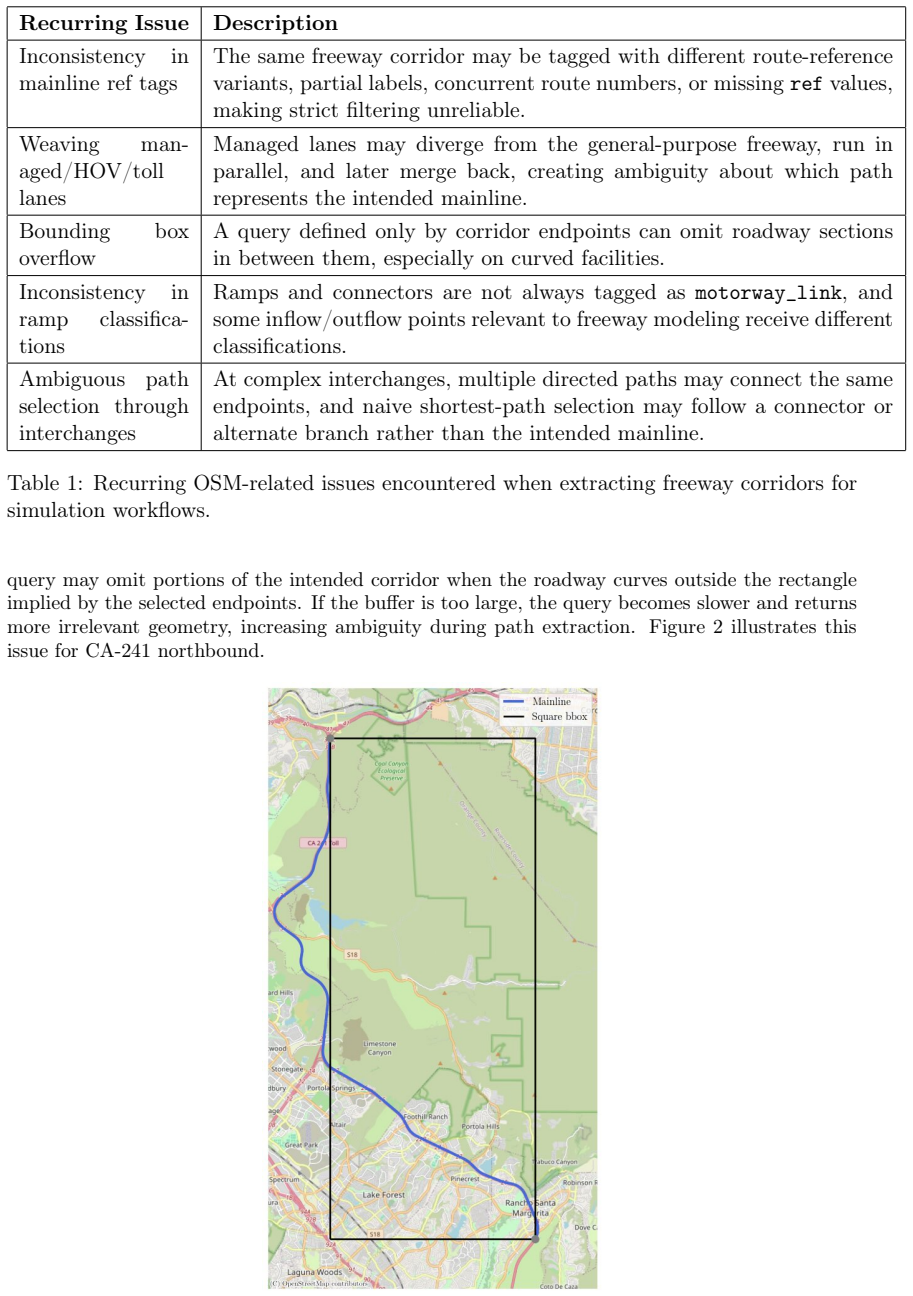
- [Abstract] Abstract: The extraction logic is asserted to resolve 'inconsistent route references, ambiguous path selection through interchanges, managed-lane interference, incomplete corridor capture from naive bounding-box queries, and inconsistent ramp classifications,' but the manuscript provides no pseudocode, algorithm description, or decision rules, preventing assessment of whether these core issues are correctly handled.
minor comments (1)
- [Abstract] Abstract: The description of the 'locally hosted frontend' for defining queries and inspecting segments does not specify the implementation (e.g., web framework or data format) or how it interfaces with the extraction backend.
Simulated Author's Rebuttal
We appreciate the referee's feedback highlighting areas where the abstract claims require more supporting detail. We will revise the manuscript to address these points while maintaining the core contributions.
read point-by-point responses
-
Referee: [Abstract] Abstract: The claim that the extract-first-then-validate approach 'required roughly one-third the analyst effort of manual ramp encoding from scratch' on two prototype corridors provides no details on effort measurement methodology, corridor selection criteria, or the precise baseline procedure, which is load-bearing for the central scalability/reproducibility argument.
Authors: We agree that the abstract would benefit from additional context on this comparison. The full paper describes the prototype tests on two corridors, but we will add a dedicated paragraph in the results section detailing the effort measurement approach (e.g., time tracking method), the criteria for selecting the prototype corridors, and a description of the manual baseline procedure used for comparison. This will better substantiate the one-third effort reduction claim. revision: yes
-
Referee: [Abstract] Abstract: The deployment result that 'OSM is sufficiently accurate for many freeway traffic studies' in well-mapped regions rests only on the 41 s/mile processing time across 359.6 miles, with no reported counts of discrepancies found/corrected, precision/recall against ground truth, or per-issue resolution statistics for the listed OSM challenges.
Authors: The claim is presented as a suggestion based on the deployment's completion with the reported processing time. We will revise the abstract to better reflect the basis of the suggestion and include any available counts of discrepancies found and corrected during validation. However, formal precision/recall metrics were not computed as part of this work. revision: partial
-
Referee: [Abstract] Abstract: The extraction logic is asserted to resolve 'inconsistent route references, ambiguous path selection through interchanges, managed-lane interference, incomplete corridor capture from naive bounding-box queries, and inconsistent ramp classifications,' but the manuscript provides no pseudocode, algorithm description, or decision rules, preventing assessment of whether these core issues are correctly handled.
Authors: We agree that more detail on the extraction logic is needed for readers to assess the approach. We will add a subsection to the Methods section providing algorithm descriptions and decision rules for addressing each of the listed OSM challenges. Pseudocode will be included for the main extraction steps. revision: yes
- Quantitative accuracy metrics such as precision and recall against ground truth, which were not part of the study.
Circularity Check
No circularity: tool description with empirical workflow reporting
full rationale
The paper presents a software tool and practical workflow for OSM freeway extraction, including logic for data issues and validation steps. It reports measured analyst effort (one-third on two prototypes) and processing time (41 s/mile on 359.6 miles) as direct outcomes of applying the described process. No equations, fitted parameters, predictions, ansatzes, or uniqueness claims exist that could reduce any result to its own inputs by construction. Self-citations are absent. The derivation chain is therefore self-contained as an engineering description rather than a mathematical or predictive model.
Axiom & Free-Parameter Ledger
Reference graph
Works this paper leans on
-
[1]
OpenStreetMap , author =
-
[2]
Lopez, Pablo Alvarez and Wiessner, Evamarie and Behrisch, Michael and Bieker-Walz, Laura and Erdmann, Jakob and Flotterod, Yun-Pang and Hilbrich, Robert and Lucken, Leonhard and Rummel, Johannes and Wagner, Peter , month = nov, year =. Microscopic. 2018 21st. doi:10.1109/ITSC.2018.8569938 , abstract =
-
[3]
Ji, Junyi and Gloudemans, Derek and Zachár, Gergely and Nice, Matthew and Barbour, William and Work, Daniel B. , month = feb, year =. Calibrating. doi:10.48550/arXiv.2602.02072 , abstract =
-
[4]
Treiber, Martin and Helbing, Dirk , editor =. An. Interface and. 2003 , keywords =. doi:10.1007/978-3-662-07969-0_33 , abstract =
-
[5]
IEEE Transactions on Intelligent Transportation Systems , author =
A. IEEE Transactions on Intelligent Transportation Systems , author =. 2026 , keywords =. doi:10.1109/TITS.2026.3658644 , abstract =
-
[6]
Transportation Research Part C: Emerging Technologies , author =
Scalable analysis of stop-and-go waves:. Transportation Research Part C: Emerging Technologies , author =. 2026 , keywords =. doi:10.1016/j.trc.2025.105385 , abstract =
-
[7]
Transportation Research Part C: Emerging Technologies , author =
Stop-and-go wave super-resolution reconstruction via iterative refinement , volume =. Transportation Research Part C: Emerging Technologies , author =. 2025 , keywords =. doi:10.1016/j.trc.2025.105313 , abstract =
- [8]
-
[9]
Journal of advanced transportation , author =
Modified. Journal of advanced transportation , author =. doi:10.1155/2019/8151582 , abstract =
-
[10]
Coordinated traffic control for highway systems , copyright =
Chavoshi, Kimia , collaborator =. Coordinated traffic control for highway systems , copyright =. 2024 , note =. doi:10.3929/ETHZ-B-000720302 , language =
-
[11]
and Mitsakis, Evangelos , month = apr, year =
Mintsis, Evangelos and Vlahogianni, Eleni I. and Mitsakis, Evangelos , month = apr, year =. Dynamic. Journal of Transportation Engineering, Part A: Systems , publisher =. doi:10.1061/JTEPBS.0000318 , abstract =
-
[12]
Recent. SIGKDD Explor. Newsl. , author =. 2021 , pages =. doi:10.1145/3447556.3447565 , abstract =
-
[13]
Schrank, David and Albert, Luke and Jha, Kartikeya and Eisele, Bill , month = aug, year =. 2025
2025
-
[14]
Wu, Pan and Xu, Lunhui and Huang, Zilin , editor =. Imputation. Artificial. 2020 , keywords =. doi:10.1007/978-981-15-5577-0_53 , abstract =
-
[15]
Reconstructing the
Treiber, Martin and Helbing, Dirk , year =. Reconstructing the
-
[16]
Computer-Aided Civil and Infrastructure Engineering , author =
Reconstructing the. Computer-Aided Civil and Infrastructure Engineering , author =. 2011 , note =. doi:10.1111/j.1467-8667.2010.00698.x , abstract =
-
[17]
Transportation Research Part B: Methodological , author =
Real-time freeway traffic state estimation based on extended. Transportation Research Part B: Methodological , author =. 2005 , pages =. doi:10.1016/j.trb.2004.03.003 , abstract =
-
[18]
IEEE Transactions on Intelligent Transportation Systems , author =
Data-. IEEE Transactions on Intelligent Transportation Systems , author =. 2016 , keywords =. doi:10.1109/TITS.2016.2530312 , abstract =
-
[19]
doi:10.3141/2099-07 , language =
Imputation of. doi:10.3141/2099-07 , language =
-
[20]
IEEE Transactions on Intelligent Transportation Systems , author =
A. IEEE Transactions on Intelligent Transportation Systems , author =. 2024 , keywords =. doi:10.1109/TITS.2024.3478816 , abstract =
-
[21]
Hegyi, A. and Hoogendoorn, S.P. , month = sep, year =. Dynamic speed limit control to resolve shock waves on freeways -. 13th. doi:10.1109/ITSC.2010.5624974 , abstract =
-
[22]
He, Zhengbing and Laval, Jorge and Han, Yu and Hegyi, Andreas and Nishi, Ryosuke and Wu, Cathy , month = may, year =. A. doi:10.48550/arXiv.2504.11372 , abstract =
-
[23]
New Journal of Physics , author =
Traffic jams without bottlenecks—experimental evidence for the physical mechanism of the formation of a jam , volume =. New Journal of Physics , author =. 2008 , pages =. doi:10.1088/1367-2630/10/3/033001 , abstract =
-
[24]
Cervero, Robert , month = aug, year =. Induced. Journal of Planning Literature , publisher =. doi:10.1177/088122017001001 , abstract =
-
[25]
Transportation Research Part B: Methodological , author =
Relation between traffic density and capacity drop at three freeway bottlenecks , volume =. Transportation Research Part B: Methodological , author =. 2007 , keywords =. doi:10.1016/j.trb.2006.02.011 , abstract =
-
[26]
Relationships between highway capacity and induced vehicle travel -
-
[28]
Zheng, Guanjie and Liu, Hanyang and Xu, Kai and Li, Zhenhui , month = apr, year =. Learning to. 2020. doi:10.1109/ICDE48307.2020.00179 , abstract =
-
[29]
IEEE Open Journal of Intelligent Transportation Systems , author =
Machine. IEEE Open Journal of Intelligent Transportation Systems , author =. 2025 , keywords =. doi:10.1109/OJITS.2025.3589208 , abstract =
-
[30]
ITS America , author =
A. ITS America , author =
-
[31]
Jayawardana, Vindula and Freydt, Baptiste and Qu, Ao and Hickert, Cameron and Sanchez, Edgar and Tang, Catherine and Taylor, Mark and Leonard, Blaine and Wu, Cathy , month = jun, year =. Mitigating. doi:10.48550/arXiv.2408.05609 , abstract =
-
[32]
ITS America , author =
-
[33]
Journal of Open Source Software , author =
dyntapy: dynamic and static traffic assignment in. Journal of Open Source Software , author =. 2022 , pages =. doi:10.21105/joss.04593 , language =
-
[34]
doi:10.48550/arXiv.2309.17114 , abstract =
Seo, Toru , month = dec, year =. doi:10.48550/arXiv.2309.17114 , abstract =
-
[35]
Transportation Research Part C: Emerging Technologies , author =
Virtual track networks:. Transportation Research Part C: Emerging Technologies , author =. 2023 , pages =. doi:10.1016/j.trc.2023.104223 , abstract =
-
[36]
Procedia Computer Science , author =
Open. Procedia Computer Science , author =. 2014 , pages =. doi:10.1016/j.procs.2014.05.492 , abstract =
-
[37]
Transportation Research Part C: Emerging Technologies , author =
Macroscopic traffic flow model validation at congested freeway off-ramp areas , volume =. Transportation Research Part C: Emerging Technologies , author =. 2014 , pages =. doi:10.1016/j.trc.2014.01.009 , abstract =
-
[38]
Transportation Research Part C: Emerging Technologies , author =
Macroscopic traffic flow modelling of large-scale freeway networks with field data verification:. Transportation Research Part C: Emerging Technologies , author =. 2022 , pages =. doi:10.1016/j.trc.2022.103904 , abstract =
-
[39]
Transportation Research Part B: Methodological , author =
Performance of continuum models for realworld traffic flows:. Transportation Research Part B: Methodological , author =. 2021 , pages =. doi:10.1016/j.trb.2021.03.007 , abstract =
-
[40]
A unified dataset for the city-scale traffic assignment model in 20. Scientific Data , author =. 2024 , pages =. doi:10.1038/s41597-024-03149-8 , abstract =
-
[41]
Transportation Research Record , author =
Design of. Transportation Research Record , author =. 2012 , note =. doi:10.3141/2291-06 , abstract =
-
[42]
Trubia, Salvatore and Curto, Salvatore and Barberi, Salvatore and Severino, Alessandro and Arena, Fabio and Pau, Giovanni and Trubia, Salvatore and Curto, Salvatore and Barberi, Salvatore and Severino, Alessandro and Arena, Fabio and Pau, Giovanni , month = jan, year =. Analysis and. Sustainability , publisher =. doi:10.3390/su13020850 , abstract =
-
[43]
IFAC Proceedings Volumes , author =
Macroscopic. IFAC Proceedings Volumes , author =. 2009 , keywords =. doi:10.3182/20090902-3-US-2007.0078 , abstract =
-
[44]
Wang, Xu and Yin, Derek and Qiu, Tony Z. , month = sep, year =. Applicability. Journal of Transportation Engineering, Part A: Systems , publisher =. doi:10.1061/JTEPBS.0000157 , abstract =
-
[45]
Wang, Yibing and Messmer, Albert and Papageorgiou, Markos , month = jan, year =. Freeway. Transportation Research Record , publisher =. doi:10.3141/1776-23 , abstract =
-
[46]
and Lin, Yong , month = dec, year =
Hadiuzzaman, Md and Qiu, Tony Z. and Lin, Yong , month = dec, year =. Real-. doi:10.1061/9780784412442.340 , language =
-
[47]
Rapelli, Marco and Casetti, Claudio and Gagliardi, Giandomenico , month = oct, year =. 2019. doi:10.1109/DS-RT47707.2019.8958652 , abstract =
-
[48]
IEEE Intelligent Transportation Systems Magazine , author =
Luxembourg. IEEE Intelligent Transportation Systems Magazine , author =. 2017 , keywords =. doi:10.1109/MITS.2017.2666585 , abstract =
-
[49]
SUMO Conference Proceedings , author =
Topology-. SUMO Conference Proceedings , author =. 2022 , keywords =. doi:10.52825/scp.v3i.111 , abstract =
-
[50]
Procedia Computer Science , author =
Large-scale. Procedia Computer Science , author =. 2012 , pages =. doi:10.1016/j.procs.2012.06.105 , abstract =
-
[51]
IEEE Transactions on Intelligent Transportation Systems , author =
Interval. IEEE Transactions on Intelligent Transportation Systems , author =. 2011 , keywords =. doi:10.1109/TITS.2011.2107900 , abstract =
-
[52]
IET Intelligent Transport Systems , author =
From. IET Intelligent Transport Systems , author =. 2025 , note =. doi:10.1049/itr2.70021 , abstract =
-
[53]
IEEE Transactions on Vehicular Technology , author =
The. IEEE Transactions on Vehicular Technology , author =. 2015 , keywords =. doi:10.1109/TVT.2015.2475608 , abstract =
-
[54]
Cai, Hubo and Oh, Jun-Seok and David Yang, C. Y. , month = jul, year =. Integrating. Journal of Computing in Civil Engineering , publisher =. doi:10.1061/(ASCE)CP.1943-5487.0000136 , abstract =
-
[55]
IEEE Transactions on Visualization and Computer Graphics , author =
Transforming. IEEE Transactions on Visualization and Computer Graphics , author =. 2012 , keywords =. doi:10.1109/TVCG.2011.116 , abstract =
-
[56]
What is a typical signalized intersection in a city?
Qu, Ao and Valiveru, Anirudh and Tang, Catherine and Jayawardana, Vindula and Freydt, Baptiste and Wu, Cathy , month = may, year =. What is a typical signalized intersection in a city?. doi:10.48550/arXiv.2405.13480 , abstract =
-
[57]
Latin American Transport Studies , author =
Evaluation of models for estimating free-flow speed on two-lane rural highways in. Latin American Transport Studies , author =. 2024 , keywords =. doi:10.1016/j.latran.2024.100011 , abstract =
-
[58]
Yuan, Kai and Knoop, Victor L. and Hoogendoorn, Serge P. , month = jan, year =. Capacity. Transportation Research Record , publisher =. doi:10.3141/2491-08 , abstract =
-
[59]
Control Engineering Practice , author =
Model predictive control for ramp metering of motorway traffic:. Control Engineering Practice , author =. 2006 , pages =. doi:10.1016/j.conengprac.2005.03.010 , abstract =
-
[60]
Transportation Research Part C: Emerging Technologies , author =
Model predictive control for optimal coordination of ramp metering and variable speed limits , volume =. Transportation Research Part C: Emerging Technologies , author =. 2005 , keywords =. doi:10.1016/j.trc.2004.08.001 , abstract =
-
[61]
Transportation Research Part B: Methodological , author =
The cell transmission model:. Transportation Research Part B: Methodological , author =. 1994 , pages =. doi:10.1016/0191-2615(94)90002-7 , abstract =
-
[62]
Transportation Research Part C: Emerging Technologies , author =
I-24. Transportation Research Part C: Emerging Technologies , author =. 2023 , pages =. doi:10.1016/j.trc.2023.104311 , abstract =
-
[63]
IFAC Proceedings Volumes , author =
An. IFAC Proceedings Volumes , author =. 2009 , pages =. doi:10.3182/20090902-3-US-2007.0069 , abstract =
-
[64]
1990 , pages =
Traffic Engineering & Control , author =. 1990 , pages =
1990
-
[65]
Dissipating stop-and-go waves in closed and open networks via deep reinforcement learning , issn =
Kreidieh, Abdul Rahman and Wu, Cathy and Bayen, Alexandre M , month = nov, year =. Dissipating stop-and-go waves in closed and open networks via deep reinforcement learning , issn =. 2018 21st. doi:10.1109/ITSC.2018.8569485 , abstract =
-
[66]
Samaei, Maryam and Ameli, Mostafa and Davis, Jon F. and McQuade, Sean T. and Lee, Jonathan and Piccoli, Benedetto and Bayen, Alexandre , year =. Integrating. doi:10.2139/ssrn.4775835 , abstract =
-
[67]
A parameter identification algorithm for the
Frejo, José Ramón Domínguez and Camacho, Eduardo Fernández and Horowitz, Roberto , month = dec, year =. A parameter identification algorithm for the. 2012. doi:10.1109/CDC.2012.6426671 , abstract =
-
[68]
International Journal of Electrical and Computer Engineering (IJECE) , author =. 2024 , note =. doi:10.11591/ijece.v14i4.pp3986-3994 , abstract =
-
[69]
Knura, Martin and Kluger, Florian and Zahtila, Moris and Schiewe, Jochen and Rosenhahn, Bodo and Burghardt, Dirk , month = nov, year =. Using. ISPRS International Journal of Geo-Information , publisher =. doi:10.3390/ijgi10110733 , abstract =
-
[70]
and Zhang, Wende , month = sep, year =
Cho, Hyunggi and Rybski, Paul E. and Zhang, Wende , month = sep, year =. Vision-based bicycle detection and tracking using a deformable part model and an. 13th. doi:10.1109/ITSC.2010.5624993 , abstract =
-
[71]
WUWM 89.7 FM - Milwaukee's NPR , author =
Dozens more traffic calming projects are coming to. WUWM 89.7 FM - Milwaukee's NPR , author =
-
[72]
KPBS Public Media , author =
San. KPBS Public Media , author =. 2024 , note =
2024
-
[74]
Influence of traffic calming measures on drivers behaviour , isbn =
Ziolkowski, Robert , year =. Influence of traffic calming measures on drivers behaviour , isbn =. The 9th. doi:10.3846/enviro.2014.180 , abstract =
-
[75]
Impact of vertical traffic calming devices on environmental noise , volume =
Dzambas, Tamara and Dragcevic, Vesna and Lakusic, Josip , year =. Impact of vertical traffic calming devices on environmental noise , volume =. GRADEVINAR , publisher =. doi:10.14256/JCE.3022.2020 , abstract =
-
[76]
Effects of traffic calming measures in different urban areas , volume =
Gonzalo-Orden, Hernan and Perez-Acebo, Heriberto and Linares Unamunzaga, Alaitz and Rojo Arce, Marta , editor =. Effects of traffic calming measures in different urban areas , volume =. 2018 , note =. doi:10.1016/j.trpro.2018.10.079 , abstract =
-
[77]
Detecting scooter-drivers using a custom object detection model based on
-
[78]
Communications in Computer and Information Science , author =
Electric. Communications in Computer and Information Science , author =. 2021 , pages =
2021
-
[79]
Detection of
Apurv, Kumar and Tian, Renran and Sherony, Rini , month = nov, year =. Detection of
discussion (0)
Sign in with ORCID, Apple, or X to comment. Anyone can read and Pith papers without signing in.