Labelled Sequent Calculi for Propositional Team Logics
Pith reviewed 2026-07-01 02:31 UTC · model grok-4.3
The pith
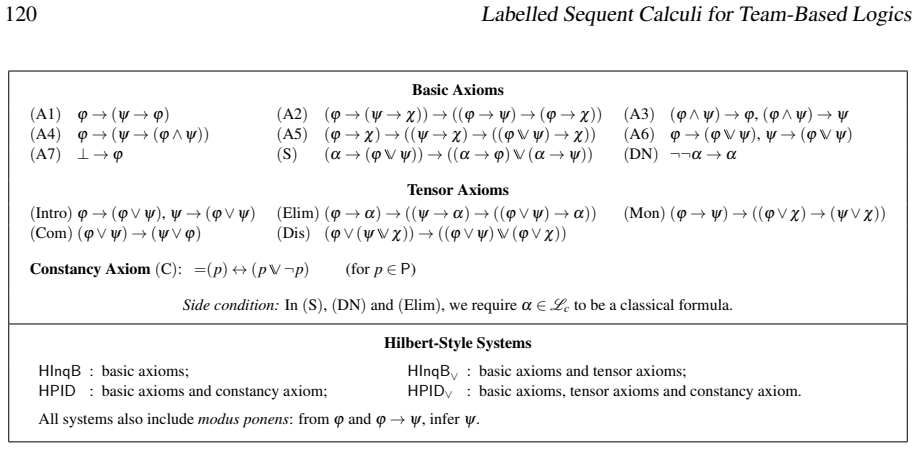
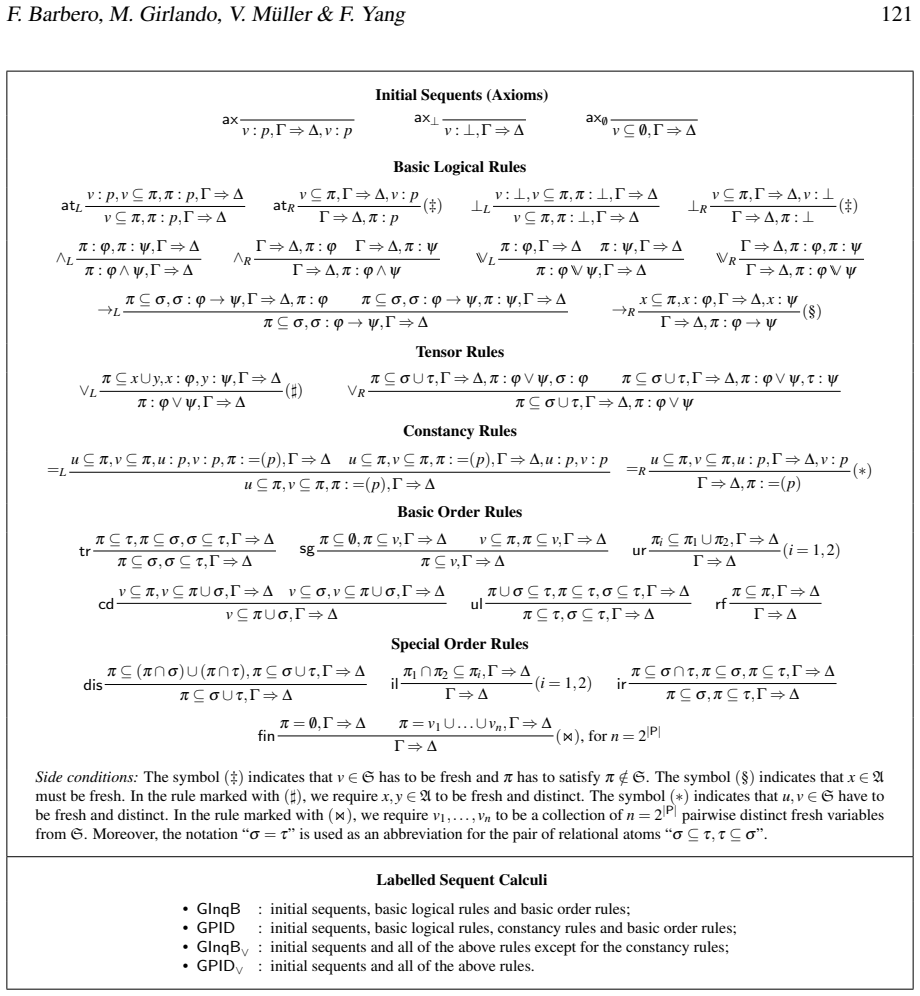
Sound and complete labelled sequent calculi exist for basic inquisitive logic, propositional intuitionistic dependence logic, and their tensor disjunction extensions.
A machine-rendered reading of the paper's core claim, the machinery that carries it, and where it could break.
Core claim
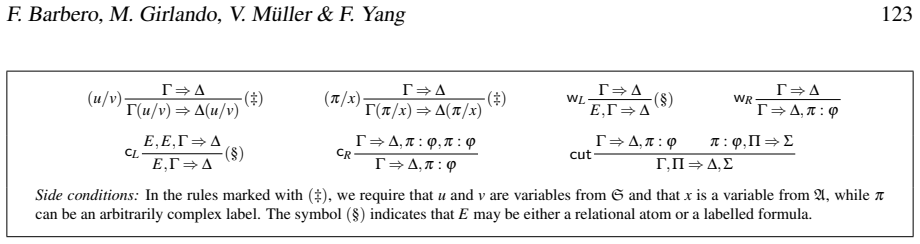
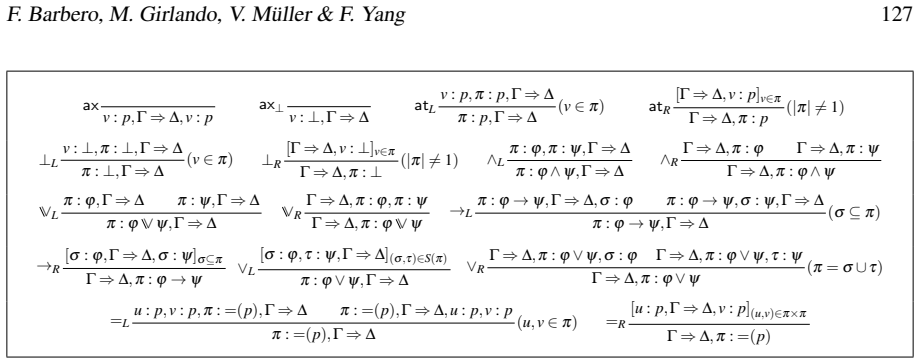
We provide sound and complete labelled sequent calculi for basic inquisitive logic, propositional intuitionistic dependence logic, and their respective extensions with tensor disjunction. The rules of weakening, contraction and cut are shown to be admissible in each of our calculi. In the last part of the paper, we present terminating proof search procedures for variants of our proof systems, in which labels have a simplified structure.
What carries the argument
Labelled sequent calculi whose labels denote teams of worlds and whose rules directly encode the team-semantic clauses for dependence atoms, inquisitive disjunction, and tensor disjunction.
If this is right
- Validity in the four logics can be checked by searching for derivations in the labelled systems.
- The admissibility results allow proofs to be written without explicit weakening, contraction or cut steps.
- The terminating proof-search procedures decide the logics in the finite-atom case.
- The same labelled framework uniformly treats both inquisitive and dependence logics and their tensor extensions.
Where Pith is reading between the lines
- The finite-atom restriction may be removable by replacing the termination argument with a different well-founded order.
- The calculi could be extended to first-order team logics by adding rules for quantifiers over teams.
- Similar labelled systems might be constructed for other team-semantic logics such as inclusion logic.
Load-bearing premise
The language contains only finitely many propositional atoms.
What would settle it
A formula that is valid under team semantics in a language with infinitely many atoms but has no derivation in one of the labelled calculi, or a derivation of a formula that is not valid.
Figures
read the original abstract
Team semantics is a general framework where formulas are not interpreted with respect to a single point of evaluation, but with respect to sets of such points. Team semantics is used in dependence logic, to reason about dependencies between variables, and in inquisitive logic, to formalize the meaning of questions. We provide sound and complete labelled sequent calculi for four logics based on team semantics: basic inquisitive logic, propositional intuitionistic dependence logic, and their respective extensions with tensor disjunction. For technical reasons, we restrict ourselves to languages with finitely many propositional atoms. The rules of weakening, contraction and cut are shown to be admissible in each of our calculi. In the last part of the paper, we present terminating proof search procedures for variants of our proof systems, in which labels have a simplified structure.
Editorial analysis
A structured set of objections, weighed in public.
Referee Report
Summary. The paper develops labelled sequent calculi for basic inquisitive logic (InqB), propositional intuitionistic dependence logic (PID), and their tensor-disjunction extensions (InqB^⊗, PID^⊗). It claims to establish soundness, completeness, admissibility of weakening/contraction/cut, and terminating proof search, all under the explicit restriction to languages with finitely many propositional atoms.
Significance. If the rule definitions, cut-elimination arguments, and termination proofs hold as stated, the work supplies the first cut-free labelled systems for these team-semantics logics together with decision procedures. The explicit disclosure of the finiteness restriction and the provision of machine-checkable-style admissibility results (where present) strengthen the contribution; the limitation is treated as a technical boundary rather than concealed.
minor comments (2)
- Abstract and introduction should cross-reference the specific sections containing the rule sets, soundness/completeness theorems, and the termination arguments for the simplified-label variants.
- Notation for team satisfaction and label semantics is introduced early; a consolidated table of all label operations and their interpretations would improve readability for readers unfamiliar with team semantics.
Simulated Author's Rebuttal
We thank the referee for the positive evaluation and the recommendation of minor revision. The report correctly identifies the scope of our results, including the explicit finiteness restriction on the language. Since no specific major comments or requested changes were raised, we have no points to address in detail.
Circularity Check
No significant circularity; derivation is self-contained
full rationale
The paper develops labelled sequent calculi for inquisitive and dependence logics via direct syntactic constructions, followed by explicit proofs of soundness, completeness, admissibility of weakening/contraction/cut, and termination of proof search under the finite-atom restriction. All load-bearing steps are standard proof-theoretic arguments internal to the calculi; the finite-atom limitation is disclosed upfront as required for termination and does not mask any reduction. No self-definitional equations, fitted parameters renamed as predictions, or load-bearing self-citations appear. The work is a conventional sequent-calculus construction whose central claims rest on the provided proofs rather than on prior results by the same authors.
Axiom & Free-Parameter Ledger
axioms (2)
- domain assumption Team semantics interprets formulas over sets of assignments rather than single assignments.
- ad hoc to paper Finiteness of the propositional atom set is assumed to ensure termination and technical tractability.
Reference graph
Works this paper leans on
-
[1]
Bulletin of Symbolic Logic 32(1), pp
Samson Abramsky, Joni Puljujärvi & Jouko Väänänen (2026): Team semantics and independence notions in quantum physics. Bulletin of Symbolic Logic 32(1), pp. 82–135, doi:10.1017/bsl.2025.10089
-
[2]
Annals of Pure and Applied Logic 173(10), pp
Rafael Albert & Erich Grädel (2022): Unifying hidden-variable problems from quantum mechanics by logics of dependence and independence . Annals of Pure and Applied Logic 173(10), pp. 103088:1–30, doi:10.1016/j.apal.2022.103088
-
[3]
Semantics and Pragmatics 15(5), pp
Maria Aloni (2022): Logic and conversation: The case of free choice. Semantics and Pragmatics 15(5), pp. 5:1–60, doi:10.3765/sp.15.5
-
[4]
Aleksi Anttila, Rosalie Iemhoff & Fan Yang (2025): A deep-inference sequent calculus for basic proposi- tional team logic (without delving too deep). arXiv:2508.07509
arXiv 2025
-
[5]
Belnap (1982): Display logic
Nuel D. Belnap (1982): Display logic . Journal of Philosophical Logic 11, pp. 375–417, doi:10.1007/ BF00284976
1982
-
[6]
In Alexandru Baltag, Jeremy Seligman & Tomoyuki Yamada, editors: Logic, Rationality, and Interaction
Jinsheng Chen & Minghui Ma (2017): Labelled sequent calculus for inquisitive logic. In Alexandru Baltag, Jeremy Seligman & Tomoyuki Yamada, editors: Logic, Rationality, and Interaction. LORI 2017 , Lecture F. Barbero, M. Girlando, V . Müller & F. Y ang 135 Notes in Computer Science 10455, Springer, Berlin and Heidelberg, pp. 526–540, doi:10.1007/978-3-662...
-
[7]
Ivano Ciardelli (2016): Dependency as question entailment . In Samson Abramsky, Juha Kontinen, Jouko Väänänen & Heribert V ollmer, editors:Dependence Logic: Theory and Applications , Birkhäuser, Cham, pp. 129–181, doi:10.1007/978-3-319-31803-5_8
-
[8]
Ivano Ciardelli (2016): Questions in Logic . Ph.D. thesis, Institute for Logic, Language and Computation, University of Amsterdam. Available at https://eprints.illc.uva.nl/id/eprint/2131/
2016
-
[9]
Notre Dame Journal of Formal Logic 61(1), pp
Ivano Ciardelli, Rosalie Iemhoff & Fan Yang (2020): Questions and dependency in intuitionistic logic. Notre Dame Journal of Formal Logic 61(1), pp. 75–115, doi:10.1215/00294527-2019-0033
-
[10]
Journal of Philosophical Logic 40, pp
Ivano Ciardelli & Floris Roelofsen (2011): Inquisitive logic. Journal of Philosophical Logic 40, pp. 55–94, doi:10.1007/s10992-010-9142-6
-
[11]
Annals of Pure and Applied Logic 170(9), pp
Jukka Corander, Antti Hyttinen, Juha Kontinen, Johan Pensar & Jouko Väänänen (2019): A logical approach to context-specific independence . Annals of Pure and Applied Logic 170(9), pp. 975–992, doi:10.1016/j.apal.2019.04.004
-
[12]
Archive for Mathematical Logic 51, pp
Roy Dyckhoff & Sara Negri (2012): Proof analysis in intermediate logics. Archive for Mathematical Logic 51, pp. 71–92, doi:10.1007/s00153-011-0254-7
-
[13]
Sabine Frittella, Giuseppe Greco, Alessandra Palmigiano & Fan Yang (2016): A multi-type calculus for in- quisitive logic. In Jouko Väänänen, Åsa Hirvonen & Ruy de Queiroz, editors:Logic, Language, Information, and Computation. WoLLIC 2016, Lecture Notes in Computer Science 9803, Springer, Berlin and Heidelberg, pp. 215–233, doi:10.1007/978-3-662-52921-8_14
-
[14]
Journal of Computer and System Sciences 82(5), pp
Miika Hannula, Juha Kontinen & Sebastian Link (2016): On the finite and general implication prob- lems of independence atoms and keys . Journal of Computer and System Sciences 82(5), pp. 856–877, doi:10.1016/j.jcss.2016.02.007
-
[15]
Logic Journal of IGPL 5(4), pp
Wilfrid Hodges (1997): Compositional semantics for a language of imperfect information. Logic Journal of the IGPL 5(4), pp. 539–563, doi:10.1093/jigpal/5.4.539
-
[16]
Tadeusz Litak & Katsuhiko Sano (2026): Bounded inquisitive logics: Sequent calculi and schematic validity. In Gian Luca Pozzato & Tarmo Uustalu, editors: Automated Reasoning with Analytic Tableaux and Re- lated Methods. TABLEAUX 2025, Lecture Notes in Computer Science 15980, Springer, Cham, pp. 39–58, doi:10.1007/978-3-032-06085-3_3
-
[17]
Master’s thesis, Institute for Logic, Language and Computation, University of Amsterdam
Valentin Müller (2023): On the Proof Theory of Inquisitive Logic . Master’s thesis, Institute for Logic, Language and Computation, University of Amsterdam. Available at https://eprints.illc.uva.nl/ id/eprint/2278/1/MoL-2023-26.text.pdf
2023
-
[18]
Valentin Müller (2024): Labelled sequent calculi for inquisitive modal logics. In George Metcalfe, Thomas Studer & Ruy de Queiroz, editors: Logic, Language, Information, and Computation. WoLLIC 2024 , Lecture Notes in Computer Science 14672, Springer, Cham, pp. 122–139, doi:10.1007/978-3-031-62687-6_9
-
[19]
Journal of Logic and Computation 36(3), p
Valentin Müller (2026): Geometric theories in inquisitive modal logic . Journal of Logic and Computation 36(3), doi:10.1093/logcom/exaf082
-
[20]
Archive for Mathematical Logic 42, pp
Sara Negri (2003): Contraction-free sequent calculi for geometric theories with an application to Barr’s theorem. Archive for Mathematical Logic 42, pp. 389–401, doi:10.1007/s001530100124
-
[21]
Journal of Philosophical Logic 34(5), p
Sara Negri (2005): Proof analysis in modal logic . Journal of Philosophical Logic 34, pp. 507–544, doi:10.1007/s10992-005-2267-3
-
[22]
Bulletin of Symbolic Logic 4(4), pp
Sara Negri & Jan von Plato (1998): Cut elimination in the presence of axioms . Bulletin of Symbolic Logic 4(4), pp. 418–435, doi:10.2307/420956
-
[23]
Cambridge University Press, doi:10.1017/cbo9780511527340
Sara Negri & Jan von Plato (2001): Structural Proof Theory . Cambridge University Press, Cambridge, doi:10.1017/CBO9780511527340. 136 Labelled Sequent Calculi for Team-Based Logics
-
[24]
Eric Pacuit & Fan Yang (2016): Dependence and independence in social choice: Arrow’s theorem. In Samson Abramsky, Juha Kontinen, Jouko Väänänen & Heribert V ollmer, editors: Dependence Logic: Theory and Applications, Birkhäuser, Cham, pp. 235–260, doi:10.1007/978-3-319-31803-5_11
-
[25]
Cambridge University Press, Cambridge, doi:10.1017/CBO9781139168717
Anne Sjerp Troelstra & Helmut Schwichtenberg (1996): Basic Proof Theory. Cambridge University Press, Cambridge, doi:10.1017/CBO9781139168717
-
[26]
London Mathematical Society Student Texts 70, Cambridge University Press, Cambridge
Jouko Väänänen (2007): Dependence Logic: A New Approach to Independence Friendly Logic . London Mathematical Society Student Texts 70, Cambridge University Press, Cambridge
2007
-
[27]
In Krzysztof R
Jouko Väänänen (2008): Modal dependence logic. In Krzysztof R. Apt & Robert van Rooij, editors: New Perspectives on Games and Interaction , Texts in Logic and Games 4, Taylor & Francis, pp. 237–254
2008
-
[28]
Annals of Pure and Applied Logic 173(6), pp
Fan Yang (2022): Propositional union closed team logics . Annals of Pure and Applied Logic 173(6), pp. 103102:1–35, doi:10.1016/j.apal.2022.103102
-
[29]
Annals of Pure and Applied Logic 167(7), pp
Fan Yang & Jouko Väänänen (2016): Propositional logics of dependence. Annals of Pure and Applied Logic 167(7), pp. 557–589, doi:10.1016/j.apal.2016.03.003
-
[30]
Annals of Pure and Applied Logic 168(7), pp
Fan Yang & Jouko Väänänen (2017): Propositional team logics. Annals of Pure and Applied Logic 168(7), pp. 1406–1441, doi:10.1016/j.apal.2017.01.007
discussion (0)
Sign in with ORCID, Apple, or X to comment. Anyone can read and Pith papers without signing in.