Hyperformalism for Relevant Modal Logics
Pith reviewed 2026-07-01 02:58 UTC · model grok-4.3
The pith
The weak relevant modal logic B-Box is MPos-hyperformal and K-MPos is the largest MPos-hyperformal sublogic of classical K.
A machine-rendered reading of the paper's core claim, the machinery that carries it, and where it could break.
Core claim
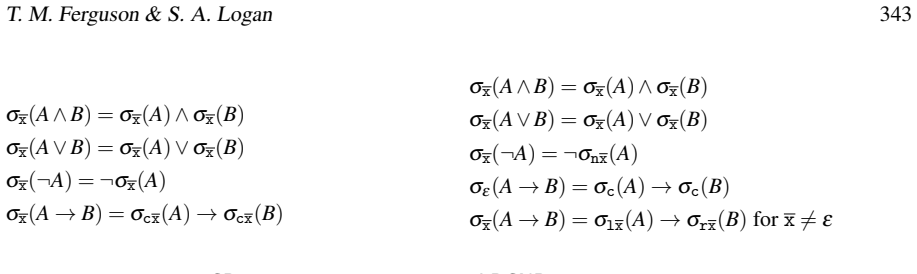
B-Box is closed under MPos substitutions, which treat occurrences of the same atom independently when their nesting within modal operators differs, and K-MPos is the largest sublogic of K that remains closed under these substitutions, with soundness and completeness established for the latter.
What carries the argument
MPos-hyperformalism: closure under non-uniform substitutions that take modal nesting into account.
If this is right
- B-Box is closed under MPos substitutions.
- Several extensions of B-Box are closed under specified classes of non-uniform substitutions.
- Refined versions of the variable sharing property hold for B-Box and its extensions.
- K-MPos is sound and complete.
Where Pith is reading between the lines
- The MPos restriction may allow modal relevant logics to preserve relevance more precisely when necessity and possibility operators interact with propositional atoms.
- The same substitution classes could be checked for other base relevant modal systems.
- K-MPos may serve as a benchmark for measuring how much classical modal reasoning can be retained while keeping MPos-hyperformalism.
Load-bearing premise
The syntactic definition of MPos-hyperformalism correctly extends non-modal hyperformalism to the modal relevant setting without introducing inconsistencies.
What would settle it
A concrete substitution respecting modal nesting under which B-Box fails to be closed, or a strictly larger MPos-hyperformal sublogic of K than K-MPos.
Figures



read the original abstract
The property of hyperformalism has proven to be a powerful tool in the analysis of relevant logics, revealing that increasingly weak relevant logics are closed under increasingly strong classes of non-uniform substitutions. In such substitutions, two instances of the same atom may be treated independently in virtue of syntactic features of their appearances in a complex. In this work, we extend the scope of hyperformalism to relevant modal logics by considering MPos-hyperformalism, that is, a property in which relevant modal logics are closed under substitutions in which nesting within the scope of modal operators is taken into account. We prove that the weak relevant modal logic B-Box is MPos-hyperformal and investigate the classes of non-uniform substitutions under which several extensions are closed. We then consider corresponding refinements of the variable sharing property that hold of such logics. We conclude by introducing a modal logic K-MPos that constitutes the largest MPos-hyperformal sublogic of the classical modal logic K and provide soundness and completeness results.
Editorial analysis
A structured set of objections, weighed in public.
Referee Report
Summary. The paper extends hyperformalism to relevant modal logics via the notion of MPos-hyperformalism (non-uniform substitutions that account for nesting inside modal operators). It proves that the weak relevant modal logic B-Box is closed under MPos-substitutions, studies the substitution classes for several extensions of B-Box, derives corresponding refinements of the variable-sharing property, and defines K-MPos as the largest MPos-hyperformal sublogic of classical modal logic K, for which soundness and completeness are established.
Significance. If the proofs hold, the work supplies a technically natural extension of the non-modal hyperformalism framework into the modal relevant setting, identifies a maximal logic inside K, and furnishes soundness/completeness results. These contributions are load-bearing for the central claim that MPos-hyperformalism is a well-behaved and useful property for relevant modal logics; the explicit provision of soundness and completeness theorems is a clear strength.
minor comments (3)
- The definition of MPos-substitution (presumably in §2 or §3) would benefit from an explicit side-by-side comparison with the non-modal hyperformalism substitution class to make the modal nesting clause immediately legible.
- A short table or diagram summarizing which logics are closed under which substitution classes (B-Box, its extensions, K-MPos) would improve readability and help the reader track the maximality claim for K-MPos.
- The variable-sharing refinements are mentioned in the abstract and conclusion; a dedicated subsection collecting the precise statements would make the connection to the substitution results easier to follow.
Simulated Author's Rebuttal
We thank the referee for the supportive summary of our work extending hyperformalism to relevant modal logics via MPos-hyperformalism, including the results on B-Box, substitution classes, variable-sharing refinements, and the definition of K-MPos with soundness and completeness. We appreciate the recommendation for minor revision.
Circularity Check
No significant circularity detected
full rationale
The paper's central claims consist of syntactic definitions of MPos-hyperformalism (extending non-modal hyperformalism via a modal nesting clause in substitutions) followed by explicit proofs that B-Box is closed under this class, that K-MPos is the largest such sublogic of K, and that soundness/completeness hold. No equations, fitted parameters, or self-referential definitions appear; the derivation chain relies on stated closure properties and completeness results rather than reducing any prediction or uniqueness claim to a prior self-citation or ansatz. Self-citations, if present for background on non-modal hyperformalism, are not load-bearing for the modal extension or maximality results.
Axiom & Free-Parameter Ledger
Reference graph
Works this paper leans on
-
[1]
Taylor & Francis
Jc Beall & Shay Allen Logan (2017): Logic: The Basics. Taylor & Francis
2017
-
[2]
Chellas (1980): Modal Logic
Brian F. Chellas (1980): Modal Logic. Cambridge University Press, Cambridge
1980
-
[3]
Ferguson (2025): γ-Admissibility in First-order Modal Relevant Logics: Method of Normal Models
Nicholas Ferenz & Thomas M. Ferguson (2025): γ-Admissibility in First-order Modal Relevant Logics: Method of Normal Models. Journal of Applied Logics 12(5), pp. 1153–1183
2025
-
[4]
Thomas M. Ferguson (2023): Subject-Matter and Intensional Operators II: Applications to the Theory of Topic-Sensitive Intentional Modals . Journal of Philosophical Logic 52(6), pp. 1673– 1701, doi:10.1007/s10992-023-09722-7
-
[5]
Ferguson & Shay Allen Logan (2025): Topic transparency and variable sharing in weak relevant logics
Thomas M. Ferguson & Shay Allen Logan (2025): Topic transparency and variable sharing in weak relevant logics. Erkenntnis 90(3), pp. 1227–1254, doi:10.1007/s10670-023-00748-6
-
[6]
Journal of Philosophical Logic 3(4), pp
Kit Fine (1974): Models for entailment . Journal of Philosophical Logic 3(4), pp. 347–372, doi:10.1007/BF00257480. 354 Hyperformalism for Relevant Modal Logics
-
[7]
Springer, Cham
Melvin Fitting & Richard L Mendelsohn (2023): First-order modal logic, second edition. Springer, Cham
2023
-
[8]
André Fuhrmann (1990): Models for relevant modal logics . Studia Logica 49(4), pp. 501–514, doi:10.1007/BF00370161
-
[9]
Graham Leach-Krouse, Shay Allen Logan & Blane Worley (2024): Logic in the deep end. Analysis 84(2), pp. 282–291, doi:10.1093/analys/anad060
-
[10]
Journal of Philosophical Logic 51(4), pp
Shay Allen Logan (2022): Depth relevance and hyperformalism . Journal of Philosophical Logic 51(4), pp. 721–737, doi:10.1007/s10992-021-09648-y
-
[11]
Cambridge University Press, Cambridge
Shay Allen Logan (2024): Relevance Logic. Cambridge University Press, Cambridge
2024
-
[12]
The Australasian Journal of Logic 22(5), pp
Shay Allen Logan (2025): Content and Depth Revisited. The Australasian Journal of Logic 22(5), pp. 508–521, doi:10.26686/ajl.v22i5.9220
-
[13]
Journal of Philosophical Logic 54(4), pp
Shay Allen Logan & Blane Worley (2025): Hyperformalism for Bunched Natural Deduction Sys- tems. Journal of Philosophical Logic 54(4), pp. 767–792, doi:10.1007/s10992-025-09802-w
-
[14]
Cambridge University Press, Cambridge
Edwin D Mares (2004): Relevant logic: A philosophical interpretation . Cambridge University Press, Cambridge
2004
-
[15]
Oxford: Blackwell
Stephen Read (1988): Relevant logic. Oxford: Blackwell
1988
-
[16]
Meyer (1972): The Semantics of Entailment: II
Richard Routley & Robert K. Meyer (1972): The Semantics of Entailment: II . Journal of Philo- sophical Logic 1(1), pp. 53–73, doi:10.1007/BF00649991
-
[17]
Meyer & Ross T
Richard Routley, Valerie Plumwood, Robert K. Meyer & Ross T. Brady (1982): Relevant Logics and their Rivals. 1, Ridgeview Publishing, Atascadero, CA
1982
-
[18]
Takahiro Seki (2011): The γ-Admissibility of Relevant Modal Logics: The Method of Normal Mod- els. Studia Logica 97, pp. 199–231, doi:10.1007/s11225-011-9306-6
-
[19]
Logic and Logical Philosophy 32(1), pp
Shawn Standefer (2023): Varieties of RelevantS5. Logic and Logical Philosophy 32(1), pp. 53–80, doi:10.12775/LLP.2022.011
-
[20]
Shawn Standefer (2024): Routes to relevance: Philosophies of relevant logics . Philosophy Com- pass 19(2), p. e12965, doi:10.1111/phc3.12965
-
[21]
Ferguson (2025): Topics, Non-Uniform Substitutions, and Variable Sharing
Shawn Standefer, Shay Allen Logan & Thomas M. Ferguson (2025): Topics, Non-Uniform Substitutions, and Variable Sharing . Review of Symbolic Logic 18(4), pp. 1090–1120, doi:10.1017/S1755020325100725
-
[22]
Australasian Journal of Logic 22(5), pp
Blane Worley (2025): Proof Invariance. Australasian Journal of Logic 22(5), pp. 753–772, doi:10.26686/ajl.v22i5.8348
discussion (0)
Sign in with ORCID, Apple, or X to comment. Anyone can read and Pith papers without signing in.