Uniform Lyndon Interpolation via Non-wellfounded Proofs
Pith reviewed 2026-07-01 02:24 UTC · model grok-4.3
The pith
The provability logic GLS has uniform Lyndon interpolation, shown via non-wellfounded sequent calculus.
A machine-rendered reading of the paper's core claim, the machinery that carries it, and where it could break.
Core claim
We show that GLS has uniform Lyndon interpolation by constructing interpolants from non-wellfounded proofs in a sequent calculus for the logic. The construction tracks polarities of propositional variables throughout the infinite branches. The same calculus yields an alternative proof of cut elimination for GLS.
What carries the argument
A non-wellfounded sequent calculus for GLS, whose infinite but locally finite proofs allow extraction of polarity-preserving interpolants.
If this is right
- GLS satisfies both uniform interpolation and uniform Lyndon interpolation.
- Cut elimination for GLS receives an alternative non-wellfounded proof.
- The method extends directly to any other provability logic that possesses a non-wellfounded sequent calculus.
- Lyndon interpolation holds in uniform form for GLS.
Where Pith is reading between the lines
- Other modal logics admitting non-wellfounded calculi may inherit uniform Lyndon interpolation by the same route.
- The explicit construction could support algorithmic extraction of Lyndon interpolants in GLS.
- Links to cut-elimination techniques in related non-wellfounded systems become available for comparison.
Load-bearing premise
A non-wellfounded sequent calculus for GLS exists and the interpolation construction can be carried out inside it.
What would settle it
A concrete GLS formula that possesses a uniform interpolant but lacks any Lyndon interpolant, or a point in the non-wellfounded calculus where the polarity-tracking step fails.
Figures

read the original abstract
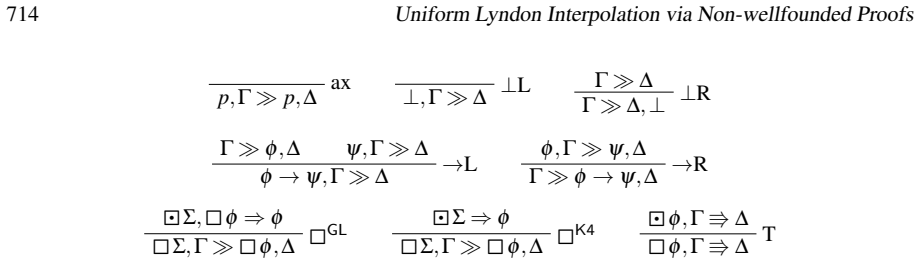
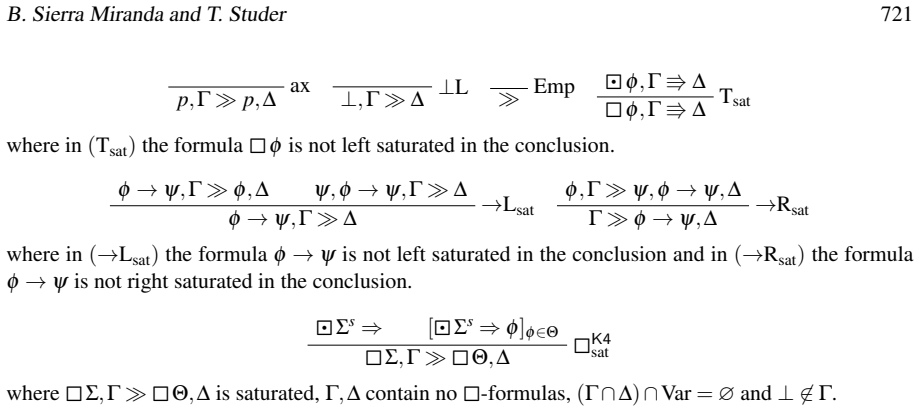
Non-wellfounded proof theory has been applied to establish uniform interpolation and Lyndon interpolation (separately) for multiple logics. However, it has not yet been used to prove uniform Lyndon interpolation. We close this gap by showing uniform Lyndon interpolation for the provability logic GLS. This logic was known to have uniform interpolation, but it was open whether it has uniform Lyndon interpolation (or at least non-uniform Lyndon interpolation). The methodology we provide is easy to adapt to other provability logics if a non-wellfounded sequent calculus is available for them. In addition, we offer an alternative proof of cut elimination for GLS via non-wellfounded proofs.
Editorial analysis
A structured set of objections, weighed in public.
Referee Report
Summary. The manuscript establishes uniform Lyndon interpolation for the provability logic GLS by constructing (or employing) a non-wellfounded sequent calculus, proving cut elimination therein, and deriving the interpolation property from the resulting proofs. It also supplies an alternative non-wellfounded proof of cut elimination for GLS and states that the same methodology applies to other provability logics once a suitable non-wellfounded calculus is available. The result closes the open question of whether GLS possesses uniform (or even non-uniform) Lyndon interpolation, given that uniform interpolation was already known.
Significance. If the derivations hold, the work supplies the first uniform Lyndon interpolation result for GLS and demonstrates that non-wellfounded proof theory can simultaneously handle both uniform interpolation and its Lyndon strengthening. The alternative cut-elimination argument and the explicit adaptability claim are additional strengths; the latter supplies a reusable template rather than an ad-hoc construction for a single logic.
minor comments (2)
- The abstract and introduction should clarify whether the non-wellfounded calculus for GLS is taken from prior work or newly constructed in the paper, and which specific sequent rules are added or modified to obtain the Lyndon property.
- Notation for the non-wellfounded rules and the precise statement of the uniform Lyndon interpolation theorem (including the precise form of the interpolant) should be introduced early and used consistently throughout.
Simulated Author's Rebuttal
We thank the referee for the accurate summary of our results on uniform Lyndon interpolation for GLS and for noting the significance of the non-wellfounded approach, the alternative cut-elimination proof, and the adaptability claim. No specific major comments were listed in the report.
Circularity Check
No significant circularity; derivation is self-contained
full rationale
The paper constructs a non-wellfounded sequent calculus for GLS, establishes cut elimination inside it, and derives uniform Lyndon interpolation as a consequence. This chain relies on standard proof-theoretic constructions and does not reduce any target property to a fitted parameter, self-definition, or load-bearing self-citation. The abstract explicitly frames the result as obtained from the calculus rather than presupposed by it. No equations or steps equate the claimed interpolation property to its own inputs by construction.
Axiom & Free-Parameter Ledger
axioms (1)
- domain assumption Existence of a non-wellfounded sequent calculus for GLS that is adequate for the interpolation argument
Reference graph
Works this paper leans on
-
[1]
B. Afshari, G. E. Leigh & G. Menéndez Turata (2021): Uniform Interpolation from Cyclic Proofs: The Case of Modal Mu-Calculus . In: Automated Reasoning with Analytic Tableaux and Related Methods: 30th In- ternational Conference, TABLEAUX 2021, Birmingham, UK, September 6–9, 2021, Proceedings , Springer- Verlag, Berlin, Heidelberg, p. 335–353, doi:10.1007/9...
-
[2]
B. Afshari, G. E. Leigh & G. Menéndez Turata (2023): A Cyclic Proof System for Full Computation Tree Logic. In B. Klin & E. Pimentel, editors: 31st EACSL Annual Conference on Computer Science Logic (CSL 2023), Leibniz International Proceedings in Informatics (LIPIcs) 252, Schloss Dagstuhl – Leibniz-Zentrum für Informatik, Dagstuhl, Germany, pp. 5:1–5:19, ...
-
[3]
In: Leonardis, A., Ricci, E., Roth, S., Russakovsky, O., Sattler, T., Varol, G
B. Afshari, L. Grotenhuis G. E. Leigh & L. Zenger (2023): Ill-Founded Proof Systems for Intuitionistic Linear-Time Temporal Logic. In R. Ramanayake & J. Urban, editors: Automated Reasoning with Analytic Tableaux and Related Methods , Springer Nature Switzerland, Cham, pp. 223–241, doi:10.1007/978-3-031- 43513-3_13
-
[4]
A. Akbar Tabatabai, R. Iemhoff & R. Jalali (2021): Uniform Lyndon Interpolation for Basic Non-normal Modal Logics. In A. Silva, R. Wassermann & R. de Queiroz, editors: Logic, Language, Information, and Computation, Springer, pp. 287–301, doi:10.1093/logcom/exae057
-
[5]
D. Baelde, A. Doumane & A. Saurin (2016): Infinitary Proof Theory: the Multiplicative Additive Case . In: Annual Conference for Computer Science Logic , pp. 42:1–42:17, doi:10.4230/LIPIcs.CSL.2016.42. Avail- able at https://api.semanticscholar.org/CorpusID:269432892
-
[6]
Justus Becker (2025): A Non-Wellfounded and Labelled Sequent Calculus for Bimodal Provability Logic . arXiv:2506.14307
-
[7]
L. D. Beklemishev (1987): Normalization of deductions and interpolation for some logics of provability . Russian Math. Surveys 42(6), pp. 223–224, doi:10.1070/RM1987v042n06ABEH001496
-
[8]
Boolos (2008): On systems of modal logic with provability interpretations
G. Boolos (2008): On systems of modal logic with provability interpretations . Theoria 46, pp. 7 – 18, doi:10.1111/j.1755-2567.1980.tb00686.x
-
[9]
M. Borzechowski, M. Gattinger, H. H. Hansen, R. Ramanayake, V . Trucco Dalmas & Y . Venema (2025): Propositional Dynamic Logic has Craig Interpolation: a tableau-based proof. arXiv:2503.13276
-
[10]
J. Brotherston & A. Simpson (2007): Complete Sequent Calculi for Induction and Infinite De- scent. In: 22nd Annual IEEE Symposium on Logic in Computer Science (LICS 2007) , pp. 51–62, doi:10.1109/LICS.2007.16
-
[11]
S. Bucheli, R. Kuznets & T. Studer (2010):Two Ways to Common Knowledge. Electronic Notes in Theoretical Computer Science 262, pp. 83–98, doi:10.1016/j.entcs.2010.04.007. Proceedings of the 6th Workshop on Methods for Modalities (M4M-6 2009)
-
[12]
A. Das & D. Pous (2018): Non-Wellfounded Proof Theory For (Kleene+Action)(Algebras+Lattices) . In D. R. Ghica & A. Jung, editors: 27th EACSL Annual Conference on Computer Science Logic, CSL 2018, Birmingham, UK, September 4-7, 2018 , LIPIcs 119, Schloss Dagstuhl - Leibniz-Zentrum für Informatik, pp. 19:1–19:18, doi:10.4230/LIPICS.CSL.2018.19
-
[13]
S. Horvat, B. Sierra Miranda & T. Studer (2025): Non-wellfounded Proof Theory for Interpretability Logic. In: Automated Reasoning with Analytic Tableaux and Related Methods: 34th International Conference, TABLEAUX 2025, Reykjavik, Iceland, September 27–29, 2025, Proceedings , Springer-Verlag, Berlin, Hei- delberg, p. 201–219, doi:10.1007/978-3-032-06085-3_11
- [14]
-
[15]
J. Kloibhofer, V . Trucco Dalmas & Y . Venema (2026): Interpolation for Converse PDL . In G. L. Pozzato & T. Uustalu, editors: Automated Reasoning with Analytic Tableaux and Related Methods , Springer Nature Switzerland, Cham, pp. 258–277, doi:10.1007/978-3-032-06085-3_14. 730 Uniform Lyndon Interpolation via Non-wellfounded Proofs
-
[16]
I. Kokkinis & T. Studer (2016): Cyclic Proofs for Linear Temporal Logic, pp. 171–192. De Gruyter, Berlin, Boston, doi:10.1515/9781501502620-011
-
[17]
Kurahashi (2020): Uniform Lyndon interpolation property in propositional modal logics
T. Kurahashi (2020): Uniform Lyndon interpolation property in propositional modal logics . Arch. Math. Log. 59(5-6), pp. 659–678, doi:10.1007/s00153-020-00713-y
-
[18]
Kushida (2020): A Proof Theory for the Logic of Provability in True Arithmetic
H. Kushida (2020): A Proof Theory for the Logic of Provability in True Arithmetic . Studia Logica 108, pp. 857–875, doi:10.1007/s11225-019-09891-0
-
[19]
Lindström (2006): Note on Some Fixed Point Constructions in Provability Logic
P. Lindström (2006): Note on Some Fixed Point Constructions in Provability Logic . J Philos Logic 35, pp. 225–230, doi:10.1007/s10992-005-9013-8
-
[20]
Proof Theory for Bimodal Provability Logics
Borja Sierra Miranda & Thomas Studer (2026): Proof Theory for Bimodal Provability Logics . arXiv:2605.12351
work page internal anchor Pith review Pith/arXiv arXiv 2026
-
[21]
Y . Savateev & D. Shamkanov (2021):Non-well-founded proofs for the Grzegorczyk modal logic. The Review of Symbolic Logic 14(1), p. 22–50, doi:10.1017/S1755020319000510
-
[22]
Shamkanov (2014): Circular proofs for the Gödel-Löb provability logic
D. Shamkanov (2014): Circular proofs for the Gödel-Löb provability logic . Mathematical Notes 96, pp. 575–585, doi:10.1134/S0001434614090326
-
[23]
Sierra Miranda & T
B. Sierra Miranda & T. Studer (in press): Cut elimination for the master modality . Journal of Symbolic Logic
-
[24]
Sierra Miranda, T
B. Sierra Miranda, T. Studer & L. Zenger (2024): Coalgebraic Proof Translations for Non-Wellfounded Proofs. In A. Ciabattoni, D. Gabelaia & I. Sedlár, editors: Advances in Modal Logic 2024 , pp. 527–548
2024
-
[25]
Smory ´nski (1985): Self-Reference and Modal Logic
C. Smory ´nski (1985): Self-Reference and Modal Logic . Universitext, Springer New York, NY , doi:10.1007/978-1-4613-8601-8
-
[26]
R. M. Solovay (1976): Provability interpretations of modal logic . Israel Journal of Mathematics 25, pp. 287–304, doi:10.1007/BF02757006
discussion (0)
Sign in with ORCID, Apple, or X to comment. Anyone can read and Pith papers without signing in.