High Frequency Wideband Study of FRB 20240114A with the Allen Telescope Array
Pith reviewed 2026-07-01 03:47 UTC · model grok-4.3
The pith
FRB 20240114A produces bursts only up to 5 GHz, with rates that change sharply by frequency and observing epoch.
A machine-rendered reading of the paper's core claim, the machinery that carries it, and where it could break.
Core claim
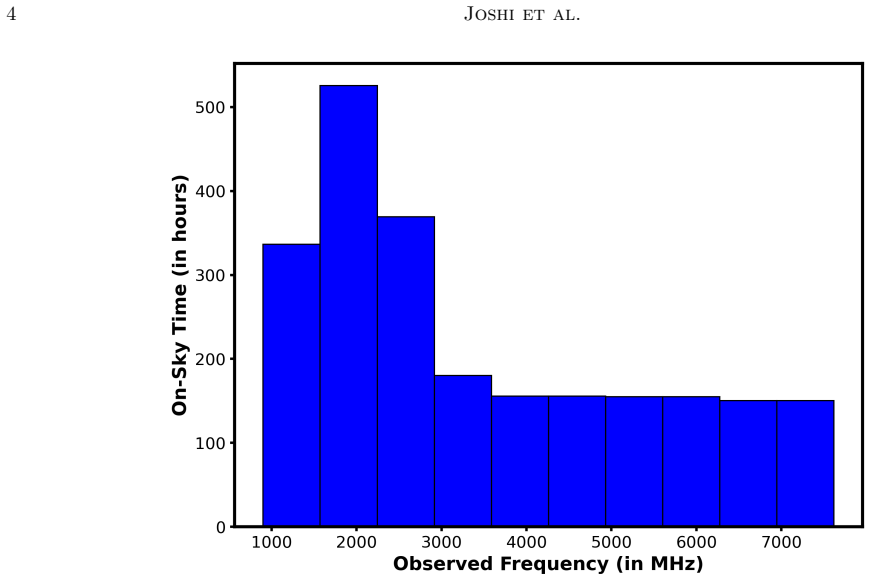
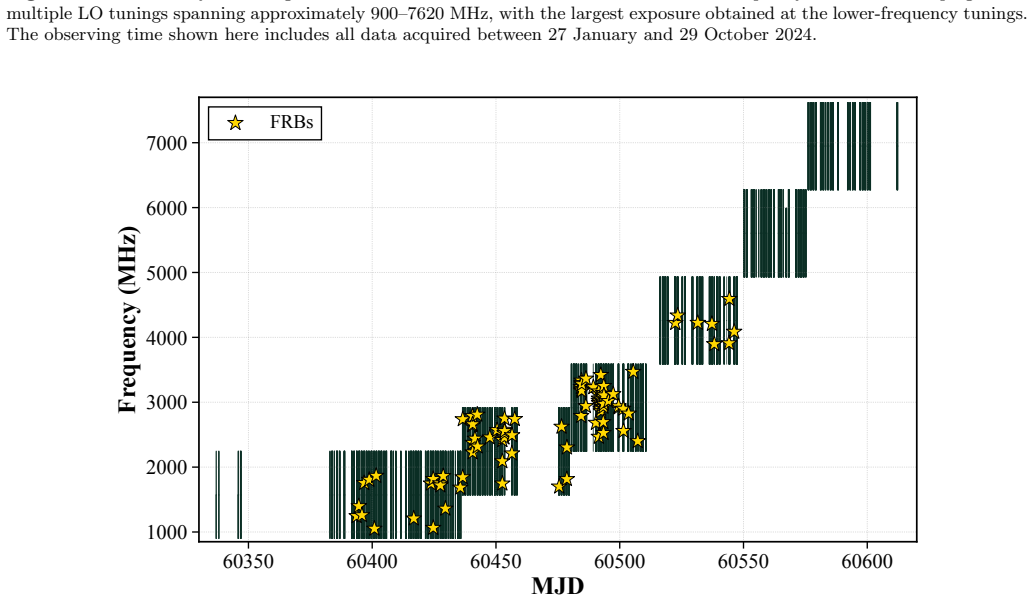
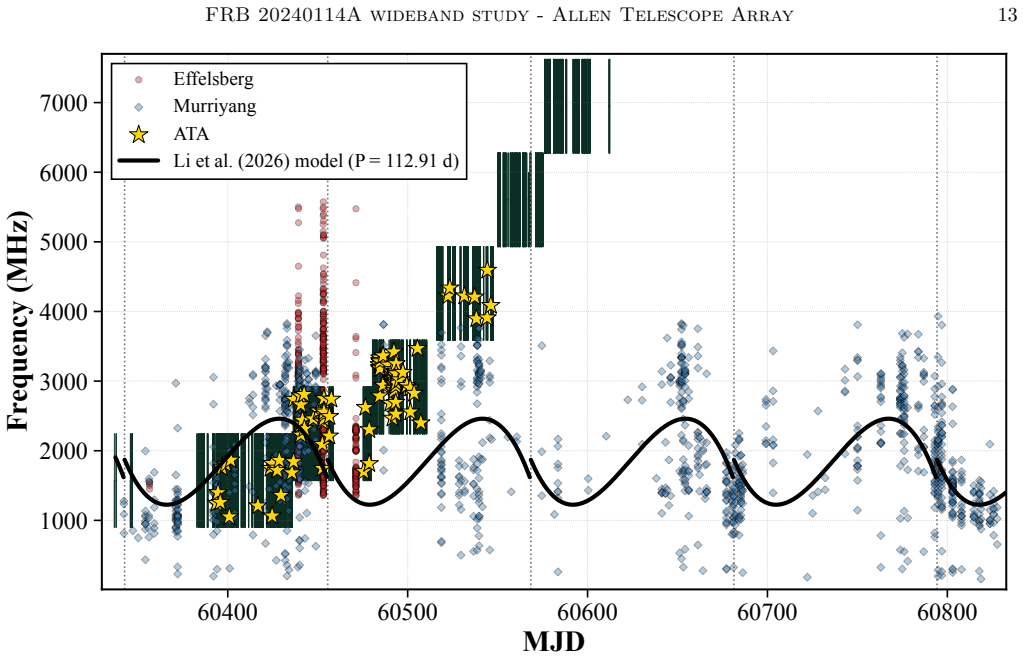
The emission from FRB 20240114A is highly chromatic and band-limited, with the burst rate varying strongly with both observing frequency and epoch; no bursts were detected above approximately 5 GHz despite 1167 hours of simultaneous wideband coverage from 900 MHz to 7620 MHz.
What carries the argument
Simultaneous wideband observations across 1344 MHz of bandwidth that directly compare burst detections and non-detections at different frequencies to establish the chromatic and band-limited nature of the emission.
If this is right
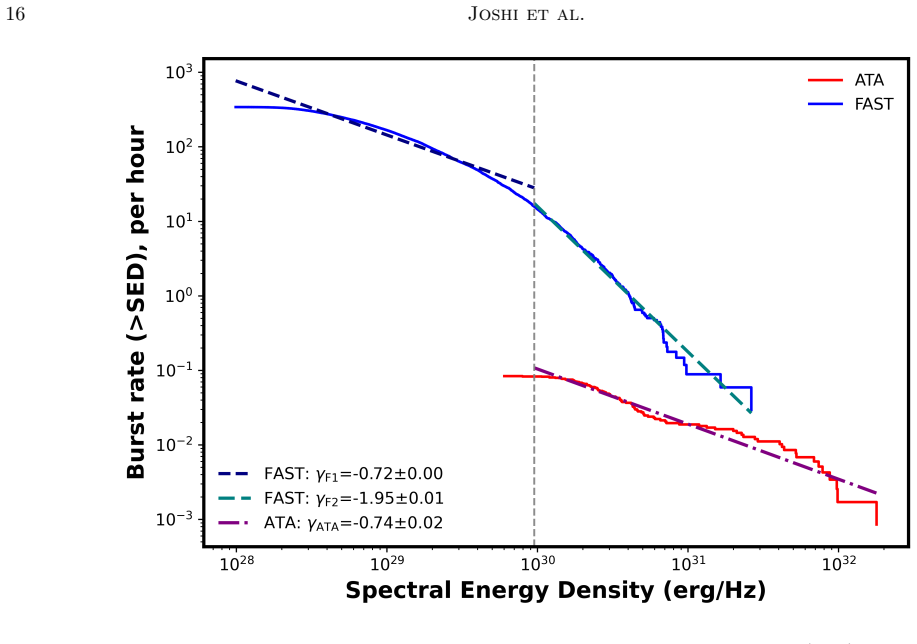
- The cumulative spectral-energy-density distribution follows a shallow power law above the completeness threshold, so high-energy bursts dominate the total energy output.
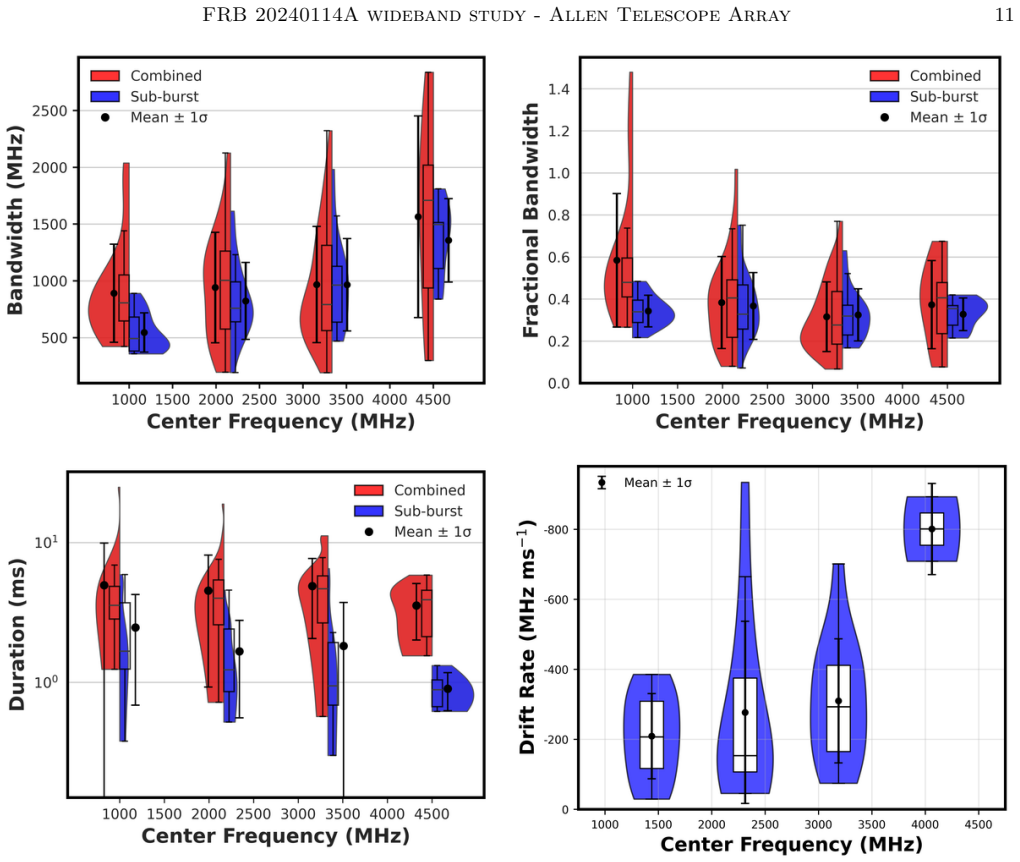
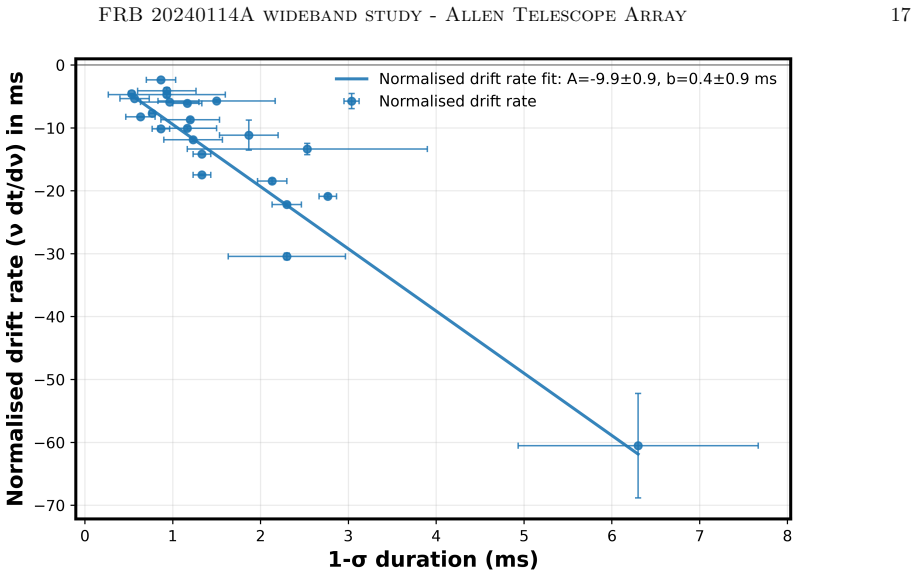
- Sub-burst durations shorten and the magnitude of downward frequency drift increases toward higher frequencies.
- Fractional bandwidth of sub-bursts remains approximately constant across the observed range.
- The high-frequency burst storm does not match predictions from strictly phase-coherent long-timescale frequency-modulation models.
- Incomplete frequency coverage can produce misleading pictures of burst activity in repeating FRBs.
Where Pith is reading between the lines
- Sustained simultaneous wideband monitoring is required to avoid selection biases when interpreting the activity of hyperactive repeaters.
- Models of FRB emission must incorporate a mechanism that naturally produces strong frequency dependence and time variability on both short and long timescales.
- Future searches for repeating FRBs should prioritize continuous coverage across at least an octave in frequency to capture the full band-limited behavior.
Load-bearing premise
The lack of detections above 5 GHz is caused by an intrinsic cutoff in the source rather than the telescope sensitivity being too low in those bands.
What would settle it
A detection of even one burst above 5 GHz in a new observation with comparable or better sensitivity at those frequencies would show the cutoff is not intrinsic.
Figures
read the original abstract
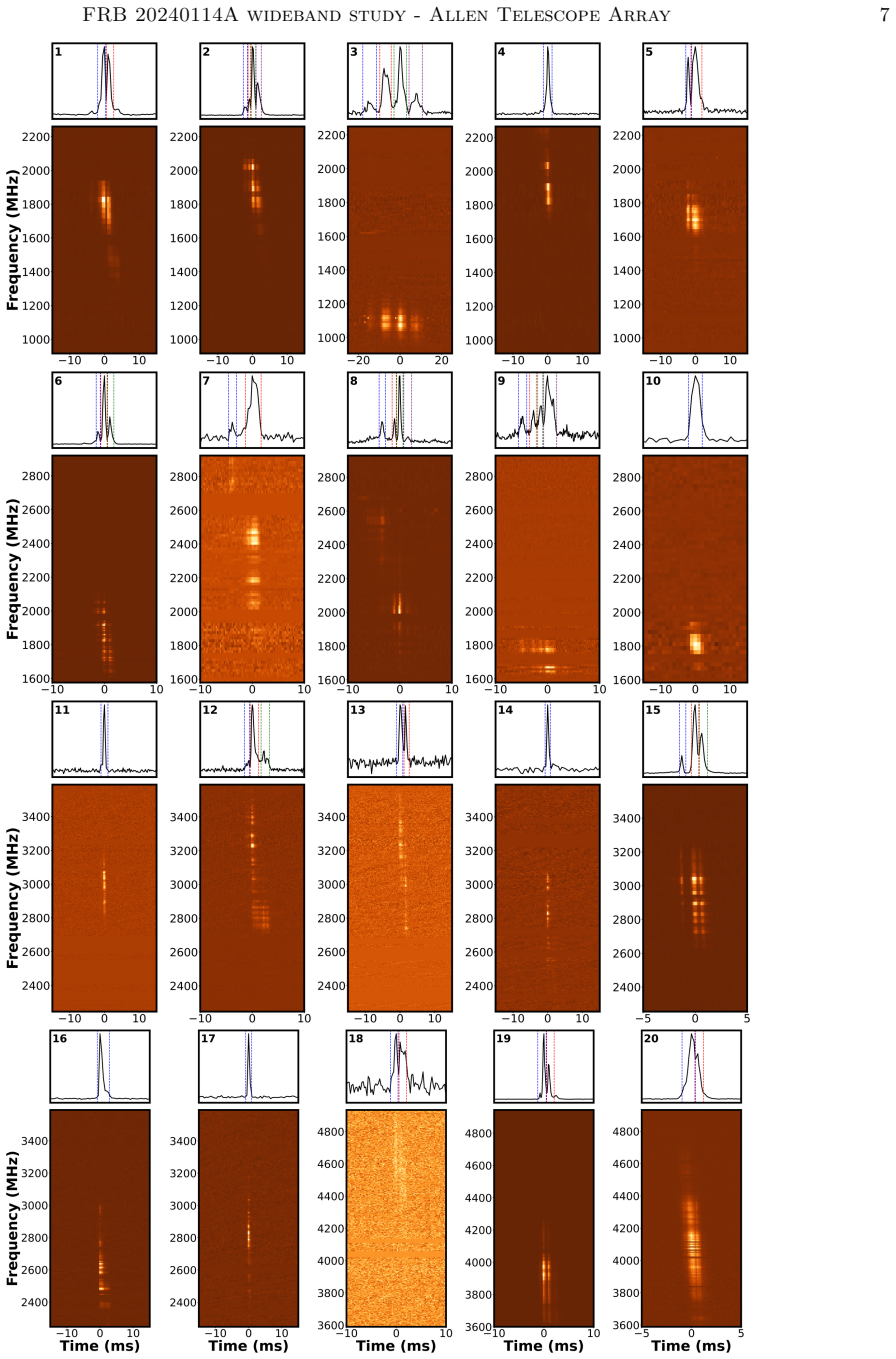
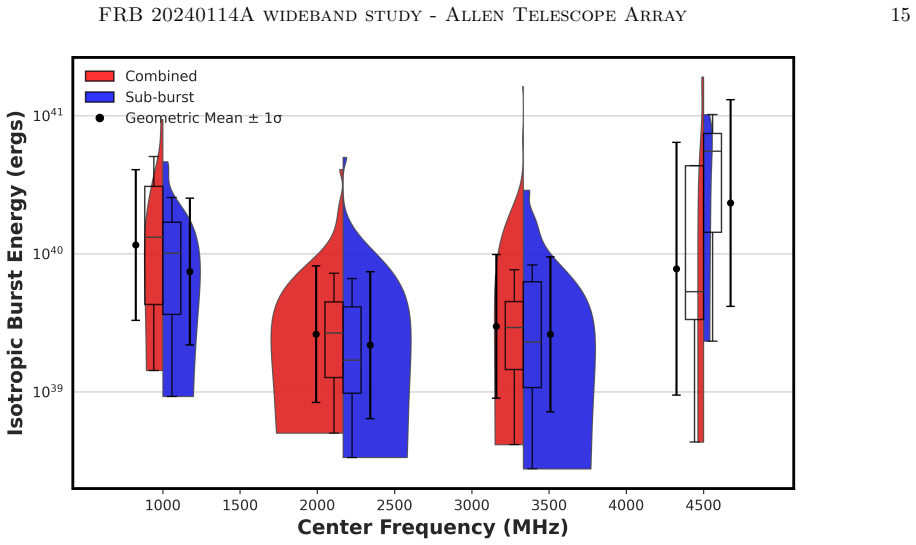
We present a high-frequency, wideband observing campaign of the hyperactive repeating fast radio burst FRB 20240114A with the Allen Telescope Array. Between 27 January and 29 October 2024, we obtained 1167 hr of on-source observations across 1344 MHz of simultaneous bandwidth covering frequencies from approximately 900 MHz to 7620 MHz. We detected 97 bursts between ~900 MHz and ~5 GHz, including a strong S-band activity episode, while no bursts were detected in the highest-frequency tunings above ~5 GHz despite substantial exposure. This campaign provides one of the very few extended samples of repeating-FRB activity above 3 GHz, a regime that remains sparsely sampled. We find that the burst rate varies strongly with both observing frequency and epoch, confirming that the emission from FRB 20240114A is highly chromatic and band-limited. We measure the spectro-temporal properties of the bursts and their sub-components, confirming that fractional bandwidth remains approximately scale-invariant. Sub-burst durations decrease toward higher frequencies, and the magnitude of the downward drift rate increases with frequency. The cumulative spectral-energy-density distribution above our completeness threshold is well described by a shallow power law, indicating that high-energy bursts contribute substantially to the observed energy output. We also compare our detections with recently proposed long-timescale frequency-modulation models and find that the ATA high-frequency burst storm is not consistent with a strictly phase-coherent modulation inferred from other datasets. Our results demonstrate that incomplete time-frequency coverage can bias interpretations of burst activity and highlight the need for sustained, simultaneous wideband monitoring of hyperactive repeaters.
Editorial analysis
A structured set of objections, weighed in public.
Referee Report
Summary. The manuscript reports 1167 hours of ATA wideband observations (0.9–7.62 GHz) of the hyperactive repeater FRB 20240114A, yielding 97 bursts detected between ~900 MHz and ~5 GHz and zero detections above ~5 GHz. The authors conclude that burst rate varies strongly with frequency and epoch, confirming highly chromatic and band-limited emission; they further report scale-invariant fractional bandwidth, decreasing sub-burst durations and increasing downward drift rates with frequency, a shallow power-law cumulative energy distribution, and inconsistency with strictly phase-coherent long-timescale frequency-modulation models.
Significance. If the non-detections are shown to be intrinsic, the work supplies one of the few extended high-frequency samples of a hyperactive repeater and demonstrates that incomplete frequency coverage can bias activity interpretations, with direct implications for emission physics and the design of future monitoring campaigns.
major comments (2)
- [Abstract] Abstract and the section discussing high-frequency non-detections: the central claim that emission is 'highly chromatic and band-limited' rests on the interpretation of zero detections above ~5 GHz despite 1167 hr total exposure. No band-by-band SEFD, T_sys, or completeness fluence thresholds are supplied, so it is not possible to exclude the possibility that the highest tunings simply have higher fluence thresholds (a factor of 3–5 degradation is common at C-band).
- [Results (burst detection and non-detections)] The section on burst detection statistics and completeness: without explicit per-tuning completeness curves or fluence limits, the reported strong frequency dependence of the burst rate cannot be verified as intrinsic rather than sensitivity-driven, directly affecting the soundness of the chromaticity conclusion.
minor comments (1)
- [Abstract] Abstract: the statement that this is 'one of the very few extended samples above 3 GHz' would be strengthened by citing the specific prior high-frequency campaigns referenced.
Simulated Author's Rebuttal
We thank the referee for the careful and constructive review. The two major comments correctly identify that our current presentation lacks sufficient quantitative detail on per-tuning sensitivity to fully substantiate the intrinsic nature of the high-frequency non-detections and the reported frequency dependence of the burst rate. We address both points below and will revise the manuscript accordingly.
read point-by-point responses
-
Referee: [Abstract] Abstract and the section discussing high-frequency non-detections: the central claim that emission is 'highly chromatic and band-limited' rests on the interpretation of zero detections above ~5 GHz despite 1167 hr total exposure. No band-by-band SEFD, T_sys, or completeness fluence thresholds are supplied, so it is not possible to exclude the possibility that the highest tunings simply have higher fluence thresholds (a factor of 3–5 degradation is common at C-band).
Authors: We agree that explicit per-tuning sensitivity metrics are required to support the non-detection claim. In the revised manuscript we will add a new table (or expanded subsection in Section 3) listing SEFD, T_sys, and estimated completeness fluence thresholds for each of the 1344 MHz tunings, derived from our calibration observations. This will allow direct comparison of sensitivity across bands and will confirm that the absence of bursts above ~5 GHz is not driven by a factor of 3–5 degradation. We will also reference these limits in the abstract. revision: yes
-
Referee: [Results (burst detection and non-detections)] The section on burst detection statistics and completeness: without explicit per-tuning completeness curves or fluence limits, the reported strong frequency dependence of the burst rate cannot be verified as intrinsic rather than sensitivity-driven, directly affecting the soundness of the chromaticity conclusion.
Authors: We concur that completeness curves and fluence limits per tuning are necessary to demonstrate that the observed rate variation is intrinsic. The revised manuscript will include per-tuning completeness curves (generated via injection-recovery tests) and explicit fluence thresholds in the burst detection statistics section. These additions will quantify the frequency dependence of the detection efficiency and thereby strengthen the evidence for chromatic, band-limited emission. revision: yes
Circularity Check
No circularity: purely observational reporting of detections and rates
full rationale
The paper reports telescope observations, burst detections between 900 MHz and 5 GHz, zero detections above 5 GHz, and measured spectro-temporal properties. No derivations, model fits, or predictions are presented that reduce to fitted parameters or self-citations by construction. The central claim (frequency- and epoch-dependent burst rate) follows directly from counting detections in the observed bands. Non-detection interpretation is an assumption about sensitivity but does not involve any definitional loop or renamed fit. This is self-contained observational work with no load-bearing self-citation chains or ansatzes.
Axiom & Free-Parameter Ledger
Reference graph
Works this paper leans on
-
[1]
2021, ApJL, 920, L18, doi: 10.3847/2041-8213/ac2a3a
Aggarwal, K. 2021, ApJL, 920, L18, doi: 10.3847/2041-8213/ac2a3a
-
[2]
Barsdell, B. R., Bailes, M., Barnes, D. G., & Fluke, C. J. 2012, MNRAS, 422, 379, doi: 10.1111/j.1365-2966.2012.20622.x
-
[3]
2024, The Astronomer’s Telegram, 16613, 1
Bhardwaj, M., Kirichenko, A., & Gil de Paz, A. 2024, The Astronomer’s Telegram, 16613, 1
2024
-
[4]
Brown, K., Chamma, M. A., Rajabi, F., et al. 2024, Monthly Notices of the Royal Astronomical Society: Letters, 529, L152, doi: 10.1093/mnrasl/slae012 CASA Team, Bean, B., Bhatnagar, S., et al. 2022, PASP, 134, 114501, doi: 10.1088/1538-3873/ac9642
-
[5]
Chamma, M. A., Pop, V., & Rajabi, F. 2025, Monthly Notices of the Royal Astronomical Society, doi: 10.1093/mnras/staf1799
-
[6]
A., Rajabi, F., Kumar, A., & Houde, M
Chamma, M. A., Rajabi, F., Kumar, A., & Houde, M. 2023, Monthly Notices of the Royal Astronomical Society, 522, 3036, doi: 10.1093/mnras/stad1108
-
[7]
Chamma, M. A., Rajabi, F., Wyenberg, C. M., Mathews, A., & Houde, M. 2021, Monthly Notices of the Royal Astronomical Society, 507, 246, doi: 10.1093/mnras/stab2070
-
[8]
Cordes, J. M., Wasserman, I., Hessels, J. W. T., et al. 2017, ApJ, 842, 35, doi: 10.3847/1538-4357/aa74da
-
[9]
Cruces, M., Spitler, L. G., Scholz, P., et al. 2021, MNRAS, 500, 448, doi: 10.1093/mnras/staa3223
-
[10]
Gajjar, V., Siemion, A. P. V., Price, D. C., et al. 2018, The Astrophysical Journal, 863, 2, doi: 10.3847/1538-4357/aad005
-
[11]
2022, ApJ, 932, 81, doi: 10.3847/1538-4357/ac6dd5
Gajjar, V., LeDuc, D., Chen, J., et al. 2022, ApJ, 932, 81, doi: 10.3847/1538-4357/ac6dd5
-
[12]
Hewitt, D. M., Snelders, M. P., Hessels, J. W. T., et al. 2022, MNRAS, 515, 3577, doi: 10.1093/mnras/stac1960
-
[13]
2025, Research in Astronomy and Astrophysics, 25, 085009, doi: 10.1088/1674-4527/ade34e
Huang, Y.-X., Zhang, J.-S., Xu, H., et al. 2025, Research in Astronomy and Astrophysics, 25, 085009, doi: 10.1088/1674-4527/ade34e
-
[14]
Jahns, J. N., Spitler, L. G., Nimmo, K., et al. 2023, \mnras, 519, 666, doi: 10.1093/mnras/stac3446
-
[15]
T., et al
Joshi, P., Medina, A., Earwicker, J. T., et al. 2024, The Astronomer’s Telegram, 16599, 1
2024
-
[16]
Konijn, D. C., Hewitt, D. M., Hessels, J. W. T., et al. 2024, MNRAS, 534, 3331, doi: 10.1093/mnras/stae2296
-
[17]
2024, ApJ, 977, 177, doi: 10.3847/1538-4357/ad84de
Kumar, A., Maan, Y., & Bhusare, Y. 2024, ApJ, 977, 177, doi: 10.3847/1538-4357/ad84de
-
[18]
Periodic Emission Frequency Modulation in a Hyperactive Fast Radio Burst
Li, R.-N., Lan, H.-T., Zhao, Z.-Y., et al. 2026, arXiv e-prints, arXiv:2605.12098, doi: 10.48550/arXiv.2605.12098
work page internal anchor Pith review Pith/arXiv arXiv doi:10.48550/arxiv.2605.12098 2026
-
[19]
2024, The Astronomer’s Telegram, 16620, 1
Limaye, P., & Spitler, L. 2024, The Astronomer’s Telegram, 16620, 1
2024
-
[20]
A broadband study of FRB20240114A with the Effelsberg 100-m radio telescope
Limaye, P., Spitler, L. G., Manaswini, N., et al. 2025, arXiv e-prints, arXiv:2510.08367, doi: 10.48550/arXiv.2510.08367
work page internal anchor Pith review Pith/arXiv arXiv doi:10.48550/arxiv.2510.08367 2025
-
[21]
Lorimer, D. R., Bailes, M., McLaughlin, M. A., Narkevic, D. J., & Crawford, F. 2007, Science, 318, 777, doi: 10.1126/science.1147532
-
[22]
Lyutikov, M. 2020, ApJ, 889, 135, doi: 10.3847/1538-4357/ab55de FRB 20240114A wideband study - Allen Telescope Array 19
-
[23]
Metzger, B. D., Margalit, B., & Sironi, L. 2019, MNRAS, 485, 4091, doi: 10.1093/mnras/stz700
-
[24]
Nimmo, K., Hessels, J. W. T., Snelders, M. P., et al. 2023, MNRAS, 520, 2281, doi: 10.1093/mnras/stad269
-
[25]
S., Hessels, J
Ould-Boukattine, O. S., Hessels, J. W. T., Kirsten, F., et al. 2024, The Astronomer’s Telegram, 16432, 1
2024
-
[26]
Ould-Boukattine, O. S., Cooper, A. J., Cook, A. M., et al. 2026, arXiv e-prints, arXiv:2605.18513, doi: 10.48550/arXiv.2605.18513
work page internal anchor Pith review Pith/arXiv arXiv doi:10.48550/arxiv.2605.18513 2026
-
[27]
2025, ApJ, 989, 15, doi: 10.3847/1538-4357/adeb74
Kudale, S. 2025, ApJ, 989, 15, doi: 10.3847/1538-4357/adeb74
-
[28]
Perley, R. A., & Butler, B. J. 2017, ApJS, 230, 7, doi: 10.3847/1538-4365/aa6df9 Planck Collaboration, Aghanim, N., Akrami, Y., et al. 2020, A&A, 641, A6, doi: 10.1051/0004-6361/201833910
-
[29]
Pleunis, Z., Michilli, D., Bassa, C. G., et al. 2021, The Astrophysical Journal Letters, 911, L3, doi: 10.3847/2041-8213/abec72
-
[30]
Rajabi, F., Chamma, M. A., Wyenberg, C. M., Mathews, A., & Houde, M. 2020, Monthly Notices of the Royal Astronomical Society, 498, 4936, doi: 10.1093/mnras/staa2723
-
[31]
2019, DM phase: Algorithm for correcting dispersion of radio signals,, Astrophysics Source Code Library, record ascl:1910.004 http://ascl.net/1910.004
Seymour, A., Michilli, D., & Pleunis, Z. 2019, DM phase: Algorithm for correcting dispersion of radio signals,, Astrophysics Source Code Library, record ascl:1910.004 http://ascl.net/1910.004
2019
-
[32]
Sheikh, S. Z., Farah, W., Pollak, A. W., et al. 2024, MNRAS, 527, 10425, doi: 10.1093/mnras/stad3630
-
[33]
2024, The Astronomer’s Telegram, 16420, 1
Shin, K., & CHIME/FRB Collaboration. 2024, The Astronomer’s Telegram, 16420, 1
2024
-
[34]
2025, arXiv e-prints, arXiv:2505.13297, doi: 10.48550/arXiv.2505.13297
Shin, K., Curtin, A., Fine, M., et al. 2025, arXiv e-prints, arXiv:2505.13297, doi: 10.48550/arXiv.2505.13297
-
[35]
P., Bhandari, S., Kirsten, F., et al
Snelders, M. P., Bhandari, S., Kirsten, F., et al. 2024, The Astronomer’s Telegram, 16542, 1
2024
-
[36]
A., Kumar, P., Lower, M
Uttarkar, P. A., Kumar, P., Lower, M. E., & Shannon, R. M. 2024, The Astronomer’s Telegram, 16430, 1
2024
-
[37]
Uttarkar, P. A., Shannon, R. M., Gourdji, K., et al. 2026, arXiv e-prints, arXiv:2602.16409, doi: 10.48550/arXiv.2602.16409 van Straten, W., & Bailes, M. 2010, DSPSR: Digital Signal Processing Software for Pulsar Astronomy,, Astrophysics Source Code Library, record ascl:1010.006 http://ascl.net/1010.006
-
[38]
Wang, F. Y., & Zhang, G. Q. 2019, ApJ, 882, 108, doi: 10.3847/1538-4357/ab35dc
-
[39]
2025, arXiv e-prints, arXiv:2508.15615, doi: 10.48550/arXiv.2508.15615
Wang, X.-W., Yan, Z., Shen, Z.-Q., et al. 2025, arXiv e-prints, arXiv:2508.15615, doi: 10.48550/arXiv.2508.15615
-
[40]
, year = 2022, month = sep, volume =
Xu, H., Niu, J. R., Chen, P., et al. 2022, Nature, 609, 685, doi: 10.1038/s41586-022-05071-8
-
[41]
2024, The Astronomer’s Telegram, 16433, 1
Zhang, J., Zhu, Y., Cao, S., et al. 2024, The Astronomer’s Telegram, 16433, 1
2024
-
[42]
2025, arXiv e-prints, arXiv:2507.14707, doi: 10.48550/arXiv.2507.14707
Zhang, J.-S., Wang, T.-C., Wang, P., et al. 2025, arXiv e-prints, arXiv:2507.14707, doi: 10.48550/arXiv.2507.14707
-
[43]
2025, arXiv e-prints, arXiv:2507.14711, doi: 10.48550/arXiv.2507.14711
Zhang, L.-X., Tian, S., Shen, J., et al. 2025, arXiv e-prints, arXiv:2507.14711, doi: 10.48550/arXiv.2507.14711
-
[44]
2022, Research in Astronomy and Astrophysics, 22, 124002, doi: 10.1088/1674-4527/ac98f7
Zhang, Y.-K., Wang, P., Feng, Y., et al. 2022, Research in Astronomy and Astrophysics, 22, 124002, doi: 10.1088/1674-4527/ac98f7
-
[45]
Zhang, Y.-K., Li, D., Zhang, B., et al. 2023, ApJ, 955, 142, doi: 10.3847/1538-4357/aced0b
-
[46]
2025, arXiv e-prints, arXiv:2507.14708, doi: 10.48550/arXiv.2507.14708
Zhou, D., Wang, P., Fang, J., et al. 2025, arXiv e-prints, arXiv:2507.14708, doi: 10.48550/arXiv.2507.14708
discussion (0)
Sign in with ORCID, Apple, or X to comment. Anyone can read and Pith papers without signing in.