MeshDNS: A Cooperative DNS Resolution Framework for Resource-Constrained IoT Networks
Pith reviewed 2026-07-02 17:02 UTC · model grok-4.3
The pith
MeshDNS achieves 0.47 ms warm-cache DNS resolution on ESP8266 devices while isolating Byzantine faults via signed quorum voting.
A machine-rendered reading of the paper's core claim, the machinery that carries it, and where it could break.
Core claim
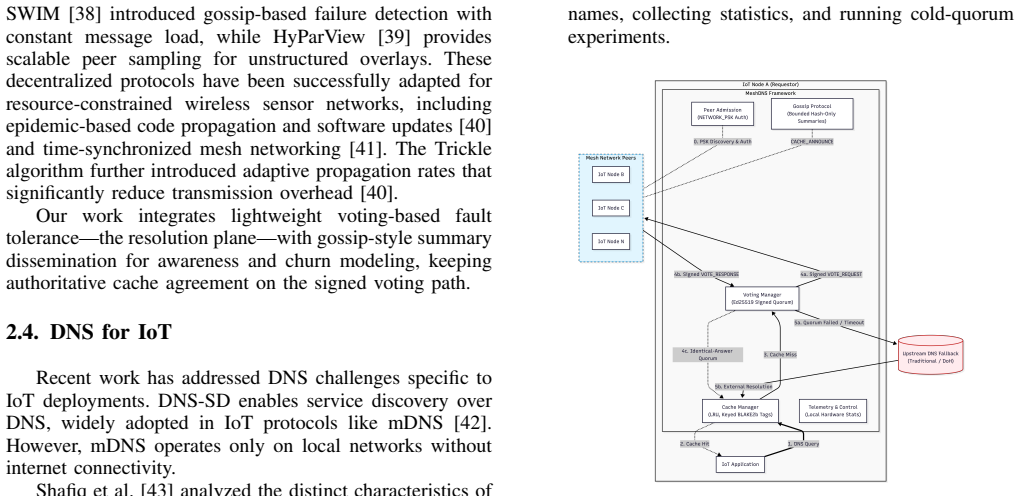
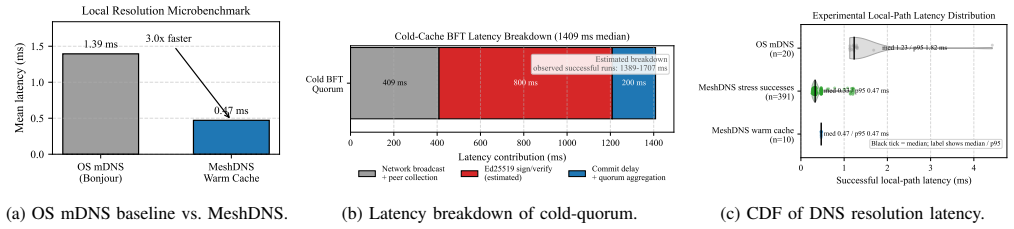
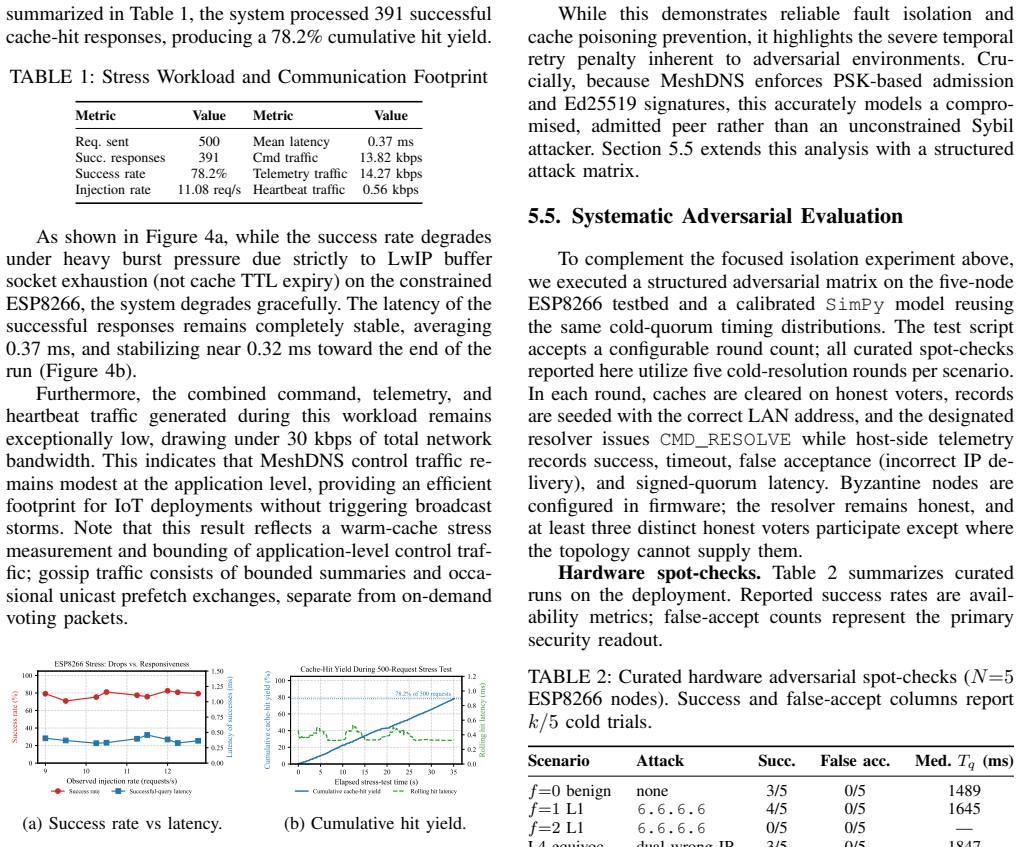
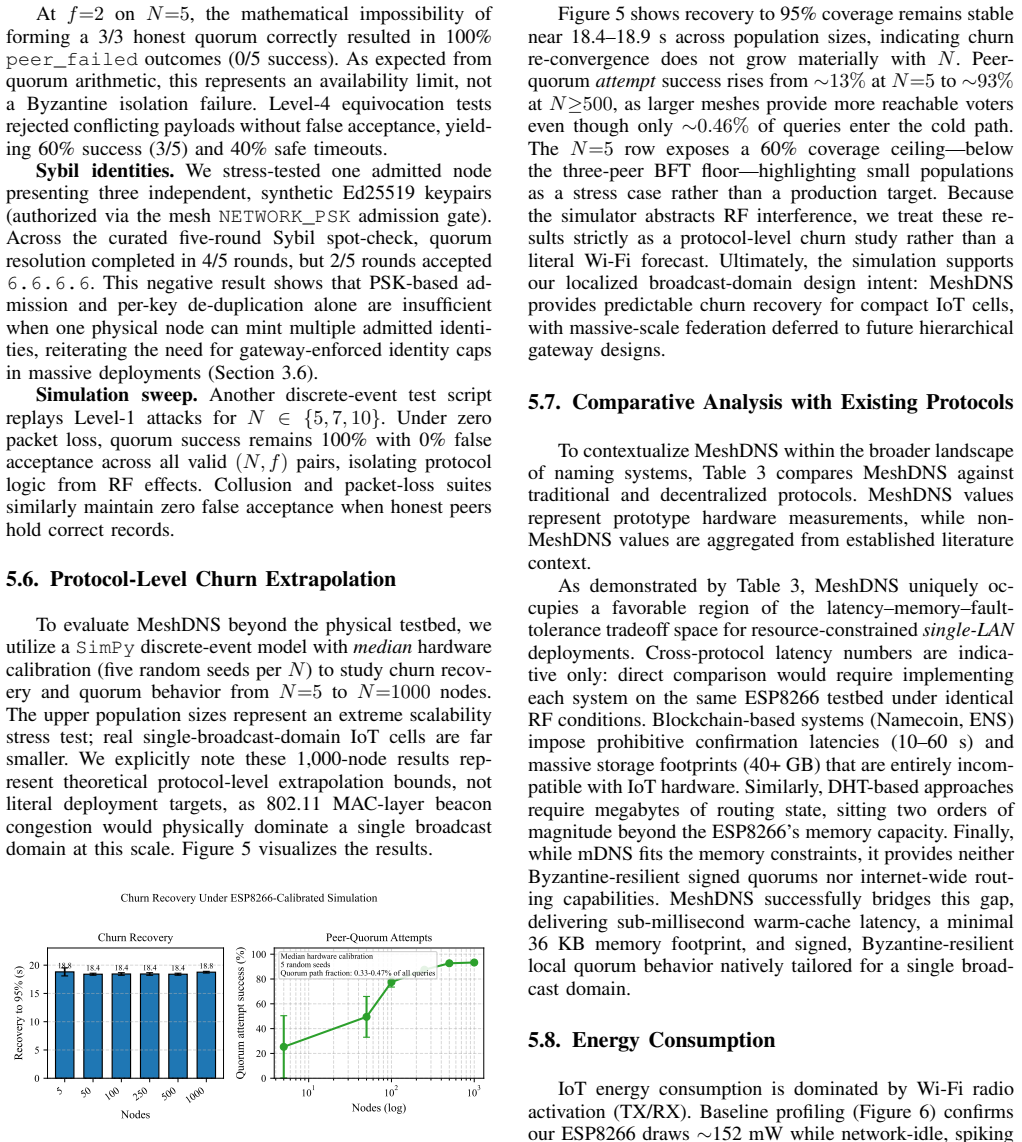
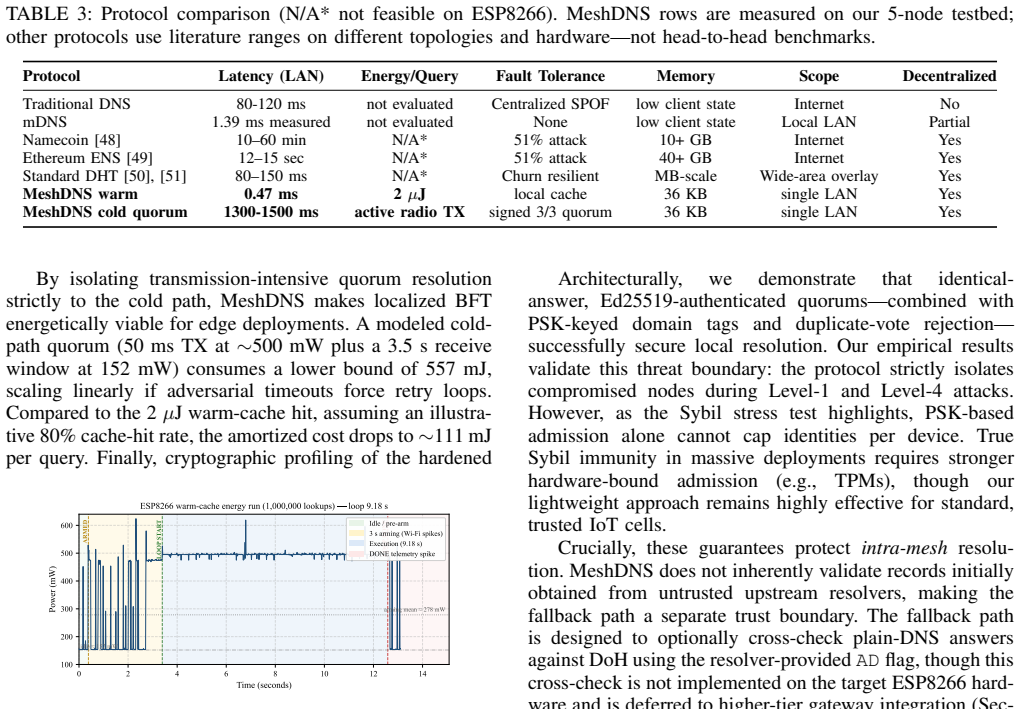
MeshDNS employs a decentralized architecture where nodes maintain cache awareness using hash-based summaries and secure cold-cache misses via Ed25519-signed, identical-answer quorum voting. Our implementation on commodity ESP8266 microcontrollers (sub-50 KB usable RAM, 80 MHz) achieves a 0.47 ms warm-cache resolution, outperforming native mDNS baselines (1.39 ms). To secure initial cold-cache misses, MeshDNS trades a predictable ~1.3-1.7s cryptographic penalty to successfully isolate Byzantine faults among admitted peers.
What carries the argument
Hash-based cache summaries combined with Ed25519-signed identical-answer quorum voting for cold-cache security.
If this is right
- Local name caches stay usable for edge telemetry even when nodes join or leave.
- The framework scales in simulation to one thousand nodes without loss of the reported resolution times.
- Byzantine faults among admitted peers are isolated after the fixed cryptographic overhead.
- No central DNS server is required for the reported warm-cache performance.
Where Pith is reading between the lines
- Similar quorum and summary techniques could apply to other resource-limited naming or discovery services beyond DNS.
- The shared-key admission step may restrict use in fully open or ad-hoc IoT deployments.
- Reducing the cryptographic overhead on the same hardware would widen the range of battery-powered sensors that can adopt the method.
Load-bearing premise
The network operates under shared-key admission that limits which nodes can participate, and physical hardware extraction is outside the threat model.
What would settle it
A test showing either warm-cache resolution slower than 0.47 ms on ESP8266 hardware or successful injection of a false DNS record by an admitted Byzantine node under the quorum rule would falsify the performance and fault-isolation claims.
Figures
read the original abstract
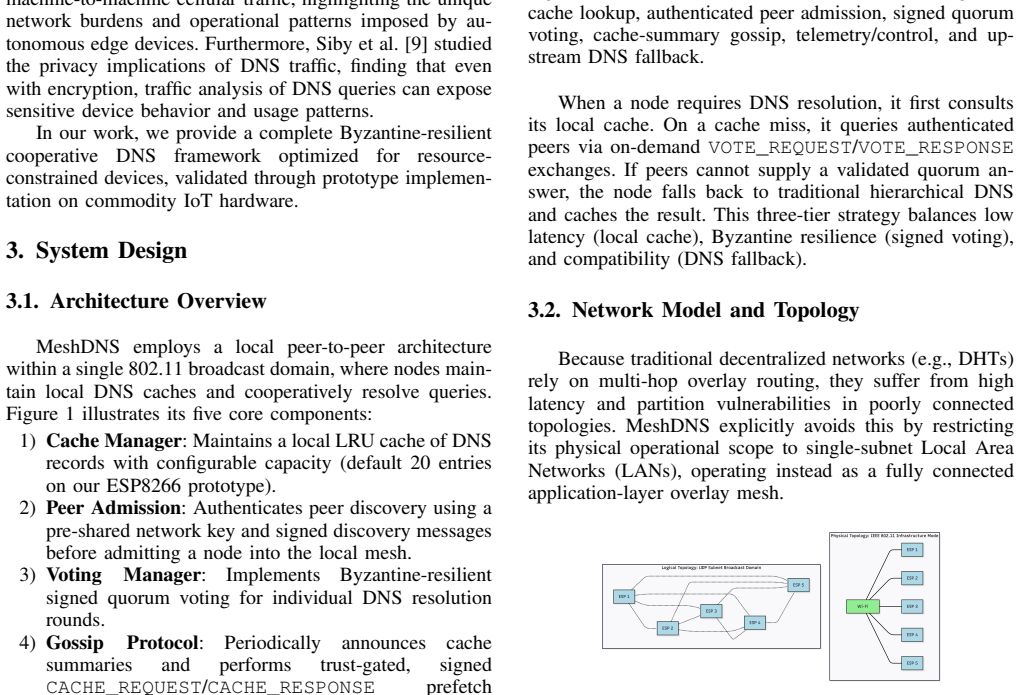
Domain Name System (DNS) resolution in Internet of Things (IoT) networks presents unique challenges due to resource constraints, unreliable connectivity, and security vulnerabilities. Traditional centralized DNS architectures introduce single points of failure. This paper presents MeshDNS, a cooperative DNS resolution framework designed for resource-constrained IoT environments operating under shared-key admission. MeshDNS employs a decentralized architecture where nodes maintain cache awareness using hash-based summaries and secure cold-cache misses via Ed25519-signed, identical-answer quorum voting. Our implementation on commodity ESP8266 microcontrollers (sub-50 KB usable RAM, 80 MHz) achieves a 0.47 ms warm-cache resolution, outperforming native mDNS baselines (1.39 ms). To secure initial cold-cache misses, MeshDNS trades a predictable ~1.3-1.7s cryptographic penalty to successfully isolate Byzantine faults among admitted peers. Assuming a threat model where physical hardware extraction remains out of scope, MeshDNS demonstrates Byzantine fault isolation. We validated the framework via a 5-node physical testbed and discrete-event simulations scaling to 1,000 nodes; the results demonstrate that MeshDNS maintains resilient local name caches for persistent edge telemetry under network churn. Code is available at https://github.com/mahbubasif/MeshDNS-Artifact.
Editorial analysis
A structured set of objections, weighed in public.
Referee Report
Summary. MeshDNS is a cooperative DNS resolution framework for resource-constrained IoT networks under shared-key admission. Nodes maintain cache awareness via hash-based summaries; cold-cache misses are secured by Ed25519-signed identical-answer quorum voting. The implementation on ESP8266 microcontrollers (sub-50 KB RAM, 80 MHz) reports 0.47 ms warm-cache resolution (vs. 1.39 ms native mDNS) and a predictable 1.3-1.7 s cryptographic penalty to isolate Byzantine faults. The framework is evaluated on a 5-node physical testbed and discrete-event simulations to 1,000 nodes, showing resilient local name caches under network churn. Public code is provided.
Significance. If the reported performance numbers and Byzantine isolation hold under the delimited threat model (physical extraction out of scope), MeshDNS supplies a concrete, reproducible advance for decentralized, secure name resolution in low-resource IoT settings. The combination of a working implementation on commodity hardware, direct performance comparison against mDNS, explicit cryptographic and quorum mechanisms, and scaling simulations to 1,000 nodes addresses single-point-of-failure and resource issues in IoT DNS. Availability of the artifact code is a clear strength that supports verification.
major comments (1)
- [Evaluation] § on evaluation methodology: the 5-node testbed and 1,000-node simulations are used to assert Byzantine isolation and performance under churn, yet the manuscript provides no error bars, exclusion criteria, or detailed fault-injection parameters; these details are load-bearing for the central claim that MeshDNS 'successfully isolate[s] Byzantine faults'.
minor comments (2)
- [Threat model] Abstract and § on threat model: the statement that physical hardware extraction is out of scope should be repeated in the evaluation section so readers can immediately map the reported results to the assumed adversary.
- [Implementation] The paper would benefit from a short table summarizing the exact RAM/CPU usage and packet sizes for the Ed25519 operations on ESP8266 to make the 1.3-1.7 s penalty more directly comparable across devices.
Simulated Author's Rebuttal
We thank the referee for the positive assessment and the recommendation of minor revision. The single major comment concerns the level of detail provided for the evaluation methodology; we address it directly below and will incorporate the requested information in the revised manuscript.
read point-by-point responses
-
Referee: [Evaluation] § on evaluation methodology: the 5-node testbed and 1,000-node simulations are used to assert Byzantine isolation and performance under churn, yet the manuscript provides no error bars, exclusion criteria, or detailed fault-injection parameters; these details are load-bearing for the central claim that MeshDNS 'successfully isolate[s] Byzantine faults'.
Authors: We agree that the current manuscript lacks sufficient methodological detail to allow full verification of the Byzantine-isolation and churn results. In the revised version we will add: (i) error bars (standard deviation or 95 % confidence intervals) for all latency and success-rate figures from both the 5-node testbed and the 1 000-node simulations; (ii) the number of independent runs performed and the explicit exclusion criteria applied to outliers; and (iii) a precise description of the fault-injection parameters, including the Byzantine fault models used (e.g., arbitrary answer forgery, selective omission), the fraction of faulty nodes injected, the exact quorum threshold (identical-answer requirement), and the cryptographic verification steps. These additions will be placed in a new subsection of the evaluation section and will be cross-referenced to the publicly available artifact code, which already contains the simulation scripts. revision: yes
Circularity Check
No significant circularity
full rationale
The manuscript describes an engineering implementation of a cooperative DNS framework, with all performance claims (0.47 ms warm-cache resolution, 1.3-1.7 s cryptographic overhead) obtained from direct measurement on a 5-node ESP8266 testbed and discrete-event simulations to 1000 nodes. No equations, fitted parameters, or derivation steps appear; results are not defined in terms of other quantities within the paper. The threat model is explicitly delimited and the Byzantine isolation mechanism (Ed25519 signatures plus quorum) is described as a concrete protocol choice rather than a self-referential prediction. No self-citation load-bearing steps or ansatz smuggling are present.
Axiom & Free-Parameter Ledger
axioms (2)
- domain assumption Ed25519 signatures are unforgeable under the stated threat model
- domain assumption Shared-key admission restricts participation to admitted peers
Reference graph
Works this paper leans on
-
[1]
Internet of things: Financial perspective and associated security concerns,
B. Pandow, A. Bamhdi, and F. Masoodi, “Internet of things: Financial perspective and associated security concerns,”International Journal of Computer Theory and Engineering, vol. 12, pp. 123–127, 01 2020
2020
-
[2]
Domain names - concepts and facilities,
P. Mockapetris, “Domain names - concepts and facilities,” IETF, RFC 1034, Nov 1987
1987
-
[3]
Deployment optimization of iot devices through attack graph analysis,
N. Agmon, A. Shabtai, and R. Puzis, “Deployment optimization of iot devices through attack graph analysis,” inProceedings of the 12th ACM Conference on Security and Privacy in Wireless and Mobile Networks (WiSec ’19), 2019
2019
-
[4]
Dywcp: Dynamic and lightweight data-channel coupling towards confidentiality in iot security,
S. Bi, T. Hou, T. Wang, Y . Liu, Z. Lu, and Q. Pei, “Dywcp: Dynamic and lightweight data-channel coupling towards confidentiality in iot security,” inProceedings of the 15th ACM Conference on Security and Privacy in Wireless and Mobile Networks, ser. WiSec ’22. New York, NY , USA: Association for Computing Machinery, 2022, p. 222–232. [Online]. Available:...
-
[5]
Privacy-preserving trajectory matching on autonomous unmanned aerial vehicles,
S. Sciancalepore and D. R. George, “Privacy-preserving trajectory matching on autonomous unmanned aerial vehicles,” inProceedings of the 38th Annual Computer Security Applications Conference, ser. ACSAC ’22. New York, NY , USA: Association for Computing Machinery, 2022, p. 1–12. [Online]. Available: https: //doi.org/10.1145/3564625.3564626
-
[6]
Root server technical operations,
IANA, “Root server technical operations,” https://www.iana.org/ domains/root/servers, 2023
2023
-
[7]
Dns performance and the effectiveness of caching,
J. Jung, E. Sit, H. Balakrishnan, and R. Morris, “Dns performance and the effectiveness of caching,” inProceedings of the 1st ACM SIGCOMM Workshop on Internet Measurement, ser. IMW ’01. New York, NY , USA: Association for Computing Machinery, 2001, p. 153–167. [Online]. Available: https://doi.org/10.1145/505202.505223
-
[8]
The Aftermath of the Dyn DDOS Attack ,
S. Greenstein, “ The Aftermath of the Dyn DDOS Attack ,”IEEE Micro, vol. 39, no. 04, pp. 66–68, Jul. 2019. [Online]. Available: https://doi.ieeecomputersociety.org/10.1109/MM.2019.2919886
-
[9]
Encrypted dns –¿ privacy? a traffic analysis perspective,
S. Siby, M. Juarez, C. Diaz, N. Vallina-Rodriguez, and C. Troncoso, “Encrypted dns –¿ privacy? a traffic analysis perspective,” 2019. [Online]. Available: https://arxiv.org/abs/1906.09682
-
[10]
Entrada: A high-performance network traffic data streaming warehouse,
M. Wullink, G. C. M. Moura, M. M ¨uller, and C. Hesselman, “Entrada: A high-performance network traffic data streaming warehouse,” inNOMS 2016 - 2016 IEEE/IFIP Network Operations and Management Symposium. IEEE Press, 2016, p. 913–918. [Online]. Available: https://doi.org/10.1109/NOMS.2016.7502925
-
[11]
Energy efficient data aggregation in wireless sensor networks,
P. Padmaja and G. Marutheswar, “Energy efficient data aggregation in wireless sensor networks,”Materials Today: Proceedings, vol. 5, no. 1, Part 1, pp. 388–396, 2018, international Conference on Processing of Materials, Minerals and Energy (July 29th – 30th) 2016, Ongole, Andhra Pradesh, India. [Online]. Available: https: //www.sciencedirect.com/science/a...
2018
-
[12]
(2026) Build with matter — smart home device solution
Connectivity Standards Alliance. (2026) Build with matter — smart home device solution. Connectivity Standards Alliance. Accessed: 2026-05-24. [Online]. Available: https://csa-iot.org/all-solutions/ matter/
2026
-
[13]
(2026) Concepts and terminology
Home Assistant. (2026) Concepts and terminology. Open Home Foundation. Accessed: 2026-05-24. [Online]. Available: https: //www.home-assistant.io/getting-started/concepts-terminology/
2026
-
[14]
Namecoin - decentralized dns,
Namecoin Project, “Namecoin - decentralized dns,” https://www. namecoin.org/, 2023
2023
-
[15]
Ethereum name service,
N. Johnson, “Ethereum name service,” https://ens.domains/, 2023
2023
-
[16]
Resource aware placement of iot application modules in fog-cloud computing paradigm,
M. Taneja and A. Davy, “Resource aware placement of iot application modules in fog-cloud computing paradigm,” in2017 IFIP/IEEE Sym- posium on Integrated Network and Service Management (IM), 2017, pp. 1222–1228
2017
-
[17]
[Online]
Espressif Systems,ESP8266EX Datasheet, version 7.0 ed., Espressif Systems, 2023, accessed: 2026-05-23. [Online]. Available: https: //documentation.espressif.com/0a-esp8266ex datasheet en.pdf
2023
-
[18]
The domain name industry brief,
Verisign, “The domain name industry brief,” 2022, q4 2022
2022
-
[19]
Deploying and monitoring dns security (dnssec),
E. Osterweil, D. Massey, and L. Zhang, “Deploying and monitoring dns security (dnssec),” inProceedings of the 2009 Annual Computer Security Applications Conference, ser. ACSAC ’09. USA: IEEE Computer Society, 2009, p. 429–438. [Online]. Available: https://doi.org/10.1109/ACSAC.2009.47
-
[20]
Prefetching the means for document transfer: a new approach for reducing web latency,
E. Cohen and H. Kaplan, “Prefetching the means for document transfer: a new approach for reducing web latency,”Proceedings IEEE INFOCOM 2000. Conference on Computer Communications. Nineteenth Annual Joint Conference of the IEEE Computer and Communications Societies (Cat. No.00CH37064), vol. 2, pp. 854– 863 vol.2, 2000. [Online]. Available: https://api.sem...
2000
-
[21]
Internet anycast: performance, problems, & potential,
Z. Li, D. Levin, N. Spring, and B. Bhattacharjee, “Internet anycast: performance, problems, & potential,” inProceedings of the 2018 Conference of the ACM Special Interest Group on Data Communication, ser. SIGCOMM ’18. New York, NY , USA: Association for Computing Machinery, 2018, p. 59–73. [Online]. Available: https://doi.org/10.1145/3230543.3230547
-
[22]
Blockstack : A new decentralized internet,
M. Ali, R. Shea, J. C. Nelson, and M. J. Freedman, “Blockstack : A new decentralized internet,” 2017. [Online]. Available: https://api.semanticscholar.org/CorpusID:36924090
2017
-
[23]
Blockchains and smart contracts for the internet of things,
K. Christidis and M. Devetsikiotis, “Blockchains and smart contracts for the internet of things,”IEEE Access, vol. 4, pp. 2292–2303, 2016
2016
-
[24]
Chord: A scalable peer-to-peer lookup service for internet applications,
I. Stoica, R. Morris, D. Karger, M. F. Kaashoek, and H. Balakrishnan, “Chord: A scalable peer-to-peer lookup service for internet applications,” inProceedings of the 2001 Conference on Applications, Technologies, Architectures, and Protocols for Computer Communications, ser. SIGCOMM ’01. New York, NY , USA: Association for Computing Machinery, 2001, p. 14...
-
[25]
Kademlia: A peer-to-peer infor- mation system based on the xor metric,
P. Maymounkov and D. Mazi `eres, “Kademlia: A peer-to-peer infor- mation system based on the xor metric,” inRevised Papers from the First International Workshop on Peer-to-Peer Systems, ser. IPTPS ’01. Berlin, Heidelberg: Springer-Verlag, 2002, p. 53–65
2002
-
[26]
Pastry: Scalable, decentralized object location, and routing for large-scale peer-to-peer systems,
A. I. T. Rowstron and P. Druschel, “Pastry: Scalable, decentralized object location, and routing for large-scale peer-to-peer systems,” inProceedings of the IFIP/ACM International Conference on Dis- tributed Systems Platforms Heidelberg, ser. Middleware ’01. Berlin, Heidelberg: Springer-Verlag, 2001, p. 329–350
2001
-
[27]
Algorithmic nuggets in content delivery,
B. M. Maggs and R. K. Sitaraman, “Algorithmic nuggets in content delivery,”SIGCOMM Comput. Commun. Rev., vol. 45, no. 3, p. 52–66, Jul. 2015. [Online]. Available: https://doi.org/10.1145/ 2805789.2805800
-
[28]
Summary cache: a scal- able wide-area web cache sharing protocol,
L. Fan, P. Cao, J. Almeida, and A. Broder, “Summary cache: a scal- able wide-area web cache sharing protocol,”IEEE/ACM Transactions on Networking, vol. 8, no. 3, pp. 281–293, 2000
2000
-
[29]
A. Rousskov and D. Wessels, “Cache digests,”Comput. Netw. ISDN Syst., vol. 30, no. 22–23, p. 2155–2168, Nov. 1998. [Online]. Available: https://doi.org/10.1016/S0169-7552(98)00251-7
-
[30]
Asap: a camera sensor network for situation awareness,
J. Shin, R. Kumar, D. Mohapatra, U. Ramachandran, and M. Ammar, “Asap: a camera sensor network for situation awareness,” inProceed- ings of the 11th International Conference on Principles of Distributed Systems, ser. OPODIS’07. Berlin, Heidelberg: Springer-Verlag, 2007, p. 31–47
2007
-
[31]
Building efficient wireless sensor networks with low-level naming,
J. Heidemann, F. Silva, C. Intanagonwiwat, R. Govindan, D. Estrin, and D. Ganesan, “Building efficient wireless sensor networks with low-level naming,”SIGOPS Oper . Syst. Rev., vol. 35, no. 5, p. 146–159, Oct. 2001. [Online]. Available: https://doi.org/10.1145/ 502059.502049
-
[32]
The byzantine generals problem,
L. Lamport, R. Shostak, and M. Pease, “The byzantine generals problem,”ACM Trans. Program. Lang. Syst., vol. 4, no. 3, p. 382–401, Jul. 1982. [Online]. Available: https://doi.org/10.1145/357172.357176
-
[33]
Practical byzantine fault tolerance,
M. Castro and B. Liskov, “Practical byzantine fault tolerance,” in Proceedings of the Third Symposium on Operating Systems Design and Implementation, ser. OSDI ’99. USA: USENIX Association, 1999, p. 173–186
1999
-
[34]
Ms-ptp: Protecting network timing from byzantine attacks,
S. Shi, Y . Xiao, C. Du, M. H. Shahriar, A. Li, N. Zhang, Y . T. Hou, and W. Lou, “Ms-ptp: Protecting network timing from byzantine attacks,” inProceedings of the 16th ACM Conference on Security and Privacy in Wireless and Mobile Networks, ser. WiSec ’23. New York, NY , USA: Association for Computing Machinery, 2023, p. 61–71. [Online]. Available: https:/...
-
[35]
Aflguard: Byzantine-robust asynchronous federated learning,
M. Fang, J. Liu, N. Z. Gong, and E. S. Bentley, “Aflguard: Byzantine-robust asynchronous federated learning,” inProceedings of the 38th Annual Computer Security Applications Conference, ser. ACSAC ’22. New York, NY , USA: Association for Computing Machinery, 2022, p. 632–646. [Online]. Available: https://doi.org/10.1145/3564625.3567991
-
[36]
Cooperative intrusion detection in wireless sensor networks,
I. Krontiris, Z. Benenson, T. Giannetsos, F. C. Freiling, and T. Dimitriou, “Cooperative intrusion detection in wireless sensor networks,” inProceedings of the 6th European Conference on Wireless Sensor Networks, ser. EWSN ’09. Berlin, Heidelberg: Springer-Verlag, 2009, p. 263–278. [Online]. Available: https: //doi.org/10.1007/978-3-642-00224-3 17
-
[37]
Epidemic algorithms for replicated database maintenance,
A. Demers, D. Greene, C. Hauser, W. Irish, J. Larson, S. Shenker, H. Sturgis, D. Swinehart, and D. Terry, “Epidemic algorithms for replicated database maintenance,” inProceedings of the Sixth Annual ACM Symposium on Principles of Distributed Computing, ser. PODC ’87. New York, NY , USA: Association for Computing Machinery, 1987, p. 1–12. [Online]. Availab...
-
[38]
Swim: scalable weakly-consistent infection-style process group membership protocol,
A. Das, I. Gupta, and A. Motivala, “Swim: scalable weakly-consistent infection-style process group membership protocol,” inProceedings International Conference on Dependable Systems and Networks, 2002, pp. 303–312
2002
-
[39]
Hyparview: A member- ship protocol for reliable gossip-based broadcast,
J. Leitao, J. Pereira, and L. Rodrigues, “Hyparview: A member- ship protocol for reliable gossip-based broadcast,” in37th Annual IEEE/IFIP International Conference on Dependable Systems and Networks (DSN’07), 2007, pp. 419–429
2007
-
[40]
Trickle: A Self-Regulating algorithm for code propagation and maintenance in wireless sensor networks,
P. Levis, N. Patel, D. Culler, and S. Shenker, “Trickle: A Self-Regulating algorithm for code propagation and maintenance in wireless sensor networks,” inFirst Symposium on Networked Systems Design and Implementation (NSDI 04). San Francisco, CA: USENIX Association, Mar. 2004. [Online]. Available: https://www.usenix.org/conference/nsdi-04/ trickle-self-re...
2004
-
[41]
Tsmp: Time synchronized mesh protocol,
K. S. J. Pister, L. Doherty, and D. Networks, “Tsmp: Time synchronized mesh protocol,” 2008. [Online]. Available: https: //api.semanticscholar.org/CorpusID:14031058
2008
-
[42]
DNS-Based Service Discovery,
S. Cheshire and M. Krochmal, “DNS-Based Service Discovery,” RFC 6763, Feb. 2013. [Online]. Available: https://www.rfc-editor. org/info/rfc6763
2013
-
[43]
A first look at cellular machine-to-machine traffic: large scale measurement and characterization,
M. Z. Shafiq, L. Ji, A. X. Liu, J. Pang, and J. Wang, “A first look at cellular machine-to-machine traffic: large scale measurement and characterization,”SIGMETRICS Perform. Eval. Rev., vol. 40, no. 1, p. 65–76, Jun. 2012. [Online]. Available: https://doi.org/10.1145/2318857.2254767
-
[44]
The BLAKE2 Cryptographic Hash and Message Authentication Code (MAC),
M.-J. O. Saarinen and J.-P. Aumasson, “The BLAKE2 Cryptographic Hash and Message Authentication Code (MAC),” RFC 7693, Nov
-
[45]
Available: https://www.rfc-editor.org/info/rfc7693
[Online]. Available: https://www.rfc-editor.org/info/rfc7693
-
[46]
Edwards-Curve Digital Signature Algorithm (EdDSA),
S. Josefsson and I. Liusvaara, “Edwards-Curve Digital Signature Algorithm (EdDSA),” RFC 8032, Jan. 2017. [Online]. Available: https://www.rfc-editor.org/info/rfc8032 [46]INA219 High-Side, Bidirectional, Current/Power Monitor with I2C Interface, Texas Instruments, Dallas, TX, USA, 2024, rev. G, available at https://www.ti.com/lit/ds/symlink/ina219.pdf. [On...
2017
-
[47]
ChaCha20 and Poly1305 for IETF Protocols,
Y . Nir and A. Langley, “ChaCha20 and Poly1305 for IETF Protocols,” RFC 8439, Jun. 2018. [Online]. Available: https: //www.rfc-editor.org/info/rfc8439
2018
-
[48]
An empirical study of namecoin and lessons for decentralized namespace design,
H. A. Kalodner, M. Carlsten, P. Ellenbogen, J. Bonneau, and A. Narayanan, “An empirical study of namecoin and lessons for decentralized namespace design,” inWorkshop on the Economics of Information Security, 2015. [Online]. Available: https://api.semanticscholar.org/CorpusID:7945593
2015
-
[49]
Ethereum: A secure decentralised gen- eralised transaction ledger,
D. D. Wood, “Ethereum: A secure decentralised gen- eralised transaction ledger,” 2014. [Online]. Available: https://api.semanticscholar.org/CorpusID:4836820
2014
-
[50]
J. Falkner, M. Piatek, J. P. John, A. Krishnamurthy, and T. Anderson, “Profiling a million user dht,” inProceedings of the 7th ACM SIGCOMM Conference on Internet Measurement, ser. IMC ’07. New York, NY , USA: Association for Computing Machinery, 2007, p. 129–134. [Online]. Available: https://doi.org/10.1145/1298306. 1298325
-
[51]
Design and evaluation of ipfs: a storage layer for the decentralized web,
D. Trautwein, A. Raman, G. Tyson, I. Castro, W. Scott, M. Schubotz, B. Gipp, and Y . Psaras, “Design and evaluation of ipfs: a storage layer for the decentralized web,” inProceedings of the ACM SIGCOMM 2022 Conference, ser. SIGCOMM ’22. New York, NY , USA: Association for Computing Machinery, 2022, p. 739–752. [Online]. Available: https://doi.org/10.1145/...
-
[52]
Edgex foundry: Open source edge platform,
EdgeX Foundry, “Edgex foundry: Open source edge platform,” https: //www.edgexfoundry.org/, n.d., accessed: 2026-02-27
2026
-
[53]
Extend cloud to edge with kubeedge,
Y . Xiong, Y . Sun, L. Xing, and Y . Huang, “Extend cloud to edge with kubeedge,” in2018 IEEE/ACM Symposium on Edge Computing (SEC), 2018, pp. 373–377
2018
discussion (0)
Sign in with ORCID, Apple, or X to comment. Anyone can read and Pith papers without signing in.