Quantile regression with measurement errors
Pith reviewed 2026-07-02 17:31 UTC · model grok-4.3
The pith
A new estimator using kernel smoothing and complex-domain moment generating functions delivers root-n consistent quantile regression estimates even when covariates have normal measurement errors.
A machine-rendered reading of the paper's core claim, the machinery that carries it, and where it could break.
Core claim
We devise a novel estimator for a general quantile regression model with normal measurement errors in the covariates. The method is applicable to both linear and nonlinear quantile regressions and does not impose the quantile requirement on multiple quantile levels simultaneously. We circumvent the difficulties caused by discontinuity in quantile regression through kernel smoothing, and overcome the nonlinearity inherent in quantile regression via considering extension to the complex domain and moment generating functions. We show that the resulting estimator achieves the standard root-n consistency and asymptotic normality under mild conditions. This is the first consistent estimator in a g
What carries the argument
Kernel smoothing of the quantile loss combined with complex-domain moment generating functions that correct the measurement-error bias.
If this is right
- The estimator remains consistent for both linear and nonlinear quantile regression specifications.
- No simultaneous imposition of the model across multiple quantile levels is required.
- Standard root-n consistency and asymptotic normality hold under mild regularity conditions.
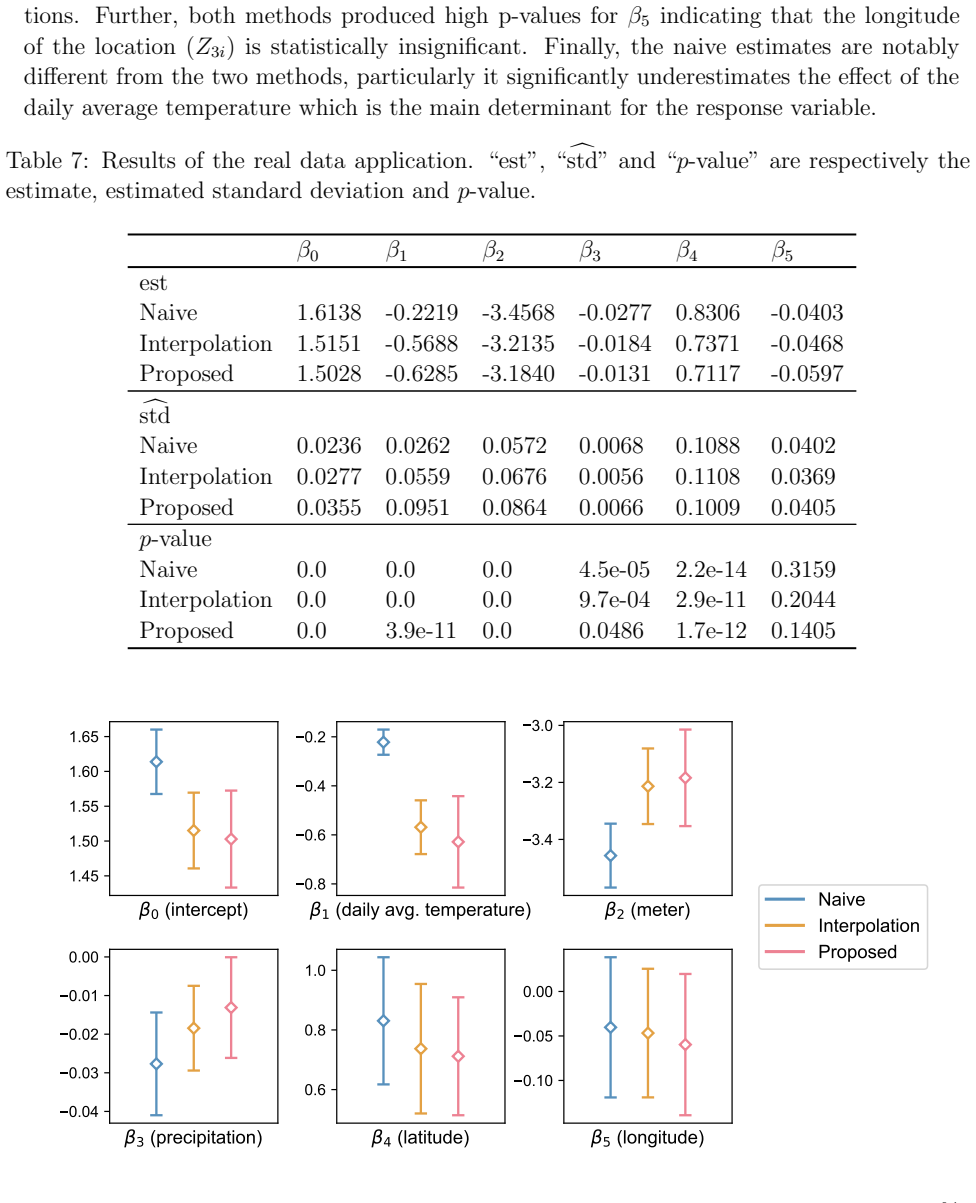
- The procedure is illustrated on simulated data and on a real dataset of Cherry Blossom flowering times.
Where Pith is reading between the lines
- Analyses that previously discarded quantile regression because of suspected covariate measurement error can now be revisited with a consistent method.
- The separation of discontinuity handling from nonlinearity correction may allow the same machinery to be reused for other non-smooth or nonlinear estimating equations.
- Empirical work in fields that routinely encounter imprecise covariates can adopt the estimator without needing to collect error-free data.
Load-bearing premise
The measurement errors in the covariates are normally distributed.
What would settle it
A large-sample simulation or theoretical calculation in which the proposed estimator fails to converge at the root-n rate when the measurement errors are exactly normal would falsify the consistency claim.
Figures
read the original abstract
We devise a novel estimator for a general quantile regression model with normal measurement errors in the covariates. The method is applicable to both linear and nonlinear quantile regressions and does not impose the quantile requirement on multiple quantile levels simultaneously. We circumvent the difficulties caused by discontinuity in quantile regression through kernel smoothing, and overcome the nonlinearity inherent in quantile regression via considering extension to the complex domain and moment generating functions. We show that the resulting estimator achieves the standard root-$n$ consistency and asymptotic normality under mild conditions. The performance of the proposed method is illustrated via numerical simulations and a real data example related to Cherry Blossom times in Japan in 2024. This is the first consistent estimator in a general quantile regression problem with normal measurement errors.
Editorial analysis
A structured set of objections, weighed in public.
Referee Report
Summary. The paper proposes a novel estimator for general quantile regression (linear and nonlinear) with normal measurement errors in covariates. It combines kernel smoothing of the check function with a bias-correction step that extends the moment generating function to the complex domain, claiming that the resulting estimator attains root-n consistency and asymptotic normality under mild conditions without requiring the quantile restriction to hold at multiple levels simultaneously. The claims are illustrated with numerical simulations and a real-data application to Cherry Blossom flowering times in Japan.
Significance. If the central theoretical claims are correct, the work would constitute a meaningful methodological advance by supplying the first consistent estimator for this class of problems; the combination of kernel smoothing and complex-domain MGF correction is a technically interesting route around the non-differentiability and nonlinearity obstacles that have previously blocked progress.
major comments (2)
- [Abstract and theoretical development section] Abstract and theoretical development section: the manuscript asserts root-n consistency and asymptotic normality but supplies neither the derivation steps nor the regularity conditions under which they hold; because this is the load-bearing claim of the paper, the absence of any proof or verification sketch prevents assessment of whether the estimator actually achieves the stated rate.
- [Abstract and theoretical development section] The normality assumption on the measurement errors is essential to the MGF correction step, yet the paper does not discuss the sensitivity of the procedure to departures from normality or provide any diagnostic for when the assumption is plausible.
minor comments (2)
- The real-data example would benefit from an explicit statement of how the measurement-error variance was estimated or assumed.
- Notation for the complex extension of the MGF is introduced without a dedicated display equation, making it difficult to follow the bias-correction algebra.
Simulated Author's Rebuttal
We thank the referee for the careful reading and the two major comments. We address each below and indicate the revisions we will make.
read point-by-point responses
-
Referee: [Abstract and theoretical development section] Abstract and theoretical development section: the manuscript asserts root-n consistency and asymptotic normality but supplies neither the derivation steps nor the regularity conditions under which they hold; because this is the load-bearing claim of the paper, the absence of any proof or verification sketch prevents assessment of whether the estimator actually achieves the stated rate.
Authors: The main text states the root-n consistency and asymptotic normality result together with the claim that it holds under mild conditions, but we accept that a self-contained proof sketch and an explicit list of regularity conditions are needed for readers to evaluate the claim. In the revision we will insert a concise proof outline (with key steps) and the full set of regularity conditions into the theoretical development section. revision: yes
-
Referee: [Abstract and theoretical development section] The normality assumption on the measurement errors is essential to the MGF correction step, yet the paper does not discuss the sensitivity of the procedure to departures from normality or provide any diagnostic for when the assumption is plausible.
Authors: We agree that the normality assumption is central to the complex-domain MGF correction and that its sensitivity should be examined. In the revised manuscript we will add a dedicated subsection that (i) analytically indicates where normality enters the bias-correction step, (ii) reports simulation results under moderate departures from normality, and (iii) suggests simple diagnostics (e.g., normality checks on replicate measurements when available). revision: yes
Circularity Check
No significant circularity
full rationale
The derivation relies on kernel smoothing of the check function combined with an MGF-based bias correction that exploits the explicit normality assumption on measurement errors. The root-n consistency and asymptotic normality are obtained via standard asymptotic arguments under stated mild conditions; these are not shown to reduce by construction to fitted parameters or prior self-citations. The normality assumption is presented as an input that enables the MGF step rather than being derived from the target result. No self-definitional, fitted-input, or self-citation-load-bearing reductions are exhibited in the provided abstract or high-level description.
Axiom & Free-Parameter Ledger
Reference graph
Works this paper leans on
-
[1]
Journal of the American Statistical Association , volume=
Simulation-extrapolation: the measurement error jackknife , author=. Journal of the American Statistical Association , volume=. 1995 , publisher=
work page 1995
-
[2]
Journal of the American Statistical association , volume=
Simulation-extrapolation estimation in parametric measurement error models , author=. Journal of the American Statistical association , volume=. 1994 , publisher=
work page 1994
-
[3]
Errors in the dependent variable of quantile regression models , author=. Econometrica , volume=. 2021 , publisher=
work page 2021
-
[4]
Journal of econometrics , volume=
Measurement errors in quantile regression models , author=. Journal of econometrics , volume=. 2017 , publisher=
work page 2017
-
[5]
Journal of the American Statistical Association , volume=
Using SIMEX for smoothing-parameter choice in errors-in-variables problems , author=. Journal of the American Statistical Association , volume=. 2008 , publisher=
work page 2008
- [6]
-
[7]
Partially functional linear quantile regression with measurement errors , author=. Statistica Sinica , volume=
-
[8]
Analysis on Censored Quantile Residual Life Model via Spline Smoothing , author=. 2012 , journal=
work page 2012
-
[9]
Electronic Journal of Statistics , volume=
Quantile regression for interval censored data using an Enriched Laplace distribution , author=. Electronic Journal of Statistics , volume=. 2025 , publisher=
work page 2025
-
[10]
Lifetime Data Analysis , pages=
Quantile regression under dependent censoring with unknown association , author=. Lifetime Data Analysis , pages=. 2025 , publisher=
work page 2025
-
[11]
Journal of the American Statistical Association , volume=
An adapted loss function for censored quantile regression , author=. Journal of the American Statistical Association , volume=. 2019 , publisher=
work page 2019
-
[12]
Wild residual bootstrap inference for penalized quantile regression with heteroscedastic errors , author=. Biometrika , volume=. 2018 , publisher=
work page 2018
-
[13]
Chinese Journal of Applied Probability and Statistics , volume=
Instrumental variable estimation in linear quantile regression models with measurement error , author=. Chinese Journal of Applied Probability and Statistics , volume=
-
[14]
Composite quantile regression estimation of linear error-in-variable models using instrumental variables , author=. Metrika , volume=. 2020 , publisher=
work page 2020
-
[15]
Econometrica: journal of the Econometric Society , pages=
Regression quantiles , author=. Econometrica: journal of the Econometric Society , pages=. 1978 , publisher=
work page 1978
-
[16]
Annual review of economics , volume=
Quantile regression: 40 years on , author=. Annual review of economics , volume=. 2017 , publisher=
work page 2017
-
[17]
Journal of the Royal Statistical Society Series D: The Statistician , volume=
Quantile regression: applications and current research areas , author=. Journal of the Royal Statistical Society Series D: The Statistician , volume=. 2003 , publisher=
work page 2003
- [18]
-
[19]
Li, Mushan and Tu, Shiqi and Li, Zijia and Tan, Fengxiang and Liu, Jian and Wang, Qian and Zhang, Yuannyu and Xu, Jian and Zhang, Yijing and Zhou, Feng and others , journal=. 2019 , publisher=
work page 2019
-
[20]
Statistics in Medicine , volume=
Robust estimation of mean-variance relation , author=. Statistics in Medicine , volume=. 2024 , publisher=
work page 2024
-
[21]
Annual Review of Statistics and Its Application , volume=
An update on measurement error modeling , author=. Annual Review of Statistics and Its Application , volume=. 2024 , publisher=
work page 2024
-
[22]
Journal of multivariate analysis , volume=
Semiparametric regression for measurement error model with heteroscedastic error , author=. Journal of multivariate analysis , volume=. 2019 , publisher=
work page 2019
- [23]
-
[24]
Handbook of econometrics , volume=
Large sample estimation and hypothesis testing , author=. Handbook of econometrics , volume=. 1994 , publisher=
work page 1994
-
[25]
Journal of the American Statistical Association , volume=
Quantile regression with measurement error , author=. Journal of the American Statistical Association , volume=. 2009 , publisher=
work page 2009
-
[26]
Journal of the American Statistical Association , volume=
Optimal Rates of Convergence for Deconvolving a Density , author=. Journal of the American Statistical Association , volume=
-
[27]
Corrected-loss estimation for quantile regression with covariate measurement errors , author=. Biometrika , volume=
-
[28]
American Journal of Epidemiology , volume=
Maternal, birth, and early-life influences on adult body size in women , author=. American Journal of Epidemiology , volume=. 2007 , publisher=
work page 2007
-
[29]
Quantile regression estimates for a class of linear and partially linear errors-in-variables models , author=. Statistica Sinica , pages=
-
[30]
Locally Efficient Semiparametric Estimators for Functional Measurement Error Models , author=. 2004 , journal=
work page 2004
-
[31]
Closed Form Semiparametric Estimators for Measurement Error Models , author=. 2006 , journal=
work page 2006
-
[32]
Simultaneous treatment of unspecified heteroskedastic model error distribution and mismeasured covariates for restricted moment models , author=. 2017 , journal=
work page 2017
-
[33]
Measurement Error in Nonlinear Models: A Modern Perspective , author=. 2006 , address=
work page 2006
-
[34]
Smoothed and Corrected Score Approach to Censored Quantile Regression with Measurement Errors , author=. 2015 , journal=
work page 2015
-
[35]
Censored Quantile Regression with Covariate Measurement Errors , author=. 2011 , journal=
work page 2011
-
[36]
Unbiased Estimation of a Nonlinear Function of a Normal Mean with Application to Measurement Error Models , author=. 1989 , journal=
work page 1989
discussion (0)
Sign in with ORCID, Apple, or X to comment. Anyone can read and Pith papers without signing in.