Pinching Antennas-Assisted Sensing: A Ziv-Zakai Bound (ZZB) Perspective
Pith reviewed 2026-07-02 17:13 UTC · model grok-4.3
The pith
The Ziv-Zakai bound provides a tighter, ambiguity-aware lower bound on sensing mean-squared error for pinching-antenna systems than the Bayesian Cramér-Rao bound.
A machine-rendered reading of the paper's core claim, the machinery that carries it, and where it could break.
Core claim
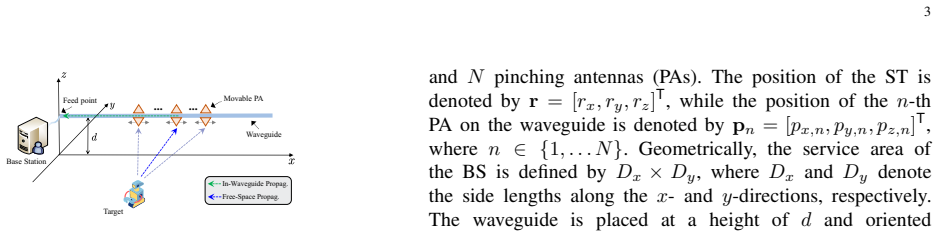
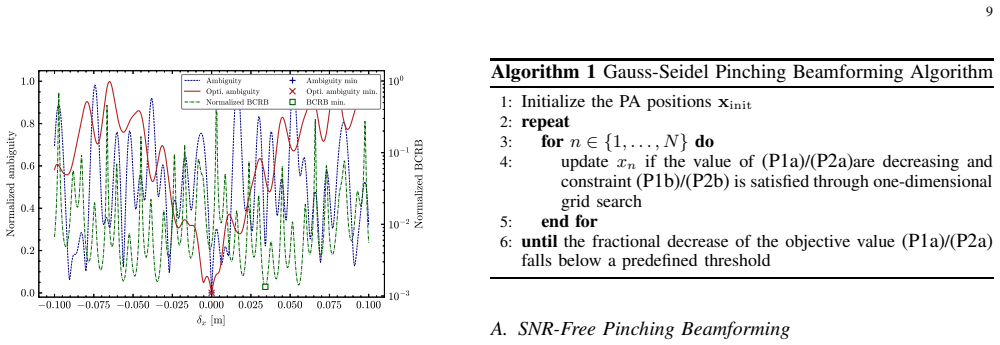
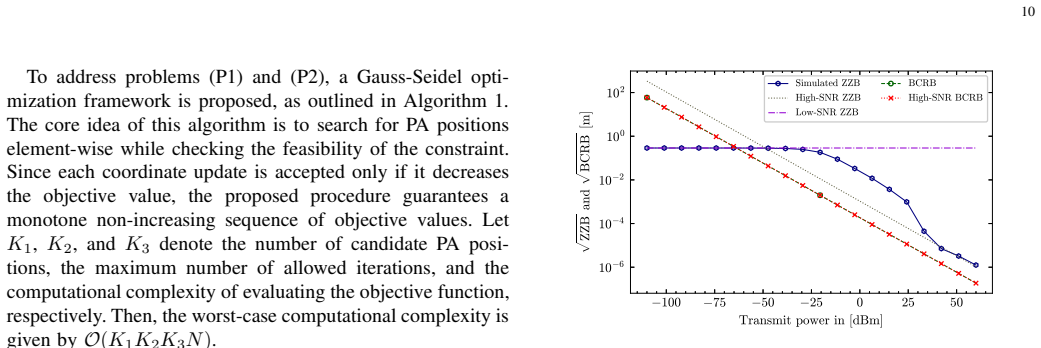
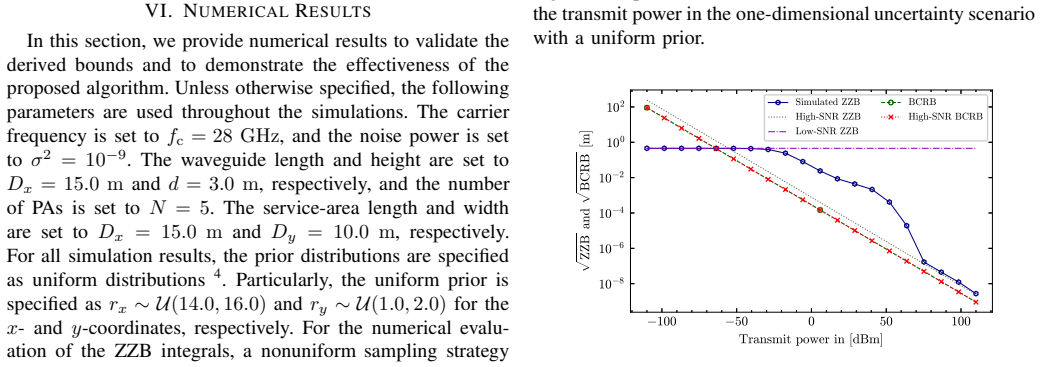
An uplink observation model is developed for a single sensing target transmitting pilots to a single-waveguide PASS receiver with multiple pinching antennas. General ZZB expressions are derived for arbitrary prior distributions of the target's position and specialized to the Gaussian and uniform cases. Asymptotic ZZBs in low- and high-SNR regimes are characterized, and the relationship between the ZZBs and the BCRB is studied by introducing an ambiguity function. SNR-free and SNR-aware surrogate objective functions are proposed to facilitate ZZB-based optimization for enhancing sensing performance.
What carries the argument
Ziv-Zakai bound expressions derived from the multimodal uplink observation model of the pinching-antenna system receiver.
If this is right
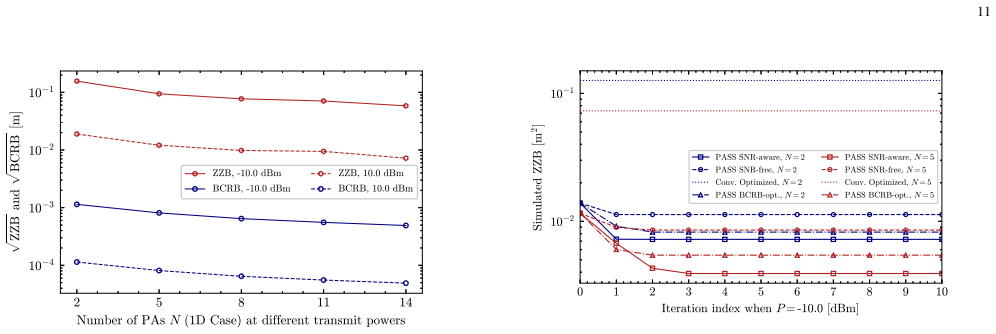
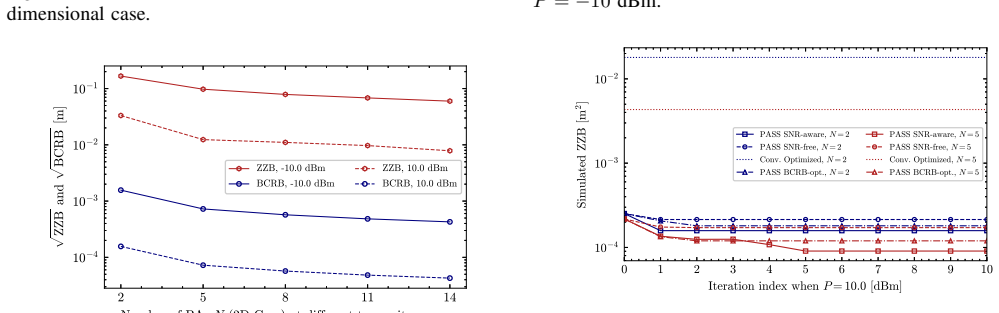
- The ZZB provides a tight sensing performance lower bound over a wide range of SNRs compared with the BCRB.
- The ambiguity-awareness of the ZZB addresses the multimodality-induced ambiguity in sensing, thereby yielding a reliable lower bound on the MSE.
- The proposed surrogate objective functions enable effective ZZB minimization with lower computational complexity.
Where Pith is reading between the lines
- ZZB-based optimization of pinching-antenna locations could directly inform hardware layouts that reduce position estimation error in deployed systems.
- The same ZZB derivation approach may apply to other wireless sensing setups that exhibit multimodal likelihoods due to array geometry.
- The surrogate functions offer a template for making other computationally heavy Bayesian bounds usable in real-time system design loops.
Load-bearing premise
The uplink observation model for a single sensing target transmitting pilots to a single-waveguide PASS receiver equipped with multiple pinching antennas accurately captures the multimodal likelihood functions.
What would settle it
Monte Carlo simulations of a practical position estimator in the described PASS setup that produce a mean-squared error below the computed ZZB in regimes with clear multimodality would falsify the bound's validity.
Figures
read the original abstract
The sensing capability of the pinching-antenna system (PASS) is analyzed from a Ziv-Zakai bound (ZZB) perspective, motivated by the sensing ambiguity arising from the multimodal observation model inherent to PASS. In comparison to other Bayesian sensing bounds, the ZZB provides a lower bound on the mean-squared error (MSE) across a broad range of signal-to-noise ratios (SNRs) and accounts for ambiguity in the likelihood functions. First, an observation model is developed for an uplink sensing scenario where a single sensing target transmits uplink pilots to a single-waveguide PASS receiver equipped with multiple pinching antennas (PAs). Building on this model, general ZZB expressions are derived for arbitrary prior distributions of the target's position, and are then specialized to the Gaussian and uniform cases. Second, the asymptotic ZZBs in low- and high-SNR regimes are characterized, and the relationship between the ZZBs and the conventional Bayesian Cram\'er-Rao bound (BCRB) is further studied by introducing the concept of an ambiguity function. Furthermore, to reduce the high computational complexity of direct evaluation of the ZZB, SNR-free and SNR-aware surrogate objective functions are proposed to facilitate ZZB-based optimization for enhancing sensing performance. Numerical results demonstrate that: i) Compared with the BCRB, the ZZB provides a tight sensing performance lower bound over a wide range of SNRs, ii) the ambiguity-awareness of the ZZB can address the multimodality-induced ambiguity in sensing, thereby yielding a reliable lower bound on the MSE, and iii) the proposed surrogate objective functions enable effective ZZB minimization with a lower computational complexity.
Editorial analysis
A structured set of objections, weighed in public.
Referee Report
Summary. The manuscript analyzes the sensing performance of pinching-antenna systems (PASS) from a Ziv-Zakai bound (ZZB) perspective. It develops an uplink observation model for a single target transmitting pilots to a single-waveguide PASS receiver with multiple pinching antennas, derives general ZZB expressions for arbitrary priors on target position (specialized to Gaussian and uniform cases), characterizes low- and high-SNR asymptotics, introduces an ambiguity function to relate ZZB to the Bayesian Cramér-Rao bound (BCRB), proposes SNR-free and SNR-aware surrogate objective functions to reduce computational complexity of ZZB evaluation, and presents numerical results claiming that ZZB is tighter than BCRB over a wide SNR range and better handles multimodality-induced ambiguity.
Significance. If the observation model is shown to produce the claimed multimodal likelihoods and the derivations are free of gaps, the work would be significant for providing the first ZZB analysis tailored to PASS hardware, demonstrating practical advantages of ambiguity-aware bounds over BCRB, and supplying computationally tractable surrogates for system optimization. The explicit handling of multimodality is a strength relative to standard Bayesian bounds.
major comments (2)
- [§II] §II (Observation Model): The uplink observation model must explicitly derive the channel gain expression at each pinching antenna and verify that the resulting likelihood p(y|θ) exhibits well-separated modes after integration over noise, with mode separation depending on PA positions and waveguide parameters. This is load-bearing for the central claim that ZZB's ambiguity-awareness yields a reliable MSE lower bound superior to BCRB; absent this verification, the numerical gap may be an artifact of the assumed model rather than a property of PASS.
- [Numerical Results] Numerical Results section: The reported tightness of ZZB and its superiority in addressing multimodality must be supported by explicit simulation parameters (e.g., specific PA spacings and waveguide lengths) that generate the multimodal likelihood; without these, it is impossible to confirm that the BCRB-ZZB gap arises from the hardware model rather than post-hoc choices in the numerical setup.
minor comments (2)
- [Abstract] Abstract: The phrase 'general ZZB expressions are derived' would benefit from a forward reference to the relevant section number for improved readability.
- [Throughout] Notation: The ambiguity function introduced to relate ZZB and BCRB should be given a distinct symbol (distinct from standard ambiguity functions in radar literature) to avoid confusion.
Simulated Author's Rebuttal
We thank the referee for the constructive comments on our manuscript. We address each major comment below and will incorporate clarifications and additional details in the revision to strengthen the presentation of the observation model and numerical results.
read point-by-point responses
-
Referee: [§II] §II (Observation Model): The uplink observation model must explicitly derive the channel gain expression at each pinching antenna and verify that the resulting likelihood p(y|θ) exhibits well-separated modes after integration over noise, with mode separation depending on PA positions and waveguide parameters. This is load-bearing for the central claim that ZZB's ambiguity-awareness yields a reliable MSE lower bound superior to BCRB; absent this verification, the numerical gap may be an artifact of the assumed model rather than a property of PASS.
Authors: Section II derives the uplink observation model, including the channel gain at each pinching antenna via the waveguide propagation model (accounting for position-dependent phase shifts and attenuation). The likelihood p(y|θ) is obtained after marginalizing over noise and is multimodal due to the geometry of the PASS. To address the request, the revised manuscript will expand the channel gain derivation with explicit intermediate steps and add a verification (via analysis or a new figure in §II or an appendix) showing well-separated modes in p(y|θ) and their dependence on PA positions and waveguide parameters. This will directly support the ZZB superiority claim. revision: yes
-
Referee: [Numerical Results] Numerical Results section: The reported tightness of ZZB and its superiority in addressing multimodality must be supported by explicit simulation parameters (e.g., specific PA spacings and waveguide lengths) that generate the multimodal likelihood; without these, it is impossible to confirm that the BCRB-ZZB gap arises from the hardware model rather than post-hoc choices in the numerical setup.
Authors: We agree that explicit parameters are essential for reproducibility and to confirm the hardware-induced multimodality. The revised Numerical Results section will include a dedicated table listing all parameters (PA count and spacings, waveguide length, carrier frequency, target prior parameters, SNR range, etc.) used to generate the reported likelihood multimodality and the ZZB-BCRB gap. Additional plots of the likelihood function under these parameters will be added if space permits. revision: yes
Circularity Check
No circularity: standard ZZB applied to newly derived observation model
full rationale
The paper first states an uplink observation model for the single-target multi-PA PASS receiver, then derives general ZZB expressions for arbitrary priors before specializing them. These steps follow the classical ZZB integral construction without any parameter fitting that is later relabeled as a prediction, without self-definitional loops, and without load-bearing self-citations that substitute for independent verification. The reported numerical comparisons between ZZB and BCRB rest on the explicit model rather than on any reduction of the bound to its own inputs. The derivation chain therefore remains self-contained against external benchmarks.
Axiom & Free-Parameter Ledger
Reference graph
Works this paper leans on
-
[1]
Toward integrated sensing and communications for 6G: Key enabling technologies, stan dardization, and challenges,
A. Kaushik, R. Singh, S. Dayarathna et al. , “Toward integrated sensing and communications for 6G: Key enabling technologies, stan dardization, and challenges,” IEEE Commun. Standards Mag. , vol. 8, no. 2, pp. 52– 59, 2024
2024
-
[2]
A tutorial on MIMO-OFDM ISAC: From far-field to near-field,
Q. Dai, Y . Zeng, H. Wang et al. , “A tutorial on MIMO-OFDM ISAC: From far-field to near-field,” IEEE Commun. Surveys Tuts. , vol. 28, pp. 4319–4358, 2026
2026
-
[3]
Spectrally constrained MIMO radar wav eform design based on mutual information,
B. Tang and J. Li, “Spectrally constrained MIMO radar wav eform design based on mutual information,” IEEE Trans. Signal Process. , vol. 67, no. 3, pp. 821–834, 2019
2019
-
[4]
Joint transmit beamforming for multiuser MIMO communications an d MIMO radar,
X. Liu, T. Huang, N. Shlezinger, Y . Liu, J. Zhou, and Y . C. E ldar, “Joint transmit beamforming for multiuser MIMO communications an d MIMO radar,” IEEE Trans. Signal Process. , vol. 68, pp. 3929–3944, 2020
2020
-
[5]
Cra m´ er-Rao bound optimization for joint radar-communication beamfor ming,
F. Liu, Y .-F. Liu, A. Li, C. Masouros, and Y . C. Eldar, “Cra m´ er-Rao bound optimization for joint radar-communication beamfor ming,” IEEE Trans. Signal Process. , vol. 70, pp. 240–253, 2022
2022
-
[6]
S. M. Kay, Fundamentals of Statistical Signal Processing: Estimatio n Theory. Englewood Cliffs, NJ, USA: Prentice Hall, 1998
1998
-
[7]
MIMO integrated sensing and communic ation exploiting prior information,
C. Xu and S. Zhang, “MIMO integrated sensing and communic ation exploiting prior information,” IEEE J. Sel. Areas Commun. , vol. 42, no. 9, pp. 2306–2321, 2024
2024
-
[8]
A fresh look at the Bayesian bounds of the weiss-weinstein fam ily,
A. Renaux, P . Forster, P . Larzabal, C. D. Richmond, and A. Nehorai, “A fresh look at the Bayesian bounds of the weiss-weinstein fam ily,” IEEE Trans. Signal Process. , vol. 56, no. 11, pp. 5334–5352, 2008
2008
-
[9]
Ziv-Zakai bound for DOAs esti mation,
Z. Zhang, Z. Shi, and Y . Gu, “Ziv-Zakai bound for DOAs esti mation,” IEEE Trans. Signal Process. , vol. 71, pp. 136–149, 2023
2023
-
[10]
Explicit Ziv-Zak ai lower bound for bearing estimation,
K. Bell, Y . Ephraim, and H. V an Trees, “Explicit Ziv-Zak ai lower bound for bearing estimation,” IEEE Trans. Signal Process. , vol. 44, no. 11, pp. 2810–2824, 1996
1996
-
[11]
The tri-hybrid MIMO architecture,
R. W. Heath, J. Carlson, N. V . Deshpande et al., “The tri-hybrid MIMO architecture,” IEEE Wireless Commun. , vol. 33, no. 1, pp. 199–206, 2026
2026
-
[12]
F luid antenna systems,
K.-K. Wong, A. Shojaeifard, K.-F. Tong, and Y . Zhang, “F luid antenna systems,” IEEE Trans. Wireless Commun., vol. 20, no. 3, pp. 1950–1962, 2021
1950
-
[13]
Movable antenna enhanced in tegrated sensing and communication via antenna position optimizati on,
W. Ma, L. Zhu, and R. Zhang, “Movable antenna enhanced in tegrated sensing and communication via antenna position optimizati on,” IEEE Trans. Signal Process. , pp. 1–17, 2026
2026
-
[14]
Flexible-ant enna systems: A pinching-antenna perspective,
Z. Ding, R. Schober, and H. Vincent Poor, “Flexible-ant enna systems: A pinching-antenna perspective,” IEEE Trans. Commun. , vol. 73, no. 10, pp. 9236–9253, 2025
2025
-
[15]
Pinching-antenna systems (PASS): A tutorial,
Y . Liu, H. Jiang, X. Xu et al. , “Pinching-antenna systems (PASS): A tutorial,” IEEE Trans. Commun. , vol. 74, pp. 4881–4918, 2026
2026
-
[16]
Twenty-five years of sensor array and multichannel signal p rocessing: A review of progress to date and potential research directio ns,
W. Liu, M. Haardt, M. S. Greco, C. F. Mecklenbr¨ auker, an d P . Willett, “Twenty-five years of sensor array and multichannel signal p rocessing: A review of progress to date and potential research directio ns,” IEEE Signal Process. Mag. , vol. 40, no. 4, pp. 80–91, 2023
2023
-
[17]
Pinching antenna—using a dielectric waveguide as an anten na,
A. Fukuda, H. Y amamoto, H. Okazaki, Y . Suzuki, and K. Kaw ai, “Pinching antenna—using a dielectric waveguide as an anten na,” NTT DOCOMO Technical Journal , vol. 23, no. 3, pp. 5–12, Jan. 2022
2022
-
[18]
Modeling a nd beamforming optimization for pinching-antenna systems,
Z. Wang, C. Ouyang, X. Mu, Y . Liu, and Z. Ding, “Modeling a nd beamforming optimization for pinching-antenna systems,” IEEE Trans. Commun., vol. 73, no. 12, pp. 13 904–13 919, 2025
2025
-
[19]
Integrated sensing and communi- cations for pinching-antenna systems (PASS),
Z. Zhang, Z. Wang, X. Mu et al. , “Integrated sensing and communi- cations for pinching-antenna systems (PASS),” IEEE Commun. Lett. , vol. 29, no. 12, pp. 2929–2933, 2025
2025
-
[20]
Mul ti- waveguide pinching antennas for ISAC,
W. Mao, Y . Lu, Y . Xu, B. Ai, O. A. Dobre, and D. Niyato, “Mul ti- waveguide pinching antennas for ISAC,” IEEE Trans. Wireless Com- mun., vol. 25, pp. 5846–5858, 2026
2026
-
[21]
Rate region of ISAC for pinching-antenna systems,
C. Ouyang, Z. Wang, Y . Liu, and Z. Ding, “Rate region of IS AC for pinching-antenna systems,” arXiv preprint arXiv:2505.10179 , 2025
-
[22]
Pinching-antenna assisted ISAC: A CRLB persp ective,
Z. Ding, “Pinching-antenna assisted ISAC: A CRLB persp ective,” npj Wireless Technol., vol. 1, no. 1, p. 4, 2025
2025
-
[23]
Pinching-antenna assisted sensing: A Bayesian Cram´ er-R ao bound perspective,
H. Jiang, C. Ouyang, Z. Wang, Y . Liu, A. Nallanathan, and Z. Ding, “Pinching-antenna assisted sensing: A Bayesian Cram´ er-R ao bound perspective,” arXiv preprint arXiv:2510.09137 , 2025
-
[24]
Pinching-ante nna system- assisted localization: A stochastic geometry perspective ,
J. He, X. Mu, H. Q. Ngo, and M. Matthaiou, “Pinching-ante nna system- assisted localization: A stochastic geometry perspective ,” IEEE Wireless Commun. Lett. , vol. 15, pp. 1737–1741, 2026
2026
-
[25]
A. Khalili, B. Kaziu, V . K. Papanikolaou, and R. Schober , “Pinching antenna-enabled ISAC systems: Exploiting look-angle depe ndence of RCS for target diversity,” arXiv preprint arXiv:2505.01777 , 2025
-
[26]
Pinching-a ntenna systems with in-waveguide attenuation: Performance analysis and a lgorithm design,
Y . Xu, Z. Ding, R. Schober, and T.-H. Chang, “Pinching-a ntenna systems with in-waveguide attenuation: Performance analysis and a lgorithm design,” arXiv preprint arXiv:2506.23966 , 2025
-
[27]
Ziv–Zakai bound for 2D-DOAs estimation,
Z. Zhang, Z. Shi, C. Shao, J. Chen, M. S. Greco, and F. Gini , “Ziv–Zakai bound for 2D-DOAs estimation,” IEEE Trans. Signal Process. , vol. 72, pp. 2483–2497, 2024
2024
-
[28]
An upper bound on the performance of pulse m odulation systems,
S. Bellini, “An upper bound on the performance of pulse m odulation systems,” IEEE Trans. Commun. , vol. 26, no. 9, pp. 1352–1355, 1978
1978
-
[29]
Y . Xu, Z. Ding, X. Y . Zhang, T. Q. Duong, and T.-H. Chang, “Environment-aware network-level design of genera lized pinching-antenna systems–Part I: Traffic-aware case,” arXiv preprint arXiv:2602.17032, 2026
discussion (0)
Sign in with ORCID, Apple, or X to comment. Anyone can read and Pith papers without signing in.