Probing the Parsec-Scale Dynamical Structure of Ionized Gas in Radio-Quiet AGN with SKA
Pith reviewed 2026-07-02 09:47 UTC · model grok-4.3
The pith
The spectral index and its spatial distribution in radio-quiet AGN depend on the observing beam size, as resolution changes the physical scale and component mixture sampled.
A machine-rendered reading of the paper's core claim, the machinery that carries it, and where it could break.
Core claim
The observed spectral index and its spatial distribution are not unique source properties unless the observing beam is specified: changing the angular resolution changes the physical scale being sampled and therefore changes the mixture of radio-emitting components. By exploiting this scale dependence with SKA, spatially resolved spectral-index mapping will reveal which physical processes dominate at different scales.
What carries the argument
The scale-dependent mixing of radio-emitting components within the observing beam, which determines the observed spectral index and allows separation of processes at different resolutions.
Load-bearing premise
The distinct spectral signatures from synchrotron self-absorption and free-free absorption, along with brightness temperature and peak frequency, remain separable when multiple components overlap within the beam at each resolution scale.
What would settle it
Measurements showing that spectral indices and component identifications do not change with angular resolution as predicted by the mixture of components, or that signatures cannot be separated in overlapping beams.
Figures
read the original abstract
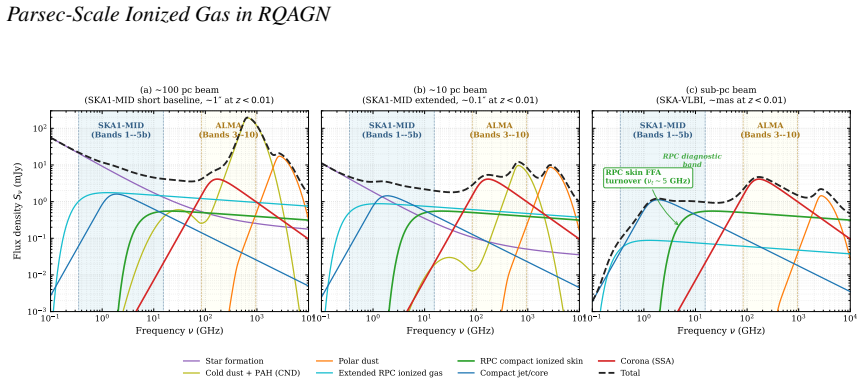
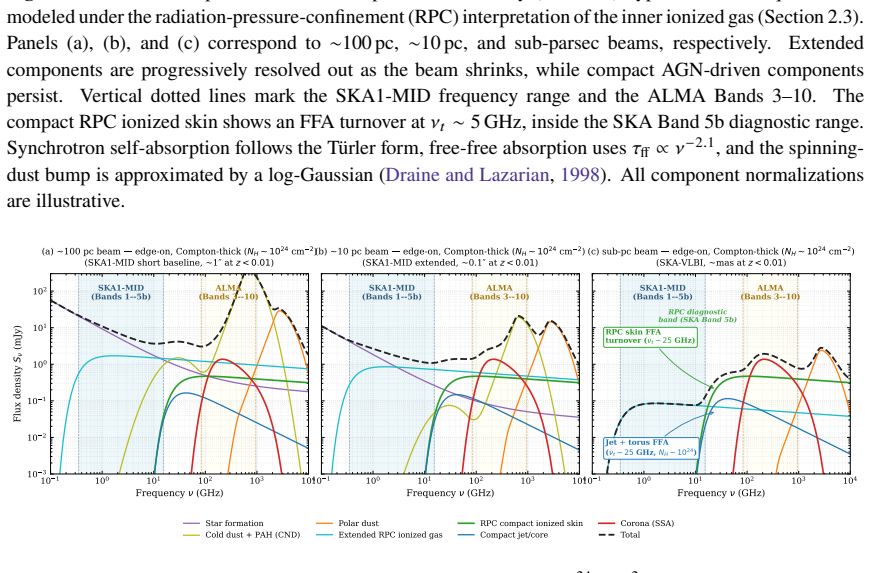
We systematically organize the radio-emitting components in radio-quiet active galactic nuclei (RQ AGN), including jets, accretion disk coronae, dust, ionized gas outflows, and circumnuclear star formation. We present a diagnostic framework for distinguishing these components using spectral turnovers and spectral indices produced by synchrotron self-absorption (SSA) and free-free absorption (FFA), together with brightness temperature and peak frequency. The central premise is that the observed spectral index and its spatial distribution are not unique source properties unless the observing beam is specified: changing the angular resolution changes the physical scale being sampled and therefore changes the mixture of radio-emitting components. By exploiting this scale dependence with SKA1-MID and SKA-VLBI, spatially resolved spectral-index mapping will reveal which physical processes dominate from circumnuclear star formation on $\sim$100 pc scales to jets, coronal emission, and compact ionized gas on parsec and sub-parsec scales. Through multi-frequency continuum imaging and spectral-index mapping, SKA observations will provide a multi-scale physical view of radio-quiet AGN that links radio emission mechanisms to accretion, obscuration, and feedback.
Editorial analysis
A structured set of objections, weighed in public.
Referee Report
Summary. The paper organizes the radio-emitting components in radio-quiet AGN (jets, accretion-disk coronae, dust, ionized outflows, circumnuclear star formation) and presents a diagnostic framework that distinguishes them via SSA and FFA spectral turnovers, spectral indices, brightness temperature, and peak frequency. The central premise is that the observed spectral index and its spatial distribution are not intrinsic source properties but depend on the observing beam, which selects different physical scales; SKA1-MID and SKA-VLBI multi-frequency continuum imaging and spectral-index mapping are proposed to map the transition from ~100 pc star-formation scales to parsec/sub-parsec jets, coronae, and compact ionized gas.
Significance. If the separability assumption holds, the framework would supply a practical multi-scale diagnostic linking radio emission mechanisms to accretion, obscuration, and feedback in RQ AGN. The paper usefully synthesizes existing component properties but supplies no new derivations, simulations, or falsifiable predictions, so its significance remains prospective rather than demonstrated.
major comments (2)
- [Abstract] Abstract: the claim that 'distinct spectral signatures from SSA and FFA, together with brightness temperature and peak frequency, remain separable when multiple components overlap within the beam' is load-bearing for the entire diagnostic framework, yet no analytic derivation, linear-combination model, or simulation is supplied showing that blended spectra remain invertible at the angular resolutions and frequency coverage of SKA1-MID and SKA-VLBI.
- [Abstract] Abstract: the statement that 'changing the angular resolution changes the physical scale being sampled and therefore changes the mixture of radio-emitting components' is presented as the central premise, but no quantitative illustration (e.g., beam-convolved model spectra or resolution-dependent component fractions) is given to show how the mixture actually varies or how the diagnostics recover the dominant process.
minor comments (1)
- The manuscript would benefit from a short table listing the characteristic turnover frequencies, spectral indices, and Tb ranges for each component (jets, coronae, outflows, star formation) so that readers can immediately assess the degree of overlap.
Simulated Author's Rebuttal
We thank the referee for the constructive comments. The manuscript is a synthesis paper that organizes known radio components in RQ AGN and proposes a scale-dependent diagnostic framework for SKA observations. We respond to the major comments below.
read point-by-point responses
-
Referee: [Abstract] Abstract: the claim that 'distinct spectral signatures from SSA and FFA, together with brightness temperature and peak frequency, remain separable when multiple components overlap within the beam' is load-bearing for the entire diagnostic framework, yet no analytic derivation, linear-combination model, or simulation is supplied showing that blended spectra remain invertible at the angular resolutions and frequency coverage of SKA1-MID and SKA-VLBI.
Authors: We acknowledge that the paper supplies no new analytic derivation or simulation of blended spectra. The separability argument rests on the distinct turnover frequencies, spectral indices, and brightness temperatures established for each component in the existing literature. The framework is presented as a conceptual tool to guide interpretation of SKA data rather than a fully modeled prediction. We agree that an explicit illustration would improve clarity and will add a short subsection with a simple two-component linear-combination example using representative parameters drawn from published observations. revision: yes
-
Referee: [Abstract] Abstract: the statement that 'changing the angular resolution changes the physical scale being sampled and therefore changes the mixture of radio-emitting components' is presented as the central premise, but no quantitative illustration (e.g., beam-convolved model spectra or resolution-dependent component fractions) is given to show how the mixture actually varies or how the diagnostics recover the dominant process.
Authors: We agree that the manuscript lacks a quantitative demonstration of how component fractions change with beam size. The premise follows from the well-documented differences in physical scale of the components (star formation on ~100 pc scales versus compact jets and coronae on parsec scales). In the revised manuscript we will include a new schematic figure showing example spectra and recovered spectral indices for three representative beam sizes to illustrate the transition in dominant emission mechanism. revision: yes
Circularity Check
No circularity: qualitative diagnostic framework with no derivations or self-referential fits
full rationale
The paper organizes known radio components in RQ AGN and proposes a diagnostic framework using established SSA/FFA properties, brightness temperature, and peak frequency, with emphasis on how beam size affects observed spectral index via scale sampling. No equations, quantitative models, parameter fits, or self-citations appear in the provided text. The central premise is a direct statement about resolution dependence rather than a result derived from prior steps within the paper. The framework is self-contained as conceptual organization without load-bearing reductions to inputs.
Axiom & Free-Parameter Ledger
axioms (2)
- domain assumption Spectral turnovers and indices produced by synchrotron self-absorption and free-free absorption can be used to tag distinct physical components when observed at varying angular resolutions.
- domain assumption SKA1-MID and SKA-VLBI will achieve the angular resolution and sensitivity needed to isolate parsec and sub-parsec scales in RQ AGN.
Reference graph
Works this paper leans on
-
[1]
doi: 10.1088/0004-637X/795/1/30. R. D. Baldi et al.Monthly Notices of the Royal Astronomical Society, 500(4):4749–4767,
-
[2]
doi: 10.1093/mnras/staa3519. A. Baskin and A. Laor.MNRAS, 474(2):1970–1994, Feb
-
[3]
doi: 10.1093/mnras/stx2850. A. Baskin and A. Laor.MNRAS, 508(1):680–697, Nov
-
[4]
doi: 10.1093/mnras/stab2555. R. Beck et al.ARA&A, 41:117–158, Jan
-
[5]
doi: 10.1146/annurev.astro.41.011802.094856. E. Behar et al.MNRAS, 478(1):399–406, July
work page internal anchor Pith review Pith/arXiv arXiv doi:10.1146/annurev.astro.41.011802.094856
-
[6]
doi: 10.1093/mnras/sty850. J. J. Condon.ARA&A, 30:575–611, Jan
-
[7]
doi: 10.1146/annurev.aa.30.090192.003043. S. del Palacio et al.A&A, 701:A41, Sept
-
[8]
doi: 10.1051/0004-6361/202554936. B. T. Draine and B. Hensley.ApJ, 765(2):159, Mar
-
[9]
doi: 10.1088/0004-637X/765/2/159. B. T. Draine and A. Lazarian.ApJL, 494(1):L19–L22, Feb
-
[10]
doi: 10.1086/311167. B. T. Draine and A. Li.ApJ, 657(2):810–837, Mar
-
[11]
doi: 10.1086/511055. F. Fiore et al.A&A, 601:A143, May
work page internal anchor Pith review doi:10.1086/511055
-
[12]
doi: 10.1051/0004-6361/201629478. J. F. Gallimore, S. A. Baum, and C. P. O’Dea.ApJ, 613(2):794–810, Oct
work page internal anchor Pith review doi:10.1051/0004-6361/201629478
-
[13]
doi: 10.1051/0004-6361/202450086. S. García-Burillo et al.ApJL, 823(1):L12, May
-
[14]
doi: 10.3847/2041-8205/823/1/L12. S. García-Burillo et al.A&A, 632:A61, Dec
-
[15]
GRAVITY Collaboration et al.A&A, 690:A76, Oct
doi: 10.1051/0004-6361/201936606. GRAVITY Collaboration et al.A&A, 690:A76, Oct
-
[16]
doi: 10.1051/0004-6361/202450746. G. Helou, B. T. Soifer, and M. Rowan-Robinson.ApJL, 298:L7–L11, Nov
-
[17]
doi: 10.3847/1538-4357/acc4c2. S. F. Hönig and M. Kishimoto.ApJL, 838(2):L20, Apr
-
[18]
doi: 10.3847/2041-8213/aa6838. M. Imanishi, K. Nakanishi, and T. Izumi.The Astrophysical Journal, 826:59,
-
[19]
doi: 10.3847/ 2041-8213/aaa8df. Y. Inoue and A. Doi.ApJ, 869(2):114, Dec
2041
-
[20]
doi: 10.3847/1538-4357/aaeb95. F. P. Israel et al.A&A, 519:A67, Sept
-
[21]
doi: 10.1051/0004-6361/201014073. M. E. Jarvis et al.Monthly Notices of the Royal Astronomical Society, 503:1780–1797,
-
[22]
doi: 10.1093/mnras/stab549. S. Kameno et al.PASJ, 53(2):169–178, Apr
-
[23]
doi: 10.1093/pasj/53.2.169. T. Kawamuro et al.ApJ, 938(1):87, Oct
-
[24]
doi: 10.3847/1538-4357/ac8794. K. I. Kellermann et al.AJ, 98:1195, Oct
-
[25]
doi: 10.1086/115207. J.-Y. Kim et al.A&A, 610:L5, Feb
-
[26]
doi: 10.1051/0004-6361/201732421. M. Kishimoto et al.ApJ, 940(1):28, Nov
-
[27]
doi: 10.3847/1538-4357/ac91c4. Y. Kudoh, K. Wada, N. Kawakatu, and M. Nomura.ApJ, 950(1):72, June
-
[28]
13 Parsec-Scale Ionized Gas in RQAGN C
doi: 10.3847/1538-4357/ab8013. 13 Parsec-Scale Ionized Gas in RQAGN C. Meny et al.A&A, 468(1):171–188, June
-
[29]
C.G.Mundell, J.M.Wrobel, A.Pedlar, andJ.F.Gallimore.ApJ,583(1):192–204, Jan.2003
doi: 10.1051/0004-6361:20065771. C.G.Mundell, J.M.Wrobel, A.Pedlar, andJ.F.Gallimore.ApJ,583(1):192–204, Jan.2003. doi: 10.1086/345356. E. J. Murphy et al.ApJ, 737(2):67, Aug
-
[30]
doi: 10.1088/0004-637X/737/2/67. A. S. Nikonov et al.MNRAS, 526(4):5949–5963, Dec
-
[31]
doi: 10.1093/mnras/stad3061. A. Njeri et al.Monthly Notices of the Royal Astronomical Society, 519(2):1732–1744,
-
[32]
doi: 10.1093/mnras/stac3569. M. Orienti and M. A. Prieto.MNRAS, 401(4):2599–2610, Feb
-
[33]
doi: 10.1111/j.1365-2966. 2009.15837.x. F. Panessa et al.Nature Astronomy, 3:387–396, Apr
-
[34]
doi: 10.1038/s41550-019-0765-4. D. Paradis, J.-P. Bernard, C. Mény, and V. Gromov.A&A, 534:A118, Oct
-
[35]
C.Riccietal.The Astrophysical Journal Letters,952:L28,2023
doi: 10.1051/0004-6361/201116473. C.Riccietal.The Astrophysical Journal Letters,952:L28,2023. doi: 10.3847/2041-8213/acda27. A.J.Sargentetal.The Astrophysical Journal,961(2):230,2024. doi: 10.3847/1538-4357/ad11d4. S. Sawada-Satoh et al.Astronomische Nachrichten, 330(2):249, Feb
-
[36]
doi: 10.1002/asna. 200811168. N. I. Shakura and R. A. Sunyaev.A&A, 24:337–355, Jan
-
[37]
doi: 10.1093/mnras/stz220. F. S. Tabatabaei et al.A&A, 561:A95, Jan
-
[38]
doi: 10.1051/0004-6361/201321441. K. Wada et al.The Astrophysical Journal, 998:60,
-
[39]
doi: 10.3847/1538-4357/ae36a7. M. S. Yun, N. A. Reddy, and J. J. Condon.ApJL, 549(2):L167–L171, Mar
-
[40]
doi: 10.1093/mnras/stad1178. 14
discussion (0)
Sign in with ORCID, Apple, or X to comment. Anyone can read and Pith papers without signing in.