An equal mass ratio supermassive binary black holes in Q J0158-4325 with periodic microlensing signature?
Pith reviewed 2026-07-02 08:12 UTC · model grok-4.3
The pith
Nearly equal-mass supermassive black hole binary best matches periodic microlensing and spectrum of Q J0158-4325.
A machine-rendered reading of the paper's core claim, the machinery that carries it, and where it could break.
Core claim
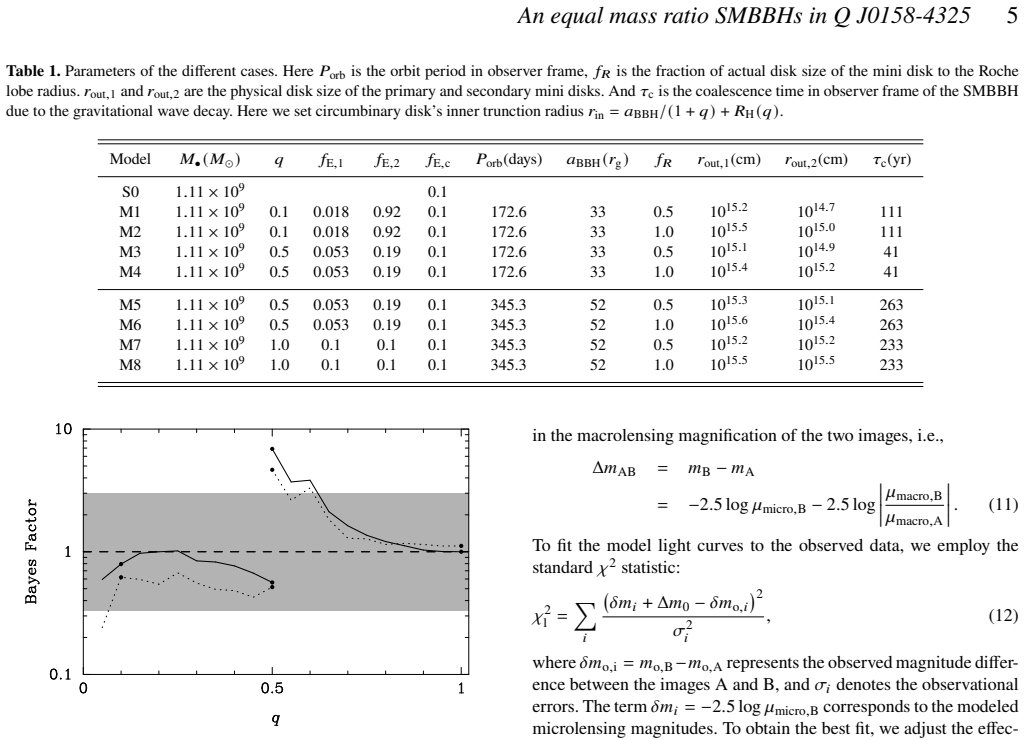
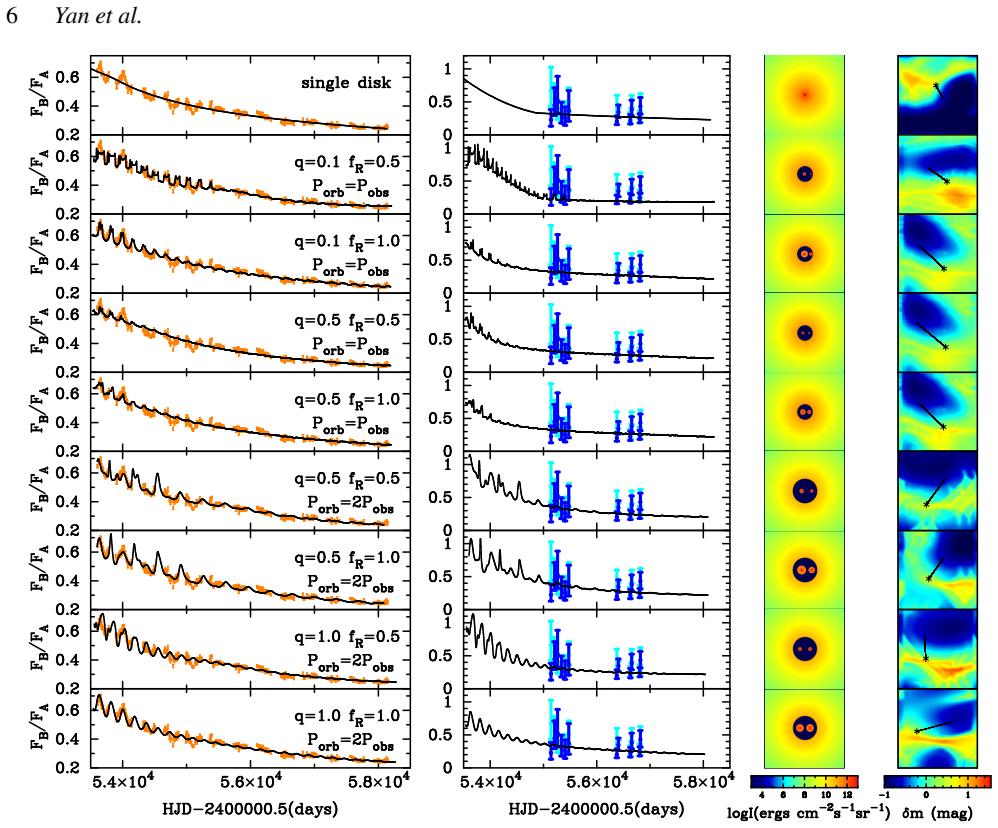
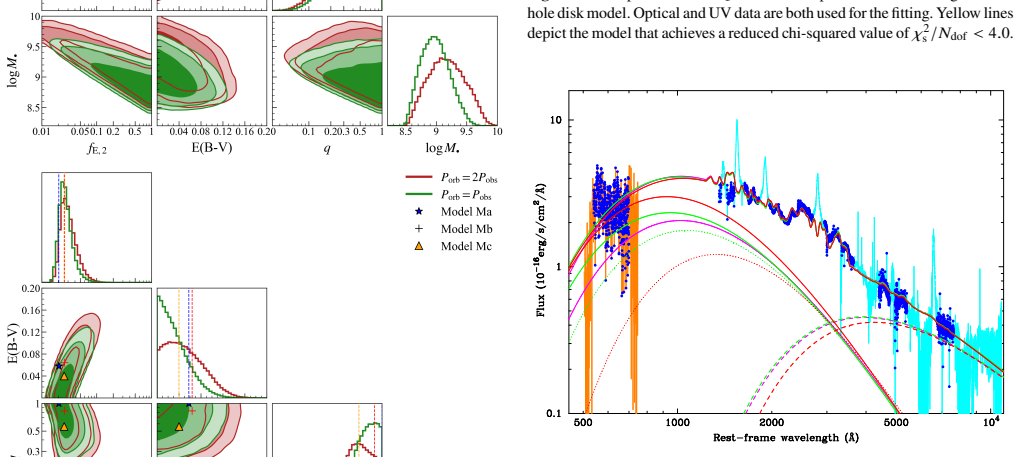
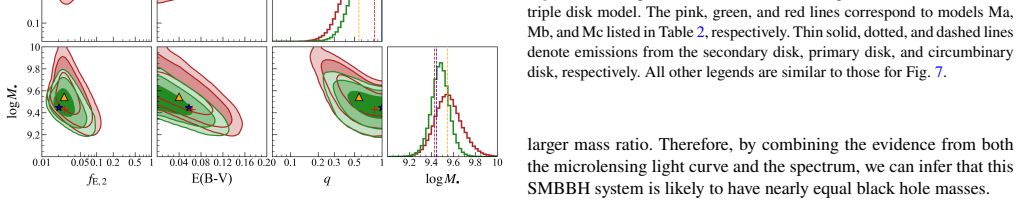
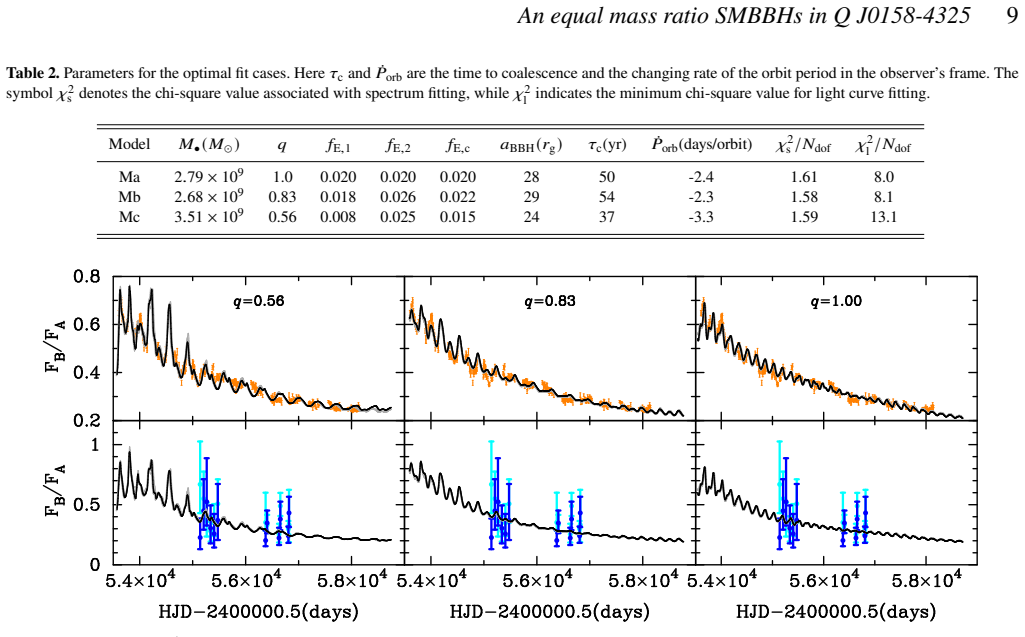
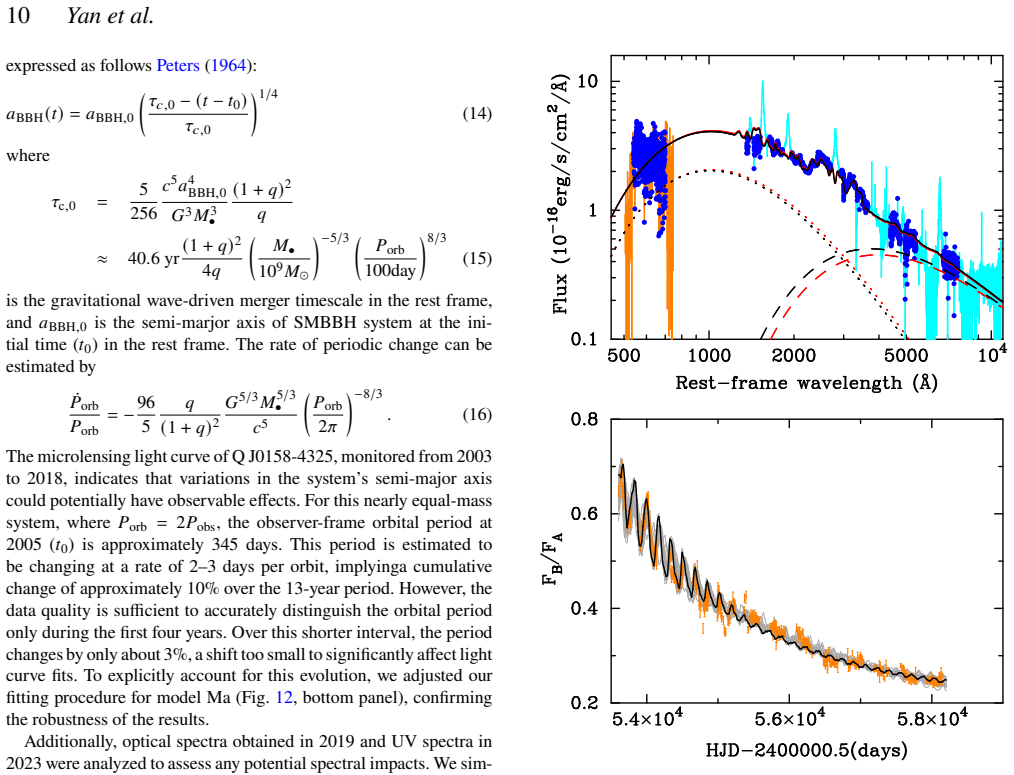
A triple-disk SMBBH model incorporating realistic accretion structures, orbital motion, and microlensing reproduces the 173-day periodic variations. Combined fitting to light curves and SEDs selects mass ratios q greater than 0.5 with total mass around 10^9.5 solar masses, and q near 1 yields the best simultaneous match to the optical/UV spectrum and the microlensing signal. Larger X-ray microlensing amplitudes are predicted but cannot be strongly constrained with current observations.
What carries the argument
Triple-disk accretion structure around the orbiting supermassive binary black hole, with microlensing generated by the binary's orbital motion.
If this is right
- The same modeling approach can be applied to other lensed quasars to search for additional SMBBH candidates.
- Nearly equal-mass binaries are expected to produce the clearest combined microlensing and spectral signatures.
- Multi-wavelength data, especially X-ray, are required to break degeneracies between binary and single-black-hole interpretations.
- The framework supplies quantitative mass-ratio and total-mass constraints once high-cadence monitoring is available.
Where Pith is reading between the lines
- Periodic microlensing could become a practical route to measuring mass ratios of distant supermassive black hole pairs without direct imaging.
- If the triple-disk configuration remains stable over many orbits, similar periodic signals may appear in other lensed systems observed at high cadence.
- Confirmation would imply that orbital motion imprints detectable periodicity even when the binary separation is small enough for the disks to interact.
Load-bearing premise
The 173-day periodicity arises from microlensing caused by the orbital motion of the binary rather than from intrinsic quasar variability or disk instabilities.
What would settle it
High-cadence X-ray monitoring that measures microlensing amplitudes no larger than those seen in optical light curves would contradict the model's prediction.
Figures
read the original abstract
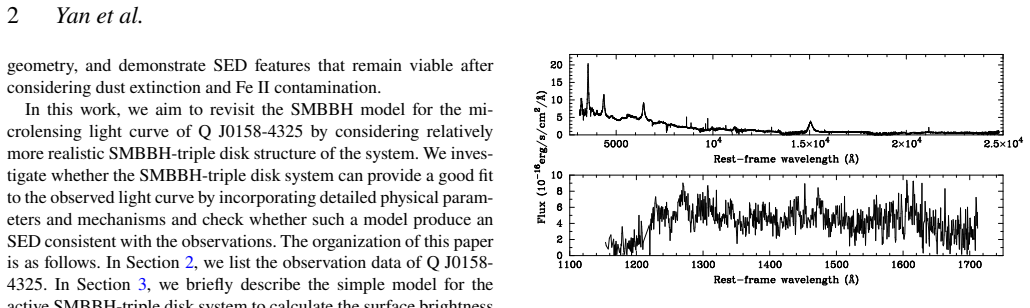
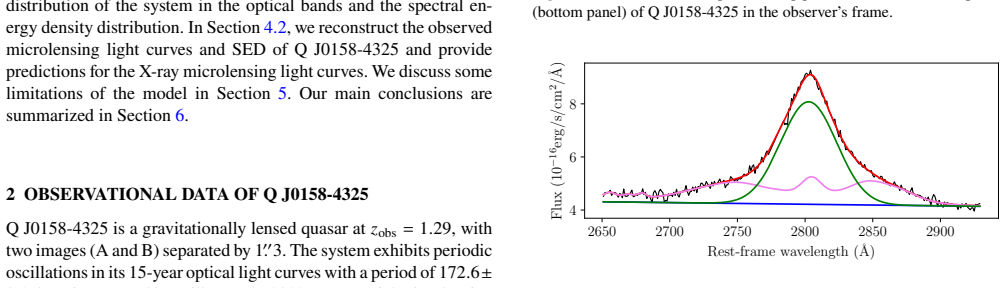
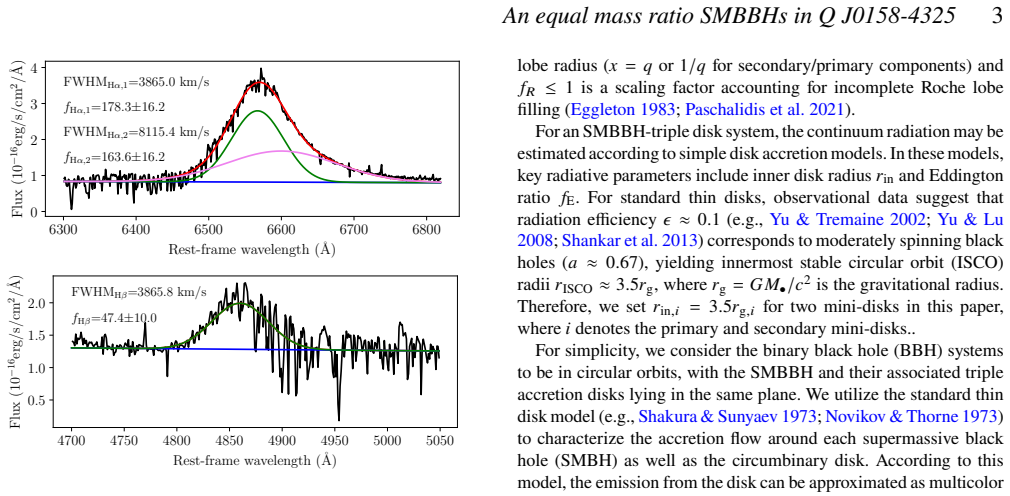
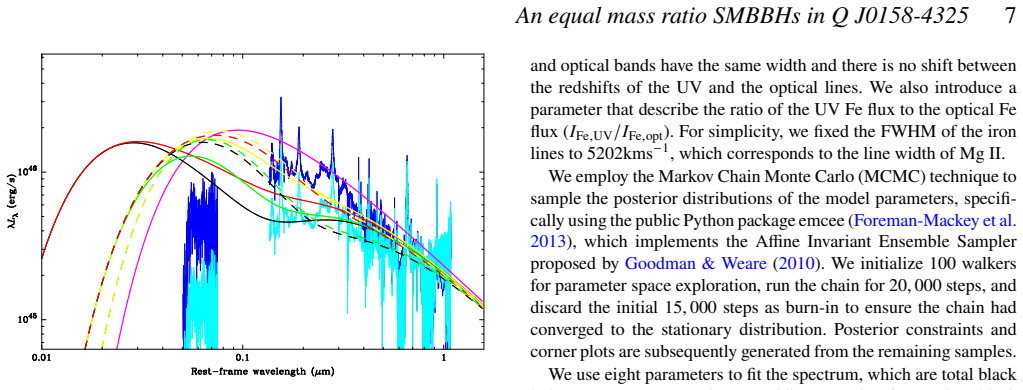
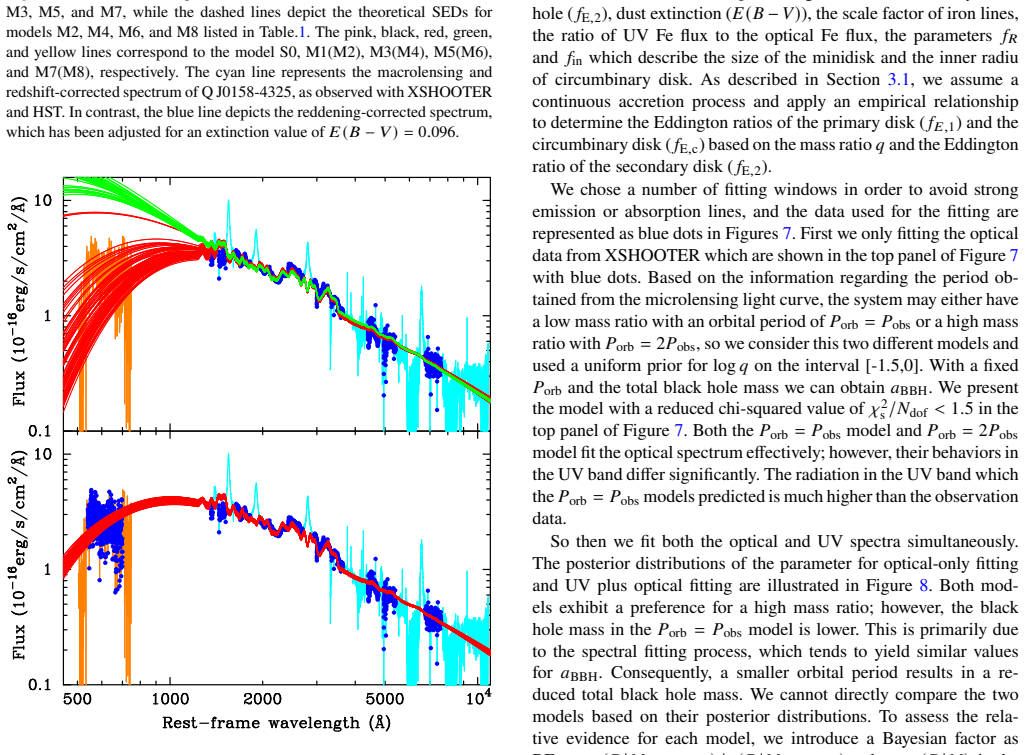
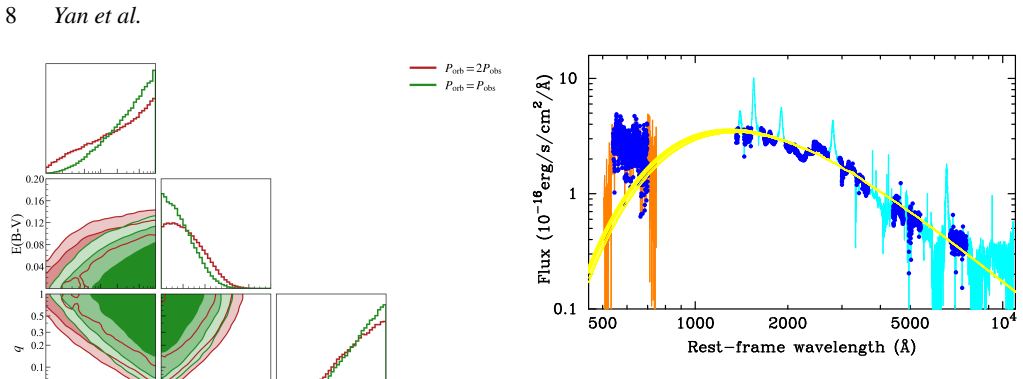
This study aims to test whether a supermassive binary black hole (SMBBH) system with a triple-disk accretion structure can explain the observed $\sim$173-day periodic microlensing variations and spectral energy distribution (SED) of the gravitationally lensed quasar Q J0158-4325. We construct a triple-disk model for the SMBBH system, incorporating realistic accretion disk structures, orbital motion, and microlensing effects. The model is used to simulate optical and X-ray microlensing light curves and SEDs, which are compared with long-term optical monitoring, X-ray observations, and UV-optical spectra from HST and XSHOOTER. Bayesian analysis and MCMC fitting are applied to constrain model parameters. The model successfully reproduces the periodic microlensing variations. Combined light curve and SED fitting favor a high mass ratio ($q>0.5$) SMBBH system with total mass $\sim 10^{9.5}M_\odot$, and nearly equal-mass binaries ($q\sim1$) provides the best agreement with both the optical/UV spectrum and the microlensing signal. This model predicts larger X-ray microlensing amplitudes than in the optical, but, the available X-ray observations lack the precision needed to place strong constraints. We emphasize the need for future high-cadence monitoring to resolve remaining uncertainties. This study demonstrates the effectiveness of combining multi-wavelength microlensing signatures with spectral modeling to provide robust constraints on SMBBH systems, with the developed framework applicable to other lensed quasars for identifying and characterizing candidate SMBBHs.
Editorial analysis
A structured set of objections, weighed in public.
Referee Report
Summary. The paper constructs a triple-disk SMBBH model (two mini-disks plus circumbinary disk) incorporating orbital motion and microlensing to reproduce the ~173-day periodic variations and UV-optical SED of the lensed quasar Q J0158-4325. Bayesian MCMC fitting to optical light curves, X-ray data, and HST/XSHOOTER spectra favors q > 0.5 (best at q ~ 1) with total mass ~10^{9.5} M_⊙; the model also predicts stronger X-ray microlensing amplitudes.
Significance. If the forward model remains valid at the reported parameters, the work demonstrates a concrete multi-wavelength method for constraining SMBBH mass ratio and total mass in lensed quasars, extending beyond single-epoch SED or periodicity arguments alone. The framework could be applied to other systems with long-term monitoring.
major comments (1)
- [Model construction and fitting results] The best-fit solution (q ~ 1, M_tot ~ 3 × 10^9 M_⊙, P = 173 d) implies a binary separation a ≈ (P² M_tot)^{1/3} ≈ 890 AU or ~30 R_S. Standard thin-disk truncation places mini-disks at 0.2–0.4 a and the circumbinary disk at ~2–3 a; these regions overlap at such small a, violating the non-interacting triple-disk geometry used to generate both the microlensing light curves and the SED. No part of the model construction or fitting procedure (described in the abstract and results) enforces a minimum separation or includes hydrodynamic truncation radii.
minor comments (1)
- [Abstract] Abstract contains a comma splice in the sentence beginning 'This model predicts larger X-ray microlensing amplitudes than in the optical, but, the available...'; rephrasing would improve readability.
Simulated Author's Rebuttal
We thank the referee for the thorough review and for identifying a key consistency issue with the triple-disk geometry at the best-fit parameters. We address this point directly below and will revise the manuscript to incorporate the necessary discussion and caveats.
read point-by-point responses
-
Referee: The best-fit solution (q ~ 1, M_tot ~ 3 × 10^9 M_⊙, P = 173 d) implies a binary separation a ≈ (P² M_tot)^{1/3} ≈ 890 AU or ~30 R_S. Standard thin-disk truncation places mini-disks at 0.2–0.4 a and the circumbinary disk at ~2–3 a; these regions overlap at such small a, violating the non-interacting triple-disk geometry used to generate both the microlensing light curves and the SED. No part of the model construction or fitting procedure (described in the abstract and results) enforces a minimum separation or includes hydrodynamic truncation radii.
Authors: We agree that the best-fit parameters yield a binary separation of ~890 AU (~15–30 R_S for M_tot ≈ 3×10^9 M_⊙), at which the assumed truncation radii (0.2–0.4a for mini-disks and ~2–3a for the circumbinary disk) produce overlapping regions. This violates the non-interacting assumption underlying both the microlensing light-curve generation and the SED modeling. The current fitting procedure does not impose a minimum-separation prior or hydrodynamic truncation radii, as the model was constructed as a first-order approximation. In the revised manuscript we will (i) explicitly compute and report the separation for the best-fit solution, (ii) add a dedicated paragraph discussing the regime of validity of the triple-disk geometry and the need for full hydrodynamic simulations at a ≲ 100 R_S, and (iii) note that future model extensions will include a separation-dependent truncation check. We maintain that the multi-wavelength fitting framework still provides useful constraints on q and M_tot even as an approximation, but we will clearly flag this limitation. revision: yes
Circularity Check
Fitted parameters to observed light curve and SED presented as independent reproduction of microlensing periodicity
specific steps
-
fitted input called prediction
[Abstract]
"The model is used to simulate optical and X-ray microlensing light curves and SEDs, which are compared with long-term optical monitoring, X-ray observations, and UV-optical spectra from HST and XSHOOTER. Bayesian analysis and MCMC fitting are applied to constrain model parameters. The model successfully reproduces the periodic microlensing variations. Combined light curve and SED fitting favor a high mass ratio (q>0.5) SMBBH system with total mass ∼10^{9.5}M_⊙, and nearly equal-mass binaries (q∼1) provides the best agreement with both the optical/UV spectrum and the microlensing signal."
Parameters (q, M_tot) are optimized via MCMC to the identical light-curve periodicity and SED data that are subsequently said to be 'reproduced' and in 'best agreement.' The reproduction is therefore the direct output of the fitting procedure rather than an independent test of the model.
full rationale
The paper constructs a triple-disk SMBBH model that assumes the 173-day periodicity arises from orbital microlensing, then applies MCMC fitting to the same light curve and SED data to constrain q and M_tot. The claim that the model 'successfully reproduces the periodic microlensing variations' and that q~1 'provides the best agreement' reduces directly to the outcome of that fit. No independent forward prediction or external validation step is described; the reproduction is the fitted result by construction. This matches the fitted_input_called_prediction pattern and raises the score to 6, while the central physical assumption (triple-disk geometry) remains unverified by the fit itself.
Axiom & Free-Parameter Ledger
free parameters (2)
- mass ratio q
- total mass
axioms (2)
- domain assumption Triple-disk accretion structure (two inner disks plus shared outer disk) for an SMBBH system
- domain assumption Orbital motion of the binary produces the observed 173-day periodicity via microlensing
Reference graph
Works this paper leans on
-
[1]
, keywords =
Redshifts and lens profile for the double quasar QJ 0158-4325. , keywords =
-
[2]
Foreman-Mackey, Daniel and Hogg, David W. and Lang, Dustin and Goodman, Jonathan , title = ". PASP , year = 2013, volume = 125, number = 925, pages =. 1202.3665 , archivePrefix =
work page internal anchor Pith review Pith/arXiv arXiv 2013
-
[3]
Goodman, Jonathan and Weare, Jonathan , title = ". Commun. Appl. Math. Comput. Sci. , year = 2010, volume = 5, number = 1, pages =
2010
-
[4]
and Lubow, S
Artymowicz, P. and Lubow, S. H. , title =. ApJ , year =
-
[5]
and Lubow, S
Artymowicz, P. and Lubow, S. H. , title =. ApJL , year =
-
[6]
Begelman, M. C. and Blandford, R. D. and Rees, M. J. , title =. Nature , year =
-
[7]
and Krawczynski, H
Chartas, G. and Krawczynski, H. and Zalesky, L. and others , title =. ApJ , year =
-
[8]
and Dai, X
Chen, B. and Dai, X. and Kochanek, C. S. and others , title =. ApJ , year =
-
[9]
and Yu, Q
Chen, Y. and Yu, Q. and Lu, Y. , title =. ApJ , year =
-
[10]
and Armitage, P
Cuadra, J. and Armitage, P. J. and Alexander, R. D. and Begelman, M. C. , title =. MNRAS , year =
-
[11]
Cornachione, M. A. and Morgan, C. W. , title =. ApJ , year =
-
[12]
and Elvis, M
Czerny, B. and Elvis, M. , title =. ApJ , year =
-
[13]
and Kochanek, C
Dai, X. and Kochanek, C. S. and Chartas, G. and others , title =. ApJ , year =
-
[14]
and Noble, S
d'Ascoli, S. and Noble, S. C. and Bowen, D. B. and others , title =. ApJ , year =
-
[15]
Dittmann, A. J. and Ryan, G. and Miller, M. C. , title =. ApJL , year =
-
[16]
D'Orazio, D. J. and Haiman, Z. and MacFadyen, A. , title =. MNRAS , year =
-
[17]
and Colpi, M
Dotti, M. and Colpi, M. and Haardt, F. and Mayer, L. , title =. MNRAS , year =
-
[18]
Duffell, P. C. and D'Orazio, D. and Derdzinski, A. and others , title =. ApJ , year =
-
[19]
Eggleton, P. P. , title =. ApJ , year =
-
[20]
and Larson, R
Escala, A. and Larson, R. B. and Coppi, P. S. and Mardones, D. , title =. ApJ , year =
-
[21]
Farris, B. D. and Duffell, P. and MacFadyen, A. I. and others , title =. ApJ , year =
-
[22]
Farris, B. D. and Duffell, P. and MacFadyen, A. I. and others , title =. MNRAS , year =
-
[23]
Fitzpatrick, E. L. , title =. PASP , year =
-
[24]
and Miller, J
Gültekin, K. and Miller, J. M. , title =. ApJ , year =
-
[25]
and Dai, X
Guerras, E. and Dai, X. and Steele, S. and others , title =. ApJ , year =
-
[26]
Gupta, K. K. and Ricci, C. and Temple, M. J. and others , title =. A&A , year =
-
[27]
and Mineshige, S
Hayasaki, K. and Mineshige, S. and Sudo, H. , title =. PASJ , year =
-
[28]
and Mineshige, S
Hayasaki, K. and Mineshige, S. and Ho, L. C. , title =. ApJ , year =
-
[29]
and Saito, H
Hayasaki, K. and Saito, H. and Mineshige, S. , title =. PASJ , year =
-
[30]
Ivanov, P. B. and Papaloizou, J. C. B. and Polnarev, A. G. , title =. MNRAS , year =
-
[31]
and Refsdal, S
Kayser, R. and Refsdal, S. and Stabell, R. , title =. A&A , year =
-
[32]
Kochanek, C. S. , title =. ApJ , year =
-
[33]
Krauth, L. M. and Davelaar, J. and Haiman, Z. and others , title =. MNRAS , year =
-
[34]
and Davis, S
Laor, A. and Davis, S. W. , title =. MNRAS , year =
-
[35]
MacLeod, C. L. and Morgan, C. W. and Mosquera, A. and others , title =. ApJ , year =
-
[36]
, title =
Martini, P. , title =. Coevolution of Black Holes and Galaxies , year =
-
[37]
and Dalang, C
Millon, M. and Dalang, C. and Lemon, C. and others , title =. A&A , year =
-
[38]
and Milosavljević, M
Merritt, D. and Milosavljević, M. , title =. Living Reviews in Relativity , year =
-
[39]
Morgan, N. D. and Dressler, A. and Maza, J. and others , title =. AJ , year =
-
[40]
Morgan, C. W. and Eyler, M. E. and Kochanek, C. S. and others , title =. ApJ , year =
-
[41]
Morgan, C. W. and Hainline, L. J. and Chen, B. and others , title =. ApJ , year =
-
[42]
and McClintock, J
Narayan, R. and McClintock, J. E. , title =. NewAR , year =
-
[43]
Novikov, I. D. and Thorne, K. S. , title =. Black Holes , editor =. 1973 , pages =
1973
-
[44]
and Marshall, P
Oguri, M. and Marshall, P. J. , title =. MNRAS , year =
-
[45]
, title =
Paczynski, B. , title =. ApJ , year =
-
[46]
and Bright, J
Paschalidis, V. and Bright, J. and Ruiz, M. and others , title =. ApJL , year =
-
[47]
Peng, C. Y. and Impey, C. D. and Ho, L. C. and Barton, E. J. and Rix, H.-W. , title =. ApJ , year =
-
[48]
Peters, P. C. , title =. Physical Review , year =
-
[49]
Phillips, M. M. , title =. ApJ , year =
-
[50]
and Krolik, J
Roedig, C. and Krolik, J. H. and Miller, M. C. , title =. ApJ , year =
-
[51]
Schlafly, E. F. and Finkbeiner, D. P. , title =. ApJ , year =
-
[52]
Shakura, N. I. and Sunyaev, R. A. , title =. A&A , year =
-
[53]
and Weinberg, D
Shankar, F. and Weinberg, D. H. and Miralda-Escudé, J. , title =. MNRAS , year =
-
[54]
and Roedig, C
Sesana, A. and Roedig, C. and Reynolds, M. T. and Dotti, M. , title =. MNRAS , year =
-
[55]
Sigut, T. A. A. and Pradhan, A. K. , title =. ApJS , year =
-
[56]
and Weinberger, R
Siwek, M. and Weinberger, R. and Muñoz, D. J. and others , title =. MNRAS , year =
-
[57]
and Kawara, K
Tsuzuki, Y. and Kawara, K. and Yoshii, Y. and others , title =. ApJ , year =
-
[58]
and Wilkes, B
Vestergaard, M. and Wilkes, B. J. , title =. ApJS , year =
-
[59]
and Joly, M
Véron-Cetty, M.-P. and Joly, M. and Véron, P. , title =. A&A , year =
-
[60]
, title =
Wambsganss, J. , title =. 1990 , note =
1990
-
[61]
, title =
Wambsganss, J. , title =. Saas-Fee Advanced Course 33, Gravitational Lensing: Strong, Weak and Micro , editor =. 2006 , pages =
2006
-
[62]
and Paczynski, B
Wambsganss, J. and Paczynski, B. and Schneider, P. , title =. ApJL , year =
-
[63]
Witt, H. J. and Mao, S. and Schechter, P. L. , title =. ApJ , year =
-
[64]
and Lu, Y
Yan, C.-S. and Lu, Y. and Yu, Q. and others , title =. ApJ , year =
-
[65]
and Lu, Y
Yan, C.-S. and Lu, Y. and Dai, X. and others , title =. ApJ , year =
-
[66]
, title =
Yu, Q. , title =. MNRAS , year =
-
[67]
and Lu, Y
Yu, Q. and Lu, Y. , title =. ApJ , year =
-
[68]
and Tremaine, S
Yu, Q. and Tremaine, S. , title =. MNRAS , year =
-
[69]
and Narayan, R
Yuan, F. and Narayan, R. , title =. ARA&A , year =
-
[70]
and Butler, N
Zheng, Z.-Y. and Butler, N. R. and Shen, Y. and others , title =. ApJ , year =
discussion (0)
Sign in with ORCID, Apple, or X to comment. Anyone can read and Pith papers without signing in.