GPU-accelerated spectrum reweighting for new-physics searches in solar neutrino--electron scattering
Pith reviewed 2026-07-02 03:36 UTC · model grok-4.3
The pith
Spectrum reweighting on GPU reduces new-physics likelihood evaluations in solar neutrino scattering to tens of milliseconds.
A machine-rendered reading of the paper's core claim, the machinery that carries it, and where it could break.
Core claim
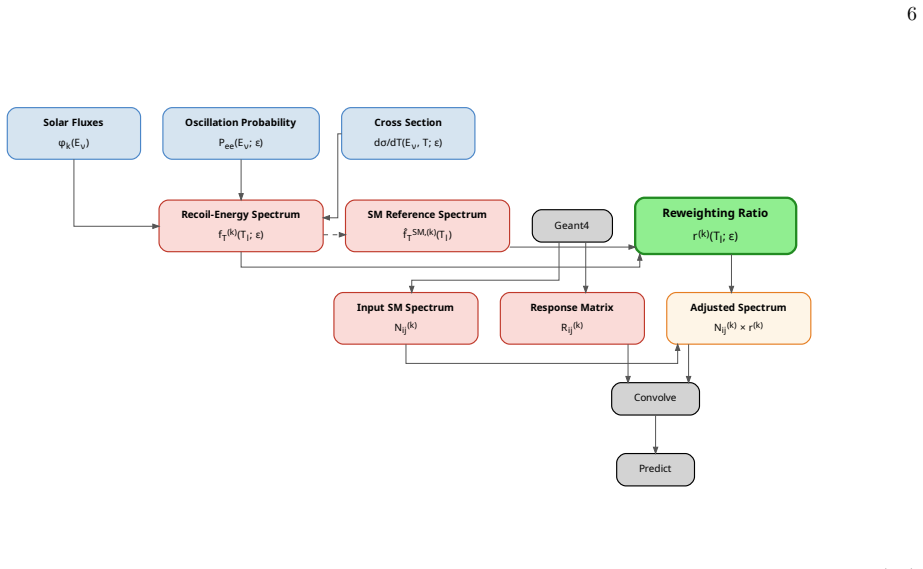
By reweighting the recoil spectrum at the bin level and folding with a fixed two-dimensional detector response in recoil and reconstructed energy, the new-physics dependence is incorporated without regenerating Monte Carlo samples, with the entire process accelerated using NVIDIA Thrust on GPU to achieve one likelihood evaluation in approximately 52 ms on an A30X.
What carries the argument
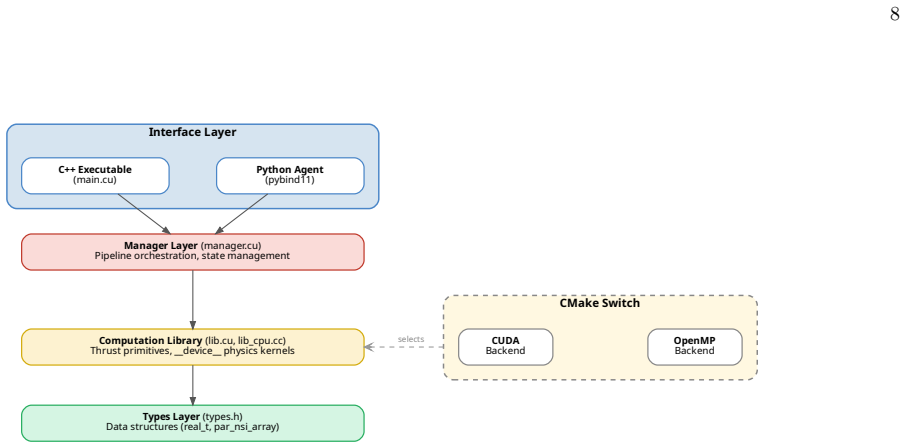
Bin-to-bin reweighting of the recoil spectrum followed by folding with a fixed two-dimensional response kernel, executed via Thrust transformation-reduction primitives on GPU.
If this is right
- Parameter updates reduce to operations on precomputed spectra and response kernels.
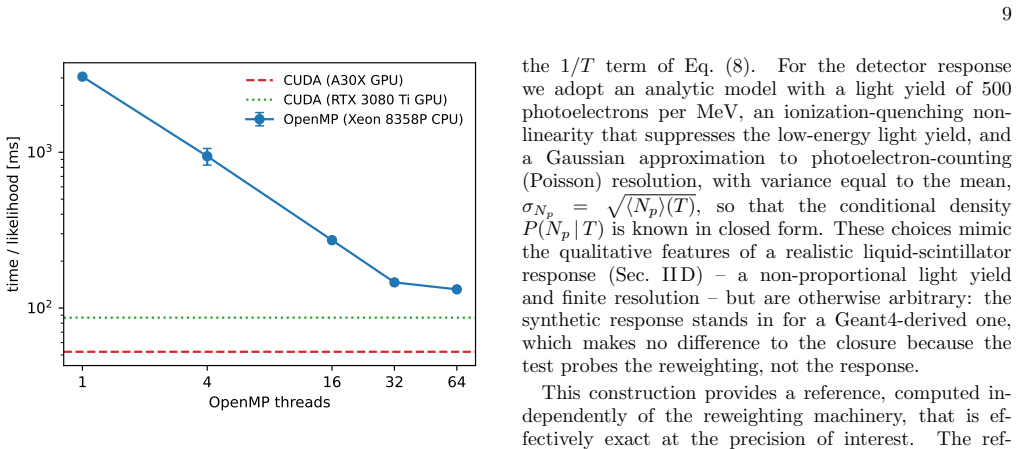
- Likelihood evaluations complete in about 87 ms on RTX 3080Ti and 52 ms on A30X.
- A 58 times speedup is obtained over a single CPU thread and about 2.5 times over a 64-thread CPU.
- Interactive parameter scans are feasible on a single workstation.
- The framework covers flavor NSI and anomalous magnetic moment searches in solar neutrino data.
Where Pith is reading between the lines
- The same approach could accelerate analyses in other experiments where new physics affects the initial particle spectrum but the detector response remains fixed.
- Future work might test the method on models where new physics has a small effect on the detector response itself.
- Integration with real-time data processing pipelines could enable on-the-fly parameter fitting during experimental runs.
Load-bearing premise
The effects of new physics can be fully captured by reweighting the true recoil spectrum from an existing Monte Carlo sample rather than requiring a new sample for each parameter point.
What would settle it
Running a full detector Monte Carlo regeneration for a test new-physics parameter point and finding that the resulting spectrum after response differs from the reweighted version by more than statistical fluctuations.
Figures
read the original abstract
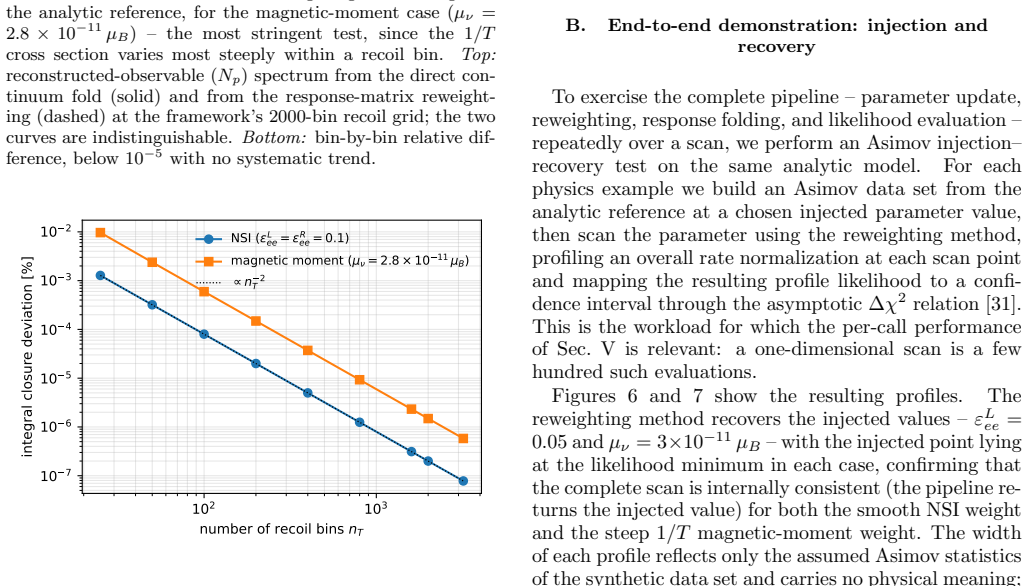
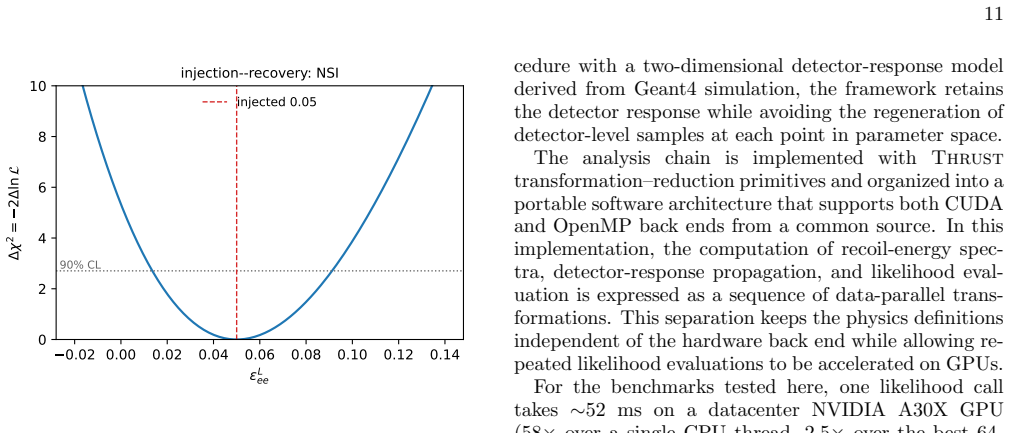
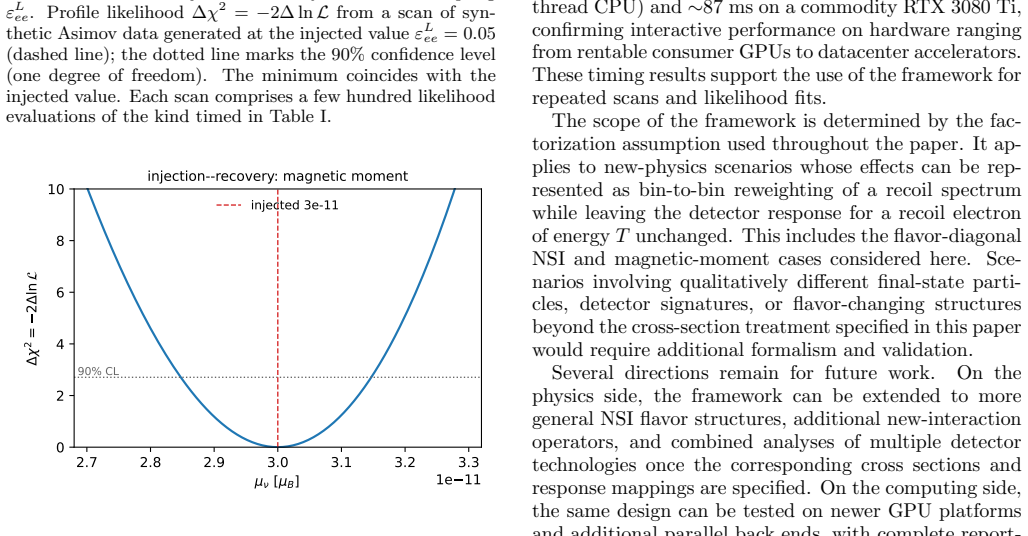
Precision measurements of neutrino--electron elastic scattering provide low-energy tests of weak interactions and beyond-the-Standard-Model effects. Non-standard interactions (NSIs) and an anomalous neutrino magnetic moment modify the differential cross section through different kinematic terms, but both can alter the normalization and shape of the recoil-electron spectrum. Likelihood tests are computationally costly when each parameter point requires the recoil spectrum to be propagated through a detector response obtained from Monte Carlo (MC) simulation. We present a GPU-accelerated spectrum-reweighting framework that avoids regenerating detector MC samples for each new-physics parameter point. Bin-to-bin weights are applied at the recoil-spectrum level and folded with a fixed two-dimensional response model in recoil and reconstructed energy. This keeps the detector response inside the likelihood calculation while reducing each parameter update to operations on precomputed spectra and response kernels. The implementation uses NVIDIA Thrust transformation--reduction primitives and is compiled from a common source for CUDA and OpenMP back ends. In the benchmarks considered here, one likelihood evaluation takes ${\sim}87$ ms on an NVIDIA RTX 3080Ti and ${\sim}52$ ms on an NVIDIA A30X; the latter gives a $58\times$ speedup over a single CPU thread and ${\sim}2.5\times$ over a fully loaded 64-thread CPU. The consumer-GPU result demonstrates that interactive parameter scans are feasible on a single workstation. The main acceleration, however, comes from avoiding detector-MC regeneration at each parameter point rather than from GPU execution alone. The framework applies to neutrino--electron scattering analyses in which the new-physics dependence can be represented by reweighting an existing recoil spectrum, including flavor NSI and magnetic-moment cases studied here.
Editorial analysis
A structured set of objections, weighed in public.
Referee Report
Summary. The paper presents a GPU-accelerated spectrum-reweighting framework for solar neutrino-electron scattering analyses that incorporates new-physics effects (flavor NSI and anomalous magnetic moment) by applying bin-to-bin weights to a precomputed recoil spectrum before folding with a fixed two-dimensional detector response kernel. This avoids regenerating Monte Carlo samples for each parameter point. The implementation uses NVIDIA Thrust primitives with a common source for CUDA and OpenMP backends. Benchmarks report one likelihood evaluation in ~87 ms on an RTX 3080Ti and ~52 ms on an A30X, yielding a 58× speedup versus a single CPU thread and ~2.5× versus a fully loaded 64-thread CPU. The central acceleration is attributed primarily to avoiding repeated detector MC regeneration rather than GPU execution alone. The framework is explicitly scoped to models whose effects are captured by recoil-spectrum reweighting.
Significance. If the performance claims hold under the stated scope, the work provides a practical computational tool that lowers the barrier to extensive parameter scans in low-energy neutrino-electron scattering searches. Enabling interactive exploration on consumer GPUs and portable multi-backend code is a concrete strength for reproducibility. The approach directly addresses a common bottleneck in beyond-Standard-Model analyses where detector response is expensive to resimulate.
minor comments (2)
- The abstract refers to 'the benchmarks considered here' without specifying the exact recoil binning, energy ranges, or number of new-physics parameter points used in the timing measurements; adding these details in §3 or a dedicated benchmark subsection would improve reproducibility.
- The statement that the main acceleration 'comes from avoiding detector-MC regeneration' is important but would benefit from a quantitative breakdown (e.g., time for MC generation versus reweighting step) to separate the two contributions clearly.
Simulated Author's Rebuttal
We thank the referee for the careful reading and positive evaluation of our manuscript. The summary accurately captures the scope and contributions of the work. We are pleased that the referee recognizes the practical value of the GPU-accelerated reweighting approach for enabling extensive parameter scans in neutrino-electron scattering analyses. Since the referee recommends minor revision but lists no specific major comments, we have no points requiring direct rebuttal or revision at this stage.
Circularity Check
No significant circularity
full rationale
The paper describes a computational reweighting framework whose central claims are measured runtime benchmarks for likelihood evaluations on precomputed spectra and fixed response kernels using Thrust primitives. These timings (~52 ms on A30X, 58x vs single CPU thread) are direct empirical results for the stated operations and do not reduce to any fitted parameter, self-defined quantity, or self-citation chain. The scope is explicitly restricted to new-physics models (flavor NSI, magnetic moment) whose effects are captured by bin-to-bin reweighting, with no load-bearing derivation, uniqueness theorem, or ansatz that loops back to the paper's own inputs. The derivation chain is therefore self-contained against external benchmarks.
Axiom & Free-Parameter Ledger
axioms (1)
- domain assumption New-physics dependence (NSI, magnetic moment) can be represented by reweighting an existing recoil spectrum
Reference graph
Works this paper leans on
-
[1]
Neutrino oscillations and Non-Standard Interactions
Y. Farzan and M. Tortola, Neutrino oscillations and Non-Standard Interactions, Front. Phys. 6, 10 (2018), arXiv:1710.09360
work page internal anchor Pith review Pith/arXiv arXiv 2018
- [2]
- [3]
-
[4]
M. Demirci and M. F. Mustamin, Solar neutrino con- straints on light mediators through coherent elastic neutrino-nucleus scattering, Phys. Rev. D 109, 015021 (2024), arXiv:2312.17502
-
[5]
Wolfenstein, Neutrino oscillations in matter, Phys
L. Wolfenstein, Neutrino oscillations in matter, Phys. Rev. D 17, 2369 (1978)
1978
-
[6]
S. P. Mikheyev and A. Yu. Smirnov, Resonant amplifica- tion ofνoscillations in matter and solar-neutrino spec- troscopy, Nuovo Cim. C 9, 17 (1986)
1986
-
[7]
Neutrino electromagnetic interactions: a window to new physics
C. Giunti and A. Studenikin, Neutrino electromagnetic interactions: A window to new physics, Rev. Mod. Phys. 87, 531 (2015), arXiv:1403.6344
work page internal anchor Pith review Pith/arXiv arXiv 2015
-
[8]
Limiting neutrino magnetic moments with Borexino Phase-II solar neutrino data
M. Agostiniet al.(Borexino Collaboration), Limiting neutrino magnetic moments with Borexino Phase-II so- lar neutrino data, Phys. Rev. D 96, 091103 (2017), arXiv:1707.09355
work page internal anchor Pith review Pith/arXiv arXiv 2017
-
[9]
A. G. Bedaet al., Gemma experiment: The results of neutrino magnetic moment search, Phys. Part. Nucl. Lett. 10, 139 (2013)
2013
-
[10]
Combined Analysis of all Three Phases of Solar Neutrino Data from the Sudbury Neutrino Observatory
B. Aharmimet al.(SNO Collaboration), Combined anal- ysis of all three phases of solar neutrino data from the Sudbury Neutrino Observatory, Phys. Rev. C 88, 025501 (2013), arXiv:1109.0763
work page internal anchor Pith review Pith/arXiv arXiv 2013
-
[11]
Basilicoet al.(Borexino Collaboration), Final results of Borexino on CNO solar neutrinos, Phys
D. Basilicoet al.(Borexino Collaboration), Final results of Borexino on CNO solar neutrinos, Phys. Rev. D 108, 102005 (2023), arXiv:2307.14636
-
[12]
V. Antonelliet al.(Borexino Collaboration), Constraints on non-standard neutrino interactions from Borexino ex- tended data-set, arXiv:2602.08685 (2026)
-
[13]
K. Abeet al.(Super-Kamiokande Collaboration), So- lar neutrino measurements using the full data period of Super-Kamiokande-IV, Phys. Rev. D 109, 092001 (2024), arXiv:2312.12907
-
[14]
A. Yankelevichet al.(Super-Kamiokande Collaboration), Measurement of the solar neutrino interaction rate below 3.49 MeV in Super-Kamiokande-IV, Phys. Rev. D 113, 112001 (2026), arXiv:2512.19887
- [15]
-
[16]
NuFit-6.0: Updated global analysis of three-flavor neutrino oscillations
I. Esteban, M. C. Gonzalez-Garcia, M. Maltoni, I. Martinez-Soler, J. P. Pinheiro and T. Schwetz, NuFit- 6.0: Updated global analysis of three-flavor neutrino os- cillations, JHEP 12, 216 (2024), arXiv:2410.05380
work page internal anchor Pith review Pith/arXiv arXiv 2024
-
[17]
First measurement of reactor neutrino oscillations at JUNO,
A. Abuslemeet al.(JUNO Collaboration), First mea- surement of reactor neutrino oscillations at JUNO, 2025, arXiv:2511.14593
-
[18]
J. F. Beacomet al., Physics prospects of the Jinping neutrino experiment, Chin. Phys. C 41, 023002 (2017)
2017
-
[19]
P. Martinez-Mirave, S. Molina Sedgwick and M. Tor- tola, Non-standard interactions from the future neu- trino solar sector, Phys. Rev. D 105, 035004 (2022), arXiv:2111.03031
-
[20]
R. G. Calland, A. C. Kaboth and D. Payne, Acceler- ated event-by-event neutrino oscillation reweighting with matter effects on a GPU, JINST 9, P04016 (2014), arXiv:1311.7579
work page internal anchor Pith review Pith/arXiv arXiv 2014
-
[21]
R. G. Calland, GPU accelerated event reweighting in the T2K experiment, Contribution to CHEP 2015 (2015)
2015
-
[22]
Kallenborn, C
F. Kallenborn, C. Hundt, S. B¨ oser and B. Schmidt, Mas- sively parallel computation of atmospheric neutrino os- cillations on CUDA-enabled accelerators, Comput. Phys. Commun. 234, 235 (2019)
2019
-
[23]
Bell and J
N. Bell and J. Hoberock, Thrust: A productivity-oriented library for CUDA, inGPU Computing Gems Jade Edi- tion, edited by W.-m. W. Hwu (Morgan Kaufmann, Boston, 2012), Chap. 26, pp. 359–371
2012
-
[24]
GooFit: A library for massively parallelising maximum-likelihood fits
R. Andreassen, B. T. Meadows, M. de Silva, M. D. Sokoloff and K. Tomko, GooFit: A library for massively parallelising maximum-likelihood fits, J. Phys. Conf. Ser. 513, 052003 (2014), arXiv:1311.1753
work page internal anchor Pith review Pith/arXiv arXiv 2014
-
[25]
H. Schreiner, C. Hasse, B. Hittle, H. Pandey, M. D. Sokoloff and K. Tomko, GooFit 2.0, J. Phys. Conf. Ser. 1085, 042014 (2018), arXiv:1710.08826
work page internal anchor Pith review Pith/arXiv arXiv 2018
- [26]
-
[27]
CUDA Support in GNA Data Analysis Framework
A. Fatkina, M. Gonchar, L. Kolupaeva, D. Naumov and K. Treskov, CUDA support in GNA data analysis frame- work, arXiv:1804.07682 (2018)
work page internal anchor Pith review Pith/arXiv arXiv 2018
-
[28]
Cranmer, G
K. Cranmer, G. Lewis, L. Moneta, A. Shibata and W. Verkerke, HistFactory: A tool for creating statisti- cal models for use with RooFit and RooStats, Report No. CERN-OPEN-2012-016 (2012)
2012
-
[29]
Heinrich, M
L. Heinrich, M. Feickert, G. Stark and K. Cranmer, pyhf: Pure-Python implementation of HistFactory statistical models, J. Open Source Softw. 6, 2823 (2021)
2021
-
[30]
James and M
F. James and M. Roos, Minuit — a system for function minimization and analysis of the parameter errors and correlations, Comput. Phys. Commun. 10, 343 (1975)
1975
-
[31]
Asymptotic formulae for likelihood-based tests of new physics
G. Cowan, K. Cranmer, E. Gross and O. Vitells, Asymp- totic formulae for likelihood-based tests of new physics, Eur. Phys. J. C 71, 1554 (2011), arXiv:1007.1727
work page internal anchor Pith review Pith/arXiv arXiv 2011
-
[32]
S. R. Johnsonet al., Celeritas: Accelerating Geant4 with GPUs, EPJ Web Conf. 295, 11005 (2024)
2024
-
[33]
S. Carrazza, J. Cruz-Martinez, M. Rossi and M. Zaro, MadFlow: automating Monte Carlo simulation on GPU for particle physics processes, Eur. Phys. J. C 81, 656 (2021), arXiv:2106.10279
-
[34]
O. Tomalak and R. J. Hill, Theory of elastic neutrino- electron scattering, Phys. Rev. D 101, 033006 (2020), arXiv:1907.03379
-
[35]
J. A. Formaggio and G. P. Zeller, From eV to EeV: Neu- trino cross sections across energy scales, Rev. Mod. Phys. 84, 1307 (2012)
2012
-
[36]
Fujikawa and R
K. Fujikawa and R. Shrock, Magnetic moment of a mas- sive neutrino and neutrino-spin rotation, Phys. Rev. Lett. 45, 963 (1980)
1980
-
[37]
R. E. Shrock, Electromagnetic properties and decays of Dirac and Majorana neutrinos in a general class of gauge theories, Nucl. Phys. B 206, 359 (1982)
1982
-
[38]
Studenikin, Neutrino magnetic moment: A window to new physics, Nucl
A. Studenikin, Neutrino magnetic moment: A window to new physics, Nucl. Phys. Proc. Suppl. 188, 220 (2009)
2009
-
[39]
Schechter and J
J. Schechter and J. W. F. Valle, Majorana neutrinos and magnetic fields, Phys. Rev. D 24, 1883 (1981);Erratum: D 25, 283 (1982)
1981
-
[40]
Vogel and J
P. Vogel and J. Engel, Neutrino electromagnetic form factors, Phys. Rev. D 39, 3378 (1989)
1989
-
[41]
H. T. Wong and H. B. Li, Neutrino magnetic moments, Mod. Phys. Lett. A 20, 1103 (2005)
2005
-
[42]
J. B. Birks, Scintillations from organic crystals: Specific fluorescence and relative response to different radiations, 13 Proc. Phys. Soc. A 64, 874 (1951)
1951
-
[43]
Agostinelliet al.(GEANT4 Collaboration), GEANT4 — a simulation toolkit, Nucl
S. Agostinelliet al.(GEANT4 Collaboration), GEANT4 — a simulation toolkit, Nucl. Instrum. Meth. A 506, 250 (2003)
2003
discussion (0)
Sign in with ORCID, Apple, or X to comment. Anyone can read and Pith papers without signing in.