Pith. sign in

REVIEW 1 major objections 1 minor 139 references

Dissecting the 3D chemo-dynamical structures of NGC 1381: a galaxy hosting an ancient slow bar with an accreted bulge and thick disc

T0 review · 1 major / 1 minor · reviewed 2026-07-02 · grok-4.3

Pith's one-line read NGC 1381 hosts an ancient slow bar formed in situ with an accreted bulge, thick disc and halo

desk verdict NGC 1381 gets a six-component chemo-dynamical split and a slow bar measurement from the authors' orbit method, but uniqueness of the recovery is not shown. read the letter →

arxiv 2607.00497 v1 pith:C75ZPC5W submitted 2026-07-01 astro-ph.GA

classification astro-ph.GA
keywords NGC1381slowbarchemo-dynamicalmodelingin-situformationex-situbarredS0galaxyFornaxclusterstellarorbits
verification ladder T0 review T1 audit T2 compute T3 formal

The pith

A machine-rendered reading of the paper's core claim, the machinery that carries it, and where it could break.

The reading

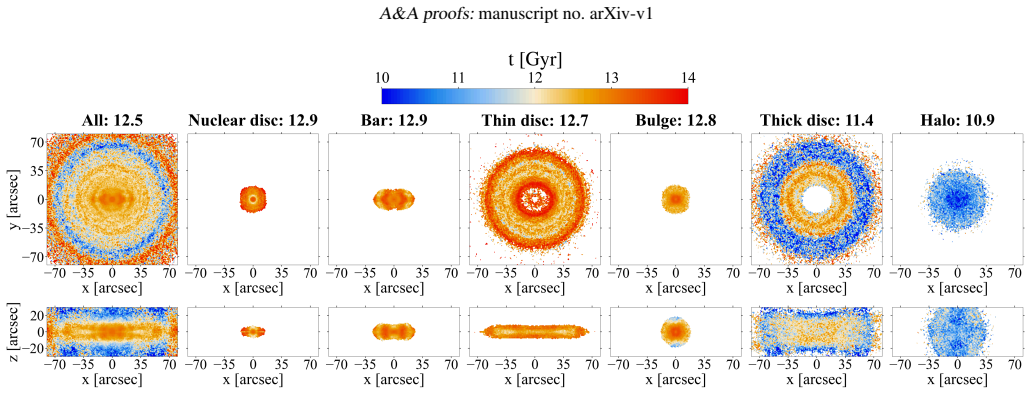
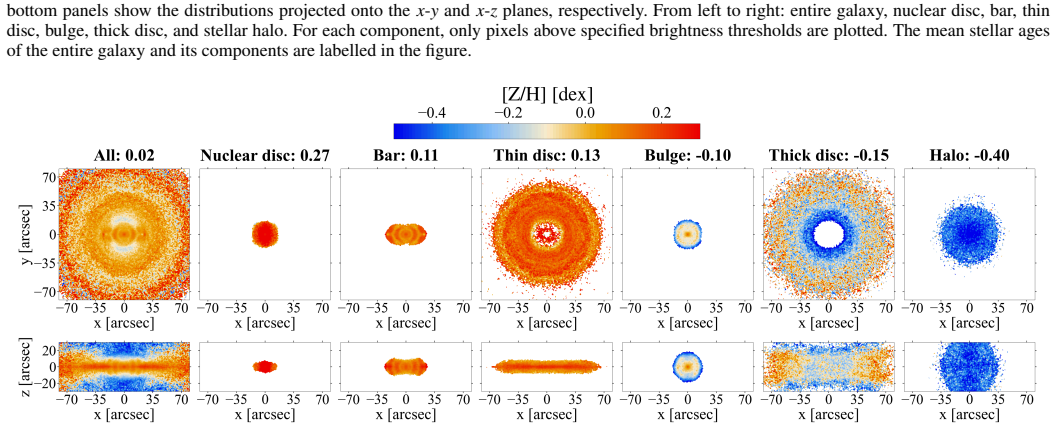
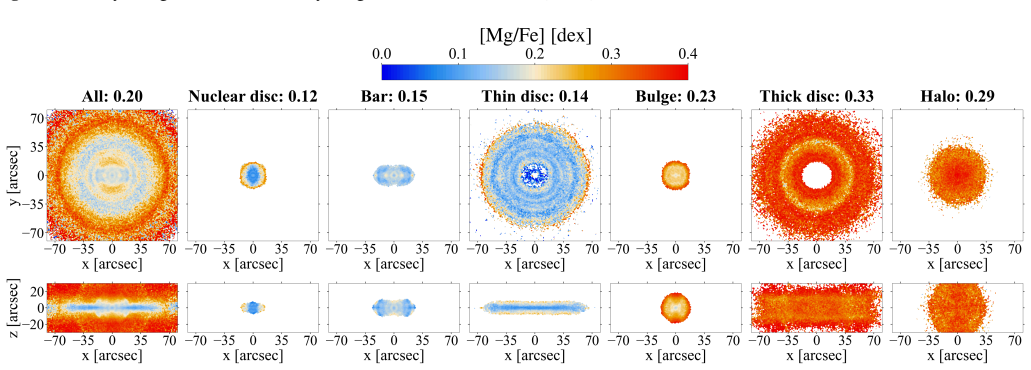
The paper applies a barred population-orbit superposition method to NGC 1381 to build 3D chemo-dynamical models from stellar orbits. It decomposes the galaxy into six components whose orbital and chemical properties are then compared. The nuclear disc, bar and thin disc turn out metal-rich, alpha-poor and old, consistent with in-situ formation in the early universe. The bulge, thick disc and halo are metal-poor, alpha-rich and younger or comparable, pointing instead to ex-situ origins through minor mergers. The bar itself is slow with a measured pattern speed of 34 km/s/kpc and corotation radius of 5.38 kpc, matching its proposed ancient formation time.

What carries the argument

barred population-orbit superposition method that assigns orbital weights to match observed kinematics and chemistry and thereby decomposes the galaxy into six distinct components

What would settle it

An independent measurement of the bar pattern speed that falls well outside the range 27-38 km/s/kpc or yields a corotation radius far from 5.38 kpc would falsify the slow ancient bar identification.

Watch

Extended reading notes

Core claim

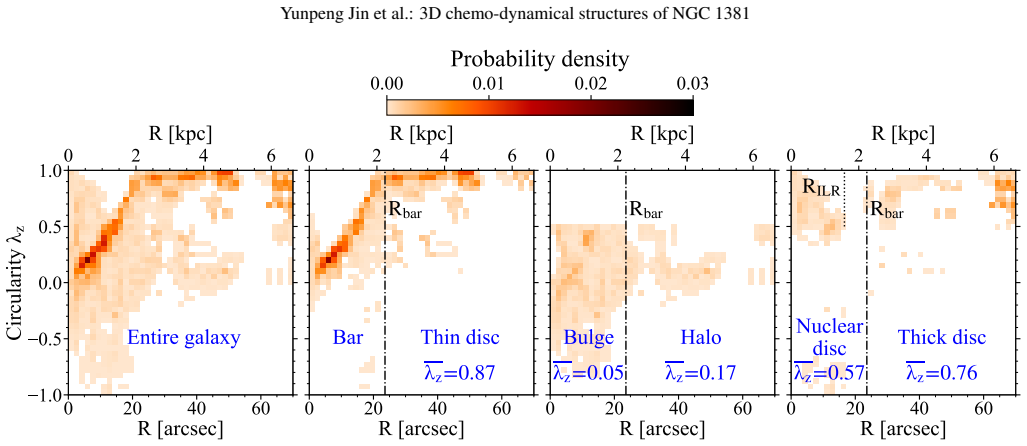
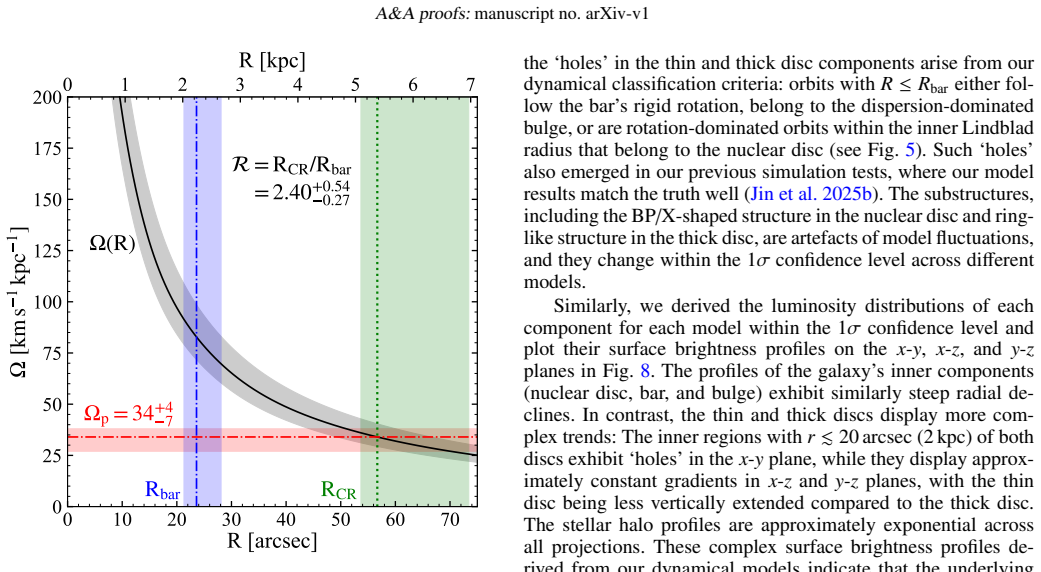
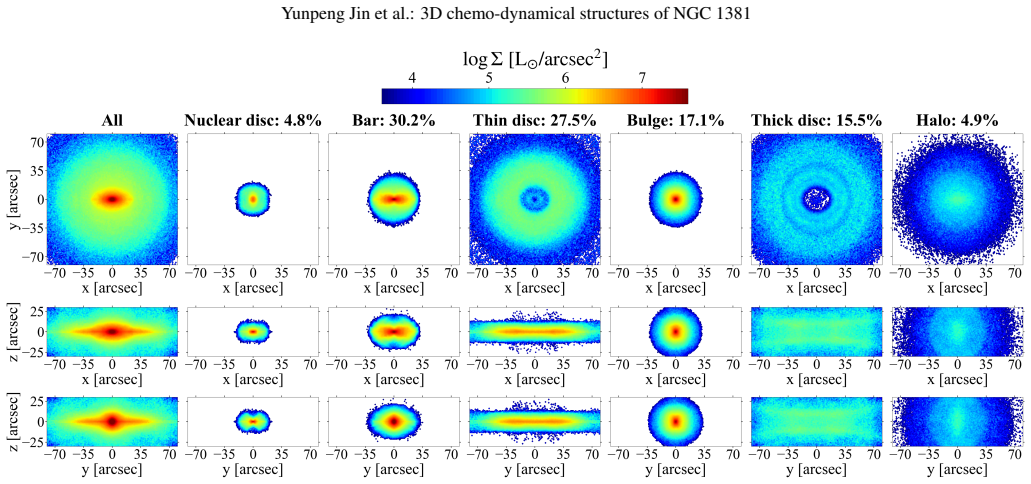
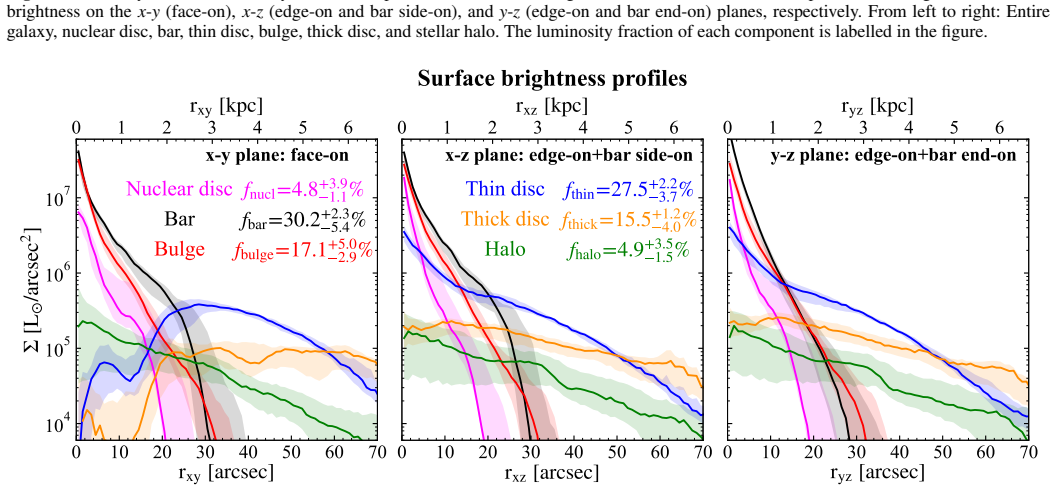
NGC 1381 is decomposed into a dynamically warm nuclear disc (5%), a rigidly rotating BP/X-shaped bar (30%), a hot spheroidal bulge (17%), a cold thin disc (28%), a vertically extended thick disc (16%), and a hot diffuse stellar halo (5%). The first three components are metal-rich, alpha-poor and ~13 Gyr old and therefore in-situ; the latter three are metal-poor, alpha-rich and indicate ex-situ formation. The bar is slow (R=2.40) with pattern speed 34 km/s/kpc, bar length 2.24 kpc and corotation radius 5.38 kpc, consistent with early formation.

Load-bearing premise

The barred population-orbit superposition method can uniquely recover the orbital weights, pattern speed and component fractions from the available kinematic and chemical data for NGC 1381.

Editorial extensions

If this is right

  • The bar, nuclear disc and thin disc formed together in place more than 13 Gyr ago.
  • The thick disc and halo share a common ex-situ population with flat metallicity and [Mg/Fe] gradients.
  • The bulge shows a negative metallicity gradient, implying either dominant ex-situ origin or a mixture of in-situ and ex-situ stars.
  • The measured slow pattern speed and large R value are consistent with the bar having formed early and remained stable.
  • Minor mergers supplied the ex-situ stars that now dominate the outer components.

Reading between the lines

Editorial extensions of the paper, not claims the author makes directly.

  • Repeating the six-component decomposition on other cluster S0 galaxies could test whether slow bars are systematically ancient.
  • The accreted bulge and thick disc may be generic signatures of minor-merger activity inside the Fornax cluster environment.
  • Higher-resolution spectroscopy could tighten the in-situ versus ex-situ fractions inside the bulge.
  • The flat chemical gradients in the thick disc and halo suggest they were built from stars stripped from similar progenitor satellites.
Share X Bluesky LinkedIn Reddit HN

Signed reviews

No signed human review yet.

Request a human review

A listed scientist reviews the paper for a fee and the review publishes here regardless of verdict. See the reviewers or get listed.

Editorial analysis

A structured set of objections, weighed in public.

Desk editor's note, referee report, simulated authors' rebuttal, and a circularity audit.

Referee Report

1 major / 1 minor

Summary. The paper applies the barred population-orbit superposition method from Jin2025a and Jin2025b to NGC 1381, decomposing the galaxy into six chemo-dynamical components (nuclear disc ~5%, bar ~30%, bulge ~17%, thin disc ~28%, thick disc ~16%, halo ~5%) with associated metallicities, [Mg/Fe], ages, and formation channels (in-situ for nuclear disc/bar/thin disc; ex-situ for bulge/thick disc/halo). It also reports a slow bar with R=2.40, Omega_p=34 km/s/kpc, R_bar=2.24 kpc, and R_CR=5.38 kpc, consistent with ancient formation.

Significance. If robust, the work provides a detailed 3D chemo-dynamical decomposition of a cluster S0 galaxy that links specific orbital populations to in-situ versus accreted origins and constrains bar dynamics, offering quantitative fractions and gradients that can be compared to simulations of galaxy assembly.

major comments (1)
  1. [Abstract] Abstract and modeling description: the six-component decomposition, in-situ/ex-situ assignments, and bar parameters (R=2.40_{-0.27}^{+0.54}, Omega_p=34_{-7}^{+4} km/s/kpc) rest on the assumption that the barred population-orbit superposition method uniquely recovers orbital weights, pattern speed, and fractions from the available kinematic+chemical data. No mock-data recovery tests, multiple converged solutions, or posterior widths on Omega_p are described to address known degeneracies when jointly fitting potential, viewing angle, and abundance distributions.
minor comments (1)
  1. [Abstract] Component fractions are given only as approximate values (~5%, ~30%, etc.) without accompanying uncertainties or a dedicated table summarizing all six components' properties.

Simulated Author's Rebuttal

1 responses · 0 unresolved

We thank the referee for their constructive review and for acknowledging the potential significance of our work. We address the major comment on the robustness of the decomposition and bar parameters below.

read point-by-point responses
  1. Referee: [Abstract] Abstract and modeling description: the six-component decomposition, in-situ/ex-situ assignments, and bar parameters (R=2.40_{-0.27}^{+0.54}, Omega_p=34_{-7}^{+4} km/s/kpc) rest on the assumption that the barred population-orbit superposition method uniquely recovers orbital weights, pattern speed, and fractions from the available kinematic+chemical data. No mock-data recovery tests, multiple converged solutions, or posterior widths on Omega_p are described to address known degeneracies when jointly fitting potential, viewing angle, and abundance distributions.

    Authors: The barred population-orbit superposition method was developed and validated in our companion papers (Jin et al. 2025a,b), which include extensive mock-data recovery tests demonstrating reliable recovery of orbital weights, pattern speeds, component fractions, and handling of degeneracies in the joint fit of potential, viewing angle, and abundance distributions. Those works also explore multiple converged solutions and report posterior information. The present manuscript applies the validated method to NGC 1381 and provides uncertainties on Ω_p (and other bar parameters) from the fitting procedure. To directly address the referee’s concern, we will revise the Methods section to include a concise summary of the key validation results and degeneracy mitigation from Jin et al. (2025a,b), and we will clarify how the chemical constraints help reduce degeneracies. The reported asymmetric errors on Ω_p already reflect the range of acceptable models. revision: yes

Circularity Check

1 steps flagged · score 6.0 of 10

Central decomposition and slow-bar parameters rest on uniqueness of self-cited orbit-superposition method

  1. self citation load bearing [Abstract]
    "We applied the barred population-orbit superposition method developed in \citet{Jin2025a,Jin2025b} to construct 3D chemo-dynamical models for the barred S0 galaxy NGC~1381 in the Fornax cluster. Based on the stellar orbits in the models, we decomposed NGC~1381 into six components: (1) a dynamically warm nuclear disc with $f_{\rm nucl}\sim5\%$; (2) a rigidly rotating, BP/X-shaped bar with $f_{\rm bar}\sim30\%$; ... Our modelling also reveals the presence of a slow bar (\mathcal{R}=2.40_{-0.27}^{+0.54}), with a bar pattern speed of \rm\Omega_p=34_{-7}^{+4}\,km\,s^{-1}\,kpc^{-1}..."

    All reported quantities (component fractions, formation channels, R, Omega_p, R_CR) are outputs of the cited method. The paper supplies no separate demonstration that the method uniquely recovers these quantities from the NGC 1381 kinematic+chemical data; uniqueness is imported solely via the self-citation to Jin2025a/Jin2025b.

full rationale

The paper's derivation applies the barred population-orbit superposition method from Jin2025a/Jin2025b to NGC 1381 data, then reports six-component fractions, in-situ/ex-situ assignments, and bar parameters (R=2.40, Omega_p=34 km/s/kpc) as direct outputs. No independent test of uniqueness or degeneracy breaking for this dataset is provided; the load-bearing premise that the method recovers unique orbital weights, pattern speed, and fractions therefore reduces to the self-citation. This produces partial circularity while the data application itself remains new.

Assumptions & free parameters 2 free parameters · 2 assumptions · 0 invented entities

The central claims rest on the applicability of the orbit-superposition method and on the interpretation of chemical abundances as formation tracers; no new entities are postulated.

free parameters (2)
  • component mass fractions
    f_nucl, f_bar, f_bulge, f_thin, f_thick, f_halo are adjusted to match observed kinematics and chemistry.
  • bar pattern speed and length
    Omega_p, R_bar and R_CR are fitted quantities reported with uncertainties.
assumptions (2)
  • domain assumption Stellar orbits can be linearly superposed to reproduce the observed line-of-sight velocity distributions and chemical maps.
    Invoked when the method from Jin2025a,b is applied to NGC 1381.
  • domain assumption Metal-rich, alpha-poor, old populations trace in-situ formation while metal-poor, alpha-rich populations trace ex-situ accretion.
    Used to assign formation histories to the six components.

how reviews work

0 comments
Cite this review

Pith. "Pith review of Dissecting the 3D chemo-dynamical structures of NGC 1381: a galaxy hosting an ancient slow bar with an accreted bulge and thick disc." pith.science (2026). https://pith.science/paper/C75ZPC5W

@misc{pith2026260700497,
  author       = {Pith},
  title        = {Pith review of: Dissecting the 3D chemo-dynamical structures of NGC 1381: a galaxy hosting an ancient slow bar with an accreted bulge and thick disc},
  year         = {2026},
  howpublished = {\url{https://pith.science/paper/C75ZPC5W}},
  note         = {Machine review of arXiv:2607.00497}
}
abstract

We applied the barred population-orbit superposition method developed in \citet{Jin2025a,Jin2025b} to construct 3D chemo-dynamical models for the barred S0 galaxy NGC~1381 in the Fornax cluster. Based on the stellar orbits in the models, we decomposed NGC~1381 into six components: (1) a dynamically warm nuclear disc with $f_{\rm nucl}\sim5\%$; (2) a rigidly rotating, BP/X-shaped bar with $f_{\rm bar}\sim30\%$; (3) a dynamically hot, spheroidal bulge with $f_{\rm bulge}\sim17\%$; (4) a dynamically cold thin disc with $f_{\rm thin}\sim28\%$; (5) a vertically extended thick disc with $f_{\rm thick}\sim16\%$; and (6) a dynamically hot, spatially diffuse stellar halo with $f_{\rm halo}\sim5\%$. The nuclear disc, bar, and thin disc are metal-rich ($[Z/\rm H]\gtrsim0$), $\alpha$-poor ($\rm[Mg/Fe]\lesssim0.2$), and old ($\sim13\rm\,Gyr$), corresponding to in situ formation in the early Universe. The bulge, thick disc, and stellar halo are metal-poor ($[Z/\rm H]\lesssim0$), $\alpha$-rich ($\rm[Mg/Fe]\gtrsim0.2$), and younger than or comparable in age to the in situ components, suggesting their relations with ex situ formation contributed by minor mergers. The flat metallicity and [Mg/Fe] gradients in the thick disc and stellar halo indicate they are dominated by a similar population of ex situ stars. In contrast, the bulge exhibits a negative metallicity gradient ($\nabla[Z/\rm H]_{bulge}<0$) pointing to a more complex formation history: the bulge could be either predominantly ex situ or contain a non-negligible mixture of in situ and ex situ stars. Our modelling also reveals the presence of a slow bar ($\mathcal{R}=2.40_{-0.27}^{+0.54}$), with a bar pattern speed of $\rm\Omega_p=34_{-7}^{+4}\,km\,s^{-1}\,kpc^{-1}$, a bar length of $R_{\rm bar}=2.24_{-0.22}^{+0.43}\rm\,kpc$, and a corotation radius of $R_{\rm CR}=5.38_{-0.28}^{+1.59}\rm\,kpc$, which is consistent with its ancient formation time.

Figures

Figures reproduced from arXiv: 2607.00497 by the authors.

Figure 1
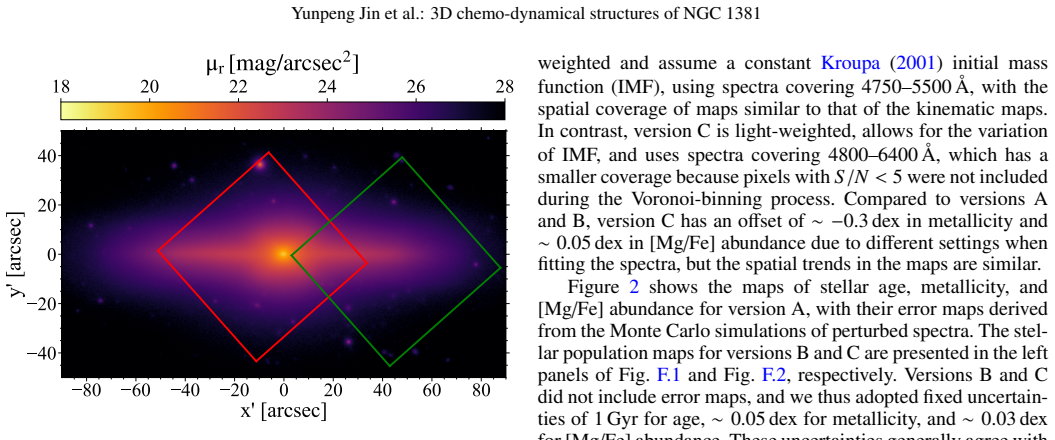
Figure 1. Imaging and MUSE coverage of NGC 1381 (FCC 170). The image shows the deep r-band imaging from FDS, with its major axis rotated to the x ′ -axis and its surface brightness indicated by the colour bar. The red and green squares represent the central and halo MUSE pointings from F3D, respectively. VLT Survey Telescope located at Cerro Paranal, Chile. We use the r-band deep imaging from FDS, which reaches a surface brig… view at source ↗
Figure 2
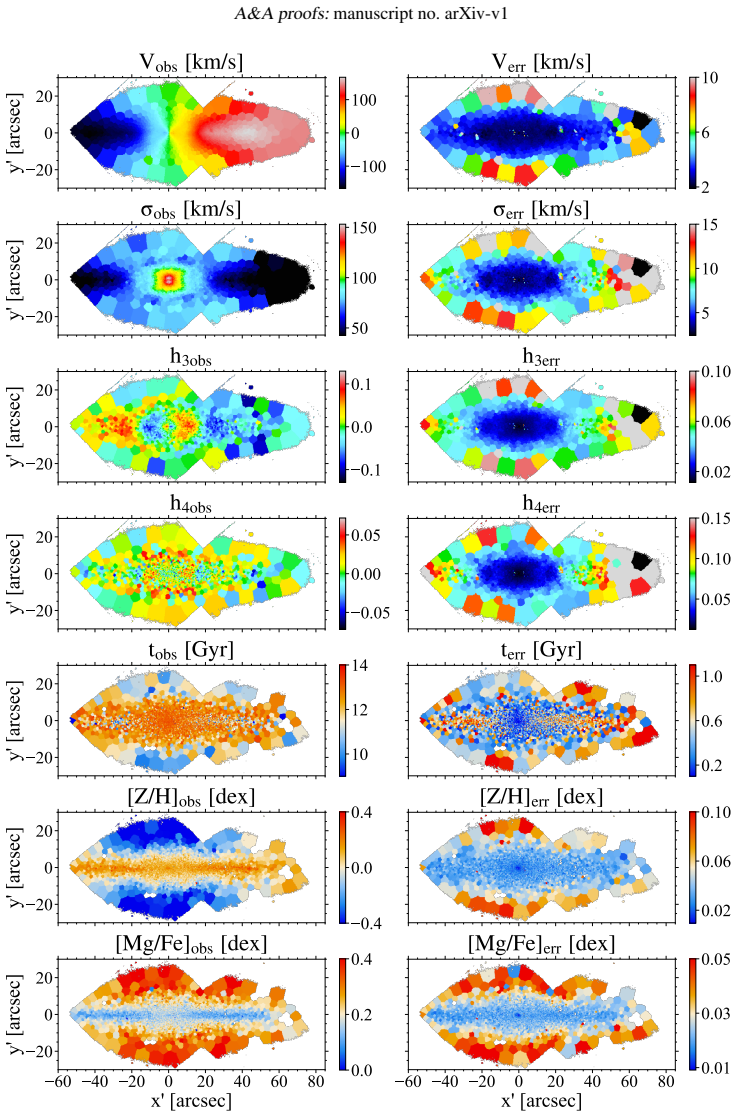
Figure 2. Stellar kinematic and population maps (left panels), and their corresponding error maps (right panels) for NGC 1381. From top to bottom: Mean velocity, V; velocity dispersion, σ; third-order Gauss-Hermite coefficient, h3; fourth-order Gauss-Hermite coefficient, h4; stellar age, t; stellar metallicity, [Z/H]; and [Mg/Fe] abundance. We note that the bar and disc mentioned here are used to con￾struct the stellar potent… view at source ↗
Figure 3
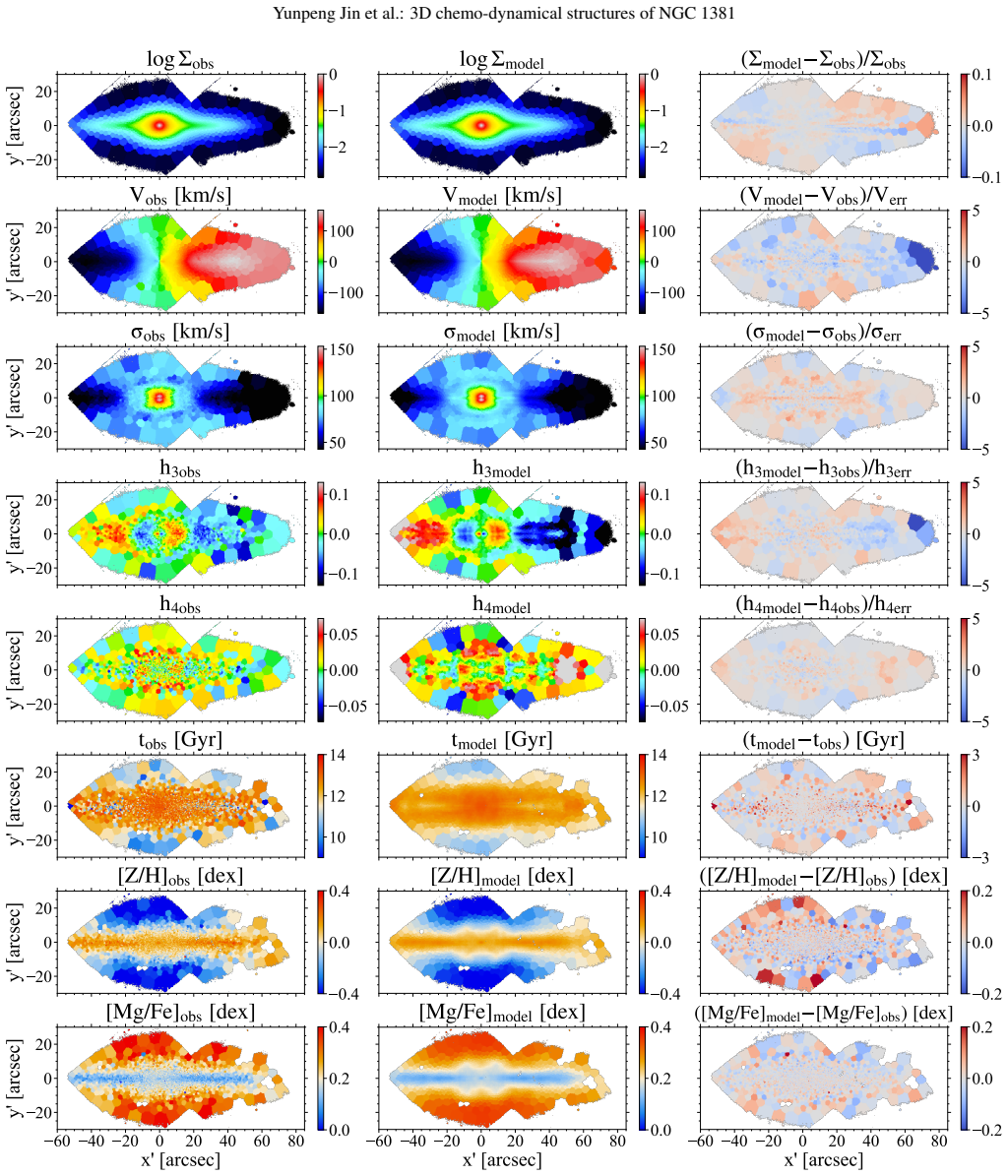
Figure 3. Surface brightness, stellar kinematic data, stellar population data, and best-fitting model for NGC 1381. From left to right: Observations, model fittings, and residuals. From top to bottom: Logarithmic normalised surface brightness, log Σ; mean velocity, V; velocity dispersion, σ; third￾order Gauss-Hermite coefficient, h3; fourth-order Gauss-Hermite coefficient, h4; stellar age, t; stellar metallicity, [Z/H]; and [… view at source ↗
Figures from the paper (10 more)
Figure 4
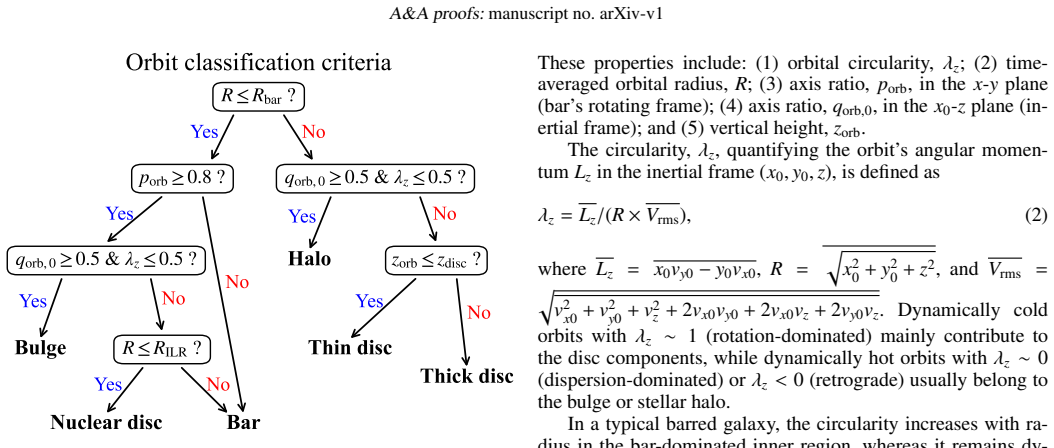
Figure 4. Figure 4: The orbit classification criteria used in our dynamical decom￾position. Each box represents a criterion. Five properties are adopted to classify the orbits: (1) circularity, λz ; (2) time-averaged radius, R; (3) axis ratio, porb, in the x-y plane (bar’s rotating frame)…
Figure 5
Figure 5. Figure 5: Probability density distributions of stellar orbits in the λz–R phase space for the best-fitting model of NGC 1381. The leftmost panel shows the stellar orbit distribution for the entire galaxy. Each of the remaining three panels displays two dynamical components, sepa…
Figure 6
Figure 6. Figure 6: Analysis of corotation resonance for NGC 1381. The black solid line, red dashed line, blue dashed line, and green dotted line represent the angular velocity profile (Ω(R)), bar pattern speed (Ωp), bar length (Rbar), and corotation radius (RCR) of the best-fitting model…
Figure 7
Figure 7. Figure 7: Luminosity distributions of dynamical components in the best-fitting model of NGC 1381. From top to bottom: logarithmic surface brightness on the x-y (face-on), x-z (edge-on and bar side-on), and y-z (edge-on and bar end-on) planes, respectively. From left to right: En…
Figure 8
Figure 8. Figure 8: Surface brightness profiles for the dynamical components in the models of NGC 1381. From left to right: the surface brightness profiles on the x-y (rxy = p x 2 + y 2 ), x-z (rxz = √ x 2 + z 2 ), and y-z (ryz = p y 2 + z 2 ) planes, respectively. The solid curves repres…
Figure 9
Figure 9. Figure 9: Spatial distributions of luminosity-weighted stellar ages for dynamical components in the best-fitting model of NGC 1381. The top and bottom panels show the distributions projected onto the x-y and x-z planes, respectively. From left to right: entire galaxy, nuclear di…
Figure 10
Figure 10. Figure 10: Similarly to [PITH_FULL_IMAGE:figures/full_fig_p010_10.png]
Figure 11
Figure 11. Figure 11: Similarly to [PITH_FULL_IMAGE:figures/full_fig_p010_11.png]
Figure 12
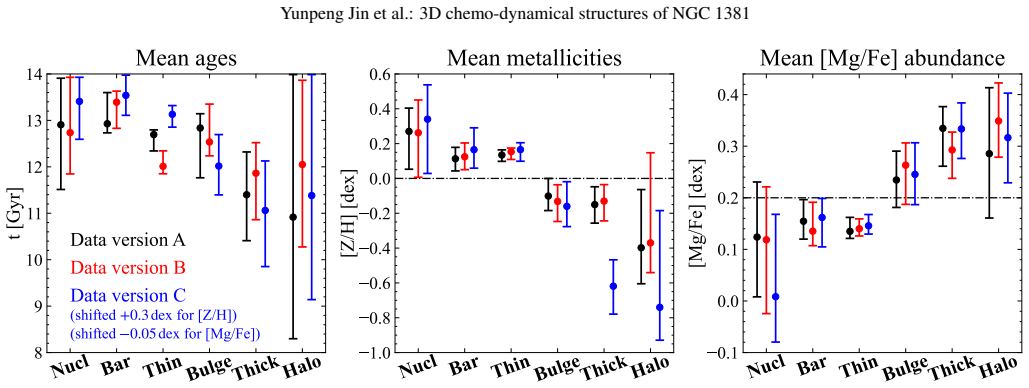
Figure 12. Figure 12: Luminosity-weighted mean stellar ages (left panel), stellar metallicities (middle panel), and [Mg/Fe] abundances (right panel) of different components derived from two data versions. Black represents data version A from Martig et al. (2026), red corresponds to data ve…
Figure 13
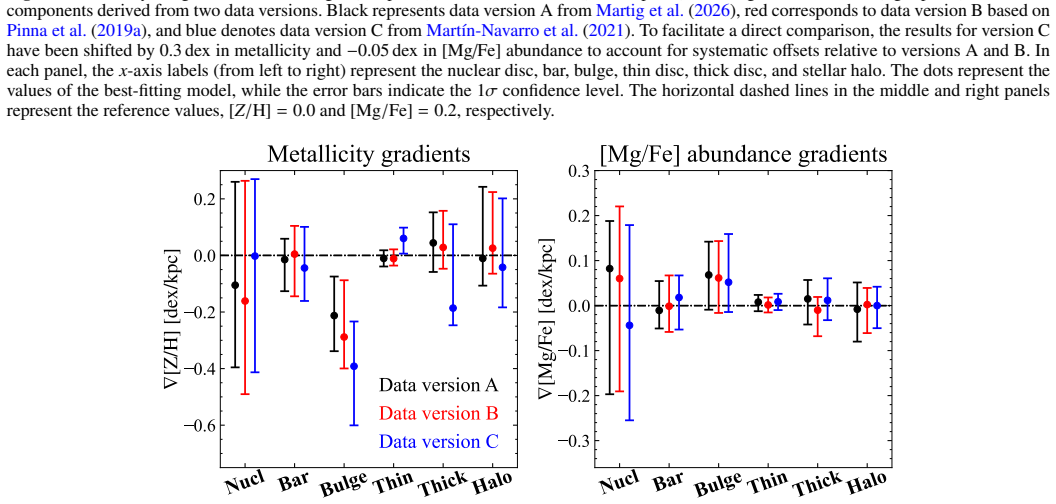
Figure 13. Figure 13: Stellar metallicity gradients (left panel) and [Mg/Fe] abundance gradients (right panel) of different components derived from two data versions. Black represents data version A, red corresponds to data version B, and blue denotes data version C. In each panel, the x-a…

Discussion (0). Continue with ORCID to comment.

Reference graph

Works this paper leans on

139 extracted references · 139 canonical work pages

  1. [1]

    Aguerri, J. A. L., M \'e ndez-Abreu, J., Falc \'o n-Barroso, J., et al. 2015, , 576, A102

  2. [2]

    1992 a , , 259, 345

    Athanassoula, E. 1992 a , , 259, 345

  3. [3]

    1992 b , , 259, 328

    Athanassoula, E. 1992 b , , 259, 328

  4. [4]

    2003, , 341, 1179

    Athanassoula, E. 2003, , 341, 1179

  5. [5]

    2005, , 358, 1477

    Athanassoula, E. 2005, , 358, 1477

  6. [6]

    2010, in Society of Photo-Optical Instrumentation Engineers (SPIE) Conference Series, Vol

    Bacon, R., Accardo, M., Adjali, L., et al. 2010, in Society of Photo-Optical Instrumentation Engineers (SPIE) Conference Series, Vol. 7735, Ground-based and Airborne Instrumentation for Astronomy III, ed. I. S. McLean , S. K. Ramsay , & H. Takami , 773508

  7. [7]

    2017, , 608, A1

    Bacon, R., Conseil, S., Mary, D., et al. 2017, , 608, A1

  8. [8]

    2001, , 326, 23

    Bacon, R., Copin, Y., Monnet, G., et al. 2001, , 326, 23

Show all 139 references
  1. [9]

    A., Marshall, P

    Barnab \`e , M., Dutton, A. A., Marshall, P. J., et al. 2012, , 423, 1073

  2. [10]

    & Tremaine, S

    Binney, J. & Tremaine, S. 2008, Galactic Dynamics: Second Edition

  3. [11]

    P., Jord \'a n, A., Mei, S., et al

    Blakeslee, J. P., Jord \'a n, A., Mei, S., et al. 2009, , 694, 556

  4. [12]

    G., & Elmegreen, D

    Bournaud, F., Elmegreen, B. G., & Elmegreen, D. M. 2007, , 670, 237

  5. [13]

    2020, , 640, A20

    Breda, I., Papaderos, P., & Gomes, J.-M. 2020, , 640, A20

  6. [14]

    J., Owers, M

    Bryant, J. J., Owers, M. S., Robotham, A. S. G., et al. 2015, , 447, 2857

  7. [15]

    A., Law, D

    Bundy, K., Bershady, M. A., Law, D. R., et al. 2015, , 798, 7

  8. [16]

    2006, , 370, 753

    Bureau, M., Aronica, G., Athanassoula, E., et al. 2006, , 370, 753

  9. [17]

    & Athanassoula, E

    Bureau, M. & Athanassoula, E. 2005, , 626, 159

  10. [18]

    J., Sheth, K., Athanassoula, E., et al

    Buta, R. J., Sheth, K., Athanassoula, E., et al. 2015, , 217, 32

  11. [19]

    Buta, R. J. & Zhang, X. 2009, , 182, 559

  12. [20]

    M., Cuomo, V., et al

    Buttitta, C., Corsini, E. M., Cuomo, V., et al. 2022, , 664, L10

  13. [21]

    2002, , 333, 400

    Cappellari, M. 2002, , 333, 400

  14. [22]

    2017, , 466, 798

    Cappellari, M. 2017, , 466, 798

  15. [23]

    & Copin, Y

    Cappellari, M. & Copin, Y. 2003, , 342, 345

  16. [24]

    & Emsellem, E

    Cappellari, M. & Emsellem, E. 2004, , 116, 138

  17. [25]

    2011, , 413, 813

    Cappellari, M., Emsellem, E., Krajnovi \'c , D., et al. 2011, , 413, 813

  18. [26]

    2013, , 432, 1709

    Cappellari, M., Scott, N., Alatalo, K., et al. 2013, , 432, 1709

  19. [27]

    & Hernandez, O

    Chemin, L. & Hernandez, O. 2009, , 499, L25

  20. [28]

    & Bureau, M

    Chung, A. & Bureau, M. 2004, , 127, 3192

  21. [29]

    & Mertzanides, C

    Contopoulos, G. & Mertzanides, C. 1977, , 61, 477

  22. [30]

    A., Schaye, J., Clauwens, B., et al

    Correa, C. A., Schaye, J., Clauwens, B., et al. 2017, , 472, L45

  23. [31]

    A., Abadi, M

    Cristiani, V. A., Abadi, M. G., Taverna, A., et al. 2024, , 692, A63

  24. [32]

    Cuomo, V., Aguerri, J. A. L., Corsini, E. M., & Debattista, V. P. 2020, , 641, A111

  25. [33]

    2024, , 530, 1195

    Dattathri, S., Valluri, M., Vasiliev, E., Wheeler, V., & Erwin, P. 2024, , 530, 1195

  26. [34]

    A., et al

    de S \'a -Freitas, C., Fragkoudi, F., Gadotti, D. A., et al. 2023, , 671, A8

  27. [35]

    A., Fragkoudi, F., et al

    de S \'a -Freitas, C., Gadotti, D. A., Fragkoudi, F., et al. 2025, , 698, A5

  28. [36]

    Debattista, V. P. & Sellwood, J. A. 2000, , 543, 704

  29. [37]

    2023, , 672, A84

    Ding, Y., Zhu, L., van de Ven, G., et al. 2023, , 672, A84

  30. [38]

    J., Gregg, M

    Drinkwater, M. J., Gregg, M. D., & Colless, M. 2001, , 548, L139

  31. [39]

    C., Debattista, V

    Du, M., Ho, L. C., Debattista, V. P., et al. 2020, , 895, 139

  32. [40]

    C., Zhao, D., et al

    Du, M., Ho, L. C., Zhao, D., et al. 2019, , 884, 129

  33. [41]

    1982, , 199, 1069

    Efstathiou, G., Lake, G., & Negroponte, J. 1982, , 199, 1069

  34. [42]

    1994, , 285, 723

    Emsellem, E., Monnet, G., & Bacon, R. 1994, , 285, 723

  35. [43]

    & Debattista, V

    Erwin, P. & Debattista, V. P. 2017, , 468, 2058

  36. [44]

    P., et al

    Erwin, P., Seth, A., Debattista, V. P., et al. 2021, , 502, 2446

  37. [45]

    Ferguson, H. C. 1989, , 98, 367

  38. [46]

    Fisher, D. B. & Drory, N. 2008, , 136, 773

  39. [47]

    A., et al

    Fraser-McKelvie, A., van de Sande, J., Gadotti, D. A., et al. 2025, , 700, A237

  40. [48]

    Gadotti, D. A. 2009, , 393, 1531

  41. [49]

    Gadotti, D. A. 2011, , 415, 3308

  42. [50]

    Gadotti, D. A. 2026, , 545, staf2072

  43. [51]

    A., Bittner, A., Falc \'o n-Barroso, J., et al

    Gadotti, D. A., Bittner, A., Falc \'o n-Barroso, J., et al. 2020, , 643, A14

  44. [52]

    2022, , 517, 5660

    Garma-Oehmichen, L., Hern \'a ndez-Toledo, H., Aquino-Ort \' z, E., et al. 2022, , 517, 5660

  45. [53]

    Gerhard, O. E. 1993, , 265, 213

  46. [54]

    Grand, R. J. J., Fragkoudi, F., G \'o mez, F. A., et al. 2024, , 532, 1814

  47. [55]

    Grand, R. J. J., G \'o mez, F. A., Marinacci, F., et al. 2017, , 467, 179

  48. [56]

    2019, , 482, 1733

    Guo, R., Mao, S., Athanassoula, E., et al. 2019, , 482, 1733

  49. [57]

    2025, , 985, 181

    Guo, Y., Jogee, S., Wise, E., et al. 2025, , 985, 181

  50. [58]

    2024, , 691, A122

    Habibi, A., Roshan, M., Hosseinirad, M., et al. 2024, , 691, A122

  51. [59]

    H., et al

    Helmi, A., Babusiaux, C., Koppelman, H. H., et al. 2018, , 563, 85

  52. [60]

    1971, , 168, 343

    Hohl, F. 1971, , 168, 343

  53. [61]

    F., Bundy, K., Croton, D., et al

    Hopkins, P. F., Bundy, K., Croton, D., et al. 2010, , 715, 202

  54. [62]

    2016, , 820, 42

    Iodice, E., Capaccioli, M., Grado, A., et al. 2016, , 820, 42

  55. [63]

    2019b, , 627, A136

    Iodice, E., Sarzi, M., Bittner, A., et al. 2019b, , 627, A136

  56. [64]

    2019a, , 623, A1

    Iodice, E., Spavone, M., Capaccioli, M., et al. 2019a, , 623, A1

  57. [65]

    2020, DYNAMITE: DYnamics, Age and Metallicity Indicators Tracing Evolution, Astrophysics Source Code Library, record ascl:2011.007

    Jethwa, P., Thater, S., Maindl, T., & Van de Ven, G. 2020, DYNAMITE: DYnamics, Age and Metallicity Indicators Tracing Evolution, Astrophysics Source Code Library, record ascl:2011.007

  58. [66]

    J., et al

    Jin, Y., Zhu, L., Long, R. J., et al. 2020, , 491, 1690

  59. [67]

    J., et al

    Jin, Y., Zhu, L., Long, R. J., et al. 2019, , 486, 4753

  60. [68]

    2025b, , 704, A262

    Jin, Y., Zhu, L., Tahmasebzadeh, B., et al. 2025b, , 704, A262

  61. [69]

    2025a, , 700, A249

    Jin, Y., Zhu, L., Tahmasebzadeh, B., et al. 2025a, , 700, A249

  62. [70]

    2024, , 681, A95

    Jin, Y., Zhu, L., Zibetti, S., et al. 2024, , 681, A95

  63. [71]

    & Kennicutt, Robert C., J

    Kormendy, J. & Kennicutt, Robert C., J. 2004, , 42, 603

  64. [72]

    2001, , 322, 231

    Kroupa, P. 2001, , 322, 231

  65. [73]

    Lawson, C. L. & Hanson, R. J. 1974, Solving least squares problems

  66. [74]

    A., Gadotti, D

    Le Conte, Z. A., Gadotti, D. A., Ferreira, L., et al. 2024, , 530, 1984

  67. [75]

    H., Hwang, H

    Lee, Y. H., Hwang, H. S., Cuomo, V., et al. 2025, , 989, 55

  68. [76]

    D., Di Matteo, P., Haywood, M., & Snaith, O

    Lehnert, M. D., Di Matteo, P., Haywood, M., & Snaith, O. N. 2014, , 789, L30

  69. [77]

    C., & Barth, A

    Li, Z.-Y., Ho, L. C., & Barth, A. J. 2017, , 845, 87

  70. [78]

    2018, , 854, 65

    Li, Z.-Y., Shen, J., Bureau, M., et al. 2018, , 854, 65

  71. [79]

    okas, E. L. 2018, , 857, 6

  72. [80]

    Long, R. J. & Mao, S. 2018, Research in Astronomy and Astrophysics, 18, 145

  73. [81]

    J., & Pohlen, M

    L \"u tticke, R., Dettmar, R. J., & Pohlen, M. 2000, , 145, 405

  74. [82]

    2021, , 508, 2458

    Martig, M., Pinna, F., Falc \'o n-Barroso, J., et al. 2021, , 508, 2458

  75. [83]

    2026, , 547, stag458

    Martig, M., Pinna, F., Falc \'o n-Barroso, J., et al. 2026, , 547, stag458

  76. [84]

    2021, , 654, A59

    Mart \' n-Navarro, I., Pinna, F., Coccato, L., et al. 2021, , 654, A59

  77. [85]

    2017, , 598, A32

    M \'e ndez-Abreu, J., Ruiz-Lara, T., S \'a nchez-Menguiano, L., et al. 2017, , 598, A32

  78. [86]

    2016, , 456, 692

    Molaeinezhad, A., Falc \'o n-Barroso, J., Mart \' nez-Valpuesta, I., et al. 2016, , 456, 692

  79. [87]

    2022, , 263, 40

    Morokuma-Matsui, K., Bekki, K., Wang, J., et al. 2022, , 263, 40

  80. [88]

    F., Frenk, C

    Navarro, J. F., Frenk, C. S., & White, S. D. M. 1996, , 462, 563

  81. [89]

    2021, , 500, 1437

    Neureiter, B., Thomas, J., Saglia, R., et al. 2021, , 500, 1437

  82. [90]

    1996, , 469, 605

    Noguchi, M. 1996, , 469, 605

  83. [91]

    Ostriker, J. P. & Peebles, P. J. E. 1973, , 186, 467

  84. [92]

    2004, , 612, 168

    Pietrinferni, A., Cassisi, S., Salaris, M., & Castelli, F. 2004, , 612, 168

  85. [93]

    2006, , 642, 797

    Pietrinferni, A., Cassisi, S., Salaris, M., & Castelli, F. 2006, , 642, 797

  86. [94]

    2019, , 490, 3196

    Pillepich, A., Nelson, D., Springel, V., et al. 2019, , 490, 3196

  87. [95]

    2019b, , 625, A95

    Pinna, F., Falc \'o n-Barroso, J., Martig, M., et al. 2019b, , 625, A95

  88. [96]

    2019a, , 623, A19

    Pinna, F., Falc \'o n-Barroso, J., Martig, M., et al. 2019a, , 623, A19

  89. [97]

    M., Lyubenova, M., et al

    Poci, A., McDermid, R. M., Lyubenova, M., et al. 2021, , 647, A145

  90. [98]

    M., Zhu, L., & van de Ven, G

    Poci, A., McDermid, R. M., Zhu, L., & van de Ven, G. 2019, , 487, 3776

  91. [99]

    2020, , 641, A60

    Pulsoni, C., Gerhard, O., Arnaboldi, M., et al. 2020, , 641, A60

  92. [100]

    E., Liepold, C

    Quenneville, M. E., Liepold, C. M., & Ma, C.-P. 2022, , 926, 30

  93. [101]

    2008, , 388, 1803

    Rautiainen, P., Salo, H., & Laurikainen, E. 2008, , 388, 1803

  94. [102]

    T., Cretton, N., van der Marel, R

    Rix, H.-W., de Zeeuw, P. T., Cretton, N., van der Marel, R. P., & Carollo, C. M. 1997, , 488, 702

  95. [103]

    2024, , 691, A351

    Ruiz-Garc \' a, M., Querejeta, M., Garc \' a-Burillo, S., et al. 2024, , 691, A351

  96. [104]

    F., Kennicutt, R

    S \'a nchez, S. F., Kennicutt, R. C., Gil de Paz, A., et al. 2012, , 538, A8

  97. [105]

    F., Jim \'e nez-Vicente, J., et al

    S \'a nchez-Bl \'a zquez, P., Peletier, R. F., Jim \'e nez-Vicente, J., et al. 2006, , 371, 703

  98. [106]

    2023, , 521, 2671

    Santucci, G., Brough, S., van de Sande, J., et al. 2023, , 521, 2671

  99. [107]

    2022, , 930, 153

    Santucci, G., Brough, S., van de Sande, J., et al. 2022, , 930, 153

  100. [108]

    2018, , 616, A121

    Sarzi, M., Iodice, E., Coccato, L., et al. 2018, , 616, A121

  101. [109]

    2025, , 698, A235

    Sattler, N., Pinna, F., Comer \'o n, S., et al. 2025, , 698, A235

  102. [110]

    2023, , 520, 3066

    Sattler, N., Pinna, F., Neumayer, N., et al. 2023, , 520, 3066

  103. [111]

    1979, , 232, 236

    Schwarzschild, M. 1979, , 232, 236

  104. [112]

    1982, , 263, 599

    Schwarzschild, M. 1982, , 263, 599

  105. [113]

    1993, , 409, 563

    Schwarzschild, M. 1993, , 409, 563

  106. [114]

    2024, , 692, A159

    Semczuk, M., Dehnen, W., Sch \"o nrich, R., & Athanassoula, E. 2024, , 692, A159

  107. [115]

    Sersic, J. L. 1968, Atlas de Galaxias Australes

  108. [116]

    Shaw, M. A. 1987, , 229, 691

  109. [117]

    W., Sarzi, M., Gal \'a n-de Anta, P

    Spriggs, T. W., Sarzi, M., Gal \'a n-de Anta, P. M., et al. 2021, , 653, A167

  110. [118]

    2024, , 534, 861

    Tahmasebzadeh, B., Zhu, L., Shen, J., et al. 2024, , 534, 861

  111. [119]

    2021, , 508, 6209

    Tahmasebzadeh, B., Zhu, L., Shen, J., Gerhard, O., & Qin, Y. 2021, , 508, 6209

  112. [120]

    2022, , 941, 109

    Tahmasebzadeh, B., Zhu, L., Shen, J., Gerhard, O., & van de Ven, G. 2022, , 941, 109

  113. [121]

    J., et al

    Thater, S., Jethwa, P., Lilley, E. J., et al. 2023, arXiv e-prints, arXiv:2305.09344

  114. [122]

    & Weinberg, M

    Tremaine, S. & Weinberg, M. D. 1984b, , 209, 729

  115. [123]

    2025, , 63, 259

    van de Ven, G., Falc \'o n-Barroso, J., & Lyubenova, M. 2025, , 63, 259

  116. [124]

    van den Bosch, R. C. E., van de Ven, G., Verolme, E. K., Cappellari, M., & de Zeeuw, P. T. 2008, , 385, 647

  117. [125]

    van der Marel, R. P. & Franx, M. 1993, , 407, 525

  118. [126]

    & Valluri, M

    Vasiliev, E. & Valluri, M. 2020, , 889, 39

  119. [127]

    2015, , 449, 1177

    Vazdekis, A., Coelho, P., Cassisi, S., et al. 2015, , 449, 1177

  120. [128]

    2010, , 404, 1639

    Vazdekis, A., S \'a nchez-Bl \'a zquez, P., Falc \'o n-Barroso, J., et al. 2010, , 404, 1639

  121. [129]

    2018, , 620, A165

    Venhola, A., Peletier, R., Laurikainen, E., et al. 2018, , 620, A165

  122. [130]

    Weinberg, M. D. 1985, , 213, 451

  123. [131]

    2019, Nature Astronomy, 3, 844

    Yoon, Y., Im, M., Lee, G.-H., Lee, S.-K., & Lim, G. 2019, Nature Astronomy, 3, 844

  124. [132]

    S., Klein, C., et al

    Yu, S., Bullock, J. S., Klein, C., et al. 2021, , 505, 889

  125. [133]

    1996, , 278, 488

    Zhao, H. 1996, , 278, 488

  126. [134]

    2022a, , 660, A20

    Zhu, L., Pillepich, A., van de Ven, G., et al. 2022a, , 660, A20

  127. [135]

    2020, , 496, 1579

    Zhu, L., van de Ven, G., Leaman, R., et al. 2020, , 496, 1579

  128. [136]

    2022b, , 664, A115

    Zhu, L., van de Ven, G., Leaman, R., et al. 2022b, , 664, A115

  129. [137]

    2018c, , 479, 945

    Zhu, L., van de Ven, G., M \'e ndez-Abreu, J., & Obreja, A. 2018c, , 479, 945

  130. [138]

    2018b, Nature Astronomy, 2, 233

    Zhu, L., van de Ven, G., van den Bosch, R., et al. 2018b, Nature Astronomy, 2, 233

  131. [139]

    2018a, , 473, 3000

    Zhu, L., van den Bosch, R., van de Ven, G., et al. 2018a, , 473, 3000

Pith tools

Reviewed July 2, 2026 · model on record in the stance chip above.