Unravelling the nonthermal emissions from the quiet solar corona with the SKA
Pith reviewed 2026-07-02 05:55 UTC · model grok-4.3
The pith
The SKA will detect weak nonthermal radio emissions from the quiet solar corona and associate them with thermal structures.
A machine-rendered reading of the paper's core claim, the machinery that carries it, and where it could break.
Core claim
The SKA, with its excellent sensitivity as well as its exquisite spectroscopic snapshot PSF would be a game-changer in this field. It would not only allow us to detect and characterise these emissions in Stokes I, but would also allow us to investigate their polarisation properties as well. The high angular resolution offered by the SKA will allow a unique association of the detected radio transients with their thermal counterparts. This would enable us to investigate the thermal-nonthermal energy partition even for these rather weak transient emissions, which in turn would allow validation of particle acceleration and magnetic reconnection theories in a regime vastly different from that don
What carries the argument
SKA sensitivity together with its spectroscopic snapshot PSF and high angular resolution for source association.
If this is right
- Detection and characterization of the emissions in Stokes I.
- Investigation of their polarization properties.
- Unique association of radio transients with thermal counterparts via high resolution.
- Measurement of thermal-nonthermal energy partition for weak events.
- Validation of particle acceleration and reconnection theories plus a new probe of coronal heating.
Where Pith is reading between the lines
- If detections occur, the same SKA capabilities could be used on other stars to study coronal energy budgets.
- Non-detections would place quantitative upper limits on the occurrence rate or brightness of such transients.
- Combined SKA plus EUV or X-ray data sets could test whether the radio transients account for a measurable fraction of the required heating flux.
Load-bearing premise
Nonthermal emissions exist at flux levels and spatial-spectral structures that the SKA can detect and separate from confusion or artifacts.
What would settle it
SKA images of the quiet solar corona showing no separable nonthermal radio transients above the projected sensitivity or with no clear one-to-one thermal matches.
Figures
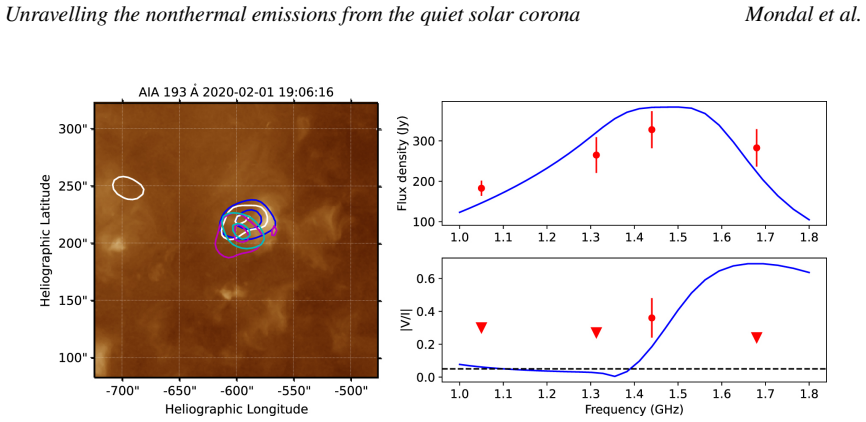
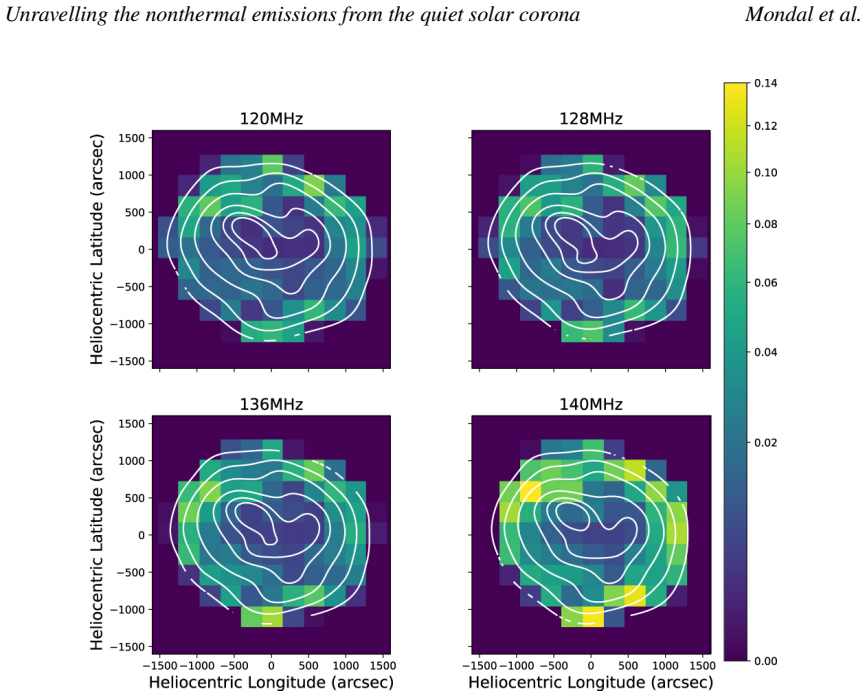
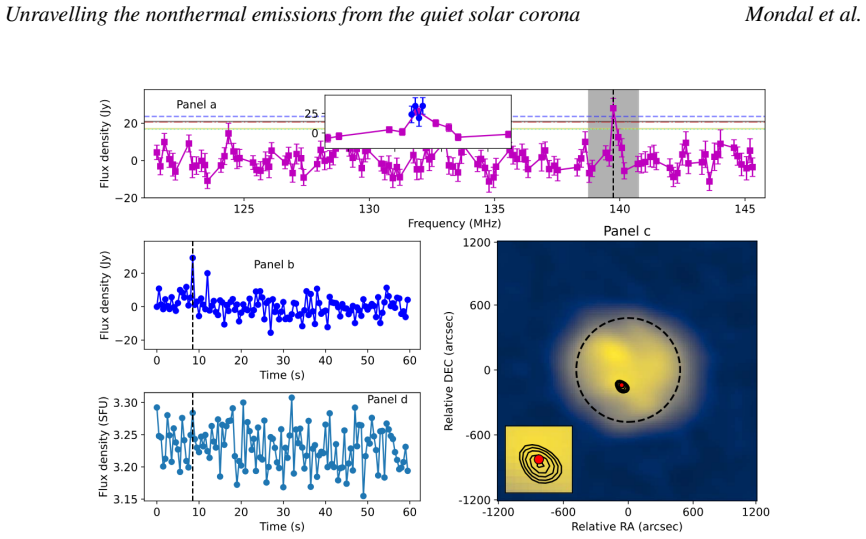
read the original abstract
Investigation of the nonthermal emissions from the quiet solar corona has been rather limited. This primarily stems from the fact that the emission is expected to be quite weak and very high dynamic range images are required to detect such emissions. Although, the few detections of the nonthermal emissions have all come from the radio band, the past observations had several issues, the most important being the low image fidelity and lack of simultaneous broadband observation capability. Recent observations have been able to tackle many of these prior difficulties using modern instrumentation, and have produced multiple interesting results. In spite of these improvements, multiple challenges remain. For example, most of the recent investigations were only able to focus on the brightest of these events, due to rather poor spectroscopic snapshot PSF of the instruments. The SKA, with its excellent sensitivity as well as its exquisite spectroscopic snapshot PSF would be a game-changer in this field. It would not only allow us to detect and characterise these emissions in Stokes I, but would also allow us to investigate their polarisation properties as well. The high angular resolution offered by the SKA will allow a unique association of the detected radio transients with their thermal counterparts. This would enable us to investigate the thermal-nonthermal energy partition even for these rather weak transient emissions, which in turn would allow validation of particle acceleration and magnetic reconnection theories in a regime vastly different from that done previously. In addition, characterization of the nonthermal emissions of these weak coronal transients may also provide a new probe to understand how energy is transferred from the photosphere and dumped into the corona, and thus serve as a new tool to tackle the coronal heating problem.
Editorial analysis
A structured set of objections, weighed in public.
Referee Report
Summary. The manuscript reviews limitations in prior radio observations of weak nonthermal emissions from the quiet solar corona, notes recent instrumental improvements, and projects that the SKA's sensitivity, spectroscopic snapshot PSF, and angular resolution will enable detection and characterization of these emissions in Stokes I and polarization, unambiguous association with thermal counterparts, measurement of thermal-nonthermal energy partition, validation of particle acceleration and reconnection models in a new regime, and a new probe of coronal heating mechanisms.
Significance. If the projected SKA performance is realized, the perspective could usefully frame a new observational capability for studying low-level nonthermal processes in the quiet corona. The identification of past dynamic-range and PSF limitations is accurate and the emphasis on polarization and multi-wavelength association is well-motivated; however, the absence of any quantitative flux, size, or fidelity estimates means the significance assessment remains conditional on future verification.
major comments (1)
- [Abstract] Abstract (and corresponding discussion of SKA capabilities): the central assertion that SKA sensitivity and snapshot PSF will detect and separate weak nonthermal quiet-corona emissions lacks supporting quantitative estimates of expected flux densities (Jy or mJy at 0.1-10 GHz), source sizes, brightness temperatures, or required dynamic range. Without these, or snapshot imaging simulations, it is not possible to verify that the claimed performance margin exists relative to thermal confusion and artifacts.
Simulated Author's Rebuttal
We thank the referee for the constructive report. We agree that the manuscript would benefit from quantitative support for the projected SKA performance and will revise to address this.
read point-by-point responses
-
Referee: [Abstract] Abstract (and corresponding discussion of SKA capabilities): the central assertion that SKA sensitivity and snapshot PSF will detect and separate weak nonthermal quiet-corona emissions lacks supporting quantitative estimates of expected flux densities (Jy or mJy at 0.1-10 GHz), source sizes, brightness temperatures, or required dynamic range. Without these, or snapshot imaging simulations, it is not possible to verify that the claimed performance margin exists relative to thermal confusion and artifacts.
Authors: We accept the point that the absence of quantitative estimates weakens the central claim. The manuscript is a perspective piece that draws on documented SKA specifications and published limitations of prior instruments, but does not contain explicit flux, size, or dynamic-range calculations. In revision we will add such estimates to the abstract and main text, drawing on (i) reported flux densities of quiet-corona nonthermal events from recent VLA and MWA observations (typically 0.1–few mJy at 1–5 GHz), (ii) source angular sizes of a few arcseconds inferred from high-resolution imaging, (iii) corresponding brightness-temperature ranges, and (iv) the dynamic-range requirements (∼10^4–10^5) needed to separate them from the thermal background. These numbers will be referenced to the SKA sensitivity specifications and to the cited observational papers. Full end-to-end snapshot imaging simulations lie outside the scope of this review; we will instead cite existing SKA imaging-performance studies that address comparable dynamic-range and confusion issues. revision: yes
Circularity Check
No circularity: qualitative projection paper with no derivations or fitted inputs
full rationale
The manuscript is a forward-looking perspective on SKA capabilities for quiet-corona nonthermal emission studies. It contains no equations, no parameter fitting, no claimed derivations, and no load-bearing self-citations. All statements are qualitative assessments of future instrument performance relative to past observational limitations. No step reduces by construction to its own inputs; the central claims rest on expected SKA sensitivity and resolution rather than any self-referential logic. This is the expected non-finding for a non-derivational review-style paper.
Axiom & Free-Parameter Ledger
Reference graph
Works this paper leans on
-
[1]
doi: 10.3847/1538-4357/ace042. X. Chen et al.ApJ, 905(1):43, Dec
-
[2]
doi: 10.3847/1538-4357/abc24e. G. D. Fleishman et al.Science, 367(6475):278–280, Jan
-
[3]
doi: 10.1126/science.aax6874. S. R. Habbal et al.ApJ, 306:740, July
-
[4]
doi: 10.1086/164383. E. P. Kontar et al.ApJ, 884(2):122, Oct
-
[5]
doi: 10.3847/1538-4357/ab40bb. S. Krucker, A. O. Benz, T. S. Bastian, and L. W. Acton.ApJ, 488(1):499–505, Oct
-
[6]
doi: 10.1086/304686. S. R. Kulkarni.AJ, 98:1112–1130, Sept
-
[7]
doi: 10.1086/115202. A. Kumari et al. InAdvancing Astrophysics with the SKA – II (AASKAII)
-
[8]
doi: 10.1086/166062. K. A. Marsh, G. J. Hurford, and H. Zirin.ApJ, 236:1017–1025, Mar
-
[9]
doi: 10.1086/157828. C. Mercier and G. Trottet.ApJL, 474(1):L65–L68, Jan
-
[10]
11 Unravelling the nonthermal emissions from the quiet solar corona Mondal et al
doi: 10.1086/310422. 11 Unravelling the nonthermal emissions from the quiet solar corona Mondal et al. A. Mohan, P. I. McCauley, D. Oberoi, and A. Mastrano.ApJ, 883(1):45, Sept
-
[11]
doi: 10.3847/1538-4357/ab3a94. S. Mondal.SoPh, 296(8):131, Aug
-
[12]
doi: 10.1007/s11207-021-01877-3. S. Mondal, D. Oberoi, and A. Mohan.ApJL, 895(2):L39, June
-
[13]
doi: 10.3847/2041-8213/ ab8817. S. Mondal, B. Chen, and S. Yu.ApJ, 949(2):56, June 2023a. doi: 10.3847/1538-4357/acc838. S. Mondal, D. Oberoi, and A. Biswas.ApJ, 943(2):122, Feb. 2023b. doi: 10.3847/1538-4357/ aca899. S. Mondal, D. Oberoi, A. Biswas, and D. Kansabanik.ApJ, 953(1):4, Aug. 2023c. doi: 10.3847/ 1538-4357/acdf4f. A.Nindos,M.R.Kundu,andS.M.Whi...
-
[14]
doi: 10.1088/0004-637X/762/2/89. R. Sharma, D. Oberoi, M. Battaglia, and S. Krucker.ApJ, 937(2):99, Oct
-
[15]
doi: 10.3847/1538-4357/aa774a. 12
discussion (0)
Sign in with ORCID, Apple, or X to comment. Anyone can read and Pith papers without signing in.