Weak-coupling tensor cross interpolation impurity solver for nonequilibrium dynamical mean-field theory
Pith reviewed 2026-07-02 05:53 UTC · model grok-4.3
The pith
Tensor cross interpolation approximates weak-coupling integrals to solve nonequilibrium DMFT impurity problems without stochastic sampling.
A machine-rendered reading of the paper's core claim, the machinery that carries it, and where it could break.
Core claim
The integrands of the weak-coupling expansion for nonequilibrium impurity models possess a low-rank structure that tensor cross interpolation can exploit to compute the integrals efficiently and without sampling, yielding results comparable to CT-QMC where the latter is reliable and remaining controlled where the sign problem is severe.
What carries the argument
Tensor cross interpolation applied to the integrands of the weak-coupling expansion, represented in tensor-train form for deterministic evaluation.
If this is right
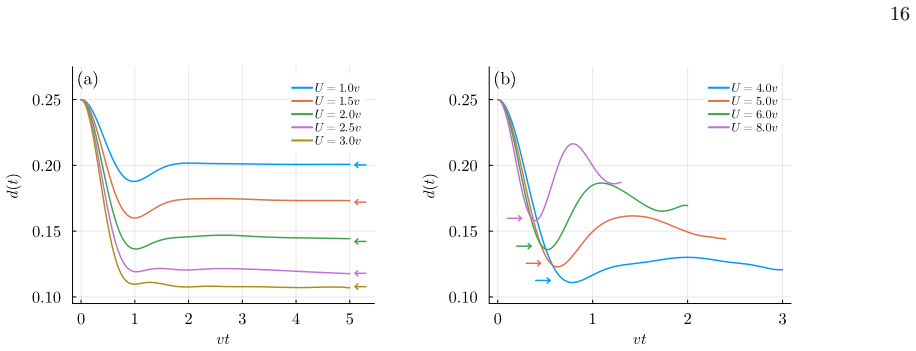
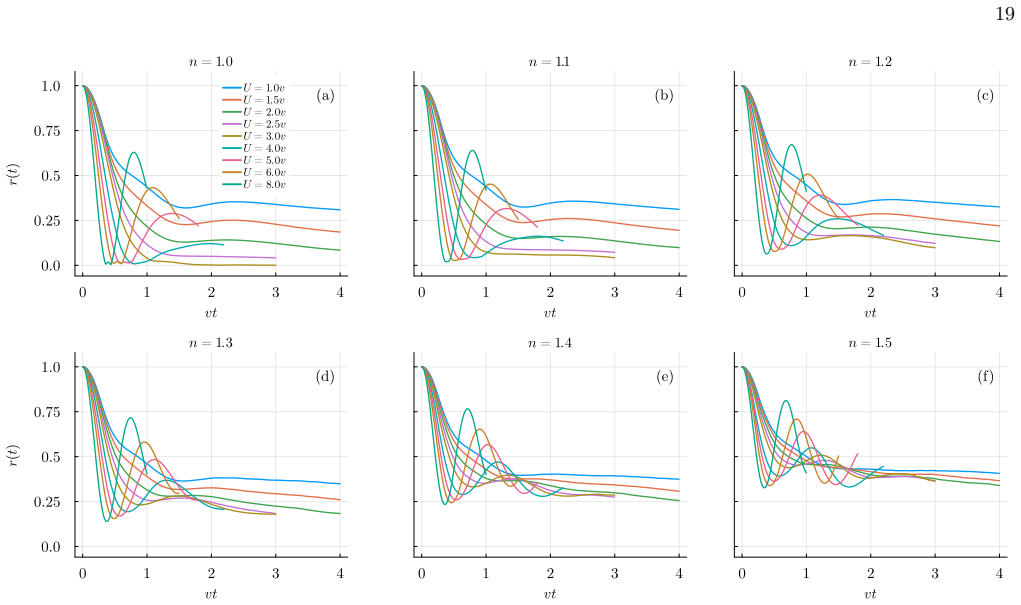
- The solver reproduces fast thermalization at a critical interaction strength in the half-filled Hubbard model with accuracy comparable to CT-QMC.
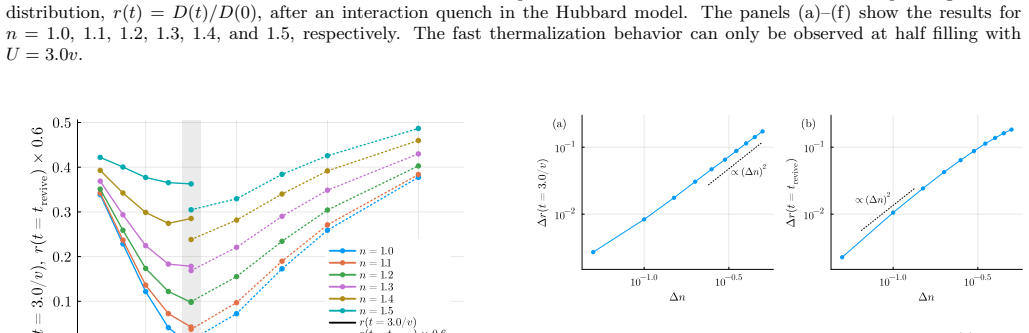
- Away from half filling the method remains controlled and shows a crossover rather than a sharply defined fast thermalization point in the 3/4-filled case.
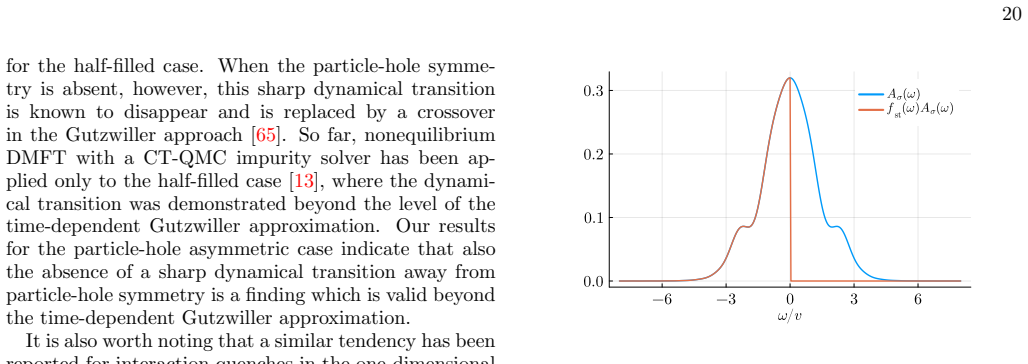
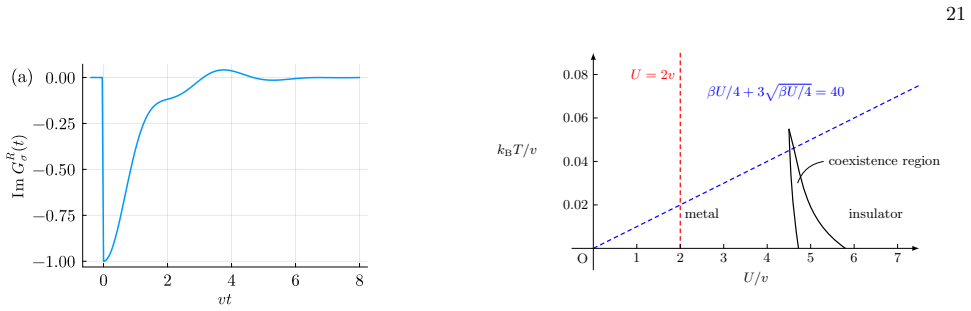
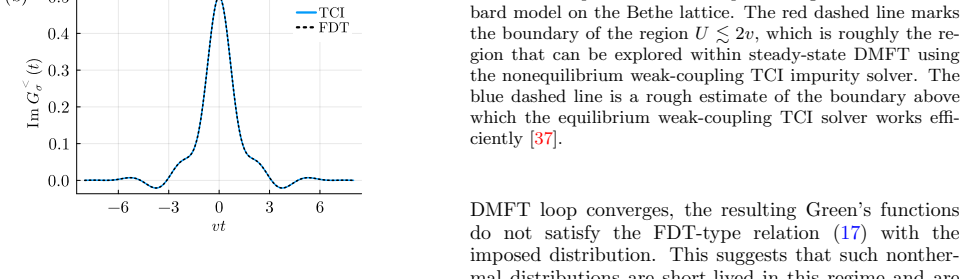
- The same approach produces accurate spectral functions for steady-state DMFT problems in the metallic regime without requiring analytic continuation.
Where Pith is reading between the lines
- If the observed low-rank structure persists for multi-orbital or cluster impurity models, the solver could extend DMFT studies to systems currently limited by the sign problem.
- The deterministic nature of the method opens a route to direct computation of real-frequency quantities in driven systems where long-time evolution is required.
- Comparison of TCI results with other deterministic nonequilibrium solvers could map the precise range of interaction strengths and fillings where the low-rank approximation holds.
Load-bearing premise
The integrands of the weak-coupling expansion possess a sufficiently low-rank structure that tensor cross interpolation can capture them accurately enough for physical observables to remain reliable.
What would settle it
A calculation showing large deviations from exact results on the solvable impurity model, or from CT-QMC where the latter has no sign problem, in any of the reported parameter regimes would falsify the claim of reliable accuracy.
Figures
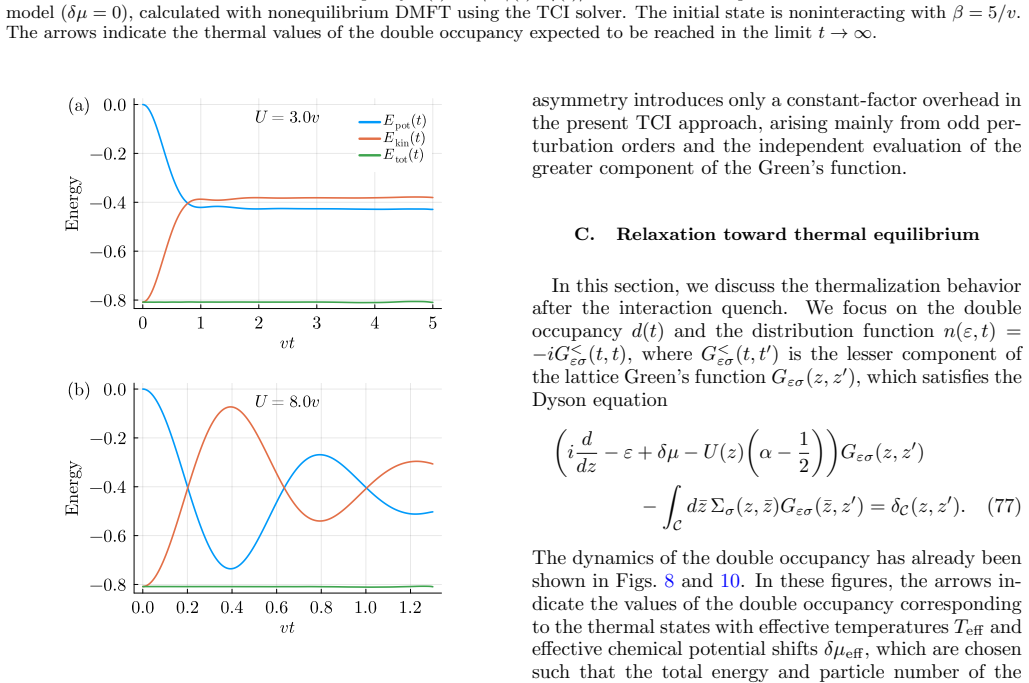
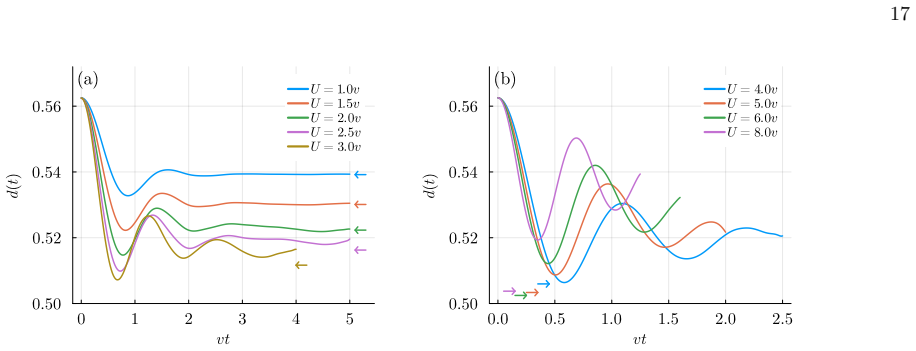
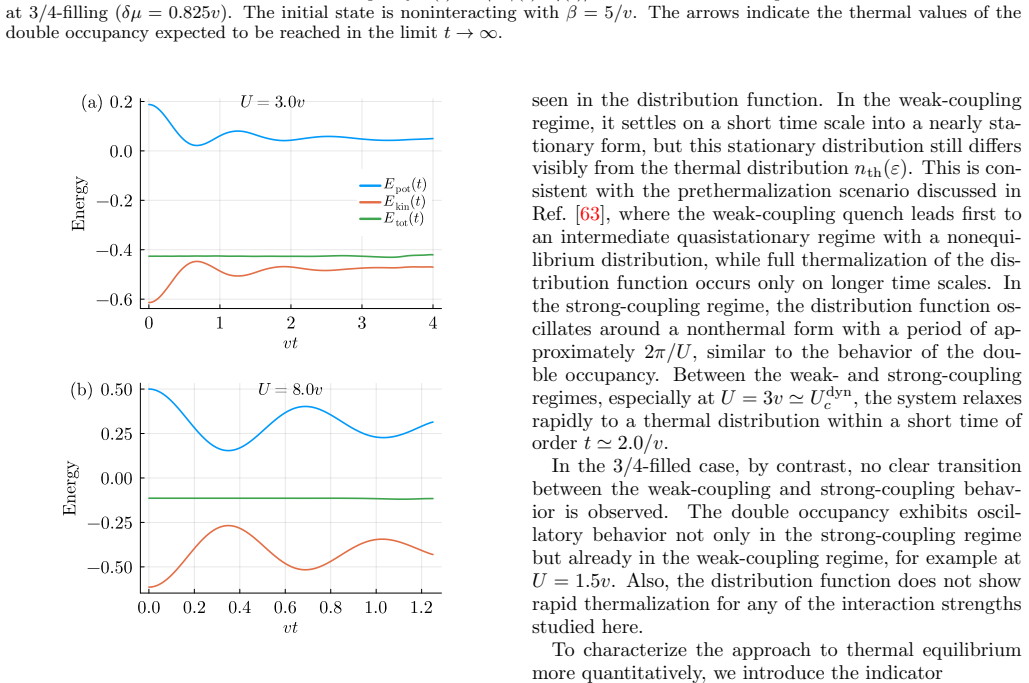
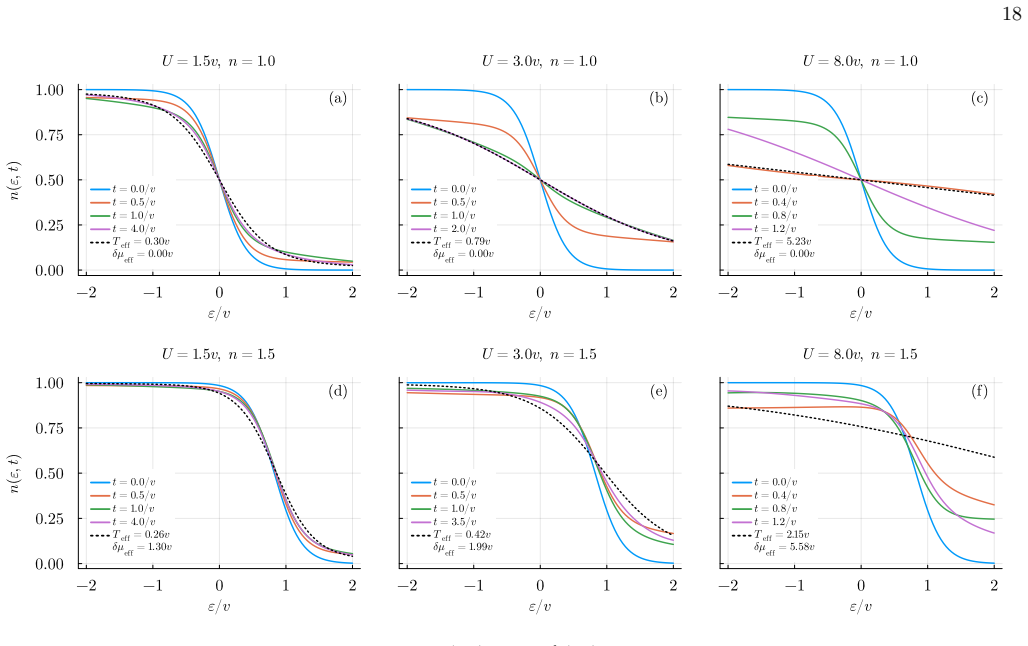
read the original abstract
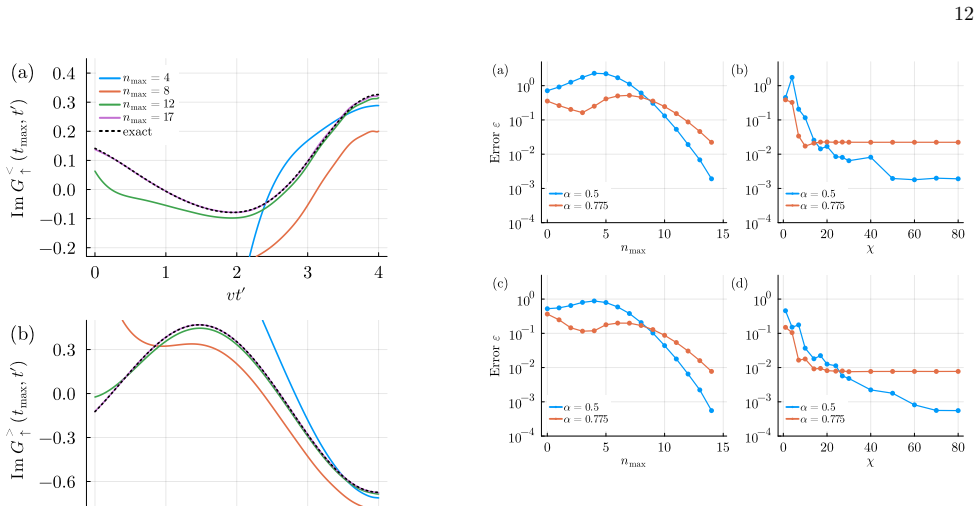
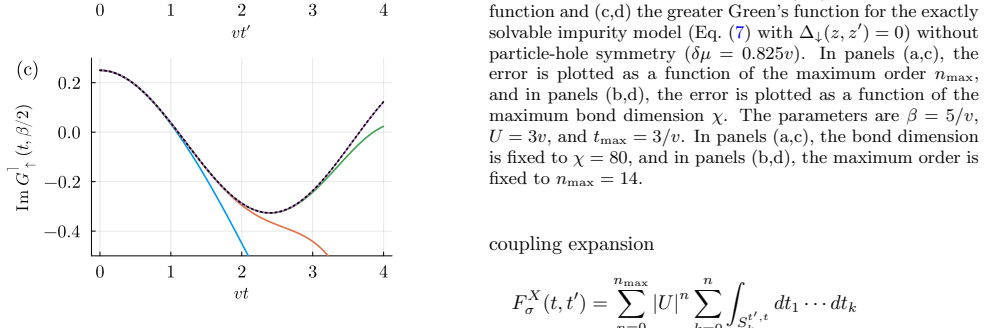
Simulating nonequilibrium quantum many-body systems remains a major challenge due to the exponential growth of the computational complexity with real time. Here we implement a nonequilibrium impurity solver based on the weak-coupling expansion and the tensor cross interpolation (TCI), and apply it to nonequilibrium dynamical mean-field theory (DMFT). The method approximates the integrands of the high-dimensional integrals arising in the weak-coupling expansion in a tensor-train form, enabling efficient evaluations without stochastic sampling and thereby mitigating the sign problem affecting continuous-time quantum Monte Carlo (CT-QMC) methods. Benchmark calculations for an exactly solvable nonequilibrium impurity model agree well with the exact results and reveal a low-rank structure of the integrands. When applied to interaction-quench problems in the half-filled Hubbard model, the method reproduces fast thermalization at a critical interaction strength with accuracy comparable to CT-QMC. Away from half filling, where the sign problem becomes even more severe, the present approach remains well controlled, revealing a crossover instead of a sharply defined fast thermalization point in the 3/4-filled case. The solver can also be applied to steady-state DMFT problems, yielding accurate spectral functions in the metallic regime without analytic continuation.
Editorial analysis
A structured set of objections, weighed in public.
Referee Report
Summary. The paper presents a nonequilibrium impurity solver for DMFT that uses the weak-coupling expansion with integrands approximated via tensor cross interpolation (TCI) in tensor-train format. This deterministic method avoids stochastic sampling and the sign problem of CT-QMC. Benchmarks on an exactly solvable nonequilibrium impurity model show good agreement with exact results and reveal low tensor rank. Applications to interaction quenches in the half-filled Hubbard model match CT-QMC accuracy for fast thermalization, while away from half-filling the approach remains controlled and indicates a crossover rather than a sharp transition at 3/4 filling. The solver also yields accurate metallic spectral functions in steady-state DMFT without analytic continuation.
Significance. If the reported low-rank structure of the weak-coupling integrands holds across relevant regimes, the method supplies a practical, sign-problem-free deterministic alternative to CT-QMC for nonequilibrium DMFT. The explicit benchmarks against exact results, direct CT-QMC comparisons, and controlled behavior away from half-filling constitute concrete evidence of utility. The absence of free parameters in the core approximation and the reproducible low-rank observations are notable strengths.
major comments (2)
- [§4.1] §4.1 (exactly solvable benchmark): the reported tensor ranks and TCI truncation errors should be shown explicitly as a function of the number of time slices or expansion order to confirm that the observed agreement is not sensitive to post-hoc rank choices.
- [§4.2] §4.2 (Hubbard quench at 3/4 filling): the claim that the method 'remains well controlled' requires a quantitative statement of how the TCI error is bounded relative to the difference from half-filling results; without this the crossover interpretation rests on visual inspection alone.
minor comments (2)
- [§3] Notation for the multi-dimensional integration variables and the precise definition of the tensor-train cores should be unified between the method section and the appendix.
- [Figs. 3-5] Figure captions for the quench dynamics should state the TCI bond dimension and maximum expansion order used.
Simulated Author's Rebuttal
We thank the referee for the positive assessment and the constructive major comments. We address each point below and will revise the manuscript accordingly.
read point-by-point responses
-
Referee: [§4.1] §4.1 (exactly solvable benchmark): the reported tensor ranks and TCI truncation errors should be shown explicitly as a function of the number of time slices or expansion order to confirm that the observed agreement is not sensitive to post-hoc rank choices.
Authors: We agree that explicit dependence on these parameters would strengthen the evidence for robustness. The revised manuscript will add figures in §4.1 displaying tensor ranks and TCI truncation errors versus number of time slices and expansion order for the benchmark model, confirming that the reported agreement and low-rank structure hold without reliance on post-hoc rank selection. revision: yes
-
Referee: [§4.2] §4.2 (Hubbard quench at 3/4 filling): the claim that the method 'remains well controlled' requires a quantitative statement of how the TCI error is bounded relative to the difference from half-filling results; without this the crossover interpretation rests on visual inspection alone.
Authors: We acknowledge the need for a quantitative bound to support the claim. In the revision we will add to §4.2 an explicit estimate of the TCI truncation error (obtained from the convergence tolerance and its propagation to observables) and compare its magnitude directly to the differences between the 3/4-filling and half-filling quench results, thereby placing the crossover interpretation on a quantitative footing. revision: yes
Circularity Check
No significant circularity
full rationale
The manuscript introduces a numerical impurity solver that combines the weak-coupling expansion with tensor cross interpolation to approximate high-dimensional integrands in nonequilibrium DMFT. All load-bearing steps consist of explicit algorithmic approximations whose accuracy is controlled by direct benchmarks against exactly solvable models and by side-by-side comparison with CT-QMC; the observed low tensor rank is reported as an empirical finding rather than imposed by definition or by a self-citation chain. No equation reduces to a fitted parameter renamed as a prediction, no uniqueness theorem is invoked from prior author work, and the central claim (sign-problem mitigation via low-rank structure) remains independently falsifiable by the supplied numerical tests.
Axiom & Free-Parameter Ledger
Reference graph
Works this paper leans on
-
[1]
connected
Left-mixing Green ’s function In the case of an interaction quench from the nonin- teracting state, the evaluation of the left-mixing Green’s function does not require high-dimensional integrals [14]. To see this, we start from the right Dyson equation for the model (7), −i d dz′ +δµ Gσ(z, z′)− Z C d¯z Gσ(z,¯z)∆σ(¯z, z′) − Z C d¯z Gσ(z,¯z)Σσ(¯z, z′) =δ C(...
-
[2]
The parameterαis set toα= 0.5. After convergence, we evaluate the double occupancy d(t) =⟨n i↑(t)ni↓(t)⟩using d(t) =αn−α 2 − ∞X n=0 (iU) n 1X s1,···,s n=0 (−1) P ℓ sℓ Z S0,t n dt1 · · ·dt n detE < n↑(t,{t i},{s i})·detE < n↓(t,{t i},{s i}), (69) where the matrixE < nσ(t,{t i},{s i}) is defined as E< nσ(t,{t i},{s i}) = G< σ (t, t)−iαG 0s1 σ (t, t1)...
2000
-
[3]
Let us consider the matrix-valued functionA(t) defined on the interval 0≤t≤t max, and expand it in terms of the Chebyshev polynomialsT k(x) = cos(karccosx)
Chebyshev polynomial expansion First, we briefly review the Chebyshev polynomial expansion. Let us consider the matrix-valued functionA(t) defined on the interval 0≤t≤t max, and expand it in terms of the Chebyshev polynomialsT k(x) = cos(karccosx). Since the Chebyshev polynomials are defined on the interval−1≤x≤1, it is convenient to introduce the rescale...
-
[4]
Computation of the convolution of two functions Let us consider the convolution of two matrix-valued functionsA(t) andB(t) defined on the interval 0≤t≤t max, C(t) = (A∗B)(t) = Z t 0 dt′ A(t−t ′)B(t′).(A7) Here we assume that we know the values ofA(t) andB(t) at the Chebyshev nodest (ℓ) (ℓ= 0,1,· · ·, N ch −1). Then, we can expandA(t) andB(t) in terms of t...
-
[5]
As we discussed in Sec
Computation of the recursive convolution Let us consider evaluating an integral I(t) = Z S0,t n dt1 · · ·dt n F(t;t 1,· · ·, t n) (A15) for 0≤t≤t max. As we discussed in Sec. III B 1, we first introduce new time difference variablesu 1,· · ·, u n as u1 =t−t 1, u 2 =t 1 −t 2,· · ·, u n =t n−1 −t n (A16) and regardF(t;t 1,· · ·, t n) as a function oftandu 1...
-
[6]
We want an extrapolation procedure which ensures that the extrapolated function is differentiable att= 0 and decays exponentially ast→ −∞
Extrapolation of single-variable functions Let us start with the extrapolation of a single-variable functionf(t) defined on [0, t max] to (−∞, tmax]. We want an extrapolation procedure which ensures that the extrapolated function is differentiable att= 0 and decays exponentially ast→ −∞. To this end, we introduce two functions, h1(t) = (1−λt)e λt, h 2(t) ...
-
[7]
The decomposition of the original and extrapolated domains is schematically shown in Fig
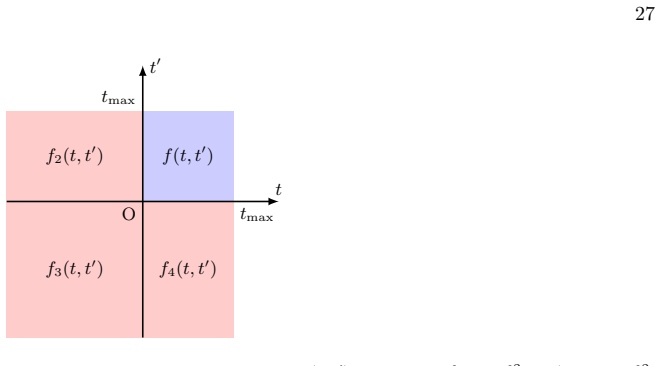
Extrapolation of two-variable functions The extrapolation of a two-variable functionf(t, t ′) defined on [0, t max]2 to (−∞, t max]2 can be performed in a similar manner. The decomposition of the original and extrapolated domains is schematically shown in Fig. 19. We first extrapolate the function along thet-direction for each fixedt ′ ∈[0, t max] using t...
-
[8]
Giannetti, M
C. Giannetti, M. Capone, D. Fausti, M. Fabrizio, F. Parmigiani, and D. Mihailovic, Ultrafast optical spectroscopy of strongly correlated materials and high- temperature superconductors: a non-equilibrium ap- proach, Advances in Physics65, 58 (2016). 28
2016
-
[9]
D. N. Basov, R. D. Averitt, and D. Hsieh, Towards prop- erties on demand in quantum materials, Nature Materials 16, 1077 (2017)
2017
-
[10]
de la Torre, D
A. de la Torre, D. M. Kennes, M. Claassen, S. Gerber, J. W. McIver, and M. A. Sentef, Colloquium: Nonther- mal pathways to ultrafast control in quantum materials, Rev. Mod. Phys.93, 041002 (2021)
2021
-
[11]
Bloch, J
I. Bloch, J. Dalibard, and W. Zwerger, Many-body physics with ultracold gases, Rev. Mod. Phys.80, 885 (2008)
2008
-
[12]
J¨ ordens, N
R. J¨ ordens, N. Strohmaier, K. G¨ unter, H. Moritz, and T. Esslinger, A mott insulator of fermionic atoms in an optical lattice, Nature455, 204 (2008)
2008
-
[13]
Schneider, L
U. Schneider, L. Hackerm¨ uller, S. Will, T. Best, I. Bloch, T. A. Costi, R. W. Helmes, D. Rasch, and A. Rosch, Metallic and insulating phases of repulsively interacting fermions in a 3d optical lattice, Science322, 1520 (2008)
2008
-
[14]
Fausti, R
D. Fausti, R. I. Tobey, N. Dean, S. Kaiser, A. Dienst, M. C. Hoffmann, S. Pyon, T. Takayama, H. Takagi, and A. Cavalleri, Light-induced superconductivity in a stripe- ordered cuprate, Science331, 189 (2011)
2011
-
[15]
Stojchevska, I
L. Stojchevska, I. Vaskivskyi, T. Mertelj, P. Kusar, D. Svetin, S. Brazovskii, and D. Mihailovic, Ultrafast switching to a stable hidden quantum state in an elec- tronic crystal, Science344, 177 (2014)
2014
-
[16]
Nonequilibrium dynamical mean-field theory of a strongly correlated system
P. Schmidt and H. Monien, Nonequilibrium dynamical mean-field theory of a strongly correlated system, arXiv preprint cond-mat/0202046 (2002)
work page internal anchor Pith review Pith/arXiv arXiv 2002
-
[17]
J. K. Freericks, V. M. Turkowski, and V. Zlati´ c, Nonequi- librium dynamical mean-field theory, Phys. Rev. Lett. 97, 266408 (2006)
2006
-
[18]
H. Aoki, N. Tsuji, M. Eckstein, M. Kollar, T. Oka, and P. Werner, Nonequilibrium dynamical mean-field theory and its applications, Rev. Mod. Phys.86, 779 (2014)
2014
-
[19]
Eckstein and M
M. Eckstein and M. Kollar, Nonthermal steady states after an interaction quench in the falicov-kimball model, Phys. Rev. Lett.100, 120404 (2008)
2008
-
[20]
Eckstein, M
M. Eckstein, M. Kollar, and P. Werner, Thermalization after an interaction quench in the hubbard model, Phys. Rev. Lett.103, 056403 (2009)
2009
-
[21]
Eckstein, M
M. Eckstein, M. Kollar, and P. Werner, Interaction quench in the hubbard model: Relaxation of the spec- tral function and the optical conductivity, Phys. Rev. B 81, 115131 (2010)
2010
-
[22]
Eckstein, T
M. Eckstein, T. Oka, and P. Werner, Dielectric break- down of mott insulators in dynamical mean-field theory, Phys. Rev. Lett.105, 146404 (2010)
2010
-
[23]
Werner, N
P. Werner, N. Tsuji, and M. Eckstein, Nonthermal symmetry-broken states in the strongly interacting hub- bard model, Phys. Rev. B86, 205101 (2012)
2012
-
[24]
Tsuji and P
N. Tsuji and P. Werner, Nonequilibrium dynamical mean-field theory based on weak-coupling perturbation expansions: Application to dynamical symmetry break- ing in the hubbard model, Phys. Rev. B88, 165115 (2013)
2013
-
[25]
Tsuji, M
N. Tsuji, M. Eckstein, and P. Werner, Nonthermal anti- ferromagnetic order and nonequilibrium criticality in the hubbard model, Phys. Rev. Lett.110, 136404 (2013)
2013
-
[26]
A. N. Rubtsov, V. V. Savkin, and A. I. Lichten- stein, Continuous-time quantum monte carlo method for fermions, Phys. Rev. B72, 035122 (2005)
2005
-
[27]
Werner, A
P. Werner, A. Comanac, L. de’ Medici, M. Troyer, and A. J. Millis, Continuous-time solver for quantum impu- rity models, Phys. Rev. Lett.97, 076405 (2006)
2006
-
[28]
E. Gull, P. Werner, O. Parcollet, and M. Troyer, Continuous-time auxiliary-field monte carlo for quantum impurity models, Europhys. Lett.82, 57003 (2008)
2008
-
[29]
M¨ uhlbacher and E
L. M¨ uhlbacher and E. Rabani, Real-time path integral approach to nonequilibrium many-body quantum sys- tems, Phys. Rev. Lett.100, 176403 (2008)
2008
-
[30]
Werner, T
P. Werner, T. Oka, and A. J. Millis, Diagrammatic monte carlo simulation of nonequilibrium systems, Phys. Rev. B 79, 035320 (2009)
2009
-
[31]
Werner, T
P. Werner, T. Oka, M. Eckstein, and A. J. Millis, Weak-coupling quantum monte carlo calculations on the keldysh contour: Theory and application to the current- voltage characteristics of the anderson model, Phys. Rev. B81, 035108 (2010)
2010
-
[32]
E. Gull, A. J. Millis, A. I. Lichtenstein, A. N. Rubtsov, M. Troyer, and P. Werner, Continuous-time monte carlo methods for quantum impurity models, Rev. Mod. Phys. 83, 349 (2011)
2011
-
[33]
Tsuji, T
N. Tsuji, T. Oka, P. Werner, and H. Aoki, Dynamical band flipping in fermionic lattice systems: An ac-field- driven change of the interaction from repulsive to attrac- tive, Phys. Rev. Lett.106, 236401 (2011)
2011
-
[34]
Eckstein and P
M. Eckstein and P. Werner, Damping of bloch oscilla- tions in the hubbard model, Phys. Rev. Lett.107, 186406 (2011)
2011
-
[35]
Canovi, P
E. Canovi, P. Werner, and M. Eckstein, First-order dy- namical phase transitions, Phys. Rev. Lett.113, 265702 (2014)
2014
-
[36]
Oseledets and E
I. Oseledets and E. Tyrtyshnikov, Tt-cross approxima- tion for multidimensional arrays, Linear Algebra Appl. 432, 70 (2010)
2010
-
[37]
Oseledets, Tensor-train decomposition, SIAM J
I. Oseledets, Tensor-train decomposition, SIAM J. Sci. Comput.33, 2295 (2011)
2011
-
[38]
Savostyanov and I
D. Savostyanov and I. Oseledets, Fast adaptive interpola- tion of multi-dimensional arrays in tensor train format, in The 2011 International Workshop on Multidimensional (nD) Systems(IEEE, 2011) pp. 1–8
2011
-
[39]
D. V. Savostyanov, Quasioptimality of maximum-volume cross interpolation of tensors, Linear Algebra Appl.458, 217 (2014)
2014
-
[40]
Dolgov and D
S. Dolgov and D. Savostyanov, Parallel cross interpola- tion for high-precision calculation of high-dimensional in- tegrals, Comput. Phys. Commun.246, 106869 (2020)
2020
-
[41]
N´ u˜ nez Fern´ andez, M
Y. N´ u˜ nez Fern´ andez, M. Jeannin, P. T. Dumitrescu, T. Kloss, J. Kaye, O. Parcollet, and X. Waintal, Learning feynman diagrams with tensor trains, Phys. Rev. X12, 041018 (2022)
2022
-
[42]
N´ u˜ nez Fern´ andez, M
Y. N´ u˜ nez Fern´ andez, M. K. Ritter, M. Jeannin, J.-W. Li, T. Kloss, T. Louvet, S. Terasaki, O. Parcollet, J. von Delft, H. Shinaoka,et al., Learning tensor networks with tensor cross interpolation: new algorithms and libraries, SciPost Physics18, 104 (2025)
2025
-
[43]
Erpenbeck, W.-T
A. Erpenbeck, W.-T. Lin, T. Blommel, L. Zhang, S. Iskakov, L. Bernheimer, Y. N´ u˜ nez Fern´ andez, G. Co- hen, O. Parcollet, X. Waintal, and E. Gull, Tensor train continuous time solver for quantum impurity models, Phys. Rev. B107, 245135 (2023)
2023
-
[44]
Matsuura, H
S. Matsuura, H. Shinaoka, P. Werner, and N. Tsuji, Ten- sor cross interpolation approach for quantum impurity problems based on the weak-coupling expansion, Phys. Rev. B111, 155150 (2025)
2025
-
[45]
Ishida, N
H. Ishida, N. Okada, S. Hoshino, and H. Shinaoka, Low- rank quantics tensor train representations of feynman di- agrams for multiorbital electron-phonon models, Phys. 29 Rev. Lett.135, 046502 (2025)
2025
-
[46]
Jeannin, Y
M. Jeannin, Y. N´ u˜ nez Fern´ andez, T. Kloss, O. Par- collet, and X. Waintal, Comprehensive study of out-of- equilibrium kondo effect and coulomb blockade, Phys. Rev. B112, 155159 (2025)
2025
-
[47]
M. Eckstein, Solving quantum impurity models in the non-equilibrium steady state with tensor trains, arXiv preprint arXiv:2410.19707 (2024)
-
[48]
A. J. Kim and P. Werner, Strong coupling impurity solver based on quantics tensor cross interpolation, Phys. Rev. B111, 125120 (2025)
2025
-
[49]
L. Geng, A. J. Kim, and P. Werner, Third-order strong- coupling impurity solver for real-frequency dynamical mean field theory: Accurate spectral functions for anti- ferromagnetic and photodoped states, Phys. Rev. B112, 245119 (2025)
2025
- [50]
- [51]
-
[52]
K¨ unzel, A
F. K¨ unzel, A. Erpenbeck, D. Werner, E. Arrigoni, E. Gull, G. Cohen, and M. Eckstein, Numerically ex- act simulation of photodoped mott insulators, Phys. Rev. Lett.132, 176501 (2024)
2024
-
[53]
Hubbard, Electron correlations in narrow energy bands, Proc
J. Hubbard, Electron correlations in narrow energy bands, Proc. R. Soc. Lond. A276, 238 (1963)
1963
-
[54]
L. M. Falicov and J. C. Kimball, Simple model for semiconductor-metal transitions: Smb 6 and transition- metal oxides, Phys. Rev. Lett.22, 997 (1969)
1969
-
[55]
J. K. Freericks and V. Zlati´ c, Exact dynamical mean-field theory of the falicov-kimball model, Rev. Mod. Phys.75, 1333 (2003)
2003
-
[56]
L. P. Kadanoff and G. Baym,Quantum Statistical Me- chanics(W. A. Benjamin, New York, 1962)
1962
-
[57]
Danielewicz, Quantum theory of nonequilibrium pro- cesses, i, Ann
P. Danielewicz, Quantum theory of nonequilibrium pro- cesses, i, Ann. Phys. (N.Y.)152, 239 (1984)
1984
-
[58]
Danielewicz, Quantum theory of nonequilibrium pro- cesses ii
P. Danielewicz, Quantum theory of nonequilibrium pro- cesses ii. application to nuclear collisions, Ann. Phys. (N.Y.)152, 305 (1984)
1984
-
[59]
Wagner, Expansions of nonequilibrium green’s func- tions, Phys
M. Wagner, Expansions of nonequilibrium green’s func- tions, Phys. Rev. B44, 6104 (1991)
1991
-
[60]
Eckstein, A
M. Eckstein, A. Hackl, S. Kehrein, M. Kollar, M. Moeckel, P. Werner, and F. A. Wolf, New theoret- ical approaches for correlated systems in nonequilibrium, Eur. Phys. J. Spec. Top.180, 217 (2009)
2009
-
[61]
Hershfield, J
S. Hershfield, J. H. Davies, and J. W. Wilkins, Probing the kondo resonance by resonant tunneling through an anderson impurity, Phys. Rev. Lett.67, 3720 (1991)
1991
-
[62]
Hershfield, J
S. Hershfield, J. H. Davies, and J. W. Wilkins, Resonant tunneling through an anderson impurity. i. current in the symmetric model, Phys. Rev. B46, 7046 (1992)
1992
-
[63]
Fujii and K
T. Fujii and K. Ueda, Perturbative approach to the nonequilibrium kondo effect in a quantum dot, Phys. Rev. B68, 155310 (2003)
2003
-
[64]
D. C. Langreth, inLinear and Nonlinear Electron Trans- port in Solids, edited by J. T. Devreese and V. E. van Doren (Plenum Press, New York, 1976)
1976
-
[65]
Brunner and P
H. Brunner and P. J. van der Houwen,The Numerical Solution of Volterra Equations(North-Holland, Amster- dam, 1986)
1986
-
[66]
Linz,Analytical and Numerical Methods for Volterra Equations(SIAM, Philadelphia, 1985)
P. Linz,Analytical and Numerical Methods for Volterra Equations(SIAM, Philadelphia, 1985)
1985
-
[67]
W. H. Press, S. A. Teukolsky, W. T. Vetterling, and B. P. Flannery,Numerical Recipes in C, 2nd ed. (Cambridge University Press, Cambridge, England, 1992)
1992
-
[68]
Bonitz,Progress in Nonequilibrium Green ’s Functions (World Scientific, Singapore, 2000)
M. Bonitz,Progress in Nonequilibrium Green ’s Functions (World Scientific, Singapore, 2000)
2000
-
[69]
A. Stan, N. E. Dahlen, and R. van Leeuwen, Time prop- agation of the kadanoff–baym equations for inhomoge- neous systems, J. Chem. Phys.130, 224101 (2009)
2009
-
[70]
Moeckel and S
M. Moeckel and S. Kehrein, Interaction quench in the hubbard model, Phys. Rev. Lett.100, 175702 (2008)
2008
-
[71]
Schir´ o and M
M. Schir´ o and M. Fabrizio, Time-dependent mean field theory for quench dynamics in correlated electron sys- tems, Phys. Rev. Lett.105, 076401 (2010)
2010
-
[72]
Schir´ o and M
M. Schir´ o and M. Fabrizio, Quantum quenches in the hubbard model: Time-dependent mean-field theory and the role of quantum fluctuations, Phys. Rev. B83, 165105 (2011)
2011
-
[73]
S. A. Hamerla and G. S. Uhrig, Dynamical transition in interaction quenches of the one-dimensional hubbard model, Phys. Rev. B87, 064304 (2013)
2013
-
[74]
Georges, L
A. Georges, L. d. Medici, and J. Mravlje, Strong correla- tions from hund’s coupling, Annual Review of Condensed Matter Physics4, 137 (2013)
2013
-
[75]
Werner, E
P. Werner, E. Gull, M. Troyer, and A. J. Millis, Spin freezing transition and non-fermi-liquid self-energy in a three-orbital model, Phys. Rev. Lett.101, 166405 (2008)
2008
-
[76]
Ganahl, M
M. Ganahl, M. Aichhorn, H. G. Evertz, P. Thunstr¨ om, K. Held, and F. Verstraete, Efficient dmft impurity solver using real-time dynamics with matrix product states, Phys. Rev. B92, 155132 (2015)
2015
-
[77]
Nayak, J
M. Nayak, J. Thoenniss, M. Sonner, D. A. Abanin, and P. Werner, Steady-state dynamical mean field the- ory based on influence functional matrix product states, Phys. Rev. B112, 035103 (2025)
2025
-
[78]
Bertrand, S
C. Bertrand, S. Florens, O. Parcollet, and X. Wain- tal, Reconstructing nonequilibrium regimes of quantum many-body systems from the analytical structure of per- turbative expansions, Phys. Rev. X9, 041008 (2019)
2019
-
[79]
Eckstein and P
M. Eckstein and P. Werner, Nonequilibrium dynamical mean-field calculations based on the noncrossing approx- imation and its generalizations, Phys. Rev. B82, 115115 (2010)
2010
-
[80]
Gramsch, K
C. Gramsch, K. Balzer, M. Eckstein, and M. Kollar, Hamiltonian-based impurity solver for nonequilibrium dynamical mean-field theory, Phys. Rev. B88, 235106 (2013)
2013
discussion (0)
Sign in with ORCID, Apple, or X to comment. Anyone can read and Pith papers without signing in.