When to Repair a Graph ANN Index: Navigability-Signal-Triggered Local Repair Protects Tail Recall Under Bursty Churn
Pith reviewed 2026-07-02 03:17 UTC · model grok-4.3
The pith
Signal-triggered repair of graph ANN indexes protects tail recall better than fixed-cadence repair at matched budget.
A machine-rendered reading of the paper's core claim, the machinery that carries it, and where it could break.
Core claim
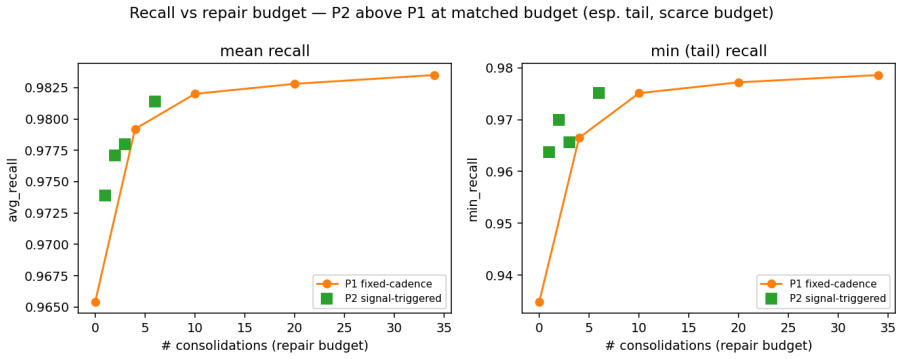
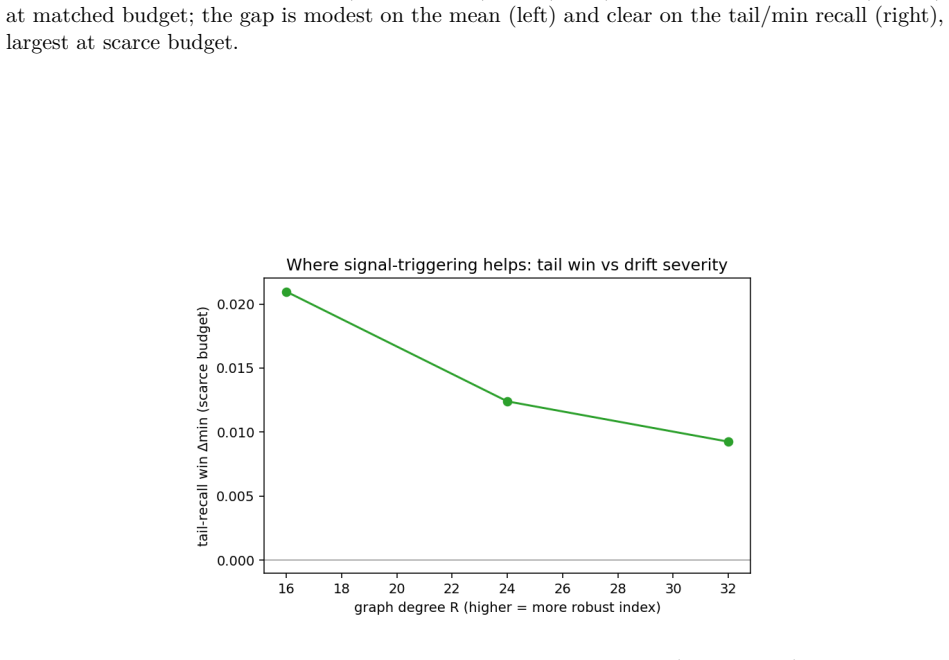
On two datasets under controlled bursty churn, a repair policy that triggers local edge repair upon a navigability-degradation signal Pareto-dominates fixed-cadence repair when total repair count is matched. The gain appears mainly in tail recall@10, with minimum improvements of +0.014 on SIFT-128 and +0.050 on Fashion-MNIST-784 across four stream seeds at one consolidation, while mean recall gain stays below 0.005. The probe-recall signal is a valid leading indicator with Spearman correlation of about 0.95, and the advantage is larger for sparser graphs.
What carries the argument
The navigability-degradation signal based on probe-recall that triggers local edge repair to restore search paths orphaned by deletions.
If this is right
- The minimum recall@10 improves under signal-triggered repair at scarce budgets compared to fixed schedules.
- The performance gain increases with drift severity and is larger for more fragile graphs.
- Mean recall improves only marginally, less than 0.005.
- The probe-recall signal reliably indicates upcoming recall loss with high correlation.
- The budget-matched protocol allows isolating the effect of repair timing from total repair effort.
Where Pith is reading between the lines
- If the signal generalizes, production systems could reduce unnecessary repairs during stable periods.
- Testing on additional datasets with real production churn patterns would strengthen the case for adoption.
- The approach might combine with other maintenance techniques to handle varying data distributions.
Load-bearing premise
The bursty churn streams and two datasets used here produce representative patterns of degradation seen in actual production workloads.
What would settle it
A new experiment with different churn patterns or datasets where the minimum recall@10 for signal-triggered repair is lower than for fixed-cadence repair at the same number of consolidations.
Figures

read the original abstract
Graph approximate-nearest-neighbor (ANN) indexes (HNSW, DiskANN/Vamana) lose recall under insert/delete churn, because deletions orphan the greedy-search paths that route through removed nodes. Production systems restore navigability by repairing the graph on a fixed schedule (consolidate every X operations). We ask whether triggering local edge repair on a measured navigability-degradation signal, rather than a blind clock, spends a fixed repair budget better. On two real ANN datasets (SIFT-128 and Fashion-MNIST-784) under a controlled bursty churn stream, and comparing repair policies at matched amortized repair budget (equal consolidation count), signal-triggered repair Pareto-dominates fixed-cadence repair. The gain is concentrated on worst-case (tail) recall at scarce budget: at roughly one consolidation it improves the minimum recall@10 by +0.014 (SIFT) to +0.050 (Fashion-MNIST) across four stream seeds, with 95% confidence intervals excluding zero, while the mean-recall gain is small (<0.005). The advantage follows a clean drift-severity gradient -- larger for sparser, more fragile graphs -- and fades to parity when the index is robust or budget is ample. A cheap probe-recall signal is a valid, leading indicator of true recall (Spearman rho ~= 0.95). We contribute the mechanism, a budget-matched evaluation protocol that separates repair scheduling from repair spend, and an open, reproducible churn-repair harness. We deliberately do not claim a mean-recall improvement or a new index; a recall-versus-repair-cost bound and data-distribution-drift coupling are left as future work.
Editorial analysis
A structured set of objections, weighed in public.
Referee Report
Summary. The paper claims that a navigability-signal-triggered local repair policy for graph ANN indexes (HNSW, DiskANN/Vamana) Pareto-dominates fixed-cadence consolidation in protecting tail recall@10 under bursty insert/delete churn, when repair budgets are matched by consolidation count. On SIFT-128 and Fashion-MNIST-784 under a controlled bursty churn stream with four stream seeds, signal-triggered repair improves minimum recall@10 by +0.014 (SIFT) to +0.050 (Fashion-MNIST) at roughly one consolidation, with 95% CIs excluding zero and small mean-recall gains (<0.005); the advantage scales with graph fragility and a cheap probe-recall signal correlates with true recall (Spearman rho ≈ 0.95). The paper contributes the mechanism, a budget-matched evaluation protocol separating scheduling from repair spend, and an open reproducible churn-repair harness, while leaving recall-vs-cost bounds and data-distribution-drift coupling as future work.
Significance. If the empirical result holds, the work supplies a practical, low-overhead scheduling policy that improves worst-case recall for the same amortized repair cost, which is directly relevant to production ANN serving systems. The budget-matched protocol is a methodological strength that cleanly isolates the scheduling question, and the open harness enables reproducibility and follow-on work. The probe-recall correlation finding is actionable for online monitoring.
major comments (2)
- [Evaluation / Experiments] The central claim of Pareto-dominance on tail recall rests on degradation patterns from one synthetic bursty churn stream on only two datasets (SIFT-128, Fashion-MNIST-784) and four seeds. The paper explicitly leaves data-distribution-drift coupling as future work; without additional datasets or churn models that vary deletion clustering or query locality, the reported gains (+0.014 to +0.050) and the policy recommendation may not generalize, which is load-bearing for the practical significance of the scheduling result.
- [Signal definition / Results] The probe-recall signal is reported as a leading indicator with Spearman rho ≈ 0.95, but the manuscript does not specify whether this correlation is computed on held-out queries or the same stream used for the main results; if the latter, the validity of the signal as an independent trigger requires an explicit cross-validation or separate test set to support the claim that it is a reliable, cheap proxy.
minor comments (1)
- [Abstract / Evaluation protocol] The abstract states gains occur 'at roughly one consolidation'; the main text should give the exact amortized budget values and consolidation counts used for each policy to allow precise reproduction.
Simulated Author's Rebuttal
We thank the referee for the constructive feedback. We address the two major comments below. We agree that the signal correlation requires clarification and will revise the manuscript to include explicit cross-validation. On generalization, the controlled evaluation isolates the scheduling question under a realistic bursty churn model; we will strengthen the discussion of scope and limitations without new experiments.
read point-by-point responses
-
Referee: [Evaluation / Experiments] The central claim of Pareto-dominance on tail recall rests on degradation patterns from one synthetic bursty churn stream on only two datasets (SIFT-128, Fashion-MNIST-784) and four seeds. The paper explicitly leaves data-distribution-drift coupling as future work; without additional datasets or churn models that vary deletion clustering or query locality, the reported gains (+0.014 to +0.050) and the policy recommendation may not generalize, which is load-bearing for the practical significance of the scheduling result.
Authors: The experiments use a controlled synthetic bursty churn stream on two standard ANN benchmarks precisely to isolate the scheduling policy from confounding factors while holding repair budget fixed by consolidation count. Gains in minimum recall@10 are consistent across four seeds with 95% CIs excluding zero, and the advantage scales with graph fragility as expected. The paper already flags data-distribution-drift coupling as future work and does not claim universality. We will revise to more explicitly discuss the churn model's design choices (bursty inserts/deletes) and the conditions under which the policy applies, but adding varied deletion clustering or query locality would constitute new experiments outside the current scope. revision: partial
-
Referee: [Signal definition / Results] The probe-recall signal is reported as a leading indicator with Spearman rho ≈ 0.95, but the manuscript does not specify whether this correlation is computed on held-out queries or the same stream used for the main results; if the latter, the validity of the signal as an independent trigger requires an explicit cross-validation or separate test set to support the claim that it is a reliable, cheap proxy.
Authors: The reported Spearman rho was computed on queries drawn from the same evaluation stream. To address the concern and validate the signal as an independent trigger, the revised manuscript will include an explicit cross-validation using a held-out query set separate from the main results stream, with the correlation recomputed and reported. This will directly support the claim that the cheap probe-recall serves as a reliable proxy. revision: yes
Circularity Check
No circularity; empirical comparison uses independent seeds and matched budgets
full rationale
The paper's central claim rests on an empirical protocol that runs signal-triggered vs. fixed-cadence repair at equal amortized consolidation counts across four independent stream seeds on two fixed datasets. No equations, fitted parameters, or self-citations are invoked to derive the reported tail-recall deltas (+0.014 to +0.050); the deltas are direct measurements. The probe-recall Spearman correlation is likewise an observed statistic, not a constructed prediction. The evaluation is therefore self-contained against its own experimental harness and does not reduce to any of the enumerated circularity patterns.
Axiom & Free-Parameter Ledger
axioms (2)
- domain assumption Deletions orphan greedy-search paths and reduce navigability in graph ANN indexes
- domain assumption A cheap probe-recall measurement is a valid leading indicator of true recall (Spearman rho ~= 0.95)
Reference graph
Works this paper leans on
-
[1]
and Yashunin, D
Malkov, Yu A. and Yashunin, D. A. , title =. IEEE Transactions on Pattern Analysis and Machine Intelligence , volume =
-
[2]
Advances in Neural Information Processing Systems (NeurIPS) , year =
Subramanya, Suhas Jayaram and. Advances in Neural Information Processing Systems (NeurIPS) , year =
-
[3]
arXiv preprint arXiv:2105.09613 , year =
Singh, Aditi and Subramanya, Suhas Jayaram and Krishnaswamy, Ravishankar and Simhadri, Harsha Vardhan , title =. arXiv preprint arXiv:2105.09613 , year =
-
[4]
International Conference on Machine Learning (ICML) , year =
Beygelzimer, Alina and Kakade, Sham and Langford, John , title =. International Conference on Machine Learning (ICML) , year =
-
[5]
Results of the big ann: Neurips’23 competition.arXiv preprint arXiv:2409.17424, 2024
Simhadri, Harsha Vardhan and Aum. Results of the Big. arXiv preprint arXiv:2409.17424 , year =
-
[6]
, title =
Liu, Dawei and Zheng, Bolong and Yue, Ziyang and Ruan, Fuhao and Zhou, Xiaofang and Jensen, Christian S. , title =. Proceedings of the VLDB Endowment , volume =
-
[7]
and Rekatsinas, Theodoros and Venkataraman, Shivaram , title =
Mohoney, Jason and Sarda, Devesh and Tang, Mengze and Chowdhury, Shihabur Rahman and Pacaci, Anil and Ilyas, Ihab F. and Rekatsinas, Theodoros and Venkataraman, Shivaram , title =. 19th USENIX Symposium on Operating Systems Design and Implementation (OSDI 25) , pages =. 2025 , note =
2025
-
[8]
Proceedings of the 29th Symposium on Operating Systems Principles (SOSP) , pages =
Xu, Yuming and Liang, Hengyu and Li, Jin and Xu, Shuotao and Chen, Qi and Zhang, Qianxi and Li, Cheng and Yang, Ziyue and Yang, Fan and Yang, Yuqing and Cheng, Peng and Yang, Mao , title =. Proceedings of the 29th Symposium on Operating Systems Principles (SOSP) , pages =
-
[9]
NeurIPS 2025 Workshop on Machine Learning for Systems , year =
Yamashita, Tomohiro and Amagata, Daichi and Matsui, Yusuke , title =. NeurIPS 2025 Workshop on Machine Learning for Systems , year =
2025
-
[10]
and Rekatsinas, Theodoros and Venkataraman, Shivaram , title =
Mohoney, Jason and Pacaci, Anil and Chowdhury, Shihabur Rahman and Minhas, Umar Farooq and Pound, Jeffery and Renggli, Cedric and Reyhani, Nima and Ilyas, Ihab F. and Rekatsinas, Theodoros and Venkataraman, Shivaram , title =. arXiv preprint arXiv:2411.00970 , year =
-
[11]
arXiv preprint arXiv:2503.00402 , year =
Yu, Song and Lin, Shengyuan and Gong, Shufeng and Xie, Yongqing and Liu, Ruicheng and Zhou, Yijie and Sun, Ji and Zhang, Yanfeng and Li, Guoliang and Yu, Ge , title =. arXiv preprint arXiv:2503.00402 , year =
-
[12]
Advances in Neural Information Processing Systems (NeurIPS) , year =
Diwan, Haya and Gou, Jinrui and Musco, Cameron and Musco, Christopher and Suel, Torsten , title =. Advances in Neural Information Processing Systems (NeurIPS) , year =
discussion (0)
Sign in with ORCID, Apple, or X to comment. Anyone can read and Pith papers without signing in.