Calibrating the Instrument: Controllability of an LLM-Driven Synthetic Population
Pith reviewed 2026-07-02 02:43 UTC · model grok-4.3
The pith
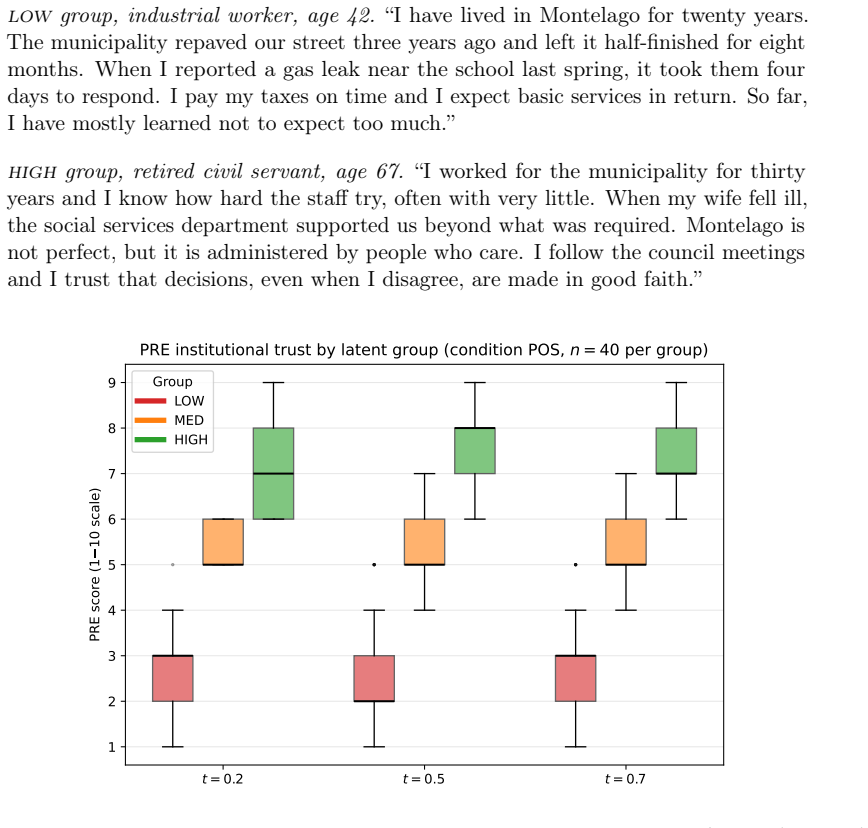
An LLM synthetic population recovers the latent structure imposed on its 120 personas in responses to institutional messages of known valence.
A machine-rendered reading of the paper's core claim, the machinery that carries it, and where it could break.
Core claim
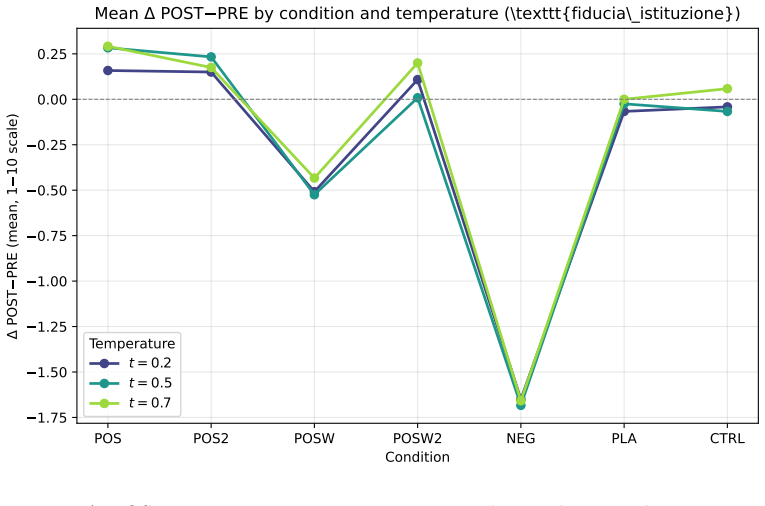
The synthetic population demonstrates controllability because its responses recover the imposed latent structure: all seven pre-registered criteria pass across a temperature sweep, the instrument correctly identifies a weakly-positive message as functionally negative due to unresolved problems and institutional passivity in the text, a redesigned message restores the expected ordering, intrinsic noise is roughly half the cross-agent estimate and stable, and individual trajectories display coherent micro-dynamics.
What carries the argument
The SIVE experiment, which imposes known latent structure on 120 personas and evaluates recovery through their responses to seven stimuli of independently known valence using seven pre-registered criteria.
If this is right
- A message designed as weakly positive is identified by the instrument as functionally negative on the basis of unresolved problems, uncertainty, and institutional passivity in its wording.
- Redesigning that message restores the expected response ordering and produces unanticipated interactions with agents' latent trust.
- The instrument's intrinsic noise floor is approximately half the cross-agent estimate and remains stable across temperatures.
- Individual agent response trajectories reveal coherent micro-dynamics that are invisible in aggregate statistics.
Where Pith is reading between the lines
- The same controllability test could be applied to synthetic populations built for other policy domains to establish internal validity before deployment.
- The approach turns calibration failures into diagnostics that can improve the stimuli themselves rather than only the model.
- Because the test is temperature-stable, the instrument may support reproducible simulation runs even when sampling parameters vary.
- The method provides a template for separating measurement error from signal in any LLM-driven agent system.
Load-bearing premise
The latent structure imposed on the personas constitutes recoverable ground truth whose presence or absence can be detected in the personas' own responses.
What would settle it
A run in which the seven criteria do not all pass or in which the ordering of persona responses fails to match the known positive-to-negative valence of the stimuli.
Figures
read the original abstract
Generative Synthetic Populations (GSP) -- the convergence of population synthesis, agent-based modelling, and LLM agents -- are attracting growing interest for urban simulation and institutional communication research. Before any GSP instrument is used on a real population, a more basic question must be answered: does it respond to stimuli of known valence in an ordered, replicable, group-structured way? We call this controllability. We ask not whether a synthetic population tracks humans, but whether it tracks itself: whether the latent structure we impose on it is recovered in its own responses. This internal-validity question is logically prior to any claim about external validity, just as characterising an instrument's response function must precede using it to test a theory. We report SIVE (Synthetic Instrument Validation Experiment): a fictional municipality (Montelago) with 120 synthetic personas of known latent structure, exposed to seven conditions spanning strongly positive to strongly negative institutional communications about a water network. Seven pre-registered criteria, evaluated across a temperature sweep, jointly assess fidelity, stability, noise floor, specificity, sensitivity, and ordering. All seven pass at every temperature. A central finding turns a calibration failure into a diagnostic success: a message designed as "weakly positive" was identified by the instrument as functionally negative, traced to unresolved problems, uncertainty, and institutional passivity in its text; a redesigned version restored the expected ordering and interacts with agents' latent trust in unanticipated ways. A noise sub-experiment shows the instrument's intrinsic noise is roughly half the cross-agent estimate and stable across temperatures. Individual trajectories reveal coherent micro-dynamics that summary statistics obscure. Full data are available via an interactive explorer.
Editorial analysis
A structured set of objections, weighed in public.
Referee Report
Summary. The manuscript introduces controllability as an internal-validity property for LLM-driven generative synthetic populations (GSPs) and reports the SIVE experiment. A fictional municipality (Montelago) is populated with 120 synthetic personas carrying explicitly imposed latent attributes; these personas are exposed to seven institutional messages about a water network whose valence is fixed by construction (strongly positive to strongly negative). Seven pre-registered criteria jointly evaluate fidelity, stability, noise floor, specificity, sensitivity, and ordering across a temperature sweep; the paper states that all seven criteria pass at every temperature. A post-hoc redesign of the “weakly positive” message is presented as a diagnostic that restored expected ordering and revealed interactions with latent trust. A noise sub-experiment and individual trajectory analysis are included, with full data released via an interactive explorer.
Significance. If the reported results hold, the work supplies a concrete, pre-registered protocol for calibrating an LLM-based synthetic instrument before it is applied to external questions. The emphasis on recovering imposed latent structure from the personas’ own responses, the explicit treatment of the message redesign as a diagnostic rather than a refutation, the noise sub-experiment, and the public release of the full dataset and explorer constitute clear strengths that raise the credibility of the internal-validity claim. The approach is logically prior to external-validity assertions and could serve as a template for other GSP studies in urban simulation and institutional-communication research.
minor comments (3)
- Abstract: the claim that “all seven pass at every temperature” would be more informative if one or two representative quantitative values (e.g., a fidelity score or noise-floor ratio) were stated explicitly rather than left as a binary assertion.
- The seven criteria are described in the text but would benefit from a compact summary table listing each criterion, its operational definition, and the temperature-sweep outcome; this would improve readability without altering the central argument.
- The interactive explorer is mentioned as the vehicle for full data release; a short footnote or appendix entry giving the exact URL or repository DOI would make the reproducibility claim immediately actionable.
Simulated Author's Rebuttal
We thank the referee for their positive and accurate summary of the manuscript, for recognizing the strengths of the pre-registered protocol, the diagnostic use of the message redesign, the noise sub-experiment, and the public data release, and for recommending acceptance.
Circularity Check
No significant circularity detected
full rationale
The paper defines controllability as recovery of explicitly imposed latent attributes in LLM responses to messages whose valence is fixed by external experimental design (positive-to-negative institutional communications). The seven pre-registered criteria evaluate fidelity, stability, ordering, etc., against this externally supplied ground truth rather than against quantities derived from the responses themselves. No equations, fitted parameters, or self-citations are shown to reduce the central claim to a tautology or to the same data used for validation; the SIVE setup therefore remains an independent test of the instrument's response function.
Axiom & Free-Parameter Ledger
axioms (1)
- domain assumption The latent structure imposed on the synthetic personas can be recovered from their responses to stimuli of known valence.
Reference graph
Works this paper leans on
-
[1]
Generative agents in agent-based modeling: Overview, validation, and emerging challenges
Carlo Adornetto, Adrian Mora, Kai Hu, Leticia Izquierdo Garcia, Parfait Atchade-Adelomou, Gianluigi Greco, Luis Alberto Alonso Pastor, and Kent Larson. Generative agents in agent-based modeling: Overview, validation, and emerging challenges. IEEE Transactions on Artificial Intelligence , 6 0 (12): 0 3165--3183, 2025. doi:10.1109/TAI.2025.3566362
-
[2]
SIN Brescia--Caffaro
ARPA Lombardia . SIN Brescia--Caffaro . Agenzia Regionale per la Protezione dell'Ambiente della Lombardia. https://www.arpalombardia.it/temi-ambientali/siti-contaminati-e-aree-degradate/bonifica-dei-siti-contaminati/siti-di-interesse-nazionale/sin-brescia-caffaro/ [In Italian], 2024. Accessed:
2024
-
[3]
Generation of synthetic populations in social simulations: A review of methods and practices
Kevin Chapuis, Patrick Taillandier, and Alexis Drogoul. Generation of synthetic populations in social simulations: A review of methods and practices. Journal of Artificial Societies and Social Simulation, 25 0 (2): 0 6, 2022. doi:10.18564/jasss.4762
-
[4]
SIN Brescia Caffaro -- Portale del Commissario Straordinario
Commissario Straordinario per la Bonifica del SIN Brescia Caffaro . SIN Brescia Caffaro -- Portale del Commissario Straordinario . Ministero dell'Ambiente e della Sicurezza Energetica. https://bresciacaffaro.it [In Italian], 2025. Accessed:
2025
-
[5]
Scalable Maximum Entropy Population Synthesis via Persistent Contrastive Divergence
Mirko Degli Esposti. Scalable maximum entropy population synthesis via persistent contrastive divergence, 2026. URL https://arxiv.org/abs/2603.27312. Code: https://github.com/mirko-degli-esposti/maxent-popsynth-pcd
work page internal anchor Pith review Pith/arXiv arXiv 2026
-
[6]
SimComm : Institutional risk communication in contaminated urban communities --- a synthetic population experiment, 2026
Mirko Degli Esposti and Matteo Tarantino. SimComm : Institutional risk communication in contaminated urban communities --- a synthetic population experiment, 2026. Work in progress
2026
-
[7]
Large language models empowered agent-based modeling and simulation: A survey and perspectives
Chen Gao, Xiaochong Lan, Nian Li, Yuan Yuan, Jingtao Ding, Zhilun Zhou, Fengli Xu, and Yong Li. Large language models empowered agent-based modeling and simulation: A survey and perspectives. Humanities and Social Sciences Communications, 11: 0 1259, 2024. doi:10.1057/s41599-024-03611-3
-
[8]
Kirk Harland, Alison Heppenstall, Dianna Smith, and Mark Birkin. Creating realistic synthetic populations at varying spatial scales: A comparative critique of population synthesis techniques. Journal of Artificial Societies and Social Simulation, 15 0 (1): 0 1, 2012. doi:10.18564/jasss.1909
-
[9]
Jessica Hullman, David Broska, Huaman Sun, and Aaron Shaw. This human study did not involve human subjects: Validating LLM simulations as behavioral evidence, 2026. URL https://arxiv.org/abs/2602.15785
-
[10]
Edwin T. Jaynes. Information theory and statistical mechanics. Physical Review, 106 0 (4): 0 620--630, 1957. doi:10.1103/PhysRev.106.620
-
[11]
A deep generative model for feasible and diverse population synthesis
Eui-Jin Kim and Prateek Bansal. A deep generative model for feasible and diverse population synthesis. Transportation Research Part C: Emerging Technologies, 148: 0 104053, 2023. doi:10.1016/j.trc.2023.104053
-
[12]
Maik Larooij and Petter T \"o rnberg. Validation is the central challenge for generative social simulation: A critical review of LLM s in agent-based modeling. Artificial Intelligence Review, 59: 0 15, 2026. doi:10.1007/s10462-025-11412-6
-
[13]
HumanStudy-Bench : Towards AI agent design for participant simulation, 2026
Xuan Liu, Haoyang Shang, Zizhang Liu, Xinyan Liu, Yunze Xiao, Yiwen Tu, and Haojian Jin. HumanStudy-Bench : Towards AI agent design for participant simulation, 2026. URL https://arxiv.org/abs/2602.00685
-
[14]
Are LLM Agents Behaviorally Coherent? Latent Profiles for Social Simulation
James Mooney, Josef Woldense, Zheng Robert Jia, et al. Are LLM agents behaviorally coherent? latent profiles for social simulation, 2026. URL https://arxiv.org/abs/2509.03736
work page internal anchor Pith review Pith/arXiv arXiv 2026
-
[15]
Maximum Entropy Relaxation of Multi-Way Cardinality Constraints for Synthetic Population Generation
Fran c ois Pachet and Jean-Daniel Zucker. Maximum entropy relaxation of multi-way cardinality constraints for synthetic population generation, 2026. URL https://arxiv.org/abs/2603.22558
work page internal anchor Pith review Pith/arXiv arXiv 2026
-
[16]
Persona Generators: Generating Diverse Synthetic Personas for Arbitrary Contexts
Davide Paglieri, Logan Cross, William A. Cunningham, Joel Z. Leibo, and Alexander Sasha Vezhnevets. Persona generators: Generating diverse synthetic personas for arbitrary contexts, 2026. URL https://arxiv.org/abs/2602.03545
work page internal anchor Pith review Pith/arXiv arXiv 2026
-
[17]
Joon Sung Park, Joseph C. O'Brien, Carrie J. Cai, Meredith Ringel Morris, Percy Liang, and Michael S. Bernstein. Generative agents: Interactive simulacra of human behavior. In Proceedings of the 36th Annual ACM Symposium on User Interface Software and Technology (UIST '23), 2023. doi:10.1145/3586183.3606763
-
[18]
LLM Agents Grounded in Self-Reports Enable General-Purpose Simulation of Individuals
Joon Sung Park, Carolyn Q. Zou, Aaron Shaw, Benjamin Mako Hill, Carrie J. Cai, Meredith Ringel Morris, Robb Willer, Percy Liang, and Michael S. Bernstein. Generative agent simulations of 1 , 000 people, 2024. URL https://arxiv.org/abs/2411.10109. Published v2 (2026) as `` LLM Agents Grounded in Self-Reports Enable General-Purpose Simulation of Individuals''
work page internal anchor Pith review Pith/arXiv arXiv 2024
-
[19]
Jinghua Piao, Yuwei Yan, Jun Zhang, Nian Li, Junbo Yan, Xiaochong Lan, Zhihong Lu, Zhiheng Zheng, Jing Yi Wang, Di Zhou, Chen Gao, Fengli Xu, Fang Zhang, Ke Rong, Jun Su, and Yong Li. AgentSociety : Large-scale simulation of LLM -driven generative agents advances understanding of human behaviors and society, 2025. URL https://arxiv.org/abs/2502.08691. v2,...
work page internal anchor Pith review Pith/arXiv arXiv 2025
-
[20]
Integrating LLM in agent-based social simulation: Opportunities and challenges, 2025
Patrick Taillandier, Jean-Daniel Zucker, Arnaud Grignard, Benoit Gaudou, Nghi Quang Huynh, and Alexis Drogoul. Integrating LLM in agent-based social simulation: Opportunities and challenges, 2025. URL https://arxiv.org/abs/2507.19364. Version 2, preprint
-
[21]
Generating feasible and diverse synthetic populations using diffusion models, 2025
Min Tang, Peng Lu, and Qing Feng. Generating feasible and diverse synthetic populations using diffusion models, 2025. URL https://arxiv.org/abs/2508.09164
-
[22]
Generating realistic synthetic population datasets
Hao Wu, Yue Ning, Prithwish Chakraborty, Jilles Vreeken, Nikolaj Tatti, and Naren Ramakrishnan. Generating realistic synthetic population datasets. ACM Transactions on Knowledge Discovery from Data , 12 0 (4): 0 45, 2018. doi:10.1145/3182383
discussion (0)
Sign in with ORCID, Apple, or X to comment. Anyone can read and Pith papers without signing in.