Deadline-Aware Electric Vehicles Charging with Distribution Transformer Overload Mitigation
Pith reviewed 2026-07-02 07:28 UTC · model grok-4.3
The pith
A real-time EV charging policy using a marginal-cost urgency index and convex aging proxy reduces transformer stress while favoring deadline-critical vehicles.
A machine-rendered reading of the paper's core claim, the machinery that carries it, and where it could break.
Core claim
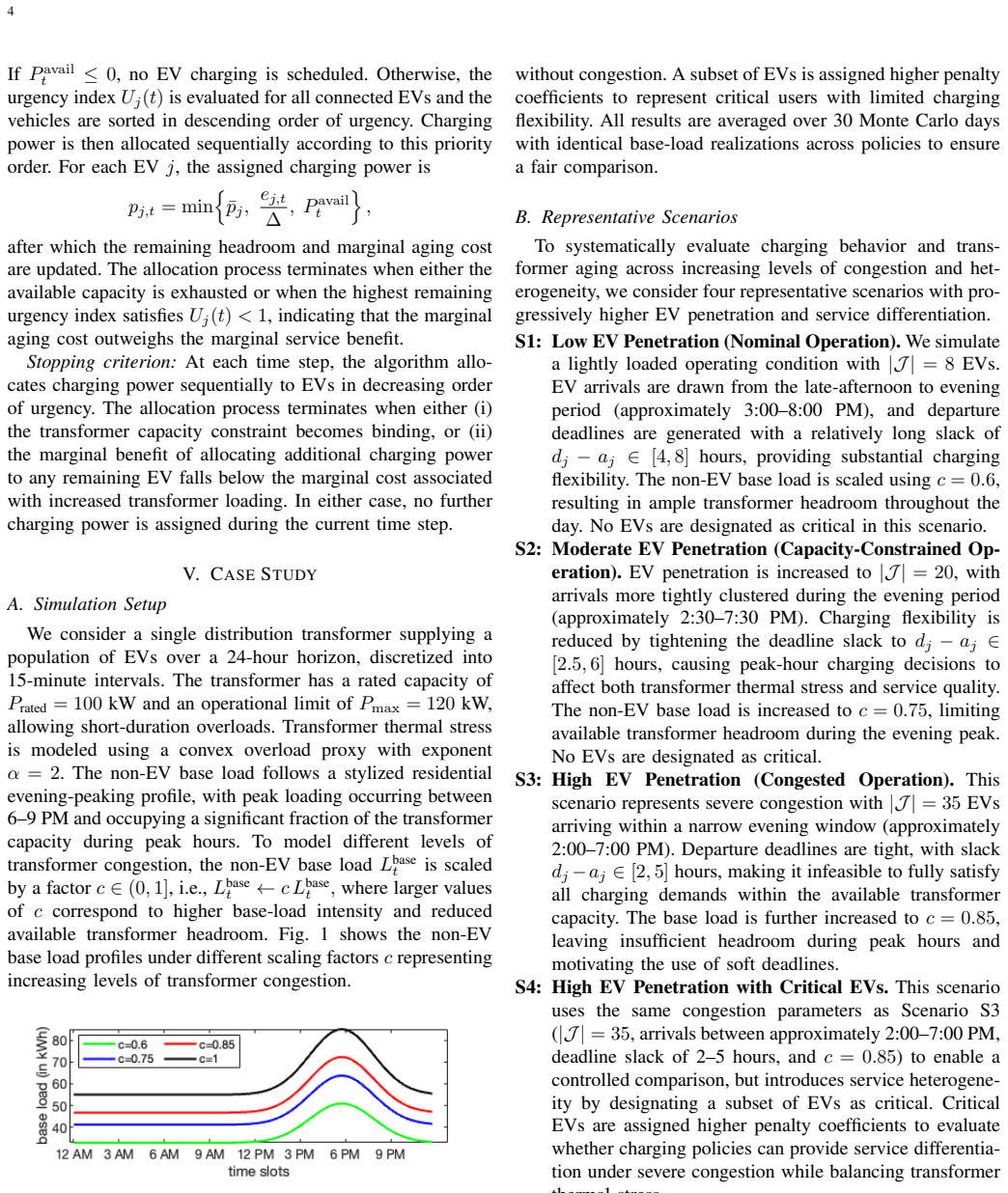
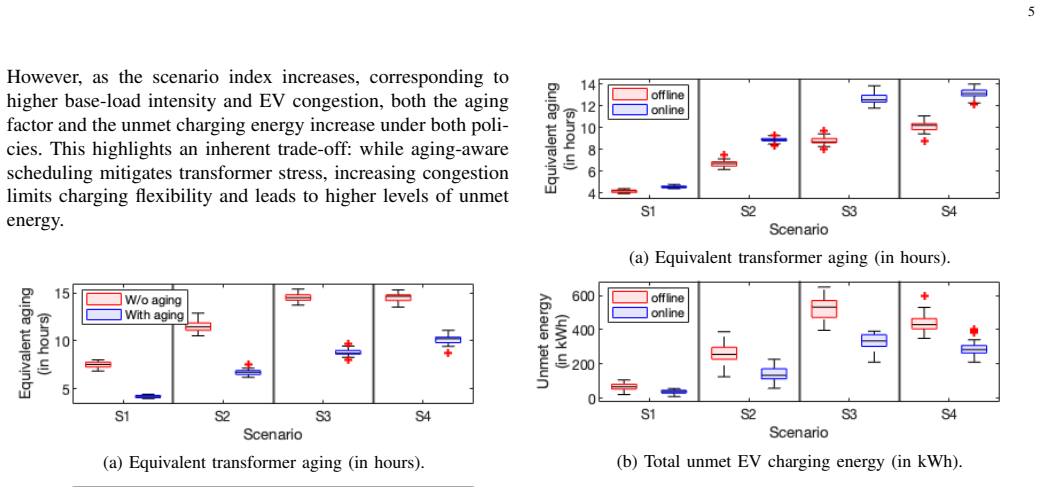
By modeling transformer stress with a convex aging proxy and softening deadlines via penalty-weighted unmet energy at departure, an online policy based on a marginal-cost-aware urgency index can allocate scarce capacity to time-critical EVs, reduce aging, and closely track offline benchmark performance under increasing penetration.
What carries the argument
The marginal-cost-aware urgency index that ranks each EV by the incremental aging cost and deadline-violation penalty of granting it charging power.
If this is right
- Transformer aging decreases as EV numbers grow compared with methods that enforce hard capacity and deadline limits.
- Charging power is preferentially allocated to vehicles with tighter departure times without explicit feasibility checks.
- The online policy achieves performance close to the offline optimum using only currently available information.
- The system continues to operate when aggregate demand exceeds transformer rating.
Where Pith is reading between the lines
- The same urgency-index logic could be tested on other capacity-constrained assets such as substation feeders or shared battery storage.
- Higher EV adoption might be sustained before transformers require replacement if the modeled aging reduction holds in practice.
Load-bearing premise
The convex aging proxy together with the penalty on unmet departure energy accurately captures the real trade-off between transformer damage and service quality.
What would settle it
Field data comparing measured transformer temperature rise and fraction of EVs meeting their energy targets under the online policy versus a strict hard-limit controller would confirm or refute the claimed reduction in aging.
Figures


read the original abstract
High adoption of electric vehicles (EVs) can overload distribution transformers when charging requests with heterogeneous departure deadlines compete for limited capacity. Most existing coordination schemes enforce hard deadlines and strict transformer limits, implicitly assuming feasibility and failing under severe congestion. We propose a deadline-aware EV charging framework that explicitly trades off transformer thermal aging and charging service quality under capacity-constrained operation. We model transformer stress using a convex aging proxy and soften charging deadlines via penalty-weighted unmet energy at departure. We further develop a low-complexity online charging policy that prioritizes EVs based on a marginal-cost-aware urgency index. We demonstrate through case studies under increasing EV penetration that the proposed approach reduces transformer aging while preferentially allocating limited capacity to time-critical EVs, closely approximating offline benchmark performance using only real-time information.
Editorial analysis
A structured set of objections, weighed in public.
Referee Report
Summary. The manuscript proposes a deadline-aware EV charging coordination framework that trades off transformer thermal aging against charging service quality under capacity constraints. It models transformer stress via a convex aging proxy, softens deadlines with penalty-weighted unmet energy at departure, and introduces a low-complexity online policy that uses a marginal-cost-aware urgency index to prioritize time-critical EVs. Case studies under increasing EV penetration are used to claim that the online policy reduces transformer aging, preferentially serves urgent requests, and closely approximates offline benchmark performance while relying only on real-time information.
Significance. If the modeling choices are validated, the work would be significant for distribution-grid EV integration by supplying a practical online method that operates without assuming feasibility of hard constraints. The low-complexity urgency-index policy and explicit comparison to offline benchmarks are strengths that could inform real-time control implementations.
major comments (2)
- [Abstract] Abstract: the central performance claims (reduced aging and close approximation to offline benchmarks) rest on an unspecified convex aging proxy and penalty-weighted unmet energy; no derivation, parameter fitting procedure, or comparison to the IEEE C57.91 hot-spot temperature model is supplied, which is load-bearing for interpreting the case-study aging reductions as physically meaningful.
- [Abstract] Abstract: the penalty weights for unmet energy and the urgency-index parameters are listed as free parameters with no sensitivity analysis or justification provided; this directly affects the claimed trade-off between transformer stress and service quality under binding capacity.
Simulated Author's Rebuttal
We thank the referee for the constructive comments and the opportunity to clarify the modeling foundations of our work. We address each major comment below and will revise the manuscript accordingly to improve transparency on the aging proxy and parameter choices.
read point-by-point responses
-
Referee: [Abstract] Abstract: the central performance claims (reduced aging and close approximation to offline benchmarks) rest on an unspecified convex aging proxy and penalty-weighted unmet energy; no derivation, parameter fitting procedure, or comparison to the IEEE C57.91 hot-spot temperature model is supplied, which is load-bearing for interpreting the case-study aging reductions as physically meaningful.
Authors: The convex aging proxy is derived in Section III-B from the standard transformer thermal model by introducing a convex upper bound on the aging acceleration factor; parameter fitting to nameplate data for 25-100 kVA distribution transformers is described in Appendix B. We agree, however, that an explicit side-by-side comparison with the full IEEE C57.91 hot-spot temperature calculation is missing and would strengthen the physical interpretation of the reported aging reductions. We will add this comparison (including relative error metrics) to the revised manuscript. revision: yes
-
Referee: [Abstract] Abstract: the penalty weights for unmet energy and the urgency-index parameters are listed as free parameters with no sensitivity analysis or justification provided; this directly affects the claimed trade-off between transformer stress and service quality under binding capacity.
Authors: We acknowledge that the manuscript presents the penalty weights and urgency-index coefficients as tunable parameters without accompanying sensitivity analysis. In the revision we will add a new subsection (or appendix) that systematically varies these parameters over representative ranges, reports the resulting changes in aging and service-quality metrics, and supplies justification drawn from typical EV-user deadline preferences and distribution-system operator service-level targets. This will make the claimed trade-off more robustly supported. revision: yes
Circularity Check
No significant circularity; derivation self-contained
full rationale
The paper introduces explicit modeling choices (convex aging proxy for transformer stress and penalty on unmet energy to soften deadlines) and derives an online policy via a marginal-cost-aware urgency index, then validates performance via case studies against an offline benchmark. No quoted equations or steps reduce any claimed prediction or result to a fitted input by construction, nor do they rely on self-citation chains or imported uniqueness theorems for load-bearing claims. The central demonstrations remain independent of the inputs.
Axiom & Free-Parameter Ledger
free parameters (2)
- penalty weights for unmet energy
- urgency index parameters
axioms (1)
- domain assumption Convex aging proxy sufficiently represents transformer thermal aging
Reference graph
Works this paper leans on
-
[1]
Distribution transformer failure modes, effects and criticality analysis (FMECA),
J. Singh, S. Singh, and A. Singh, “Distribution transformer failure modes, effects and criticality analysis (FMECA),”Engineering Failure Analysis, vol. 99, pp. 180–191, 2019
work page 2019
-
[2]
Failure diagnosis and root-cause analysis of in-service and defective distribution transformers,
S. Arumugam, “Failure diagnosis and root-cause analysis of in-service and defective distribution transformers,”Energies, vol. 14, no. 16, p. 4997, 2021
work page 2021
-
[3]
Optimal decentralized protocol for electric vehicle charging,
L. Gan, U. Topcu, and S. H. Low, “Optimal decentralized protocol for electric vehicle charging,”IEEE Transactions on Power Systems, vol. 28, no. 2, pp. 940–951, 2013
work page 2013
-
[4]
Optimal charging strategies for unidirectional vehicle-to-grid,
E. Sortomme and M. A. El-Sharkawi, “Optimal charging strategies for unidirectional vehicle-to-grid,”IEEE Transactions on Smart Grid, vol. 2, no. 1, pp. 131–138, 2011
work page 2011
-
[5]
Decentralized charging con- trol of large populations of plug-in electric vehicles,
Z. Ma, D. S. Callaway, and I. A. Hiskens, “Decentralized charging con- trol of large populations of plug-in electric vehicles,”IEEE Transactions on Control Systems Technology, vol. 21, no. 1, pp. 67–78, 2013
work page 2013
-
[6]
S. Deilami, A. S. Masoum, P. S. Moses, and M. A. S. Masoum, “Real- time coordination of plug-in electric vehicle charging in smart grids to minimize power losses and improve voltage profile,”IEEE Transactions on Smart Grid, vol. 2, no. 3, pp. 456–467, 2011
work page 2011
-
[7]
Z. Chen, L. Wu, and Y . Fu, “Real-time price-based demand response management for residential appliances via stochastic optimization and robust optimization,”IEEE Transactions on Smart Grid, vol. 3, no. 4, pp. 1822–1831, 2012
work page 2012
-
[8]
Resource allocation and cross-layer control in wireless networks,
L. Georgiadis, M. J. Neely, and L. Tassiulas, “Resource allocation and cross-layer control in wireless networks,”Foundations and Trends in Networking, vol. 1, no. 1, pp. 1–144, 2006
work page 2006
-
[9]
Scheduling in a queueing system with soft deadlines,
M. Andrews, K. Kumaran, K. Ramanan, A. Stolyar, R. Vijayakumar, and P. Whiting, “Scheduling in a queueing system with soft deadlines,” IEEE Transactions on Information Theory, vol. 47, no. 7, pp. 2740– 2758, 2001
work page 2001
-
[10]
IEEE guide for loading mineral-oil-immersed transformers,
“IEEE guide for loading mineral-oil-immersed transformers,” 2012
work page 2012
-
[11]
A fundamental approach to transformer thermal modeling—part i: Theory and equivalent circuit,
G. W. Swift, T. S. Molinski, and W. Lehn, “A fundamental approach to transformer thermal modeling—part i: Theory and equivalent circuit,” IEEE Transactions on Power Delivery, vol. 16, no. 2, pp. 171–175, 2001
work page 2001
discussion (0)
Sign in with ORCID, Apple, or X to comment. Anyone can read and Pith papers without signing in.