The Singular Source of Vineyard Monodromy
Pith reviewed 2026-07-02 01:31 UTC · model grok-4.3
The pith
Vineyard monodromy for small loops on 1-manifolds arises only from specific distance singularities on the symmetry set
A machine-rendered reading of the paper's core claim, the machinery that carries it, and where it could break.
Core claim
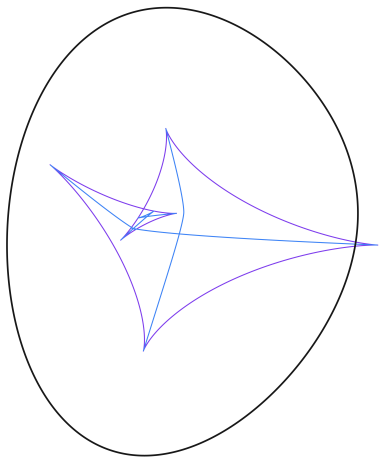
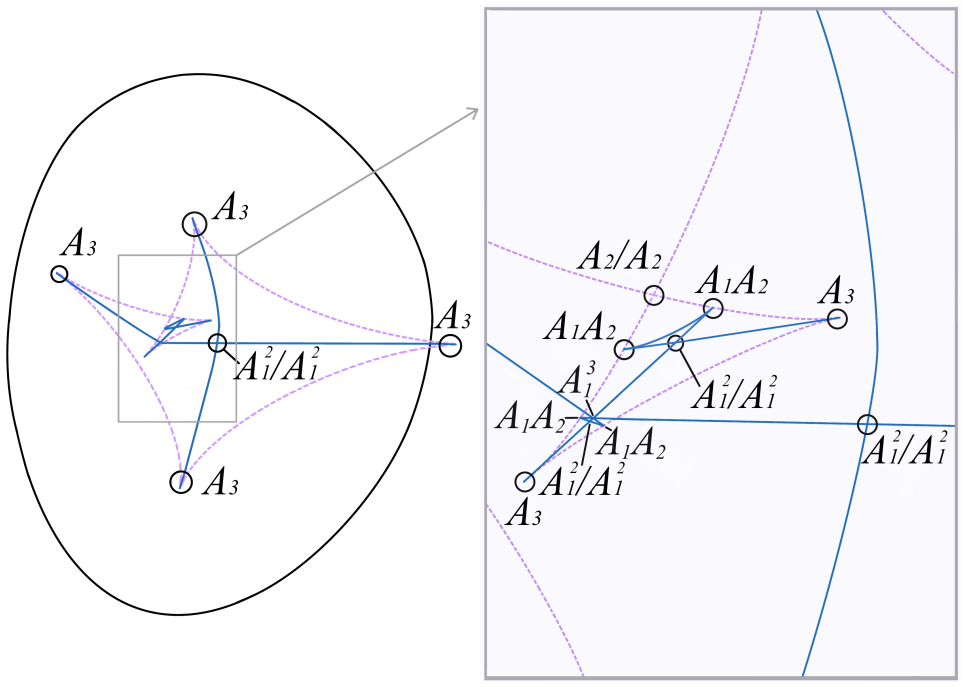
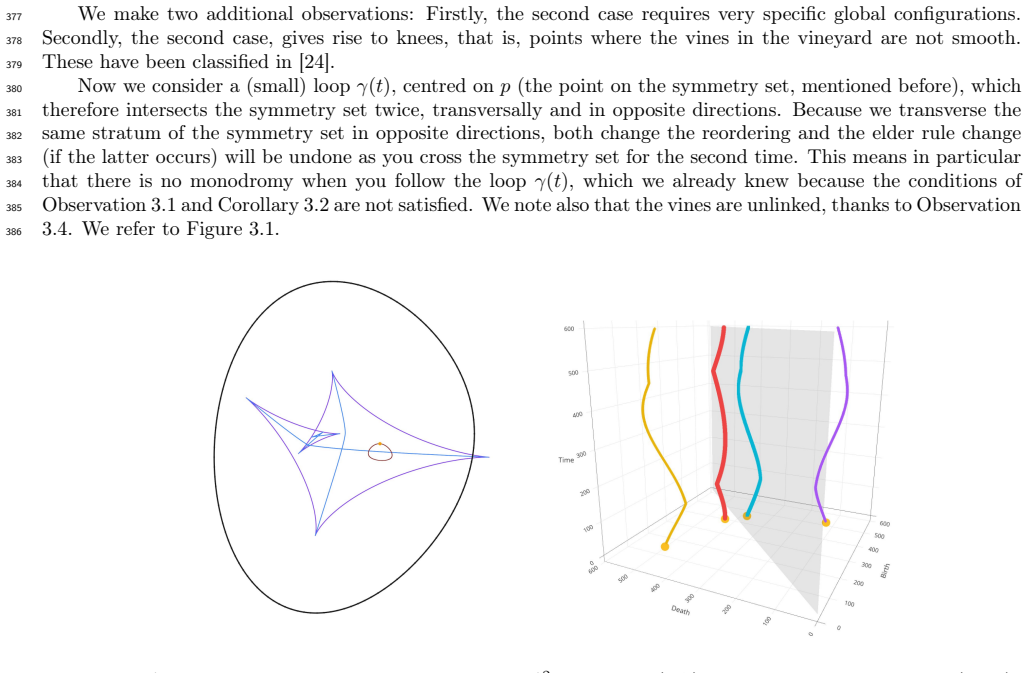
We prove that the vineyard of a sufficiently small loop γ cannot exhibit monodromy unless it contains a specific singularity of the distance function. The central geometric object in our analysis is the symmetry set, which is the locus of centers of spheres tangent in more than one point to the manifold; this object classifies singularities of the distance function, and in our setting, dictates precisely when monodromy occurs.
What carries the argument
The symmetry set, the locus of centers of spheres tangent in more than one point to the manifold, which classifies singularities of the distance function and dictates when monodromy occurs in the vineyard.
Load-bearing premise
The symmetry set is the complete classifier of all distance-function singularities that can produce monodromy for small loops.
What would settle it
A counterexample would be a sufficiently small loop around a 1-manifold in R^2 that avoids all points of the symmetry set yet produces a vineyard with monodromy.
Figures
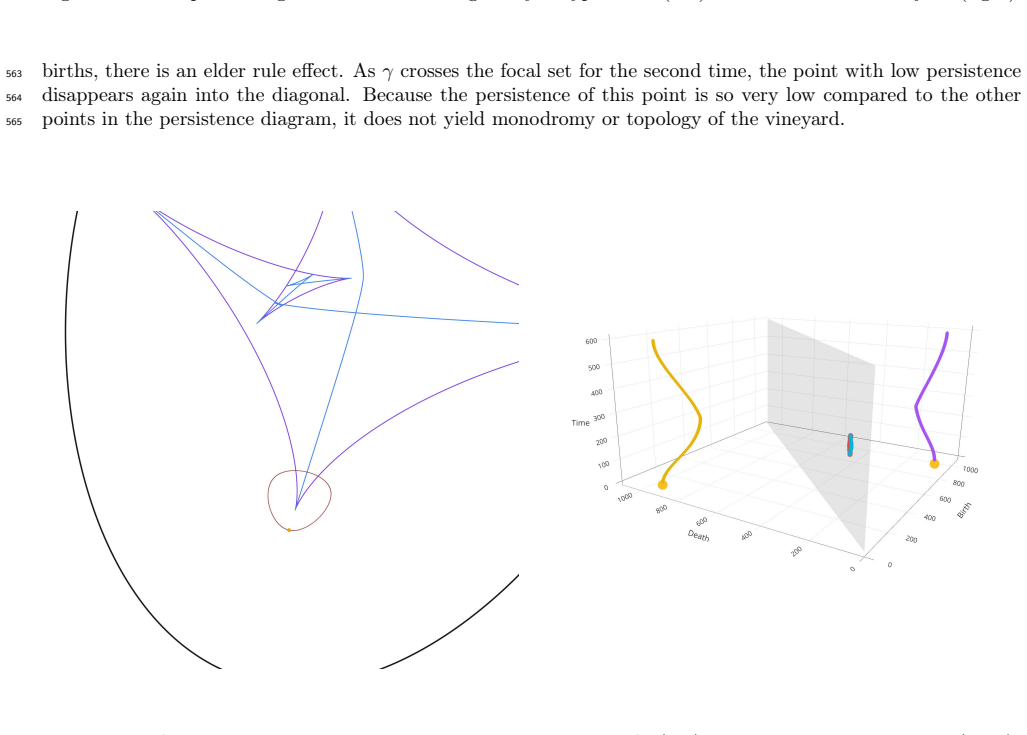
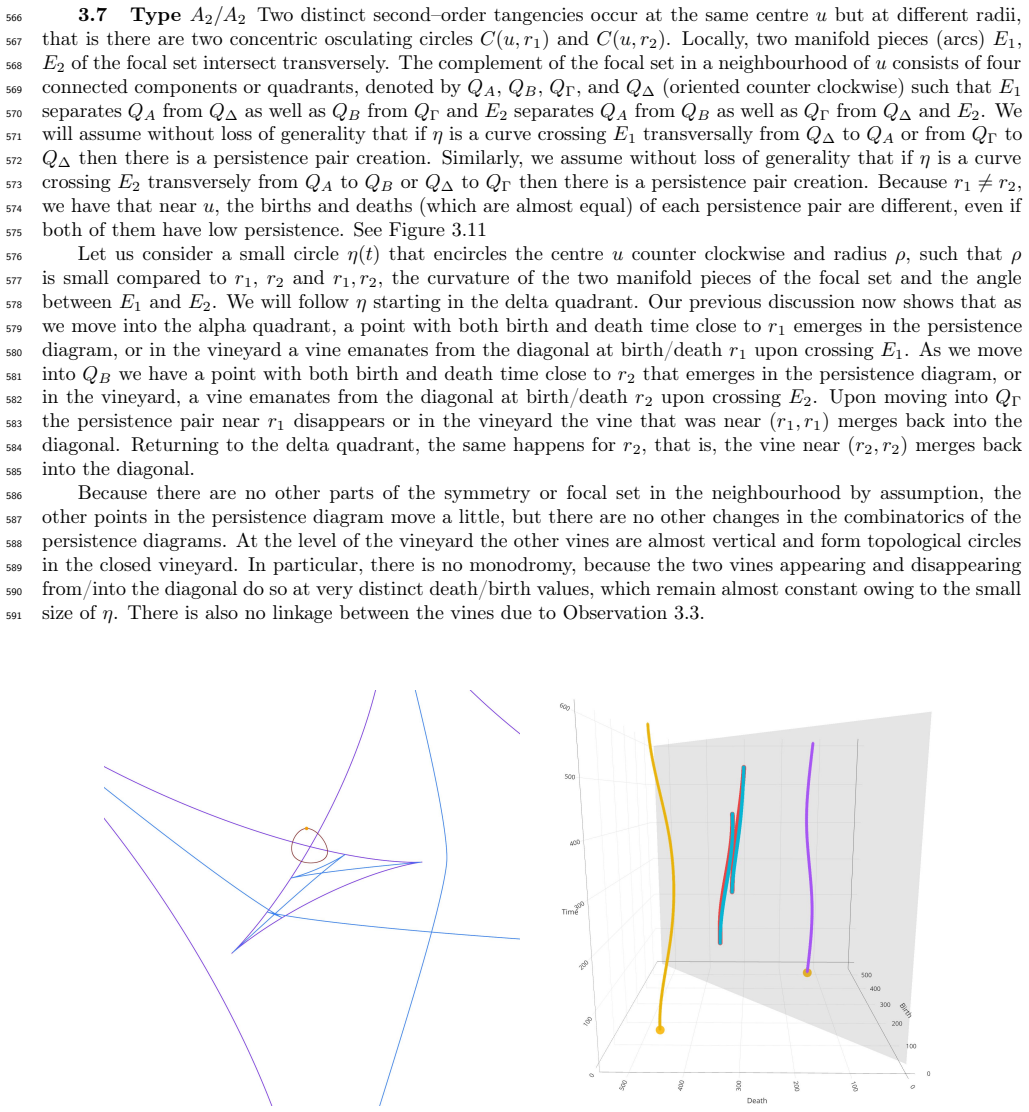
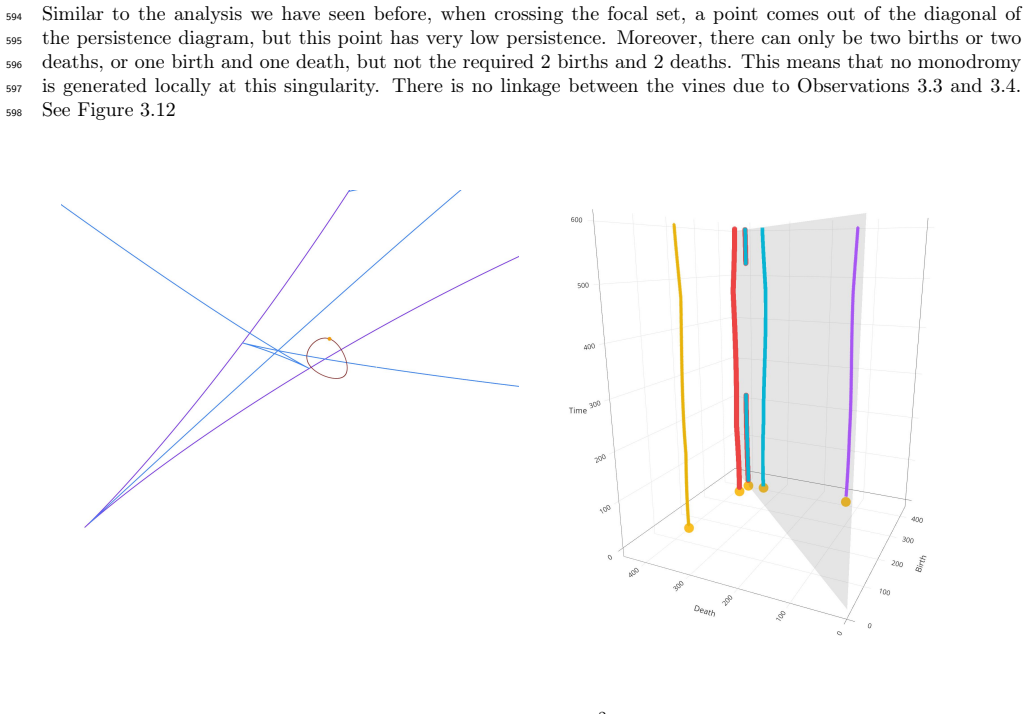
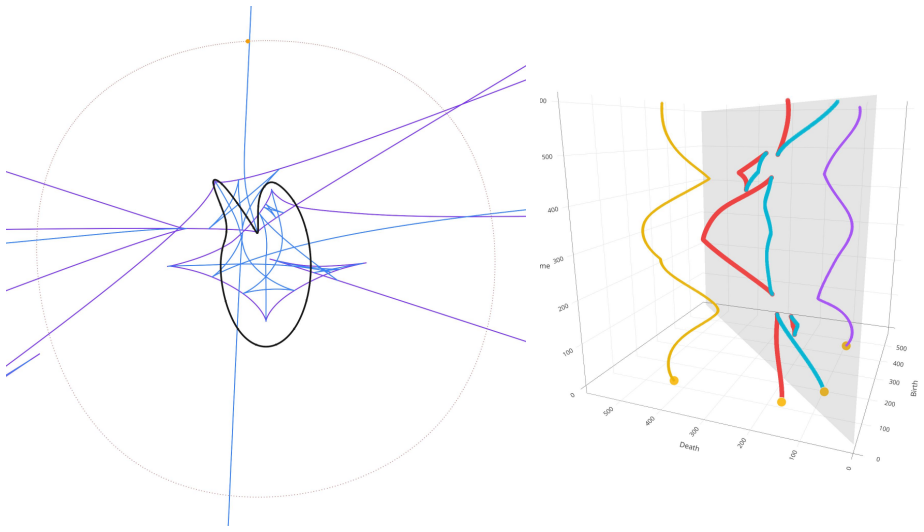
read the original abstract
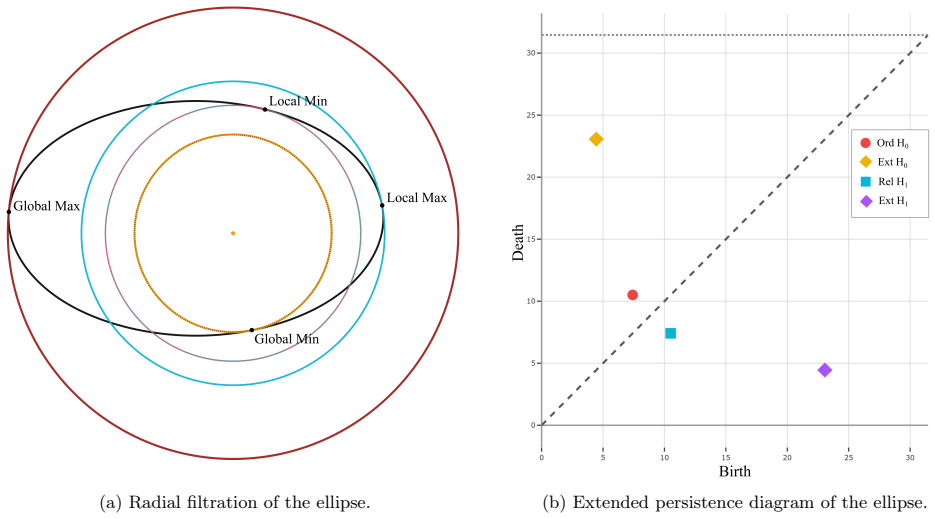
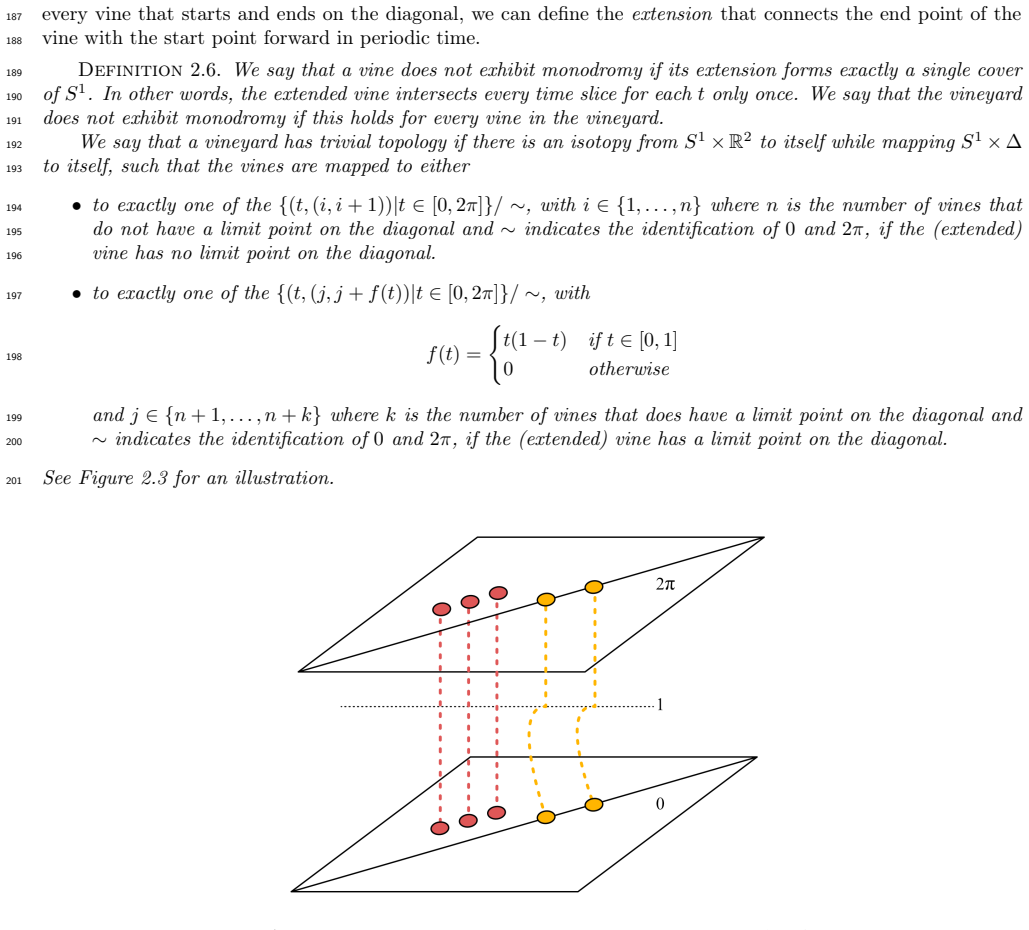
Vineyards, or time-varying families of persistence diagrams, are widely used in topological data analysis (TDA) pipelines to track how topological features change and evolve as a parameter varies. When the parameter traces a closed loop, a vineyard can exhibit monodromy: diagram points permute over the course of a full traversal, which obstructs feature tracking and can complicate downstream analysis of such data. Chambers et al. considered the periodic vineyards that arise from the radial persistence transform, which maps the manifold to a family of persistence diagrams, where each diagram fixes a base point and considers the filtration that is based on Euclidean distance to that point, and showed that monodromy and knotting can occur. Other recent work by Arya et al. considers geometric conditions that exclude monodromy in two dimensions, in an effort to better understand when this effect happens. That said, understanding when and why monodromy occurs is a fundamental open problem with direct practical consequences for many data analysis pipelines. In this work, we study this question for 1-manifolds in $\mathbb{R}^2$, using a surprising connection with tools from singularity theory, and provide a classification for the causes of monodromy in vineyards. More precisely, we prove that the vineyard of a sufficiently small loop $\gamma$ cannot exhibit monodromy unless it contains a specific singularity of the distance function. The central geometric object in our analysis is the symmetry set, which is the locus of centers of spheres tangent in more than one point to the manifold; this object classifies singularities of the distance function, and in our setting, dictates precisely when monodromy occurs. This characterization opens the door to the development of algorithmic criteria for detecting and utilizing (or avoiding) monodromy in TDA pipelines.
Editorial analysis
A structured set of objections, weighed in public.
Referee Report
Summary. The paper claims to classify the causes of monodromy in vineyards arising from the radial persistence transform on 1-manifolds in R^2. It proves that for a sufficiently small loop γ, the vineyard exhibits monodromy if and only if the loop encounters a specific singularity of the distance function; the symmetry set (locus of centers of spheres tangent to the manifold at more than one point) is the central object that classifies all such distance-function singularities capable of producing monodromy.
Significance. If the classification holds, the result supplies a geometric criterion linking monodromy directly to singularities of the distance function via established tools from singularity theory. This could support algorithmic detection or avoidance of monodromy in TDA pipelines and clarifies when feature tracking is obstructed for closed parameter loops.
major comments (1)
- [Abstract] Abstract (central claim paragraph): the manuscript asserts a complete classification proof but supplies no derivation steps, lemmas, or verification that the symmetry set is exhaustive for all distance-function singularities producing monodromy; without these the load-bearing claim that monodromy occurs precisely from symmetry-set singularities cannot be evaluated.
minor comments (1)
- [Abstract] The abstract references prior work by Chambers et al. and Arya et al. but does not indicate how the new classification improves upon or differs from the geometric conditions already studied in two dimensions.
Simulated Author's Rebuttal
We thank the referee for their comments. We address the major comment on the abstract below, noting that the full proof appears in the body of the manuscript.
read point-by-point responses
-
Referee: [Abstract] Abstract (central claim paragraph): the manuscript asserts a complete classification proof but supplies no derivation steps, lemmas, or verification that the symmetry set is exhaustive for all distance-function singularities producing monodromy; without these the load-bearing claim that monodromy occurs precisely from symmetry-set singularities cannot be evaluated.
Authors: The abstract is a concise summary of the main result: for 1-manifolds in R^2, a sufficiently small loop γ produces vineyard monodromy if and only if it intersects a singularity of the distance function, with all such singularities classified by the symmetry set. The derivation steps, lemmas establishing exhaustiveness via singularity theory, and the if-and-only-if argument are contained in the body of the paper (using the geometry of the symmetry set as the locus of centers of spheres tangent at multiple points). We are happy to revise the abstract to include a brief pointer to the relevant sections or a one-sentence outline of the key steps if that would facilitate evaluation. revision: partial
Circularity Check
No significant circularity; classification rests on external singularity theory
full rationale
The paper's central claim is a mathematical proof that monodromy in vineyards of small loops on 1-manifolds in R^2 occurs precisely when the symmetry set of the distance function exhibits specific singularities. This classification invokes established results from singularity theory to position the symmetry set as the complete classifier of relevant distance-function singularities, without reducing any derived statement to a fitted parameter, self-defined quantity, or load-bearing self-citation. Prior references to Chambers et al. establish the existence of monodromy phenomena but do not substitute for the new geometric argument. The derivation chain is therefore self-contained against external mathematical benchmarks rather than internally circular.
Axiom & Free-Parameter Ledger
axioms (2)
- standard math The symmetry set classifies singularities of the distance function to a 1-manifold
- domain assumption Radial persistence transform produces vineyards whose monodromy is governed by distance-function singularities
Reference graph
Works this paper leans on
-
[1]
doubling
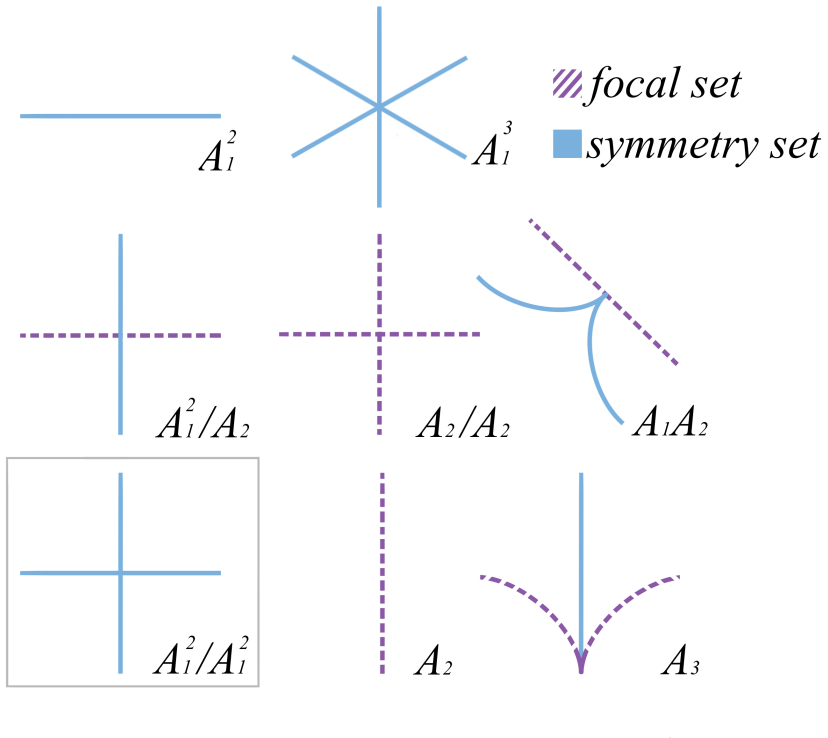
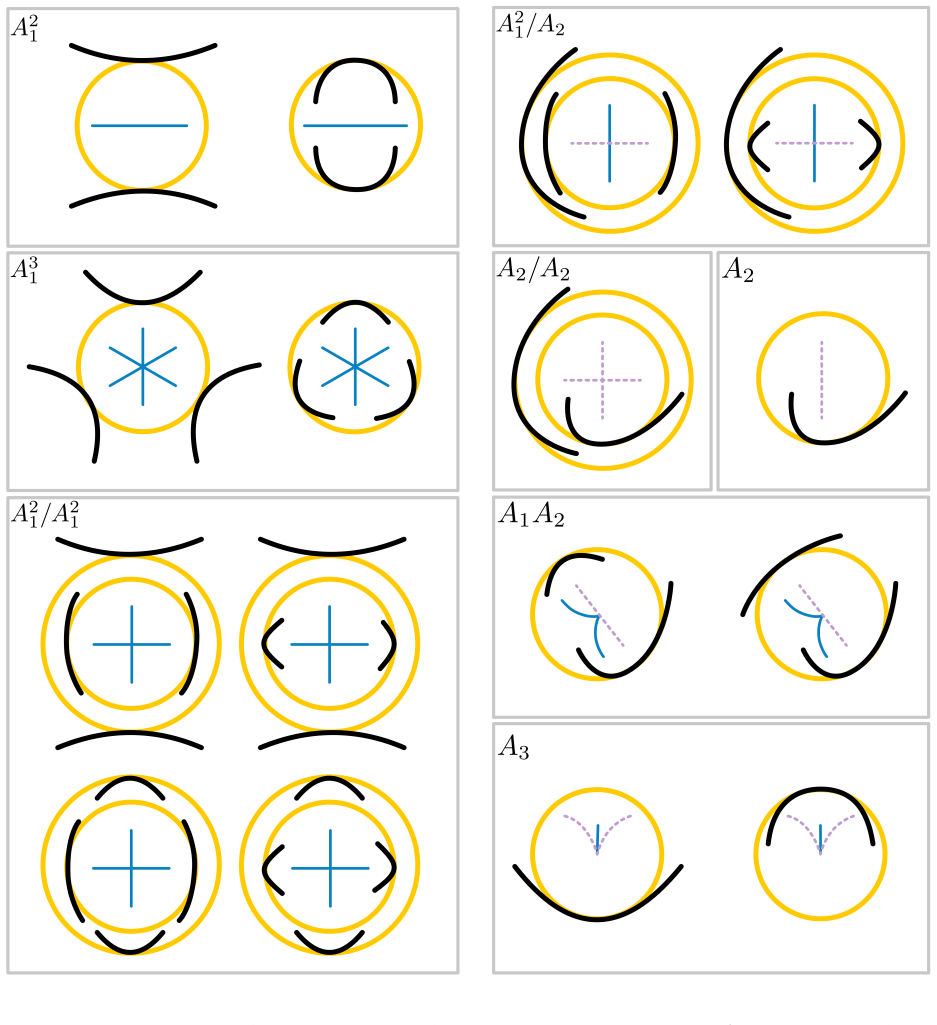
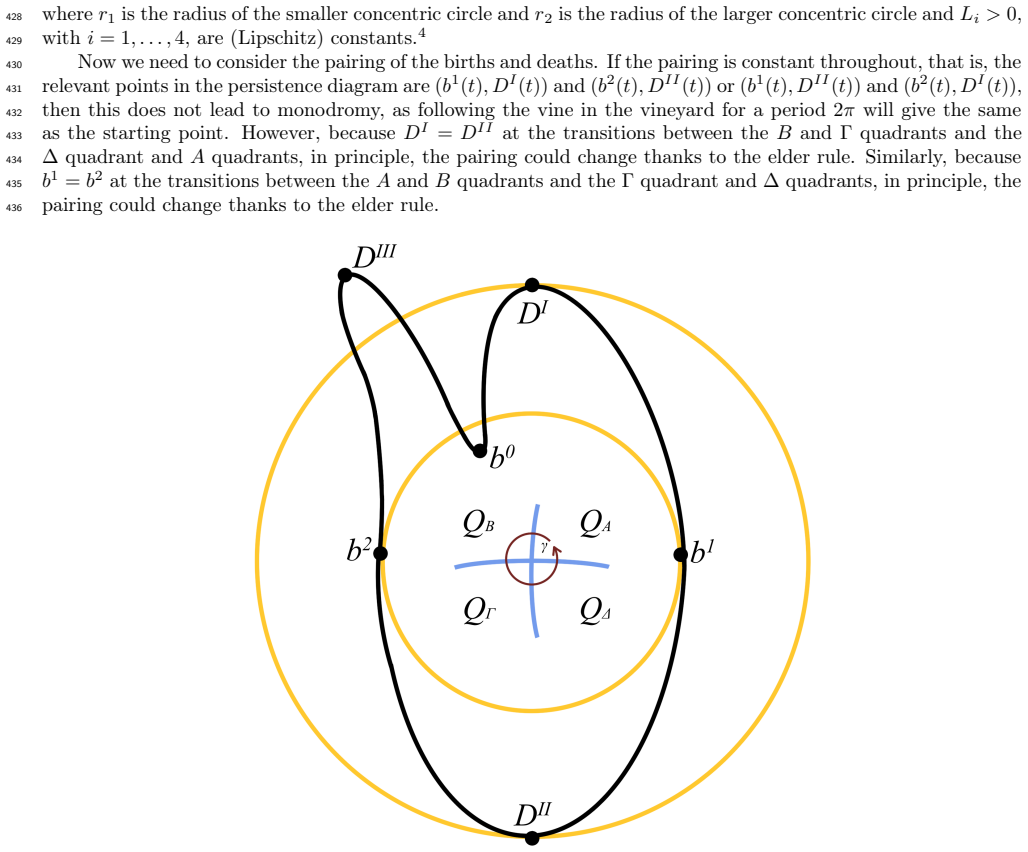
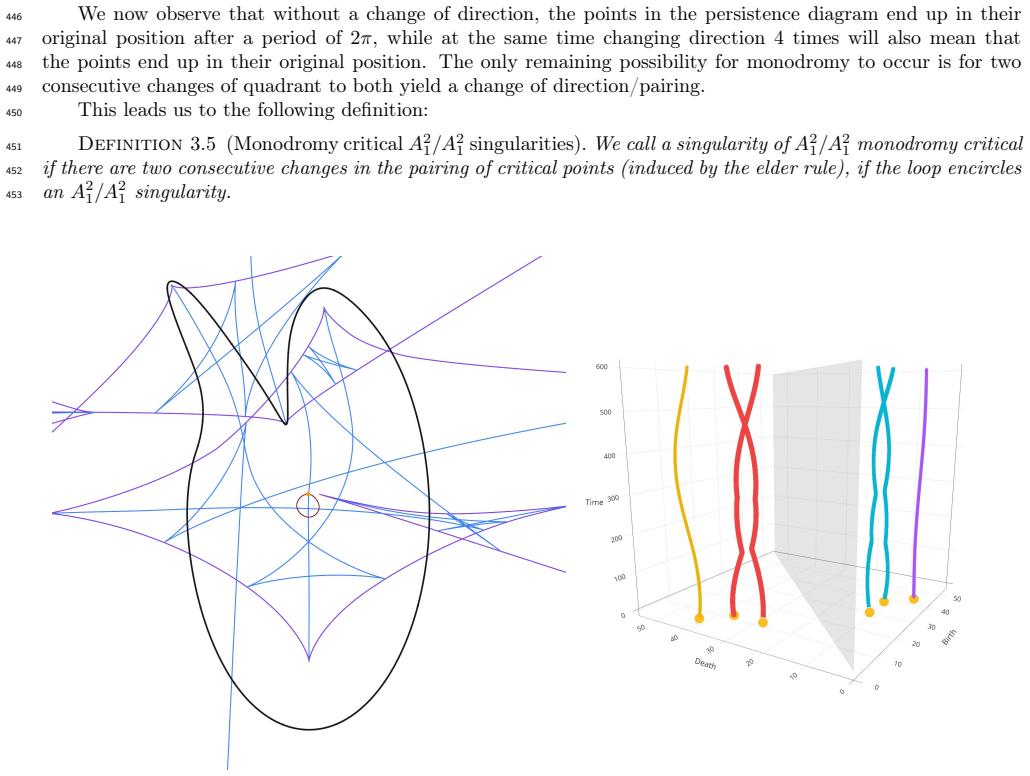
If there are contacts between circles with223 different radii, but sharing the same centre, and the manifold (curve in this case) then we indicate this by a slash,224 for exampleA 2 1/A2 1, indicates that there are two concentric circles, each of which with an ordinary contact with225 the curveM.226 Having now described the notation, we can go over the ty...
-
[2]
Agarwal, Herbert Edelsbrunner, John Harer, and Yusu Wang
Pankaj K. Agarwal, Herbert Edelsbrunner, John Harer, and Yusu Wang. Extreme elevation on a 2-638 manifold.Discrete & Computational Geometry, 36(4):553–572, Sept 2006. URL: http://dx.doi.org/10.1007/639 s00454-006-1265-8,doi:10.1007/s00454-006-1265-8.640
work page doi:10.1007/639 2006
-
[3]
N. Amenta and M. Bern. Surface reconstruction by Voronoi filtering.Discrete & Computational Geometry,641 22(4):481–504, December 1999. URL: http://dx.doi.org/10.1007/PL00009475,doi:10.1007/pl00009475.642
-
[4]
V. I. Arnold, S. M. Gusein-Zade, and A. N. Varchenko.The bifurcation sets and the monodromy group of a643 singularity, page 67–113. Birkhäuser Boston, 2012. URL: http://dx.doi.org/10.1007/978-0-8176-8343-6_3,644 doi:10.1007/978-0-8176-8343-6_3.645
-
[5]
V.I. Arnold, S.M. Gusein-Zade, and A.N. Varchenko.Singularities of Differentiable Maps, Volume 1:646 Classification of Critical Points, Caustics and Wave Fronts. Birkhäuser Boston, 2012. URL: http:647 //dx.doi.org/10.1007/978-0-8176-8340-5,doi:10.1007/978-0-8176-8340-5.648
-
[6]
Springer Science & Business Media, 2003.649
Vladimir I Arnold.Catastrophe theory. Springer Science & Business Media, 2003.649
2003
-
[7]
Springer Science & Business Media, 1998.651
Vladimir Igorevič Arnold, Victor V Goryunov, OV Lyashko, and Valerij Aleksandrovič Vasil’ev.Singularity650 theory I, volume 1. Springer Science & Business Media, 1998.651
1998
-
[8]
Singularity theory II classification652 and applications
Vladimir Igorevich Arnold, VV Goryunov, OV Lyashko, and VA Vasil’ev. Singularity theory II classification652 and applications. InDynamical Systems VIII: Singularity Theory II. Applications, pages 1–235. Springer,653 1993.654
1993
-
[9]
V. I. Arnol’d. Normal forms for functions near degenerate critical points, the Weyl groups ofa k,d k,655 ek and lagrangian singularities.Functional Analysis and Its Applications, 6(4):254–272, Oct 1972. URL:656 http://dx.doi.org/10.1007/BF01077644,doi:10.1007/bf01077644.657
-
[10]
URL: https://arxiv.org/abs/659 2408.14995,doi:10.48550/ARXIV.2408.14995.660
Shreya Arya, Barbara Giunti, Abigail Hickok, Lida Kanari, Sarah McGuire, and Katharine Turner.658 Decomposing the persistent homology transform of star-shaped objects, 2024. URL: https://arxiv.org/abs/659 2408.14995,doi:10.48550/ARXIV.2408.14995.660
-
[11]
Millman, Daniel Salinas,661 Anna Schenfisch, Jordan Schupbach, and Lucia Williams
Robin Lynne Belton, Brittany Terese Fasy, Rostik Mertz, Samuel Micka, David L. Millman, Daniel Salinas,661 Anna Schenfisch, Jordan Schupbach, and Lucia Williams. Reconstructing embedded graphs from persistence662 diagrams.Computational Geometry, 90:101658, October 2020. URL: http://dx.doi.org/10.1016/j.comgeo.663 2020.101658,doi:10.1016/j.comgeo.2020.101658.664
-
[12]
Mattia G. Bergomi and Adriano Baratè. Homological persistence in time series: an application to music665 classification.Journal of Mathematics and Music, 14(2):204–221, May 2020. URL: http://dx.doi.org/10.666 1080/17459737.2020.1786745,doi:10.1080/17459737.2020.1786745.667
-
[13]
URL: http://dx.doi.org/10.1017/9781108297806,doi:10.1017/669 9781108297806.670
Jean-Daniel Boissonnat, Frédéric Chazal, and Mariette Yvinec.Geometric and Topological Inference.668 Cambridge University Press, Sept 2018. URL: http://dx.doi.org/10.1017/9781108297806,doi:10.1017/669 9781108297806.670
-
[14]
Cambridge University Press, July 1975
Theodor Bröcker.Differentiable Germs and Catastrophes. Cambridge University Press, July 1975. Translated671 by: L. Lander. URL: http://dx.doi.org/10.1017/CBO9781107325418,doi:10.1017/cbo9781107325418.672
-
[15]
Cambridge university press, 1992.674
James William Bruce and Peter J Giblin.Curves and Singularities: a geometrical introduction to singularity673 theory. Cambridge university press, 1992.674
1992
-
[16]
Bruce, P.J
J.W. Bruce, P.J. Giblin, and C.G. Gibson. Symmetry sets.Proceedings of the Royal Society of Edinburgh:675 Section A Mathematics, 104A:179–204, 1985.676
1985
-
[17]
Dan Burghelea and Tamal K. Dey. Topological persistence for circle-valued maps.Discrete & Computational677 Geometry, 50(1):69–98, April 2013. URL: http://dx.doi.org/10.1007/s00454-013-9497-x,doi:10.1007/678 s00454-013-9497-x.679
-
[18]
A study of monodromy in the computation of680 multidimensional persistence
Andrea Cerri, Marc Ethier, and Patrizio Frosini. A study of monodromy in the computation of680 multidimensional persistence. InDiscrete Geometry for Computer Imagery, pages 192–202, Berlin,681 Heidelberg, 2013. Springer Berlin Heidelberg.682
2013
-
[19]
Counting triangulations of fixed683 cardinal degrees.Journal of Computational Geometry, 17, 2026
Erin Chambers, Tim Ophelders, Anna Schenfisch, and Julia Sollberger. Counting triangulations of fixed683 cardinal degrees.Journal of Computational Geometry, 17, 2026. URL: https://jocg.org/index.php/jocg/684 article/view/5627,doi:10.20382/JOCG.V17I1A6.685
-
[20]
Erin W. Chambers, Christopher Fillmore, Elizabeth Stephenson, and Mathijs Wintraecken.Braiding686 Vineyards, page 6240–6263. Society for Industrial and Applied Mathematics, January 2026. URL:687 http://dx.doi.org/10.1137/1.9781611978971.225,doi:10.1137/1.9781611978971.225.688
-
[21]
Bouquet: A Visualization Tool for Symmetry Sets and Vineyards
Erin Wolf Chambers, Christopher Fillmore, Shankha Shubhra Mukherjee, Rohit Roy, Elizabeth Stephenson,689 and Mathijs Wintraecken. Bouquet: A Visualization Tool for Symmetry Sets and Vineyards. InEuroCG690 2026 - 42nd European Workshop on Computational Geometry, Hagen, Germany, March 2026. URL:691 https://hal.science/hal-05546179.692
2026
-
[22]
Vines and vineyards by updating703 persistence in linear time
Frédéric Chazal and André Lieutier. Topology guaranteeing manifold reconstruction using distance function693 to noisy data. InProceedings of the twenty-second annual symposium on Computational geometry, SoCG06,694 page 112–118. ACM, 2006. URL: http://dx.doi.org/10.1145/1137856.1137876,doi:10.1145/1137856.695 1137876.696
-
[23]
David Cohen-Steiner, Herbert Edelsbrunner, and John Harer. Stability of persistence diagrams.Dis-697 crete & Computational Geometry, 37(1):103–120, December 2006. URL: http://dx.doi.org/10.1007/698 s00454-006-1276-5,doi:10.1007/s00454-006-1276-5.699
work page doi:10.1007/698 2006
-
[24]
David Cohen-Steiner, Herbert Edelsbrunner, and John Harer. Extending persistence using Poincaré and700 Lefschetz duality.Foundations of Computational Mathematics, 9(1):79–103, April 2008. URL: http:701 //dx.doi.org/10.1007/s10208-008-9027-z,doi:10.1007/s10208-008-9027-z.702
-
[25]
Vines and vineyards by updating703 persistence in linear time
David Cohen-Steiner, Herbert Edelsbrunner, and Dmitriy Morozov. Vines and vineyards by updating703 persistence in linear time. InProceedings of the twenty-second annual symposium on Computational704 geometry, SoCG06, page 119–126. ACM, June 2006. URL: http://dx.doi.org/10.1145/1137856.1137877,705 doi:10.1145/1137856.1137877.706
-
[26]
Justin Curry, Sayan Mukherjee, and Katharine Turner. How many directions determine a shape and other707 sufficiency results for two topological transforms.Transactions of the American Mathematical Society, Series708 B, 9(32):1006–1043, October 2022. URL: http://dx.doi.org/10.1090/btran/122,doi:10.1090/btran/122.709
-
[27]
James Damon. The global medial structure of regions inR3.Geometry & Topology, 10(4):2385–2429, 2006.710 doi:10.2140/gt.2006.10.2385.711
-
[28]
James Damon and Ellen Gasparovic. Medial/skeletal linking structures for multi-region configurations.712 Memoirs of the American Mathematical Society, 250, 02 2014.doi:10.1090/memo/1193.713
-
[29]
Shannon Dee Algar, Débora C. Corrêa, and David M. Walker. On detecting dynamical regime change714 using a transformation cost metric between persistent homology diagrams.Chaos: An Interdisciplinary715 Journal of Nonlinear Science, 31(12), December 2021. URL: http://dx.doi.org/10.1063/5.0073247,doi:716 10.1063/5.0073247.717
-
[30]
Cambridge University718 Press, February 2022
Tamal Krishna Dey and Yusu Wang.Computational Topology for Data Analysis. Cambridge University718 Press, February 2022. URL: http://dx.doi.org/10.1017/9781009099950,doi:10.1017/9781009099950.719
-
[31]
Springer Berlin Heidelberg,720
André Diatta and Peter Giblin.Pre-symmetry Sets of 3D Shapes, page 36–48. Springer Berlin Heidelberg,720
-
[32]
URL: http://dx.doi.org/10.1007/11577812_4,doi:10.1007/11577812_4.721
-
[33]
Springer, 1992.722
Manfredo Perdigao Do Carmo.Riemannian geometry, volume 2. Springer, 1992.722
1992
-
[34]
Edelsbrunner, Letscher, and Zomorodian. Topological persistence and simplification.Discrete & Com-723 putational Geometry, 28(4):511–533, November 2002. URL: http://dx.doi.org/10.1007/s00454-002-2885-2,724 doi:10.1007/s00454-002-2885-2.725
-
[35]
The726 Depth Poset Under Transpositions in the Filter
Herbert Edelsbrunner, Michał Lipiński, Marian Mrozek, Manuel Soriano-Trigueros, and Fedor Zimin. The726 Depth Poset Under Transpositions in the Filter. In Hee-Kap Ahn, Michael Hoffmann, and Amir Nayyeri,727 editors,42nd International Symposium on Computational Geometry (SoCG 2026), volume 367 ofLeibniz728 International Proceedings in Informatics (LIPIcs),...
work page doi:10.4230/730 2026
-
[36]
The poset of cancellations induced by gradient dynamics in a filtered Lefschetz complex
Herbert Edelsbrunner, Michał Lipiński, Marian Mrozek, and Manuel Soriano-Trigueros. The poset of732 cancellations induced by gradient dynamics in a filtered Lefschetz complex, 2023. URL: https://arxiv.org/733 abs/2311.14364,doi:10.48550/ARXIV.2311.14364.734
work page internal anchor Pith review Pith/arXiv arXiv doi:10.48550/arxiv.2311.14364.734 2023
-
[37]
Herbert Edelsbrunner, Elizabeth Stephenson, and Martin Hafskjold Thoresen. The mid-sphere cousin of735 the medial axis transform.4th International Joint Conference on Discrete Geometry and Mathematical736 Morphology, pages 133–147, 2025.doi:10.1007/978-3-032-09544-2_10.737
-
[38]
Brittany Terese Fasy, Maksym Makarchuk, Samuel Micka, and David L. Millman. Too many or too738 few? sampling bounds for topological descriptors, 2025. URL: https://arxiv.org/abs/2511.12059,doi:739 10.48550/ARXIV.2511.12059.740
-
[39]
Robert Ghrist, Rachel Levanger, and Huy Mai. Persistent homology and euler integral transforms.Journal741 of Applied and Computational Topology, 2(1–2):55–60, August 2018. URL: http://dx.doi.org/10.1007/742 s41468-018-0017-1,doi:10.1007/s41468-018-0017-1.743
work page doi:10.1007/742 2018
-
[40]
Symmetry sets and medial axes in two and three dimensions
Peter Giblin. Symmetry sets and medial axes in two and three dimensions. In Roberto Cipolla and Ralph744 Martin, editors,The Mathematics of Surfaces IX, pages 306–321, London, 2000. Springer London.745
2000
-
[41]
Peter Giblin and André Diatta. Symmetry sets and medial axes in two dimensions, 2003.746 URL: https://www.researchgate.net/profile/Peter-Giblin-2/publication/221403718_Symmetry_747 Sets_and_Medial_Axes_in_Two_and_Three_Dimensions/links/5cc0825b299bf120977d5eb5/748 Symmetry-Sets-and-Medial-Axes-in-Two-and-Three-Dimensions.pdf.749
-
[42]
Peter Giblin and Benjamin B. Kimia.Transitions of the 3D Medial Axis under a One-Parameter Family750 of Deformations, page 718–734. Springer Berlin Heidelberg, 2002. URL: http://dx.doi.org/10.1007/751 3-540-47967-8_48,doi:10.1007/3-540-47967-8_48.752
work page doi:10.1007/751 2002
-
[43]
Peter J. Giblin and Benjamin B. Kimia. On the local form and transitions of symmetry sets, medial753 axes, and shocks.International Journal of Computer Vision, 54(1-3):143–157, August 2003. URL:754 http://dx.doi.org/10.1023/A:1023761518825,doi:10.1023/a:1023761518825.755
-
[44]
DONUT: Database of Original & Non-Theoretical Uses756 of Topology, 2022
Barbara Giunti, J¯ anis Lazovskis, and Bastian Rieck. DONUT: Database of Original & Non-Theoretical Uses756 of Topology, 2022. https://donut.topology.rocks.757
2022
-
[45]
Algorithms for recognizing knots and 3-manifolds
Joel Hass. Algorithms for recognizing knots and 3-manifolds.arXiv preprint math/9712269, 1997.758
work page internal anchor Pith review Pith/arXiv arXiv 1997
-
[46]
Hofer, Roland Kwitt, and Marc Niethammer
Christoph D. Hofer, Roland Kwitt, and Marc Niethammer. Learning representations of persistence barcodes.759 Journal of Machine Learning Research, 20(126):1–45, 2019. URL: http://jmlr.org/papers/v20/18-358.html.760
2019
-
[47]
Kazuhiro Ichihara, Yuya Nishimura, and Seiichi Tani. The computational complexity of classical knot761 recognition.Journal of Knot Theory and Its Ramifications, 32(11), October 2023. URL: http://dx.doi.762 org/10.1142/S0218216523500694,doi:10.1142/s0218216523500694.763
-
[48]
Dale Koenig and Anastasiia Tsvietkova. NP–hard problems naturally arising in knot theory.Transactions of764 the American Mathematical Society, Series B, 8(15):420–441, May 2021. URL: http://dx.doi.org/10.1090/765 btran/71,doi:10.1090/btran/71.766
work page doi:10.1090/765 2021
-
[49]
A. Kuijper and O.F. Olsen. Transitions of the pre-symmetry set. InProceedings of the 17th International767 Conference on Pattern Recognition, 2004. ICPR 2004., page 190–193 Vol.3. IEEE, 2004. URL: http:768 //dx.doi.org/10.1109/ICPR.2004.1334500,doi:10.1109/icpr.2004.1334500.769
-
[50]
Springer Berlin Heidelberg, 2004
Arjan Kuijper, Ole Fogh Olsen, Peter Giblin, Philip Bille, and Mads Nielsen.From a 2D Shape to770 a String Structure Using the Symmetry Set, page 313–325. Springer Berlin Heidelberg, 2004. URL:771 http://dx.doi.org/10.1007/978-3-540-24671-8_25,doi:10.1007/978-3-540-24671-8_25.772
-
[51]
Marc Lackenby. The efficient certification of knottedness and thurston norm.Advances in Mathematics,773 387:107796, August 2021. URL: http://dx.doi.org/10.1016/j.aim.2021.107796,doi:10.1016/j.aim.2021.774 107796.775
-
[52]
PhD thesis, Universiteit van776 Amsterdam, 1974.777
Eduard Looijenga.Structural Stability of smooth families ofC ∞-functions. PhD thesis, Universiteit van776 Amsterdam, 1974.777
1974
-
[53]
Distance from a submanifold in Euclidean-space
John N Mather. Distance from a submanifold in Euclidean-space. InProceedings of symposia in pure778 mathematics, volume 40, pages 199–216. American Mathematical Society, 1983.779
1983
-
[54]
Sara Scaramuccia (04/23/25): Monodromy in bi-parameter persistence780 modules, 2025
Applied Algebraic Topology Network. Sara Scaramuccia (04/23/25): Monodromy in bi-parameter persistence780 modules, 2025. URL: https://youtu.be/14dSHjeFUoI?si=XUdRBLtG1ImwrR88.781
2025
-
[55]
Partha Niyogi, Stephen Smale, and Shmuel Weinberger. Finding the homology of submanifolds with high782 confidence from random samples.Discrete & Computational Geometry, 39(1-3):419–441, March 2008. URL:783 http://dx.doi.org/10.1007/s00454-008-9053-2,doi:10.1007/s00454-008-9053-2.784
-
[56]
Shoving tubes through shapes gives a sufficient and efficient785 shape statistic, 2024
Adam Onus, Nina Otter, and Renata Turkes. Shoving tubes through shapes gives a sufficient and efficient785 shape statistic, 2024. URL: https://arxiv.org/abs/2412.18452,doi:10.48550/ARXIV.2412.18452.786
-
[57]
Cambridge University787 Press, 2001.788
Ian R Porteous.Geometric differentiation: for the intelligence of curves and surfaces. Cambridge University787 Press, 2001.788
2001
-
[58]
Towards computing homology from approximations.Topology Proceedings, 24, 01 1999.789
Vanessa Robins. Towards computing homology from approximations.Topology Proceedings, 24, 01 1999.789
1999
-
[59]
McGraw-Hill inc., 3rd edition, 1976.790
Walter Rudin.Principles of mathematical analysis. McGraw-Hill inc., 3rd edition, 1976.790
1976
-
[60]
Stratified braid groups: monodromy, 2023
Nick Salter. Stratified braid groups: monodromy, 2023. URL: https://arxiv.org/abs/2304.04627,arXiv:791 2304.04627.792
-
[61]
Monodromy of stratified braid groups, ii.Research in the Mathematical Sciences, 11(4), October793
Nick Salter. Monodromy of stratified braid groups, ii.Research in the Mathematical Sciences, 11(4), October793
-
[62]
URL: http://dx.doi.org/10.1007/s40687-024-00477-4,doi:10.1007/s40687-024-00477-4.794
-
[63]
Stephenson
Elizabeth R. Stephenson. Generalizing medial axes with homology switches. Master’s thesis, IST Austria,795
-
[64]
URL: https://research-explorer.ista.ac.at/record/14226,doi:10.15479/AT:ISTA:14226.796
-
[65]
Representing vineyard modules.arXiv preprint arXiv:2307.06020, 2023.797
Katharine Turner. Representing vineyard modules.arXiv preprint arXiv:2307.06020, 2023.797
-
[66]
Katharine Turner, Vanessa Robins, and James Morgan. The extended persistent homology transform of798 manifolds with boundary.Journal of Applied and Computational Topology, 8(7):2111–2154, May 2024. URL:799 http://dx.doi.org/10.1007/s41468-024-00175-8,doi:10.1007/s41468-024-00175-8.800
-
[67]
On the local structure of a generic central set.Compositio Mathematica, 43(2):225–238, 1981.801 URL: http://www.numdam.org/item/CM_1981__43_2_225_0/.802
Yosef Yomdin. On the local structure of a generic central set.Compositio Mathematica, 43(2):225–238, 1981.801 URL: http://www.numdam.org/item/CM_1981__43_2_225_0/.802
1981
-
[68]
Jaejun Yoo, Eun Young Kim, Yong Min Ahn, and Jong Chul Ye. Topological persistence vineyard for803 dynamic functional brain connectivity during resting and gaming stages.Journal of Neuroscience Methods,804 267:1–13, July 2016. URL: http://dx.doi.org/10.1016/j.jneumeth.2016.04.001,doi:10.1016/j.jneumeth.805 2016.04.001.806
discussion (0)
Sign in with ORCID, Apple, or X to comment. Anyone can read and Pith papers without signing in.