Chiral enhancement of two-magnon bound states in an S=1/2 triangular-lattice magnet
Pith reviewed 2026-07-02 05:26 UTC · model grok-4.3
The pith
Scalar chirality cancels exactly for single magnons but splits and strengthens two-magnon bound states on the triangular lattice.
A machine-rendered reading of the paper's core claim, the machinery that carries it, and where it could break.
Core claim
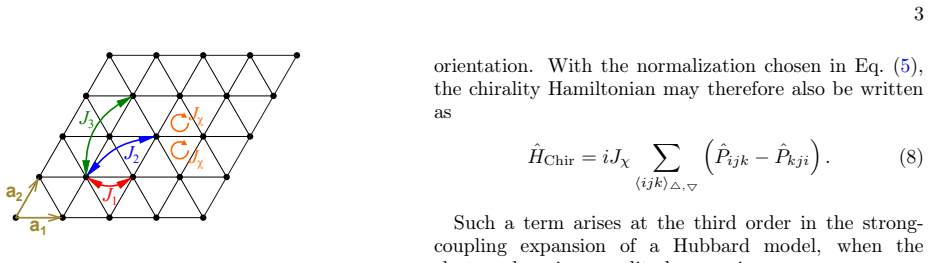
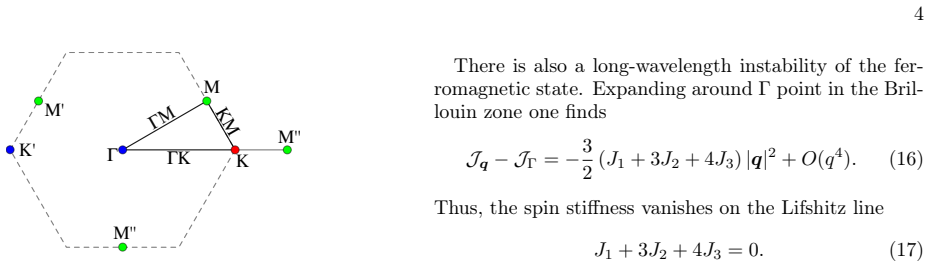
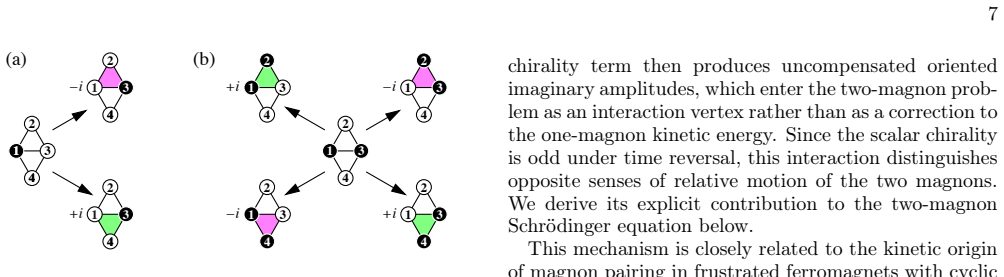
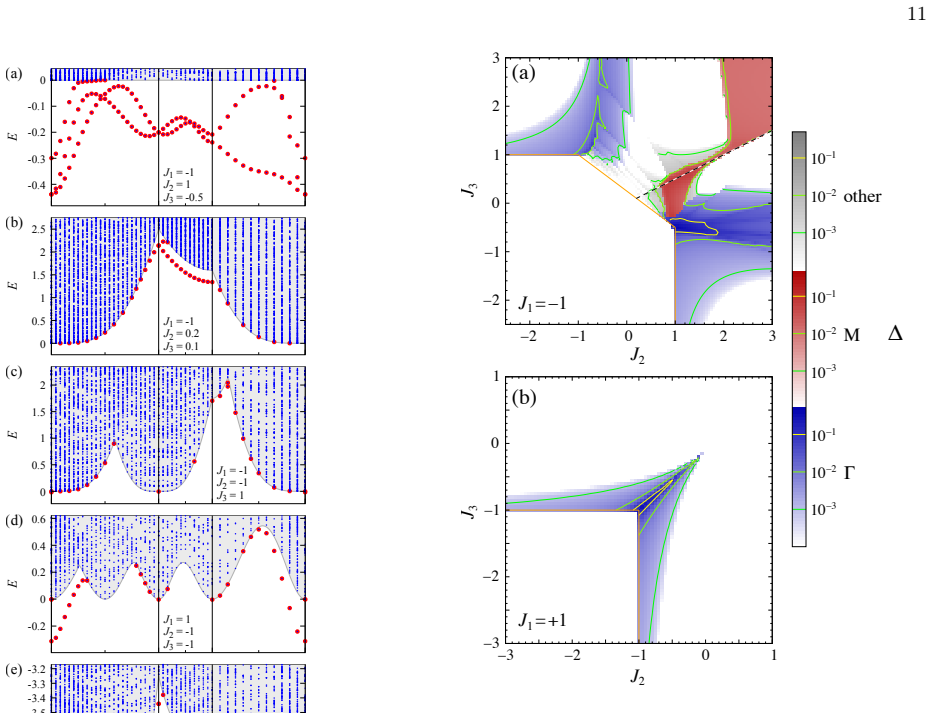
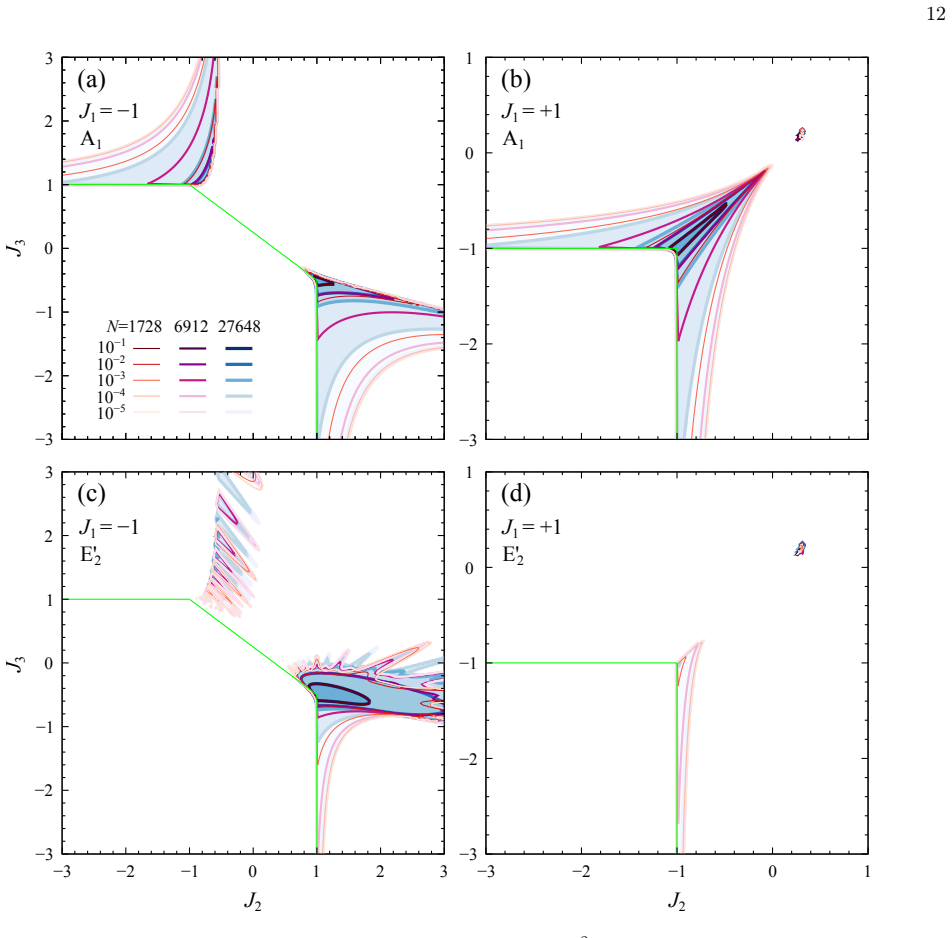
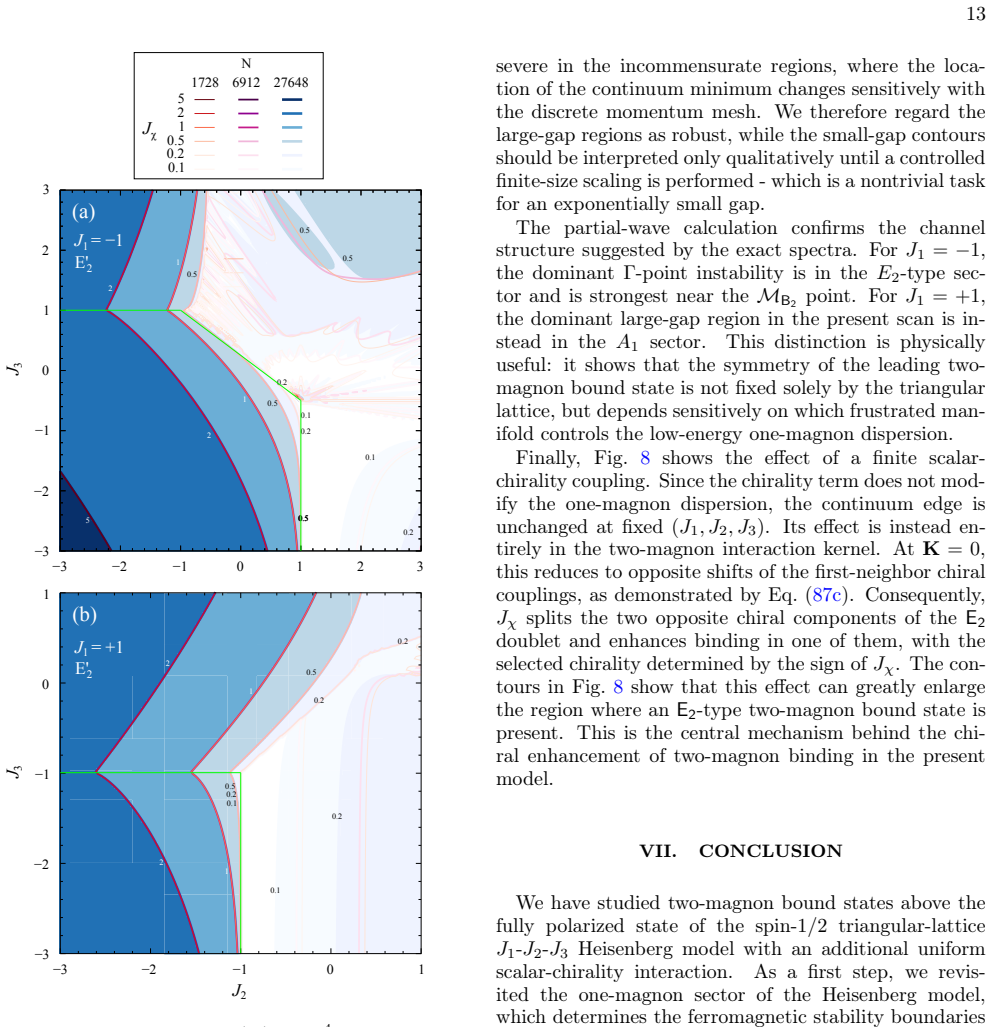
In the one-magnon sector the scalar-chirality term cancels exactly, so the dispersion and single-magnon instability remain the same as in the pure Heisenberg model. In the two-magnon sector the term acts as an oriented nearest-neighbor interaction that splits the two opposite relative-motion chiralities in the E2-type partial-wave channel and selectively enhances one bound-state channel. Finite-dimensional gap equations derived with triangular-lattice harmonics at the Gamma point capture this splitting, and exact diagonalization confirms the enhanced binding together with additional bound states at the M point and at incommensurate total momenta.
What carries the argument
Symmetry-resolved A1 and E2 partial-wave channels for the two-magnon gap equations, constructed from triangular-lattice harmonics, with the scalar-chirality term entering only as an oriented nearest-neighbor interaction between flipped spins.
If this is right
- The threshold for single-magnon instability remains fixed while two-magnon binding is strengthened.
- The E2 sector experiences a splitting of opposite chiralities that enhances binding in only one of the two channels.
- Additional two-magnon bound states appear at the M point and at incommensurate total momenta.
- The mechanism supplies a route to high-field spin-nematic and multipolar instabilities that does not alter the one-magnon spectrum.
Where Pith is reading between the lines
- Materials with intrinsic scalar chirality could host stable two-magnon bound states at magnetic fields where the one-magnon continuum is still gapped.
- The same oriented-interaction mechanism may produce analogous channel-selective enhancements in three-magnon or higher sectors on the same lattice.
- High-field neutron scattering could resolve the chiral splitting through the momentum dependence of two-magnon continua.
Load-bearing premise
The two-magnon problem at the Gamma point reduces to finite-dimensional gap equations in the symmetry-resolved A1 and E2 channels using triangular-lattice harmonics, with the scalar-chirality interaction entering solely as a nearest-neighbor oriented term.
What would settle it
A direct computation or spectroscopic measurement that finds either a shift in the one-magnon dispersion when scalar chirality is introduced or no selective enhancement and splitting of the E2 two-magnon bound-state energies at the Gamma point.
Figures
read the original abstract
We study one- and two-magnon excitations above the fully polarized state of the spin-$1/2$ triangular-lattice $J_1$-$J_2$-$J_3$ Heisenberg model with an additional uniform scalar-chirality interaction. In the one-magnon sector of the Heisenberg model, we identify two special minimum manifolds by rewriting the dispersion in complete-square form. The scalar-chirality term cancels exactly in this sector, leaving the one-magnon dispersion and the single-magnon instability unchanged. In contrast, it survives in the two-magnon sector as an oriented interaction between neighboring flipped spins. Using symmetry-adapted triangular-lattice harmonics, we derive finite-dimensional gap equations at the $\Gamma$ point in the symmetry-resolved $\mathsf{A_1}$ and $\mathsf{E_2}$-type partial-wave channels. The chirality coupling splits the two opposite relative-motion chiralities in the $\mathsf{E_2}$-type sector, thereby selectively enhancing one two-magnon bound-state channel. Exact diagonalization confirms this mechanism and reveals enhanced binding, as well as additional bound states at $M$ and at incommensurate total momenta. Our results identify scalar chirality as an efficient microscopic mechanism for strengthening two-magnon binding without shifting the one-magnon spectrum, and provide a route toward high-field spin-nematic and multipolar instabilities.
Editorial analysis
A structured set of objections, weighed in public.
Referee Report
Summary. The manuscript examines one- and two-magnon excitations above the fully polarized state of the S=1/2 J1-J2-J3 Heisenberg model on the triangular lattice with an added uniform scalar-chirality term. It reports that the chirality interaction cancels exactly in the one-magnon sector (leaving the dispersion and single-magnon instability unchanged) but survives in the two-magnon sector as a nearest-neighbor oriented interaction. Using symmetry-adapted triangular-lattice harmonics, the two-magnon problem at the Gamma point is reduced to finite-dimensional gap equations in the A1 and E2 partial-wave channels; the chirality term splits the opposite relative-motion chiralities within the E2 sector and selectively enhances one bound-state channel. Exact diagonalization is used to confirm enhanced binding and to identify additional bound states at M and incommensurate momenta.
Significance. If the symmetry reduction and exact cancellation hold, the work identifies scalar chirality as a mechanism that strengthens two-magnon binding without shifting the one-magnon spectrum, offering a route to high-field spin-nematic or multipolar instabilities. The exact cancellation in the one-magnon sector and the use of ED for cross-check are explicit strengths.
major comments (2)
- [two-magnon gap equations (Gamma point)] The central claim of selective E2-channel enhancement rests on the reduction of the two-magnon Schrödinger equation at the Gamma point to closed finite-dimensional gap equations in the A1 and E2 channels via symmetry-adapted triangular-lattice harmonics (abstract and the two-magnon analysis section). The oriented scalar-chirality interaction must not mix higher harmonics or other irreps; otherwise the reported splitting of opposite relative-motion chiralities is invalidated. Please supply the explicit basis functions, the matrix elements of the oriented term, and a demonstration that the projected equations close.
- [one-magnon sector] The statement that the scalar-chirality term 'cancels exactly' in the one-magnon sector is load-bearing for the claim that the single-magnon instability remains unchanged. The cancellation should be shown explicitly by rewriting the one-magnon dispersion (including the chirality contribution) in complete-square form and confirming that no residual term survives for any wave-vector.
minor comments (2)
- [exact diagonalization] The abstract states that ED 'confirms this mechanism'; the main text should specify the cluster sizes, boundary conditions, and momentum sectors used so that the reported additional bound states at M and incommensurate momenta can be reproduced.
- [symmetry analysis] Notation for the partial-wave channels (A1, E2) and the definition of 'relative-motion chiralities' should be introduced with a brief symmetry table or character table reference for the triangular lattice point group.
Simulated Author's Rebuttal
We thank the referee for the careful reading and for identifying points where explicit demonstrations will strengthen the manuscript. We address both major comments below and will revise the text to incorporate the requested details.
read point-by-point responses
-
Referee: [two-magnon gap equations (Gamma point)] The central claim of selective E2-channel enhancement rests on the reduction of the two-magnon Schrödinger equation at the Gamma point to closed finite-dimensional gap equations in the A1 and E2 channels via symmetry-adapted triangular-lattice harmonics (abstract and the two-magnon analysis section). The oriented scalar-chirality interaction must not mix higher harmonics or other irreps; otherwise the reported splitting of opposite relative-motion chiralities is invalidated. Please supply the explicit basis functions, the matrix elements of the oriented term, and a demonstration that the projected equations close.
Authors: We agree that the explicit basis functions, matrix elements, and closure proof will make the symmetry reduction fully transparent. In the revised manuscript we will add an appendix (or expanded subsection) listing the symmetry-adapted triangular-lattice harmonics for the A1 and E2 irreps at Gamma, tabulating the matrix elements of the oriented scalar-chirality term between these basis states, and showing that the projected two-magnon equations remain closed within each finite-dimensional subspace with no mixing to higher harmonics or other irreps. revision: yes
-
Referee: [one-magnon sector] The statement that the scalar-chirality term 'cancels exactly' in the one-magnon sector is load-bearing for the claim that the single-magnon instability remains unchanged. The cancellation should be shown explicitly by rewriting the one-magnon dispersion (including the chirality contribution) in complete-square form and confirming that no residual term survives for any wave-vector.
Authors: The manuscript already notes that the one-magnon dispersion can be rewritten in complete-square form and that the chirality term cancels exactly. To meet the referee’s request we will expand the one-magnon section to display the explicit dispersion relation that includes the scalar-chirality contribution, perform the complete-square rewriting in full, and verify algebraically that the residual term vanishes identically for arbitrary wave-vector. revision: yes
Circularity Check
No significant circularity detected
full rationale
The derivation begins from the explicit J1-J2-J3 Heisenberg Hamiltonian plus uniform scalar-chirality term. The exact cancellation of the chirality term in the one-magnon sector and its survival as a nearest-neighbor oriented interaction in the two-magnon sector are direct algebraic consequences of the Hamiltonian matrix elements. The subsequent reduction to finite-dimensional gap equations in the A1 and E2 channels at the Gamma point is performed via standard symmetry projection onto triangular-lattice harmonics; this is a conventional basis truncation whose validity is external to the result itself and does not render the reported selective enhancement equivalent to the input by construction. No fitted parameters are relabeled as predictions, and no load-bearing uniqueness theorem or ansatz is imported via self-citation. The analysis remains self-contained against the stated microscopic model.
Axiom & Free-Parameter Ledger
axioms (2)
- domain assumption The scalar-chirality interaction is uniform and enters the two-magnon sector as an oriented nearest-neighbor term.
- domain assumption The fully polarized state serves as the vacuum for magnon excitations.
Reference graph
Works this paper leans on
-
[1]
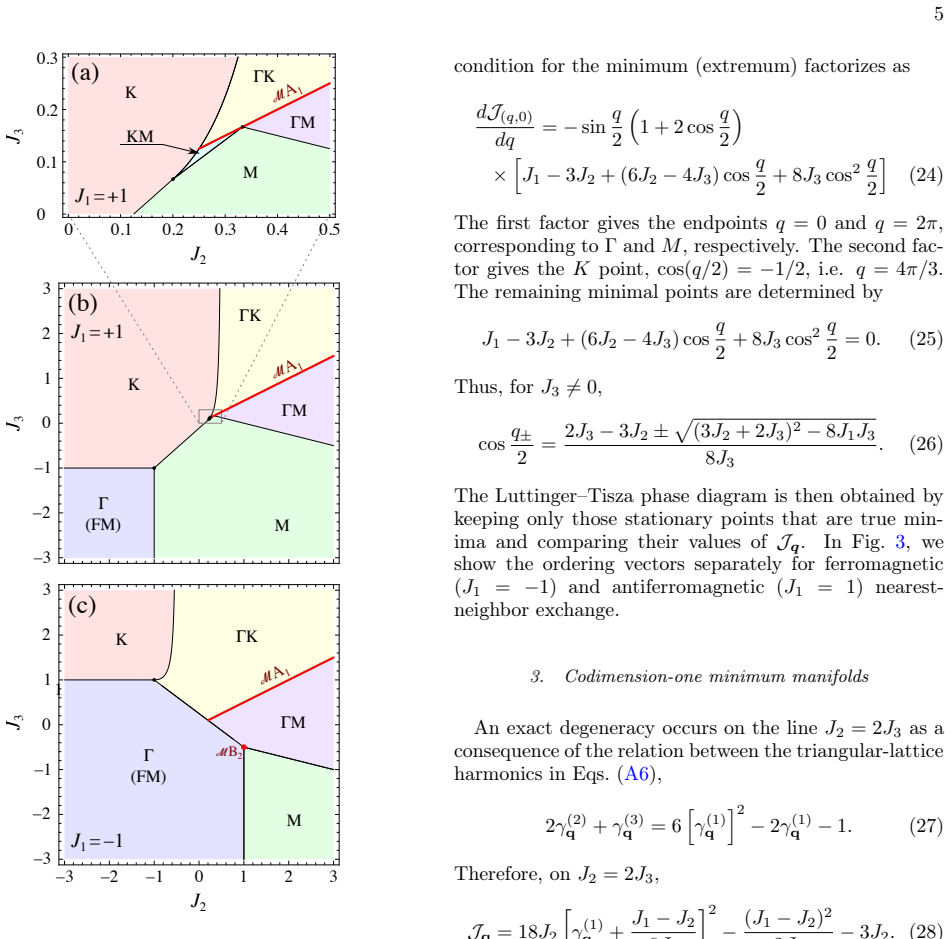
Stability of the ferromagnetic phase The ferromagnetic state corresponds to a minimum at Γ. The direct crossings with the commensurateKoccurs whenJ K =J Γ, which gives J1 +J 3 = 0.(14) Similarly, the crossing with the commensurateM-point minimum is determined byJM =J Γ, providing J1 +J 2 = 0(15) On these two boundaries, the additional soft modes are locat...
-
[2]
Commensurate and spiral phases Away from the ferromagnetic region, the ordering wave vector is obtained by comparing the local minima ofJq. The minimum at the commensurate K-point realizes the usual three-sublattice order, while the minimum at the M point is either a stripy phase (single-q) or a four- sublattice order (triple-qstructure). But the minima c...
-
[3]
Codimension-one minimum manifolds An exact degeneracy occurs on the lineJ2 = 2J3 as a consequence of the relation between the triangular-lattice harmonics in Eqs. (A6), 2γ(2) q +γ (3) q = 6 h γ(1) q i2 −2γ (1) q −1.(27) Therefore, onJ 2 = 2J3, Jq = 18J2 γ(1) q + J1 −J 2 6J2 2 − (J1 −J 2)2 2J2 −3J 2.(28) ForJ 2 >0, the coefficient of the square is positive...
-
[4]
Since ann-magnon state lowers the totalS z byn, the Zeeman term of the form given in Eq
Binding energy AboundstateatfixedtotalmomentumKoccurswhen its energyE2 lies below the lower edge of the two-magnon continuum, Emin cont(K) = min q h ε K 2 +q +ε K 2 −q i .(69) We parameterize the bound-state energy as E2 =E min cont(K)−∆,∆>0.(70) Equivalently, ifqmin minimizes the continuum energy at fixedK, then E2 =ε K 2 +qmin +ε K 2 −qmin −∆.(71) Beyon...
-
[5]
In the ferromagnetic region, the lowest two-magnon con- tinuum occurs atK= Γ
Gap equation Below, we concentrate on theK= Γtotal momentum. In the ferromagnetic region, the lowest two-magnon con- tinuum occurs atK= Γ. It is then plausible that the bound states relevant to the instability of the fully po- larized state are found at the same total momentum. We therefore setK= 0from this point on. We assume this also holds in other par...
-
[6]
PHY-2309135 to the Kavli Institute for Theoretical Physics (KITP)
This research was supported in part by the National 15 Science Foundation under Grant No. PHY-2309135 to the Kavli Institute for Theoretical Physics (KITP). We thank A. L. Chernyshev and J. Romhányi for discussions that led to this work, and N. Shannon for helpful discus- sions on spin-nematic physics. Appendix A: The triangular lattice and the lattice ha...
-
[7]
Blume and Y
M. Blume and Y. Y. Hsieh, Biquadratic exchange and quadrupolar ordering, J. Appl. Phys.40, 1249 (1969); A. F. Andreev and I. A. Grishchuk, Spin nematics, Sov. Phys. JETP60, 267 (1984)
1969
-
[8]
Penc and A
K. Penc and A. M. Läuchli, Spin Nematic Phases in Quantum Spin Systems, inIntroduction to Frustrated Magnetism: Materials, Experiments, Theory, edited by C. Lacroix, P. Mendels, and F. Mila (Springer-Verlag Berlin Heidelberg, 2011) p. 331
2011
-
[9]
A. V. Chubukov, Chiral, nematic, and dimer states in quantum spin chains, Phys. Rev. B44, 4693 (1991)
1991
-
[10]
V. Zapf, M. Jaime, and C. D. Batista, Bose-einstein con- densation in quantum magnets, Rev. Mod. Phys.86, 563 (2014)
2014
-
[11]
R. O. Kuzian and S.-L. Drechsler, Exact one- and two- particle excitation spectra of acute-angle helimagnets 17 above their saturation magnetic field, Phys. Rev. B75, 024401 (2007)
2007
-
[12]
Hikihara, L
T. Hikihara, L. Kecke, T. Momoi, and A. Furusaki, Vec- tor chiral and multipolar orders in the spin-1 2 frustrated ferromagnetic chain in magnetic field, Phys. Rev. B78, 144404 (2008)
2008
-
[13]
Sudan, A
J. Sudan, A. Lüscher, and A. M. Läuchli, Emergent mul- tipolar spin correlations in a fluctuating spiral: The frus- trated ferromagnetic spin-1/2 Heisenberg chain in a mag- netic field, Phys. Rev. B80, 140402(R) (2009)
2009
-
[14]
M. E. Zhitomirsky and H. Tsunetsugu, Magnon pairing in quantum spin nematic, Europhysics Letters92, 37001 (2010)
2010
-
[15]
Balents and O
L. Balents and O. A. Starykh, Quantum lifshitz field the- ory of a frustrated ferromagnet, Phys. Rev. Lett.116, 177201 (2016)
2016
-
[16]
Shannon, T
N. Shannon, T. Momoi, and P. Sindzingre, Nematic Or- der in Square Lattice Frustrated Ferromagnets, Phys. Rev. Lett.96, 027213 (2006)
2006
-
[17]
Iqbal, P.Ghosh, R.Narayanan, B
Y. Iqbal, P.Ghosh, R.Narayanan, B. Kumar, J. Reuther, and R. Thomale, Intertwined nematic orders in a frus- trated ferromagnet, Phys. Rev. B94, 224403 (2016)
2016
- [18]
-
[19]
Mila, Closing in on a Magnetic Analog of Liquid Crys- tals, Physics10, 64 (2017)
F. Mila, Closing in on a Magnetic Analog of Liquid Crys- tals, Physics10, 64 (2017)
2017
-
[20]
R. Nath, A. A. Tsirlin, H. Rosner, and C. Geibel, Mag- netic properties of BaCdVO(PO 4)2: A strongly frus- trated spin-1 2 square lattice close to the quantum critical regime, Phys. Rev. B78, 064422 (2008)
2008
-
[21]
L. E. Svistov, T. Fujita, H. Yamaguchi, S. Kimura, K. Omura, A. Prokofiev, A. I. Smirnov, Z. Honda, and M. Hagiwara, New high magnetic field phase of the frus- tratedS= 1/2 chain compound LiCuVO4, JETP letters 93, 21 (2011)
2011
-
[22]
Orlova, E
A. Orlova, E. L. Green, J. M. Law, D. I. Gorbunov, G. Chanda, S. Krämer, M. Horvatić, R. K. Kremer, J. Wosnitza, and G. L. J. A. Rikken, Nuclear mag- netic resonance signature of the spin-nematic phase in LiCuVO4 at high magnetic fields, Phys. Rev. Lett.118, 247201 (2017)
2017
-
[23]
Yoshida, K
M. Yoshida, K. Nawa, H. Ishikawa, M. Takigawa, M. Jeong, S. Krämer, M. Horvatić, C. Berthier, K. Mat- sui, T. Goto, S. Kimura, T. Sasaki, J. Yamaura, H. Yoshida, Y. Okamoto, and Z. Hiroi, Spin dynamics in the high-field phases of volborthite, Phys. Rev. B96, 180413(R) (2017)
2017
-
[24]
Kohama, H
Y. Kohama, H. Ishikawa, A. Matsuo, K. Kindo, N. Shan- non, and Z. Hiroi, Possible observation of quantum spin- nematic phase in a frustrated magnet, Proc. Natl. Acad. Sci. U.S.A.116, 10686 (2019)
2019
-
[25]
K. Y. Povarov, V. K. Bhartiya, Z. Yan, and A. Zheludev, Thermodynamics of a frustrated quantum magnet on a square lattice, Phys. Rev. B99, 024413 (2019)
2019
-
[26]
V. K. Bhartiya, K. Y. Povarov, D. Blosser, S. Bet- tler, Z. Yan, S. Gvasaliya, S. Raymond, E. Ressouche, K. Beauvois, J. Xu, F. Yokaichiya, and A. Zheludev, Pre- saturation phase with no dipolar order in a quantum ferro-antiferromagnet, Phys. Rev. Research1, 033078 (2019)
2019
-
[27]
Landolt, S
F. Landolt, S. Bettler, Z. Yan, S. Gvasaliya, A. Zhe- ludev, S. Mishra, I. Sheikin, S. Krämer, M. Horvatić, A. Gazizulina, and O. Prokhnenko, Presaturation phase in the frustrated ferro-antiferromagnetPb 2VO(PO4)2, Phys. Rev. B102, 094414 (2020)
2020
-
[28]
K. M. Ranjith, F. Landolt, S. Raymond, A. Zheludev, and M. Horvatić, NMR evidence against a spin-nematic nature of the presaturation phase in the frustrated mag- netSrZnVO(PO 4)2, Phys. Rev. B105, 134429 (2022)
2022
-
[29]
Flavián, S
D. Flavián, S. Hayashida, L. Huberich, D. Blosser, K. Y. Povarov, Z. Yan, S. Gvasaliya, and A. Zhe- ludev, Magnetic phase diagram of the linear quantum ferro-antiferromagnetCs 2Cu2Mo3O12,Phys.Rev.B101, 224408 (2020)
2020
-
[30]
R. K. Kaul, Spin nematic ground state of the triangular lattices= 1biquadratic model, Phys. Rev. B86, 104411 (2012)
2012
-
[31]
Völl and S
A. Völl and S. Wessel, Spin dynamics of the bilinear- biquadratics= 1heisenberg model on the triangular lattice: A quantum monte carlo study, Phys. Rev. B91, 165128 (2015)
2015
-
[32]
A.SmeraldandN.Shannon,Theoryofspinexcitationsin a quantum spin-nematic state, Phys. Rev. B88, 184430 (2013)
2013
-
[33]
B. S. Shastry and B. I. Shraiman, Theory of raman scat- tering in mott-hubbard systems, Phys. Rev. Lett.65, 1068 (1990)
1990
-
[34]
Michaud, F
F. Michaud, F. Vernay, and F. Mila, Theory of inelastic light scattering in spin-1 systems: Resonant regimes and detection of quadrupolar order, Phys. Rev. B84, 184424 (2011)
2011
-
[35]
Ko, Z.-X
W.-H. Ko, Z.-X. Liu, T.-K. Ng, and P. A. Lee, Raman signature of the u(1) dirac spin-liquid state in the spin-1 2 kagome system, Phys. Rev. B81, 024414 (2010)
2010
-
[36]
Probing Hidden Orders with Resonant Inelastic X-Ray Scattering
L. Savary and T. Senthil, Probing hidden orders with res- onant inelastic x-ray scattering (2015), arXiv:1506.04752 [cond-mat.str-el]
work page internal anchor Pith review Pith/arXiv arXiv 2015
-
[37]
A. Nag, A. Nocera, S. Agrestini, M. Garcia-Fernandez, A. C. Walters, S.-W. Cheong, S. Johnston, and K.-J. Zhou, Quadrupolar magnetic excitations in an isotropic spin-1 antiferromagnet, Nature Communications13, 2327 (2022)
2022
-
[38]
Kim, J.-K
H. Kim, J.-K. Kim, J. Kwon, J. Kim, H.-W. J. Kim, S. Ha, K. Kim, W. Lee, J. Kim, G. Y. Cho, H. Heo, J. Jang, C. J. Sahle, A. Longo, J. Strempfer, G. Fabbris, Y. Choi, D. Haskel, J. Kim, J. W. Kim, and B. J. Kim, Quantum spin nematic phase in a square-lattice iridate, Nature625, 264 (2024)
2024
-
[39]
T. Arima, Ferroelectricity induced by proper- screw type magnetic order, Journal of the Physical Society of Japan76, 073702 (2007), https://doi.org/10.1143/JPSJ.76.073702
-
[40]
Akaki, D
M. Akaki, D. Yoshizawa, A. Okutani, T. Kida, J. Romhányi, K. Penc, and M. Hagiwara, Direct ob- servation of spin-quadrupolar excitations insr 2coge2o7 by high-field electron spin resonance, Phys. Rev. B96, 214406 (2017)
2017
-
[41]
Kalmeyer and R
V. Kalmeyer and R. B. Laughlin, Equivalence of the resonating-valence-bond and fractional quantum hall states, Phys. Rev. Lett.59, 2095 (1987); X. G. Wen, F. Wilczek, and A. Zee, Chiral spin states and supercon- ductivity, Phys. Rev. B39, 11413 (1989)
2095
-
[42]
A. Wietek and A. M. Läuchli, Chiral spin liquid and quantum criticality in extendeds= 1/2heisenberg mod- els on the triangular lattice, Phys. Rev. B95, 035141 (2017), arXiv:1604.07829 [cond-mat.str-el]. 18
work page internal anchor Pith review Pith/arXiv arXiv 2017
- [43]
- [44]
-
[45]
T. Cookmeyer, J. Motruk, and J. E. Moore, Four-spin terms and the origin of the chiral spin liquid in mott insulators on the triangular lattice, Phys. Rev. Lett.127, 087201 (2021), arXiv:2103.07438 [cond-mat.str-el]
- [46]
-
[47]
Exact ground states with deconfined gapless excitations for the 3 leg spin-1/2 tube
T. Momoi, P. Sindzingre, and K. Kubo, Spin nematic order in multiple-spin exchange models on the trian- gular lattice, Phys. Rev. Lett.108, 057206 (2012), arXiv:1107.5501 [cond-mat.str-el]
work page internal anchor Pith review Pith/arXiv arXiv 2012
-
[48]
Läuchli, F
A. Läuchli, F. Mila, and K. Penc, Quadrupolar phases of thes= 1bilinear-biquadratic heisenberg model on the triangular lattice, Phys. Rev. Lett.97, 087205 (2006)
2006
-
[49]
H. Tsunetsugu and M. Arikawa, Spin nematic phase in s=1 triangular antiferromagnets, Journal of the Physical Society of Japan75, 083701 (2006), https://doi.org/10.1143/JPSJ.75.083701
-
[50]
Bhattacharjee, V
S. Bhattacharjee, V. B. Shenoy, and T. Senthil, Possible ferro-spin nematic order inNiga 2s4, Phys. Rev. B74, 092406 (2006)
2006
-
[51]
S. Nakatsuji, Y. Nambu, H. Tonomura, O. Sakai, S. Jonas, C. Broholm, H. Tsunet- sugu, Y. Qiu, and Y. Maeno, Spin disorder on a triangular lattice, Science309, 1697 (2005), https://www.science.org/doi/pdf/10.1126/science.1114727
-
[52]
Sheng, J.-W
J. Sheng, J.-W. Mei, L. Wang, X. Xu, W. Jiang, L. Xu, H. Ge, N. Zhao, T. Li, A. Candini, B. Xi, J. Zhao, Y. Fu, J. Yang, Y. Zhang, G. Biasiol, S. Wang, J. Zhu, P. Miao, X. Tong, D. Yu, R. Mole, Y. Cui, L. Ma, Z. Zhang, Z. Ouyang, W. Tong, A. Podlesnyak, L. Wang, F. Ye, D. Yu, W. Yu, L. Wu, and Z. Wang, Bose–einstein con- densation of a two-magnon bound st...
2025
-
[53]
Sheng, J
J. Sheng, J. Hu, L. Xu, L. Wang, X. Shi, R. Chi, D. Yu, A. Podlesnyak, P. Piyawongwatthana, N. Murai, S. Ohira-Kawamura, H. Yuan, L. Wang, J.-W. Mei, H.-J. Liao, T. Xiang, L. Wu, and Z. Wang, Possible observa- tion of quadrupole waves in spin nematics, Phys. Rev. Lett.135, 156704 (2025)
2025
-
[54]
O. I. Motrunich, Orbital magnetic field effects in spin liquid with spinon fermi sea: Possible application toκ- (et)2cu2(cn)3, Phys. Rev. B73, 155115 (2006)
2006
-
[55]
Khomskii, Electronic orbital currents and polarization in mott insulators, Phys
L.N.Bulaevskii, C.D.Batista, M.V.Mostovoy,andD.I. Khomskii, Electronic orbital currents and polarization in mott insulators, Phys. Rev. B78, 024402 (2008)
2008
-
[56]
Messio, C
L. Messio, C. Lhuillier, and G. Misguich, Lattice symme- tries and regular magnetic orders in classical frustrated antiferromagnets, Phys. Rev. B83, 184401 (2011)
2011
-
[57]
Mohylna, F
M. Mohylna, F. A. Gómez Albarracín, M. Žukovič, and H. D. Rosales, Spontaneous antiferromagnetic skyrmion/antiskyrmion lattice and spiral spin-liquid states in the frustrated triangular lattice, Phys. Rev. B 106, 224406 (2022)
2022
-
[58]
Okubo, S
T. Okubo, S. Chung, and H. Kawamura, Multiple-q states and the skyrmion lattice of the triangular-lattice heisenberg antiferromagnet under magnetic fields, Phys. Rev. Lett.108, 017206 (2012)
2012
-
[59]
A. O. Leonov and M. Mostovoy, Multiply periodic states and isolated skyrmions in an anisotropic frustrated mag- net, Nature Communications6, 8275 (2015)
2015
-
[60]
Balla, Y
P. Balla, Y. Iqbal, and K. Penc, Affine lattice construc- tion of spiral surfaces in frustrated heisenberg models, Phys. Rev. B100, 140402 (2019)
2019
-
[61]
Shannon, T
N. Shannon, T. Momoi, and P. Sindzingre, Nematic or- der in square lattice frustrated ferromagnets, Phys. Rev. Lett.96, 027213 (2006)
2006
-
[62]
Wortis, Bound States of Two Spin Waves in The Heisenberg Ferromagnet, Phys
M. Wortis, Bound States of Two Spin Waves in The Heisenberg Ferromagnet, Phys. Rev.132, 85 (1963)
1963
-
[63]
Hanus, Bound states in the heisenberg ferromagnet, Phys
J. Hanus, Bound states in the heisenberg ferromagnet, Phys. Rev. Lett.11, 336 (1963)
1963
-
[64]
D. C. Mattis,The Theory of Magnetism Made Simple: An Introduction to Physical Concepts and to Some Use- ful Mathematical Methods(World Scientific, Singapore, 2006)
2006
-
[65]
Momoi and N
T. Momoi and N. Shannon, Nematic Order in the Multiple-Spin Exchange Model on the Triangular Lat- tice, Prog. Theor. Phys.159, 72 (2005)
2005
-
[66]
Shannon, B
N. Shannon, B. Schmidt, K. Penc, and P. Thalmeier, Finite temperature properties and frustrated ferromag- netism in a square lattice heisenberg model, The Euro- pean Physical Journal B - Condensed Matter and Com- plex Systems38, 599 (2004)
2004
discussion (0)
Sign in with ORCID, Apple, or X to comment. Anyone can read and Pith papers without signing in.