Sharp Lower Bounds for Sumsets in Hypercubes
Pith reviewed 2026-07-03 19:52 UTC · model grok-4.3
The pith
Sumsets of n subsets inside an m-hypercube obey a sharp lower bound |A1+⋯+An| ≥ (|A1|⋯|An|)^{1/p} with p = n log(m+1)/log(nm+1).
A machine-rendered reading of the paper's core claim, the machinery that carries it, and where it could break.
Core claim
For any sets A_j ⊆ {0,1,…,m}^d the inequality |A1+⋯+An| ≥ (|A1|⋯|An|)^{1/p} holds with p = n log(m+1)/log(nm+1), and the exponent is best possible. The same conclusion holds when the upper limits m_j are allowed to differ across the sets. This follows from a stronger functional inequality on sup-convolutions that is proved via a mixed-volume representation of the lattice-path norm together with a sharp one-dimensional inequality.
What carries the argument
Mixed-volume representation of the lattice-path norm together with a sharp one-dimensional functional inequality on Z.
If this is right
- The bound remains valid when each set A_j is confined to its own hypercube {0,…,m_j}^d.
- The exponent p cannot be replaced by any smaller number while keeping the inequality true for all choices of sets.
- The inequality specializes to the known sharp results when m=1 for any n and when m=2 and n=2.
Where Pith is reading between the lines
- The mixed-volume approach may extend to other discrete Brunn-Minkowski-type statements on product sets.
- Small explicit examples in low dimension and small m can be checked computationally to verify the bound saturates.
- The functional form may yield new inequalities for the support size of convolutions of arbitrary nonnegative functions rather than just indicators.
Load-bearing premise
A sharp one-dimensional functional inequality holds for the relevant functions on the integers.
What would settle it
Explicit sets A_j inside {0,…,m}^d whose sumset has cardinality strictly smaller than the right-hand side for the stated p would falsify the claim.
Figures
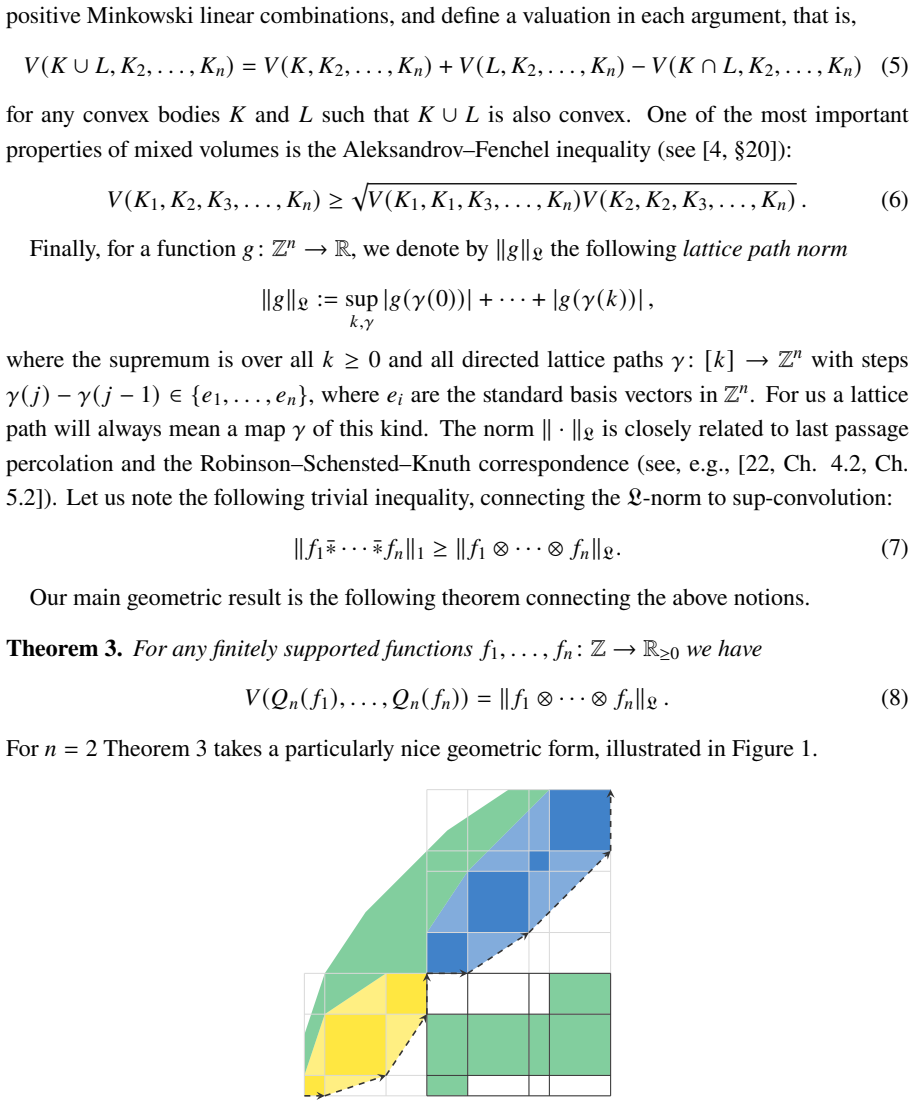
read the original abstract
We prove a sharp lower bound for the cardinality of sumsets of subsets of $\mathbb{Z}^d$ confined to a hypercube, resolving in strong form a conjecture that was made explicit by Becker, Ivanisvili, Krachun and Madrid and had circulated in the folklore of the field for some time. Specifically, for sets $A_j\subseteq \{0,1,2,\dots,m\}^d$ we show that \[|A_1+\dots+A_n|\;\geq\; (|A_1|\cdots|A_n|)^{1/p},\qquad p=\frac{n\log(m+1)}{\log(nm+1)},\] with the exponent best possible. The only previously known sharp cases were $A_j\subseteq \{0,1\}^d$, for all $n\ge1$, and $A_j\subseteq \{0,1,2\}^d$ for $n=2$. We also prove a sharp inequality in the case when $A_j\subseteq\{0,1,\dots,m_j\}^d$ for different $m_j$. We obtain the above inequality as a corollary of a stronger result on sup-convolution of functions on $\mathbb{Z}^d$, whose proof is based on a novel mixed volume representation of a lattice path norm, together with a sharp one-dimensional functional inequality.
Editorial analysis
A structured set of objections, weighed in public.
Referee Report
Summary. The paper proves sharp lower bounds on sumset cardinalities for subsets A_j of the hypercube {0,1,...,m}^d in Z^d: |A1+⋯+An| ≥ (|A1|⋯|An|)^{1/p} with p = n log(m+1)/log(nm+1), and shows the exponent is optimal. It also treats the case of distinct m_j. The result is obtained as a corollary of a stronger sup-convolution inequality for functions on Z^d, derived from a novel mixed-volume representation of the lattice-path norm combined with a sharp one-dimensional functional inequality on Z.
Significance. If correct, the result resolves a folklore conjecture in additive combinatorics with the first sharp bounds for general m beyond the cases m=1 (all n) and m=2 (n=2). The mixed-volume approach to the lattice-path norm constitutes a methodological advance with potential for further applications in discrete geometry and inequalities.
major comments (2)
- [Proof of the sup-convolution inequality (via mixed-volume representation and 1D inequality)] The central claim rests on transferring the mixed-volume representation of the lattice-path norm to a strict lower bound on discrete sumset cardinalities via the 1D functional inequality. The manuscript must supply an explicit discretization or approximation argument (with error term shown to vanish in the relevant regime) to confirm that the inequality passes to the indicator functions of the sets A_j without loss of sharpness; this step is load-bearing for both the inequality and the optimality statement.
- [Sharpness / equality cases] Equality cases are asserted to arise exactly from the 1D construction. The interaction between the mixed-volume representation and the support constraints {0,…,m}^d must be verified to ensure that the extremal examples in the hypercube achieve equality without additional discretization error; otherwise the sharpness claim requires adjustment.
minor comments (2)
- Clarify the precise statement of the one-dimensional functional inequality (including the class of functions to which it applies) and its proof, as this is invoked as a black box for the higher-dimensional result.
- Add a short comparison table or paragraph contrasting the new exponent with the previously known sharp cases (m=1 and m=2, n=2) to highlight the improvement.
Simulated Author's Rebuttal
We thank the referee for the careful reading and positive assessment of the significance of the results. We address the major comments point by point below.
read point-by-point responses
-
Referee: [Proof of the sup-convolution inequality (via mixed-volume representation and 1D inequality)] The central claim rests on transferring the mixed-volume representation of the lattice-path norm to a strict lower bound on discrete sumset cardinalities via the 1D functional inequality. The manuscript must supply an explicit discretization or approximation argument (with error term shown to vanish in the relevant regime) to confirm that the inequality passes to the indicator functions of the sets A_j without loss of sharpness; this step is load-bearing for both the inequality and the optimality statement.
Authors: The mixed-volume representation is developed directly for the lattice-path norm on the discrete group Z^d, and the sup-convolution inequality is proved for arbitrary nonnegative functions on Z^d. The one-dimensional functional inequality holds exactly on Z. Indicator functions of subsets A_j ⊆ {0,…,m}^d are admissible inputs, so the passage to the sumset cardinality bound is immediate and exact, with no approximation or discretization step required. We will insert a short clarifying paragraph after the statement of the functional inequality to make this direct applicability explicit. revision: partial
-
Referee: [Sharpness / equality cases] Equality cases are asserted to arise exactly from the 1D construction. The interaction between the mixed-volume representation and the support constraints {0,…,m}^d must be verified to ensure that the extremal examples in the hypercube achieve equality without additional discretization error; otherwise the sharpness claim requires adjustment.
Authors: The extremal configurations are obtained by taking identical one-dimensional extremal sets in each coordinate; these sets lie inside {0,…,m} and therefore inside the hypercube. Because both the mixed-volume identity and the one-dimensional inequality are exact equalities on Z, the resulting functions on Z^d attain equality in the sup-convolution inequality with no error term. We will add an explicit verification of equality attainment (including the coordinate-wise construction) in the revised manuscript. revision: yes
Circularity Check
No circularity: derivation relies on independent mixed-volume representation and 1D inequality
full rationale
The paper derives the sumset bound as a corollary of a sup-convolution inequality obtained from a novel mixed-volume representation of the lattice-path norm plus a sharp 1D functional inequality on Z. These steps are presented as external to the target cardinality result, with no reduction of the final inequality to fitted parameters, self-definitions, or self-citation chains. The exponent is shown best possible via explicit equality cases, and the argument is self-contained against the stated conjecture without importing uniqueness theorems or ansatzes from prior self-work. No load-bearing step reduces by construction to the input data or target claim.
Axiom & Free-Parameter Ledger
Reference graph
Works this paper leans on
-
[1]
Becker, P
L. Becker, P. Ivanisvili, D. Krachun and J. Madrid, Discrete Brunn–Minkowski inequality for subsets of the cube, Combinatorica 45 (2025), no. 48
2025
- [2]
-
[3]
J.Bourgain,S.J.Dilworth,K.Ford,S.KonyaginandD.Kutzarova,ExplicitconstructionsofRIPmatrices and related problems, Duke Math. J. 159 (2011), no. 1, 145–185
2011
-
[4]
Yu. D. Burago and V. A. Zalgaller, Geometric inequalities, Grundlehren Math. Wiss., vol. 285, Springer- Verlag, Berlin, 1988
1988
-
[5]
1, 87–94
G.Brown,M.S.Keane,W.MoranandC.E.M.Pierce,Aninequality,withapplicationstoCantormeasures and normal numbers, Mathematika 35 (1988), no. 1, 87–94
1988
-
[6]
J.Cilleruelo,I.Z.RuzsaandC.Vinuesa,GeneralizedSidonsets,Adv.Math.225(2010),no.5,2786–2807
2010
-
[7]
de Dios, R
J. de Dios, R. Greenfeld, P. Ivanisvili and J. Madrid, Additive energies on discrete cubes, Discrete Anal. (2023), no. 13, 16 pp
2023
-
[8]
Fradelizi and O
M. Fradelizi and O. Guédon, A generalized localization theorem and geometric inequalities for convex bodies, Adv. Math. 204 (2006), no. 2, 509–529
2006
- [9]
-
[10]
Green, Waring’s problem with restricted digits, preprint (2023), arXiv:2309.09383
B. Green, Waring’s problem with restricted digits, preprint (2023), arXiv:2309.09383
-
[11]
Green and T
B. Green and T. Tao, Compressions, convex geometry and the Freiman–Bilu theorem, Q. J. Math. 57 (2006), no. 4, 495–504
2006
-
[12]
3, 205–214
D.HajelaandP.Seymour,Countingpointsinhypercubesandconvolutionmeasurealgebras,Combinator- ica 5 (1985), no. 3, 205–214
1985
-
[13]
Bellman partial differential equation and the hill property for classical isoperimetric problems
P. Ivanisvili and A. Volberg, Bellman partial differential equation and the hill property for classical isoperimetric problems, preprint (2015), arXiv:1506.03409
work page internal anchor Pith review Pith/arXiv arXiv 2015
-
[14]
H. J. Landau, B. F. Logan and L. A. Shepp, An inequality conjectured by Hajela and Seymour arising in combinatorial geometry, Combinatorica 5 (1985), no. 4, 337–342. 20
1985
-
[15]
Kane and T
D. Kane and T. Tao, A bound on partitioning clusters, Electron. J. Combin. 24 (2017), no. 2, P2.31
2017
-
[16]
L. A. Lyusternik, Convex figures and polyhedra, Dover Publications, New York, 1963
1963
-
[17]
Madiman, P
M. Madiman, P. Nayar and T. Tkocz, Sharp moment-entropy inequalities and capacity bounds for sym- metric log-concave distributions, IEEE Trans. Inform. Theory 67 (2021), no. 1, 81–94
2021
-
[18]
Matolcsi, I
D. Matolcsi, I. Z. Ruzsa, G. Shakan and D. Zhelezov, An analytic approach to cardinalities of sumsets, Combinatorica 42 (2022), no. 1, 71–85
2022
-
[19]
Melbourne, P
J. Melbourne, P. Nayar and C. Roberto, Minimum entropy of a log-concave variable with fixed variance, Probab. Theory Related Fields (2025)
2025
-
[20]
2, Teubner, Leipzig-Berlin, 1911, pp
H.Minkowski,TheoriederkonvexenKörper,insbesondereBegründungihresOberflächenbegriffs,Gesam- melte Abhandlungen, vol. 2, Teubner, Leipzig-Berlin, 1911, pp. 131–229
1911
-
[21]
Páles, Inequalities for differences of powers, J
Z. Páles, Inequalities for differences of powers, J. Math. Anal. Appl. 131 (1988), 271–281
1988
-
[22]
Romik, The surprising mathematics of longest increasing subsequences, Cambridge University Press, Cambridge, 2015
D. Romik, The surprising mathematics of longest increasing subsequences, Cambridge University Press, Cambridge, 2015
2015
-
[23]
R.Schneider,Convexbodies: theBrunn–Minkowskitheory,2nded.,EncyclopediaMath.Appl.,vol.151, Cambridge University Press, Cambridge, 2014
2014
-
[24]
A 31 (1981), no
R.P.Stanley,TwocombinatorialapplicationsoftheAleksandrov–Fenchelinequalities,J.Combin.Theory Ser. A 31 (1981), no. 1, 56–65
1981
-
[25]
Tao and V
T. Tao and V. Vu, Additive combinatorics, Cambridge Stud. Adv. Math., vol. 105, Cambridge University Press, Cambridge, 2006
2006
-
[26]
D. R. Woodall, A theorem on cubes, Mathematika 24 (1977), 60–62. IMPA - Instituto de Matemática Pura e Aplicada, Rio de Janeiro, 22460-320, Brazil. Email address:goncalves@impa.br Institut des Hautes Études Scientifiques, CNRS, Laboratoire Alexander Grothendieck, 35 route de Chartres, Bures-sur- Yvette 91440, France Email address:danradchenko@gmail.com 21
1977
discussion (0)
Sign in with ORCID, Apple, or X to comment. Anyone can read and Pith papers without signing in.