An unsupervised kernel norm monitoring for fault detection in a time series photovoltaic system
Pith reviewed 2026-07-03 00:40 UTC · model grok-4.3
The pith
Kernel norm monitoring identifies photovoltaic faults at 99.1 percent accuracy using only normal operation data.
A machine-rendered reading of the paper's core claim, the machinery that carries it, and where it could break.
Core claim
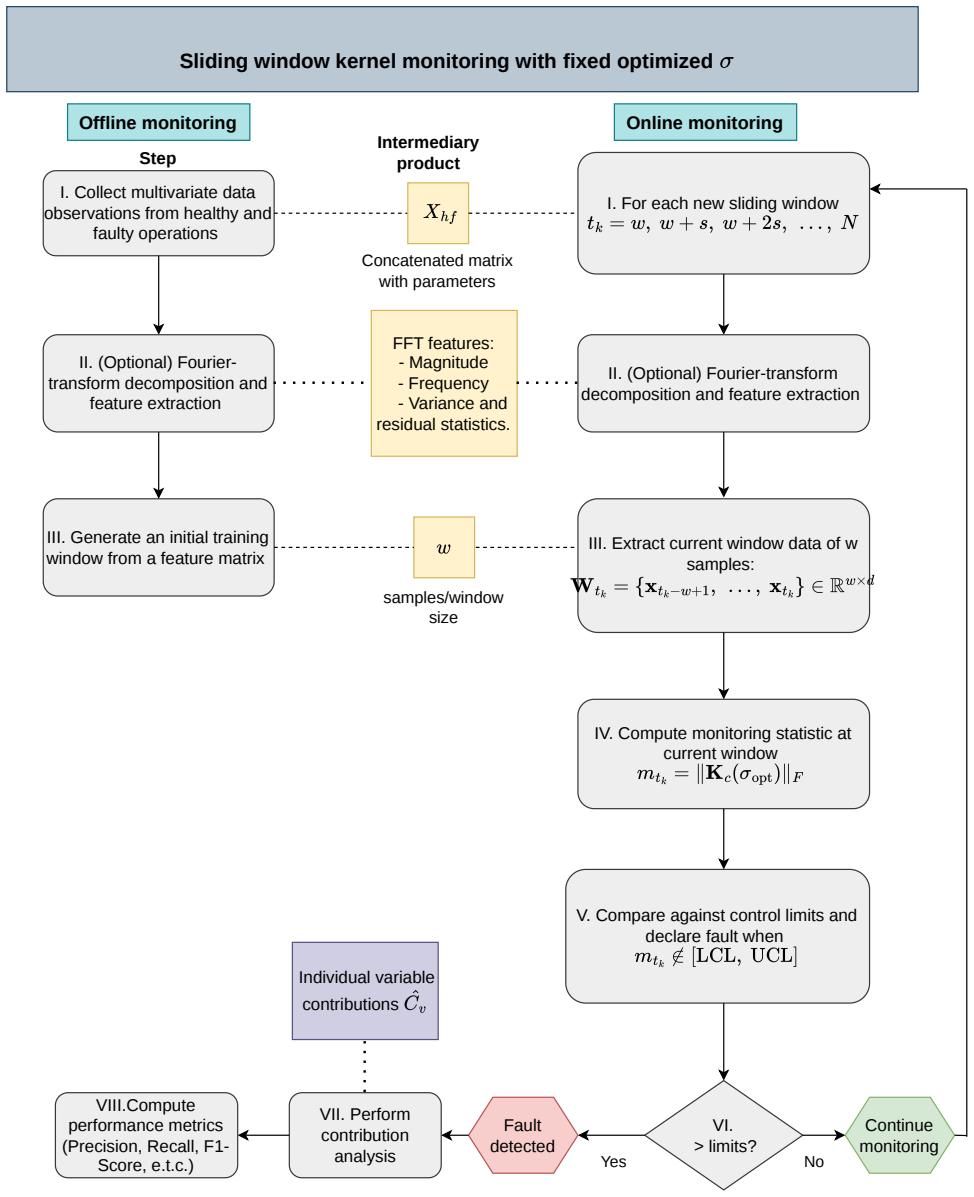
KNM is a non-linear, window-based, unsupervised fault-detection method that computes anomaly scores from the norm in the reproducing kernel Hilbert space induced by a chosen kernel function. When applied to the Grid-connected PV System Faults dataset, it achieves up to 99.1 percent accuracy for sensor faults and 98.3 percent for partial shading using the Cauchy kernel, surpassing the 93.5 percent of the strongest baseline while requiring no labeled fault examples or prior knowledge of the fault regime. The method is presented as a general-purpose monitoring framework for continuous industrial processes.
What carries the argument
kernel-based norm monitoring (KNM), a window-based procedure that maps observations through a kernel and tracks the norm of the resulting feature vectors to produce anomaly scores
If this is right
- KNM operates without labeled fault examples or knowledge of the fault regime.
- The Cauchy kernel produces the highest reported accuracies among the kernels examined.
- Variable contribution plots can be derived to identify which input variables drive each detection.
- The framework is positioned as applicable to other continuous industrial time series beyond photovoltaic systems.
Where Pith is reading between the lines
- - Hyperparameters chosen without fault knowledge imply the method could be deployed on new installations with minimal configuration.
- - If the norm-based scoring remains stable across kernels, KNM may reduce the tuning burden compared with other unsupervised detectors.
- - Extending the evaluation to additional fault modes or operating conditions would test how far the reported accuracies generalize.
Load-bearing premise
The kernel hyperparameters in KNM can be set without any prior knowledge of the fault regime, allowing truly unsupervised operation on new data.
What would settle it
Applying the same hyperparameter selection rule to an independent photovoltaic time series and checking whether accuracy on the same two fault types remains above the best benchmark level.
Figures



read the original abstract
Grid-connected photovoltaic systems (GCPVS) are generally robust but remain susceptible to faults that can compromise energy conversion efficiency or raise safety concerns. Promptly and automatically detecting such anomalies is therefore essential for maintaining system reliability and performance. However, in practice, labeled fault data are rarely available in real-world deployments, which limits the applicability of supervised approaches. Conventional unsupervised baseline models, including a one-class support vector machine (OCSVM), isolation forest (iForest), and local outlier factor (LOF), are trained on normal operation data and assign anomaly scores reflecting how closely new observations resemble that baseline. Although these methods already accommodate non-linear behavior to varying degrees, kernel-based formulations offer further flexibility in shaping the decision boundary; however, tuning the kernel hyperparameters ordinarily requires some prior knowledge of the fault regime. We overcome this limitation by proposing kernel-based norm monitoring (KNM), a non-linear, unsupervised, window-based fault-detection method designed for continuous processes. Although the paper focuses on the GCPVS as a case study, KNM is a general-purpose monitoring framework applicable to a wide range of industrial processes. Using the Grid-connected PV System Faults (GPVS-Faults) dataset operating in intermediate power point tracking (IPPT) mode, KNM is evaluated in two fault scenarios, sensor faults and partial shading, against three benchmark techniques: OCSVM, iForest, and LOF. KNM achieves up to 99.1% and 98.3% accuracy on the two fault scenarios, respectively, using the Cauchy kernel, compared to 93.5% for the best-performing benchmark. The method is interpretable, and variable contribution plots are proposed to support fault identification.
Editorial analysis
A structured set of objections, weighed in public.
Referee Report
Summary. The manuscript introduces Kernel Norm Monitoring (KNM), a window-based unsupervised fault-detection framework that applies kernel norms to time-series observations from grid-connected photovoltaic systems. It evaluates the approach on the GPVS-Faults dataset under two fault scenarios (sensor faults and partial shading) in IPPT mode, reporting peak accuracies of 99.1 % and 98.3 % with the Cauchy kernel versus a best-benchmark performance of 93.5 % from OCSVM, iForest, or LOF. The method is positioned as general-purpose for continuous industrial processes and includes variable-contribution plots for interpretability.
Significance. If the unsupervised claim is substantiated, KNM would supply a practical, non-linear monitoring tool that avoids the hyperparameter-tuning barrier of standard kernel methods when only normal-operation data are available. The reported accuracy margins and the interpretability component could translate to operational value in photovoltaic and similar process-monitoring settings; the general framing also invites application beyond the PV case study.
major comments (2)
- [§3] §3 (methodology) and the hyperparameter-selection paragraph: the concrete rule used to fix the single kernel scale/bandwidth parameter (Cauchy kernel) must be shown to operate exclusively on normal-operation statistics. The central unsupervised claim rests on this step; without an explicit equation or algorithm demonstrating that no fault-labeled observations or test-distribution information enters the choice, the performance gap versus the benchmarks cannot be attributed unambiguously to the KNM construction rather than unequal supervision.
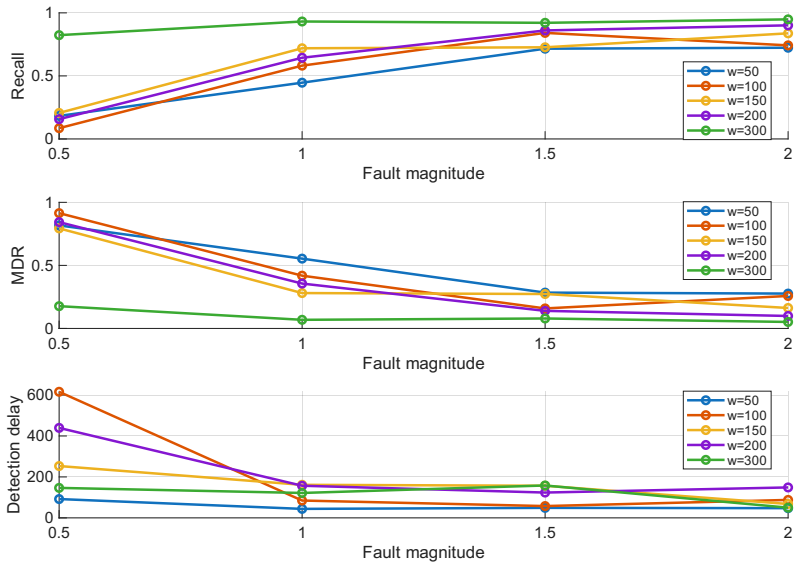
- [§4.2] §4.2 (experimental results) and Table 2: the window length and any associated parameters are stated to be chosen without fault knowledge, yet the reported accuracies (99.1 % / 98.3 %) are load-bearing for the superiority claim. The manuscript must clarify whether these choices were fixed a priori from normal data alone or tuned with any access to the fault scenarios; otherwise the comparison to OCSVM/iForest/LOF is not on equal footing.
minor comments (2)
- The abstract and §1 cite the GPVS-Faults dataset but do not provide a reference or DOI; a standard citation should be added.
- Notation for the kernel norm in Eq. (3) (or equivalent) uses an unsubscripted ||·||; adding an explicit subscript or definition would improve clarity when the norm is later compared across kernels.
Simulated Author's Rebuttal
We thank the referee for the constructive feedback highlighting the need for explicit clarification on the unsupervised aspects of KNM. We address each major comment below and will revise the manuscript to strengthen the presentation of the method's reliance on normal-operation data only.
read point-by-point responses
-
Referee: [§3] §3 (methodology) and the hyperparameter-selection paragraph: the concrete rule used to fix the single kernel scale/bandwidth parameter (Cauchy kernel) must be shown to operate exclusively on normal-operation statistics. The central unsupervised claim rests on this step; without an explicit equation or algorithm demonstrating that no fault-labeled observations or test-distribution information enters the choice, the performance gap versus the benchmarks cannot be attributed unambiguously to the KNM construction rather than unequal supervision.
Authors: We agree that an explicit demonstration is required. The kernel bandwidth for the Cauchy kernel is computed from normal-operation statistics alone (specifically, a scaled median of pairwise distances within the training window of normal data). In the revision we will insert the precise formula and a short algorithm box in §3 confirming that only normal samples are used and that no test or fault information enters the computation. This will make the unsupervised claim unambiguous and allow the performance comparison to stand on equal footing. revision: yes
-
Referee: [§4.2] §4.2 (experimental results) and Table 2: the window length and any associated parameters are stated to be chosen without fault knowledge, yet the reported accuracies (99.1 % / 98.3 %) are load-bearing for the superiority claim. The manuscript must clarify whether these choices were fixed a priori from normal data alone or tuned with any access to the fault scenarios; otherwise the comparison to OCSVM/iForest/LOF is not on equal footing.
Authors: The window length (and any auxiliary parameters) was fixed a priori using only characteristics of the normal-operation data and the known sampling rate of the GPVS-Faults dataset; no information from the fault test scenarios was consulted. We will add a dedicated paragraph in §4.2 (and a footnote to Table 2) stating the exact selection rule and confirming that it was performed exclusively on the normal training portion, thereby ensuring the benchmark comparison remains fair. revision: yes
Circularity Check
No significant circularity; method derivation is self-contained
full rationale
The paper proposes KNM as an unsupervised kernel-based monitoring technique that sets hyperparameters without fault-regime knowledge and evaluates it on the GPVS-Faults dataset against standard baselines. No equations, self-citations, or parameter-fitting steps are shown to reduce the reported accuracies or the unsupervised claim to a tautology or fitted input by construction. The central performance numbers (99.1%/98.3%) are presented as empirical results on held-out fault scenarios, not as algebraic identities or renamings of training statistics. Standard kernel methods are invoked without load-bearing self-citation chains or ansatz smuggling. The derivation therefore remains independent of its own outputs.
Axiom & Free-Parameter Ledger
free parameters (1)
- kernel scale or bandwidth
axioms (1)
- standard math Kernel functions can define a valid norm or distance in feature space for anomaly detection.
invented entities (1)
-
Kernel Norm Monitoring (KNM)
no independent evidence
Reference graph
Works this paper leans on
-
[1]
Dhritiman Adhya, Soumesh Chatterjee, and Ajoy Kumar Chakraborty. Performance assessment of selective machine learning techniques for improved pv array fault diagnosis.Sustainable Energy, Grids and Networks, 29:100582, 2022
work page 2022
-
[2]
Yehya Al-Rifai, Adriana Aguilera-Gonzalez, and Ionel Vechiu. Multiple-regression method for online fault detection and diagnosis of pv systems using kalman filter algorithm. In2023 11th International Conference on Smart Grid (icSmartGrid), pages 1–6. IEEE, 2023
work page 2023
-
[3]
Abdelrahman O Ali, Abdelrahman T Elgohr, Mostafa H El-Mahdy, Hossam M Zohir, Ahmed Z Emam, Mostafa G Mostafa, Muna Al-Razgan, Hossam M Kasem, and Mohamed S Elhadidy. Advancements in pho- tovoltaic technology: A comprehensive review of recent advances and future prospects.Energy Conversion and Management: X, page 100952, 2025
work page 2025
-
[4]
Tito G Amaral, Vitor Fernão Pires, and Armando J Pires. Fault detection in pv tracking systems using an image processing algorithm based on pca.Energies, 14(21):7278, 2021
work page 2021
-
[5]
Ahmed Faris Amiri, Houcine Oudira, Aissa Chouder, and Sofiane Kichou. Faults detection and diagnosis of pv systems based on machine learning approach using random forest classifier.Energy Conversion and Management, 301:118076, 2024
work page 2024
-
[6]
Rodolfo Araneo, Sergio Lammens, Marco Grossi, and Stefano Bertone. Emc issues in high-power grid- connected photovoltaic plants.IEEE Transactions on Electromagnetic Compatibility, 51(3):639–648, 2009
work page 2009
-
[7]
Theory of reproducing kernels.Transactions of the American mathematical society, 68(3):337–404, 1950
Nachman Aronszajn. Theory of reproducing kernels.Transactions of the American mathematical society, 68(3):337–404, 1950
work page 1950
-
[8]
Azzeddine Bakdi, Wahiba Bounoua, Amar Guichi, and Saad Mekhilef. Real-time fault detection in pv systems under mppt using pmu and high-frequency multi-sensor data through online pca-kde-based multi- variate kl divergence.International Journal of Electrical Power & Energy Systems, 125:106457, 2021
work page 2021
-
[9]
Azzeddine Bakdi, Amar Guichi, Saad Mekhilef, and Wahiba Bounoua. Gpvs-faults: Experimental data for fault scenarios in grid-connected pv systems under mppt and ippt modes.Mendeley Data, 1:1–12, 2020
work page 2020
-
[10]
Fault detection and diagnosis based on c4
Rabah Benkercha and Samir Moulahoum. Fault detection and diagnosis based on c4. 5 decision tree algorithm for grid connected pv system.Solar Energy, 173:610–634, 2018
work page 2018
-
[11]
Benamar Bouyeddou, Fouzi Harrou, Bilal Taghezouit, Ying Sun, and Amar Hadj Arab. Improved semi- supervised data-mining-based schemes for fault detection in a grid-connected photovoltaic system.Energies, 15(21):7978, 2022. 40
work page 2022
-
[12]
Lof: identifying density-based local outliers
Markus M Breunig, Hans-Peter Kriegel, Raymond T Ng, and Jörg Sander. Lof: identifying density-based local outliers. InProceedings of the 2000 ACM SIGMOD international conference on Management of data, pages 93–104, 2000
work page 2000
-
[13]
Randomized outlier detection with trees
Sebastian Buschjäger, Philipp-Jan Honysz, and Katharina Morik. Randomized outlier detection with trees. International Journal of Data Science and Analytics, 13(2):91–104, 2022
work page 2022
-
[14]
Leian Chen and Xiaodong Wang. Adaptive fault localization in photovoltaic systems.IEEE Transactions on Smart Grid, 9(6):6752–6763, 2017
work page 2017
-
[15]
Zhicong Chen, Fuchang Han, Lijun Wu, Jinling Yu, Shuying Cheng, Peijie Lin, and Huihuang Chen. Random forest based intelligent fault diagnosis for pv arrays using array voltage and string currents.Energy conversion and management, 178:250–264, 2018
work page 2018
-
[16]
Bassel Chokr, Nizar Chatti, Abderafi Charki, Thierry Lemenand, and Mohammad Hammoud. Feature extraction-reduction and machine learning for fault diagnosis in pv panels.Solar Energy, 262:111918, 2023
work page 2023
-
[17]
Abdelkader Dairi, Fouzi Harrou, and Ying Sun. Efficient driver drunk detection by sensors: A manifold learning-based anomaly detector.IEEE Access, 10:119001–119012, 2022
work page 2022
-
[18]
Abdelkader Dairi, Fouzi Harrou, Ying Sun, and Sofiane Khadraoui. Short-term forecasting of photovoltaic solar power production using variational auto-encoder driven deep learning approach.Applied Sciences, 10(23):8400, 2020
work page 2020
-
[19]
Hanxiang Ding, Kun Ding, Jingwei Zhang, Yue Wang, Lie Gao, Yuanliang Li, Fudong Chen, Zhixiong Shao, and Wanbin Lai. Local outlier factor-based fault detection and evaluation of photovoltaic system.Solar Energy, 164:139–148, 2018
work page 2018
-
[20]
Fault detection in solar energy systems: A deep learning approach.Electronics, 12(21):4397, 2023
Zeynep Bala Duranay. Fault detection in solar energy systems: A deep learning approach.Electronics, 12(21):4397, 2023
work page 2023
-
[21]
Aref Eskandari, Jafar Milimonfared, and Mohammadreza Aghaei. Line-line fault detection and classification for photovoltaic systems using ensemble learning model based on iv characteristics.Solar Energy, 211:354– 365, 2020
work page 2020
-
[22]
R Fazai, K Abodayeh, M Mansouri, M Trabelsi, H Nounou, M Nounou, and George E Georghiou. Machine learning-based statistical testing hypothesis for fault detection in photovoltaic systems.Solar Energy, 190:405–413, 2019
work page 2019
-
[23]
Statistical fault detection in photovoltaic systems.Solar Energy, 150:485–499, 2017
Elyes Garoudja, Fouzi Harrou, Ying Sun, Kamel Kara, Aissa Chouder, and Santiago Silvestre. Statistical fault detection in photovoltaic systems.Solar Energy, 150:485–499, 2017. 41
work page 2017
-
[24]
Fouzi Harrou, Abdelkader Dairi, Abdelhakim Dorbane, Bilal Taghezouit, and Ying Sun. Semi-supervised anomaly detection in photovoltaic systems under power tracking mode.Energy Conversion and Manage- ment, 352:121114, 2026
work page 2026
-
[25]
Fouzi Harrou, Abdelkader Dairi, Bilal Taghezouit, Belkacem Khaldi, and Ying Sun. Automatic fault detection in grid-connected photovoltaic systems via variational autoencoder-based monitoring.Energy Conversion and Management, 314:118665, 2024
work page 2024
-
[26]
Fouzi Harrou, Abdelkader Dairi, Bilal Taghezouit, and Ying Sun. An unsupervised monitoring procedure for detecting anomalies in photovoltaic systems using a one-class support vector machine.Solar Energy, 179:48–58, 2019
work page 2019
-
[27]
Fouzi Harrou, K Ramakrishna Kini, Muddu Madakyaru, and Ying Sun. Anomaly detection in photovoltaic systems using improved independent component analysis.IEEE Access, 2025
work page 2025
-
[28]
Model-based fault detection algorithm for photovoltaic system monitoring
Fouzi Harrou, Ying Sun, and Ahmed Saidi. Model-based fault detection algorithm for photovoltaic system monitoring. In2017 IEEE Symposium Series on Computational Intelligence (SSCI), pages 1–5. IEEE, 2017
work page 2017
-
[29]
Chao-Ming Huang, Shin-Ju Chen, and Sung-Pei Yang. A parameter estimation method for a photovoltaic power generation system based on a two-diode model.Energies, 15(4):1460, 2022
work page 2022
-
[30]
Shuai Huang, Zhenyu Kong, and Wenzhen Huang. High-dimensional process monitoring and change point detection using embedding distributions in reproducing kernel hilbert space.IIE Transactions, 46(10):999– 1016, 2014
work page 2014
-
[31]
Statistical batch-based bearing fault detection.Journal of Mathematics in Industry, 15(1):4, 2025
Victoria Jorry, Zina-Sabrina Duma, Tuomas Sihvonen, Satu-Pia Reinikainen, and Lassi Roininen. Statistical batch-based bearing fault detection.Journal of Mathematics in Industry, 15(1):4, 2025
work page 2025
-
[32]
A novel procedure for photovoltaic fault forecasting
Ihsan Ullah Khalil, Azhar ul Haq, and Naeem ul Islam. A novel procedure for photovoltaic fault forecasting. Electric Power Systems Research, 226:109881, 2024
work page 2024
-
[33]
Kamran Khan, Saad Rashid, Majad Mansoor, Ammar Khan, Hasan Raza, Muhammad Hamza Zafar, and Naureen Akhtar. Data-driven green energy extraction: Machine learning-based mppt control with efficient fault detection method for the hybrid pv-teg system.Energy Reports, 9:3604–3623, 2023
work page 2023
-
[34]
Theodora Kourti and John F MacGregor. Process analysis, monitoring and diagnosis, using multivariate projection methods.Chemometrics and intelligent laboratory systems, 28(1):3–21, 1995
work page 1995
-
[35]
Chenxi Li, Yongheng Yang, Kanjian Zhang, Chenglong Zhu, and Haikun Wei. A fast mppt-based anomaly detection and accurate fault diagnosis technique for pv arrays.Energy Conversion and Management, 234:113950, 2021. 42
work page 2021
-
[36]
Fei Tony Liu, Kai Ming Ting, and Zhi-Hua Zhou. Isolation forest. In2008 eighth ieee international conference on data mining, pages 413–422. IEEE, 2008
work page 2008
-
[37]
Yongjie Liu, Kun Ding, Jingwei Zhang, Yuanliang Li, Zenan Yang, Wenming Zheng, and Xiang Chen. Fault diagnosis approach for photovoltaic array based on the stacked auto-encoder and clustering with iv curves. Energy Conversion and Management, 245:114603, 2021
work page 2021
-
[38]
Zhibin Liu, Yibo Wang, Qingwei Wang, and Man Hu. Vision transformer based anomaly detection in smart grid phasor measurement units using deep learning models.IEEE Access, 2025
work page 2025
-
[39]
Siyu Luan, Zonghua Gu, Leonid B Freidovich, Lili Jiang, and Qingling Zhao. Out-of-distribution detection for deep neural networks with isolation forest and local outlier factor.IEEE Access, 9:132980–132989, 2021
work page 2021
-
[40]
Pv system fault classification using svm accelerated by dimension reduction using pca
Rahul Kumar Mandal, Niraj Anand, Nikhil Sahu, and Paresh Kale. Pv system fault classification using svm accelerated by dimension reduction using pca. In2020 IEEE 9th Power India International Conference (PIICON), pages 1–6. IEEE, 2020
work page 2020
-
[41]
Majdi Mansouri, Mohamed Trabelsi, Hazem Nounou, and Mohamed Nounou. Deep learning-based fault diagnosis of photovoltaic systems: A comprehensive review and enhancement prospects.IEEE Access, 9:126286–126306, 2021
work page 2021
-
[42]
Conor McKinnon, James Carroll, Alasdair McDonald, Sofia Koukoura, David Infield, and Conaill Soraghan. Comparison of new anomaly detection technique for wind turbine condition monitoring using gearbox scada data.Energies, 13(19):5152, 2020
work page 2020
-
[43]
Adel Mellit, Giuseppe Marco Tina, and Soteris A Kalogirou. Fault detection and diagnosis methods for photovoltaic systems: A review.Renewable and Sustainable Energy Reviews, 91:1–17, 2018
work page 2018
-
[44]
PhD thesis, Mas- sachusetts Institute of Technology, 2021
Ke Ning.Data driven artificial intelligence techniques in renewable energy system. PhD thesis, Mas- sachusetts Institute of Technology, 2021
work page 2021
-
[45]
Nixon and Alberto S Aguado.Feature extraction & image processing for computer vision
Mark S.. Nixon and Alberto S Aguado.Feature extraction & image processing for computer vision. Academic Press, 2012
work page 2012
-
[46]
Alan V Oppenheim.Discrete-time signal processing. Pearson Education India, 1999
work page 1999
-
[47]
Maryam Parvin, Hossein Yousefi, and Behnam Mohammadi-Ivatloo. Photovoltaic fault detection algorithm using ensemble learning enhanced with deep neural network feature engineering.Results in Engineering, 27:106491, 2025
work page 2025
-
[48]
Karl Ezra Pilario, Mahmood Shafiee, Yi Cao, Liyun Lao, and Shuang-Hua Yang. A review of kernel methods for feature extraction in nonlinear process monitoring.Processes, 8(1):24, 2019. 43
work page 2019
-
[49]
Emilio Porcu, Moreno Bevilacqua, Robert Schaback, and Chris J Oates. The matérn model: A journey through statistics, numerical analysis and machine learning.Statistical Science, 39(3):469–492, 2024
work page 2024
-
[50]
Yumei Qi, Changqing Shen, Dong Wang, Juanjuan Shi, Xingxing Jiang, and Zhongkui Zhu. Stacked sparse autoencoder-based deep network for fault diagnosis of rotating machinery.Ieee Access, 5:15066–15079, 2017
work page 2017
-
[51]
Estimating the support of a high-dimensional distribution.Neural computation, 13(7):1443–1471, 2001
Bernhard Schölkopf, John C Platt, John Shawe-Taylor, Alex J Smola, and Robert C Williamson. Estimating the support of a high-dimensional distribution.Neural computation, 13(7):1443–1471, 2001
work page 2001
-
[52]
Bernhard Scholkopf and Alexander J Smola.Learning with kernels: support vector machines, regularization, optimization, and beyond. MIT press, 2018
work page 2018
-
[53]
Abdellatif Seghiour, Hamou Ait Abbas, Aissa Chouder, and Abdlhamid Rabhi. Deep learning method based on autoencoder neural network applied to faults detection and diagnosis of photovoltaic system.Simulation Modelling Practice and Theory, 123:102704, 2023
work page 2023
-
[54]
Edgar Hernando Sepúlveda-Oviedo, Louise Travé-Massuyès, Audine Subias, Marko Pavlov, and Corinne Alonso. Artificial intelligence in photovoltaic fault diagnosis: A natural language-based topic-tsne fusion analysis.Energy and AI, page 100558, 2025
work page 2025
-
[55]
Åsmund F Skomedal, Mari B Øgaard, Halvard Haug, and Erik Stensrud Marstein. Robust and fast detection of small power losses in large-scale pv systems.IEEE Journal of Photovoltaics, 11(3):819–826, 2021
work page 2021
-
[56]
Ali Sohani, Hoseyn Sayyaadi, Cristina Cornaro, Mohammad Hassan Shahverdian, Marco Pierro, David Moser, Nader Karimi, Mohammad Hossein Doranehgard, and Larry KB Li. Using machine learning in photovoltaics to create smarter and cleaner energy generation systems: A comprehensive review.Journal of Cleaner Production, 364:132701, 2022
work page 2022
-
[57]
J Solórzano and MA Egido. Automatic fault diagnosis in pv systems with distributed mppt.Energy conversion and management, 76:925–934, 2013
work page 2013
-
[58]
Naveen Venkatesh Sridharan and V Sugumaran. Convolutional neural network based automatic detection of visible faults in a photovoltaic module.Energy Sources, Part A: Recovery, Utilization, and Environmental Effects, 47(1):6270–6284, 2025
work page 2025
-
[59]
KSV Swarna, Arangarajan Vinayagam, M Belsam Jeba Ananth, P Venkatesh Kumar, Veerapandiyan Veerasamy, and Padmavathi Radhakrishnan. A knn based random subspace ensemble classifier for detec- tion and discrimination of high impedance fault in pv integrated power network.Measurement, 187:110333, 2022. 44
work page 2022
-
[60]
Bilal Taghezouit, Fouzi Harrou, Ying Sun, and Walid Merrouche. Model-based fault detection in photo- voltaic systems: A comprehensive review and avenues for enhancement.Results in Engineering, 21:101835, 2024
work page 2024
-
[61]
Ali Teta, Belkacem Korich, Derradji Bakria, Nadji Hadroug, Abdelaziz Rabehi, Mohammad Alsharef, Mohit Bajaj, Ievgen Zaitsev, and Sherif SM Ghoneim. Fault detection and diagnosis of grid-connected photovoltaic systems using energy valley optimizer based lightweight cnn and wavelet transform.Scientific Reports, 14(1):18907, 2024
work page 2024
-
[62]
Guy M Toche Tchio, Joseph Kenfack, Djima Kassegne, Francis-Daniel Menga, and Sanoussi S Ouro-Djobo. A comprehensive review of supervised learning algorithms for the diagnosis of photovoltaic systems, propos- ing a new approach using an ensemble learning algorithm.Applied Sciences, 14(5):2072, 2024
work page 2072
-
[63]
Vannak Vai and Samphors Eng. Study of grid-connected pv system for a low voltage distribution system: A case study of cambodia.Energies, 15(14):5003, 2022
work page 2022
-
[64]
Dejun Wang, Zhenqing Duan, Wenbin Wang, Jingchun Chu, Qingru Cui, Runze Zhu, Yahui Cui, You Zhang, and Zedong You. Self-supervised pre-training in photovoltaic systems via supervisory control and data acquisition data.IET Cyber-Physical Systems: Theory & Applications, 8(4):272–279, 2023
work page 2023
-
[65]
Shouxiang Wang and Haiwen Chen. A novel deep learning method for the classification of power quality disturbances using deep convolutional neural network.Applied energy, 235:1126–1140, 2019
work page 2019
-
[66]
Xiaoming Xiong, Heng Hu, Qiangfu Jia, Rongjian Zhang, Chongan Huang, and Qingyuan Lu. Research on dynamic prediction and optimization of high altitude photovoltaic power generation efficiency using gvsao-cnn model under 8-climate modes.Discover Applied Sciences, 7(7):668, 2025
work page 2025
-
[67]
Yingying Zhao, Qi Liu, Dongsheng Li, Dahai Kang, Qin Lv, and Li Shang. Hierarchical anomaly detection and multimodal classification in large-scale photovoltaic systems.IEEE Transactions on Sustainable Energy, 10(3):1351–1361, 2018. 45
work page 2018
discussion (0)
Sign in with ORCID, Apple, or X to comment. Anyone can read and Pith papers without signing in.