REVIEW 2 major objections 6 minor 21 references
Enabling Real-Time AI in O-RAN: Deploying and Measuring AI Inside a Near-RT RIC xApp
T0 review · 2 major / 6 minor · reviewed 2026-07-12 · grok-4.5
Pith's one-line read Lightweight AI compiled into a Near-RT RIC xApp runs in microseconds and stays under the 10 ms control budget on a live testbed.
desk verdict Solid systems measurement paper: C-compiled µs inference inside a live FlexRIC xApp, with honest feasibility scoping and a useful commodity testbed tool. read the letter →
The pith
A machine-rendered reading of the paper's core claim, the machinery that carries it, and where it could break.
The reading
What carries the argument
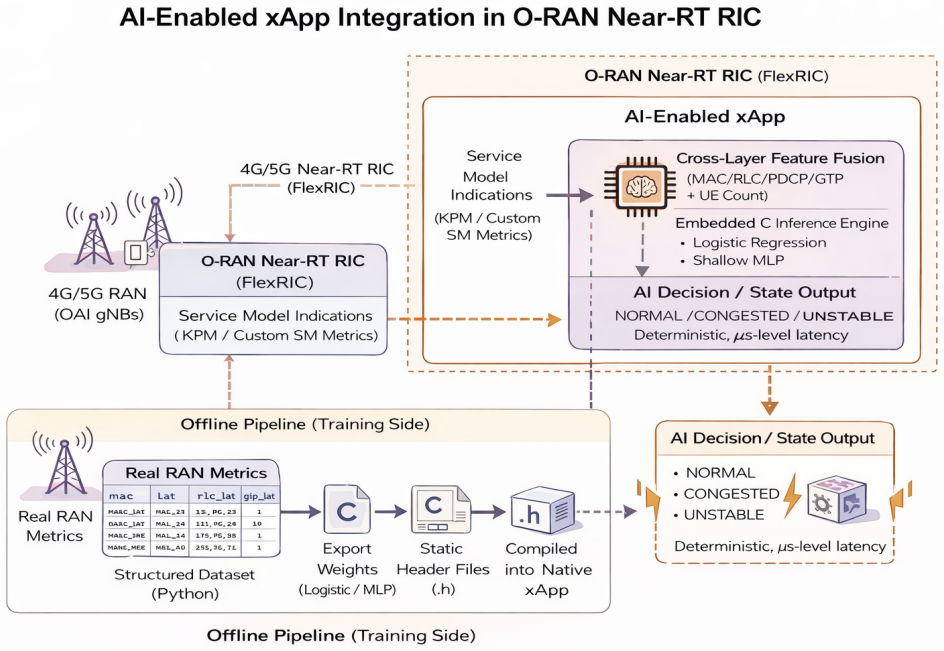
The offline-to-online C-export pipeline: trained logistic-regression and shallow-MLP parameters are written as static const float arrays in C headers, compiled into the xApp binary, and run inline on five-dimensional service-model feature vectors (MAC, RLC, PDCP, GTP latencies and UE count) with monotonic-clock instrumentation of service, inference, and end-to-end latency.
What would settle it
Replace the synthetic proxy with live multi-cell E2 indications under realistic load, re-export the same C models (or a modestly larger one), and re-measure the end-to-end latency CDF: if more than a few percent of loops exceed 10 ms or inference ceases to be negligible relative to E2 transport, the central feasibility claim fails for that workload.
Extended reading notes
Core claim
Lightweight supervised models, exported as deterministic C inference modules and compiled into a Near-RT RIC xApp, can classify cross-layer network states on a live OAI/FlexRIC testbed with measured inference of 1–5 µs (logistic regression) or 10–25 µs (shallow MLP) and typical end-to-end service latency below 4 ms, satisfying the 10 ms Near-RT control budget for more than 95 percent of projected executions and showing that AI computation is not the bottleneck under this setup.
Load-bearing premise
The claim that lightweight AI can operate inside Near-RT timing rests on a rule-structured five-feature synthetic proxy task and a small RF-simulation testbed; if real traffic or larger models change the latency mix, the feasibility result may not transfer.
Editorial extensions
If this is right
- Near-RT xApp designers can treat simple compiled classifiers as a negligible-cost inline step rather than an external service.
- Model choice for this class of state classifiers can prioritize auditability and C-deployability over marginal accuracy gains.
- Reproducible commodity-hardware stacks become a practical path for measuring AI inside the RIC loop without dedicated testbeds.
- Future closed-loop control can start from the measured classification signal once E2SM-RC actuation is added.
Reading between the lines
- The same C-export pattern would likely keep inference negligible for other compact tabular models (small trees, linear SVMs) until feature dimension or depth forces dynamic allocation or larger matrix work.
- If E2 transport remains the dominant cost, research effort on this path should shift from model compression toward message-path and scheduling optimizations.
- A natural next measurement is multi-xApp co-residency: whether concurrent compiled inferences still leave headroom under the same 10 ms budget.
Editorial analysis
A structured set of objections, weighed in public.
Referee Report
Summary. The paper demonstrates that lightweight supervised models (logistic regression and a shallow two-hidden-layer MLP) can be exported as deterministic C inference modules, compiled into a FlexRIC xApp binary, and executed inline on a live OAI/FlexRIC Near-RT RIC path. On a structured five-feature synthetic proxy for network-state classification (MAC/RLC/PDCP/GTP latencies + UE count), offline supervised accuracy clusters in 0.88–0.90; measured inference is 1–5 µs (LR) and 10–25 µs (MLP), typical end-to-end service latency stays below 4 ms, and both models are reported to meet the 10 ms Near-RT budget for >95% of projected loop executions. The contribution is scoped as embedding/execution feasibility and pipeline reproducibility (including the released RIC Workbench), not production generalization or closed-loop control.
Significance. The identified gap—measured, in-process, deterministic C inference with three-component latency instrumentation on a live OAI/FlexRIC stack—is real and under-served relative to simulation or external-inference xApp work. The offline-to-online export path, monotonic-clock instrumentation, noise ablation, and six-model offline comparison are concrete systems evidence that AI compute is negligible versus E2 transport under the reported conditions. Releasing RIC Workbench as a single-binary commodity orchestration tool is a genuine reproducibility contribution. If the measurements hold as stated, the paper supplies a useful template and lower bound for Near-RT RIC AI embedding rather than a new learning algorithm.
major comments (2)
- §IV-E and Fig. 8 (left): the claim that both models satisfy the 10 ms Near-RT budget for >95% of loop executions is based on a “projected” end-to-end loop that includes action dispatch, while §VI and the design text state that closed-loop control is not implemented and the xApp only classifies. The primary, fully measured result is E2 arrival + inference (and the reported typical service latency <4 ms). The manuscript should (i) report the measured E2+inference CDF as the main result, (ii) state explicitly and quantitatively what latency was assumed for the projected action-dispatch term, and (iii) keep “projected closed-loop” clearly labeled so the central feasibility claim does not rest on an unmeasured component.
- Abstract / §I / §VII vs. §III-C and §VI: the abstract and conclusion state that the results “demonstrate that lightweight AI can operate within Near-RT RIC timing constraints,” while the body correctly scopes the work as embedding feasibility on a rule-structured synthetic proxy and a 2-gNB/2-UE RFsim + Docker commodity stack. The transfer claim should be tightened in the abstract and conclusion to match the body (e.g., “under the reported OAI/FlexRIC path and proxy task”), so the headline does not outrun the experimental conditions that the limitations section already acknowledges.
minor comments (6)
- Table IV “C Budget” column mixes qualitative deployability (✓ / Partial / No) with latency ranges; define the criteria for Partial/No in the caption or text so the six-model comparison is reproducible.
- Fig. 8 caption and §IV-E: clarify whether the rare >100 ms service spikes are included in the plotted CDFs and in the “>95% under 10 ms” statistic, or whether that statistic is conditioned on non-preempted samples.
- §III-C: state the exact random seed and generation script version (or release them with RIC Workbench) so the 32k-sample synthetic set is bit-reproducible by others.
- Table VI peak inference latencies (<2 ms / <3 ms) are orders of magnitude above the typical 1–25 µs ranges; briefly explain what produces those peaks (e.g., first-call, cache, or measurement artifact) so they are not read as model compute.
- Related work (§II-C): a short explicit contrast table (Python/external vs. compiled C; presence/absence of per-indication monotonic timing) would sharpen the claimed gap versus ColO-RAN and other cited xApp demos.
- Minor polish: consistent hyphenation of Near-RT / Near-Real-Time; “µs” vs “us” in axis labels; ensure Fig. 3 console screenshot remains legible in print.
Circularity Check
No significant circularity: measured latencies and scoped feasibility claims are independent of the synthetic proxy labels.
full rationale
The paper's central claim is measured embedding feasibility of deterministic C inference (LR 1–5 µs, MLP 10–25 µs; typical E2E service latency <4 ms; >95% of projected loops under the 10 ms Near-RT budget) on a live OAI/FlexRIC path, not production generalization. Inference and service latencies are obtained from monotonic-clock instrumentation inside the xApp callback on the live stack; they are not derived from fitted constants or from the synthetic label rules. Classification accuracy (0.88–0.90) is evaluated only on the authors' rule-structured five-feature synthetic proxy and is explicitly scoped as pipeline/embedding evidence rather than a first-principles prediction (Abstract; §III-C; §VI). The six-model comparison, noise ablation, and confusion matrices are likewise internal to that proxy and do not force the timing results. There is no self-definitional loop, no fitted parameter renamed as prediction of a related quantity, no load-bearing uniqueness theorem imported from the authors, and no ansatz smuggled via self-citation. Self-contained construction of synthetic labels is disclosed and does not make the measured microsecond timings tautological. Score 0 is therefore the correct outcome.
Assumptions & free parameters
free parameters (4)
- Gaussian noise sigma for synthetic features =
15–30 µs (ablation 5–75 µs)
- MLP hidden architecture =
2 × 32 units
- Synthetic dataset size and balance =
32000 samples, 4×8000
- iperf3 load and indication rate =
10 Mbps DL/UE; ~1k ind/s
assumptions (5)
- domain assumption Near-RT RIC control loops must complete within a 10 ms–1 s budget (O-RAN Alliance timing model).
- ad hoc to paper MAC/RLC/PDCP/GTP latencies plus UE count form a sufficient five-dimensional feature vector for the proxy state task.
- ad hoc to paper Four rule-structured labels (Healthy, Congestion Forming, User-Plane Stress, Control-Plane Stress) are valid operationally motivated proxy classes for embedding tests.
- domain assumption FlexRIC E2 indication path and OAI RFsim on commodity Linux are an acceptable software-path proxy for Near-RT timing characterization (not production OTA latency).
- standard math Standard supervised learning (softmax LR, ReLU MLP, train/test split metrics) applies without further theoretical justification.
invented entities (2)
-
RIC Workbench
-
Four synthetic RAN operational states (labels 0–3)
Cite this review
Pith. "Pith review of Enabling Real-Time AI in O-RAN: Deploying and Measuring AI Inside a Near-RT RIC xApp." pith.science (2026). https://pith.science/paper/DXBV5VHC
@misc{pith2026260701583,
  author       = {Pith},
  title        = {Pith review of: Enabling Real-Time AI in O-RAN: Deploying and Measuring AI Inside a Near-RT RIC xApp},
  year         = {2026},
  howpublished = {\url{https://pith.science/paper/DXBV5VHC}},
  note         = {Machine review of arXiv:2607.01583}
}
read the original abstract
Open Radio Access Network (O-RAN) architectures introduce programmable Near-Real-Time RAN Intelligent Controllers (Near-RT RICs) that support closed-loop control through xApps at timescales from 10 ms to 1 s. Although AI has been widely studied for RAN optimization, fewer works demonstrate measured AI inference embedded directly within the Near-RT RIC software loop on a live testbed. This paper presents an AI-enabled network-state classification xApp implemented on an OpenAirInterface (OAI) and FlexRIC testbed. The xApp is trained and evaluated on a structured synthetic dataset that emulates cross-layer RAN states using MAC, RLC, PDCP, GTP, and UE-count features. The results validate embedding and execution feasibility rather than production-level generalization. Logistic regression and a shallow multilayer perceptron (MLP) are exported as deterministic C inference modules and compiled into the xApp binary, eliminating external machine-learning runtime dependencies. Measured inference latency is 1 to 5 microseconds for logistic regression and 10 to 25 microseconds for the MLP, while end-to-end service latency remains below 4 ms. A six-model comparison shows that supervised models achieve similar accuracy, ranging from 0.88 to 0.90, indicating that LR and MLP similarity reflects the proxy problem structure rather than limited model exploration. Noise ablation, confusion-matrix analysis, and CDF-based latency characterization show that both embedded models satisfy the 10 ms Near-RT budget for more than 95% of projected loop executions. These results demonstrate that lightweight AI can operate within Near-RT RIC timing constraints while preserving deterministic execution. We also release RIC Workbench, a lightweight orchestration dashboard for reproducing the testbed on commodity hardware.
Figures


Figures from the paper (4 more)


Reference graph
Works this paper leans on
-
[1]
What will 5G be?
J. G. Andrews, S. Buzzi, W. Choi, S. V . Hanly, A. Lozano, A. C. K. Soong, and J. C. Zhang, “What will 5G be?”IEEE Journal on Selected Areas in Communications, vol. 32, no. 6, pp. 1065–1082, 2014
2014
-
[2]
5G wire- less network slicing for eMBB, URLLC, and mMTC: A communication- theoretic view,
P. Popovski, K. F. Trillingsgaard, O. Simeone, and G. Durisi, “5G wire- less network slicing for eMBB, URLLC, and mMTC: A communication- theoretic view,”IEEE Access, vol. 6, pp. 55 765–55 779, 2018
2018
-
[3]
Ultrareliable and low-latency wireless communication: Tail, risk, and scale,
M. Bennis, M. Debbah, and H. V . Poor, “Ultrareliable and low-latency wireless communication: Tail, risk, and scale,”Proceedings of the IEEE, vol. 106, no. 10, pp. 1834–1853, 2018
2018
-
[4]
O-RAN architecture description,
O-RAN Alliance, “O-RAN architecture description,” O-RAN Alliance, Tech. Rep., 2020
2020
-
[5]
Under- standing O-RAN: Architecture, interfaces, algorithms, security, and re- search challenges,
M. Polese, L. Bonati, S. D’Oro, S. Basagni, and T. Melodia, “Under- standing O-RAN: Architecture, interfaces, algorithms, security, and re- search challenges,”IEEE Communications Surveys & Tutorials, vol. 25, no. 2, pp. 1376–1411, 2023
2023
-
[6]
Intelli- gence and learning in O-RAN for data-driven NextG cellular networks,
L. Bonati, S. D’Oro, M. Polese, S. Basagni, and T. Melodia, “Intelli- gence and learning in O-RAN for data-driven NextG cellular networks,” IEEE Communications Magazine, vol. 59, no. 2, pp. 21–27, 2021
2021
-
[7]
Open, programmable, and virtualized 5G networks: State-of-the-art and the road ahead,
L. Bonati, M. Polese, S. D’Oro, S. Basagni, and T. Melodia, “Open, programmable, and virtualized 5G networks: State-of-the-art and the road ahead,”Computer Networks, vol. 182, p. 107516, 2020
2020
-
[8]
RIC: A RAN intelligent controller platform for AI-enabled cellular networks,
B. Balasubramanian, E. S. Daniels, M. Hiltunen, R. Jana, K. Joshi, R. Sivaraj, T. X. Tran, and C. Wang, “RIC: A RAN intelligent controller platform for AI-enabled cellular networks,”IEEE Internet Computing, vol. 25, no. 2, pp. 7–17, 2021
2021
Show all 21 references
-
[9]
Colo- ran: Developing machine learning-based xapps for open ran closed-loop control on programmable experimental platforms,
M. Polese, L. Bonati, S. D’Oro, S. Basagni, and T. Melodia, “Colo- ran: Developing machine learning-based xapps for open ran closed-loop control on programmable experimental platforms,”IEEE Transactions on Mobile Computing, vol. 22, no. 10, pp. 5787–5800, 2023
2023
-
[10]
O-RAN working group overview,
O-RAN Alliance, “O-RAN working group overview,” O-RAN Alliance, Tech. Rep., 2021
2021
-
[11]
Artificial neural networks-based machine learning for wireless networks: A tutorial,
M. Chen, U. Challita, W. Saad, C. Yin, and M. Debbah, “Artificial neural networks-based machine learning for wireless networks: A tutorial,” IEEE Communications Surveys & Tutorials, vol. 21, no. 4, pp. 3039– 3071, 2019
2019
-
[12]
Deep learning for wireless communications: An emerging interdisciplinary paradigm,
L. Dai, R. Jiao, F. Adachi, H. V . Poor, and L. Hanzo, “Deep learning for wireless communications: An emerging interdisciplinary paradigm,” IEEE Wireless Communications, vol. 27, no. 4, pp. 133–139, 2020
2020
-
[13]
Applications of deep reinforcement learning in communications and networking: A survey,
N. C. Luong, D. T. Hoang, S. Gong, D. Niyato, P. Wang, Y .-C. Liang, and D. I. Kim, “Applications of deep reinforcement learning in communications and networking: A survey,”IEEE Communications Surveys & Tutorials, vol. 21, no. 4, pp. 3133–3174, 2019
2019
-
[14]
To- ward 6G networks: Use cases and technologies,
M. Giordani, M. Polese, M. Mezzavilla, S. Rangan, and M. Zorzi, “To- ward 6G networks: Use cases and technologies,”IEEE Communications Magazine, vol. 58, no. 3, pp. 55–61, 2020
2020
-
[15]
Machine learning paradigms for next-generation wireless networks,
C. Jiang, H. Zhang, Y . Ren, Z. Han, K.-C. Chen, and L. Hanzo, “Machine learning paradigms for next-generation wireless networks,” IEEE Wireless Communications, vol. 24, no. 2, pp. 98–105, 2017
2017
-
[16]
Edge intelligence: Paving the last mile of artificial intelligence with edge computing,
Z. Zhou, X. Chen, E. Li, L. Zeng, K. Luo, and J. Zhang, “Edge intelligence: Paving the last mile of artificial intelligence with edge computing,”Proceedings of the IEEE, vol. 107, no. 8, pp. 1738–1762, 2019
2019
-
[17]
Team learning-based re- source allocation for open radio access network (O-RAN),
H. Zhang, H. Zhou, and M. Erol-Kantarci, “Team learning-based re- source allocation for open radio access network (O-RAN),” inICC 2022 – IEEE International Conference on Communications, 2022, pp. 4938– 4943
2022
-
[18]
Network- aided intelligent traffic steering in 6G O-RAN: A multi-layer optimiza- tion framework,
V .-D. Nguyen, T. X. Vu, N. T. Nguyen, D. C. Nguyen, M. Juntti, N. C. Luong, D. T. Hoang, D. N. Nguyen, and S. Chatzinotas, “Network- aided intelligent traffic steering in 6G O-RAN: A multi-layer optimiza- tion framework,”IEEE Journal on Selected Areas in Communications, vol. ...
2024
-
[19]
Demonstration of closed loop AI-driven RAN controllers using O-RAN SDR testbed,
N. H. Stephenson, A. J. Chiejina, N. B. Kabigting, and V . K. Shah, “Demonstration of closed loop AI-driven RAN controllers using O-RAN SDR testbed,” inMILCOM 2023 – 2023 IEEE Military Communications Conference, 2023, pp. 241–242
2023
-
[20]
FlexRIC: An SDK for next-generation SD-RANs,
R. Schmidt, M. Irazabal, and N. Nikaein, “FlexRIC: An SDK for next-generation SD-RANs,” inProceedings of the 17th International Conference on Emerging Networking Experiments and Technologies (CoNEXT ’21). ACM, 2021, pp. 411–425
2021
-
[21]
OpenAirInterface 5G software documentation,
OpenAirInterface Software Alliance, “OpenAirInterface 5G software documentation,” 2023, https://www.openairinterface.org
2023
Reviewed July 12, 2026 · model on record in the stance chip above.
Discussion (0). Continue with ORCID to comment.